Uniform Evidence Law Guidebook John Anderson Anthony Hopkins
Uniform Evidence Law Guidebook John Anderson Anthony Hopkins
Uniform Evidence Law Guidebook John Anderson Anthony Hopkins
Uniform Evidence Law Guidebook John Anderson Anthony Hopkins
Uniform Evidence Law Guidebook John Anderson Anthony Hopkins
1.
Uniform Evidence LawGuidebook John Anderson
Anthony Hopkins download
https://ebookbell.com/product/uniform-evidence-law-guidebook-
john-anderson-anthony-hopkins-32834802
Explore and download more ebooks at ebookbell.com
2.
Here are somerecommended products that we believe you will be
interested in. You can click the link to download.
Uniform Evidence Law 1st Edition Elisabeth Peden
https://ebookbell.com/product/uniform-evidence-law-1st-edition-
elisabeth-peden-32834790
Uniform Evidence Law 6th Edition Miiko Kumar
https://ebookbell.com/product/uniform-evidence-law-6th-edition-miiko-
kumar-32834794
Uniform Evidence Law 2nd Edition David Field
https://ebookbell.com/product/uniform-evidence-law-2nd-edition-david-
field-32834796
Australian Evidence A Principled Approach To The Common Law And
Uniform Acts 6th Edition Andrew Ligertwood
https://ebookbell.com/product/australian-evidence-a-principled-
approach-to-the-common-law-and-uniform-acts-6th-edition-andrew-
ligertwood-32834762
3.
Uniform Evidence 2ndEdition Jeremy Gans Andrew Palmer
https://ebookbell.com/product/uniform-evidence-2nd-edition-jeremy-
gans-andrew-palmer-32834788
Uniform Clothing And Discipline In The Modern World Jane Tynan Lisa
Godson Editors
https://ebookbell.com/product/uniform-clothing-and-discipline-in-the-
modern-world-jane-tynan-lisa-godson-editors-50216692
Uniform Rules For European Contract Law A Critical Assessment
Francisco De Elizalde Editor
https://ebookbell.com/product/uniform-rules-for-european-contract-law-
a-critical-assessment-francisco-de-elizalde-editor-50222942
Uniform Feelings Scenes From The Psychic Life Of Policing Jessi Lee
Jackson
https://ebookbell.com/product/uniform-feelings-scenes-from-the-
psychic-life-of-policing-jessi-lee-jackson-50581478
Uniform Approximations By Trigonometric Polynomials Reprint 2018
Alexander I Stepanets
https://ebookbell.com/product/uniform-approximations-by-trigonometric-
polynomials-reprint-2018-alexander-i-stepanets-51034122
v
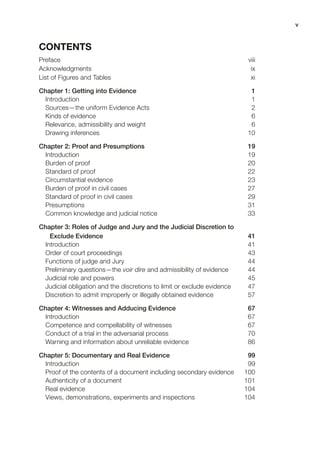
CONTENTS
Preface viii
Acknowledgments ix
Listof Figures and Tables xi
Chapter 1: Getting into Evidence 1
Introduction 1
Sources—the uniform Evidence Acts 2
Kinds of evidence 6
Relevance, admissibility and weight 6
Drawing inferences 10
Chapter 2: Proof and Presumptions 19
Introduction 19
Burden of proof 20
Standard of proof 22
Circumstantial evidence 23
Burden of proof in civil cases 27
Standard of proof in civil cases 29
Presumptions 31
Common knowledge and judicial notice 33
Chapter 3: Roles of Judge and Jury and the Judicial Discretion to
Exclude Evidence 41
Introduction 41
Order of court proceedings 43
Functions of judge and Jury 44
Preliminary questions—the voir dire and admissibility of evidence 44
Judicial role and powers 45
Judicial obligation and the discretions to limit or exclude evidence 47
Discretion to admit improperly or illegally obtained evidence 57
Chapter 4: Witnesses and Adducing Evidence 67
Introduction 67
Competence and compellability of witnesses 67
Conduct of a trial in the adversarial process 70
Warning and information about unreliable evidence 86
Chapter 5: Documentary and Real Evidence 99
Introduction 99
Proof of the contents of a document including secondary evidence 100
Authenticity of a document 101
Real evidence 104
Views, demonstrations, experiments and inspections 104
7.
vi CONTENTS
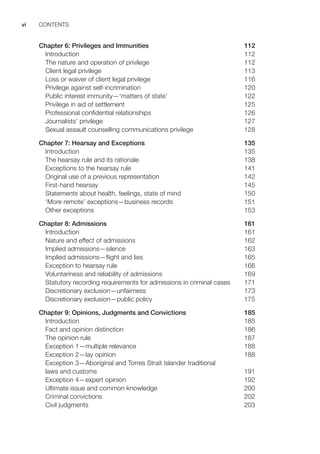
Chapter 6:Privileges and Immunities 112
Introduction 112
The nature and operation of privilege 112
Client legal privilege 113
Loss or waiver of client legal privilege 116
Privilege against self-incrimination 120
Public interest immunity—‘matters of state’ 122
Privilege in aid of settlement 125
Professional confidential relationships 126
Journalists’ privilege 127
Sexual assault counselling communications privilege 128
Chapter 7: Hearsay and Exceptions 135
Introduction 135
The hearsay rule and its rationale 138
Exceptions to the hearsay rule 141
Original use of a previous representation 142
First-hand hearsay 145
Statements about health, feelings, state of mind 150
‘More remote’ exceptions—business records 151
Other exceptions 153
Chapter 8: Admissions 161
Introduction 161
Nature and effect of admissions 162
Implied admissions—silence 163
Implied admissions—flight and lies 165
Exception to hearsay rule 166
Voluntariness and reliability of admissions 169
Statutory recording requirements for admissions in criminal cases 171
Discretionary exclusion—unfairness 173
Discretionary exclusion—public policy 175
Chapter 9: Opinions, Judgments and Convictions 185
Introduction 185
Fact and opinion distinction 186
The opinion rule 187
Exception 1—multiple relevance 188
Exception 2—lay opinion 188
Exception 3—Aboriginal and Torres Strait Islander traditional
laws and customs 191
Exception 4—expert opinion 192
Ultimate issue and common knowledge 200
Criminal convictions 202
Civil judgments 203
8.
vii
CONTENTS
Chapter 10: DispositionEvidence I: Credibility and Character 211
Introduction 211
Credibility evidence 212
The credibility rule 213
Exceptions to the credibility rule 215
Credibility of the defendant in criminal cases 221
Character evidence 223
Character of the defendant in criminal cases 223
Chapter 11: Disposition Evidence II: Tendency and Coincidence 235
Introduction 235
Common law origins of the exclusionary rule 236
General features of the legislative scheme 236
The tendency rule 237
The coincidence rule 240
Further admissibility restriction in criminal cases 242
Cases not involving tendency or coincidence reasoning 244
Relationship or context evidence 246
Chapter 12: Identification Evidence 256
Introduction 256
Meaning of identification evidence 258
Exclusion of visual identification evidence 259
Exclusion of picture identification evidence 261
Judicial warning 262
Other kinds of ‘identification’ evidence 264
Table of Cases 272
Table of Statutes 280
Index 284
9.
viii
PREFACE
The law ofevidence provides the framework within which legal contests take place.
It provides the rules, principles and processes that regulate proof of disputed facts.
For this reason, evidence law is central to the resolution of all substantive legal
disputes that are determined in, or in the shadow of, court. The Uniform Evidence
Law Guidebook offers students a concise yet comprehensive tool to engage with
both the principles and practice of evidence law in the jurisdictions that have adopted
the uniform evidence legislation. It provides a summary of the law in key topic areas,
together with incisive commentary, cross-referenced to more detailed substantive
material in other texts. The guidebook includes short extracts from and summaries of
principal cases and key legislative provisions, with tables, checklists, flow diagrams
and ‘how to’ tips, bringing together all the relevant and most up-to-date material.
Central to this guidebook is its capacity to facilitate student engagement with
the process of proof, drawing and maintaining explicit links between theory and
practice. Through the use of a Criminal Trial Thread Scenario, the guidebook enables
students to become active participants in a trial, promoting deep experiential
learning. Witness statements and other materials are provided for the majority of
topic areas, with each new statement requiring students to apply their acquired
knowledge incrementally in a progressive and continuous manner as either
prosecution or defence lawyers. This ‘taste of reality’ experience also allows for
incremental development of important skills in oral communication, decision-making
and advocacy. For those teachers who choose to adopt this approach, online
materials are provided to ensure the efficacy and authenticity of assessment tasks.
In other topic areas, review problems are provided to encourage students to develop
their analytical problem-solving skills in relation to realistic and typical evidence
issues arising in the context of criminal and civil litigation. Guides to answering these
problems are available at the online resource centre.
This guidebook does not undertake detailed critique or criticism of the law of
evidence. However, its premise is not simply that evidence law is best understood in
practical context, but that ‘in role’ student engagement fosters a capacity for critique
and challenge as the complexities and shortcomings of the trial process are directly
revealed.
John Anderson
Newcastle
October 2014
Anthony Hopkins
Canberra
October 2014
10.
ix
ACKNOWLEDGMENTS
This guidebook originatedfrom a perceived need for a learner-centred book for
students of the law of evidence in the various uniform evidence law jurisdictions of
Australia. Thus, our collaboration was launched and the project has evolved over
approximately 18 months into this work. John contributed the substantive material for
all chapters together with the brain teasers and review problems for Chapters 1, 2, 3
and 6. Anthony contributed the criminal trial thread scenario materials for Chapters
4, 5, 7, 8, 9, 10, 11 and 12 as well as undertaking the review and critique of the
substantive content of each chapter. This provided an important check consistent
with the Guidebook philosophy and the development of a great collaborative synergy.
John specifically thanks Tyler Fox for his invaluable research assistance in
November and December 2012. This assistance was generously funded by a
Teaching Development Program grant from the Faculty of Business and Law at
the University of Newcastle. Further, John’s colleagues at Newcastle Law School,
including Emeritus Professor Frank Bates and Michael Guihot have indirectly
contributed to this project by sharing materials and through long discussions about
the utility of the criminal trial thread scenario. The 2012 cohort of students in the
Evidence course at Newcastle Law School were the guinea pigs for John’s testing
of the efficacy of the mock trial. They deserve special thanks for admirably rising to
the task of examining and cross-examining witnesses, presenting well-formulated
arguments on admissibility of evidence in seminar classes each week and ultimately
providing important insights and feedback for this project. John’s family was a great
support while he was engrossed in drafting the manuscript. His wife, Melissa, was
very tolerant and accepting of the time commitment while youngest son, Heath,
successfully navigated his HSC exams through this time.
Anthony thanks his past and present colleagues at the University of Canberra
School of Law and Justice for their support, encouragement and enthusiasm in the
development and consolidation of the criminal trial thread scenario model of teaching.
In particular, he thanks all those students who have faced their fears and gamely
taken to their feet to participate and later share their reflections. Anthony also thanks
his colleagues at Burley Griffin Chambers for their support and guidance through his
early years at the bar, during which he has straddled the teaching practice divide,
enriching his experience and capacity in each field of endeavour. Anthony thanks his
partner Kelli and children for their support and unfailing belief in him.
We both extend thanks to Michelle Head, Publishing Editor in the Higher
Education Division of Oxford University Press. Michelle, and Katie Ridsdale before
her, were excited by the unique vision for this project in using the criminal trial thread
scenario as the ‘how to’ aspect of this guidebook, reflecting the special challenges
11.
x ACKNOWLEDGMENTS
and needsfor students learning the law of evidence. Throughout the subsequent life
of this project, Michelle has provided unfailing support and encouragement. Together
with the editorial team coordinated by Tiffany Bridger, Michelle has been instrumental
in seeing this guidebook through the various processes to final publication. Also, we
thank the anonymous reviewers of the original proposal through to the draft chapters
and the full draft manuscript, who have all made useful suggestions that have
contributed in various ways to the final product.
The authors and the publisher wish to thank the following copyright holders for
reproduction of their material.
Commonwealth of Australia for extracts from the Evidence Act. This legislative
material is reproduced by permission, but is not the official or authorised version.
It is subject to Commonwealth of Australia copyright; Incorporated Council of Law
Reporting for extracts from the Weekly Law Reports (WLR); Lexis Nexis Australia
for extracts from Australian Law Reports (ALR); The State of New South Wales
through the Department of Police and Justice for extract from Evidence in Chief—
The Ten Commandments, 2002, reproduced with the approval of His Honour Judge
Peter Graeme Berman SC and the Public Defenders Office; Thomson Reuters
(Professional) Australia Limited for extracts from, Australian Capital Territory Reports
(ACTR) Australian Criminal Reports (A Crim R), Commonwealth Law Reports (CLR),
Federal Court Reports (FCR) New South Wales Law Review (NSWLR), Thomson
Reuters Lawbook, 11th ed, 2014 reproduced with permission of Thomson Reuters
(Professional) Australia Limited, www.thomsonreuters.com.au.
Every effort has been made to trace the original source of copyright material
contained in this book. The publisher will be pleased to hear from copyright holders
to rectify any errors or omissions.
12.
xi
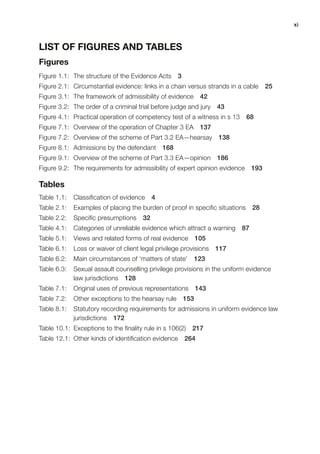
LIST OF FIGURESAND TABLES
Figures
Figure 1.1: The structure of the Evidence Acts 3
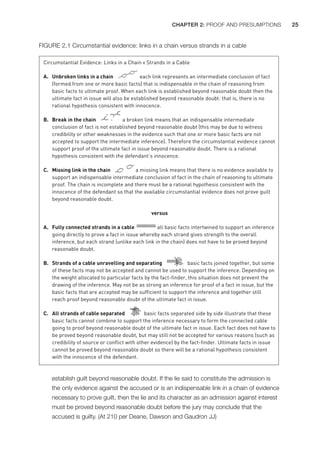
Figure 2.1: Circumstantial evidence: links in a chain versus strands in a cable 25
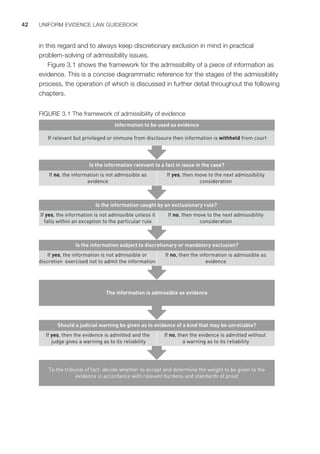
Figure 3.1: The framework of admissibility of evidence 42
Figure 3.2: The order of a criminal trial before judge and jury 43
Figure 4.1: Practical operation of competency test of a witness in s 13 68
Figure 7.1: Overview of the operation of Chapter 3 EA 137
Figure 7.2: Overview of the scheme of Part 3.2 EA—hearsay 138
Figure 8.1: Admissions by the defendant 168
Figure 9.1: Overview of the scheme of Part 3.3 EA—opinion 186
Figure 9.2: The requirements for admissibility of expert opinion evidence 193
Tables
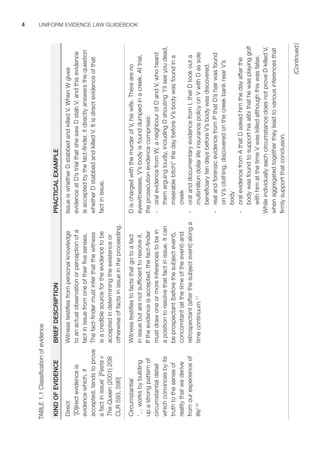
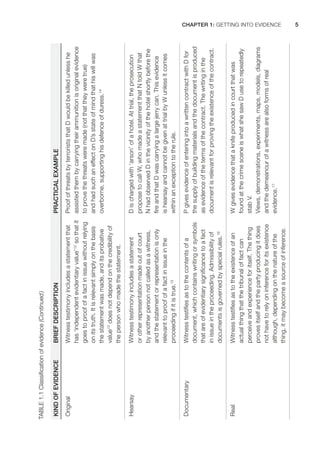
Table 1.1: Classification of evidence 4
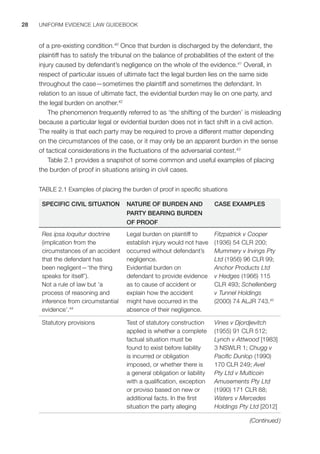
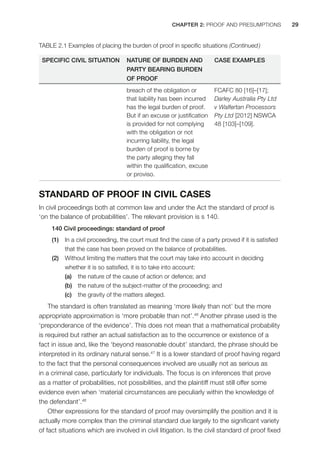
Table 2.1: Examples of placing the burden of proof in specific situations 28
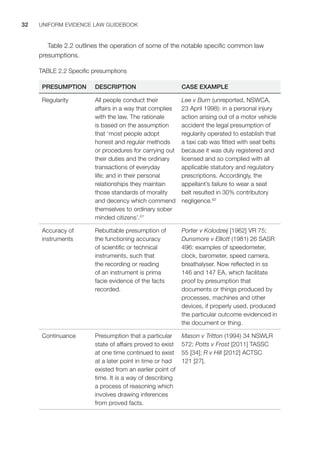
Table 2.2: Specific presumptions 32
Table 4.1: Categories of unreliable evidence which attract a warning 87
Table 5.1: Views and related forms of real evidence 105
Table 6.1: Loss or waiver of client legal privilege provisions 117
Table 6.2: Main circumstances of ‘matters of state’ 123
Table 6.3: Sexual assault counselling privilege provisions in the uniform evidence
law jurisdictions 128
Table 7.1: Original uses of previous representations 143
Table 7.2: Other exceptions to the hearsay rule 153
Table 8.1: Statutory recording requirements for admissions in uniform evidence law
jurisdictions 172
Table 10.1: Exceptions to the finality rule in s 106(2) 217
Table 12.1: Other kinds of identification evidence 264
13.
1
CHAPTER 1
GETTING INTOEVIDENCE
COVERED IN THIS CHAPTER
In this chapter, you will learn about:
• sources—the uniform Evidence Acts;
• kinds of evidence;
• relevance, admissibility and weight; and
• drawing inferences.
CASES TO REMEMBER
Smith v The Queen (2001) 206 CLR 650
STATUTES AND SECTIONS TO REMEMBER
Evidence Act ss 55, 56, 57, 142(1)
INTRODUCTION
The law of evidence regulates the proof of the facts in issue at a trial through the
operation of various rules and principles.1
It is essential to have a good grasp of the
rules and principles of evidence to ensure the adequate conduct of any kind of legal
practice, particularly in the adversarial context of criminal and civil litigation. The rules
of evidence, based on considerations of justice and practicality, shape the way in
which judges and lawyers think about fact-finding. As a lawyer preparing a matter
for litigation, you must carefully consider how the fact-finder will evaluate the factual
material adduced by the parties. Problems about the admissibility or otherwise of
information as evidence may be anticipated before trial, but can also arise quite
unexpectedly during a trial. In the atmosphere of a trial, with the pace and other
constraints operating, it is not always possible to take time to remedy your lack,
or depth, of understanding of the relevant rules and principles. The point at which
knowledge is necessary will quickly emerge and then subside during the course of
a trial. Consequently, evidence is a most important area of study in your law degree
program.
A major objective of the rules and principles of evidence is to bring integrity to
the fact-finding process, and ensure that witnesses and parties are treated equitably
and fairly in this process. Importantly, and perhaps ideally, the law of evidence should
be a ‘wholly rational body of rules and principles designed to aid the courts in their
14.
UNIFORM EVIDENCE LAWGUIDEBOOK
2
discovery of the truth’.2
They represent a valuable form of knowledge for any person
concerned with the fact-finding process.
For students of evidence law it is important to emphasise that it is a form
of procedural or adjectival law that provides the framework through which the
substantive law, such as criminal, contract or tort law, is given practical effect.3
The substantive law determines whether alleged conduct leads to some legal
consequence, such as creating a right to damages or liability for a criminal offence,
but it is the law of evidence which determines how the parties can attempt to prove
that the alleged conduct actually occurred. It is the province of the law of evidence
to provide a regulatory framework to decide the information which can and cannot
be used to prove the facts in issue in the proceedings, ultimately leading to a
determination of what are the true facts. The impact of the rules of admissibility of
evidence can often determine the outcome of a case. Accordingly, even though
evidence law is procedural in nature, its fundamental importance cannot be
underestimated.
SOURCES—THE UNIFORM EVIDENCE ACTS
With its focus on the trial process in the courtroom, the law of evidence originated in
the hectic adversarial context of court litigation. Accordingly, the traditional primary
source was the common law. During the past century, parliaments in all Australian
jurisdictions have legislated incrementally to provide various written statements of,
and supplements and changes to, the law of evidence, while still preserving the
common law foundation. Statutory modifications as supplements to the rules of
evidence have varied across the Australian jurisdictions although it is apparent that
broader shared aims have underpinned these modifications and were a catalyst for
the uniform Evidence Acts (EA) that now exist in the majority of jurisdictions: the
Commonwealth, New South Wales, Tasmania, Victoria, the Australian Capital Territory
and the Northern Territory.4
The Acts in the various jurisdictions are substantially identical and are largely
based on reports by the Australian Law Reform Commission (ALRC) and other state
commissions.5
Queensland and South Australia have indicated that they will not
adopt the national uniform evidence legislation. Where the legislation does operate
it is now the primary legal source, and it has resulted in wide-ranging reforms with
simplification and clarification of complex aspects of evidence law. The legislation
is not a complete codification6
as some topics associated with the law of evidence
are not covered. Clearly though, full effect must be given to provisions that do cover
the field and it is not ‘to be used as a means to retain aspects of the common law of
evidence which are inconsistent with the operation of the Act’.7
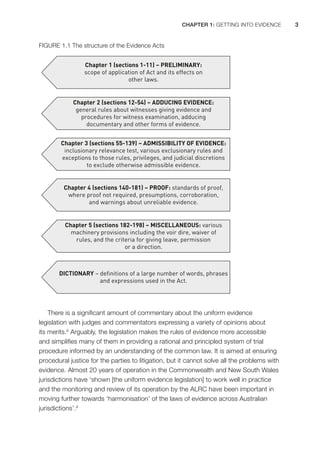
The EA is structured into five chapters and Figure 1.1 on the next page provides a
snapshot of the essential contents of this structure.
15.
3
CHAPTER 1: GETTINGINTO EVIDENCE
There is a significant amount of commentary about the uniform evidence
legislation with judges and commentators expressing a variety of opinions about
its merits.8
Arguably, the legislation makes the rules of evidence more accessible
and simplifies many of them in providing a rational and principled system of trial
procedure informed by an understanding of the common law. It is aimed at ensuring
procedural justice for the parties to litigation, but it cannot solve all the problems with
evidence. Almost 20 years of operation in the Commonwealth and New South Wales
jurisdictions have ‘shown [the uniform evidence legislation] to work well in practice
and the monitoring and review of its operation by the ALRC have been important in
moving further towards ‘harmonisation’ of the laws of evidence across Australian
jurisdictions’.9
Chapter 1 (sections 1-11) – PRELIMINARY:
scope of application of Act and its effects on
other laws.
Chapter 2 (sections 12-54) – ADDUCING EVIDENCE:
general rules about witnesses giving evidence and
procedures for witness examination, adducing
documentary and other forms of evidence.
Chapter 3 (sections 55-139) – ADMISSIBILITY OF EVIDENCE:
inclusionary relevance test, various exclusionary rules and
exceptions to those rules, privileges, and judicial discretions
to exclude otherwise admissible evidence.
Chapter 4 (sections 140-181) – PROOF: standards of proof,
where proof not required, presumptions, corroboration,
and warnings about unreliable evidence.
Chapter 5 (sections 182-198) – MISCELLANEOUS: various
machinery provisions including the voir dire, waiver of
rules, and the criteria for giving leave, permission
or a direction.
DICTIONARY – definitions of a large number of words, phrases
and expressions used in the Act.
FIGURE 1.1 The structure of the Evidence Acts
16.
UNIFORM EVIDENCE LAWGUIDEBOOK
4
KIND
OF
EVIDENCE
BRIEF
DESCRIPTION
PRACTICAL
EXAMPLE
Direct
‘[D]irect
evidence
is
evidence
which,
if
accepted,
tends
to
prove
a
fact
in
issue’
[Festa
v
The
Queen
(2001)
208
CLR
593,
596]
Witness
testifi
es
from
personal
knowledge
to
an
actual
observation
or
perception
of
a
fact
in
issue
from
one
of
their
fi
ve
senses.
The
fact-fi
nder
must
infer
that
the
witness
is
a
credible
source
for
the
evidence
to
be
accepted
in
determining
the
existence
or
otherwise
of
facts
in
issue
in
the
proceeding.
Issue
is
whether
D
stabbed
and
killed
V.
When
W
gives
evidence
at
D’s
trial
that
she
saw
D
stab
V,
and
this
evidence
is
accepted
by
the
fact-fi
nder,
it
directly
answers
the
question
whether
D
stabbed
and
killed
V.
It
is
direct
evidence
of
that
fact
in
issue.
Circumstantial
‘…
works
by
building
up
a
strong
pattern
of
circumstantial
detail
which
convinces
by
its
truth
to
the
sense
of
reality
that
we
derive
from
our
experience
of
life’
10
Witness
testifi
es
to
facts
that
go
to
a
fact
in
issue
but
are
not
suffi
cient
to
resolve
it.
If
the
evidence
is
accepted,
the
fact-fi
nder
must
draw
one
or
more
inferences
to
be
in
a
position
to
resolve
that
fact
in
issue.
It
can
be
prospectant
(before
the
subject
event),
concomitant
(at
the
time
of
the
event)
and
retrospectant
(after
the
subject
event)
along
a
time
continuum.
11
D
is
charged
with
the
murder
of
V,
his
wife.
There
are
no
eyewitnesses.
V’s
body
is
found
dumped
in
a
creek.
At
trial,
the
prosecution
evidence
comprises:
-
oral
evidence
from
W,
a
neighbour
of
D
and
V,
who
heard
them
arguing
loudly,
including
D
shouting
‘I’ll
see
you
dead,
miserable
bitch!’
the
day
before
V’s
body
was
found
in
a
creek
-
oral
and
documentary
evidence
from
I,
that
D
took
out
a
multimillion
dollar
life
insurance
policy
on
V
with
D
as
sole
benefi
ciary
ten
days
before
V’s
body
was
discovered.
-
real
and
forensic
evidence
from
P
that
D’s
hair
was
found
on
V’s
clothing,
discovered
on
the
creek
bank
near
V’s
body
-
oral
evidence
from
A
that
D
asked
him
the
day
after
the
body
was
found
to
support
his
alibi
that
he
was
playing
golf
with
him
at
the
time
V
was
killed
although
this
was
false.
While
individually
each
circumstance
does
not
prove
D
killed
V,
when
aggregated
together
they
lead
to
various
inferences
that
fi
rmly
support
that
conclusion.
TABLE
1.1
Classifi
cation
of
evidence
(Continued
)
17.
5
CHAPTER 1: GETTINGINTO EVIDENCE
KIND
OF
EVIDENCE
BRIEF
DESCRIPTION
PRACTICAL
EXAMPLE
Original
Witness
testimony
includes
a
statement
that
has
‘independent
evidentiary
value’
12
so
that
it
goes
to
proof
of
a
fact
in
issue
without
relying
on
its
truth.
It
is
relevant
simply
on
the
basis
the
statement
was
made,
and
its
probative
value
13
does
not
depend
on
the
credibility
of
the
person
who
made
the
statement.
Proof
of
threats
by
terrorists
that
D
would
be
killed
unless
he
assisted
them
by
carrying
their
ammunition
is
original
evidence
to
prove
the
threats
were
made
(not
that
they
were
true)
and
had
such
an
effect
on
D’s
state
of
mind
that
his
will
was
overborne,
supporting
his
defence
of
duress.
14
Hearsay
Witness
testimony
includes
a
statement
or
other
representation
made
out
of
court
by
another
person
not
called
as
a
witness,
and
the
statement
or
representation
is
only
relevant
to
proof
of
a
fact
in
issue
in
the
proceeding
if
it
is
true.
15
D
is
charged
with
‘arson’
of
a
hotel.
At
trial,
the
prosecution
propose
to
call
W,
who
made
a
statement
that
N
told
W
that
N
had
observed
D
in
the
vicinity
of
the
hotel
shortly
before
the
fi
re
and
that
D
was
carrying
a
large
jerry
can.
This
evidence
is
hearsay
and
cannot
be
given
at
trial
by
W
unless
it
comes
within
an
exception
to
the
rule.
Documentary
Witness
testifi
es
as
to
the
contents
of
a
document,
which
contains
writing
or
symbols
that
are
of
evidentiary
signifi
cance
to
a
fact
in
issue
in
the
proceeding.
Admissibility
of
documents
is
governed
by
special
rules.
16
P
gives
evidence
of
entering
into
a
written
contract
with
D
for
the
supply
of
building
materials
and
the
document
is
produced
as
evidence
of
the
terms
of
the
contract.
The
writing
in
the
document
is
relevant
for
proving
the
existence
of
the
contract.
Real
Witness
testifi
es
as
to
the
existence
of
an
actual
thing
that
the
tribunal
of
fact
can
perceive
and
experience
for
itself.
The
thing
proves
itself
and
the
party
producing
it
does
not
have
to
rely
on
inference
for
its
existence
although,
depending
on
the
nature
of
the
thing,
it
may
become
a
source
of
inference.
W
gives
evidence
that
a
knife
produced
in
court
that
was
found
at
the
crime
scene
is
what
she
saw
D
use
to
repeatedly
stab
V.
Views,
demonstrations,
experiments,
maps,
models,
diagrams
and
the
demeanour
of
a
witness
are
also
forms
of
real
evidence.
17
TABLE
1.1
Classifi
cation
of
evidence
(Continued
)
18.
UNIFORM EVIDENCE LAWGUIDEBOOK
6
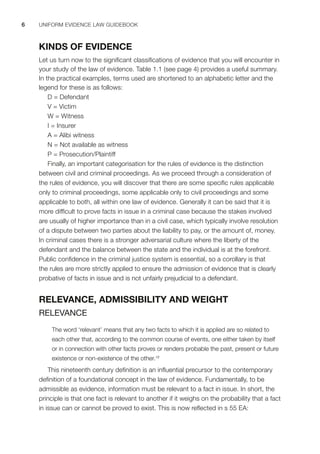
KINDS OF EVIDENCE
Let us turn now to the significant classifications of evidence that you will encounter in
your study of the law of evidence. Table 1.1 (see page 4) provides a useful summary.
In the practical examples, terms used are shortened to an alphabetic letter and the
legend for these is as follows:
D = Defendant
V = Victim
W = Witness
I = Insurer
A = Alibi witness
N = Not available as witness
P = Prosecution/Plaintiff
Finally, an important categorisation for the rules of evidence is the distinction
between civil and criminal proceedings. As we proceed through a consideration of
the rules of evidence, you will discover that there are some specific rules applicable
only to criminal proceedings, some applicable only to civil proceedings and some
applicable to both, all within one law of evidence. Generally it can be said that it is
more difficult to prove facts in issue in a criminal case because the stakes involved
are usually of higher importance than in a civil case, which typically involve resolution
of a dispute between two parties about the liability to pay, or the amount of, money.
In criminal cases there is a stronger adversarial culture where the liberty of the
defendant and the balance between the state and the individual is at the forefront.
Public confidence in the criminal justice system is essential, so a corollary is that
the rules are more strictly applied to ensure the admission of evidence that is clearly
probative of facts in issue and is not unfairly prejudicial to a defendant.
RELEVANCE, ADMISSIBILITY AND WEIGHT
RELEVANCE
The word ‘relevant’ means that any two facts to which it is applied are so related to
each other that, according to the common course of events, one either taken by itself
or in connection with other facts proves or renders probable the past, present or future
existence or non-existence of the other.18
This nineteenth century definition is an influential precursor to the contemporary
definition of a foundational concept in the law of evidence. Fundamentally, to be
admissible as evidence, information must be relevant to a fact in issue. In short, the
principle is that one fact is relevant to another if it weighs on the probability that a fact
in issue can or cannot be proved to exist. This is now reflected in s 55 EA:
19.
7
CHAPTER 1: GETTINGINTO EVIDENCE
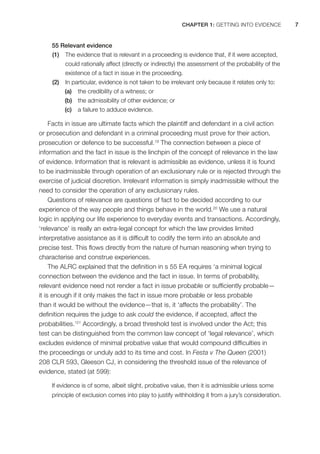
55 Relevant evidence
(1) The evidence that is relevant in a proceeding is evidence that, if it were accepted,
could rationally affect (directly or indirectly) the assessment of the probability of the
existence of a fact in issue in the proceeding.
(2) In particular, evidence is not taken to be irrelevant only because it relates only to:
(a) the credibility of a witness; or
(b) the admissibility of other evidence; or
(c) a failure to adduce evidence.
Facts in issue are ultimate facts which the plaintiff and defendant in a civil action
or prosecution and defendant in a criminal proceeding must prove for their action,
prosecution or defence to be successful.19
The connection between a piece of
information and the fact in issue is the linchpin of the concept of relevance in the law
of evidence. Information that is relevant is admissible as evidence, unless it is found
to be inadmissible through operation of an exclusionary rule or is rejected through the
exercise of judicial discretion. Irrelevant information is simply inadmissible without the
need to consider the operation of any exclusionary rules.
Questions of relevance are questions of fact to be decided according to our
experience of the way people and things behave in the world.20
We use a natural
logic in applying our life experience to everyday events and transactions. Accordingly,
‘relevance’ is really an extra-legal concept for which the law provides limited
interpretative assistance as it is difficult to codify the term into an absolute and
precise test. This flows directly from the nature of human reasoning when trying to
characterise and construe experiences.
The ALRC explained that the definition in s 55 EA requires ‘a minimal logical
connection between the evidence and the fact in issue. In terms of probability,
relevant evidence need not render a fact in issue probable or sufficiently probable—
it is enough if it only makes the fact in issue more probable or less probable
than it would be without the evidence—that is, it ‘affects the probability’. The
definition requires the judge to ask could the evidence, if accepted, affect the
probabilities.’21
Accordingly, a broad threshold test is involved under the Act; this
test can be distinguished from the common law concept of ‘legal relevance’, which
excludes evidence of minimal probative value that would compound difficulties in
the proceedings or unduly add to its time and cost. In Festa v The Queen (2001)
208 CLR 593, Gleeson CJ, in considering the threshold issue of the relevance of
evidence, stated (at 599):
If evidence is of some, albeit slight, probative value, then it is admissible unless some
principle of exclusion comes into play to justify withholding it from a jury’s consideration.
20.
UNIFORM EVIDENCE LAWGUIDEBOOK
8
It is not enough to say that it is ‘weak’ … whether it is weak might depend on what use
is made of it.
That final point relates to another important evidentiary concept known as ‘weight’,
which we will consider later in this chapter.
A CASE TO REMEMBER
Smith v The Queen (2001) 206 CLR 650
Smith v The Queen (2001) is a bank robbery case where there was an issue of
identification in relation to photographs taken by a security camera. The appellant had
been identified as the person in the photograph apparently keeping lookout (‘cockatoo’)
while the co-offenders took the money. The identification was made by two police officers
who had had previous dealings with the appellant and recognised him as the person
depicted in the bank security camera images. The High Court emphasised that the
first question to address with such evidence (and by logical extension—any evidence)
is whether it is relevant and, if it is not, no further questions about admissibility arise.
In determining relevance, the majority (Gleeson CJ, Gaudron, Gummow and Hayne JJ
at 653–654) stated it is fundamentally important to determine the issues at the trial. In
criminal trials, the ultimate issues are expressed in terms of the elements of the offence
and, applying s 55(1) EA to the specific facts of this case, there was a narrow issue of
whether the appellant is depicted in the bank photographs. The police witnesses were
held to be ‘in no better position to make a comparison between the appellant and the
person in the photographs than the jurors … who had been sitting in court observing the
proceedings’ (at 655). Accordingly, the witness’s assertion that he recognised the appellant
was not evidence that could rationally affect the assessment by the jury of the fact in issue.
Rather it simply permitted substitution of one view for another and did not promote the
process of reasoning from relevant evidence to the conclusion of a fact in issue. Therefore
the appeal was allowed because the police evidence was irrelevant and inadmissible, as
the jury were as well placed as the police officers to have a view on this fundamental issue
of fact.
In the later case of R v Marsh [2005] NSWCCA 331, a similar issue arose involving
identification of an appellant from bank security camera images. On this occasion,
however, the identification was made by the appellant’s sister from photographs
published in a newspaper and was held to have been correctly admitted as relevant
evidence, with the Court of Criminal Appeal distinguishing the facts in Smith v The
Queen (at [18]):
Unlike the police officers in Smith, Ms Wood had grown up with her brother and had an
ongoing association with him. The witness had the advantage, not shared by the jury,
of the long time opportunity, which she asserted, of observing her brother and of noting
his characteristics, his stature, his facial features, and the manner in which he wore his
21.
9
CHAPTER 1: GETTINGINTO EVIDENCE
jacket, which the witness claimed was so familiar to her. Hence the evidence which Ms
Wood was able to give and did give satisfied the requirement of relevance.
Basically, in the contemporary context of the EA, a fair summary is that all
information that is logically relevant is admissible as evidence although if the
connection to a fact in issue is too ambiguous and vague it may not reach this
threshold.22
Otherwise it will ultimately be subject to the trial judge having a discretion
to exclude evidence on the grounds of remoteness or insufficiency.23
Provisional relevance
The relevance of certain information submitted as evidence in a proceeding will
sometimes depend upon the proof of another fact,24
which can create inexpedient
obstructions to proof if the question of admissibility must be held in abeyance until
there is adequate proof of the facts on which its relevance depends. Section 57 EA
addresses this problem with a flexible approach allowing the court to make a
finding of provisional relevance for certain evidence subject to further evidence
being admitted at a later stage of the proceeding based on a test of whether it is
reasonably open to a jury to find the fact established when that further evidence is
admitted. The party seeking to adduce the information as evidence will ordinarily give
an undertaking to the court to adduce it at a later point in the trial. In practical terms
it is an issue about the order of calling witnesses. Usually a party will adopt the most
logical and practical method of calling witnesses listed in the case having regard to
the matters of proof to which each of their evidence is directed and their availability to
appear in court at designated times.
ADMISSIBILITY
Information is ‘admissible’ as evidence in a proceeding if, in addition to being
relevant, it is not rejected through the operation of an exclusionary rule, or in the
exercise of judicial discretion, or under one of the procedural provisions in the Act.
This position is reflected in s 56 EA:
56 Relevant evidence to be admissible
(1) Except as otherwise provided by this Act, evidence that is relevant in a proceeding
is admissible in the proceeding.
(2) Evidence that is not relevant in the proceeding is not admissible.
Importantly, evidence may be found to be admissible for one purpose but
inadmissible for another. The essential question to be asked is: ‘What is the use
which the court is invited to make of the evidence by the party tendering it?’25
Where information is submitted to have multiple relevance to a fact in issue and
an exclusionary rule operates to prevent the information from being used in one of
those ways, it will not necessarily prevent it from being admitted as evidence to be
used in another way.26
If this happens in a trial where a jury is the fact-finder, the trial
22.
UNIFORM EVIDENCE LAWGUIDEBOOK
10
judge will be required to give a carefully framed direction as to how the evidence can
be used. If it involves a complex direction which will be an insurmountable barrier
to compliance, the trial judge may exercise their discretion to exclude the evidence
having regard to the overriding obligation to ensure a fair trial.
The question of admissibility is a matter of law for the court to decide and under
s 142(1) EA such questions are decided on the balance of probabilities. It is possible
that determining a question of admissibility may depend upon a preliminary finding of
fact by the court, but it must be distinguished from the weight of evidence, the next
evidentiary concept we will consider, which is a question of fact.
WEIGHT
Once admitted as relevant, the weight of evidence is its persuasive effect on proof
of the fact in issue to which it is directed. There is a close relationship between
weight and relevance27
but, rather than simply just advancing proof of a fact in issue,
weight is identified with factors that affect the extent to which the jury or fact-finder
would accept the evidence in reaching their determination about the existence or
otherwise of a fact in issue. The cogency or degree of acceptance of evidence will
be paramount in determining the weight it has in resolving disputed factual issues.
An important factor which affects the weight of evidence is its source, and whether
it is the best that a party can reasonably procure in all the circumstances. Overall,
understanding of the evidentiary concept of ‘weight’ can be summed up to be ‘more
intuitive than analytical; weight is something we are more likely to “appreciate” than to
understand’.28
DRAWING INFERENCES
The process of drawing inferences is a prominent evidentiary concept. The
significance of drawing inferences was touched on when we considered
circumstantial and some other types of evidence above. Essentially there is a
two-step process29
where the question to be determined is whether from the
existence of a particular fact (A) it should be inferred that another fact (B) existed,
exists or will exist. First, in this reasoning process, is it possible or open to draw that
inference? Second, if it is, should it be drawn in the particular case?
Inferences will be drawn by the tribunal of fact from a consideration of human
conduct and experience so that, in the case of R v Ryan (unreported, NSWCCA,
15 April 1994), it was a question of whether the alleged victim’s distress was
evidence supporting an inference that the sexual intercourse was non-consensual.
Certainly human experience tells us that the inference where A (distress) exists, it is
possible to draw an inference that B (forced intercourse) took place. It then remains
23.
11
CHAPTER 1: GETTINGINTO EVIDENCE
to be determined whether, in the particular circumstances of the case before the
court, it is the inference that should in fact be drawn:
If it be concluded that the inference is open, it remains for the jury to determine
whether, in the circumstances, the inference should be drawn. This will be affected
by, amongst other things, the jury’s view of what are the circumstances in which
sexual assault led to distress of the relevant kind and whether the circumstances in
the instant case are such. These are matters in which the jury must act upon its own
experience of life.30
(Emphasis added)
24.
UNIFORM EVIDENCE LAWGUIDEBOOK
12
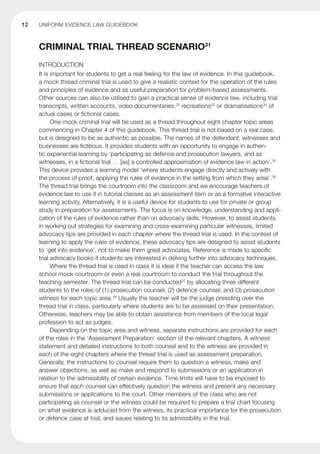
CRIMINAL TRIAL THREAD SCENARIO31
INTRODUCTION
It is important for students to get a real feeling for the law of evidence. In this guidebook,
a mock thread criminal trial is used to give a realistic context for the operation of the rules
and principles of evidence and as useful preparation for problem-based assessments.
Other sources can also be utilised to gain a practical sense of evidence law, including trial
transcripts, written accounts, video documentaries,32
recreations33
or dramatisations34
of
actual cases or fictional cases.
One mock criminal trial will be used as a thread throughout eight chapter topic areas
commencing in Chapter 4 of this guidebook. This thread trial is not based on a real case,
but is designed to be as authentic as possible. The names of the defendant, witnesses and
businesses are fictitious. It provides students with an opportunity to engage in authen-
tic experiential learning by ‘participating as defence and prosecution lawyers, and as
witnesses, in a fictional trial … [as] a controlled approximation of evidence law in action’.35
This device provides a learning model ‘where students engage directly and actively with
the process of proof, applying the rules of evidence in the setting from which they arise’.36
The thread trial brings the courtroom into the classroom and we encourage teachers of
evidence law to use it in tutorial classes as an assessment item or as a formative interactive
learning activity. Alternatively, it is a useful device for students to use for private or group
study in preparation for assessments. The focus is on knowledge, understanding and appli-
cation of the rules of evidence rather than on advocacy skills. However, to assist students
in working out strategies for examining and cross-examining particular witnesses, limited
advocacy tips are provided in each chapter where the thread trial is used. In the context of
learning to apply the rules of evidence, these advocacy tips are designed to assist students
to ‘get into evidence’, not to make them great advocates. Reference is made to specific
trial advocacy books if students are interested in delving further into advocacy techniques.
Where the thread trial is used in class it is ideal if the teacher can access the law
school mock courtroom or even a real courtroom to conduct the trial throughout the
teaching semester. The thread trial can be conducted37
by allocating three different
students to the roles of (1) prosecution counsel; (2) defence counsel; and (3) prosecution
witness for each topic area.38
Usually the teacher will be the judge presiding over the
thread trial in class, particularly where students are to be assessed on their presentation.
Otherwise, teachers may be able to obtain assistance from members of the local legal
profession to act as judges.
Depending on the topic area and witness, separate instructions are provided for each
of the roles in the ‘Assessment Preparation’ section of the relevant chapters. A witness
statement and detailed instructions to both counsel and to the witness are provided in
each of the eight chapters where the thread trial is used as assessment preparation.
Generally, the instructions to counsel require them to question a witness, make and
answer objections, as well as make and respond to submissions or an application in
relation to the admissibility of certain evidence. Time limits will have to be imposed to
ensure that each counsel can effectively question the witness and present any necessary
submissions or applications to the court. Other members of the class who are not
participating as counsel or the witness could be required to prepare a trial chart focusing
on what evidence is adduced from the witness, its practical importance for the prosecution
or defence case at trial, and issues relating to its admissibility in the trial.
25.
13
CHAPTER 1: GETTINGINTO EVIDENCE
The following is important information to keep for use throughout the conduct of
the entire thread criminal trial. It sets the scene for you in providing a summary of the
prosecution case, details of the charge against the defendant, the initial instructions from
the defendant and his criminal record. It will be necessary for you to research the elements
of the ‘aggravated robbery’ charge and identify the facts in issue in the thread trial. This
research will inform all decisions made by you as counsel with respect to the progress of
the trial, the evidence adduced, and material that will be the subject of objection.
PROSECUTION CASE STATEMENT
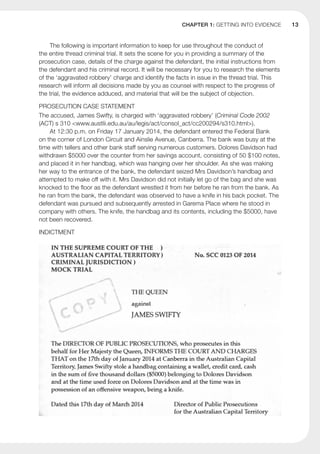
The accused, James Swifty, is charged with ‘aggravated robbery’ (Criminal Code 2002
(ACT) s 310 <www.austlii.edu.au/au/legis/act/consol_act/cc200294/s310.html>).
At 12:30 p.m. on Friday 17 January 2014, the defendant entered the Federal Bank
on the corner of London Circuit and Ainslie Avenue, Canberra. The bank was busy at the
time with tellers and other bank staff serving numerous customers. Dolores Davidson had
withdrawn $5000 over the counter from her savings account, consisting of 50 $100 notes,
and placed it in her handbag, which was hanging over her shoulder. As she was making
her way to the entrance of the bank, the defendant seized Mrs Davidson’s handbag and
attempted to make off with it. Mrs Davidson did not initially let go of the bag and she was
knocked to the floor as the defendant wrestled it from her before he ran from the bank. As
he ran from the bank, the defendant was observed to have a knife in his back pocket. The
defendant was pursued and subsequently arrested in Garema Place where he stood in
company with others. The knife, the handbag and its contents, including the $5000, have
not been recovered.
INDICTMENT
26.
UNIFORM EVIDENCE LAWGUIDEBOOK
14
DEFENCE INITIAL INSTRUCTIONS
At the initial interview, James Swifty instructs his counsel as follows:
It wasn’t me. They must have me confused with someone else. I was just
hanging around with me mates in Garema Place. I went off to buy some
smokes up in the bus interchange. Not long after I got back with the smokes
the coppers turned up and arrested me. Look, I don’t want to talk about it any
more. Just get me off. This charge is bullshit. Yeah … I might have been in the
bank earlier that day, but I never went back.
Note: In a real case your instructions would ordinarily be much more detailed, but a
defendant is not required to give any particular instructions to their lawyer. They could
simply say, ‘I want to plead not guilty’.
Taking proper instructions is an essential skill for any lawyer, but it is beyond the scope
of this mock criminal trial.
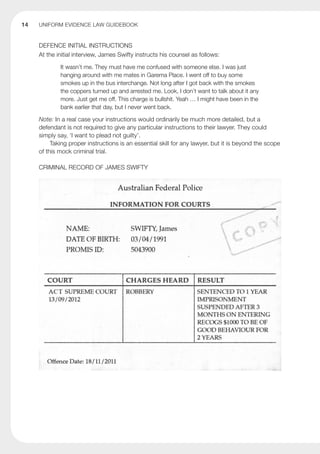
CRIMINAL RECORD OF JAMES SWIFTY
27.
15
CHAPTER 1: GETTINGINTO EVIDENCE
Important references
For more extensive coverage of introductory material, relevance and associated concepts,
see:
1 John Anderson and Peter Bayne, Uniform Evidence Law: Text and Essential Cases
(Federation Press, 2nd edn, 2009) Introduction and Chapter 1.
2 Jill Anderson, Neil Williams and Louise Clegg, The New Law of Evidence (LexisNexis
Butterworths, 2nd edn, 2009) Introduction and 160–180.
3 Peter Faris, Mirko Bagaric, Francine Feld and Brad Johnson, Uniform Evidence Law:
Principles and Practice (CCH Australia, 2011) Chapters 1 and 5.
4 Jeremy Gans and Andrew Palmer, Uniform Evidence (Oxford University Press, 2010)
Chapters 1 and 4.
5 Stephen Odgers, Uniform Evidence Law (Thomson Reuters Lawbook, 11th edn, 2014)
Introduction and 200–246.
ASSESSMENT PREPARATION
Short brain-teasers
1 The body of Verity (V) was discovered in bushland. Her death resulted from multiple
blows to her head with a blunt instrument. A star-shaped hammer, which is ordinarily
used as part of the equipment to tune pianos, was found a few metres from her body.
There were traces of blood on the hammer and the DNA profile from these blood traces
was found to match that of V. Damien (D), who works as a piano tuner, is charged with
the murder of V. At trial, during the evidence of the police officer in charge of the case,
the following occurs:
Prosecutor: Your Honour, the witness has identified the four star-shaped hammers
that were found in D’s garage when a search warrant was executed at D’s
premises the day after V’s body was found. I tender those hammers.
Defence counsel: I object, your Honour – this evidence is irrelevant. The four
star-shaped hammers found in D’s garage are all stainless steel with black star tips
and rounded wooden handles of the ‘Keyes’ brand. The hammer found near the
body of V is a larger ‘Baxter’ brand hammer made of hardened steel with a silver
star tip and nylon handle. Also, D is a piano tuner by trade and it is common for
him to have these implements for his everyday work.
How would the trial judge rule on defence counsel’s objection? What reasons would
be given for this ruling?
2 When David’s (D) vehicle was stopped and searched by police in connection with a
drug trafficking surveillance operation, a sports bag was found on the front passenger
seat containing a commercial quantity of the prohibited drug, methylamphetamine,
and a box of bullets was found in the front passenger door pocket. No handgun in
which the bullets could be used was found in the vehicle. D is charged with supplying a
commercial quantity of a prohibited drug.
28.
UNIFORM EVIDENCE LAWGUIDEBOOK
16
At trial, what arguments could counsel for D raise to challenge the relevance of the
box of bullets to facts in issue? What is the likelihood of counsel for D having the box of
bullets successfully excluded on this basis?
3 Paul (P) has taken an action in negligence against his local council (D) for damages
for personal injuries resulting from a fall into a concrete drain in a council-owned park.
The fall occurred in the early hours of the morning. P was moderately intoxicated at
the time and has no recollection as to how he fell into the drain. The drain has a sheer
unfenced wall approximately 1.75 metres high at one end, but the sides of the drain
have a gentle downward slope, which children use for skateboarding. There were no
eyewitnesses to P’s fall and the only information to support P’s assertion that he fell
from the sheer unfenced wall and not one of the sides is the following written record
made by two ambulance officers who attended the scene several hours after the fall
when morning walkers discovered P lying injured in the drain:
Found by bystanders—parkland
? Fall from 1.75 metres onto concrete
No other history.
At the trial of this action before a judge alone, a question arises as to the relevance of
this written record. Discuss the arguments for and against a finding that this document
is relevant to facts in issue.
For additional notes on the brain-teasers, please refer to
<www.oup.com.au/andersonhopkins>.
Notes
1 See HML v The Queen (2008) 235 CLR 334, 350–351 per Gleeson CJ for a neat
statement of the essential features of the law of evidence.
2 Peter K Waight and Charles R Williams, Evidence: Commentary and Materials
(Thomson Lawbook, 7th edn, 2006) 2.
3 See Pollitt v The Queen (1992) 174 CLR 558, 573 where Brennan J describes it as a
‘working tool … [and] the ground on which the dynamics of a trial, especially a criminal
trial, are played out’.
4 Evidence Act 1995 (Cth) (commenced operation 18 April 1995), Evidence Act
1995 (NSW) (commenced operation 1 September 1995), Evidence Act 2001 (Tas)
(commenced operation 1 July 2002), Evidence Act 2008 (Vic) (commenced operation
1 January 2010), Evidence Act 2011 (ACT) (commenced operation 1 March 2012), and
Evidence Act 2011 (NT) (commenced operation 1 January 2013). Hereafter these Acts
will be referred to collectively as the Act or EA. The New South Wales Act will be used
as the standard in this guidebook with any differences in the legislative provisions of
other jurisdictions noted in the relevant part of the text or in an endnote.
5 These include ALRC, Report No 26 (1985) volumes 1 and 2 (hereafter referred to as
ALRC26), ALRC Report No 38 (1987) (hereafter referred to as ALRC38), ALRC Uniform
Evidence Law Report No 102 (2005), collaborative with the NSWLRC (Report 112) and
Victorian LRC (Final Report) (hereafter referred to as ALRC102).
6 See the observations by Einstein J in Idoport Pty Ltd v National Australia Bank (2000)
50 NSWLR 640, 651 that ‘it is obviously correct to say that the Evidence Act is not a
code in the sense that it contains a complete and exhaustive statement of the law of
evidence’. Note also s 9(1) EA that it does not affect the operation of other legislation or
(consistent) common law and equitable rules of evidence.
29.
17
CHAPTER 1: GETTINGINTO EVIDENCE
7 Idoport Pty Ltd v National Australia Bank Ltd (2000) 50 NSWLR 640, 652.
8 See, for example W A N Wells QC, ‘A Critique of the Australian Law Reform
Commission Draft Evidence Bill’ (1992) Australian Bar Review 185–201; The Hon.
Justice Smith, ‘The More Things Change The More They Stay The Same? The Evidence
Acts 1995—An Overview’ (1995) 18 UNSWLJ 1; and Stephen Odgers, Uniform
Evidence Law (Thomson Reuters Lawbook, 11th edn, 2014) 25–26.
9 John Anderson and Peter Bayne, Uniform Evidence Law: Text and Essential Cases
(Federation Press, 2nd edn, 2009) 10–11.
10 Graham Roberts, Evidence: Proof and Practice (LBC Information Services, 1998) 65.
Circumstantial evidence is explored in detail in Chapter 2.
11 Ibid, 66.
12 See Walton v The Queen (1989) 166 CLR 283, 289 (Mason CJ).
13 The term ‘probative value’ is defined in the EA Dictionary Part 1 and this meaning is
discussed in Chapter 3.
14 Facts of the case of Subramanian v Public Prosecutor [1956] 1 WLR 965 (PC).
15 The hearsay rule and its exceptions are discussed in detail in Chapter 7.
16 Documentary evidence is covered in detail in Chapter 5.
17 Real evidence is covered in detail in Chapter 5.
18 Sir James Fitzjames Stephen, Digest of the Law of Evidence (Macmillan & Co.,
4th edn, 1893) 2.
19 See Goldsmith v Sandilands (2002) 190 ALR 370 in relation to civil actions where
McHugh J observed (at [31]) that relevance is determined by reference to the elements
of the cause of action and any defence raised by a party in the pleadings.
20 See Martin v Osborne (1936) 55 CLR 367, 375 (Dixon J).
21 ALRC26, vol 1 [641]. Also, see Papakosmas v The Queen (1999) 196 CLR 297.
22 See Lithgow City Council v Jackson [2011] HCA 36 [25]–[26].
23 This will be by using s 135 EA after the information has been found to be relevant and
otherwise admissible. See Chapter 3 for detailed consideration of the judicial discretion
to exclude evidence.
24 For some common examples see Jeremy Gans and Andrew Palmer, Uniform Evidence
(Oxford University Press, 2010) 77–78.
25 Roberts, above n 10, 73.
26 This phenomenon of multiple relevance will be considered in relation to hearsay
evidence in Chapter 7, opinion evidence in Chapter 9, credibility evidence in
Chapter 10, and tendency and coincidence evidence in Chapter 11.
27 See R v Stephenson [1976] VR 376, 380–381.
28 Roberts, above n 10, 77.
29 See R v Ryan (unreported, NSWCCA, 15 April 1994). Also, see Jones v Sutherland
Shire Council [1979] 2 NSWLR 206.
30 R v Ryan, ibid, per Mahoney JA—BC9402482, 7.
31 We are grateful for the assistance of Shane Drumgold, Senior Prosecutor, Office of the
Director of Public Prosecutions (ACT) for the initial provision of materials to enhance
authenticity of this scenario.
32 See, for example, On Trial (five-part documentary series, ABC Television, 2011); and
The Staircase (eight-part documentary about the trial of Michael Peterson for the
murder of his wife in North Carolina, USA, Maha Productions, 2004).
30.
UNIFORM EVIDENCE LAWGUIDEBOOK
18
33 See Beyond Reasonable Doubt (four-part series involving presentation, discussion and
recreation of four notorious Australian criminal trials, ABC Television, 1977).
34 Useful films include The Accused (Paramount Pictures, 1988), Presumed Innocent
(Warner Bros, 1990), Primal Fear (Paramount Pictures, 1996), A Civil Action (Buena
Vista Pictures, 1998), and Snow Falling on Cedars (Universal Pictures, 1999). Television
series include—North Square (Channel 4 UK, 2000–1), Crownies (ABC Television,
2011), Rake (ABC Television, 2010–2014), Janet King (ABC Television 2014), and Silk
(BBC Television UK, 2011–2014).
35 Anthony Hopkins, ‘Teaching Evidence Law within the Framework of a Trial: Relating
Theory to Practice as Students Take to their Feet and Take Responsibility for the Trial
Narrative’ (2009) 2 Journal of Australian Law Teachers Association 173–184, 173–174.
36 Ibid, 176.
37 See ibid, 177–182 where Anthony Hopkins describes how the thread criminal trial was
designed and conducted in the tutorials in his Evidence course at the University of
Canberra in 2008.
38 Ultimately the allocation of roles will depend on the number of student enrolments in the
course and in each tutorial class. Another strategy for teachers is to organise students
into groups and each counsel could be instructed by another student acting as a
solicitor to foster the capacity for working in teams.
31.
19
CHAPTER 2
PROOF ANDPRESUMPTIONS
COVERED IN THIS CHAPTER
In this chapter, you will learn about:
• burden of proof—criminal cases;
• standard of proof—criminal cases;
• circumstantial evidence;
• burden of proof—civil cases;
• standard of proof—civil cases;
• presumptions; and
• common knowledge and judicial notice.
CASES TO REMEMBER
Burrell v The Queen [2007] NSWCCA 65
Rees v The Queen (2010) 200 A Crim R 83
STATUTES AND SECTIONS TO REMEMBER
Evidence Act ss 140, 141, 144
INTRODUCTION
The rules relating to burden (or onus) and standard (or degree) of proof, and
presumptions are designed to assist a tribunal of fact in determining the existence
or not of an ultimate fact in issue in the proceedings. You will recall from Chapter 1
that facts in issue are the ultimate issues that have to be resolved in the legal cause
of action or defence relied on by the parties. Behind these ultimate issues there will
often be issues about the existence of facts that support or undermine proof of the
facts in issue. These have been described as ‘basic facts’.1
If there is uncertainty
about the existence of these basic facts, the rules relating to burden and standard of
proof may sometimes have application. The Act only deals with the standard of proof
in proceedings; it does not deal with the allocation of the burden of proof in respect
of facts in issue. This was regarded by the ALRC as a matter of substantive law and
so not to be regulated in the statutory scheme.
19
32.
UNIFORM EVIDENCE LAWGUIDEBOOK
20
BURDEN OF PROOF
The term ‘burden of proof’ describes an obligation on a particular party to prove
a fact or facts. The general obligation for proof will lie on the party that asserts the
existence of particular facts. There are two aspects to the burden of proof:
1 The legal or persuasive burden is the overall burden of persuading the tribunal of
fact that the party who has asserted the existence of the ultimate facts in issue has
proved them to the necessary standard. In the same proceedings, the burdens
on different issues may be distributed between the parties as, for example, in
a civil negligence action when the defendant raises the defence of contributory
negligence. Simply put, ‘it is the burden of winning the mind of the fact-finder,
by the evidence, to those propositions of fact asserted by the party who will fail if
those propositions are not accepted’.2
The High Court has recently described it as
‘the burden of establishing a case’.3
2 The evidential burden is the burden of producing sufficient evidence to raise an
issue or, as the High Court has described it, ‘the burden of proof in the sense of
introducing evidence’.4
That is, for the judge to leave the issue to the jury or, if the
judge is sitting alone, to be required to consider the issue when deciding whether
the legal burden has been discharged, the party must have produced enough
evidence relating to that issue. It is sometimes known as ‘getting past the judge’.5
BURDEN OF PROOF IN CRIMINAL CASES
In a criminal trial the defendant is presumed innocent and does not have to explain
or contradict what is already in evidence, as the prosecution has the legal burden to
prove the elements of the crime charged against the defendant.6
There is no legal
onus on the defendant to raise a reasonable doubt.7
Tactically the defendant may
have a burden to adduce some evidence to raise a doubt, but this is a practical
consideration in the forensic contest and not a legal obligation.8
Historically, the leading case on the incidence of the legal burden of proof in
criminal cases is Woolmington v DPP [1935] AC 462. In that case, the defendant
had been convicted of the shooting murder of his wife, but had pleaded the defence
of accident on the basis of an accidental discharge of the gun. The trial judge had
directed the jury that, once the prosecution had proved the killing, it was presumed
to be murder and the defendant had to prove circumstances that would excuse the
killing as an accident or reduce it to manslaughter. The House of Lords held that this
was a material misdirection and quashed the conviction. In the well-known words
of Viscount Sankey LC (at 481) it is abundantly clear that the prosecution generally
carries the legal burden of proof:
Throughout the web of the English criminal law one golden thread is always to be
seen, that it is the duty of the prosecution to prove the prisoner’s guilt subject to … the
33.
21
CHAPTER 2: PROOFAND PRESUMPTIONS
defence of insanity and subject also to any statutory exception. If, at the end of and on
the whole of the case, there is a reasonable doubt, created by the evidence given by
either the prosecution or the prisoner, as to whether the prisoner killed the deceased
with a malicious intention, the prosecution has not made out the case and the prisoner
is entitled to an acquittal.
Also, it is apparent from the above passage that a legal burden of proof is
imposed on a defendant in two principal areas. First, there is a legal presumption of
sanity so if this presumption is to be challenged the defendant will raise the defence
of insanity9
and they have the legal burden of proof.10
Second, there may be created statutory exceptions which reverse the burden of
proof.11
Some examples from the New South Wales jurisdiction are:
• s 23A(4) Crimes Act 1900, which provides that the defendant must prove the
statutory defence of ‘substantial impairment by abnormality of mind’.12
This
defence has been described as ‘a plea of confession and avoidance. Any person,
relying on the plea, must prove it … Until an accused tenders evidence in support
of the claim of diminished responsibility, the Crown has no issue to meet’.13
• s 29 Drug Misuse and Trafficking Act 1985, which provides that where a certain
quantity of a prohibited drug (‘traffickable quantity’) is found in the possession of
the defendant they are deemed to be in possession for the purposes of supply
and the legal burden falls on the accused to establish that the drug was not in
their possession for the purposes of supply. This is also in the nature of a plea of
confession and avoidance.
If the words of the statutory provision relating to the burden of proof are not in
clear terms, the presumption of innocence means the favoured construction of the
statute is that an evidential burden, rather than a legal burden, is imposed on the
defendant.14
That takes us to the next consideration in burden of proof, the placing of
the evidential burden.
Logically, where there is a legal burden there will invariably be an evidential
burden, so this latter burden will generally also fall on the prosecution in criminal
cases. A defendant may, however, bear an evidential burden when defences like
self-defence and provocation are raised, having to point to some evidence in support
of the defence. This requirement is usually described as a ‘reasonable possibility’
of the existence of the defence by reference to the available evidence taken at its
highest for the defendant.15
Generally the evidential burden applies to those defences
that would justify or excuse the defendant’s acts even if the prosecution discharges
its burden of proof in relation to the elements of the offence.16
These defences raise
factual issues which go beyond what may be termed the ‘definitional facts’ as proved
by the prosecution, and a significant factor to consider in placing the burdens is
whether the nature of the defence is peculiarly within the defendant’s knowledge.
34.
UNIFORM EVIDENCE LAWGUIDEBOOK
22
Overall, it is clear that, in the absence of a defence that specifically casts a
legal or evidential burden on a defendant, the onus of proof never shifts from the
prosecution.17
STANDARD OF PROOF
This term relates to the sufficiency of evidence required for a party to discharge the
burden of proof in a proceeding. Essentially it is concerned with the degree to which
the party bearing the burden of proof has to persuade the tribunal of fact in order
to successfully establish their case. Although quantitative words are often used in
this context, it is important to emphasise that proof does not solely depend on the
quantity of evidence; it also has a qualitative aspect related to the weight of the
evidence, which is for the subjective assessment of the tribunal of fact. Following on
from burden of proof, we will first examine the standard of proof in criminal cases.
STANDARD OF PROOF IN CRIMINAL CASES
Section 141(1) EA restates the common law on the standard of proof in a criminal
proceeding, which was laid down in the seminal case of Woolmington v DPP and
followed in a long line of Australian authority:18
141 Criminal proceedings: standard of proof
(1) In a criminal proceeding, the court is not to find the case of the prosecution
proved unless it is satisfied that it has been proved beyond reasonable doubt.
(2) In a criminal proceeding, the court is to find the case of a defendant proved if it is
satisfied that the case has been proved on the balance of probabilities.
In relation to the time-honoured phrase ‘beyond reasonable doubt’, the courts
have emphasised that it is not necessary to explain or define the three words,
which are ordinary, everyday words. If amplification is necessary to assist the jury or
resolve confusion,‘it should go no further than to tell the jury that a reasonable doubt
is one which they, as reasonable persons, are prepared to entertain’.19
The best
course is for the judge to state the rule without comment and as illustrated in R v
Southammavong; R v Sihavong [2003] NSWCCA 312, describing them as ‘ordinary
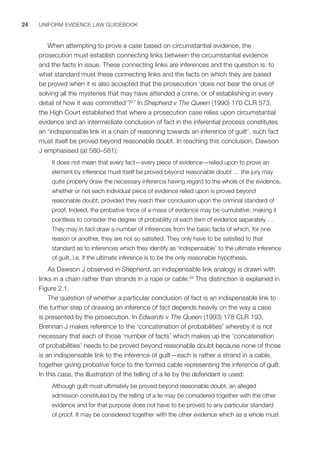
everyday words’ simply means ‘they are words which require no further definition’
and that the jury members themselves set a standard of what is reasonable in terms
of a doubt in the particular circumstances of the trial.
Section 141(2) EA affirms that when a legal burden is imposed on the defendant,
the question for the tribunal of fact is whether the evidence available establishes
the defence on the lesser standard of the balance of probabilities.20
It is clear
that distinguishing the standard of proof for the defence from the higher standard
imposed on the prosecution is based on the policy consideration that it is ‘preferable
35.
23
CHAPTER 2: PROOFAND PRESUMPTIONS
that defendants who are probably guilty should be acquitted, than that those who
might well not be guilty should be convicted’.21
CIRCUMSTANTIAL EVIDENCE
An important exception for where the phrase ‘beyond reasonable doubt’ can be
elaborated upon is where the prosecution’s case is substantially dependent on
circumstantial evidence. Circumstantial evidence is evidence that does not directly
establish the facts in issue which have to be proved beyond reasonable doubt,
but can be used to infer the existence of facts in issue.22
In the context of a case
based on circumstantial evidence, the tribunal of fact is only entitled to find that
guilt has been proven beyond reasonable doubt if it is satisfied that there is no
rational hypothesis consistent with the innocence of the defendant.23
If a hypothesis
consistent with innocence cannot be excluded as unreasonable, then the defendant
must be acquitted.24
Although there is an obligation on the trial judge to provide
directions that are necessary to prevent a perceptible risk of a miscarriage of justice,
the qualifications in a circumstantial case are that the hypothesis must be both
reasonable and available on the evidence—there must be some evidentiary basis for
it and there is no obligation on a trial judge to put all conceivable constructions of the
facts to the jury.25
It has been emphasised that ‘tortuous reasoning’ should not be
engaged ‘in order to explain away every individual circumstance as being consistent
with innocence’.26
A CASE TO REMEMBER
Burrell v The Queen [2007] NSWCCA 65
In Burrell v The Queen [2007], a case involving a prosecution for murder based entirely
on circumstantial evidence, it was contended both at trial and on appeal that the police
investigation was inadequate so that there were reasonable hypotheses consistent with
the innocence of the defendant that had not been excluded. It was argued that, without
further and thorough investigations by the police into any available alternative hypotheses,
the prosecution could not exclude them as reasonable possibilities. The trial judge had
directed the jury that any finding that they might make that the police investigation was
inadequate was not capable of weakening the prosecution case and this was challenged
on appeal. The Court of Criminal Appeal held that the trial judge was correct and that
evidence of an inadequate police investigation is not in itself evidence of a reasonable
hypothesis consistent with the innocence of the defendant. It may be of greater
significance if it has a direct bearing upon the cogency of the evidence that is actually
before the court, such as where the evidence adversely affects the credibility of police
witnesses or reveals that the police did not follow proper procedures in relation to search
or identification of suspects. Overall though, the jury must not speculate as to any matter
which a more thorough police investigation might have revealed.
36.
UNIFORM EVIDENCE LAWGUIDEBOOK
24
When attempting to prove a case based on circumstantial evidence, the
prosecution must establish connecting links between the circumstantial evidence
and the facts in issue. These connecting links are inferences and the question is: to
what standard must these connecting links and the facts on which they are based
be proved when it is also accepted that the prosecution ‘does not bear the onus of
solving all the mysteries that may have attended a crime, or of establishing in every
detail of how it was committed’?27
In Shepherd v The Queen (1990) 170 CLR 573,
the High Court established that where a prosecution case relies upon circumstantial
evidence and an intermediate conclusion of fact in the inferential process constitutes
an ‘indispensable link in a chain of reasoning towards an inference of guilt’, such fact
must itself be proved beyond reasonable doubt. In reaching this conclusion, Dawson
J emphasised (at 580–581):
It does not mean that every fact—every piece of evidence—relied upon to prove an
element by inference must itself be proved beyond reasonable doubt … the jury may
quite properly draw the necessary inference having regard to the whole of the evidence,
whether or not each individual piece of evidence relied upon is proved beyond
reasonable doubt, provided they reach their conclusion upon the criminal standard of
proof. Indeed, the probative force of a mass of evidence may be cumulative, making it
pointless to consider the degree of probability of each item of evidence separately …
They may in fact draw a number of inferences from the basic facts of which, for one
reason or another, they are not so satisfied. They only have to be satisfied to that
standard as to inferences which they identify as ‘indispensable’ to the ultimate inference
of guilt, i.e. if the ultimate inference is to be the only reasonable hypothesis.
As Dawson J observed in Shepherd, an indispensable link analogy is drawn with
links in a chain rather than strands in a rope or cable.28
This distinction is explained in
Figure 2.1.
The question of whether a particular conclusion of fact is an indispensable link to
the further step of drawing an inference of fact depends heavily on the way a case
is presented by the prosecution. In Edwards v The Queen (1993) 178 CLR 193,
Brennan J makes reference to the ‘concatenation of probabilities’ whereby it is not
necessary that each of those ‘number of facts’ which makes up the ‘concatenation
of probabilities’ needs to be proved beyond reasonable doubt because none of those
is an indispensable link to the inference of guilt—each is rather a strand in a cable,
together giving probative force to the formed cable representing the inference of guilt.
In this case, the illustration of the telling of a lie by the defendant is used:
Although guilt must ultimately be proved beyond reasonable doubt, an alleged
admission constituted by the telling of a lie may be considered together with the other
evidence and for that purpose does not have to be proved to any particular standard
of proof. It may be considered together with the other evidence which as a whole must
37.
25
CHAPTER 2: PROOFAND PRESUMPTIONS
Circumstantial Evidence: Links in a Chain v Strands in a Cable
A. Unbroken links in a chain each link represents an intermediate conclusion of fact
(formed from one or more basic facts) that is indispensable in the chain of reasoning from
basic facts to ultimate proof. When each link is established beyond reasonable doubt then the
ultimate fact in issue will also be established beyond reasonable doubt: that is, there is no
rational hypothesis consistent with innocence.
B. Break in the chain a broken link means that an indispensable intermediate
conclusion of fact is not established beyond reasonable doubt (this may be due to witness
credibility or other weaknesses in the evidence such that one or more basic facts are not
accepted to support the intermediate inference). Therefore the circumstantial evidence cannot
support proof of the ultimate fact in issue beyond reasonable doubt. There is a rational
hypothesis consistent with the defendant’s innocence.
C. Missing link in the chain a missing link means that there is no evidence available to
support an indispensable intermediate conclusion of fact in the chain of reasoning to ultimate
proof. The chain is incomplete and there must be a rational hypothesis consistent with the
innocence of the defendant so that the available circumstantial evidence does not prove guilt
beyond reasonable doubt.
versus
A. Fully connected strands in a cable all basic facts intertwined to support an inference
going directly to prove a fact in issue whereby each strand gives strength to the overall
inference, but each strand (unlike each link in the chain) does not have to be proved beyond
reasonable doubt.
B. Strands of a cable unravelling and separating basic facts joined together, but some
of these facts may not be accepted and cannot be used to support the inference. Depending on
the weight allocated to particular facts by the fact-finder, this situation does not prevent the
drawing of the inference. May not be as strong an inference for proof of a fact in issue, but the
basic facts that are accepted may be sufficient to support the inference and together still
reach proof beyond reasonable doubt of the ultimate fact in issue.
C. All strands of cable separated basic facts separated side by side illustrate that these
basic facts cannot combine to support the inference necessary to form the connected cable
going to proof beyond reasonable doubt of the ultimate fact in issue. Each fact does not have to
be proved beyond reasonable doubt, but may still not be accepted for various reasons (such as
credibility of source or conflict with other evidence) by the fact-finder. Ultimate facts in issue
cannot be proved beyond reasonable doubt so there will be a rational hypothesis consistent
with the innocence of the defendant.
FIGURE 2.1 Circumstantial evidence: links in a chain versus strands in a cable
establish guilt beyond reasonable doubt. If the lie said to constitute the admission is
the only evidence against the accused or is an indispensable link in a chain of evidence
necessary to prove guilt, then the lie and its character as an admission against interest
must be proved beyond reasonable doubt before the jury may conclude that the
accused is guilty. (At 210 per Deane, Dawson and Gaudron JJ)
38.
UNIFORM EVIDENCE LAWGUIDEBOOK
26
The importance of specific context in determining the significance of particular
intermediate conclusions of fact is illustrated in a line of cases from R v Merritt
[1999] NSWCCA 29. Also, a requirement stated in Merritt and some subsequent
cases29
that the trial judge is to identify all facts for the jury which might reasonably
be regarded as indispensable intermediate facts in their chain of reasoning to proof
of ultimate facts in issue and the guilt of the defendant has been questioned in
later cases.30
Most recently, the courts have emphasised that there is a danger of
the jury considering such evidence in separate and isolated compartments rather
than as a cumulative whole of circumstances. The jury should undertake a holistic
assessment of the direct evidence of witnesses and the inferences to be drawn from
a combination of events and not approach their task in a piecemeal fashion.31
In
order to restrict artificial compartmentalisation of facts, the test for whether a fact is
indispensable was stated by Simpson J in the following terms:
Whether a fact on which the Crown relies as part of a circumstantial case is or is
not ‘indispensable’ may be tested by asking whether, in the absence of evidence of
that fact, there would nonetheless be a case to go to the jury. If the answer is in the
affirmative, even if the Crown case is weakened, even considerably, the fact is not
‘indispensable’. Where the answer is in the negative, the fact is ‘indispensable’ and the
jury should be directed accordingly.32
(Emphasis added)
The following is a useful case example of the characterisation of the components
of a circumstantial case against a defendant.
A CASE TO REMEMBER
Rees v The Queen (2010) 200 A Crim R 83
In Rees v The Queen (2010) the appellant had been convicted of two counts of ‘armed
robbery’ and one count of ‘aggravated break, enter and steal’ being in a joint criminal
enterprise with two other men. The proceeds from one armed robbery included the
victim’s wallet and this was later found in the bedroom of the appellant during a police
search of the premises. The appellant was not identified as an assailant but was linked
to the offences through a combination of circumstances, including being in the company
of the co-offenders proximate to the time the offences were committed, and the finding
of the victim’s wallet under his bed (at 94–95). One ground of appeal was that the trial
judge had failed to direct the jury that they should not convict unless they were satisfied
beyond reasonable doubt that the wallet found in the appellant’s bedroom was that stolen
from the victim during the course of the robbery. This was argued to be an indispensable
link in the chain of reasoning to the guilt of the appellant. The Court of Criminal Appeal
found that although this was a strong piece of circumstantial evidence, it was not the only
evidence that linked the appellant with the commission of the offences (at 97) and should
not be considered as a separate and isolated compartment. The court held that ‘the jury
was required to weigh up all of the circumstances and decide whether they were satisfied
beyond reasonable doubt of the appellant’s guilt of the three offences with which he was
charged’ so that a Shepherd direction was not required in these circumstances (at 97).
39.
27
CHAPTER 2: PROOFAND PRESUMPTIONS
A no-case submission, where it is alleged that the circumstantial evidence cannot
sustain a guilty verdict, requires a trial judge to decide whether the evidence and
its associated inferences taken at their highest in relation to every element of the
offence charged could, if accepted and reasonably open, prove that element beyond
reasonable doubt.33
Finally, it is important to emphasise that circumstantial evidence by its nature
is not necessarily less reliable than direct evidence and where a case relies on
circumstantial evidence to the exclusion of direct evidence it will not be bound to
fail.34
In El Hassan v The Queen [2007] NSWCCA 148, Hunt AJA highlighted (at [27])
that in some cases circumstantial evidence can be more convincing, particularly
cases of the ‘strands in a cable’ variety:
It is a matter of common sense that the more strands in the cable, the stronger the
cable is. The more circumstances pointing to the guilt of the accused, the less likely it
is that there could be any reasonable explanation for those circumstances other than
the guilt of the accused, and thus the stronger is the circumstantial case against him.
(Emphasis added)
BURDEN OF PROOF IN CIVIL CASES
Generally the plaintiff or applicant bringing the action will bear the burden of proof in
civil cases but it will vary depending on the circumstances in which the claim arises.
It is well known that it is difficult for a plaintiff to prove a negative35
and it has really
become a matter of legal policy as to how the burden is placed in different civil cases.
This can be illustrated by comparing and contrasting contract and bailment cases
with personal injury cases.36
In a bailment scenario, where a plaintiff has taken an
action for damages for breach of contract on the basis that goods were delivered
otherwise than in accordance with the contract, they have the initial burden of
proving the existence of the contract and the breach. When, however, the defendant,
‘confessing and avoiding—seeks to justify or excuse a failure to deliver in accordance
with the contract … [the] burden of proof rests upon him’.37
The burden in these
circumstances is on the defendant to justify that breach by proving that the delivery in
fact made was a delivery which the plaintiff had authorised. In an action for damages
for breach of contract due to delay in delivery of the item contracted for, if the plaintiff
alleges that the frustration of the contract claimed by the defendant was due to the
negligence of the defendant, the plaintiff has the burden of proving that negligence.38
Generally, the plaintiff bears the burden of proving all elements of negligence by
the defendant.39
In an action for damages for personal injury, however, where the
defendant claims the plaintiff’s disability resulted from a pre-existing condition, then
although the plaintiff has the burden of establishing a prima facie case that their
disability resulted from the defendant’s negligence, there is an evidential burden on
the defendant to produce sufficient evidence to show that the disability was the result
40.
UNIFORM EVIDENCE LAWGUIDEBOOK
28
of a pre-existing condition.40
Once that burden is discharged by the defendant, the
plaintiff has to satisfy the tribunal on the balance of probabilities of the extent of the
injury caused by defendant’s negligence on the whole of the evidence.41
Overall, in
respect of particular issues of ultimate fact the legal burden lies on the same side
throughout the case—sometimes the plaintiff and sometimes the defendant. In
relation to an issue of ultimate fact, the evidential burden may lie on one party, and
the legal burden on another.42
The phenomenon frequently referred to as ‘the shifting of the burden’ is misleading
because a particular legal or evidential burden does not in fact shift in a civil action.
The reality is that each party may be required to prove a different matter depending
on the circumstances of the case, or it may only be an apparent burden in the sense
of tactical considerations in the fluctuations of the adversarial contest.43
Table 2.1 provides a snapshot of some common and useful examples of placing
the burden of proof in situations arising in civil cases.
SPECIFIC CIVIL SITUATION NATURE OF BURDEN AND
PARTY BEARING BURDEN
OF PROOF
CASE EXAMPLES
Res ipsa loquitur doctrine
(implication from the
circumstances of an accident
that the defendant has
been negligent—‘the thing
speaks for itself’).
Not a rule of law but ‘a
process of reasoning and
inference from circumstantial
evidence’.44
Legal burden on plaintiff to
establish injury would not have
occurred without defendant’s
negligence.
Evidential burden on
defendant to provide evidence
as to cause of accident or
explain how the accident
might have occurred in the
absence of their negligence.
Fitzpatrick v Cooper
(1936) 54 CLR 200;
Mummery v Irvings Pty
Ltd (1956) 96 CLR 99;
Anchor Products Ltd
v Hedges (1966) 115
CLR 493; Schellenberg
v Tunnel Holdings
(2000) 74 ALJR 743.45
Statutory provisions Test of statutory construction
applied is whether a complete
factual situation must be
found to exist before liability
is incurred or obligation
imposed, or whether there is
a general obligation or liability
with a qualification, exception
or proviso based on new or
additional facts. In the first
situation the party alleging
Vines v Djordjevitch
(1955) 91 CLR 512;
Lynch v Attwood [1983]
3 NSWLR 1; Chugg v
Pacific Dunlop (1990)
170 CLR 249; Avel
Pty Ltd v Multicoin
Amusements Pty Ltd
(1990) 171 CLR 88;
Waters v Mercedes
Holdings Pty Ltd [2012]
TABLE 2.1 Examples of placing the burden of proof in specific situations
(Continued)
41.
29
CHAPTER 2: PROOFAND PRESUMPTIONS
STANDARD OF PROOF IN CIVIL CASES
In civil proceedings both at common law and under the Act the standard of proof is
‘on the balance of probabilities’. The relevant provision is s 140.
140 Civil proceedings: standard of proof
(1) In a civil proceeding, the court must find the case of a party proved if it is satisfied
that the case has been proved on the balance of probabilities.
(2) Without limiting the matters that the court may take into account in deciding
whether it is so satisfied, it is to take into account:
(a) the nature of the cause of action or defence; and
(b) the nature of the subject-matter of the proceeding; and
(c) the gravity of the matters alleged.
The standard is often translated as meaning ‘more likely than not’ but the more
appropriate approximation is ‘more probable than not’.46
Another phrase used is the
‘preponderance of the evidence’. This does not mean that a mathematical probability
is required but rather an actual satisfaction as to the occurrence or existence of a
fact in issue and, like the ‘beyond reasonable doubt’ standard, the phrase should be
interpreted in its ordinary natural sense.47
It is a lower standard of proof having regard
to the fact that the personal consequences involved are usually not as serious as
in a criminal case, particularly for individuals. The focus is on inferences that prove
as a matter of probabilities, not possibilities, and the plaintiff must still offer some
evidence even when ‘material circumstances are peculiarly within the knowledge of
the defendant’.48
Other expressions for the standard of proof may oversimplify the position and it is
actually more complex than the criminal standard due largely to the significant variety
of fact situations which are involved in civil litigation. Is the civil standard of proof fixed
SPECIFIC CIVIL SITUATION NATURE OF BURDEN AND
PARTY BEARING BURDEN
OF PROOF
CASE EXAMPLES
breach of the obligation or
that liability has been incurred
has the legal burden of proof.
But if an excuse or justification
is provided for not complying
with the obligation or not
incurring liability, the legal
burden of proof is borne by
the party alleging they fall
within the qualification, excuse
or proviso.
FCAFC 80 [16]–[17];
Darley Australia Pty Ltd
v Walfertan Processors
Pty Ltd [2012] NSWCA
48 [103]–[109].
TABLE 2.1 Examples of placing the burden of proof in specific situations (Continued)
42.
UNIFORM EVIDENCE LAWGUIDEBOOK
30
for all cases or does it vary to take account of different types of case? This question
relates to the possibility of a third standard intermediate between the existing civil and
criminal standards and the notion that the civil standard shifts with the gravity of the
issue in the proceeding.
It is clear that there is no third, intermediate standard of proof and in Briginshaw v
Briginshaw (1938) 60 CLR 336, Dixon J emphasised that the same standard applies
in all civil cases but ‘the nature of the issue necessarily affects the process by which
reasonable satisfaction is attained’ (at 363). His Honour’s reasoning (at 362) is now
echoed in s 140(2) EA pointing to particular features of a case that affect proof on the
balance of probabilities to the reasonable satisfaction of the tribunal:49
No doubt an opinion that a state of facts exists may be held according to indefinite
gradations of certainty; and this has led to attempts to define exactly the standard
required by the law for various purposes … The seriousness of an allegation made,
the inherent unlikelihood of an occurrence of a given description, or the gravity of the
consequences flowing from a particular finding are considerations which must affect
the answer to the question whether the issue has been proved to the reasonable
satisfaction of the tribunal. (Emphasis added)
Later, in Neat Holdings v Karajan Holdings Pty Ltd (1992) 110 ALR 449, a case
involving the tort of deceit and whether projected takings of an amusement centre
business had been misrepresented by the vendor company to the purchaser
company, the plurality judgment in the High Court emphasised the importance of the
issue to be proved in applying the civil standard of proof (at 449–450):
The ordinary standard of proof required of a party who bears the onus in civil litigation
in this country is proof on the balance of probabilities. That remains so even where
the matter to be proved involves criminal conduct or fraud … . On the other hand,
the strength of the evidence necessary to establish a fact or facts on the balance of
probabilities may vary according to the nature of what it is sought to prove. Thus,
authoritative statements have often been made to the effect that clear or cogent or
strict proof is necessary ‘where so serious a matter as fraud is to be found’. Statements
to that effect should not, however, be understood as directed to the standard of proof.
Rather, they should be understood as merely reflecting a conventional perception that
members of our society do not ordinarily engage in fraudulent or criminal conduct and
a judicial approach that a court should not lightly make a finding that, on the balance of
probabilities, a party to civil litigation has been guilty of such conduct.50
It is apparent that the standard of proof does not shift with the gravity of the issue,
but the court must consider the ‘forensic context of forming an opinion as to its
satisfaction’ under s 140(2) EA by having more regard to ‘the strength and weakness
of evidence before coming to a conclusion’ relative to the ‘consequences of what is
contested in litigation’.51
43.
31
CHAPTER 2: PROOFAND PRESUMPTIONS
Finally, where there is only circumstantial evidence in a civil case, it must give
rise to more than conflicting inferences of equal degrees of probability or mere
conjecture.52
There should be a reasonable and definite inference53
and the existence
of other reasonable hypotheses may be taken into account to determine whether
a fact in issue should be inferred from facts proved, but as it is a lesser standard
of proof it is not necessary that all reasonable hypotheses inconsistent with the
existence of a fact be excluded before that fact can be found.54
PRESUMPTIONS
The substantive operation of presumptions is not addressed in the Act, but simply
put a presumption is that the truth of a particular fact is assumed. In the common law
of evidence, a presumption will establish a fact without specific proof. Presumptions
may arise from ‘general experience, or probability of any kind; or merely on policy
or convenience. On whatever basis they rest, they operate in advance of argument
or evidence, or irrespective of it, by taking something for granted; by assuming its
existence’.55
Presumptions have traditionally been classified in the following categories:
• Conclusive or irrebuttable presumptions of law: these are really substantive rules
of law—for example, the age of criminal responsibility or that marriage is not a
defence to an allegation of rape.56
• Persuasive or rebuttable presumptions of law: this is the substantive rule of law
based on facts which provide prima facie evidence of the matter presumed—
that is, proof of a particular fact allows presumption of some other fact but it
can be rebutted by sufficient contrary evidence. Taking the example of criminal
responsibility of children, the doli incapax presumption applies to children until
they are 14 years of age unless there is evidence to prove that they knew the
act committed was wrong and not simply naughty or mischievous.57
Specific
presumptions, such as regularity, accuracy of instruments, and the formal validity
of marriage fall into this category. Another example may be that a testator
destroyed their will with the intention of revoking it if a will is traced to the
testator’s possession and not located after their death.58
• Rebuttable presumptions of fact: these involve patterns of circumstantial
evidence where similar instances of facts have given rise to the same
conclusion. The presumption may be refuted by evidence suggesting that in
particular circumstances the facts will not lead to that conclusion. The accuracy
of transcripts adduced in proceedings is a presumption of fact59
as is the
presumption of continuance, namely whether a state of affairs, proved to exist at a
certain point in time, existed earlier or continued to exist at a later time. It does not
appear to apply when determining whether parties intend to enter into contractual
relationships.60
44.
UNIFORM EVIDENCE LAWGUIDEBOOK
32
Table 2.2 outlines the operation of some of the notable specific common law
presumptions.
PRESUMPTION DESCRIPTION CASE EXAMPLE
Regularity All people conduct their
affairs in a way that complies
with the law. The rationale
is based on the assumption
that ‘most people adopt
honest and regular methods
or procedures for carrying out
their duties and the ordinary
transactions of everyday
life; and in their personal
relationships they maintain
those standards of morality
and decency which commend
themselves to ordinary sober
minded citizens’.61
Lee v Burn (unreported, NSWCA,
23 April 1998): in a personal injury
action arising out of a motor vehicle
accident the legal presumption of
regularity operated to establish that
a taxi cab was fitted with seat belts
because it was duly registered and
licensed and so complied with all
applicable statutory and regulatory
prescriptions. Accordingly, the
appellant’s failure to wear a seat
belt resulted in 30% contributory
negligence.62
Accuracy of
instruments
Rebuttable presumption of
the functioning accuracy
of scientific or technical
instruments, such that
the recording or reading
of an instrument is prima
facie evidence of the facts
recorded.
Porter v Kolodzeij [1962] VR 75;
Dunsmore v Elliott (1981) 26 SASR
496: examples of speedometer,
clock, barometer, speed camera,
breathalyser. Now reflected in ss
146 and 147 EA, which facilitate
proof by presumption that
documents or things produced by
processes, machines and other
devices, if properly used, produced
the particular outcome evidenced in
the document or thing.
Continuance Presumption that a particular
state of affairs proved to exist
at one time continued to exist
at a later point in time or had
existed from an earlier point of
time. It is a way of describing
a process of reasoning which
involves drawing inferences
from proved facts.
Mason v Tritton (1994) 34 NSWLR
572; Potts v Frost [2011] TASSC
55 [34]; R v Hill [2012] ACTSC
121 [27].
TABLE 2.2 Specific presumptions
45.
33
CHAPTER 2: PROOFAND PRESUMPTIONS
Where presumptions are provided in statutory form, the court is allowed or
directed to be satisfied that a certain fact is true either conclusively or prima facie
when a certificate is tendered or because appropriate evidence establishes a related
fact. Part 4.3 EA, headed ‘Facilitation of Proof’, provides a number of presumptions
that can be applied across different types of cases but which do not arise if merely a
doubt, which does not have to satisfy the civil standard of proof, is raised:63
• s 149: not necessary to adduce evidence of a witness to the signature and
attestation of documents;
• s 152: document more than 20 years old produced from proper custody is
presumed to be the document it purports to be;
• ss 153–159: certain matters of official record, public documents, and official
statistics presumed to be what they purport to be;
• ss 160–162: matters relating to post and electronic communications: postal
articles (s 160) presumed to have been received on fourth working day after
being posted; email (s 161) presumed to have been sent and received on the day
and at the time appearing from the communication sent. These presumptions
are not applicable to proceedings that relate to a contract where the terms are
inconsistent with the presumption.
COMMON KNOWLEDGE AND JUDICIAL NOTICE
Section 144 EA is an important provision that obviates the need for proof of certain
matters of common knowledge and of which judicial notice is taken. This replaces
the common law doctrine of ‘judicial notice’.64
144 Matters of common knowledge
(1) Proof is not required about knowledge that is not reasonably open to question
and is:
(a) common knowledge in the locality in which the proceeding is being held or
generally; or
(b) capable of verification by reference to a document the authority of which
cannot reasonably be questioned.
(2) The judge may acquire knowledge of that kind in any way the judge thinks fit.
(3) The court (including, if there is a jury, the jury) is to take knowledge of that kind into
account.
(4) The judge is to give a party such opportunity to make submissions, and to refer to
relevant information, relating to the acquiring or taking into account of knowledge
of that kind as is necessary to ensure that the party is not unfairly prejudiced.
46.
UNIFORM EVIDENCE LAWGUIDEBOOK
34
In addition to the large number of matters in the world which are common
knowledge for adults of ordinary intelligence,65
some recent examples of facts falling
within common knowledge of which judicial notice has been taken include:
• published statistics;66
• the internet itself may be common knowledge,67
but the specific information on a
website of a business or organisation would not be covered;68
• the 2008 global financial crisis.69
On the other hand, a judge cannot use s 144 to inform themselves of issues upon
which ‘reasonable minds may differ’,70
so that it may be outside judicial notice to
apply dictionary definitions71
as would also be a judge’s views on the particular effects
of child sexual abuse.72
In giving an opportunity to the parties to challenge what
may or may not be taken into account as common knowledge, a court must accord
procedural fairness to ensure that no party is unfairly prejudiced.73
Important references
For more extensive coverage of burden and standard of proof and presumptions, see:
1 John Anderson and Peter Bayne, Uniform Evidence Law: Text and Essential Cases
(Federation Press, 2nd edn, 2009) Chapter 3.
2 Jill Anderson, Neil Williams and Louise Clegg, The New Law of Evidence (LexisNexis
Butterworths, 2nd edn, 2009) 26–27, 687–705.
3 Jeremy Gans and Andrew Palmer, Uniform Evidence (Oxford University Press, 2010)
Chapters 17 and 18.
4 Stephen Odgers, Uniform Evidence Law (Thomson Reuters Lawbook, 11th edn, 2014)
54, 901–928.
47.
35
CHAPTER 2: PROOFAND PRESUMPTIONS
ASSESSMENT PREPARATION
Active learning questions
1 ‘… a legal decision depends upon the court discovering the material facts which satisfy
the granting of a remedy under a particular legal rule. The common law requires one or
other of the parties, normally the claimant initiating proceedings, to substantiate those
facts, first by adducing evidence of them and, secondly, by persuading the court that
they exist or occurred.’ (Andrew Ligertwood and Gary Edmond, Australian Evidence
(5th ed, 2010) 520)
With reference to this statement and to the relevant law, what is your understanding of
legal and evidential burdens of proof?
2 What is the role of the trial judge sitting with a jury when it is argued that an evidential
burden has not been met? What is the consequence of a party failing to meet an
evidential burden?
3 In a criminal trial where the prosecution is relying on various intermediate facts from
which to draw an inference of guilt of the accused, to what standard must these
intermediate facts be proved? Why is this standard set?
4 What is your understanding of the Briginshaw principle? Is it still applicable in any
contemporary litigation context?
5 What is a presumption and how does it operate when it is relied on by a party in a
proceeding?
Review problems
1 For the two cases set out below, identify:
(a) the facts in issue;
(b) the incidence of the evidential burden;
(c) the incidence of the legal burden; and
(d) the standard of proof.
Case 1
The plaintiff, Computers-are-us, has brought an action against the defendant, the
haulage contractor Roadways Australia, for breach of contract. The contract was
for carriage of a consignment of laptop computers by truck from the port to the
Computers-are-us regional warehouse. A term of the contract was that Roadways
Australia was liable for any loss resulting from fire provided there was no negligence on
the part of any of their employees. The truck and the entire load of laptop computers
were destroyed by fire during the journey while the truck was parked in a motorway
rest area. The defendant denies liability for the loss. The plaintiff alleges that Roadways
Australia was facing insolvency and that the truck was deliberately set on fire so that
they could make a claim on the insurers of the truck. In the alternative, the plaintiff
alleges that the fire was caused by the truck driver, an employee of Roadways
Australia, failing to take due care when he parked the truck and its load in the
motorway rest area.
Case 2
Dwaine is being prosecuted for assaulting Vincent, who received serious head injuries
as a result of a dispute and physical altercation they had approximately three months
ago outside a city hotel. Vincent spent a week in hospital after the incident due to
48.
UNIFORM EVIDENCE LAWGUIDEBOOK
36
the injuries suffered from being struck on the head by a metal post that was part of
a damaged street sign. The prosecution case consisted of Vincent’s evidence that
following a short argument with Dwaine about money Vincent allegedly owed Dwaine
from a bet, Dwaine started punching Vincent in the head and upper body before
picking up a metal post from a damaged street sign and hitting Vincent repeatedly in
the head until he was unconscious. Also, medical evidence of the nature and extent
of Vincent’s injuries was produced by the prosecution. In his defence, Dwaine testified
that Vincent started the argument when they walked outside the hotel, threw a punch
connecting with Dwaine’s jaw and then picked up the metal post and started swinging
it towards Dwaine. His further evidence was that he eventually overcame Vincent and
managed to wrestle the metal post away from him and only struck him once with the
post in self-defence when he saw Vincent reach into his jacket pocket for what Dwaine
believed was an automatic switchblade knife. Three eyewitnesses were also called
in the defence case and they each gave evidence which supported Dwaine’s version
of the incident and they were aware that Vincent always carried a switchblade knife,
which he had shown to them on a prior occasion.
Alternatively, if Dwaine raised the defence of mental illness or mental impairment how,
if at all, would this alter the incidence of the evidential and legal burdens?
2 Assume the following facts:
Darcy Cunningham (DC) is on trial for attempting to abduct an 11-year-old girl (V). It is
alleged that, about 3:50 p.m. on Wednesday 6 November 2013, V, who is a primary
school student, was walking home from school when a slow moving white station
wagon drove towards her. She noticed the driver of the station wagon looking directly
at her. V became concerned and started to walk faster entering the registration number
of the vehicle in her mobile telephone as she walked. She heard a car door slam
behind her and looked back to see a man walking around the front of the white station
wagon. She again quickened her pace but had only taken a few steps when she felt
someone grab her arm and say, ‘Get in the car!’ V tried to break free from the grip on
her arm but the man maintained his grip and repeatedly told her to get in the car. Even
though fearing for her life, V turned around and faced the man and kicked him in the
groin area causing him to stumble backwards allowing her to break free and run away.
Later in her video-recorded interview with a police officer at the police station, V stated
that she noticed that the driver’s seat of the white station wagon was ‘leaning right
back’ and observed that the man was wearing blue tracksuit pants and a white T-shirt,
which was dirty and stained. She also said that the man had yellow, stained teeth and
a very ‘creepy’ smile. She said she had noted the car registration number in her mobile
phone because of what she had remembered from a recent police visit to her school
when they talked about ‘stranger danger’.
Following up on the registration number of the vehicle reported by V, police attended
DC’s home at about 5:15 p.m. on the same day. DC’s home was about four blocks
away from the primary school and the police found the white station wagon, with
the registration number that V had noted, in the yard of DC’s home. Both the driver’s
and front passenger’s seat were significantly reclined. V had described the man who
attacked her as having brown wavy collar-length hair, brown eyes, short, skinny and
about 30 years old. This general description fitted DC although he is aged only 22
years. Further, DC has only two natural teeth; his two front bottom teeth, which are
distinctively stained yellow. His other teeth are dentures. DC also has a substantial
49.
37
CHAPTER 2: PROOFAND PRESUMPTIONS
and colourful tattoo of a dragon on his left arm. When spoken to by police, DC was
wearing blue denim jeans and a brown-coloured T-shirt with the words ‘Perfect Paints’
in large lettering. The police officers noticed that there was a strong paint and chemical
smell on DC’s clothing from the solvents he used at his workplace, a paint factory
about 20 minutes’ drive from his home.
DC denies that he was responsible for the attack on V and refused to participate in
an interview with the investigating police officers. He has given instructions to defence
counsel that he is not guilty and that on 6 November 2013 he drove home directly
from his workplace after finishing his shift at 3:30 p.m. and had not changed out of his
work clothes by the time the police called at his home that afternoon.
At the trial the prosecution called V as its first witness to give evidence via closed-
circuit television. Following the examination in chief which included the playing of V’s
video recorded interview with police to the court, she was cross-examined by counsel
for DC. During cross-examination V agreed that she could not remember seeing any
other teeth than those yellow, stained teeth of the man who attacked her and couldn’t
remember how many teeth he had. She was shown the dentures and agreed that
her assailant did not have teeth like that. The dentures were tendered in evidence.
V did not remember seeing a large and colourful dragon tattoo on her assailant’s left
arm. She did not smell any chemicals or strong odours on her assailant’s clothing
and insisted he was wearing track-suit pants and a dirty white T-shirt. She could not
recall any writing on the T-shirt. The clothing that V was wearing at the time of the
attack was examined for traces of DNA. A sample of DC’s DNA had been taken in
accordance with the requirements of the relevant legislation. The only DNA found on
V’s clothing was matched to her own and a friend’s profile. The DNA of DC was not
found.
DC’s girlfriend, Natalie Grahame (NG), was called to give evidence for the defence and
testified that on 6 November 2013 DC telephoned NG at home at 3:35 p.m. to advise
her that he was leaving work and asked her to open the roller door of the garage and
keep their pet dog inside. Further, NG said that this was in accordance with his usual
habit and he then arrived home approximately 20 minutes later at 3:55 p.m. wearing
his usual work clothes, blue denim jeans and a ‘Perfect Paints’ T-shirt, which smelt
strongly of chemicals.
Analyse the evidence available to the prosecution to prove DC’s guilt for the offence
of ‘attempted child abduction’ to the requisite standard of proof and the prospects of
the jury returning a verdict of guilty in this case. In your analysis include a discussion of
the judicial directions that you would seek as counsel for DC in relation to the burden
and standard of proof, identifying any intermediate facts which might reasonably be
regarded as indispensable to proof of guilt.
Notes
1 Shepherd v The Queen (1990) 170 CLR 573, 579 (Dawson J).
2 Graham Roberts, Evidence: Proof and Practice (LBC Information Services, 1998)
80. Roberts notes that the legal burden is sometimes referred to as ‘the risk of
non-persuasion’.
3 Braysich v The Queen (2011) 243 CLR 434, 453.
4 Ibid, 453–454.
5 Roberts, above n 2, 80–81.
50.
UNIFORM EVIDENCE LAWGUIDEBOOK
38
6 Azzopardi v R (2001) 205 CLR 50, 73–75 (Gaudron, Gummow, Kirby and Hayne JJ);
DF v R [2011] ACTCA 11 [4]. Also, see R v Hettiarachchi [2009] VSCA 270 [51]–[52].
7 DF v R [2011] ACTCA 11 [15]–[28]; R v Fairbairn [2011] ACTSC 78 [11]–[20];
R v Meyboom [2011] ACTSC 13 [9]–[11]; R v Meyboom [2010] ACTSC 90 [2]–[3].
8 See Roberts, above n 2, 81–82.
9 In the contemporary context this is known as the defence of mental illness (New South
Wales) or mental impairment (Victoria).
10 This goes back to M’Naghten’s Case (1843) 8 ER 718, where the court clearly placed
the burden of proving insanity on the defendant.
11 A statutory reversal of the burden of proof is not in itself unconstitutional—see, for
example, KS v Veitch (No 2) [2012] NSWCCA 266 [47]–[54].
12 This defence was formerly known as ‘diminished responsibility’ and applies only to
murder.
13 Melbourne v The Queen (1999) 198 CLR 1, 8 (McHugh J).
14 Momcilovic v the Queen (2011) 245 CLR 1, 43–44 (French CJ).
15 See R v Youssef (1990) 50 A Crim R 1, 3; Braysich v The Queen (2011) 243 CLR 434,
452–455 (French CJ, Crennan and Kiefel JJ); CTM v The Queen (2008) 236 CLR 440,
456 (Gleeson CJ, Gummow, Crennan and Kiefel JJ); Momcilovic v The Queen (2011)
245 CLR 1, 31 (French CJ), 242 (Bell J); The Queen v Khazaal (2012) 246 CLR 601,
605 (French CJ); Taiapa v The Queen (2009) 240 CLR 95, 98 (French CJ, Heydon,
Crennan, Kiefel and Bell JJ). Also, see Criminal Code Act 1995 (Cth) s 13.3(6).
16 See, for example Crimes Act 1900 (NSW) s 417, and Criminal Code Act 1995
(Cth) s 13.3.
17 Chahine v The Queen [2006] NSWCCA 179 [62].
18 See, for example, Thomas v The Queen (1960) 102 CLR 584; Green v The Queen
(1974) 126 CLR 28; R v Wilson (1986) 22 A Crim R 130; R v Southammavong;
R v Sihavong [2003] NSWCCA 312; R v Li [2003] NSWCCA 386; R v Chami [2004]
NSWCCA 36 and RWB v R [2010] NSWCCA 147.
19 R v Wilson (1986) 22 A Crim R 130, 133.
20 Also, see Braysich v the Queen (2011) 243 CLR 43, 454–455 (French CJ, Crennan and
Kiefel JJ).
21 Frank Bates, Principles of Evidence (Lawbook, 3rd edn, 1985) 40.
22 See Table 1.1 in Chapter 1 as to the difference between, and practical examples of,
direct and circumstantial evidence.
23 Chamberlain v The Queen (No 2) (1984) 153 CLR 521 and Shepherd v R (1990) 170
CLR 573 are the leading cases in this regard.
24 Braslin v Tasmania [2011] TASCCA 14 [53]; Wood v The Queen [2012] NSWCCA 21
[50]–[53], [555]–[571]; Gilham v The Queen [2012] NSWCCA 131 [466].
25 R v Park [2003] NSWCCA 203; Pemble v The Queen (1971) 124 CLR 107.
26 Gilham v The Queen [2012] NSWCCA 131 [466]. Also, see R v Micallef [2002]
NSWCCA 480 [42]; and Burrell v The Queen [2009] NSWCCA 193 [55].
27 Chamberlain v The Queen (No 2) (1984) 153 CLR 521, 568 (Gibbs CJ and Mason J).
28 See Roberts, above 2, 101–102 for an illustration of circumstantial evidence in a murder
case and what intermediate conclusions of fact (inferences) must be proved beyond
reasonable doubt as an indispensable step in the chain of reasoning from basic facts
to ultimate proof. The metaphor using links in a chain and strands in a cable is from
Wigmore on Evidence (Chadbourn rev 1981) 412–414.
29 See, for example, R v Whyte [2006] NSWCCA 75.
51.
39
CHAPTER 2: PROOFAND PRESUMPTIONS
30 See, for example, The Queen v Hillier (2007) 228 CLR 618; The Queen v Keenan (2009)
236 CLR 397; R v Davidson (2009) 75 NSWLR 150; R v Burrell [2009] NSWCCA
163; Rees v The Queen (2010) 200 A Crim R 83; and Neill-Fraser v Tasmania [2012]
TASCCA 2 [157]–[164].
31 R v Hillier (2007) 228 CLR 618, 637–638; Shepherd v The Queen [2011] NSWCCA 245
[53]; Gilham v The Queen [2012] NSWCCA 131 [466].
32 R v Davidson (2009) 75 NSWLR 150, 165 (Spigelman CJ and James J agreeing).
33 See R v XHR [2012] NSWCCA 247 [11]–[18] (Beazley JA), [106] (Hall J), [107] (S G
Campbell J). Also, see R v Mocenigo (Ruling No 4) [2012] VSC 442.
34 Wood v The Queen [2012] NSWCCA 21 [51].
35 See A v State of NSW (2007) 230 CLR 500, 520–521.
36 Evans v Queanbeyan City Council [2011] NSWCA 230 [41] (Allsop P).
37 Tozer Kemsley & Millbourne (Australasia) Pty Ltd v Collier’s Interstate Transport Service
Ltd (1956) 94 CLR 384, 400–401 (Fullagar J).
38 Joseph Constantine Steamship Line Ltd v Imperial Smelting Corporation Ltd [1942]
AC 154.
39 See, for example, Harmer v Hare [2011] NSWCA 229 [233]–[239].
40 Purkess v Crittenden (1965) 114 CLR 164. Also, see Australian Winch and Haulage
Company Pty Ltd v Collins [2013] NSWCA 327 [79]–[80].
41 Ibid, 168 (Barwick CJ).
42 See Munce v Vinidex Tubemakers Pty Ltd [1974] 2 NSWLR 235, 237–238; and Coshott
v Sakic (unreported, NSWCA, 3 September 1998).
43 See Poricanin v Australian Consolidated Industries [1979] 2 NSWLR 419, 425–426
(Glass and Hope JJA), 429 (Reynolds JA).
44 Anchor Products Ltd v Hedges (1966) 115 CLR 493, 500 (Windeyer J). Also, see
Government Insurance Office of NSW v Fredrichberg (1968) 118 CLR 403, 413
(Barwick CJ).
45 Compare position in the United Kingdom in Barkway v South Wales Transport Co Ltd
[1949] 1 KB 54 and Esso Petroleum Co Ltd v Southport Corporation [1956] AC 218,
which are authority for the view that the defendant has a legal burden to prove that they
were not negligent.
46 TNT Management v Brooks (1979) 53 ALJR 267.
47 Evans v Queanbeyan City Council [2011] NSWCA 230 [42] (Allsop P), [68] (Basten JA);
NOM v DPP [2012] VSCA 198 [105]–[112].
48 See Condos v Clycut Pty Ltd [2009] NSWCA 200 [68]–[70].
49 Briginshaw is treated as consistent with the operation of s 140(2) EA: see Australian
Securities and Investments Commission v Hellicar (2012) 247 CLR 345, 381–382, 405;
and NOM v DPP [2012] VSCA 198 [113]–[124].
50 Also, see Palmer v Dolman [2005] NSWCA 361 [47].
51 Communications, Electrical, Electronic, Energy, Information, Postal, Plumbing and Allied
Services Union of Australia v ACCC [2007] FCAFC 132 [30]–[31]. Also, see Helton v
Allen (1940) 63 CLR 691; Re Dellow’s Will Trusts [1964] 1 WLR 451; Sands v Channel
Seven Adelaide [2010] SASC 202 [48]–[53]; and IMC Aviation Solutions Pty Ltd v Altain
Khuder LLC [2011] VSCA 248 [193] for allegations of criminal acts in civil proceedings,
such as defamation, succession and insurance cases.
52 Asim v Penrose [2010] NSWCA 366 [143] approving Luxton v Vines (1952) 85 CLR
352, 358.
52.
UNIFORM EVIDENCE LAWGUIDEBOOK
40
53 Communications, Electrical, Electronic, Energy, Information, Postal, Plumbing and Allied
Services Union of Australia v ACCC [2007] FCAFC 132 [38].
54 In the Matter of Idylic Solutions Pty Ltd—ASIC v Hobbs [2012] NSWSC 1276 [1531]
applying Doney v R (1990) 171 CLR 207, 211; and Nguyen v Cosmopolitan Homes
[2008] NSWCA 246 [55].
55 James Bradley Thayer, A Preliminary Treatise on Evidence at the Common Law (Little,
Brown & Co, 1898) 314.
56 See PGA v The Queen (2012) 245 CLR 355, 382–384. Also, see Board of Bendigo
Regional Institute of Technical and Further Education v Barclay (2012) 86 ALJR 1044,
1066 (Gummow and Hayne JJ).
57 See R v CRH (unreported, NSWCCA, 18 December 1996).
58 Mordecai v Rotman [2000] NSWCA 123 [135]; Yazbek v Yazbek [2012] NSWSC 594
[133]–[134]
59 Altaranesi v Industrial Relations Commission (NSW) [2011] NSWCA 351 [91].
60 Ashton v Pratt (No 2) [2012] NSWSC 3 [32]; Darmanin v Cowan [2010] NSWSC 1118
[206]; Evans v Secretary, Department of Families, Housing, Community Services and
Indigenous Affairs [2012] FCAFC 81 [12]–[21].
61 William Wells, An Introduction to the Law of Evidence (Government Printer South
Australia, 4th edn, 1991) 32.
62 Also, see Darley Australia Pty Ltd v Walfertan Processors Pty Ltd [2012] NSWCA 48
[111]–[120] in relation to development consents.
63 North Sydney Leagues’ Club v Synergy Protection Agency Pty Ltd [2012] NSWCA
168 [60].
64 Gattellaro v Westpac Banking Group (2004) 78 ALJR 394, 397; Aytugrul v
The Queen (2012) 247 CLR 170, 202–203 (Heydon J).
65 See Wells, above n 61 at 26 where the following facts were instanced: the order of
years, the months, and the days of the week; the ordinary weights and measures; the
existence of well-known transport links; the gestation period of a normal baby is about
nine months; the general geography of Australia and the world; the fact that we live by
eating, drinking and breathing; well-known facts in history; and the existence of certain
customs and conventions (parliamentary, constitutional and otherwise).
66 ACCC v Edirect Pty Ltd (in liq) [2012] FCA 976 [8].
67 ACCC v Jutsen (No 3) [2011] FCA 1352 [100]; Jones v Toben [2002] FCA 1150
[64]–[65].
68 Parmar v Minister for Immigration and Citizenship [2011] FCA 760 [12]–[13].
69 Brennan v McGuire [2010] FCA 1443 [85].
70 McGregor v McGregor [2012] FamCAFC 69 [74].
71 Waller v Yamaha Motor Finance Australia Pty Ltd [2012] FCA 934 [7].
72 CMG v the Queen [2011] VSCA 416 [13]–[18].
73 DPP (NSW) v Gramelis [2010] NSWSC 787 [51].
53.
CHAPTER 3
ROLES OFJUDGE AND JURY AND
THE JUDICIAL DISCRETION TO
EXCLUDE EVIDENCE
COVERED IN THIS CHAPTER
In this chapter, you will learn about:
• order of court proceedings;
• functions of judge and jury;
• preliminary questions—the voir dire and admissibility of evidence;
• judicial role and powers;
• judicial obligation and the discretions to limit or exclude evidence—probative
value and unfair prejudice; and
• judicial discretion to admit improperly or illegally obtained evidence.
CASES TO REMEMBER
R v Haughbro (1997) 135 ACTR 15
R v Lisoff [1999] NSWCCA 364
Robinson v Woolworths Ltd (2005) 64 NSWLR 612
Stanoevski v The Queen (2001) 202 CLR 115
STATUTES AND SECTIONS TO REMEMBER
Evidence Act ss 11, 135, 136, 137, 138, 189, 192
INTRODUCTION
We now turn to an examination of the trial process. An important feature of this
process is the application of the rules of evidence to relevant information about an
event or dispute so that accurate and fair fact-finding can take place. We are setting
up a framework for the operation of the rules of evidence, which are examined in later
chapters.
Also, at this early stage we will consider the operation of the judicial discretion
to exclude what would otherwise be admissible evidence. Although it is usually the
last step in the process of the determination of a piece of information as admissible
evidence, it is important to understand the fundamental gatekeeping role of judges
41
54.
UNIFORM EVIDENCE LAWGUIDEBOOK
42
in this regard and to always keep discretionary exclusion in mind in practical
problem-solving of admissibility issues.
Figure 3.1 shows the framework for the admissibility of a piece of information as
evidence. This is a concise diagrammatic reference for the stages of the admissibility
process, the operation of which is discussed in further detail throughout the following
chapters.
Information to be used as evidence
If relevant but privileged or immune from disclosure then information is withheld from court
Is the information relevant to a fact in issue in the case?
Is the information caught by an exclusionary rule?
Is the information subject to discretionary or mandatory exclusion?
The information is admissible as evidence
Should a judicial warning be given as to evidence of a kind that may be unreliable?
To the tribunal of fact: decide whether to accept and determine the weight to be given to the
evidence in accordance with relevant burdens and standards of proof
If no, the information is not admissible as
evidence
If yes, then move to the next admissibility
consideration
If yes, the information is not admissible unless it
falls within an exception to the particular rule
If no, then move to the next admissibility
consideration
If yes, the information is not admissible or
discretion exercised not to admit the information
If no, then the information is admissible as
evidence
If yes, then the evidence is admitted and the
judge gives a warning as to its reliability
If no, then the evidence is admitted without
a warning as to its reliability
FIGURE 3.1 The framework of admissibility of evidence
Death of Mary
andReginald
Pole.
Usher died at a great age in 1613, and was Treasurer of St. Patrick’s
as early as 1573. In the absence of anything to rebut it, such
evidence can hardly be rejected. The story is that a Protestant
citizen of Dublin named John Edmonds had a sister living at Chester
married to one Mattershed, who kept an inn or lodging-house in
which Cole, Dean of St. Paul’s, slept when on his way to purge the
Irish Church. ‘Here,’ said Cole, in the hearing of his hostess, ‘is a
commission that shall lash the heretics of Ireland.’ The good woman
watched her opportunity, possessed herself of the doctor’s wallet,
and substituted a pack of cards for the commission—a service for
which she received a pension of 40l. from Queen Elizabeth. On
reaching Dublin, Cole went straight to the Castle, where the Lord
Deputy, who had just returned from his Scotch expedition, was
sitting in council. Cole declared his business in a set speech; but
when the secretary opened his wallet he found only the cards, with
the knave of clubs uppermost. Sussex had conformed to the
dominant creed, but had probably no wish to be a persecutor, and
may have rejoiced at Cole’s discomfiture. ‘Let us have another
commission,’ he said, ‘and we will shuffle the cards in the
meanwhile.’ A new scourge for the heretics was despatched, but
before it came to hand Mary’s unhappy career had closed.[423]
The weak enthusiast who, far more than Gardiner
or Bonner, must share the responsibility for the
persecution with which this Queen’s name is
inseparably connected, was not long divided from
her in death. Reginald Pole survived his kinswoman some twenty-
two hours, and almost the last sounds to reach his ears were the
cheers with which a people that breathed freely once more greeted
the accession of Queen Elizabeth.
FOOTNOTES:
[391] Morrin’s Patent Rolls, p. 304.
57.
[392] Instructions forSir A. St. Leger, Oct. 1553; Morrin’s Patent
Rolls, pp. 300-304.
[393] Petition of Connor MacCarthy, 1553. The Queen to Sussex,
July 6, 1558. Orders taken at Drogheda, Dec. 6, 1553, in Carew.
[394] Bale’s select works, Parker Society; King Johan, a play, ed.
J. Payne Collier, Camden Society; ‘God’s promises in all ages of
the old law,’ in Dodsley’s Old Plays, vol. i.; a brief comedy or
interlude of John Baptist in Harl. Misc. vol. i.
[395] Bale’s Vocation; Cotton’s Fasti, vol. i. p. 123.
[396] Bale’s Vocation; Ware’s Annals. Queen Elizabeth to the two
St. Legers, calendared under 1559 (No. 85). Dr. Reid printed the
following contemporary epigram:—
‘Plurima Lutherus patefecit, Platina multa,
Quædam Vergerius, cuncta Balæus habet.’
[397] Hook’s Life of Pole, vol. iii. p. 359, note; Machyn’s Diary,
Jan. 27, 1554; Life of Sir Peter Carew, ed. by Macleane, and also
printed in Carew, vol. i.
[398] Brady; Cotton. Dowling says of Thonory: ‘Pro dolore
amissionis thesauri sui per fures mortuus. Fures confitebantur et
executi.’
[399] Indentures with the O’Briens, Sept. 1554, in Carew; Four
Masters, 1554.
[400] Sarpi’s Council of Trent, trans. by Courayer, lib. v. cap. 15,
and the notes. Dr. Lingard, vol. v. end of chap. v., objects to Fra
Paolo’s account, but I cannot see that his own much differs.
[401] Brady; Hook’s Life of Pole; Ware’s Life of Curwin; Rymer,
Feb. 22, and April 25, 1555; Morrin’s Patent Rolls, p. 339.
[402] Hooker in Holinshed; St. Leger to Petre, Dec. 18, 1555;
Four Masters, 1555. James MacDonnell’s agents to Calvagh
O’Donnell, calendared under 1554 (No. 7).
[403] Instructions to Lord Fitzwalter, April 28, 1556, in Carew.
Sidney Papers, i. p. 85.
[404] Ware’s Annals.
58.
[405] Sussex’s Journal,Aug. 8, 1556, in Carew; Sidney’s Relation,
in Carew; 1583; Lord Deputy Fitzwalter to the Queen, Jan. 2,
1557; Calendar of Foreign State Papers, Oct. 28, 1556.
[406] Opinions of Lord Fitzwalter, Jan. 2, 1557. He mentions hake
as ‘a kind of salt fish much eaten in Ireland.’
[407] Privy Council to Lord Deputy, Sept. 30, 1556; Orders for
Leix, Dec.; Lord Deputy to the Queen, Jan. 2, 1557. An Act of
Parliament was passed in 1557, entitling the Crown to Leix and
Offaly, and authorising the Lord Deputy to make grants under the
Great Seal.
[408] Proceedings of the Deputy and Council, Feb. 25, 1557, in
Carew. Four Masters for 1555 and 1556.
[409] Four Masters, 1555 and 1556. Proceedings of Deputy and
Council, Feb. 25, 1557, in Carew. Dowling says Connel O’More
was ‘apud pontem Leighlin cruci affixus.’ Ware’s Annals.
[410] Thomas Alen to Cecil, Dec. 18, 1558; Letters of Queen
Mary, calendared under 1557 (Nos. 63 and 64), and petitions
(Nos. 65 and 66). For grants of abbey-lands, see Morrin’s Patent
Rolls, passim. Mary’s only Irish Parliament (3 and 4 Phil. et Mar.),
met June 1, 1557, in Dublin. There were adjournments to
Limerick and Drogheda. See Stuart’s Armagh, p. 244, and Rymer,
Dec. 1, 1556.
[411] July 1557; Journal by Sussex of that date in Carew; Four
Masters, 1557.
[412] October; Four Masters, 1557.
[413] Four Masters. This was towards the end of 1557.
[414] Four Masters, 1557.
[415] Lord Justice Sidney and Council to the Privy Council, Feb. 8,
1558; Desmond to the Queen, Feb. 5 and Feb. 23, and her
answer, April 19; Sidney to Sussex, Feb. 26, and to the Queen,
March 1.
[416] Piers to Curwin, Feb. 14, 1558; Sussex to Boxoll, June 8;
Articles by an Irishman, 1558 (No. 15).
[417] The Queen’s letters are all dated March 12.
59.
[418] See instructionsin Carew, March 20; Estimate for
munitions, March 13.
[419] Machyn’s Diary; Sussex to Privy Council, April 7, with
inclosures; Dowdall to Heath, Nov. 17, 1557.
[420] This tour is in Carew, i. 274-277; the date in the end of July
1558.
[421] For the expedition to the isles, see Sussex to the Queen,
Oct. 3, Oct. 6, and Oct. 31, 1558.
[422] Journeys by the Earl of Sussex, July and Nov. 1558, in
Carew; oath of Gerald Earl of Desmond, Nov. 28.
[423] Ware’s Life of Browne. In their instructions to the Lord
Deputy and Council, Philip and Mary say:—‘Lord Cardinal Poole,
being sent unto us from the Pope’s Holiness and the said See
Apostolic Legate of our said realms, mindeth in brief time to
despatch into Ireland certain his commissioners and officials to
visit the clergy and other members of the said realm of Ireland,’
&c., Carew, April 28, 1556.
60.
INDEX
TO
THE FIRST VOLUME.
Abbeyleix,399
Abertivy, 41, 42
Adamnan, St., 6, 15
Adare, 191, 218, 229, 267
Adrian IV., Pope (Nicholas Breakspeare), his bull, 37-39, 49, 260
Aedh, or Hugh, King, 29
Æneas Sylvius;
see Pius II.
Agard, Thomas, Vice-Treasurer and Treasurer of the Mint, 207, 208,
319, 320
Aghmacarte monastery, 314
Agricola, 1, 2
Aidan, St., 6
61.
Alban’s, St., 34
Alemand,L. A., his history of Irish monasticism, 314-316, 318
Alen, or Allen, John, Archbishop of Dublin (1529-1534), 163;
murdered, 165, 166, 171, 172, 290-296
Alen, Sir John, Master of the Rolls (1533-1538), Lord Chancellor
(1538-1546 and 1548-1550), 156, 158-160, 162, 164, 171,
193, 195, 208, 212, 233, 235-237, 244, 259, 267, 283-285,
304, 305, 313, 320, 335, 337-339, 345, 346, 348, 357, 358,
385
Alexander II., Pope, 33
— III., Pope, 37, 49, 54
Aline, Strongbow’s daughter, 50
Allen, Bog of, 176
All Saints’, Dublin, 321
Ambrose, St., 366
Amlaf, 18, 19;
and see Olaf.
Andreas, Bernard, his works on Henry VII., 116, 117
Andrew’s, St., in Scotland, 306
— — in Dublin, 302
Angareta, mother of Giraldus Cambrensis, 41
Angevins, 11
— County, 56
—church, abbacy, and see of, 14, 17, 18, 25, 34, 45, 104, 289, 367,
369, 386;
for Archbishops (called by the Irish Successors of St. Patrick),
see Cellach, O’Toole, Octavian, Kite, Cromer, Dowdall,
Wauchop, Goodacre.
Artane, 165
Aryan race, 11
Ascham, Roger, 337
Aslaby, John, 188
Assaroe, 239
Athassel Abbey, 70, 73, 99, 291, 319
Athboy, 115, 222
Ath-Cliath (the Celtic name for Dublin), 34
Athelstane, 21, 32
Athenry, 69, 78, 122, 228, 300, 321, 410
Athlone, 17, 60, 77, 84, 125, 334, 374, 402, 408
Athole, Earl of, 271
Athy, 54, 88, 130, 167, 200, 328
Audeley, Thomas Lord, Lord Chancellor of England, 178, 179, 196,
197, 253
Aughrim, 228
64.
Augustine, St., CanonsRegular of, 99, 314, 317
Augustinian Hermits or Austin Friars, 289, 300, 319, 320, 392
Aylmer, Sir Gerald, Chief Justice of the King’s Bench (1535-1559),
215, 223, 233, 237, 303, 378, 384, 385
Aylmer, Richard, of Lyons in Kildare, 223
Bacon, Francis, 105, 111, 116
Bagenal, Sir Nicolas, Marshal of the Army (1546-1553, and 1565-
1590), 332, 353, 364, 368, 373
— Sir Ralph, 357, 361
Baldoyle, 19
Bale, John, Bishop of Ossory (1552-1553), 299, 368, 379, 380-383,
386-390
Balgriffin, 177
Ballibogan, 305
Ballinaclogh, 224
Ballinskelligs, 188
Ballinure, 251
Ballyboy, 402
Ballycastle, in Antrim, 272, 361
Ballydrohid, 317
Ballyhack, 372
65.
Ballymore Eustace, 91,129, 238, 326
Balrath, 119
Balrothery, 123
Baltimore, 88, 351
Baltinglass, 130, 251
— Viscount, Sir Thomas Eustace, Baron of Kilcullen, 161, 163, 170,
178, 254, 344
Banagher, 228, 335
Bangor, in Down, 17
Bann River, 266, 351, 398
Bannockburn, 65
Bannow, 42, 372
Barbaro, a Venetian, 350
Barbarossa, 39
Barkley, Lord, 198
Barnesmore Gap, 140, 141
Barnewall, Sir Patrick, 249, 301, 312, 320
Barnewalls, the, 76
Baron, Milo, Bishop of Ossory, (1527-1551), 297, 305
Barretts, the, 71
66.
Barrow River, 113,130, 167, 264, 329, 340
Barry, David, Archdeacon of Cork, 118
— Gerald;
see Giraldus.
— William de, 41
Barrymore, Barons of, and Viscounts from 1405, 76
— John, Viscount, 76, 118, 191, 242, 268, 332, 333
— William, Viscount, murdered in 1499, 118
Barry Oge of Kinalea, 242, 268, 329
Barry Roe, 242, 268
Barrys, the, 41, 64, 76, 242, 268. In the 16th century they were all
settled in the County of Cork.
Bartholomew’s, St., in London, 291
Basel, 389
Basilia, Strongbow’s sister, 50
Basilius, 308
Basnet, Edward, last Dean of St. Patrick’s of the old foundation, 358,
368
Bath Abbey, 198
Bathe, James, Chief Baron, 385
Bearhaven, or Berehaven, 351
67.
Beaton, Cardinal, 271,273, 276, 285
Beaumanoir, 217
Beaumaris, 169
Becket, Thomas, 48, 86
Bective Abbey, 392
Bedell, William, Bishop of Kilmore, 350
Bedford, Jasper, Duke of, Lord-Lieutenant, 100, 102, 111
Belfast, 125, 360, 364, 376-378, 398
Belfast Lough, 143, 281
Belgard, near Dublin, 142
Bellahoe, battle of, 240
Bellingham, Sir Edward, Viceroy (1548-1549), 88, 286;
sent to Ireland with troops, 326;
Lord Deputy, 327;
his ceaseless activity, 328;
his treatment of the disloyal, 329, 330;
he projects the town of Maryborough, 331;
his dealings with Galway, Limerick, and Drogheda, 331;
with Dublin, 332;
he routs the O’Connors, 332;
his dissatisfaction with Desmond, 333;
establishes a garrison at Athlone, 334;
frees the Pale from rebels, 335;
his dealings with the currency, 336;
his impolitic self-assertion, 337;
his treatment of the Irish, 338;
68.
he cannot agreewith his council, 338;
his jealousy of the Ormondes, 337, 339;
he seizes Desmond, 339;
he establishes a garrison at Leighlin Bridge, 340;
a Protestant, 341;
well informed, 342;
his dealings with Primate Dowdall in furtherance of the royal
supremacy, 343;
the darling of the Protestant party, 343-344;
recalled, 344;
his death and character, 344-345, 348, 349, 350;
his fort at Athlone, 374
Benbulben, 141
Benedictines, 314
Berehaven, 351
Berengaria, Queen, 58
Berengarius, 33
Bergagni, Francis de, 181
Bermingham, Baron of Athenry, 228
— John de, Earl of Louth, 67
— Patrick, Chief Justice of the King’s Bench, 150, 155, 199
— Richard de, 69
— William, created Baron of Carbury in Kildare, 226, 258, 320
Berminghams, the, 69, 71, 213
Bermingham’s Tower, 233
69.
Bernard, St., 15,314, 315
Berners, William, 208, 230
Berwick, 373
Betagh, Robert, 241
Bicknor, Alexander de, Archbishop of Dublin, 322
Bicton, James, 358
Bigot, Hugh, 63
Birr, 157, 224, 226, 227
Biscayans, 188
Bissett, or Missett family, 71, 271
Blackwater River in Ulster, 237
— — — Munster, 242
Blessington, 326
Blois, 252
Blore Heath, 90
Bobbio, 6
Bodkin, Christopher, Archbishop of Tuam (1537-1562), 228, 292,
294, 305, 334
Body, William, 200, 202, 203
Boleyn family, how related to the Butlers, 126, 142
70.
— Mary, 149
—Queen Anne, proposed as a wife for Ormonde, 149, 156, 190,
195, 196, 394, 395
— Sir Thomas, 125, 126, 149, 156
— Sir William, 126
Bolger, Barnaby, 389
Bonner, Edmund, Bishop of London, 306, 395, 413
Boulogne, 277, 335
Bourbon, the Constable, 181
Boyle, 125, 317
Boyne River, 85, 213
Boys, James, 175
Brabazon, Sir William, Vice-Treasurer (1534-1553), Lord Justice
(1543, 1545, and 1549), 176-178, 193, 194, 196, 197, 199,
205-207, 209, 213, 218, 232-233, 235-237, 244, 254, 268,
275, 304, 305, 320, 346, 377
Brackland, 206, 213
Braose, William de, 60, 63
Brasier, Richard, first auditor of the Irish Exchequer (1547-1550),
344
Bray Head, 130
Breakspeare, Nicholas;
71.
see Adrian IV.
Brefny,39;
see O’Rourke and O’Reilly.
Brehons, 3-5, 7, 12, 143, 186, 221, 273, 277, 291
Brereton, Andrew, 353
— John, 328, 332
— Sir William, Lord Justice in 1540, 169-171, 173, 174, 243, 244,
247, 352
Brian Borumha, King of Ireland, 22-31, 33
Brictius, 36
Brigid, or Bride, St., 13, 294
Bristol, 147, 170, 359
Bristol Abbey, 198
Brito, 186
Brode, a pirate, 166, 169, 170, 173
Brodir, 26
Broet, Paschal, 308-310
Broke, Roger, 353
Brosna, River, 334
Broughton, Sir Thomas, 105
Browne, George, Archbishop of Dublin (1553-1555), 200, 207, 208;
72.
his tour inthe South, 235-237, 255, 299;
his quarrels with Staples and others, 301-305, 311;
his hatred of the Franciscans, 320;
account of him, 322-324, 341;
his conference with Dowdall, 354-357;
his relations with St. Leger, 357-358;
with Croft, 360, 378;
with Dowdall, 367, 379;
with Bale, 379 and 381;
story of him told by Harpsfield, 383
Browne, Mabel, Countess of Kildare, 375
— Sir Anthony, 216
Bruce, Edward, 66-68
— Robert, 66-68, 272
Brunanburgh, 21
Brussels, 219, 390
Bryan, Sir Francis, Viceroy, Lord Marshal of Ireland, 337;
married to Lady Ormonde, 337;
disliked by Bellingham, 337;
in practical command of the Butler influence, 339;
Lord Justice after Bellingham’s departure, 345;
his death under suspicious circumstances, 346
Bulmer, Sir John, 137, 138
Bunamargy, 300
Bunratty, 77, 300
Burgo, Hubert de, 6, 61
73.
Burgundy, Margaret, Duchessof, 103, 104
Burkes, Bourkes, De Burghs, or De Burgos;
see MacWilliam, MacDavid, MacPhilbin, MacRaymond,
MacShoneen, MacWalter, and FitzAdelm.
— of Clanricarde, 75, 93, 120-122, 173, 227, 241, 256, 289, 300,
331;
see MacWilliam Uachtar and Clanricarde.
— or De Burghs, Earls of Clanricarde;
see Clanricarde.
Burke, or De Burgo, Rowland, Bishop of Clonfert, 289, 294, 370
— of Clanwilliam in Limerick, 227, 409
— of Mayo;
see MacWilliam Iochtar.
— — — Sir William, 69
— — Richard, 61, 74
— — — Earl of Ulster, 27
— Ulick, of Clanricarde, son of the first earl and captain during the
minority of the second, 333, 374
Burnell, John, 166, 177
Burnet, Bishop, 380
Burntchurch, 155
Bush River, 266, 398
Bute, 411
74.
Butler, Edmund, Archbishopof Cashel (1524-1561), natural son of
the eighth Earl of Ormonde, 183, 241, 255, 261;
account of him, 291;
his oppressive conduct, 296;
state of his monastery, 298;
takes the oath of supremacy, 305;
not a zealous reformer, 343
— Earls of Ormonde;
see Ormonde.
— Lady Helen, daughter of the eighth Earl of Ormonde, married to
Donogh O’Brien, second Earl of Thomond, 191
— Richard, son of the eighth Earl of Ormonde, created Viscount of
Mountgarret;
see Mountgarret.
— Sir Edmund, first Baron of Dunboyne;
see Dunboyne.
— Sir Edmund, Viceroy in 1312 and 1314, 66, 70
— Sir Thomas, first Baron of Cahir;
see Cahir.
— Thomas, Prior of Kilmainham, 89
— Thomas, son of the eighth Earl of Ormonde, 160, 225
Butleraboo, the Ormonde war cry, 112
Butlers, the, 64;
origin of name, 72, 93, 125-127;
and see Ormonde, Ossory, Carrick, Mountgarret, Dunboyne, and
Cahir.
75.
Butside, a pirate,330
Cadamstown, 334, 335
Cade, Jack, 90
Cæsar, 301
Cahir, 182, 227, 258, 317
— Sir Thomas Butler, first Baron of, 189, 227, 236, 255, 276, 320,
393, 409
Cahirconlish, 409
Calais, 83, 335
Caledon, 154
Callan, 74, 189, 388
Cambridge, 384
Campbell, Lady Agnes, married to James MacDonnell of Cantire and
Antrim, 273, 281
Campbells, the, 280, 282;
see Argyle.
Campeggio, Cardinal, 290
Camus, 182
Candolle, Francis de, 181
Canice’s, St., 388, 389;
see Kilkenny.
76.
Cannon, Thomas, 163
Canterbury,its connection with Ireland, 32-36;
the Prior had lands in Ireland, 198, 389
Cantire, 410
Cantoke, name of, 64
Cantuarian succession, 35
Cantwell, William, 284, 285
Canute, 21, 32
Capel, Henry Lord, Lord Lieutenant in 1695, 101
Cappys, or Kate, a merchant, 239
Carbery, in Cork, 36, 124, 191, 218
Carbury, in Kildare, Baron of;
see Bermingham.
Carew, Sir Peter, 390, 391
Carews, the, 41
Carlingford, 241, 398
Carlisle, 289
Carlow, 63, 65, 83, 167, 231, 235, 327, 340, 375, 408
— Castle, 111
— County, 158
Carmelites, 114, 300, 319, 320, 340, 368, 380
Castleknock, 66
Castlemaine, 124
Castlereagh,376
Castletown Roche, 76
Cavan, 262
Cavendish, William, 250
Cecil, William, afterwards Lord Burghley, 326
Celestinus, Pope, 366
Cellach, or Celsus, Bishop or Archbishop of Armagh (1106-1129), 34,
35
Cerberus, 303
Challoner, John, Mayor of Dublin in 1556, 397
Chamberlayne, name of, 222
Charlemagne, 172
Charles I., 209, 279
Charles V., Emperor and King of Spain, 7, 136, 172, 173, 175;
negotiates with Desmond, 184-186, 192, 219, 274
Charles VIII., King of France, 110
Chateaubriand, Governor of Brittany, 212
Cheeke, Sir John, 390, 391
Chepstow, 41
79.
Chester, 54, 128,161, 408, 413
Christ Church, Dublin, 32, 385
Ciaran, St., 13, 296, 374
Cistercians, 16, 99, 267, 293, 314, 317, 318, 392
Citeaux, 315
Clairvaux, 314
Clandeboye (Clan Hugh Boy), 76, 77, 129, 142, 198, 258, 266, 376
Clandonnell, gallowglasses, 140
Clane, 175
Clangibbon, 76
Clanricarde (the south-eastern portion of Galway), 218, 335, 402
— Earldom of, 71, 271
— Ulick Burke, or De Burgh, first Earl of, 120, 140, 227, 228, 238,
256-258, 270, 271, 275, 335
— Richard Burke, or De Burgh, second Earl of, called ‘Sassenagh,’
son of the last named, 333, 349, 353, 374
Clanwilliam, the Burke district in Limerick, 227, 409
Clare Castle, 227, 411
— Richard de;
see Strongbow.
— a later Richard de, and others, 65, 70
80.
Welcome to ourwebsite – the perfect destination for book lovers and
knowledge seekers. We believe that every book holds a new world,
offering opportunities for learning, discovery, and personal growth.
That’s why we are dedicated to bringing you a diverse collection of
books, ranging from classic literature and specialized publications to
self-development guides and children's books.
More than just a book-buying platform, we strive to be a bridge
connecting you with timeless cultural and intellectual values. With an
elegant, user-friendly interface and a smart search system, you can
quickly find the books that best suit your interests. Additionally,
our special promotions and home delivery services help you save time
and fully enjoy the joy of reading.
Join us on a journey of knowledge exploration, passion nurturing, and
personal growth every day!
ebookbell.com