Gilbert Law Summaries on Evidence 18th Edition John Kaplan
Gilbert Law Summaries on Evidence 18th Edition John Kaplan
Gilbert Law Summaries on Evidence 18th Edition John Kaplan
Gilbert Law Summaries on Evidence 18th Edition John Kaplan
Gilbert Law Summaries on Evidence 18th Edition John Kaplan
1.
Gilbert Law Summarieson Evidence 18th Edition
John Kaplan pdf download
https://ebookfinal.com/download/gilbert-law-summaries-on-
evidence-18th-edition-john-kaplan/
Explore and download more ebooks or textbooks
at ebookfinal.com
2.
Here are somerecommended products for you. Click the link to
download, or explore more at ebookfinal
Gilbert Law Summaries on Community Property 18th Edition
William A. Reppy Jr.
https://ebookfinal.com/download/gilbert-law-summaries-on-community-
property-18th-edition-william-a-reppy-jr/
Gilbert Law Summary on Remedies 12 ed. Edition John Bauman
https://ebookfinal.com/download/gilbert-law-summary-on-remedies-12-ed-
edition-john-bauman/
Commonwealth Caribbean Trusts Law Gilbert Kodilinye
https://ebookfinal.com/download/commonwealth-caribbean-trusts-law-
gilbert-kodilinye/
Commonwealth Caribbean Tort Law 4th Edition Gilbert
Kodilinye
https://ebookfinal.com/download/commonwealth-caribbean-tort-law-4th-
edition-gilbert-kodilinye/
3.
Bioactive Compounds inFoods 1st Edition John Gilbert
https://ebookfinal.com/download/bioactive-compounds-in-foods-1st-
edition-john-gilbert/
Corporate Taxes 2002 2003 Worldwide Summaries Worldwide
Summaries Corporate Taxes 2002-2003 Edition
Pricewaterhousecoopers
https://ebookfinal.com/download/corporate-taxes-2002-2003-worldwide-
summaries-worldwide-summaries-corporate-taxes-2002-2003-edition-
pricewaterhousecoopers/
Uniform evidence law Thirteenth Edition. Edition Stephen
Odgers
https://ebookfinal.com/download/uniform-evidence-law-thirteenth-
edition-edition-stephen-odgers/
Law of Evidence Sixth Edition Vepa P. Sarathi
https://ebookfinal.com/download/law-of-evidence-sixth-edition-vepa-p-
sarathi/
The Law of EVIDENCE 19th Edition Batuk Lal
https://ebookfinal.com/download/the-law-of-evidence-19th-edition-
batuk-lal/
5.
Gilbert Law Summarieson Evidence 18th Edition John
Kaplan Digital Instant Download
Author(s): John Kaplan; Roger C. Park
ISBN(s): 9780314152213, 0314152210
Edition: 18th
File Details: PDF, 13.57 MB
Year: 2005
Language: english
8.
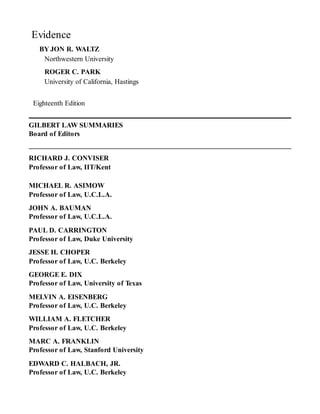
Evidence
BY JON R.WALTZ
Northwestern University
ROGER C. PARK
University of California, Hastings
Eighteenth Edition
GILBERT LAW SUMMARIES
Board of Editors
RICHARD J. CONVISER
Professor of Law, IIT/Kent
MICHAEL R. ASIMOW
Professor of Law, U.C.L.A.
JOHN A. BAUMAN
Professor of Law, U.C.L.A.
PAUL D. CARRINGTON
Professor of Law, Duke University
JESSE H. CHOPER
Professor of Law, U.C. Berkeley
GEORGE E. DIX
Professor of Law, University of Texas
MELVIN A. EISENBERG
Professor of Law, U.C. Berkeley
WILLIAM A. FLETCHER
Professor of Law, U.C. Berkeley
MARC A. FRANKLIN
Professor of Law, Stanford University
EDWARD C. HALBACH, JR.
Professor of Law, U.C. Berkeley
9.
GEOFFREY C. HAZARD,JR.
Professor of Law, U.C. Hastings
STANLEY M. JOHANSON
Professor of Law, University of Texas
THOMAS M. JORDE
Professor of Law, U.C. Berkeley
HERMA HILL KAY
Professor of Law, U.C. Berkeley
JAMES E. KRIER
Professor of Law, University of Michigan
JOHN H. MCCORD
Professor of Law, University of Illinois
PAUL MARCUS
Professor of Law, College of William and Mary
RICHARD L. MARCUS
Professor of Law, U.C. Hastings
ROBERT H. MNOOKIN
Professor of Law, Harvard University
THOMAS D. MORGAN
Professor of Law, George Washington University
JARRET C. OELTJEN
Professor of Law, Florida State University
JAMES C. OLDHAM
Professor of Law, Georgetown University
ROGER C. PARK
Professor of Law, U.C. Hastings
WILLIAM A. REPPY, JR.
Professor of Law, Duke University
THOMAS D. ROWE, JR.
Professor of Law, Duke University
DOUGLAS J. WHALEY
Professor of Law, Ohio State University
10.
CHARLES H. WHITEBREAD
Professorof Law, U.S.C.
KENNETH H. YORK
Professor of Law, Pepperdine University
EDITORIALOFFICES: 1 North Dearborn St., Suite 650, Chicago, IL60602
REGIONALOFFICES: Chicago, Dallas, Los Angeles, New York, Washington, D.C.
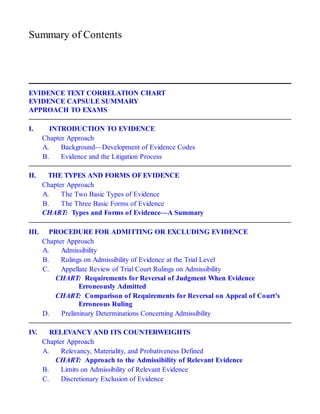
Summary of Contents
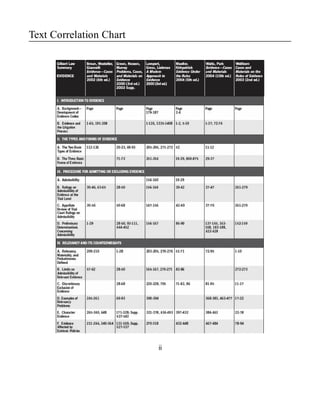
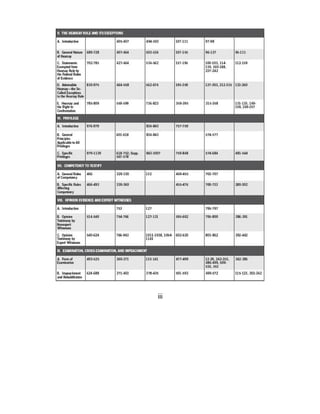
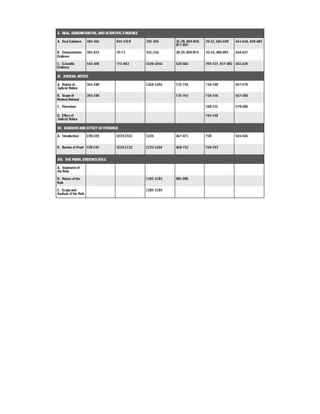
EVIDENCETEXT CORRELATION CHART
EVIDENCE CAPSULE SUMMARY
APPROACH TO EXAMS
I. INTRODUCTION TO EVIDENCE
Chapter Approach
A. Background—Development of Evidence Codes
B. Evidence and the Litigation Process
II. THE TYPES AND FORMS OF EVIDENCE
Chapter Approach
A. The Two Basic Types of Evidence
B. The Three Basic Forms of Evidence
CHART: Types and Forms of Evidence—A Summary
III. PROCEDURE FOR ADMITTING OR EXCLUDING EVIDENCE
Chapter Approach
A. Admissibility
B. Rulings on Admissibility of Evidence at the Trial Level
C. Appellate Review of Trial Court Rulings on Admissibility
CHART: Requirements for Reversal of Judgment When Evidence
Erroneously Admitted
CHART: Comparison of Requirements for Reversal on Appeal of Court’s
Erroneous Ruling
D. Preliminary Determinations Concerning Admissibility
IV. RELEVANCY AND ITS COUNTERWEIGHTS
Chapter Approach
A. Relevancy, Materiality, and Probativeness Defined
CHART: Approach to the Admissibility of Relevant Evidence
B. Limits on Admissibility of Relevant Evidence
C. Discretionary Exclusion of Evidence
13.
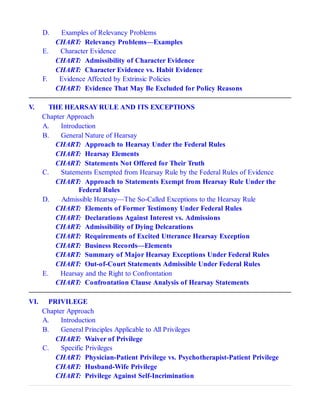
D. Examples ofRelevancy Problems
CHART: Relevancy Problems—Examples
E. Character Evidence
CHART: Admissibility of Character Evidence
CHART: Character Evidence vs. Habit Evidence
F. Evidence Affected by Extrinsic Policies
CHART: Evidence That May Be Excluded for Policy Reasons
V. THE HEARSAY RULE AND ITS EXCEPTIONS
Chapter Approach
A. Introduction
B. General Nature of Hearsay
CHART: Approach to Hearsay Under the Federal Rules
CHART: Hearsay Elements
CHART: Statements Not Offered for Their Truth
C. Statements Exempted from Hearsay Rule by the Federal Rules of Evidence
CHART: Approach to Statements Exempt from Hearsay Rule Under the
Federal Rules
D. Admissible Hearsay—The So-Called Exceptions to the Hearsay Rule
CHART: Elements of Former Testimony Under Federal Rules
CHART: Declarations Against Interest vs. Admissions
CHART: Admissibility of Dying Delcarations
CHART: Requirements of Excited Utterance Hearsay Exception
CHART: Business Records—Elements
CHART: Summary of Major Hearsay Exceptions Under Federal Rules
CHART: Out-of-Court Statements Admissible Under Federal Rules
E. Hearsay and the Right to Confrontation
CHART: Confrontation Clause Analysis of Hearsay Statements
VI. PRIVILEGE
Chapter Approach
A. Introduction
B. General Principles Applicable to All Privileges
CHART: Waiver of Privilege
C. Specific Privileges
CHART: Physician-Patient Privilege vs. Psychotherapist-Patient Privilege
CHART: Husband-Wife Privilege
CHART: Privilege Against Self-Incrimination
14.
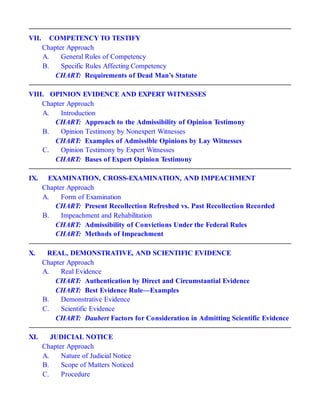
VII. COMPETENCY TOTESTIFY
Chapter Approach
A. General Rules of Competency
B. Specific Rules Affecting Competency
CHART: Requirements of Dead Man’s Statute
VIII. OPINION EVIDENCE AND EXPERT WITNESSES
Chapter Approach
A. Introduction
CHART: Approach to the Admissibility of Opinion Testimony
B. Opinion Testimony by Nonexpert Witnesses
CHART: Examples of Admissible Opinions by Lay Witnesses
C. Opinion Testimony by Expert Witnesses
CHART: Bases of Expert Opinion Testimony
IX. EXAMINATION, CROSS-EXAMINATION, AND IMPEACHMENT
Chapter Approach
A. Form of Examination
CHART: Present Recollection Refreshed vs. Past Recollection Recorded
B. Impeachment and Rehabilitation
CHART: Admissibility of Convictions Under the Federal Rules
CHART: Methods of Impeachment
X. REAL, DEMONSTRATIVE, AND SCIENTIFIC EVIDENCE
Chapter Approach
A. Real Evidence
CHART: Authentication by Direct and Circumstantial Evidence
CHART: Best Evidence Rule—Examples
B. Demonstrative Evidence
C. Scientific Evidence
CHART: Daubert Factors for Consideration in Admitting Scientific Evidence
XI. JUDICIAL NOTICE
Chapter Approach
A. Nature of Judicial Notice
B. Scope of Matters Noticed
C. Procedure
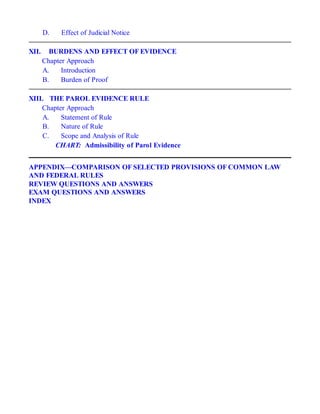
15.
D. Effect ofJudicial Notice
XII. BURDENS AND EFFECT OF EVIDENCE
Chapter Approach
A. Introduction
B. Burden of Proof
XIII. THE PAROL EVIDENCE RULE
Chapter Approach
A. Statement of Rule
B. Nature of Rule
C. Scope and Analysis of Rule
CHART: Admissibility of Parol Evidence
APPENDIX—COMPARISON OF SELECTED PROVISIONS OF COMMON LAW
AND FEDERAL RULES
REVIEW QUESTIONS AND ANSWERS
EXAM QUESTIONS AND ANSWERS
INDEX
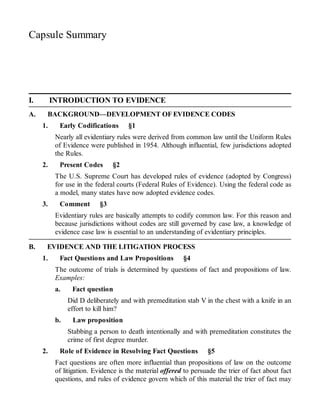
Capsule Summary
I. INTRODUCTIONTO EVIDENCE
A. BACKGROUND—DEVELOPMENT OF EVIDENCE CODES
1. Early Codifications §1
Nearly all evidentiary rules were derived from common law until the Uniform Rules
of Evidence were published in 1954. Although influential, few jurisdictions adopted
the Rules.
2. Present Codes §2
The U.S. Supreme Court has developed rules of evidence (adopted by Congress)
for use in the federal courts (Federal Rules of Evidence). Using the federal code as
a model, many states have now adopted evidence codes.
3. Comment §3
Evidentiary rules are basically attempts to codify common law. For this reason and
because jurisdictions without codes are still governed by case law, a knowledge of
evidence case law is essential to an understanding of evidentiary principles.
B. EVIDENCE AND THE LITIGATION PROCESS
1. Fact Questions and Law Propositions §4
The outcome of trials is determined by questions of fact and propositions of law.
Examples:
a. Fact question
Did D deliberately and with premeditation stab V in the chest with a knife in an
effort to kill him?
b. Law proposition
Stabbing a person to death intentionally and with premeditation constitutes the
crime of first degree murder.
2. Role of Evidence in Resolving Fact Questions §5
Fact questions are often more influential than propositions of law on the outcome
of litigation. Evidence is the material offered to persuade the trier of fact about fact
questions, and rules of evidence govern which of this material the trier of fact may
22.
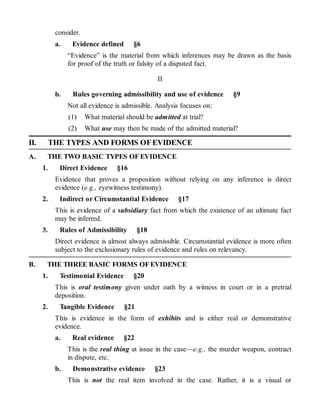
consider.
a. Evidence defined§6
“Evidence” is the material from which inferences may be drawn as the basis
for proof of the truth or falsity of a disputed fact.
II
b. Rules governing admissibility and use of evidence §9
Not all evidence is admissible. Analysis focuses on:
(1) What material should be admitted at trial?
(2) What use may then be made of the admitted material?
II. THE TYPES AND FORMS OFEVIDENCE
A. THE TWO BASIC TYPES OF EVIDENCE
1. Direct Evidence §16
Evidence that proves a proposition without relying on any inference is direct
evidence (e.g., eyewitness testimony).
2. Indirect or Circumstantial Evidence §17
This is evidence of a subsidiary fact from which the existence of an ultimate fact
may be inferred.
3. Rules of Admissibility §18
Direct evidence is almost always admissible. Circumstantial evidence is more often
subject to the exclusionary rules of evidence and rules on relevancy.
B. THE THREE BASIC FORMS OF EVIDENCE
1. Testimonial Evidence §20
This is oral testimony given under oath by a witness in court or in a pretrial
deposition.
2. Tangible Evidence §21
This is evidence in the form of exhibits and is either real or demonstrative
evidence.
a. Real evidence §22
This is the real thing at issue in the case—e.g., the murder weapon, contract
in dispute, etc.
b. Demonstrative evidence §23
This is not the real item involved in the case. Rather, it is a visual or
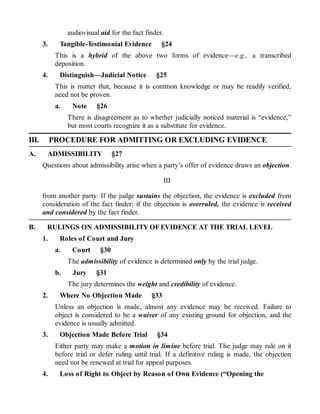
23.
audiovisual aid forthe fact finder.
3. Tangible-Testimonial Evidence §24
This is a hybrid of the above two forms of evidence—e.g., a transcribed
deposition.
4. Distinguish—Judicial Notice §25
This is matter that, because it is common knowledge or may be readily verified,
need not be proven.
a. Note §26
There is disagreement as to whether judicially noticed material is “evidence,”
but most courts recognize it as a substitute for evidence.
III. PROCEDURE FOR ADMITTING OR EXCLUDING EVIDENCE
A. ADMISSIBILITY §27
Questions about admissibility arise when a party’s offer of evidence draws an objection
III
from another party. If the judge sustains the objection, the evidence is excluded from
consideration of the fact finder; if the objection is overruled, the evidence is received
and considered by the fact finder.
B. RULINGS ON ADMISSIBILITY OF EVIDENCE AT THE TRIAL LEVEL
1. Roles of Court and Jury
a. Court §30
The admissibility of evidence is determined only by the trial judge.
b. Jury §31
The jury determines the weight and credibility of evidence.
2. Where No Objection Made §33
Unless an objection is made, almost any evidence may be received. Failure to
object is considered to be a waiver of any existing ground for objection, and the
evidence is usually admitted.
3. Objection Made Before Trial §34
Either party may make a motion in limine before trial. The judge may rule on it
before trial or defer ruling until trial. If a definitive ruling is made, the objection
need not be renewed at trial for appeal purposes.
4. Loss of Right to Object by Reason of Own Evidence (“Opening the
24.
Door”) §35
A partymay be held to have waived the right to object as a consequence of her
own tactics in presenting evidence.
a. Introducing part of transaction §36
When P introduces evidence as to part of a conversation or event, she waives
the right to object to D’s cross-examination or introduction of rebuttal evidence
as to any other part of the same transaction necessary to make it fully
understandable.
b. Introducing inadmissible evidence §38
P is precluded from objecting to the admissibility of evidence offered by D to
rebut evidence offered by P and wrongly admitted.
C. APPELLATE REVIEW OF TRIAL COURT RULINGS ON ADMISSIBILITY
1. Grounds for Reversal for Evidence Erroneously Admitted §40
For an appellate court to reverse the trial court’s judgment based on improperly
admitted evidence, there must have been:
a. A specific objection;
b. Timely made;
c. On a valid ground for objecting; and
d. Error in admitting the evidence that was prejudicial.
2. Grounds for Reversal for Evidence Erroneously Excluded §52
For a reversal of a trial court’s judgment based on erroneously excluded evidence,
it must be established that:
a. There is no valid ground for objection;
b. An offer of proof was made; and
c. The error in excluding the evidence was prejudicial.
IV
D. PRELIMINARY DETERMINATIONS CONCERNING ADMISSIBILITY
1. Burden of Proof of Preliminary Fact §63
The proponent of the evidence or the claimant of a privilege has the burden of
proof as to preliminary facts (e.g., whether the witness is qualified to testify;
whether the witness is privileged not to testify; or whether the confession was
voluntary).
2. Preliminary Facts About Which Judge Makes Ultimate Decision §64
25.
When the preliminaryfact concerns the legal admissibility of the offered evidence
(e.g., the qualifications of an “expert” witness), only the trial judge makes the
determination. The proponent must establish the preliminary fact by a
preponderance of the evidence.
a. Procedure §70
Questions of legal admissibility must be decided before the evidence is
admitted.
3. Role of Jury §72
The jury decides the weight or believability of the evidence. It is generally
erroneous to allow a jury to determine the admissibility of evidence.
a. Exceptions §73
There are a few situations (when those issues also go to the weight of the
evidence) when the jury is allowed to reconsider preliminary facts on which
legal admissibility depends (e.g., whether confession was voluntary, whether
dying declaration was made in fear of impending death, etc.).
b. Modern trend §77
The current trend is to require the trial judge to make all preliminary fact
determinations relating to the admissibility of evidence.
4. Procedure in Making Preliminary Fact Determinations
a. Presence of jury discretionary §78
The trial judge has discretion as to whether or not the determination will be
made in the jury’s presence. Usually, the jury is excused.
(1) Exceptions §79
The admissibility of confessions to crimes must be determined outside
the jury’s hearing. Similarly, when the accused in a criminal case elects to
testify regarding a preliminary fact, the jury must be excused if the
accused so requests; such testimony does not waive the accused’s
privilege against self-incrimination.
b. Evidence that can be considered §82
Generally, only admissible evidence may be considered in ruling on
preliminary fact questions in state courts, but the Federal Rules allow judges to
consider any nonprivileged, relevant evidence (including hearsay). This rule is
also the trend in state courts.
5. Preliminary Facts Which Jury Decides §84
When a preliminary fact goes to the relevancy, credibility, or weight of the
V
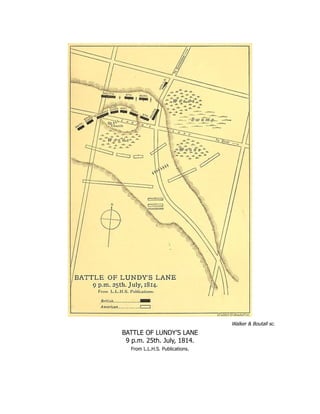
Walker & Boutallsc.
BATTLE OF LUNDY’S LANE
9 p.m. 25th. July, 1814.
From L.L.H.S. Publications.
28.
For over twohours this desperate struggle in the dark continued,
with varying fortunes. At one moment, the 103rd, a young regiment,
was forced back in disorder; at another the U.S. guns were
captured, and two of them spiked. Neither side could make
headway, in spite of frequent attacks and counter-attacks.
Drummond was severely wounded but kept the field: nearly one-
third of the British force were killed and wounded. The U.S. forces
were in equally bad case. Three of their generals were wounded,
while the rank and file had lost heavily. In the confusion and
darkness the whole force had become disorganized; Scott’s brigade,
that had commenced the fight, had dwindled to a few companies:
there were an enormous number of stragglers. Closing their ranks
for a last attack the wearied British troops, headed by the light
company of the 41st, regained possession of the hill and of the
guns, just as Brown had decided on withdrawing. Desultory firing
continued for a few minutes: it was not till near midnight that the
British troops, wearied by prolonged marching and fighting,
remained in undisturbed possession of the field. Two of the enemy’s
guns remained in their possession, while one British gun was carried
off.
Thus ended the battle of Lundy’s Lane, the most severely
contested action of the war. On the British side both generals were
severely wounded, one of them being taken prisoner. Out of a total
strength of somewhat less than 3000, the total British loss amounted
to 5 officers and 76 men killed, 30 officers and 532 men wounded,
14 officers and 219 men missing and prisoners. The disproportion of
wounded to killed, in this and other actions, was mainly due to the
frequent use of buckshot by the enemy. The heaviest losses fell on
the Royal Scots and 89th, who, out of a total of about 900 present,
suffered a loss of 426. The 19th Light Dragoons had two wounded
and one missing, together with three horses killed, ten wounded,
and one missing. The United States’ loss was never correctly stated.
Of the four generals engaged, three were wounded, while the
disorganization of their force of about 4500 men engaged, and the
loss of 16 officers killed and 56 wounded, makes it probable that
29.
their loss inkilled and wounded was not less than 1200. Several
hundred prisoners remained in the hands of the British. In his
dispatch, General Drummond writes, “In reviewing the action from
its commencement, the first object which presents itself as
deserving of notice, is the steadiness and good countenance of the
squadron of the 19th Light Dragoons, under Major Lisle, and the
very creditable and excellent defence made by the incorporated
militia-battalion &c.” This refers to the first period of the action when
the left of the line was forced back.
The following day, General Ripley, who had succeeded to the
command of the United States’ troops, advanced across the
Chippewa to see to his dead and wounded; finding the field in
occupation of the British, he immediately retired, broke down the
bridge, destroyed a quantity of camp equipage and stores, and
retired precipitately to Erie, which he reached on 27th. The light
troops, cavalry and Indians were sent in pursuit, and made a few
prisoners. On reaching Erie, Ripley at once set to work to enlarge
and strengthen the defences, in anticipation of attack.
Drummond, after repairing the bridge, and receiving some
reinforcements that brought his effective strength up to 3150 men,
followed in Ripley’s footsteps, and appeared before Erie, which he
invested on 3rd August. Ripley’s position was now very strong, with
new earthworks and batteries extending from the fort to the edge of
the lake. On the river side he was covered by the batteries at Black
Rock: while from the lake, his defences were flanked by the fire of
three gunboats. On the night of the 3rd, Drummond threw a small
party of about 450 men across the river to capture the batteries at
Black Rock. Failing to effect a surprise, they recrossed, with the loss
of 25 men k.w.m. Two days later, the spirits of the besieged were
raised by the arrival of General Gaines to supersede Ripley. On the
night of the 12th, a daring exploit was performed by Captain Dobbs
of the Royal Navy. With 75 seamen from Lake Ontario, he attacked
and captured, in open boats transported overland, two of the three
gunboats on Lake Erie: the third gunboat cut its cable, and escaped.
On the 13th, Drummond’s batteries opened fire on the enemy’s
30.
works, and continuedthe cannonade on the following day,
preparatory to a grand assault. At 2 A.M. on the 15th, the assault was
delivered in three columns. The right column, headed by Sergeant
Powell of the 19th Light Dragoons, “who was perfectly acquainted
with the ground, volunteered to act as guide, and preceded the
leading subdivision in the most intrepid style,” was to attack a work
called Snake Hill at the border of the lake. The picquet of cavalry
under Captain Eustace, 19th Light Dragoons was detailed to act with
the right column. The rest of the squadron was drawn up in the rear
of the most advanced battery, in readiness to receive prisoners, and
conduct them to the rear. The centre and left columns were to
assault the fort at different points. The scaling ladders with the right
attack were too short; after prolonged efforts, and suffering great
losses, the column was obliged to retire without gaining a footing.
The left column also was beaten back, losing its leader and many
men. The centre column, which was the weakest of the three, led by
Lt. Colonel Drummond, the general’s nephew, alone effected a
lodgment, and maintained its position till daylight, in spite of the
most desperate efforts of the garrison. Lt. Colonel Drummond fell;
but his men, reinforced from the left column, continued to resist all
attacks made to dislodge them, till a tremendous explosion of stored
ammunition took place, killing many, and forcing the remainder to
retire. Almost every officer with the centre and left columns was
killed or wounded. This disastrous repulse cost the British force a
loss of 905 of all ranks, killed, wounded and missing; great part of
the loss being ascribed to the explosion.
Drummond continued the blockade, and his troops now began to
suffer greatly from sickness. On the 2nd September, General Brown,
who had recovered from his wound received at Lundy’s Lane,
resumed command of the U.S. forces at Erie, in place of Gaines who
had been severely wounded. On the morning of the 7th, a United
States’ picquet, consisting of an officer and 21 men, was surprised
and cut off to a man, by a small party of infantry and a detachment
of the 19th Light Dragoons under Captain Eustace, the whole
commanded by Captain Powell, D.A.Q.M.G. The General Order of the
31.
same day says:“Sergeant Powell, 19th Light Dragoons, has been
named to the Lieutenant General as having again distinguished
himself on this occasion.” This brave soldier was subsequently taken
prisoner, and is believed to have died before he could be exchanged.
On the 17th September, favoured by a heavy fall of rain, Brown
made a sortie in three strong divisions. The battery guards were
surprised, and the whole line of entrenchments was for a time in the
assailants’ hands; till Drummond, bringing up troops from the camp,
drove out the enemy, and recovered possession of his batteries. The
sortie cost the British troops 609 killed, wounded and prisoners, in
addition to three of their few heavy guns destroyed, and other
damage. This, together with continuous bad weather and increasing
sickness among his troops, caused Drummond to give up the
blockade, on the 21st, and withdraw his Head Quarters across the
Chippewa on the 24th, which was done without molestation. A
strong body of troops was maintained in advance of the Chippewa,
occupying the line of the Black Creek. In his dispatch of 2nd October
to Sir George Prevost, Drummond reports the capture by the enemy
of a patrol of a corporal and six men of the 19th Light Dragoons.
“The Dragoons must have been most culpably careless and
confident, or the circumstance could not have happened.” About the
8th October, General Izard, with a large body of U.S. troops, arrived
by land at Lewiston, from Sackett’s Harbour. Instead of crossing the
river to Drummond’s rear, as he should have done, he continued
along the river to Black Rock, and assumed the command at Erie.
Izard’s force now amounted to over 8000 men, from whom some
decisive action was to be expected. Izard advanced to Black Creek,
and offered battle, which Drummond was not strong enough to
accept. Beyond some skirmishing, Izard made no further use of his
superiority of force, awaiting co-operation from the lake. But the
U.S. squadron on Ontario was held fast in Sackett’s Harbour by Sir
James Yeo. Izard remained inactive till 20th October, when he fell
back, and carried his force across the river to Black Rock and
Buffalo. On the 5th November, he blew up Fort Erie and evacuated
the place. Drummond at once disposed the men in winter quarters.
Major Lisle’s squadron was ordered to hold itself in readiness to
32.
proceed to LowerCanada, and one troop under Captain Eustace was
sent to Ancaster.
Several times during the summer marauding parties from the
United States, taking advantage of the undefended state of the
Detroit frontier, had crossed the border, plundering and burning, and
carrying off peaceable inhabitants. Drummond was unable to spare
any force to meet this evil, and the province suffered cruelly.
Towards the end of October, a mounted force of 1500 undisciplined
men, under General McArthur, crossed the border by Lake St Clair,
and marched to Moravian town on the Thames river, continuing
eastwards in the direction of Burlington Heights, where only a few
militia and some 300 of the 103rd, under Lt. Colonel Smelt, were
stationed. Smelt at once moved forward to Grand River with about
170 men of the 103rd, 27 of the 19th Light Dragoons, 150 militia
and some Indians. After making a demonstration of crossing,
McArthur turned back and regained Detroit, on the 17th November,
without having effected anything beyond the destruction of a great
quantity of property. “Both in their advance and in their retreat their
progress was marked by plunder and devastation.” Captain Eustace
and his party marched to Dover.
A return, dated 8th November, shows that out of 7552 men on the
frontier between Toronto and Long Point, 1327 were in hospital at
that date. The total strength of the 19th Light Dragoons’ squadron
was 123, of whom 34 were sick.
The operations for the year were at an end on this part of the
frontier. Fort Niagara still remained in British hands, and the
projected attack on Kingston had not been made. The only results of
the strenuous efforts made by the United States’ government, at this
point, had been to show the improvement of their troops, both in
generalship and fighting power, since the beginning of the war.
Beyond this, there was nothing to show for the offensive operations
undertaken by the United States during the year.
The abdication of Napoleon, and the peace concluded in Paris at
the end of May, set free for service in America the troops serving
33.
under Wellington inthe south of France. A number of regiments
were embarked at once for Quebec, so that, by the end of August,
Sir George Prevost had upwards of 16,000 British troops in Lower
Canada. With them came instructions to attack Plattsburgh, which,
to observers at a distance, appeared to be the point from which the
most formidable attack might be directed against Montreal. The
strategy was at fault, as the experience of the preceding year had
shown that, while Kingston continued to be held in force, no attack
from Plattsburgh was likely to be successful. On the other hand, a
British success at Plattsburgh could lead to no decisive result. The
true point of attack was Sackett’s Harbour, on Lake Ontario. The
occupation and retention of this point would have destroyed the U.S.
naval power on the lake; Montreal and Kingston would have been
secured from attack; and Sir Gordon Drummond would have been
master of the situation on the Niagara frontier. The U.S. government
gauged the situation more correctly, and denuded Plattsburgh of
troops to reinforce Sackett’s Harbour. The event showed that
Plattsburgh was only of secondary importance.
For the expedition against Plattsburgh Sir George Prevost formed
three brigades on the frontier extending from the Richelieu river to
the St Lawrence commanded by Major Generals Power, Robinson
and Brisbane. The whole division was under command of Major
General de Rottenburg, and amounted to 11,000 men. With it was
the rest of the 19th Light Dragoons not engaged on the Niagara
frontier.
On the 3rd of September, Sir George Prevost, advancing by
Chateaugay from the St Lawrence, crossed the frontier to Chazy,
and, on the 5th, reached, without opposition, a point eight miles
from Plattsburgh. The U.S. troops about Plattsburgh, at the time,
amounted to about 1500 men, of inferior quality, under General
Macomb. This force was augmented by about 3000 militia from the
surrounding neighbourhood during the operations, but neither in
quality or numbers was it fit to stand before the troops under
Prevost. On the 6th, the army advanced on Plattsburgh, driving in
the U.S. pickets and outposts. So feeble was the resistance made
34.
that General Macombmentions in his dispatch that the British troops
pressed on in column, not even deigning to fire, except by their
flankers and advanced patrols, on the militia that they brushed out
of their way. In the advance, the 19th Light Dragoons had one man
and two horses wounded, two men and six horses missing.
Plattsburgh stands on the Saranac creek which runs at right angles
into Lake Champlain. The high ground on the south side of the
Saranac was occupied by Macomb with some hastily constructed
redoubts. The houses on the north of the Saranac were occupied by
British troops, on the 6th. On the lake lay the U.S. squadron,
consisting of four vessels and ten gunboats. The British squadron,
consisting of four vessels and twelve gunboats, was still at the north
end of Lake Champlain, awaiting the completion of the flag-ship
which had only been launched ten days previously, and whose crew
had hardly joined her from Quebec. Sir George Prevost had only to
advance on the 7th to make himself master of the feeble defences
opposed to him, when he suddenly conceived the idea that he must
await the co-operation of his lake squadron. For four days Prevost
lay inactive, while he urged Captain Downie with his ill-prepared
ships to join him, and engage the enemy’s squadron: the time was
utilised by Macomb in strengthening his defences and collecting
reinforcements. On the 11th, the British squadron appeared in sight,
and engaged the U.S. ships, while Prevost put his troops tardily in
motion. They forded the Saranac, and ascended the opposing
heights, when, with victory in their grasp, they suddenly received the
order to withdraw to their former positions. The British lake
squadron, after a most deadly contest of over two hours, had been
completely defeated, and Sir George Prevost at once threw up the
sponge. The same night, leaving his sick and wounded, together
with a quantity of stores, he commenced a retreat, which much
resembled a flight, to the Canadian frontier. In the many wars in
which the British army has fought, it would be hard to find a parallel
instance in which British troops have been so mishandled. The co-
operation of the fleet was unnecessary, as the enemy’s squadron
could not have maintained its position with the whole of Plattsburgh
in British hands. Nine thousand of Wellington’s veterans, who had
35.
defeated Napoleon’s choicesttroops again and again, were made to
retreat from an inferior force that could not have withstood them for
an hour, with a loss of less than 40 killed since they had crossed the
frontier. No wonder that the enemy first took the retreat for a ruse
de guerre, and that a British General broke his sword, vowing he
would never serve again. In the whole of the operations against
Plattsburgh, the land forces under Prevost’s immediate command
suffered a total loss of 37 killed, 150 wounded and 55 missing. In
their anger at the fiasco, an immense number of men deserted
during the retreat, causing a greater loss than a successful
prosecution of the enterprise could possibly have entailed. The 19th
Light Dragoons while covering the retirement, lost five men and
horses taken prisoners.
Only brief mention need be made of land operations elsewhere, as
they do not come within the scope of operations in which the 19th
Light Dragoons were concerned. In the middle of August, a
combined military and naval expedition fitted out from Bermuda,
under Major General Ross and Vice Admiral Cockburn, landed at
Benedict in the Potomac river, 50 miles from Washington, and
marched on that town. At Bladensberg, on the 24th, Ross
encountered a U.S. army of about 8000 men under General Winder,
and gained a complete and easy victory, taking 10 guns.[65]
Washington was occupied the same evening. On the following
evening, after burning the most important public buildings, in
retaliation for the outrages committed on the Canadian non-
combatants, the force retired, and re-embarked on the 29th, without
molestation.
At daylight on the 12th September, the same force landed 13
miles from Baltimore, and advanced on that place. On first coming in
touch with the enemy, Ross was killed by a chance shot. Colonel
Brook assumed the command, and at about five miles from
Baltimore a United States’ force of about 7000 men was encountered
and overthrown in less than half an hour. Two field pieces and many
prisoners were captured. Preparations were then made for a
36.
combined attack onthe city, when it was discovered that the
harbour was so effectually closed by sunken vessels, that naval co-
operation was impossible. It being considered that, under these
circumstances, the loss that must be incurred in taking the place by
storm would be out of proportion to any benefit to be gained, the
troops were withdrawn, and re-embarked without the slightest
molestation, on the 15th. The troopships, after hovering on the
coast, rather aimlessly for another month, then set sail for Jamaica,
where an expedition was preparing against New Orleans.
The mistake that had been made by the United States government
in the early part of the war, in under-rating the difficulty of
conquering Canada, and in believing that the inhabitants would join
the invaders, was now to be repeated by the British government.
British Ministers had been brought to believe that the inhabitants of
Louisiana were disaffected to the U.S. government, and that the
State could easily be taken possession of. With this object, an
expedition against New Orleans had been planned in England; and,
it was in order to save the troops for this purpose, that the attack on
Baltimore had been abandoned. New Orleans, though a great
commercial centre, was devoid of any military importance, and the
expedition was destined to furnish another example of the faulty
strategy that was exhibited on both sides during the war.
On the 8th December, the expedition under Major General Sir
Edward Pakenham, appeared off the coast, and, on the night of the
12th, captured the enemy’s squadron of gunboats. On the 16th, the
landing of the troops commenced, at the mouth of the Pearl river.
Considerable delay ensued, owing to the swampy nature of the
ground, and the advance did not approach the city till the 23rd.
General Jackson, in command at New Orleans, occupied a long line
of entrenchments at right angles to the river. He was also assisted
by armed vessels on the Mississippi which inflicted severe losses on
the British troops, and greatly delayed their advance. On the
morning of the 8th January, the attack was made, and repulsed with
heavy slaughter. Pakenham fell at the head of his men; Major
General Gibbs died of his wounds the following day, and Major
37.
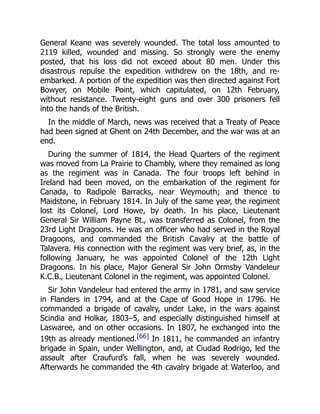
General Keane wasseverely wounded. The total loss amounted to
2119 killed, wounded and missing. So strongly were the enemy
posted, that his loss did not exceed about 80 men. Under this
disastrous repulse the expedition withdrew on the 18th, and re-
embarked. A portion of the expedition was then directed against Fort
Bowyer, on Mobile Point, which capitulated, on 12th February,
without resistance. Twenty-eight guns and over 300 prisoners fell
into the hands of the British.
In the middle of March, news was received that a Treaty of Peace
had been signed at Ghent on 24th December, and the war was at an
end.
During the summer of 1814, the Head Quarters of the regiment
was moved from La Prairie to Chambly, where they remained as long
as the regiment was in Canada. The four troops left behind in
Ireland had been moved, on the embarkation of the regiment for
Canada, to Radipole Barracks, near Weymouth; and thence to
Maidstone, in February 1814. In July of the same year, the regiment
lost its Colonel, Lord Howe, by death. In his place, Lieutenant
General Sir William Payne Bt., was transferred as Colonel, from the
23rd Light Dragoons. He was an officer who had served in the Royal
Dragoons, and commanded the British Cavalry at the battle of
Talavera. His connection with the regiment was very brief, as, in the
following January, he was appointed Colonel of the 12th Light
Dragoons. In his place, Major General Sir John Ormsby Vandeleur
K.C.B., Lieutenant Colonel in the regiment, was appointed Colonel.
Sir John Vandeleur had entered the army in 1781, and saw service
in Flanders in 1794, and at the Cape of Good Hope in 1796. He
commanded a brigade of cavalry, under Lake, in the wars against
Scindia and Holkar, 1803–5, and especially distinguished himself at
Laswaree, and on other occasions. In 1807, he exchanged into the
19th as already mentioned.[66] In 1811, he commanded an infantry
brigade in Spain, under Wellington, and, at Ciudad Rodrigo, led the
assault after Craufurd’s fall, when he was severely wounded.
Afterwards he commanded the 4th cavalry brigade at Waterloo, and
38.
succeeded to thecommand of the whole of the cavalry, on Lord
Uxbridge being wounded.
During 1814, gold lace was substituted for silver in the uniform of
the regiment.
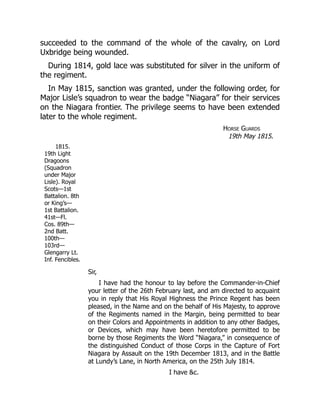
In May 1815, sanction was granted, under the following order, for
Major Lisle’s squadron to wear the badge “Niagara” for their services
on the Niagara frontier. The privilege seems to have been extended
later to the whole regiment.
Horse Guards
19th May 1815.
1815.
19th Light
Dragoons
(Squadron
under Major
Lisle). Royal
Scots—1st
Battalion. 8th
or King’s—
1st Battalion.
41st—Fl.
Cos. 89th—
2nd Batt.
100th—
103rd—
Glengarry Lt.
Inf. Fencibles.
Sir,
I have had the honour to lay before the Commander-in-Chief
your letter of the 26th February last, and am directed to acquaint
you in reply that His Royal Highness the Prince Regent has been
pleased, in the Name and on the behalf of His Majesty, to approve
of the Regiments named in the Margin, being permitted to bear
on their Colors and Appointments in addition to any other Badges,
or Devices, which may have been heretofore permitted to be
borne by those Regiments the Word “Niagara,” in consequence of
the distinguished Conduct of those Corps in the Capture of Fort
Niagara by Assault on the 19th December 1813, and in the Battle
at Lundy’s Lane, in North America, on the 25th July 1814.
I have &c.
39.
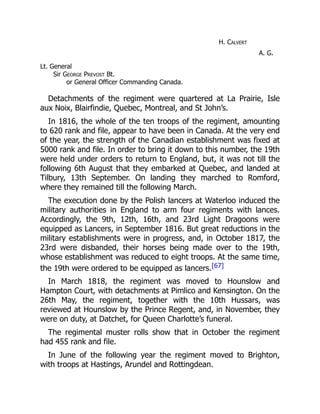
H. Calvert
A. G.
Lt.General
Sir George Prevost Bt.
or General Officer Commanding Canada.
Detachments of the regiment were quartered at La Prairie, Isle
aux Noix, Blairfindie, Quebec, Montreal, and St John’s.
In 1816, the whole of the ten troops of the regiment, amounting
to 620 rank and file, appear to have been in Canada. At the very end
of the year, the strength of the Canadian establishment was fixed at
5000 rank and file. In order to bring it down to this number, the 19th
were held under orders to return to England, but, it was not till the
following 6th August that they embarked at Quebec, and landed at
Tilbury, 13th September. On landing they marched to Romford,
where they remained till the following March.
The execution done by the Polish lancers at Waterloo induced the
military authorities in England to arm four regiments with lances.
Accordingly, the 9th, 12th, 16th, and 23rd Light Dragoons were
equipped as Lancers, in September 1816. But great reductions in the
military establishments were in progress, and, in October 1817, the
23rd were disbanded, their horses being made over to the 19th,
whose establishment was reduced to eight troops. At the same time,
the 19th were ordered to be equipped as lancers.[67]
In March 1818, the regiment was moved to Hounslow and
Hampton Court, with detachments at Pimlico and Kensington. On the
26th May, the regiment, together with the 10th Hussars, was
reviewed at Hounslow by the Prince Regent, and, in November, they
were on duty, at Datchet, for Queen Charlotte’s funeral.
The regimental muster rolls show that in October the regiment
had 455 rank and file.
In June of the following year the regiment moved to Brighton,
with troops at Hastings, Arundel and Rottingdean.
40.
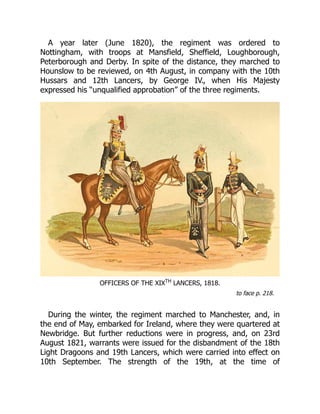
A year later(June 1820), the regiment was ordered to
Nottingham, with troops at Mansfield, Sheffield, Loughborough,
Peterborough and Derby. In spite of the distance, they marched to
Hounslow to be reviewed, on 4th August, in company with the 10th
Hussars and 12th Lancers, by George IV., when His Majesty
expressed his “unqualified approbation” of the three regiments.
OFFICERS OF THE XIXTH
LANCERS, 1818.
to face p. 218.
During the winter, the regiment marched to Manchester, and, in
the end of May, embarked for Ireland, where they were quartered at
Newbridge. But further reductions were in progress, and, on 23rd
August 1821, warrants were issued for the disbandment of the 18th
Light Dragoons and 19th Lancers, which were carried into effect on
10th September. The strength of the 19th, at the time of
41.
disbandment, was 103officers and non-commissioned officers, 336
rank and file, 273 horses.
43.
PART IV
THE NINETEENTH“PRINCESS OF WALES’
OWN” HUSSARS
( 1 8 5 8 – 1 8 9 9 )
CHAPTER I
RAISING OF THE REGIMENT
(1858–1882)
The East India Company raises European Cavalry regiments—Their formation—The
Bengal 1st European Light Cavalry—Services transferred to the Crown—The
“White Mutiny”—Made 19th Light Dragoons, afterwards Hussars—General
Pattle—Regiment at Meerut—General Hall—Regiment ordered to England—
Badges of old 19th Light Dragoons granted—Regiment ordered to Ireland—
Guidons of old 19th Light Dragoons presented to the regiment—Regiment
returns to England—Ordered on active service.
In May 1857, the mutiny of the Bengal Native Army occurred, which
so profoundly changed the nature of British administration in India.
Through carelessness and false economy, the East India Company
had allowed the number of European troops in India to sink to a
dangerously low level, in proportion to the number of native troops.
As against some 230,000 native soldiers, the European troops
numbered less than 40,000 men, of whom about 23,500 were royal
troops. The Company’s European troops in India consisted, at that
44.
time, of ninebattalions of Infantry, seventeen troops of Horse
Artillery, and forty-eight companies of Foot Artillery. Apart from other
measures for restoring tranquillity, it was determined to raise three
additional battalions of Infantry, and to replace the mutinous Bengal
Native Cavalry by Europeans. Of the ten regiments of regular Bengal
Native Cavalry, seven had mutinied, and two had been disarmed.
In November 1857, intimation was sent to the Governor General
that it had been decided to form four regiments of Cavalry, for the
Company’s service, of men recruited in England, of ages between 20
and 30 years, and of a standard height not less than 5 ft., and not
exceeding 5 ft. 4 in. Each regiment was to consist of ten troops, with
70 privates per troop, together with the usual number of officers,
non-commissioned officers and staff. All accoutrements, arms, and
equipments were to be of a lighter description than those in
common use by British Cavalry: and the men were to be collected at
a depot in England (Warley), to be trained for three months, before
being embarked for India. A lower standard of height than that of
the Royal Army was adopted, with the intention that the recruiting
for the Royal Army should not be interfered with, and it was thought
that, by tapping a new stratum of recruits, men would be easily
obtained. These anticipations were justified. The whole nation had
been roused by the sufferings of our countrywomen in India, and
recruits flocked in. Three weeks later, the Court of Directors were
obliged to write to the Governor General that, in consequence of the
very rapid recruiting, accommodation could not be provided for the
men, in England, and it was necessary to embark a large body of
them, for Calcutta, at once.
With regard to these undersized men, it may be said here, that a
large number of them made excellent soldiers in time; but there was
a considerable proportion of them, big men on short legs, over 25
years of age at the time of enlistment, who were unfit for cavalry
purposes.
After being kept some time near Calcutta, the men were gradually
forwarded to Allahabad, where they were collected in June 1858, an
45.
almost undisciplined mob,without permanent officers, without
horses, and without equipments. On the 17th June, we find Major
General Sir William Mansfield (afterwards Lord Sandhurst) writing to
Major General Sir Hope Grant, then in the field against the rebels:
“We are about to organize the four regiments of Bengal Dragoons,
and to divide the recruits into four bodies without delay. How would
it suit you to have one of these young corps attached to the ‘Bays’
(2nd Dragoon Guards), and another to the 7th (Hussars)? Not a man
has ever been on a horse, and the men are at present armed with
muskets.”
By the end of June, the apportioning of the men into regiments
was complete, and, on the 3rd July, the regiment with which our
interest lies, became established as the Bengal 1st European Light
Cavalry, to be quartered at Allahabad. The other three regiments
marched for various cantonments in North Western India. A fifth
regiment was formed at Peshawur, in November, of volunteers from
Royal infantry regiments, who had been formed into a cavalry corps
for temporary service during the Mutiny.
To officer each of these regiments, the officers of two of the ten
mutinied or disbanded Bengal Native Cavalry regiments were
utilized: but, instead of placing them upon a single list, they were
kept on separate lists for promotion, which were styled Right and
Left Wings, corresponding to their late regiments. All officers newly
appointed, who had belonged to neither of the old Native regiments,
were to be borne on the strength of the Right Wing, so that, in
process of time, the Left Wing was destined to disappear; but the
process would have been one of thirty years or more, according to
the rate of promotion then existing in the Company’s service.
The Bengal 1st European Light Cavalry was officered by the
surviving officers of the 1st and 3rd Bengal Native Cavalry, both of
which regiments had mutinied. For remounts, the men were given a
number of horses hastily purchased at the Cape of Good Hope and
in Australia, most of them wild unbroken bush horses that had never
46.
been handled. Anofficer who served with the regiment at this time,
writing of it forty years afterwards, says:—
“No regiments were ever raised under such absurd conditions, and, if the
object had been to prove them a failure, no course better calculated to achieve
that end could have been pursued. The only old soldiers sent to assist us were two
or three infantry men from a Fusilier regiment, none higher in rank than Corporal.
When the authorities were addressed on this subject, one or two cavalry soldiers,
I think from the 7th Hussars, were sent; the highest in rank being a Lance
Corporal who was promptly made a Troop Sergeant Major, and I don’t think turned
out a success. The horses, like the men, were all untrained, and some of the
horses from the Cape were perfect devils, very difficult to clean, and for some time
impossible to ride or to shoe. I have a vivid recollection of one roan, who stood in
his stall for days covered with mud, because no one could go near him. Out of the
crowd of raw recruits, we had to find all our Non-Commissioned officers from
Troop Sergeant Major downwards, so it may be imagined what little respect was
paid to the highest grades.”
On the 1st November 1858, the Crown assumed the government
of India, and the East India Company thenceforth ceased to exist.
No attention was paid to the view that might be taken of the
change, in the ranks of the Company’s army. The British soldier,
though he yields to discipline, never forgets that he is a soldier by
his own free will; he objects to be treated like a conscript. The late
Company’s European soldiers quickly came to believe that their
rights had been infringed. Had they been asked to volunteer for
service under the Crown, they would have done so almost to a man;
but they objected to be handed over “like bullocks,” as they
expressed it. The Indian government consulted its legal advisers,
who treated the objection as a purely technical one, prompted by a
wish for the offer of a bounty. So long as the men were retained for
the local service for which they had enlisted, it was considered that
they had no grievance. It was decided that the men had no case,
and a General Order to this effect was published in April 1859. The
agitation quickly assumed a serious aspect, and, during May, there
was a time when, in a few cantonments, a collision between the
Royal and the late Company’s European troops appeared possible.
The movement was not confined to the newly raised regiments, but
was equally shared in by the old soldiers of the late Company, who
47.
had shown theirfine qualities on many a hard fought field. The
behaviour of the 1st Bengal European Light Cavalry was similar to
that of the local European forces in most other places. All guards
and barrack duties were performed without demur, but the men
refused to turn out for parade. On one occasion the canteen was
broken into, and an attempt was made to release prisoners.
Mutinous language was used to officers in a few instances, and
shots fired in defiance, but not with evil intent. Under the
circumstances already related, it is surprising that nothing worse
occurred. In one instance alone, in one of the newly raised infantry
regiments, was there a dangerous attempt to act as an organized
armed body hostile to the State. This was speedily repressed, and
the ringleader shot.
The Calcutta government quickly recognized its mistake. In the
end of June, orders were published allowing the men the option of
discharge, but no bounty was offered to those who elected to
remain, while those who took their discharge were not allowed the
option of re-enlistment, as long as they remained in the country.
Under the feeling of exasperation that had grown up, upwards of
10,000 men elected to take their discharge, of whom 2800 re-
enlisted on reaching England.
The trouble with the Indian local European forces, in 1859, has
been frequently cited as a cogent reason against the maintenance of
a body of British troops in India, for local service only; a measure
that would overcome many difficulties now felt in army
administration. Those who study the events of 1859 must recognize
that the trouble arose, not from the conditions of service, but from
the mistakes of those in authority at Calcutta. The “White Mutiny”
was no mere outbreak against discipline: it was the vindication of
the men’s claim to be consulted in the disposal of their services.
While these events were in progress, orders were received for the
regiment to march to Cawnpore, which it did in June.
Early in 1861, it was determined to cease the maintenance of any
European force for local service in India, and, on 6th May, the
48.
officers, non-commissioned officersand men were called on to
volunteer for General Service. They responded, almost to a man,
and the regiment received the designation of the 19th Light
Dragoons. In the same way, the Bengal 2nd and 3rd European Light
Cavalry became the 20th and 21st Light Dragoons; the 4th and 5th
being disbanded. At the same time, the establishment was
assimilated to that of other British cavalry regiments in India, viz.
nine troops (one at the depot in England) with 585 corporals and
privates: 693 of all ranks. Three months later, under Horse Guards
order of 17th August 1861, the designation of the regiment was
changed to the 19th Hussars. The standard for recruits was
assimilated to that of other Hussar regiments.
At the beginning of February 1862, the regiment was moved to
Lucknow.
On the 30th July, in the same year, the complete roll of officers
was gazetted.
Lieutenant Colonel Charles Vanbrugh Jenkins.
Major
John Hatfield Brooks.
Roland Richardson.
Captain
Henry Cadogan Craigie.
Sir John Hill, Bt. Bt. Major.
Henry Edward Ellice.
Robert Baring.
Melville Clarke.
Hugh Henry Gough, V.C., Brevet Major.
Frederick Peter Luard.
Richard Talbot Plantagenet Stapleton
Charles Manners Sutton Fairbrother.
Lieutenant Charles Hay Fairlie.
Abel Henry Chapman.
Cecil Clarke Jervoise.
Arthur George Webster.
49.
Robert Morris.
Edward StirlingRivett-Carnac.
John Biddulph.
George Cortlandt Buller Taylor.
Charles John Prinsep.
Albert Hearsey.
Cornet
Elliot Alexander Money.
Joseph Boulderson.
Frederick Henry Huth.
Charles Robert St. Quintin.
Francis Dallas Harding.
Seymour Duncan Barrow.
Riding Master George Couch.
Adjutant Abel Henry Chapman.
Paymaster Henry Octavius Currie.
The greater number of them had belonged to the Company’s 1st
and 3rd Bengal Native Cavalry.
In September, General William Pattle C.B. was gazetted to be
Colonel of the regiment. He was an old Company’s officer who had
entered the service in 1800. He served under Lord Lake in the
Mahratta campaigns of 1803 and 1804, and was present at the
battles of Alyghur, Delhi, Laswaree, the siege of Bhurtpore &c. He
served through the Mahratta war of 1817–18, and commanded the
cavalry under Sir Charles Napier, during the conquest of Scinde, and
at the battles of Meeanee and Hyderabad.
Under orders from the War office, dated 6th January 1863, the
establishment was reduced by one troop, leaving seven service
troops and one at Maidstone.
In the autumn, orders were received for the regiment to march to
Meerut, where it arrived 28th November. Here the regiment
50.
remained till theend of 1867. The only events to be noticed during
these four years are a reduction of establishment by 56 privates in
1866: and the presence of the regiment at the great Durbar held by
the Viceroy, Sir John Lawrence, at Agra, in November 1866, when
the 19th were brigaded with the 2nd Dragoon Guards.
In the beginning of 1865, the regiment lost its Colonel by death.
In his place Lieutenant General John Hall was appointed Colonel.
On the 10th December 1867, the Head Quarters of the regiment,
with four troops, marched for Benares, being followed, a month
later, by the remaining three troops, who marched to Cawnpore.
In the ordinary course of relief, the regiment was intended to
leave India in 1872. In a sudden fit of economy, the Indian
Government decided to get rid of two cavalry regiments, so that,
without any previous warning, the regiment received telegraphic
orders, on 18th January 1870, to proceed to England immediately.
Similar orders were sent to the 7th Hussars, then serving in India.
Volunteering was at once opened to men electing to serve in other
regiments remaining in India, and, on 24th January, the regiment
was re-united at Allahabad, whence it proceeded to Bombay, where
it embarked on board the Jumna on the 14th February. So
unexpected had been the move, that a draft for the regiment, from
England, joined it four days before sailing. The strength of the
regiment leaving India, was as follows: 18 officers, 51 sergeants and
corporals, 7 trumpeters, 257 privates, 28 women and 55 children.
On the 22nd March, the regiment landed at Dover, and proceeded
to Canterbury, whence all the Cavalry Depot troops, excepting those
of the 20th and 21st Hussars, had been moved to Maidstone. But
the British Government were as unwilling to have the home military
establishment increased by the two regiments thus sent from India,
as the Indian Government had been to retain them, and the idea of
disbanding two regiments was entertained. The Manchester school
was predominant; shortsighted financial considerations alone had
any weight. The changes rung in the establishment of the regiment
for the next four months show the hesitating counsels that prevailed.
51.
On the 1stApril, one troop was absorbed. A month later, the
establishment was nominally fixed at 25 officers, 457 Sergeants and
privates, and 300 horses, but recruiting to make the regiment up to
that strength was forbidden. At the end of June the establishment of
horses was reduced to 200. A week later, the war between France
and Germany broke out, while the question of the strength of
military establishments was still being bandied about between the
Treasury and the War Office. On the 1st August, orders were
received to complete the strength of the regiment up to 540 of all
ranks, which was done by the end of September. The number of
horses was also raised to 350.
Consequent on the increase of establishment, an eighth troop was
formed in February 1871.
In May, the Head Quarters of the regiment and five troops
marched to Brighton; the other three troops going to the camp at
Shorncliffe.
On the 17th June, an inspection of the regiment was held at
Brighton by its Colonel, General John Hall.
In August 1872, the regiment marched to Aldershot, and, a few
days after arrival, marched to take part in the Wiltshire manœuvres
at Pewsey, where it was brigaded under the command of Major
General Shute C.B.; returning to Aldershot in September.
During 1872, the regiment lost its Colonel, Lieutenant General
Hall, who was succeeded by General John Yorke C.B. He was an old
officer of the Royal Dragoons, which regiment he commanded in the
Crimean War, and was severely wounded at Balaclava.
In June 1873, the regiment marched to Windsor, to take part in
the review held in honour of H.M. the Shah of Persia, on the 24th;
returning to Aldershot the following day.
In August, manœuvres were held at Dartmoor, in which the
regiment took part; proceeding by train as far as Exeter, and
returning to Aldershot by route march. The fine appearance of the
52.
regiment, and itsproficiency in outpost and reconnoissance duties
attracted more than usual attention on this occasion.
Early in 1874, the regiment was granted the privilege of wearing
the badges so gloriously earned by the old 19th Light Dragoons.
Horse Guards 24th Feb. 1874.
Sir,
I have the honor, by desire of His Royal Highness the Field Marshall
Commanding in Chief to acquaint you that Her Majesty has been
graciously pleased to approve of the regiment under your command
being permitted to wear the badges granted to the old 19th Light
Dragoons for achievements during the present Century, viz.:
The Elephant
“Assaye” “Niagara”
J. W. Armstrong,
Depy. Adj. General
To the
Officer Commanding
19th Hussars.
It will be observed that the “Seringapatam” badge, granted to the
old 19th Light Dragoons for four campaigns in the last century, was
withheld. The 23rd of September is now observed as an annual
holiday in the regiment, in commemoration of Assaye.
On the 19th May, the regiment took part in the review held at
Aldershot, in honour of H.I.M. the Emperor of Russia.
At the end of June, the regiment marched to new quarters at
Hounslow, with a troop at Hampton Court, and another at
Kensington.
At the end of July 1875, the regiment marched to Leeds, with
troops at Preston and Bury.
In June 1876, the regiment proceeded to Ireland. After going
through the drill season at the Curragh, it went into quarters at
Longford, Gort, Castlebar, Dunmore, and Athlone. In the following
spring it returned to the Curragh, and, in October, marched to
53.
Dublin, where itwas quartered in the Royal Barracks and Arbour Hill.
In the following August, it again marched to the Curragh, whence,
after a month, it marched for Ballincollig, with out-quarters at Cork,
Cahir, Limerick, Bandon, Fermoy, and afterwards Waterford. In these
quarters the regiment remained till May 1880, when it was again
ordered to the Curragh. In August, the regiment again marched to
Dublin, leaving one squadron at the Curragh. Three months later, a
wing was ordered to Ballinrobe and Lough Mask, by rail, in aid of the
civil power, returning to Dublin after a fortnight’s work, in, what was
then called, the “Boycott” campaign.
In May 1881, the regiment moved to Dundalk, with two troops at
Belfast and one at Belturbet. The time was one of much excitement
in Ireland, when the Land League conspiracy was in full force, and
the regiment was employed, during the winter, in much harassing
work in support of the civil power.
While at Belfast the regiment became possessed of some greatly
prized relics of the old 19th Light Dragoons, through the generosity
of a lady whose husband had served in the old regiment. As is well
known, all cavalry regiments except Hussars and Lancers, at the
beginning of the century, had a standard or guidon for each
squadron. After their return from India, and shortly after the
conferring of the Elephant and Assaye badges (1807) the 19th Light
Dragoons received a new set of guidons.[68] On the regiment being
equipped as Lancers (1817) the guidons could no longer be used,
and, on the disbanding of the regiment they became the property of
the Colonel, Sir John Vandeleur. At his death he bequeathed them to
his relative Major William Armstrong of Farney Castle, Thurles, who
had served in the 19th from 1809 to 1819. Major Armstrong’s widow
now made known her wish to restore the guidons to the regiment
that bears the number and badges which the old regiment so
worthily earned. On the 28th March 1882, the Belfast squadron
paraded, under Lieutenant Colonel Coghill, and received the guidons
with a royal salute. The Princess of Wales’ Own Yorkshire Regiment
(formerly the 19th Foot) lent the services of their band, and the
54.
guidons were marchedin all honour, through the town, to barracks,
where they were deposited in the Mess Room, after a royal salute
and an address to the squadron from Colonel Coghill.
The honorary guidon granted to the old regiment for Assaye, has
not been traced. If it is still in existence, it is to be hoped that the
possessor will restore it to its rightful guardians.
According to the old custom one guidon in each regiment was
known as the King’s. The King’s guidon was of crimson silk with the
Union badge in the centre. The regimental guidons were of the same
colour as the regimental facings, with the regimental badge in the
centre. Guidons were discarded on active service, after 1811, if not
earlier.[69]
55.
Welcome to ourwebsite – the ideal destination for book lovers and
knowledge seekers. With a mission to inspire endlessly, we offer a
vast collection of books, ranging from classic literary works to
specialized publications, self-development books, and children's
literature. Each book is a new journey of discovery, expanding
knowledge and enriching the soul of the reade
Our website is not just a platform for buying books, but a bridge
connecting readers to the timeless values of culture and wisdom. With
an elegant, user-friendly interface and an intelligent search system,
we are committed to providing a quick and convenient shopping
experience. Additionally, our special promotions and home delivery
services ensure that you save time and fully enjoy the joy of reading.
Let us accompany you on the journey of exploring knowledge and
personal growth!
ebookfinal.com