Ongoing Alcohol Prevention
Education: Training Beyond
Incoming Students
Kimberley Timpf, Senior Director of Prevention Education, EVERFI
Beth DeRicco, Director of Higher Education Outreach, Caron
Treatment Center
Sondra Solovay, Vice President of Content, EVERFI
February 15, 2018
Scope of the Challenge: Providing Evidence Based
Prevention Beyond the First Year
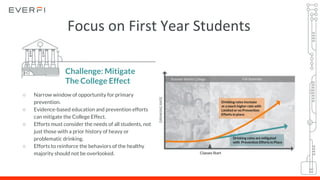
Challenge: Mitigate
The College Effect
○ Narrow window of opportunity for primary
prevention.
○ Evidence-based education and prevention efforts
can mitigate the College Effect.
○ Efforts must consider the needs of all students, not
just those with a prior history of heavy or
problematic drinking.
○ Efforts to reinforce the behaviors of the healthy
majority should not be overlooked.
Focus on First Year Students
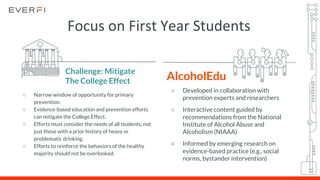
AlcoholEdu
○ Developed in collaboration with
prevention experts and researchers
○ Interactive content guided by
recommendations from the National
Institute of Alcohol Abuse and
Alcoholism (NIAAA)
○ Informed by emerging research on
evidence-based practice (e.g., social
norms, bystander intervention)
Challenge: Mitigate
The College Effect
○ Narrow window of opportunity for primary
prevention.
○ Evidence-based education and prevention efforts
can mitigate the College Effect.
○ Efforts must consider the needs of all students, not
just those with a prior history of heavy or
problematic drinking.
○ Efforts to reinforce the behaviors of the healthy
majority should not be overlooked.
Focus on First Year Students
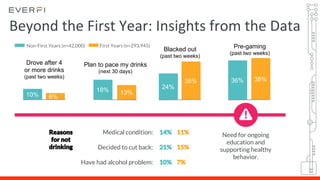
Beyond the First Year: Insights from the Data
Need for ongoing
education and
supporting healthy
behavior.
First Years (n=293,945)Non-First Years (n=42,000)
Plan to pace my drinks
(next 30 days)
18% 13%
35%
Blacked out
(past two weeks)
24%
36% 38%
Pre-gaming
(past two weeks)
Drove after 4
or more drinks
(past two weeks)
10% 6%
14%
21%
10%
Medical condition:
Decided to cut back:
Have had alcohol problem:
11%
15%
7%
Reasons
for not
drinking
Societal
Community
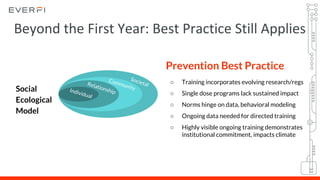
Prevention Best Practice
○ Training incorporates evolving research/regs
○ Single dose programs lack sustained impact
○ Norms hinge on data, behavioral modeling
○ Ongoing data needed for directed training
○ Highly visible ongoing training demonstrates
institutional commitment, impacts climate
Social
Ecological
Model
Beyond the First Year: Best Practice Still Applies
RelationshipIndividual
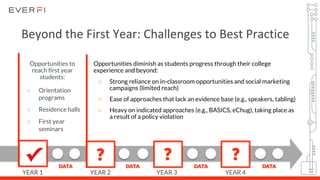
Beyond the First Year: Challenges to Best Practice
Opportunities to
reach first year
students:
○ Orientation
programs
○ Residence halls
○ First year
seminars
Opportunities diminish as students progress through their college
experience and beyond:
○ Strong reliance on in-classroom opportunities and social marketing
campaigns (limited reach)
○ Ease of approaches that lack an evidence base (e.g., speakers, tabling)
○ Heavy on indicated approaches (e.g., BASICS, eChug), taking place as
a result of a policy violation
YEAR 3
DATA
?
YEAR 4
DATA
?
YEAR 1
DATA
YEAR 2
DATA
?
Balancing Research, Best Practice and Policy
Dr. Beth DeRicco
Director of Higher Education Outreach, Caron Treatment Center
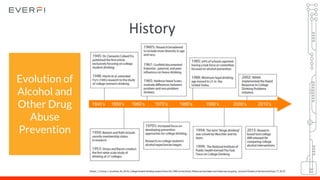
History
Evolution of
Alcohol and
Other Drug
Abuse
Prevention
1940’s 1950’s 1960’s 1970’s 1980’s 1990’s 2000’s 2010’s
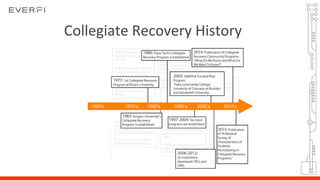
Collegiate Recovery History
1960’s 1970’s 1980’s 1990’s 2000’s 2010’s
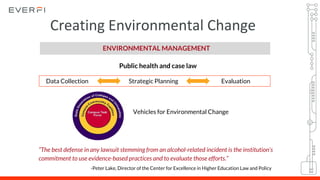
“The best defense in any lawsuit stemming from an alcohol-related incident is the institution’s
commitment to use evidence-based practices and to evaluate those efforts.”
-Peter Lake, Director of the Center for Excellence in Higher Education Law and Policy
Creating Environmental Change
ENVIRONMENTAL MANAGEMENT
Public health and case law
Data Collection Strategic Planning Evaluation
Vehicles for Environmental Change
OPPORTUNITY TO LEVERAGE FEDERAL
REQUIREMENTS: EDGAR Part 86
EDGAR Part 86
Regulations
Having a compliant program
requires that IHEs:
[1] conduct a biennial review of
their drug and alcohol prevention
programs
[2] annually distribute specified
drug and alcohol prevention
information to students and
employees (“annual notification”)
Standards of conduct; federal, state and
local laws; available drug and alcohol
programs; and a description of the health
risks associated with alcohol abuse and
illicit drug use, including:
• risk of dependence,
• possible short-term effects,
• possible long-term effects, and
• likelihood and effects of overdose.
20 U.S.C. 1145g—Drug and Alcohol Abuse Prevention
Annual Notification Requirements
Drug Free Schools and Campuses Regulations
Certification Requirements
“Part 86, the Drug-Free Schools and Campuses Regulations, requires
that, as a condition of receiving funds or any other form of financial
assistance under any federal program, an institution of higher
education (IHE) must certify that is has adopted and implemented
a program to prevent the unlawful possession, use, or distribution
of illicit drugs and alcohol by students and employees.”
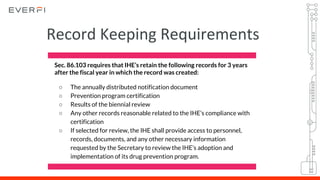
Sec. 86.103 requires that IHE’s retain the following records for 3 years
after the fiscal year in which the record was created:
○ The annually distributed notification document
○ Prevention program certification
○ Results of the biennial review
○ Any other records reasonable related to the IHE’s compliance with
certification
○ If selected for review, the IHE shall provide access to personnel,
records, documents, and any other necessary information
requested by the Secretary to review the IHE’s adoption and
implementation of its drug prevention program.
Record Keeping Requirements
A Population-Level Approach
to Ongoing Education
Sondra Solovay, Esq.
Vice President of Content, EVERFI
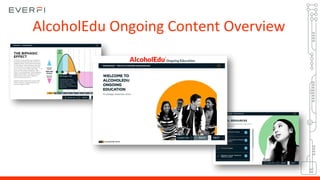
AlcoholEdu Ongoing Content Overview
KEY DIFFERENCES
Course Audience
All non-first year students
KEY DIFFERENCES
Course Length
20-30 minutes
KEY DIFFERENCES
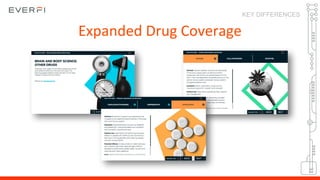
Expanded Drug Coverage
KEY DIFFERENCES
Expanded National & State Law Coverage
KEY DIFFERENCES
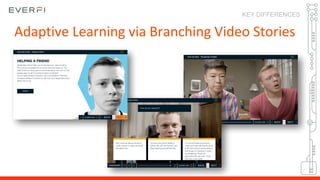
Adaptive Learning via Branching Video Stories
KEY DIFFERENCES
KEY SIMILARITIES
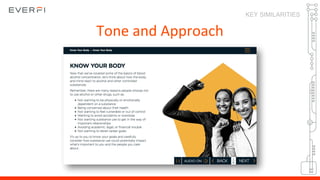
Tone and Approach
KEY SIMILARITIES
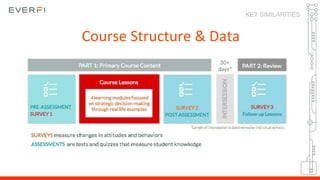
Course Structure & Data
4
KEY SIMILARITIES
• Custom welcome
letter
• Custom videos
• Custom closing
message
• School-specific
links and resources
Tailored Content
KEY SIMILARITIES
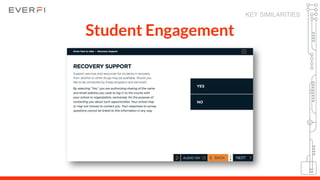
Student Engagement
KEY SIMILARITIES
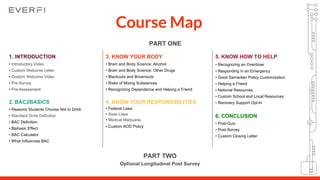
Course Map
PART ONE
1. INTRODUCTION
• Introductory Video
• Custom Welcome Letter
• Custom Welcome Video
• Pre-Survey
• Pre-Assessment
2. BAC2BASICS
• Reasons Students Choose Not to Drink
• Standard Drink Definition
• BAC Definition
• Biphasic Effect
• BAC Calculator
• What Influences BAC
3. KNOW YOUR BODY
• Brain and Body Science: Alcohol
• Brain and Body Science: Other Drugs
• Blackouts and Brownouts
• Risks of Mixing Substances
• Recognizing Dependence and Helping a Friend
4. KNOW YOUR RESPONSIBILITIES
• Federal Laws
• State Laws
• Medical Marijuana
• Custom AOD Policy
5. KNOW HOW TO HELP
• Recognizing an Overdose
• Responding in an Emergency
• Good Samaritan Policy Customization
• Helping a Friend
• National Resources
• Custom School and Local Resources
• Recovery Support Opt-In
6. CONCLUSION
• Post-Quiz
• Post-Survey
• Custom Closing Letter
PART TWO
Optional Longitudinal Post Survey
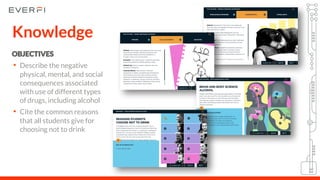
Knowledge
OBJECTIVES
• Describe the negative
physical, mental, and social
consequences associated
with use of different types
of drugs, including alcohol
• Cite the common reasons
that all students give for
choosing not to drink
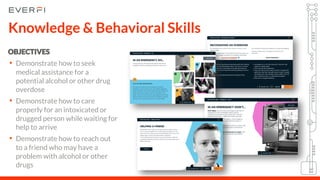
OBJECTIVES
• Demonstrate how to seek
medical assistance for a
potential alcohol or other drug
overdose
• Demonstrate how to care
properly for an intoxicated or
drugged person while waiting for
help to arrive
• Demonstrate how to reach out
to a friend who may have a
problem with alcohol or other
drugs
Knowledge & Behavioral Skills
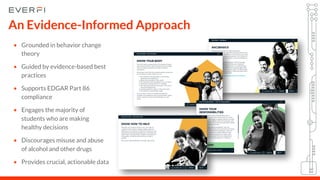
An Evidence-Informed Approach
• Grounded in behavior change
theory
• Guided by evidence-based best
practices
• Supports EDGAR Part 86
compliance
• Engages the majority of
students who are making
healthy decisions
• Discourages misuse and abuse
of alcohol and other drugs
• Provides crucial, actionable data
A special thanks to our external subject matter experts for contributing
their time and expertise to the development of this course!
Beth DeRicco, PhD
Director of Higher Education Outreach, Caron Treatment Center
Ryan Travia, MEd
Associate Dean of Students for Wellness, Babson College
Subject Matter Experts
Note: Subject matter experts’ involvement in course development does not imply an endorsement of the course by these
individuals or their respective institutions or organizations.
Thank you!
CONTACT US
kimberley@everfi.com
BDeRicco@caron.org
ssolovay@everfi.com
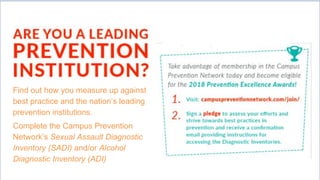
Find out how you measure up against
best practice and the nation’s leading
prevention institutions.
Complete the Campus Prevention
Network’s Sexual Assault Diagnostic
Inventory (SADI) and/or Alcohol
Diagnostic Inventory (ADI)

EVERFI: Ongoing Alcohol Prevention Education

  • 1.
    Ongoing Alcohol Prevention Education:Training Beyond Incoming Students Kimberley Timpf, Senior Director of Prevention Education, EVERFI Beth DeRicco, Director of Higher Education Outreach, Caron Treatment Center Sondra Solovay, Vice President of Content, EVERFI February 15, 2018
  • 2.
    Scope of theChallenge: Providing Evidence Based Prevention Beyond the First Year
  • 3.
    Challenge: Mitigate The CollegeEffect ○ Narrow window of opportunity for primary prevention. ○ Evidence-based education and prevention efforts can mitigate the College Effect. ○ Efforts must consider the needs of all students, not just those with a prior history of heavy or problematic drinking. ○ Efforts to reinforce the behaviors of the healthy majority should not be overlooked. Focus on First Year Students
  • 4.
    AlcoholEdu ○ Developed incollaboration with prevention experts and researchers ○ Interactive content guided by recommendations from the National Institute of Alcohol Abuse and Alcoholism (NIAAA) ○ Informed by emerging research on evidence-based practice (e.g., social norms, bystander intervention) Challenge: Mitigate The College Effect ○ Narrow window of opportunity for primary prevention. ○ Evidence-based education and prevention efforts can mitigate the College Effect. ○ Efforts must consider the needs of all students, not just those with a prior history of heavy or problematic drinking. ○ Efforts to reinforce the behaviors of the healthy majority should not be overlooked. Focus on First Year Students
  • 5.
    Beyond the FirstYear: Insights from the Data Need for ongoing education and supporting healthy behavior. First Years (n=293,945)Non-First Years (n=42,000) Plan to pace my drinks (next 30 days) 18% 13% 35% Blacked out (past two weeks) 24% 36% 38% Pre-gaming (past two weeks) Drove after 4 or more drinks (past two weeks) 10% 6% 14% 21% 10% Medical condition: Decided to cut back: Have had alcohol problem: 11% 15% 7% Reasons for not drinking
  • 6.
    Societal Community Prevention Best Practice ○Training incorporates evolving research/regs ○ Single dose programs lack sustained impact ○ Norms hinge on data, behavioral modeling ○ Ongoing data needed for directed training ○ Highly visible ongoing training demonstrates institutional commitment, impacts climate Social Ecological Model Beyond the First Year: Best Practice Still Applies RelationshipIndividual
  • 7.
    Beyond the FirstYear: Challenges to Best Practice Opportunities to reach first year students: ○ Orientation programs ○ Residence halls ○ First year seminars Opportunities diminish as students progress through their college experience and beyond: ○ Strong reliance on in-classroom opportunities and social marketing campaigns (limited reach) ○ Ease of approaches that lack an evidence base (e.g., speakers, tabling) ○ Heavy on indicated approaches (e.g., BASICS, eChug), taking place as a result of a policy violation YEAR 3 DATA ? YEAR 4 DATA ? YEAR 1 DATA YEAR 2 DATA ?
  • 8.
    Balancing Research, BestPractice and Policy Dr. Beth DeRicco Director of Higher Education Outreach, Caron Treatment Center
  • 9.
    History Evolution of Alcohol and OtherDrug Abuse Prevention 1940’s 1950’s 1960’s 1970’s 1980’s 1990’s 2000’s 2010’s
  • 10.
    Collegiate Recovery History 1960’s1970’s 1980’s 1990’s 2000’s 2010’s
  • 11.
    “The best defensein any lawsuit stemming from an alcohol-related incident is the institution’s commitment to use evidence-based practices and to evaluate those efforts.” -Peter Lake, Director of the Center for Excellence in Higher Education Law and Policy Creating Environmental Change ENVIRONMENTAL MANAGEMENT Public health and case law Data Collection Strategic Planning Evaluation Vehicles for Environmental Change
  • 12.
    OPPORTUNITY TO LEVERAGEFEDERAL REQUIREMENTS: EDGAR Part 86
  • 13.
    EDGAR Part 86 Regulations Havinga compliant program requires that IHEs: [1] conduct a biennial review of their drug and alcohol prevention programs [2] annually distribute specified drug and alcohol prevention information to students and employees (“annual notification”) Standards of conduct; federal, state and local laws; available drug and alcohol programs; and a description of the health risks associated with alcohol abuse and illicit drug use, including: • risk of dependence, • possible short-term effects, • possible long-term effects, and • likelihood and effects of overdose. 20 U.S.C. 1145g—Drug and Alcohol Abuse Prevention Annual Notification Requirements Drug Free Schools and Campuses Regulations
  • 14.
    Certification Requirements “Part 86,the Drug-Free Schools and Campuses Regulations, requires that, as a condition of receiving funds or any other form of financial assistance under any federal program, an institution of higher education (IHE) must certify that is has adopted and implemented a program to prevent the unlawful possession, use, or distribution of illicit drugs and alcohol by students and employees.”
  • 15.
    Sec. 86.103 requiresthat IHE’s retain the following records for 3 years after the fiscal year in which the record was created: ○ The annually distributed notification document ○ Prevention program certification ○ Results of the biennial review ○ Any other records reasonable related to the IHE’s compliance with certification ○ If selected for review, the IHE shall provide access to personnel, records, documents, and any other necessary information requested by the Secretary to review the IHE’s adoption and implementation of its drug prevention program. Record Keeping Requirements
  • 16.
    A Population-Level Approach toOngoing Education Sondra Solovay, Esq. Vice President of Content, EVERFI
  • 17.
  • 18.
  • 19.
    Course Audience All non-firstyear students KEY DIFFERENCES
  • 20.
  • 21.
  • 22.
    Expanded National &State Law Coverage KEY DIFFERENCES
  • 23.
    Adaptive Learning viaBranching Video Stories KEY DIFFERENCES
  • 24.
  • 25.
  • 26.
    Course Structure &Data 4 KEY SIMILARITIES
  • 27.
    • Custom welcome letter •Custom videos • Custom closing message • School-specific links and resources Tailored Content KEY SIMILARITIES
  • 28.
  • 29.
    Course Map PART ONE 1.INTRODUCTION • Introductory Video • Custom Welcome Letter • Custom Welcome Video • Pre-Survey • Pre-Assessment 2. BAC2BASICS • Reasons Students Choose Not to Drink • Standard Drink Definition • BAC Definition • Biphasic Effect • BAC Calculator • What Influences BAC 3. KNOW YOUR BODY • Brain and Body Science: Alcohol • Brain and Body Science: Other Drugs • Blackouts and Brownouts • Risks of Mixing Substances • Recognizing Dependence and Helping a Friend 4. KNOW YOUR RESPONSIBILITIES • Federal Laws • State Laws • Medical Marijuana • Custom AOD Policy 5. KNOW HOW TO HELP • Recognizing an Overdose • Responding in an Emergency • Good Samaritan Policy Customization • Helping a Friend • National Resources • Custom School and Local Resources • Recovery Support Opt-In 6. CONCLUSION • Post-Quiz • Post-Survey • Custom Closing Letter PART TWO Optional Longitudinal Post Survey
  • 30.
    Knowledge OBJECTIVES • Describe thenegative physical, mental, and social consequences associated with use of different types of drugs, including alcohol • Cite the common reasons that all students give for choosing not to drink
  • 31.
    OBJECTIVES • Demonstrate howto seek medical assistance for a potential alcohol or other drug overdose • Demonstrate how to care properly for an intoxicated or drugged person while waiting for help to arrive • Demonstrate how to reach out to a friend who may have a problem with alcohol or other drugs Knowledge & Behavioral Skills
  • 32.
    An Evidence-Informed Approach •Grounded in behavior change theory • Guided by evidence-based best practices • Supports EDGAR Part 86 compliance • Engages the majority of students who are making healthy decisions • Discourages misuse and abuse of alcohol and other drugs • Provides crucial, actionable data
  • 33.
    A special thanksto our external subject matter experts for contributing their time and expertise to the development of this course! Beth DeRicco, PhD Director of Higher Education Outreach, Caron Treatment Center Ryan Travia, MEd Associate Dean of Students for Wellness, Babson College Subject Matter Experts Note: Subject matter experts’ involvement in course development does not imply an endorsement of the course by these individuals or their respective institutions or organizations.
  • 34.
  • 36.
    Find out howyou measure up against best practice and the nation’s leading prevention institutions. Complete the Campus Prevention Network’s Sexual Assault Diagnostic Inventory (SADI) and/or Alcohol Diagnostic Inventory (ADI)