Understanding Evaluative
Language
What is Evaluative
Language?
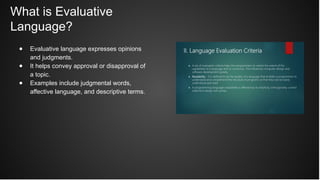
● Evaluative language expresses opinions
and judgments.
● It helps convey approval or disapproval of
a topic.
● Examples include judgmental words,
affective language, and descriptive terms.
Key Components of
Evaluative Language
● Judgmental Words: Indicate moral or
ethical views (e.g., unfair, commendable).
● Affective Language: Reflects emotions
(e.g., disappointing, heartwarming).
● Modal Verbs: Show certainty or obligation
(e.g., must, should).
Why is Evaluative Language Important?
● Shapes arguments and influences reader perception.
● Helps writers express their attitudes clearly.
● Engages readers by evoking emotional responses.
Identifying Attitudes in
Writing
● Attitudes reveal how a writer feels about a
topic.
● Look for specific words that indicate
approval or disapproval.
● Analyze the context to understand the
author's perspective.
Examples of
Evaluative Language
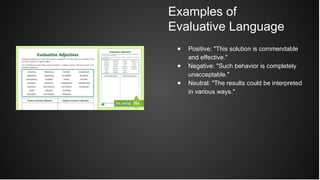
● Positive: "This solution is commendable
and effective."
● Negative: "Such behavior is completely
unacceptable."
● Neutral: "The results could be interpreted
in various ways."
Activity: Finding Evaluative Language
● Work in groups to find examples of evaluative language in texts.
● Identify judgmental words, affective language, and modal verbs.
● Discuss how these choices reflect the author's attitude.
Discussion: Impact of
Language Choices
● How do specific words shape your
understanding of the author's attitude?
● Were there any surprising words that
changed your perception?
● Share your thoughts with the class.
Practice: Analyzing a Passage
● Read a new passage containing evaluative language.
● Write a paragraph identifying the author's attitude.
● Cite examples of evaluative language that support your
interpretation.
Wrap-Up: Key
Takeaways
● Evaluative language is crucial for
expressing opinions.
● Identifying attitudes helps deepen
understanding of texts.
● Use this knowledge to enhance your
writing and analysis.
Exit Ticket: Your Opinion
● Write one sentence using evaluative language about a current
event.
● Share your sentence with a partner.
● Reflect on how your choice of words conveys your attitude.
Evaluative Language in
Everyday Life
● Evaluative language is everywhere: news
articles, social media, and conversations.
● Recognizing it helps you become a more
critical reader and writer.
● Pay attention to how language influences
your opinions.
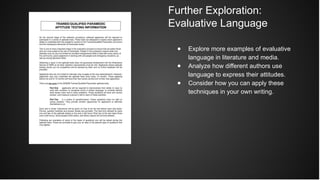
Further Exploration:
Evaluative Language
● Explore more examples of evaluative
language in literature and media.
● Analyze how different authors use
language to express their attitudes.
● Consider how you can apply these
techniques in your own writing.
Questions and Answers
● What questions do you have about evaluative language?
● How can you apply what you've learned in your writing?
● Discuss with your peers to clarify any doubts.
Thank You for
Participating!
● Thank you for engaging in today's lesson!
● Remember to practice identifying
evaluative language in your reading.
● Keep exploring how language shapes our
understanding of the world.

evaluative language concepts and examples

  • 1.
  • 2.
    What is Evaluative Language? ●Evaluative language expresses opinions and judgments. ● It helps convey approval or disapproval of a topic. ● Examples include judgmental words, affective language, and descriptive terms.
  • 3.
    Key Components of EvaluativeLanguage ● Judgmental Words: Indicate moral or ethical views (e.g., unfair, commendable). ● Affective Language: Reflects emotions (e.g., disappointing, heartwarming). ● Modal Verbs: Show certainty or obligation (e.g., must, should).
  • 4.
    Why is EvaluativeLanguage Important? ● Shapes arguments and influences reader perception. ● Helps writers express their attitudes clearly. ● Engages readers by evoking emotional responses.
  • 5.
    Identifying Attitudes in Writing ●Attitudes reveal how a writer feels about a topic. ● Look for specific words that indicate approval or disapproval. ● Analyze the context to understand the author's perspective.
  • 6.
    Examples of Evaluative Language ●Positive: "This solution is commendable and effective." ● Negative: "Such behavior is completely unacceptable." ● Neutral: "The results could be interpreted in various ways."
  • 7.
    Activity: Finding EvaluativeLanguage ● Work in groups to find examples of evaluative language in texts. ● Identify judgmental words, affective language, and modal verbs. ● Discuss how these choices reflect the author's attitude.
  • 8.
    Discussion: Impact of LanguageChoices ● How do specific words shape your understanding of the author's attitude? ● Were there any surprising words that changed your perception? ● Share your thoughts with the class.
  • 9.
    Practice: Analyzing aPassage ● Read a new passage containing evaluative language. ● Write a paragraph identifying the author's attitude. ● Cite examples of evaluative language that support your interpretation.
  • 10.
    Wrap-Up: Key Takeaways ● Evaluativelanguage is crucial for expressing opinions. ● Identifying attitudes helps deepen understanding of texts. ● Use this knowledge to enhance your writing and analysis.
  • 11.
    Exit Ticket: YourOpinion ● Write one sentence using evaluative language about a current event. ● Share your sentence with a partner. ● Reflect on how your choice of words conveys your attitude.
  • 12.
    Evaluative Language in EverydayLife ● Evaluative language is everywhere: news articles, social media, and conversations. ● Recognizing it helps you become a more critical reader and writer. ● Pay attention to how language influences your opinions.
  • 13.
    Further Exploration: Evaluative Language ●Explore more examples of evaluative language in literature and media. ● Analyze how different authors use language to express their attitudes. ● Consider how you can apply these techniques in your own writing.
  • 14.
    Questions and Answers ●What questions do you have about evaluative language? ● How can you apply what you've learned in your writing? ● Discuss with your peers to clarify any doubts.
  • 15.
    Thank You for Participating! ●Thank you for engaging in today's lesson! ● Remember to practice identifying evaluative language in your reading. ● Keep exploring how language shapes our understanding of the world.

Editor's Notes

  • #1 Created from: https://docs.google.com/document/d/1UKKWv4x6vtUGcm3zBt8ZhhKFsSFZvb23NkwC_XuuCZ4/edit?tab=t.0#heading=h.4bls47mx6ei6