IN WHAT WAYS DOES
YOUR MEDIA PRODUCT
USE, DEVELOP OR
CHALLENGE FORMS AND
CONVENTIONS OF REAL
MEDIA PRODUCTS?
MY INITIAL PLANS
➤ After researching a variety of types of documentaries, I identified a gap in the
market for a new of type of wedding documentary.
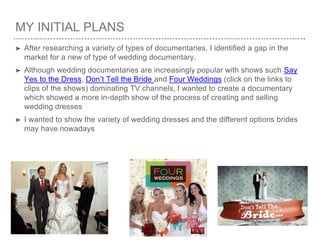
➤ Although wedding documentaries are increasingly popular with shows such Say
Yes to the Dress, Don’t Tell the Bride and Four Weddings (click on the links to
clips of the shows) dominating TV channels, I wanted to create a documentary
which showed a more in-depth show of the process of creating and selling
wedding dresses
➤ I wanted to show the variety of wedding dresses and the different options brides
may have nowadays
THE IMPORTANCE OF RESEARCH AND PLANNING
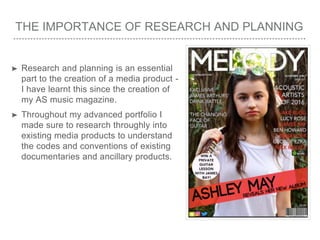
➤ Research and planning is an essential
part to the creation of a media product -
I have learnt this since the creation of
my AS music magazine.
➤ Throughout my advanced portfolio I
made sure to research throughly into
existing media products to understand
the codes and conventions of existing
documentaries and ancillary products.
DOCUMENTARY TITLE
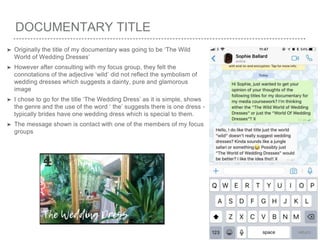
➤ Originally the title of my documentary was going to be ‘The Wild
World of Wedding Dresses’
➤ However after consulting with my focus group, they felt the
connotations of the adjective ‘wild’ did not reflect the symbolism of
wedding dresses which suggests a dainty, pure and glamorous
image
➤ I chose to go for the title ‘The Wedding Dress’ as it is simple, shows
the genre and the use of the word ‘ the’ suggests there is one dress -
typically brides have one wedding dress which is special to them.
➤ The message shown is contact with one of the members of my focus
groups
CUTAWAYS
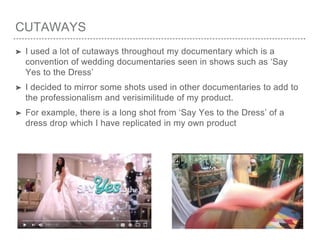
➤ I used a lot of cutaways throughout my documentary which is a
convention of wedding documentaries seen in shows such as ‘Say
Yes to the Dress’
➤ I decided to mirror some shots used in other documentaries to add to
the professionalism and verisimilitude of my product.
➤ For example, there is a long shot from ‘Say Yes to the Dress’ of a
dress drop which I have replicated in my own product
CHALLENGING CONVENTIONS - USE OF A NARRATOR
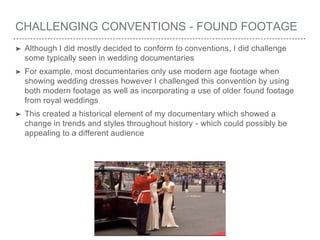
➤ After analysing ‘The Wedding Shop’
documentary which filmed a wedding dress
shop, I decided to use a narrator throughout
the documentary
➤ Shows such as ‘Say Yes to the Dress’ do have
a presenter - in the UK version the presenter is
celebrity wedding dress designer David
Emmanuel. By therefore not using a narrator I
am challenging the conventions set by the
genre
➤ Due to the type of my documentary being
expository I decided to use a voice over
narrative as this was typically seen in other
documentaries which were similarly
constructed - for example ‘The Wedding Shop’.
CHALLENGING CONVENTIONS - FOUND FOOTAGE
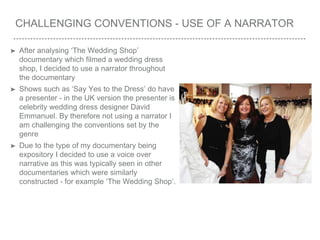
➤ Although I did mostly decided to conform to conventions, I did challenge
some typically seen in wedding documentaries
➤ For example, most documentaries only use modern age footage when
showing wedding dresses however I challenged this convention by using
both modern footage as well as incorporating a use of older found footage
from royal weddings
➤ This created a historical element of my documentary which showed a
change in trends and styles throughout history - which could possibly be
appealing to a different audience
INTERVIEWS WITH EXPERTS
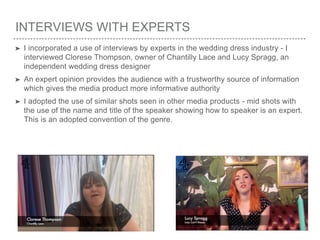
➤ I incorporated a use of interviews by experts in the wedding dress industry - I
interviewed Clorese Thompson, owner of Chantilly Lace and Lucy Spragg, an
independent wedding dress designer
➤ An expert opinion provides the audience with a trustworthy source of information
which gives the media product more informative authority
➤ I adopted the use of similar shots seen in other media products - mid shots with
the use of the name and title of the speaker showing how to speaker is an expert.
This is an adopted convention of the genre.
MIRRORING SHOT TYPES
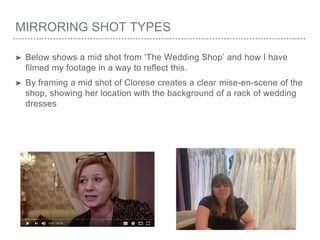
➤ Below shows a mid shot from ‘The Wedding Shop’ and how I have
filmed my footage in a way to reflect this.
➤ By framing a mid shot of Clorese creates a clear mise-en-scene of the
shop, showing her location with the background of a rack of wedding
dresses
THE USE OF SOUND IN MY DOCUMENTARY
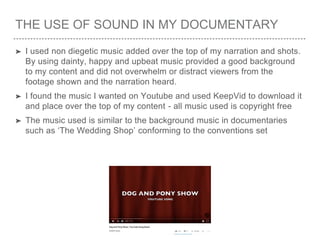
➤ I used non diegetic music added over the top of my narration and shots.
By using dainty, happy and upbeat music provided a good background
to my content and did not overwhelm or distract viewers from the
footage shown and the narration heard.
➤ I found the music I wanted on Youtube and used KeepVid to download it
and place over the top of my content - all music used is copyright free
➤ The music used is similar to the background music in documentaries
such as ‘The Wedding Shop’ conforming to the conventions set
MUSIC USED IN MY DOCUMENTARY
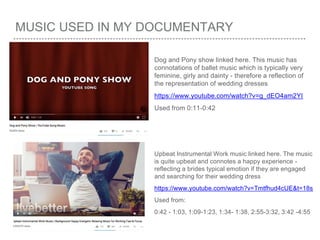
Dog and Pony show linked here. This music has
connotations of ballet music which is typically very
feminine, girly and dainty - therefore a reflection of
the representation of wedding dresses
https://www.youtube.com/watch?v=g_dEO4am2YI
Used from 0:11-0:42
Upbeat Instrumental Work music linked here. The music
is quite upbeat and connotes a happy experience -
reflecting a brides typical emotion if they are engaged
and searching for their wedding dress
https://www.youtube.com/watch?v=Tmtfhud4cUE&t=18s
Used from:
0:42 - 1:03, 1:09-1:23, 1:34- 1:38, 2:55-3:32, 3:42 -4:55
IMPORTANCE OF ANCILLARY PRODUCTS
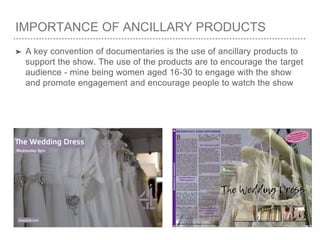
➤ A key convention of documentaries is the use of ancillary products to
support the show. The use of the products are to encourage the target
audience - mine being women aged 16-30 to engage with the show
and promote engagement and encourage people to watch the show
ANCILLARY POSTER
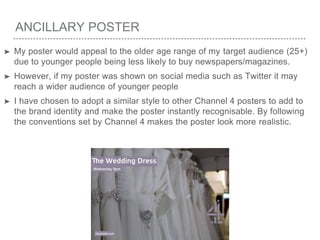
➤ My poster would appeal to the older age range of my target audience (25+)
due to younger people being less likely to buy newspapers/magazines.
➤ However, if my poster was shown on social media such as Twitter it may
reach a wider audience of younger people
➤ I have chosen to adopt a similar style to other Channel 4 posters to add to
the brand identity and make the poster instantly recognisable. By following
the conventions set by Channel 4 makes the poster look more realistic.
CHANNEL 4 POSTER CONVENTIONS
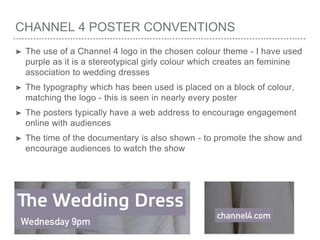
➤ The use of a Channel 4 logo in the chosen colour theme - I have used
purple as it is a stereotypical girly colour which creates an feminine
association to wedding dresses
➤ The typography which has been used is placed on a block of colour,
matching the logo - this is seen in nearly every poster
➤ The posters typically have a web address to encourage engagement
online with audiences
➤ The time of the documentary is also shown - to promote the show and
encourage audiences to watch the show
NEWSPAPER DOUBLE PAGE SPREAD
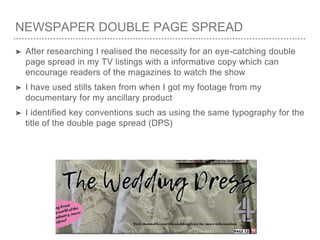
➤ After researching I realised the necessity for an eye-catching double
page spread in my TV listings with a informative copy which can
encourage readers of the magazines to watch the show
➤ I have used stills taken from when I got my footage from my
documentary for my ancillary product
➤ I identified key conventions such as using the same typography for the
title of the double page spread (DPS)
IN CONCLUSION
➤ My main product reflects a lot of conventions set in the genre such as
using upbeat non diegetic music in the background, the use of
cutaways, a narration and certain shot types.
➤ However, I have challenged some conventions such as not using a
presenter and using found footage adding a historical element to my
media product
➤ My ancillary products do use and conform to the conventions
especially my poster as I have used the same layout and same
techniques used in a Channel 4 poster

Evaluation Question 1 - Media A Level

  • 1.
    IN WHAT WAYSDOES YOUR MEDIA PRODUCT USE, DEVELOP OR CHALLENGE FORMS AND CONVENTIONS OF REAL MEDIA PRODUCTS?
  • 2.
    MY INITIAL PLANS ➤After researching a variety of types of documentaries, I identified a gap in the market for a new of type of wedding documentary. ➤ Although wedding documentaries are increasingly popular with shows such Say Yes to the Dress, Don’t Tell the Bride and Four Weddings (click on the links to clips of the shows) dominating TV channels, I wanted to create a documentary which showed a more in-depth show of the process of creating and selling wedding dresses ➤ I wanted to show the variety of wedding dresses and the different options brides may have nowadays
  • 3.
    THE IMPORTANCE OFRESEARCH AND PLANNING ➤ Research and planning is an essential part to the creation of a media product - I have learnt this since the creation of my AS music magazine. ➤ Throughout my advanced portfolio I made sure to research throughly into existing media products to understand the codes and conventions of existing documentaries and ancillary products.
  • 4.
    DOCUMENTARY TITLE ➤ Originallythe title of my documentary was going to be ‘The Wild World of Wedding Dresses’ ➤ However after consulting with my focus group, they felt the connotations of the adjective ‘wild’ did not reflect the symbolism of wedding dresses which suggests a dainty, pure and glamorous image ➤ I chose to go for the title ‘The Wedding Dress’ as it is simple, shows the genre and the use of the word ‘ the’ suggests there is one dress - typically brides have one wedding dress which is special to them. ➤ The message shown is contact with one of the members of my focus groups
  • 5.
    CUTAWAYS ➤ I useda lot of cutaways throughout my documentary which is a convention of wedding documentaries seen in shows such as ‘Say Yes to the Dress’ ➤ I decided to mirror some shots used in other documentaries to add to the professionalism and verisimilitude of my product. ➤ For example, there is a long shot from ‘Say Yes to the Dress’ of a dress drop which I have replicated in my own product
  • 6.
    CHALLENGING CONVENTIONS -USE OF A NARRATOR ➤ After analysing ‘The Wedding Shop’ documentary which filmed a wedding dress shop, I decided to use a narrator throughout the documentary ➤ Shows such as ‘Say Yes to the Dress’ do have a presenter - in the UK version the presenter is celebrity wedding dress designer David Emmanuel. By therefore not using a narrator I am challenging the conventions set by the genre ➤ Due to the type of my documentary being expository I decided to use a voice over narrative as this was typically seen in other documentaries which were similarly constructed - for example ‘The Wedding Shop’.
  • 7.
    CHALLENGING CONVENTIONS -FOUND FOOTAGE ➤ Although I did mostly decided to conform to conventions, I did challenge some typically seen in wedding documentaries ➤ For example, most documentaries only use modern age footage when showing wedding dresses however I challenged this convention by using both modern footage as well as incorporating a use of older found footage from royal weddings ➤ This created a historical element of my documentary which showed a change in trends and styles throughout history - which could possibly be appealing to a different audience
  • 8.
    INTERVIEWS WITH EXPERTS ➤I incorporated a use of interviews by experts in the wedding dress industry - I interviewed Clorese Thompson, owner of Chantilly Lace and Lucy Spragg, an independent wedding dress designer ➤ An expert opinion provides the audience with a trustworthy source of information which gives the media product more informative authority ➤ I adopted the use of similar shots seen in other media products - mid shots with the use of the name and title of the speaker showing how to speaker is an expert. This is an adopted convention of the genre.
  • 9.
    MIRRORING SHOT TYPES ➤Below shows a mid shot from ‘The Wedding Shop’ and how I have filmed my footage in a way to reflect this. ➤ By framing a mid shot of Clorese creates a clear mise-en-scene of the shop, showing her location with the background of a rack of wedding dresses
  • 10.
    THE USE OFSOUND IN MY DOCUMENTARY ➤ I used non diegetic music added over the top of my narration and shots. By using dainty, happy and upbeat music provided a good background to my content and did not overwhelm or distract viewers from the footage shown and the narration heard. ➤ I found the music I wanted on Youtube and used KeepVid to download it and place over the top of my content - all music used is copyright free ➤ The music used is similar to the background music in documentaries such as ‘The Wedding Shop’ conforming to the conventions set
  • 11.
    MUSIC USED INMY DOCUMENTARY Dog and Pony show linked here. This music has connotations of ballet music which is typically very feminine, girly and dainty - therefore a reflection of the representation of wedding dresses https://www.youtube.com/watch?v=g_dEO4am2YI Used from 0:11-0:42 Upbeat Instrumental Work music linked here. The music is quite upbeat and connotes a happy experience - reflecting a brides typical emotion if they are engaged and searching for their wedding dress https://www.youtube.com/watch?v=Tmtfhud4cUE&t=18s Used from: 0:42 - 1:03, 1:09-1:23, 1:34- 1:38, 2:55-3:32, 3:42 -4:55
  • 12.
    IMPORTANCE OF ANCILLARYPRODUCTS ➤ A key convention of documentaries is the use of ancillary products to support the show. The use of the products are to encourage the target audience - mine being women aged 16-30 to engage with the show and promote engagement and encourage people to watch the show
  • 13.
    ANCILLARY POSTER ➤ Myposter would appeal to the older age range of my target audience (25+) due to younger people being less likely to buy newspapers/magazines. ➤ However, if my poster was shown on social media such as Twitter it may reach a wider audience of younger people ➤ I have chosen to adopt a similar style to other Channel 4 posters to add to the brand identity and make the poster instantly recognisable. By following the conventions set by Channel 4 makes the poster look more realistic.
  • 14.
    CHANNEL 4 POSTERCONVENTIONS ➤ The use of a Channel 4 logo in the chosen colour theme - I have used purple as it is a stereotypical girly colour which creates an feminine association to wedding dresses ➤ The typography which has been used is placed on a block of colour, matching the logo - this is seen in nearly every poster ➤ The posters typically have a web address to encourage engagement online with audiences ➤ The time of the documentary is also shown - to promote the show and encourage audiences to watch the show
  • 15.
    NEWSPAPER DOUBLE PAGESPREAD ➤ After researching I realised the necessity for an eye-catching double page spread in my TV listings with a informative copy which can encourage readers of the magazines to watch the show ➤ I have used stills taken from when I got my footage from my documentary for my ancillary product ➤ I identified key conventions such as using the same typography for the title of the double page spread (DPS)
  • 16.
    IN CONCLUSION ➤ Mymain product reflects a lot of conventions set in the genre such as using upbeat non diegetic music in the background, the use of cutaways, a narration and certain shot types. ➤ However, I have challenged some conventions such as not using a presenter and using found footage adding a historical element to my media product ➤ My ancillary products do use and conform to the conventions especially my poster as I have used the same layout and same techniques used in a Channel 4 poster