QUESTION 1
IN WHAT WAYS DOES YOUR MEDIA
PRODUCT USE, DEVELOP OR
CHALLENGE FORMS AND
CONVENTIONS OF REAL MEDIA
PRODUCTS?
Brief
• Our brief was to create the opening sequence
to a thriller movie, to last around two
minutes.
• We decided to create a psychological thriller
to appeal to the 16-24 demographic. The
conventions of this particular genre are a
distorting plot which gives the audience an
insight into the mind of the protagonist.
USE OF NARRATIVE
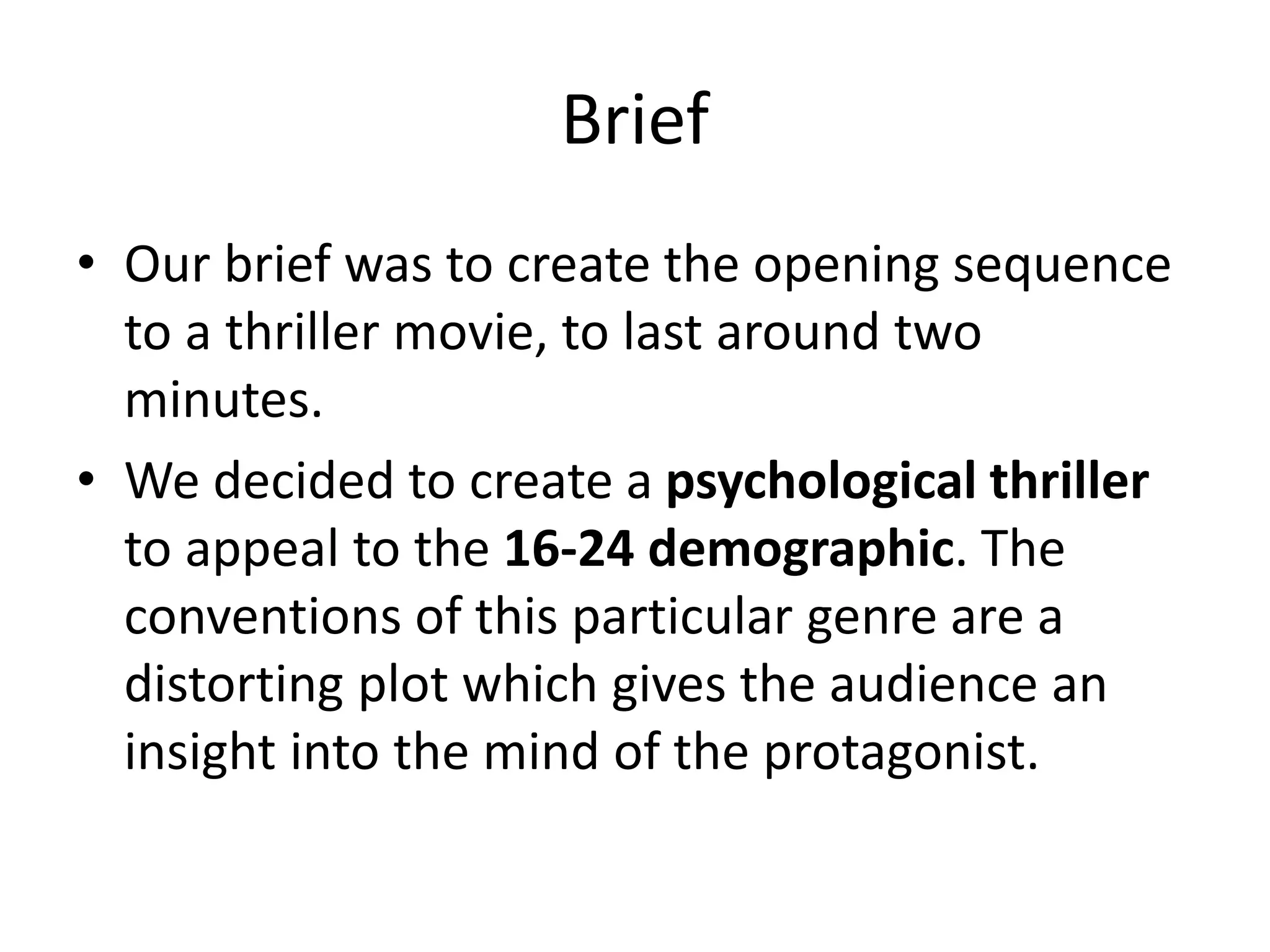
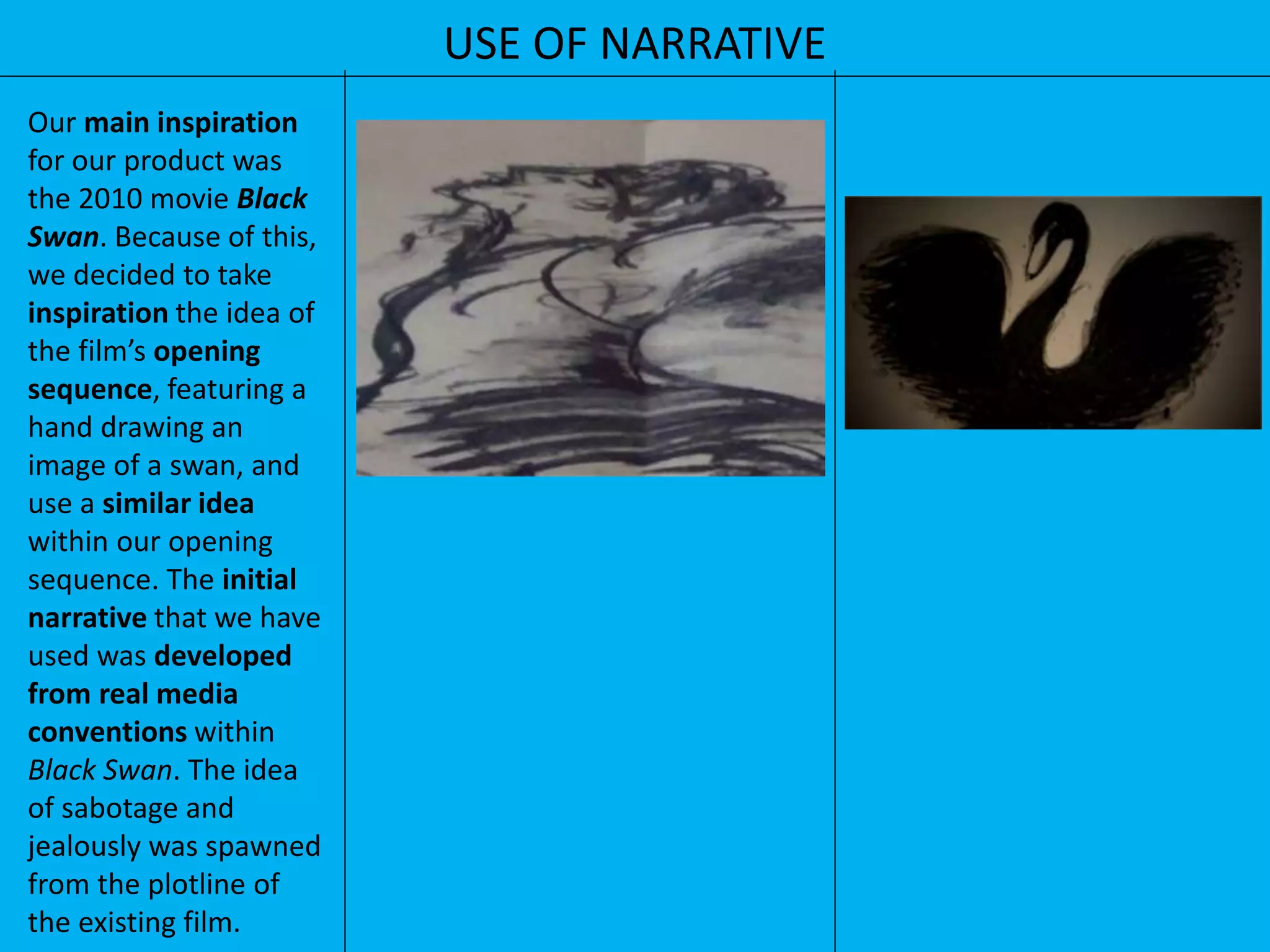
Our main inspiration
for our product was
the 2010 movie Black
Swan. Because of this,
we decided to take
inspiration the idea of
the film’s opening
sequence, featuring a
hand drawing an
image of a swan, and
use a similar idea
within our opening
sequence. The initial
narrative that we have
used was developed
from real media
conventions within
Black Swan. The idea
of sabotage and
jealously was spawned
from the plotline of
the existing film.
USE OF NARRATIVE
Our decision to rip the
drawing at the end of the
piece was chosen in order
to represent the inner
turmoil within the dancer,
as though she is, like the
drawing, being torn apart.
This idea follows uses the
Semantic Code from
Barthes’ Code Theory,
meaning that an
additional meaning has
been added to the
drawing due to its
connotation, allowing the
audience to ask questions
that they will want to
answer.
USE OF NARRATIVE
We decided to follow
Propp’s Character
Theory by using the
Hero and Villain
character types, which
Propp claims are
featured in all
narratives. Regarding
the use of sabotage
within the opening,
we challenged
Todorov’s Narrative
Theory by beginning
the film with
disequilibrium,
allowing us to gain the
audience’s interest
immediately.
MISE-EN-SCENE
We decided to use a
Drama Studio as the
setting for our piece.
Whilst this allowed us
to film at any time
without worrying
about continuity
errors, the dark
curtains within the
area helped to create
a feeling of isolation.
As a way of
challenging the
conventions of Black
Swan’s opening, we
decided to feature our
dancer performing
alone rather than with
another, creating a
larger sense of
isolation.
MISE-EN-SCENE
We decided to use the
typical conventions
and mise-en-scene of
professional dance.
Our setting was
specially designed for
such an activity and
the use of props that
are typical of such an
environment, such as
spotlights and a
soundboard, reflects
this. The inspiration
for this setting came
from the similar
setting for the
opening of Black
Swan.
MISE-EN-SCENE
In many thriller films, the
identity of the antagonist
is known throughout. We
decided to use our piece
to challenge the normal
representation of
antagonists within
thriller movies by only
giving hints of there
being a villain. The
antagonist is suggested
via:
• The close up of the
soundboard being
turned down.
• The close up of the
door being slammed.
• A cut scene in which
the lights in the
Drama Studio
suddenly went out.
EDITING
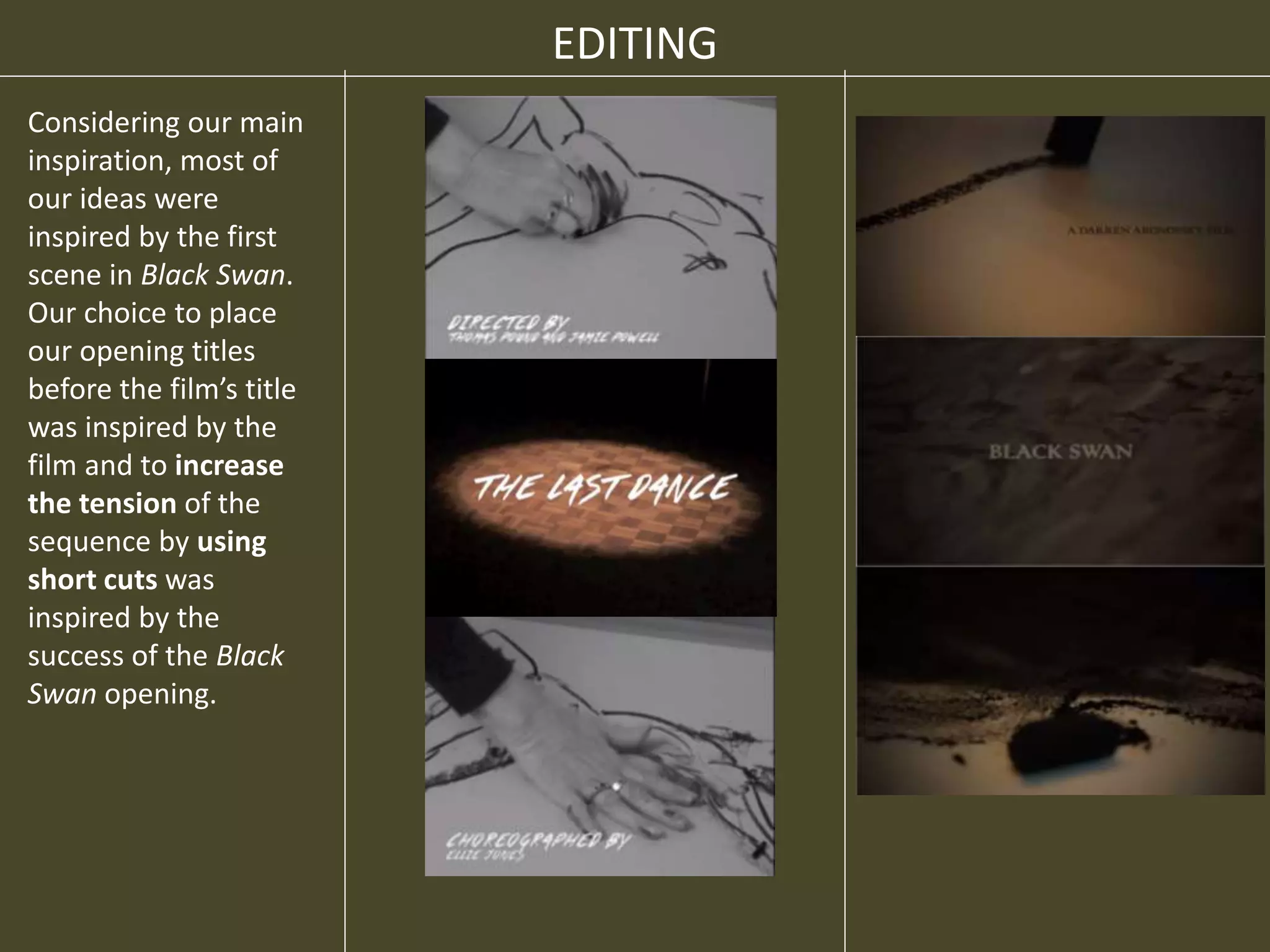
Considering our main
inspiration, most of
our ideas were
inspired by the first
scene in Black Swan.
Our choice to place
our opening titles
before the film’s title
was inspired by the
film and to increase
the tension of the
sequence by using
short cuts was
inspired by the
success of the Black
Swan opening.
EDITING
Our choice of titles
differs from that of
Black Swan. After
researching several
fonts via the website
Dafont, we decided to
use the sans serif font
“Last Feast” as we felt
it matched the
drawing aspect of the
sequence. In contrast,
Black Swan uses a
serif font that reflects
the formal aspect of
ballet.
SOUND
Our choice of non-digetic music differs from the piece used in the
opening scene of Black Swan as we used a piece of music that was
fast paced throughout rather than a piece that varied in tempo. We
felt our choice of music helped to increase the intensity of the dance
as well as create a tense atmosphere from the very beginning.
Whilst the piece in Black Swan could be considered stereotypical for
the art of ballet dancing, our piece goes against the normal
conventions of traditional dance music by being fast paced and quite
harsh sounding.
CAMERA
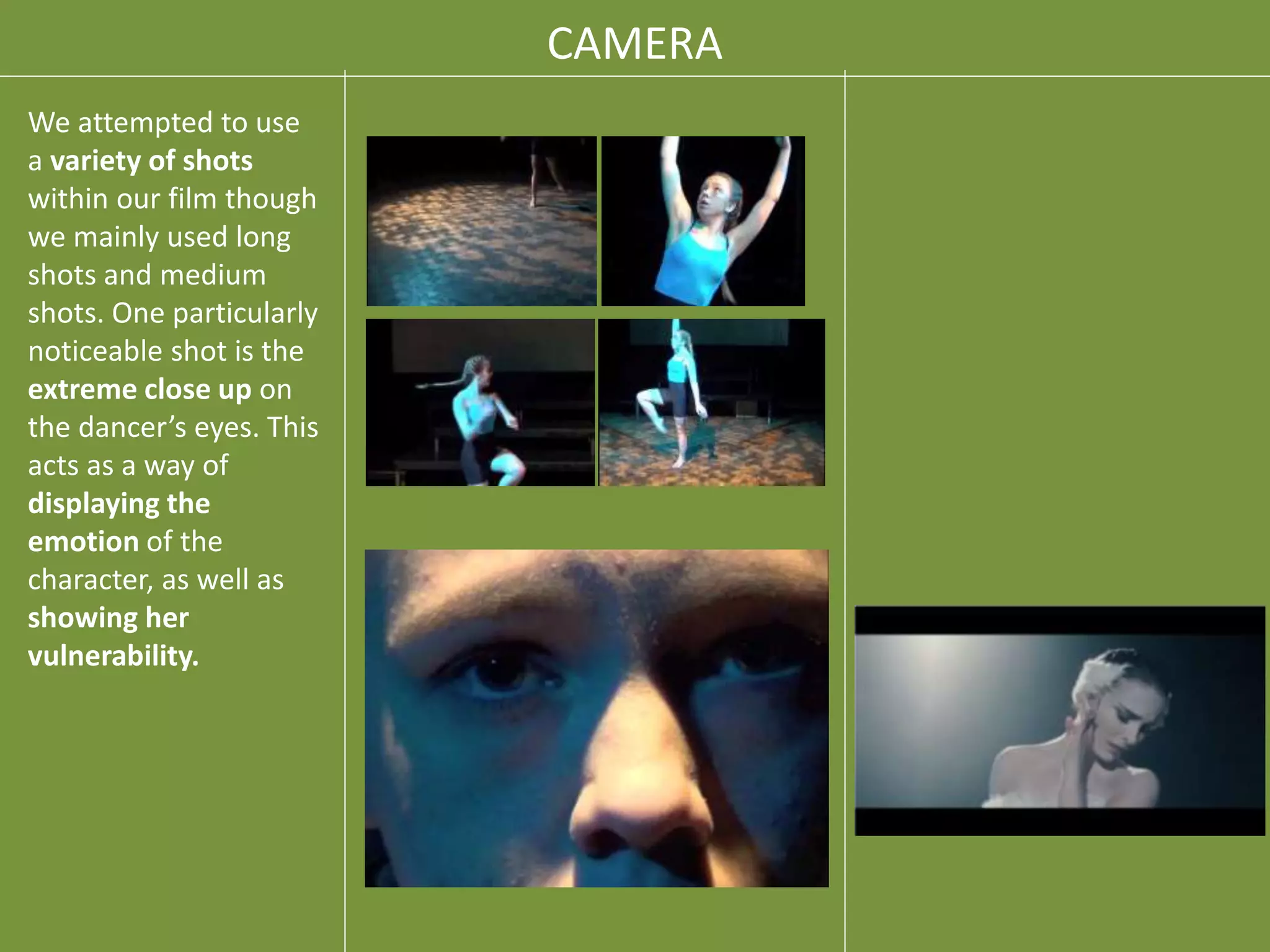
We attempted to use
a variety of shots
within our film though
we mainly used long
shots and medium
shots. One particularly
noticeable shot is the
extreme close up on
the dancer’s eyes. This
acts as a way of
displaying the
emotion of the
character, as well as
showing her
vulnerability.

Evaluation Question 1

  • 1.
    QUESTION 1 IN WHATWAYS DOES YOUR MEDIA PRODUCT USE, DEVELOP OR CHALLENGE FORMS AND CONVENTIONS OF REAL MEDIA PRODUCTS?
  • 2.
    Brief • Our briefwas to create the opening sequence to a thriller movie, to last around two minutes. • We decided to create a psychological thriller to appeal to the 16-24 demographic. The conventions of this particular genre are a distorting plot which gives the audience an insight into the mind of the protagonist.
  • 3.
    USE OF NARRATIVE Ourmain inspiration for our product was the 2010 movie Black Swan. Because of this, we decided to take inspiration the idea of the film’s opening sequence, featuring a hand drawing an image of a swan, and use a similar idea within our opening sequence. The initial narrative that we have used was developed from real media conventions within Black Swan. The idea of sabotage and jealously was spawned from the plotline of the existing film.
  • 4.
    USE OF NARRATIVE Ourdecision to rip the drawing at the end of the piece was chosen in order to represent the inner turmoil within the dancer, as though she is, like the drawing, being torn apart. This idea follows uses the Semantic Code from Barthes’ Code Theory, meaning that an additional meaning has been added to the drawing due to its connotation, allowing the audience to ask questions that they will want to answer.
  • 5.
    USE OF NARRATIVE Wedecided to follow Propp’s Character Theory by using the Hero and Villain character types, which Propp claims are featured in all narratives. Regarding the use of sabotage within the opening, we challenged Todorov’s Narrative Theory by beginning the film with disequilibrium, allowing us to gain the audience’s interest immediately.
  • 6.
    MISE-EN-SCENE We decided touse a Drama Studio as the setting for our piece. Whilst this allowed us to film at any time without worrying about continuity errors, the dark curtains within the area helped to create a feeling of isolation. As a way of challenging the conventions of Black Swan’s opening, we decided to feature our dancer performing alone rather than with another, creating a larger sense of isolation.
  • 7.
    MISE-EN-SCENE We decided touse the typical conventions and mise-en-scene of professional dance. Our setting was specially designed for such an activity and the use of props that are typical of such an environment, such as spotlights and a soundboard, reflects this. The inspiration for this setting came from the similar setting for the opening of Black Swan.
  • 8.
    MISE-EN-SCENE In many thrillerfilms, the identity of the antagonist is known throughout. We decided to use our piece to challenge the normal representation of antagonists within thriller movies by only giving hints of there being a villain. The antagonist is suggested via: • The close up of the soundboard being turned down. • The close up of the door being slammed. • A cut scene in which the lights in the Drama Studio suddenly went out.
  • 9.
    EDITING Considering our main inspiration,most of our ideas were inspired by the first scene in Black Swan. Our choice to place our opening titles before the film’s title was inspired by the film and to increase the tension of the sequence by using short cuts was inspired by the success of the Black Swan opening.
  • 10.
    EDITING Our choice oftitles differs from that of Black Swan. After researching several fonts via the website Dafont, we decided to use the sans serif font “Last Feast” as we felt it matched the drawing aspect of the sequence. In contrast, Black Swan uses a serif font that reflects the formal aspect of ballet.
  • 11.
    SOUND Our choice ofnon-digetic music differs from the piece used in the opening scene of Black Swan as we used a piece of music that was fast paced throughout rather than a piece that varied in tempo. We felt our choice of music helped to increase the intensity of the dance as well as create a tense atmosphere from the very beginning. Whilst the piece in Black Swan could be considered stereotypical for the art of ballet dancing, our piece goes against the normal conventions of traditional dance music by being fast paced and quite harsh sounding.
  • 12.
    CAMERA We attempted touse a variety of shots within our film though we mainly used long shots and medium shots. One particularly noticeable shot is the extreme close up on the dancer’s eyes. This acts as a way of displaying the emotion of the character, as well as showing her vulnerability.