How to Evaluate Sewing Machine Operators?
Grading stitching machine operators proves highly effective in optimizing productivity along a
stitching line while also serving as a morale booster for employees.
Typically, when a stitching operator advances to a higher grade, they become more motivated
and exert greater effort in subsequent tasks.
Over time, major garment manufacturing companies have adopted a practice of setting
stitching operators' salaries based on their grading.
Grading System of Stitching Operators in Apparel Industry:
Normally stitching operator’s wage has to pay according to the category of the operator. There
are different types of categories such as skilled, semi-skilled, unskilled, and A, B, C which are
done according to their experience.
Without these, garments manufacturing factories followed some systems or methods in doing
sewing operators grading which are mentioned in the below:
1. Grading according to types of operation,
2. Grading according to sewing operators’ capability in various operations.
1. Grading according to types of operation:
A, B and C grade stitching operator is selected in this grading system, where A, B, and C grade
stitching operator is perfect for completing A, B, and C grade operations respectively. This type
of grading is done according to the below points. Such as-
• Critical and non-critical operations,
• Skill level required to operate,
• Machine using capacities such as flatlock machine and single needle lock stitch,
• Operations in the various parts of garments.
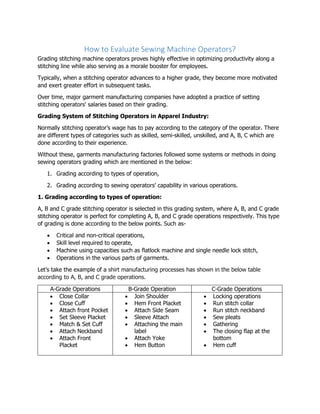
Let’s take the example of a shirt manufacturing processes has shown in the below table
according to A, B, and C grade operations.
A-Grade Operations B-Grade Operation C-Grade Operations
• Close Collar
• Close Cuff
• Attach front Pocket
• Set Sleeve Placket
• Match & Set Cuff
• Attach Neckband
• Attach Front
Placket
• Join Shoulder
• Hem Front Placket
• Attach Side Seam
• Sleeve Attach
• Attaching the main
label
• Attach Yoke
• Hem Button
• Locking operations
• Run stitch collar
• Run stitch neckband
• Sew pleats
• Gathering
• The closing flap at the
bottom
• Hem cuff
2. Grading according to Stitching operators’ capability in various operations:
It’s another stitching operator grading system followed in the garments industry. Here,
operators are categorized according to the number of operations performed by an operator
from the A, B, and C grade operations.
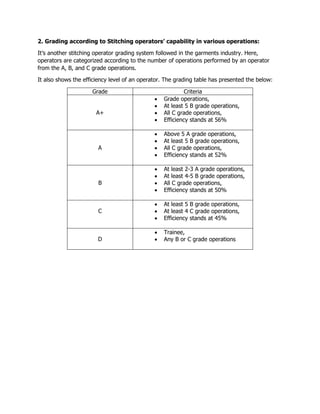
It also shows the efficiency level of an operator. The grading table has presented the below:
Grade Criteria
A+
• Grade operations,
• At least 5 B grade operations,
• All C grade operations,
• Efficiency stands at 56%
A
• Above 5 A grade operations,
• At least 5 B grade operations,
• All C grade operations,
• Efficiency stands at 52%
B
• At least 2-3 A grade operations,
• At least 4-5 B grade operations,
• All C grade operations,
• Efficiency stands at 50%
C
• At least 5 B grade operations,
• At least 4 C grade operations,
• Efficiency stands at 45%
D
• Trainee,
• Any B or C grade operations

Evaluating Stitching Machine Operators.pdf

  • 1.
    How to EvaluateSewing Machine Operators? Grading stitching machine operators proves highly effective in optimizing productivity along a stitching line while also serving as a morale booster for employees. Typically, when a stitching operator advances to a higher grade, they become more motivated and exert greater effort in subsequent tasks. Over time, major garment manufacturing companies have adopted a practice of setting stitching operators' salaries based on their grading. Grading System of Stitching Operators in Apparel Industry: Normally stitching operator’s wage has to pay according to the category of the operator. There are different types of categories such as skilled, semi-skilled, unskilled, and A, B, C which are done according to their experience. Without these, garments manufacturing factories followed some systems or methods in doing sewing operators grading which are mentioned in the below: 1. Grading according to types of operation, 2. Grading according to sewing operators’ capability in various operations. 1. Grading according to types of operation: A, B and C grade stitching operator is selected in this grading system, where A, B, and C grade stitching operator is perfect for completing A, B, and C grade operations respectively. This type of grading is done according to the below points. Such as- • Critical and non-critical operations, • Skill level required to operate, • Machine using capacities such as flatlock machine and single needle lock stitch, • Operations in the various parts of garments. Let’s take the example of a shirt manufacturing processes has shown in the below table according to A, B, and C grade operations. A-Grade Operations B-Grade Operation C-Grade Operations • Close Collar • Close Cuff • Attach front Pocket • Set Sleeve Placket • Match & Set Cuff • Attach Neckband • Attach Front Placket • Join Shoulder • Hem Front Placket • Attach Side Seam • Sleeve Attach • Attaching the main label • Attach Yoke • Hem Button • Locking operations • Run stitch collar • Run stitch neckband • Sew pleats • Gathering • The closing flap at the bottom • Hem cuff
  • 2.
    2. Grading accordingto Stitching operators’ capability in various operations: It’s another stitching operator grading system followed in the garments industry. Here, operators are categorized according to the number of operations performed by an operator from the A, B, and C grade operations. It also shows the efficiency level of an operator. The grading table has presented the below: Grade Criteria A+ • Grade operations, • At least 5 B grade operations, • All C grade operations, • Efficiency stands at 56% A • Above 5 A grade operations, • At least 5 B grade operations, • All C grade operations, • Efficiency stands at 52% B • At least 2-3 A grade operations, • At least 4-5 B grade operations, • All C grade operations, • Efficiency stands at 50% C • At least 5 B grade operations, • At least 4 C grade operations, • Efficiency stands at 45% D • Trainee, • Any B or C grade operations