Evaluating Other’s Draft
DISCOVER
1. How to make our ideas clear in creative nonfiction?
Clear writing is a writing that readers can follow.
Readers must easily understand every point.
We'll explore two tools for increasing clarity:
Simple sentences
Examples and Counterexamples
You use plain phrasing.
You use fewer ideas per sentence.
Simple Sentences
DISCOVER
Use plain phrasing where possible.
Here’s a sentence with complex phrasing:
"The city, a concrete jungle teeming with life, pulsed with a vibrant energy that was
both exhilarating and overwhelming."
Let’s rewrite that sentence plainly:
“The city was full of people and felt exciting and overwhelming."
Simplify your sentences without dumbing down your ideas.
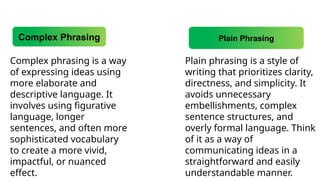
Complex phrasing is a way
of expressing ideas using
more elaborate and
descriptive language. It
involves using figurative
language, longer
sentences, and often more
sophisticated vocabulary
to create a more vivid,
impactful, or nuanced
effect.
Plain phrasing is a style of
writing that prioritizes clarity,
directness, and simplicity. It
avoids unnecessary
embellishments, complex
sentence structures, and
overly formal language. Think
of it as a way of
communicating ideas in a
straightforward and easily
understandable manner.
Complex Phrasing Plain Phrasing
DISCOVER
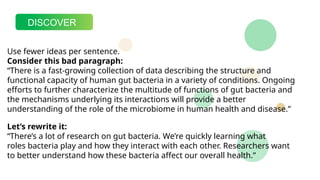
Use fewer ideas per sentence.
Consider this bad paragraph:
“There is a fast-growing collection of data describing the structure and
functional capacity of human gut bacteria in a variety of conditions. Ongoing
efforts to further characterize the multitude of functions of gut bacteria and
the mechanisms underlying its interactions will provide a better
understanding of the role of the microbiome in human health and disease.”
Let’s rewrite it:
“There’s a lot of research on gut bacteria. We’re quickly learning what
roles bacteria play and how they interact with each other. Researchers want
to better understand how these bacteria affect our overall health.”
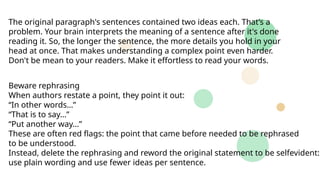
The original paragraph's sentences contained two ideas each. That’s a
problem. Your brain interprets the meaning of a sentence after it's done
reading it. So, the longer the sentence, the more details you hold in your
head at once. That makes understanding a complex point even harder.
Don't be mean to your readers. Make it effortless to read your words.
Beware rephrasing
When authors restate a point, they point it out:
“In other words…”
“That is to say…”
“Put another way…”
These are often red flags: the point that came before needed to be rephrased
to be understood.
Instead, delete the rephrasing and reword the original statement to be selfevident:
use plain wording and use fewer ideas per sentence.
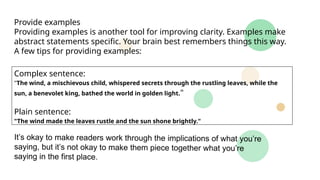
Provide examples
Providing examples is another tool for improving clarity. Examples make
abstract statements specific. Your brain best remembers things this way.
A few tips for providing examples:
Complex sentence:
"The wind, a mischievous child, whispered secrets through the rustling leaves, while the
sun, a benevolet king, bathed the world in golden light."
Plain sentence:
"The wind made the leaves rustle and the sun shone brightly."
It’s okay to make readers work through the implications of what you’re
saying, but it’s not okay to make them piece together what you’re
saying in the first place.
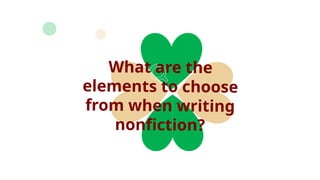
What are the
elements to choose
from when writing
nonfiction?
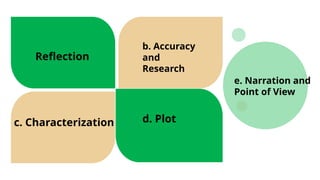
Reflection
b. Accuracy
and
Research
c. Characterization d. Plot
e. Narration and
Point of View
a. Reflection
Narrative nonfiction focuses on personal
experiences that are significant to the writer.
Writers often reflect on these events, sharing
their thoughts and views. They may discuss how
these experiences have influenced their lives and
other aspects of their thoughts. In this way,
narrative nonfiction shares similarities with
memoirs and personal essays, as they provide a
platform for the writer's personal perspectives
and opinions.
b. Accuracy and Research
In narrative nonfiction, writers tell true stories based on
real events, ensuring accuracy in portraying people,
places, and events. Extensive research is often required
to maintain truthfulness while blending storytelling
techniques creatively. Biographies share this
commitment to accuracy, but narrative nonfiction allows
more creative freedom in depicting characters and
events.
C. Characterization
Characters in narrative nonfiction can be dynamic
and change, just like in fiction. Writers can use their
own memories and perceptions to develop
characters, and they have the freedom to
fictionalize or blur certain details to make them
more engaging. This is because writers don't
always know the full truth about someone's
thoughts and motivations.
Dialogue and conflict help to make characters
unique, but narrative nonfiction may sometimes
simplify or not perfectly represent a person's actual
d. Plot
The plot of a narrative nonfiction work
may follow the structure of a fictional
novel, starting with the element of
exposition and moving on to rising action,
climax, falling action, and resolution. This
narrative structure allows the writer to
bring cohesion and resolution to real-life
events that may not have been so clearly
defined.
e. Narration and point of view
Sometimes works of nonfiction, like biographies,
may chronicle the life of a person over a span of
years. In narrative nonfiction, writers use techniques
such as time sequencing to jump to or between
critical parts of the story. The writer may also use
flash-forward or flashback to move through the plot.
Narrative pacing also enables writers to slow down
or speed up the pace of the story to emphasize
critical moments.
As with other narrative forms, writers of narrative
nonfiction can use different narrative point of views,
but first person and third person are the most
common. First-person narration enables writers to
express their personal views about real-life people and
events. In third person, the perspective is limited for
writers because they cannot accurately understand the
internal thoughts and motivations of the real people
represented by their characters. Instead, writers must
use what they've learned or observed about the actual
people to develop the characters and events.
THANKS

Evaluating-Othe-WPS-Office-Group4-1.pptx

  • 1.
  • 2.
    DISCOVER 1. How tomake our ideas clear in creative nonfiction? Clear writing is a writing that readers can follow. Readers must easily understand every point. We'll explore two tools for increasing clarity: Simple sentences Examples and Counterexamples You use plain phrasing. You use fewer ideas per sentence. Simple Sentences
  • 3.
    DISCOVER Use plain phrasingwhere possible. Here’s a sentence with complex phrasing: "The city, a concrete jungle teeming with life, pulsed with a vibrant energy that was both exhilarating and overwhelming." Let’s rewrite that sentence plainly: “The city was full of people and felt exciting and overwhelming." Simplify your sentences without dumbing down your ideas.
  • 4.
    Complex phrasing isa way of expressing ideas using more elaborate and descriptive language. It involves using figurative language, longer sentences, and often more sophisticated vocabulary to create a more vivid, impactful, or nuanced effect. Plain phrasing is a style of writing that prioritizes clarity, directness, and simplicity. It avoids unnecessary embellishments, complex sentence structures, and overly formal language. Think of it as a way of communicating ideas in a straightforward and easily understandable manner. Complex Phrasing Plain Phrasing
  • 5.
    DISCOVER Use fewer ideasper sentence. Consider this bad paragraph: “There is a fast-growing collection of data describing the structure and functional capacity of human gut bacteria in a variety of conditions. Ongoing efforts to further characterize the multitude of functions of gut bacteria and the mechanisms underlying its interactions will provide a better understanding of the role of the microbiome in human health and disease.” Let’s rewrite it: “There’s a lot of research on gut bacteria. We’re quickly learning what roles bacteria play and how they interact with each other. Researchers want to better understand how these bacteria affect our overall health.”
  • 6.
    The original paragraph'ssentences contained two ideas each. That’s a problem. Your brain interprets the meaning of a sentence after it's done reading it. So, the longer the sentence, the more details you hold in your head at once. That makes understanding a complex point even harder. Don't be mean to your readers. Make it effortless to read your words. Beware rephrasing When authors restate a point, they point it out: “In other words…” “That is to say…” “Put another way…” These are often red flags: the point that came before needed to be rephrased to be understood. Instead, delete the rephrasing and reword the original statement to be selfevident: use plain wording and use fewer ideas per sentence.
  • 7.
    Provide examples Providing examplesis another tool for improving clarity. Examples make abstract statements specific. Your brain best remembers things this way. A few tips for providing examples: Complex sentence: "The wind, a mischievous child, whispered secrets through the rustling leaves, while the sun, a benevolet king, bathed the world in golden light." Plain sentence: "The wind made the leaves rustle and the sun shone brightly." It’s okay to make readers work through the implications of what you’re saying, but it’s not okay to make them piece together what you’re saying in the first place.
  • 8.
    What are the elementsto choose from when writing nonfiction?
  • 9.
    Reflection b. Accuracy and Research c. Characterizationd. Plot e. Narration and Point of View
  • 10.
    a. Reflection Narrative nonfictionfocuses on personal experiences that are significant to the writer. Writers often reflect on these events, sharing their thoughts and views. They may discuss how these experiences have influenced their lives and other aspects of their thoughts. In this way, narrative nonfiction shares similarities with memoirs and personal essays, as they provide a platform for the writer's personal perspectives and opinions.
  • 11.
    b. Accuracy andResearch In narrative nonfiction, writers tell true stories based on real events, ensuring accuracy in portraying people, places, and events. Extensive research is often required to maintain truthfulness while blending storytelling techniques creatively. Biographies share this commitment to accuracy, but narrative nonfiction allows more creative freedom in depicting characters and events.
  • 12.
    C. Characterization Characters innarrative nonfiction can be dynamic and change, just like in fiction. Writers can use their own memories and perceptions to develop characters, and they have the freedom to fictionalize or blur certain details to make them more engaging. This is because writers don't always know the full truth about someone's thoughts and motivations. Dialogue and conflict help to make characters unique, but narrative nonfiction may sometimes simplify or not perfectly represent a person's actual
  • 13.
    d. Plot The plotof a narrative nonfiction work may follow the structure of a fictional novel, starting with the element of exposition and moving on to rising action, climax, falling action, and resolution. This narrative structure allows the writer to bring cohesion and resolution to real-life events that may not have been so clearly defined.
  • 14.
    e. Narration andpoint of view Sometimes works of nonfiction, like biographies, may chronicle the life of a person over a span of years. In narrative nonfiction, writers use techniques such as time sequencing to jump to or between critical parts of the story. The writer may also use flash-forward or flashback to move through the plot. Narrative pacing also enables writers to slow down or speed up the pace of the story to emphasize critical moments.
  • 15.
    As with othernarrative forms, writers of narrative nonfiction can use different narrative point of views, but first person and third person are the most common. First-person narration enables writers to express their personal views about real-life people and events. In third person, the perspective is limited for writers because they cannot accurately understand the internal thoughts and motivations of the real people represented by their characters. Instead, writers must use what they've learned or observed about the actual people to develop the characters and events.
  • 16.