4th Comenius Meeting in Kirchheim Topics:  Eures Europass-CV
EUR opean  E mployment  S ervices http://ec.europa.eu/eures/home.jsp?lang=en
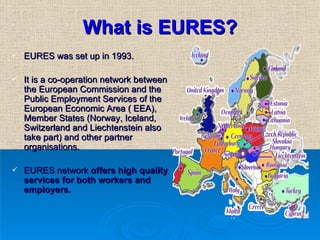
What is EURES? EURES was set up in 1993. It is a co-operation network between the European Commission and the Public Employment Services of the European Economic Area ( EEA), Member States (Norway, Iceland, Switzerland and Liechtenstein also take part) and other partner organisations.   EURES network  offers high quality services for both workers and employers.
EURES Aims The European Job Mobility Portal aims… to provide information about job vacancies in 31 European countries, in the European Economic Area ( EEA);  to inform, guide and advise potentially mobile workers on job opportunities as well as living and working conditions abroad;  - to assist employers wishing to recruit workers from other countries; - to provide advice and guidance to workers and employers in cross-border regions.
EURES in cross-border partnerships These partnerships bring together public employment and vocational training services, employers and trades union organisations, local authorities and other institutions dealing with employment and vocational training.  More than  600 000  people who live in one EU country and work in another have to cope with different national practices and legal systems.  They may come across administrative, legal or fiscal obstacles to mobility on a daily basis. EURES advisers provide specific advice and guidance on the rights and obligations of workers living in one country and working in another.
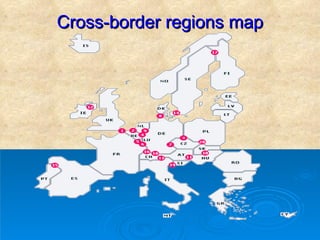
Cross-border regions map
EURES CV Online For Jobseekers EURES CV-online gives you the opportunity  to create a CV  and  to post it  online , thus making it visible to EURES advisers and registered employers.  Do not forget  to log in  to your account every once in a while to check out what has happened ( at least once a month ).  You may find  enquiries from employers, job ads, job vacancies, … You can  create and store search profiles  and  receive e-mail alerts  when jobs matching your profile become available. My EURES  is a service which is free of charge to both jobseekers and employers.
Benefits Of Working Abroad It’s the opportunity to: get new professional and personal skills by developing one’s professional competencies, self-confidence and communication ability; - expand one’s cultural background;  - to learn or improve a foreign language.
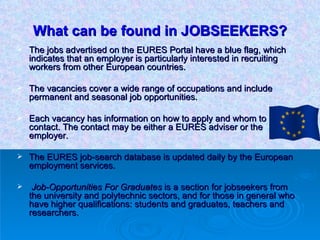
What can be found in JOBSEEKERS? The jobs advertised on the EURES Portal have a blue flag, which indicates that an employer is particularly interested in recruiting workers from other European countries.  The vacancies cover a wide range of occupations and include permanent and seasonal job opportunities.  Each vacancy has information on how to apply and whom to contact. The contact may be either a EURES adviser or the employer. The EURES job-search database is updated daily by the European employment services. Job-Opportunities For Graduates  is a section for jobseekers from the university and polytechnic sectors, and for those in general who have higher qualifications: students and graduates, teachers and researchers.
Employers’ section It helps European employers to find the workers they need to fill their vacancies and to provide useful information about recruitment on the European labour market. If employers need to recruit workers / employees, they can…  - consult the labour market information and statistics per country; look for CVs of suitable candidates and get in touch with them;  find out how to post jobs on the EURES portal;  - get information about the recruitment process abroad; - know of on-going EURES information & recruitment events in Europe.
Living   & Working Abroad   EURES provides  information of practical, legal and administrative questions  considering moving to or recruiting from another country.   The  Living and Working Conditions  database contains details on a number of important issues such as  finding accommodation, finding a school, taxes, cost of living, health, social legislation, comparability of qualifications,  etc.
EUROPASS http://europass.cedefop.europa.eu/europass/home/hornav/Introduction.csp?loc=en_GB
What is EUROPASS? Help you to make your skills and qualifications  clearly understood; Create your CV online, download it and update it at any time; Get information about EU programmes for education and training; Learn about the European Language Portfolio, which is a document for those who want to register their language learning and cultural experiences; Get information on Europass Mobility which is a record of a period of time that someone spent in another EU country for learning or training: a  workplacement in a company, an academic exchange programme, …
EUROPASS CURRICULUM VITAE The Europass CV is a document that enables you to make your skills and qualifications visible;  Read the instructions and some samples before creating your CV; Think of all the competences that you have: social, organizational, technical, computer, language or other skills!

EURES

  • 1.
    4th Comenius Meetingin Kirchheim Topics: Eures Europass-CV
  • 2.
    EUR opean E mployment S ervices http://ec.europa.eu/eures/home.jsp?lang=en
  • 3.
    What is EURES?EURES was set up in 1993. It is a co-operation network between the European Commission and the Public Employment Services of the European Economic Area ( EEA), Member States (Norway, Iceland, Switzerland and Liechtenstein also take part) and other partner organisations. EURES network offers high quality services for both workers and employers.
  • 4.
    EURES Aims TheEuropean Job Mobility Portal aims… to provide information about job vacancies in 31 European countries, in the European Economic Area ( EEA); to inform, guide and advise potentially mobile workers on job opportunities as well as living and working conditions abroad; - to assist employers wishing to recruit workers from other countries; - to provide advice and guidance to workers and employers in cross-border regions.
  • 5.
    EURES in cross-borderpartnerships These partnerships bring together public employment and vocational training services, employers and trades union organisations, local authorities and other institutions dealing with employment and vocational training. More than 600 000 people who live in one EU country and work in another have to cope with different national practices and legal systems. They may come across administrative, legal or fiscal obstacles to mobility on a daily basis. EURES advisers provide specific advice and guidance on the rights and obligations of workers living in one country and working in another.
  • 6.
  • 7.
    EURES CV OnlineFor Jobseekers EURES CV-online gives you the opportunity to create a CV and to post it online , thus making it visible to EURES advisers and registered employers. Do not forget to log in to your account every once in a while to check out what has happened ( at least once a month ). You may find enquiries from employers, job ads, job vacancies, … You can create and store search profiles and receive e-mail alerts when jobs matching your profile become available. My EURES is a service which is free of charge to both jobseekers and employers.
  • 8.
    Benefits Of WorkingAbroad It’s the opportunity to: get new professional and personal skills by developing one’s professional competencies, self-confidence and communication ability; - expand one’s cultural background; - to learn or improve a foreign language.
  • 9.
    What can befound in JOBSEEKERS? The jobs advertised on the EURES Portal have a blue flag, which indicates that an employer is particularly interested in recruiting workers from other European countries. The vacancies cover a wide range of occupations and include permanent and seasonal job opportunities. Each vacancy has information on how to apply and whom to contact. The contact may be either a EURES adviser or the employer. The EURES job-search database is updated daily by the European employment services. Job-Opportunities For Graduates is a section for jobseekers from the university and polytechnic sectors, and for those in general who have higher qualifications: students and graduates, teachers and researchers.
  • 10.
    Employers’ section Ithelps European employers to find the workers they need to fill their vacancies and to provide useful information about recruitment on the European labour market. If employers need to recruit workers / employees, they can… - consult the labour market information and statistics per country; look for CVs of suitable candidates and get in touch with them; find out how to post jobs on the EURES portal; - get information about the recruitment process abroad; - know of on-going EURES information & recruitment events in Europe.
  • 11.
    Living & Working Abroad EURES provides information of practical, legal and administrative questions considering moving to or recruiting from another country. The Living and Working Conditions database contains details on a number of important issues such as finding accommodation, finding a school, taxes, cost of living, health, social legislation, comparability of qualifications, etc.
  • 12.
  • 13.
    What is EUROPASS?Help you to make your skills and qualifications clearly understood; Create your CV online, download it and update it at any time; Get information about EU programmes for education and training; Learn about the European Language Portfolio, which is a document for those who want to register their language learning and cultural experiences; Get information on Europass Mobility which is a record of a period of time that someone spent in another EU country for learning or training: a workplacement in a company, an academic exchange programme, …
  • 14.
    EUROPASS CURRICULUM VITAEThe Europass CV is a document that enables you to make your skills and qualifications visible; Read the instructions and some samples before creating your CV; Think of all the competences that you have: social, organizational, technical, computer, language or other skills!