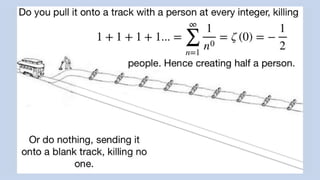
One pound for Zero pounds?
“Let’s say you sit in a pub, minding your own
business, when all of a sudden a stranger walks
up to you and offers you a bet:
We’ll choose two positive integers at random.
If they have any divisor in common (other than 1)
I’ll pay you a dollar, else you’ll pay me a dollar.”
Are you in? Is this a good bet for you?
Euler vs Riemann:
Why 0/0 = ?
Con-fusion or Confusion?
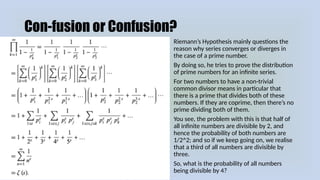
Riemann’s Hypothesis mainly questions the
reason why series converges or diverges in
the case of a prime number.
By doing so, he tries to prove the distribution
of prime numbers for an infinite series.
For two numbers to have a non-trivial
common divisor means in particular that
there is a prime that divides both of these
numbers. If they are coprime, then there’s no
prime dividing both of them.
You see, the problem with this is that half of
all infinite numbers are divisible by 2, and
hence the probability of both numbers are
1/2^2; and so if we keep going on, we realise
that a third of all numbers are divisible by
three.
So, what is the probability of all numbers
being divisible by 4?
Euler’s Zeta Function
Leonhard Euler’s prime harmonic series is defined for any number s
greater than 1 by the infinite sum:
He then found a connection between primes:
What Euler’s conjecture disagrees with Riemann’s Hypothesis is that
there is a cycle of fourths for each differentiated product. This is known
as the Taylor Series:
Looks confusing, but it really represent the bare bones of prime
differentiation. For instance if we took sin (x) and kept differentiating it,
after four cycles we return back to the original sin (x) that we inputted:
So if this is the case, if we did it with any
prime sequence, we would realise that it also
take four cycles to return back to the prime
sequence (a lot of painful maths required!!!).
So, why the hassle, Riemann?
Basel and adding infinity
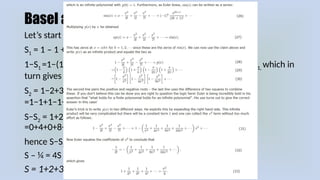
Let’s start with 1:
S1 = 1 – 1 + 1 – 1 + 1 – 1 ±
1−S1 =1−(1−1+1−1±…) =1−1+1−1+1 so we return to 1 – S
∓ 1 = S1, which in
turn gives S1 = ½
S2 = 1−2+3−4+5−6±… 2S2 = 1−2+3−4+5−6±… +1−2+3−4+5 …
∓
=1−1+1−1+1−1+1 ; so 2S
∓ 2 = S1 = ½ , which means S2 = ¼
S−S2 = 1+2+3+4+5+6+7+8+… −1+2−3+4−5+6−7+8 …
∓
=0+4+0+8+0+12+0+16+… leading to 4 + 8 + 12…
hence S−S2 = 4(1+2+3+4+5+…)
S – ¼ = 4S
S = 1+2+3+4+5+6+ … = −1/12
Now Calculus:
If we have the sum of all
numbers equal or bigger than 1
which is squared reciprocally:
This is the general function:
If we put -1 as s:
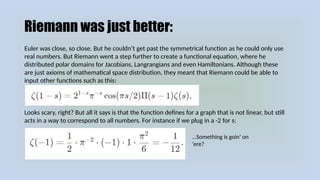
Riemann was just better:
Euler was close, so close. But he couldn’t get past the symmetrical function as he could only use
real numbers. But Riemann went a step further to create a functional equation, where he
distributed polar domains for Jacobians, Langrangians and even Hamiltonians. Although these
are just axioms of mathematical space distribution, they meant that Riemann could be able to
input other functions such as this:
Looks scary, right? But all it says is that the function defines for a graph that is not linear, but still
acts in a way to correspond to all numbers. For instance if we plug in a -2 for s:
…Something is goin’ on
‘ere?
Divergent… Convergent… Divergent… Convergent
This means that all
converging series has a
limit, but does this mean all
diverging series have no
limit?
Gaussian Integrals
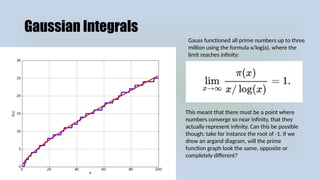
Gauss functioned all prime numbers up to three
million using the formula x/log(x), where the
limit reaches infinity:
This meant that there must be a point where
numbers converge so near infinity, that they
actually represent infinity. Can this be possible
though: take for instance the root of -1. If we
drew an argand diagram, will the prime
function graph look the same, opposite or
completely different?
Analytic Continuation
Take any real and imaginary number and plug it into the zeta function.
What would you realise?
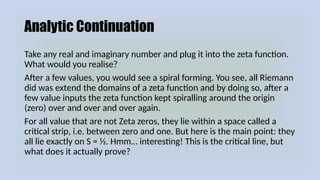
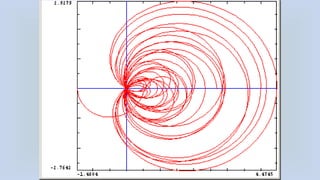
After a few values, you would see a spiral forming. You see, all Riemann
did was extend the domains of a zeta function and by doing so, after a
few value inputs the zeta function kept spiralling around the origin
(zero) over and over and over again.
For all value that are not Zeta zeros, they lie within a space called a
critical strip, i.e. between zero and one. But here is the main point: they
all lie exactly on S = ½. Hmm… interesting! This is the critical line, but
what does it actually prove?
Riemann’s One Million Dollar Question
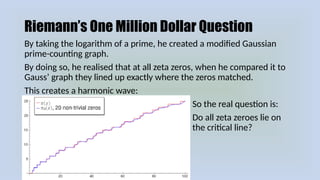
By taking the logarithm of a prime, he created a modified Gaussian
prime-counting graph.
By doing so, he realised that at all zeta zeros, when he compared it to
Gauss’ graph they lined up exactly where the zeros matched.
This creates a harmonic wave:
So the real question is:
Do all zeta zeroes lie on
the critical line?
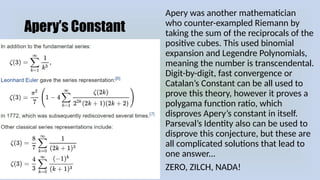
Apery’s Constant
Apery was another mathematician
who counter-exampled Riemann by
taking the sum of the reciprocals of the
positive cubes. This used binomial
expansion and Legendre Polynomials,
meaning the number is transcendental.
Digit-by-digit, fast convergence or
Catalan’s Constant can be all used to
prove this theory, however it proves a
polygama function ratio, which
disproves Apery’s constant in itself.
Parseval’s Identity also can be used to
disprove this conjecture, but these are
all complicated solutions that lead to
one answer...
ZERO, ZILCH, NADA!
WAFFLE
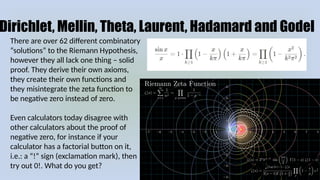
Dirichlet, Mellin, Theta, Laurent, Hadamard and Godel
There are over 62 different combinatory
“solutions” to the Riemann Hypothesis,
however they all lack one thing – solid
proof. They derive their own axioms,
they create their own functions and
they misintegrate the zeta function to
be negative zero instead of zero.
Even calculators today disagree with
other calculators about the proof of
negative zero, for instance if your
calculator has a factorial button on it,
i.e.: a “!” sign (exclamation mark), then
try out 0!. What do you get?
How the hell does this relate to NORMAL
maths
Riemann created a stump in the world of maths. He provided a conjecture that put a
dent in the laws and axioms or orders of numbers and created a world of deep
mathematical foundations that gave rise to logarithmic integrals, differential
functions and most notably the formation of series graph, a graph that you use every
single day without realising that the numbers on it don’t actually mean anything.
And the shape you are actually drawing only exists not because the numbers
represent the line boundary between the next number but rather because the
domain of that function – the first domain – is zero… zeta zero.
Hence, the reason 0 is indivisible by 0 is not because you mathematically can’t, it is
because there are no value that can create a zeta graph that doesn’t pass through
zero.
Voila.
Euler vs Riem           ann IC IC YEAH BOI.pptx

Euler vs Riem ann IC IC YEAH BOI.pptx

  • 1.
    One pound forZero pounds? “Let’s say you sit in a pub, minding your own business, when all of a sudden a stranger walks up to you and offers you a bet: We’ll choose two positive integers at random. If they have any divisor in common (other than 1) I’ll pay you a dollar, else you’ll pay me a dollar.” Are you in? Is this a good bet for you?
  • 2.
  • 3.
    Con-fusion or Confusion? Riemann’sHypothesis mainly questions the reason why series converges or diverges in the case of a prime number. By doing so, he tries to prove the distribution of prime numbers for an infinite series. For two numbers to have a non-trivial common divisor means in particular that there is a prime that divides both of these numbers. If they are coprime, then there’s no prime dividing both of them. You see, the problem with this is that half of all infinite numbers are divisible by 2, and hence the probability of both numbers are 1/2^2; and so if we keep going on, we realise that a third of all numbers are divisible by three. So, what is the probability of all numbers being divisible by 4?
  • 4.
    Euler’s Zeta Function LeonhardEuler’s prime harmonic series is defined for any number s greater than 1 by the infinite sum: He then found a connection between primes:
  • 5.
    What Euler’s conjecturedisagrees with Riemann’s Hypothesis is that there is a cycle of fourths for each differentiated product. This is known as the Taylor Series: Looks confusing, but it really represent the bare bones of prime differentiation. For instance if we took sin (x) and kept differentiating it, after four cycles we return back to the original sin (x) that we inputted: So if this is the case, if we did it with any prime sequence, we would realise that it also take four cycles to return back to the prime sequence (a lot of painful maths required!!!). So, why the hassle, Riemann?
  • 6.
    Basel and addinginfinity Let’s start with 1: S1 = 1 – 1 + 1 – 1 + 1 – 1 ± 1−S1 =1−(1−1+1−1±…) =1−1+1−1+1 so we return to 1 – S ∓ 1 = S1, which in turn gives S1 = ½ S2 = 1−2+3−4+5−6±… 2S2 = 1−2+3−4+5−6±… +1−2+3−4+5 … ∓ =1−1+1−1+1−1+1 ; so 2S ∓ 2 = S1 = ½ , which means S2 = ¼ S−S2 = 1+2+3+4+5+6+7+8+… −1+2−3+4−5+6−7+8 … ∓ =0+4+0+8+0+12+0+16+… leading to 4 + 8 + 12… hence S−S2 = 4(1+2+3+4+5+…) S – ¼ = 4S S = 1+2+3+4+5+6+ … = −1/12
  • 7.
    Now Calculus: If wehave the sum of all numbers equal or bigger than 1 which is squared reciprocally: This is the general function: If we put -1 as s:
  • 8.
    Riemann was justbetter: Euler was close, so close. But he couldn’t get past the symmetrical function as he could only use real numbers. But Riemann went a step further to create a functional equation, where he distributed polar domains for Jacobians, Langrangians and even Hamiltonians. Although these are just axioms of mathematical space distribution, they meant that Riemann could be able to input other functions such as this: Looks scary, right? But all it says is that the function defines for a graph that is not linear, but still acts in a way to correspond to all numbers. For instance if we plug in a -2 for s: …Something is goin’ on ‘ere?
  • 9.
    Divergent… Convergent… Divergent…Convergent This means that all converging series has a limit, but does this mean all diverging series have no limit?
  • 10.
    Gaussian Integrals Gauss functionedall prime numbers up to three million using the formula x/log(x), where the limit reaches infinity: This meant that there must be a point where numbers converge so near infinity, that they actually represent infinity. Can this be possible though: take for instance the root of -1. If we drew an argand diagram, will the prime function graph look the same, opposite or completely different?
  • 11.
    Analytic Continuation Take anyreal and imaginary number and plug it into the zeta function. What would you realise? After a few values, you would see a spiral forming. You see, all Riemann did was extend the domains of a zeta function and by doing so, after a few value inputs the zeta function kept spiralling around the origin (zero) over and over and over again. For all value that are not Zeta zeros, they lie within a space called a critical strip, i.e. between zero and one. But here is the main point: they all lie exactly on S = ½. Hmm… interesting! This is the critical line, but what does it actually prove?
  • 12.
    Riemann’s One MillionDollar Question By taking the logarithm of a prime, he created a modified Gaussian prime-counting graph. By doing so, he realised that at all zeta zeros, when he compared it to Gauss’ graph they lined up exactly where the zeros matched. This creates a harmonic wave: So the real question is: Do all zeta zeroes lie on the critical line?
  • 14.
    Apery’s Constant Apery wasanother mathematician who counter-exampled Riemann by taking the sum of the reciprocals of the positive cubes. This used binomial expansion and Legendre Polynomials, meaning the number is transcendental. Digit-by-digit, fast convergence or Catalan’s Constant can be all used to prove this theory, however it proves a polygama function ratio, which disproves Apery’s constant in itself. Parseval’s Identity also can be used to disprove this conjecture, but these are all complicated solutions that lead to one answer... ZERO, ZILCH, NADA!
  • 15.
  • 16.
    Dirichlet, Mellin, Theta,Laurent, Hadamard and Godel There are over 62 different combinatory “solutions” to the Riemann Hypothesis, however they all lack one thing – solid proof. They derive their own axioms, they create their own functions and they misintegrate the zeta function to be negative zero instead of zero. Even calculators today disagree with other calculators about the proof of negative zero, for instance if your calculator has a factorial button on it, i.e.: a “!” sign (exclamation mark), then try out 0!. What do you get?
  • 17.
    How the helldoes this relate to NORMAL maths Riemann created a stump in the world of maths. He provided a conjecture that put a dent in the laws and axioms or orders of numbers and created a world of deep mathematical foundations that gave rise to logarithmic integrals, differential functions and most notably the formation of series graph, a graph that you use every single day without realising that the numbers on it don’t actually mean anything. And the shape you are actually drawing only exists not because the numbers represent the line boundary between the next number but rather because the domain of that function – the first domain – is zero… zeta zero. Hence, the reason 0 is indivisible by 0 is not because you mathematically can’t, it is because there are no value that can create a zeta graph that doesn’t pass through zero. Voila.