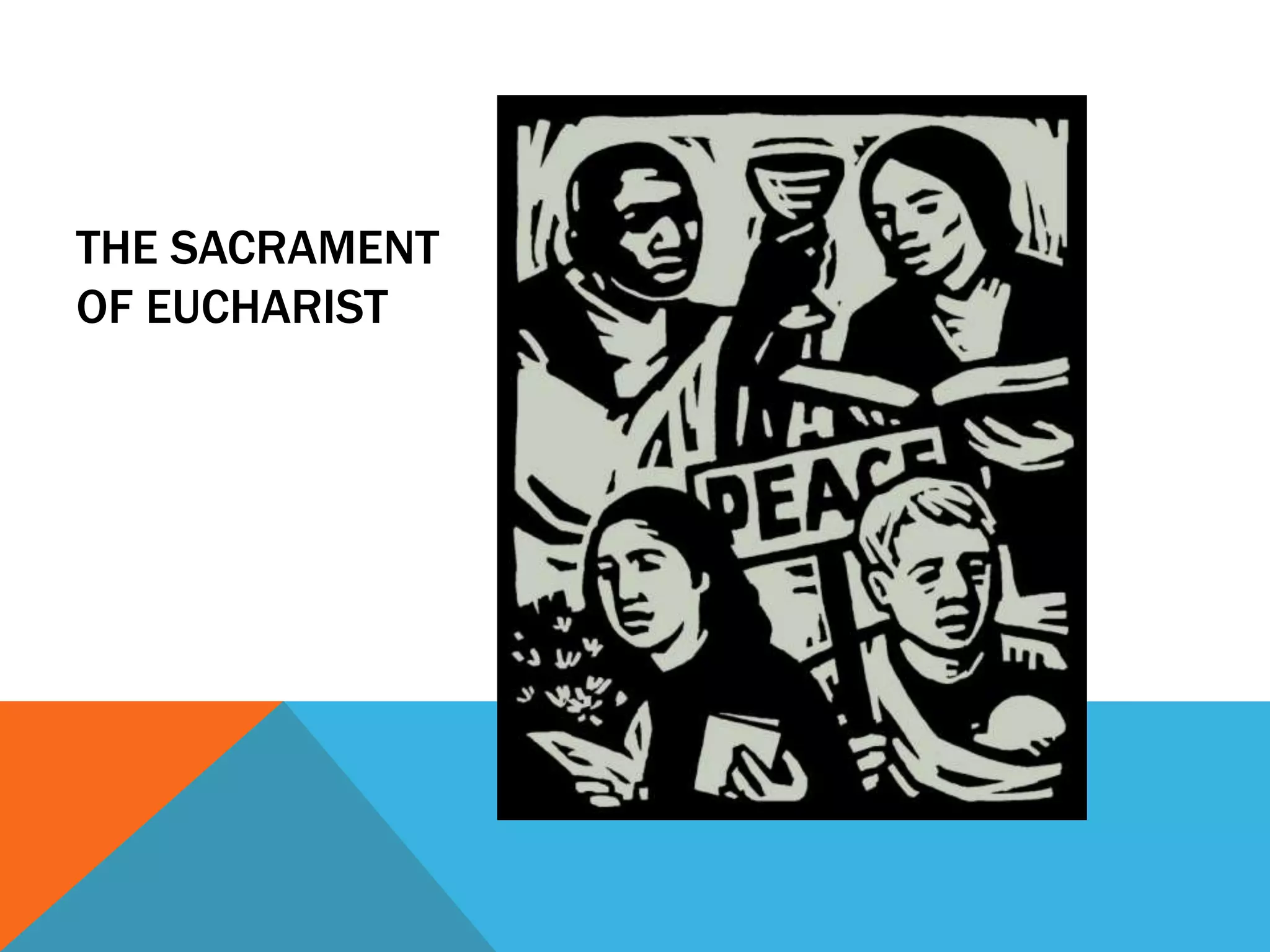
THE SACRAMENT
OF EUCHARIST
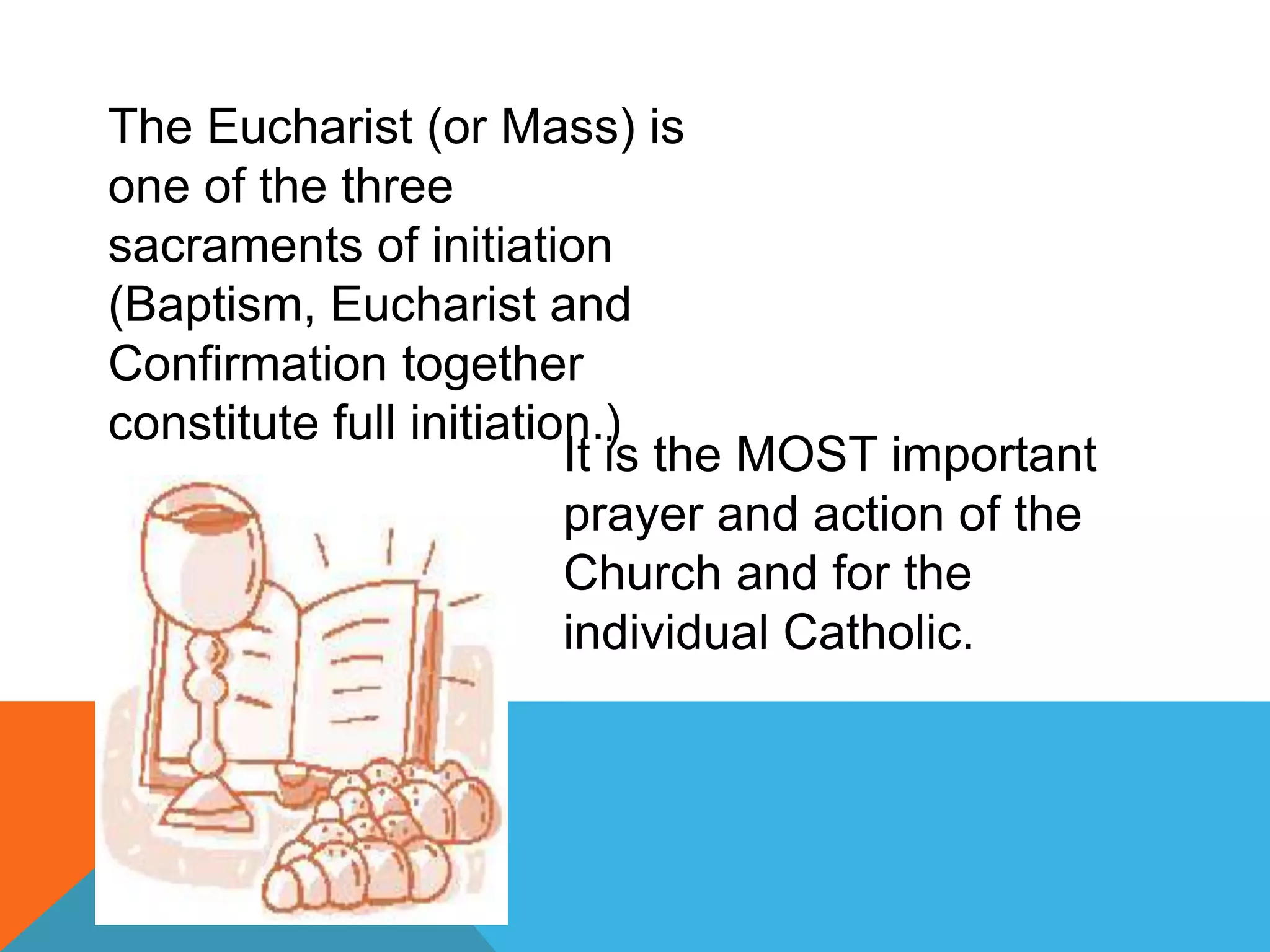
The Eucharist (or Mass) is
one of the three
sacraments of initiation
(Baptism, Eucharist and
Confirmation together
constitute full initiation.)
                         It is the MOST important
                         prayer and action of the
                         Church and for the
                         individual Catholic.
The real presence
                                     refers to the
                                     miracle of Christ’s
                                     presence under the
                                     species of bread
                                     and wine.
                                     The bread and the
                                     wine becomes the
                                     body and blood of
                                     Christ in a
                                     substantial way.
The word “transubstantiation” refers to the substantial presence of
Christ in the bread and wine even though the “accidents” or
appearance does not change. St. Thomas Aquinas coined the term.
THE EUCHARIST IS OFTEN
REFERRED TO AS HOLY COMMUNION?

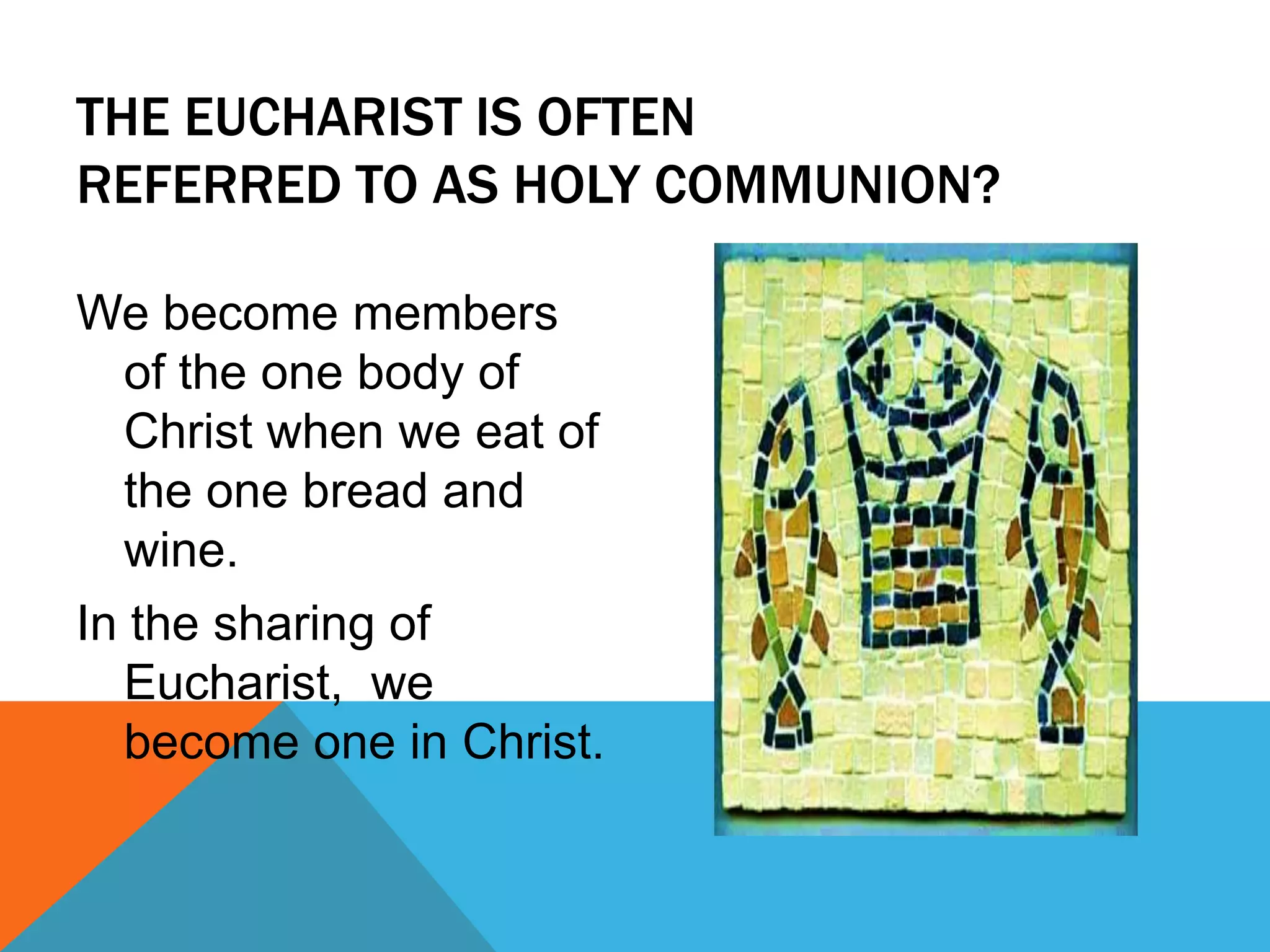
We become members
  of the one body of
  Christ when we eat of
  the one bread and
  wine.
In the sharing of
  Eucharist, we
  become one in Christ.
THE WORD “EUCHARIST”

Means “to give thanks”
As we gather for the
celebration, each to his/her proper
role, enters fully into the
Mass, because it is both the right and
duty of the baptized person to do so.
GIVING THANKS….
In our lives, how do we show
  thanks?
What words do we use?
Facial expressions, body
 language?
Actions?
Thoughts, feelings?
Full, active
participation in Mass is:
  a right because the
Eucharist, provides the
nourishment and grace
we need to live out our
       baptismal call.
          It is a duty
 because without the
 Eucharist, we cannot
  fully live the life to
  which God calls us.
The Constitution on Sacred Liturgy
  (Sacrosanctum Concilium) is the Vatican
  II document that legislates liturgy.

The Roman Missal
 outlines the rubrics, ritual prayers,
 gestures and postures of the Church
 when gathered for ritual prayer.


         LITURGY IN THE
     ROMAN CATHOLIC CHURCH
The word “liturgy”
originally meant:
1. a public work
2. a service in the
name of/ on behalf of
the people.

The Christian
meaning of the word
“liturgy” is
“participation in the
work of God”. (CCC
1069)
LITURGY IS

• Public
  •Communal
        •Ritual
             Prayer of the
Church.
LITURGY IS WORSHIP
Worship was the first area to be
  considered at the Second Vatican
  Council.
Worship is the way in which we praise and
 give glory to God.
Worship is foundational to all the work of the
 Church; it is the MOST important action of
 the Church. Everything else flows from and
 toward worship.
FOUR IDEALS FROM VATICAN II

1. The Christian life is to be lived with
   vigor
2. The Church needs to change to meet
   the needs of the world – The Church
   brings Christ to all people, all times, all
   cultures
3. The Church is not united, but unity is
   desired
4. The Church has much to offer the world
EUCHARIST…
is source and summit of Christian
   living – source, because we receive the
   grace we need to live the life to which God
   calls us, and summit because at Mass we
   have the most intimate connection with
   Christ that is possible in this life.
It is a sign   and instrument of
  unity.
    • Eucharist both demonstrates
      unity and makes unity possible.
CHRIST IS TRULY PRESENT
    AT MASS IN FOUR WAYS:
The gathered assembly
The Word proclaimed
The person of the Priest
The consecrated bread and wine
STRUCTURE OF MASS

Liturgy of Word
Liturgy of Eucharist
GATHERING RITES: A TIME FOR UNITY

Coming from our individual lives, bound
 by our common baptism, we form the
 Body of Christ, the Assembly.
Penitential Rite acknowledges
 individual responsibility to the
 community.
LITURGY OF THE WORD: A TIME TO LISTEN
Share the stories of faith:
 First Reading
 Psalm
 Second Reading
 Gospel
 Homily
LITURGY OF THE WORD

 In Scripture, it is God who speaks directly to us,
  individually and as a community
 Dei Verbum (Constitution on Divine Revelation)
  defines Catholic understanding of Scripture.
 Three-year cycle for Sunday Lectionary (2 year-cycle
  for daily readings)
 Homily opens Scriptures for the gathered assembly.
TRANSITIONING FROM WORD TO
EUCHARIST


 Recitation of Creed (Nicene or
  Apostles)
 Prayers of the Faithful
LITURGY OF EUCHARIST

Collection of gifts
Presentation of gifts
Early Church practices contained in current
 prayers and gestures
We place ourselves, along with the bread
 and wine, on the altar, asking that we, too, be
 transformed.
LITURGY OF EUCHARIST
Eucharistic Prayer
Our Father
Sign of Peace
Sharing in meal: we become what we consume:
  Real Presence of Christ
Sending to bring Christ to the world, to do the
  essential work of the laity: to make the world
  holy.
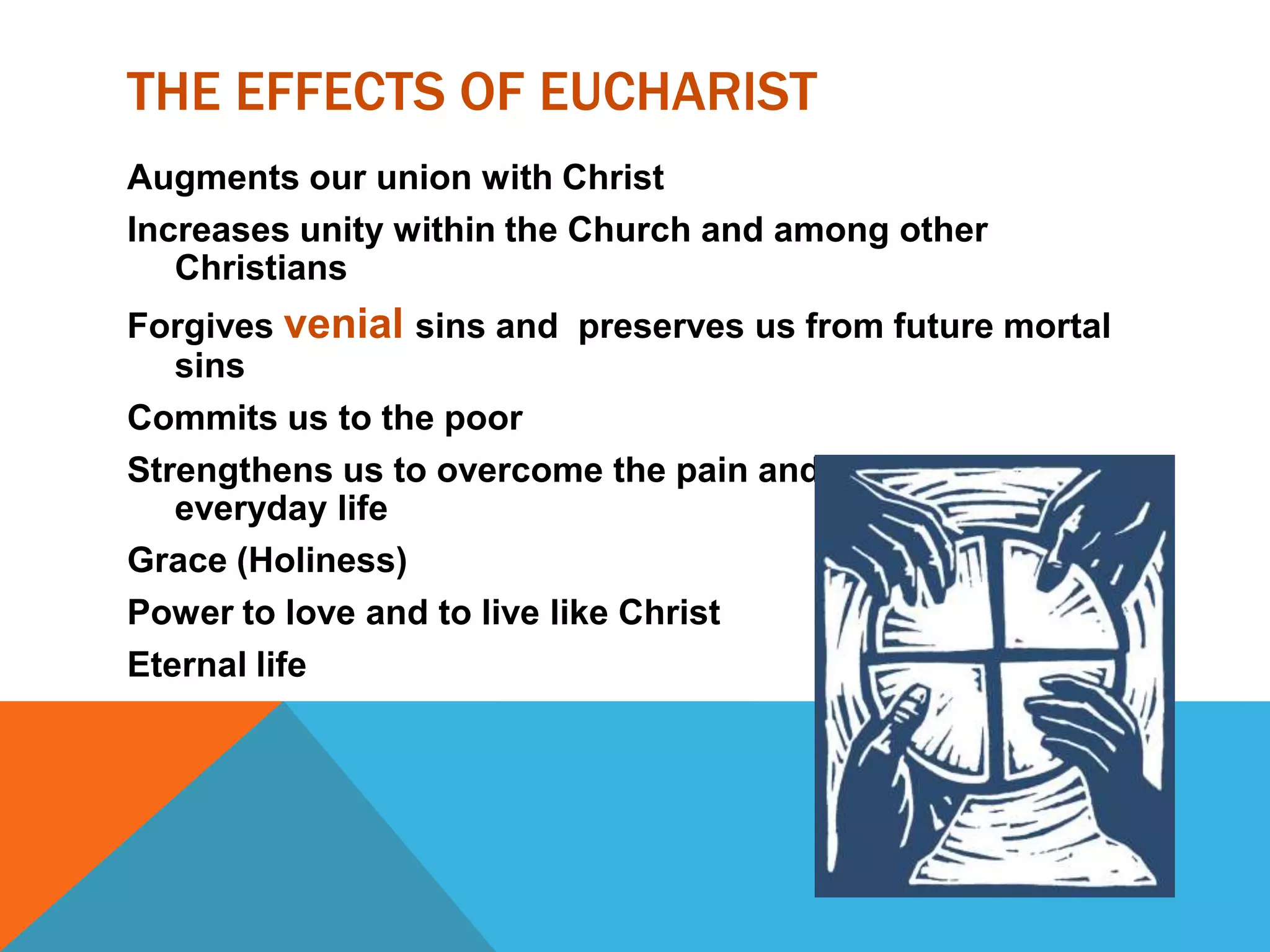
THE EFFECTS OF EUCHARIST
Augments our union with Christ
Increases unity within the Church and among other
   Christians
Forgives venial sins and preserves us from future mortal
   sins
Commits us to the poor
Strengthens us to overcome the pain and burden of
   everyday life
Grace (Holiness)
Power to love and to live like Christ
Eternal life
FORM OF THE SACRAMENT
The Consecration of the Bread and wine occurs
  when the priest says the words of institution,
  given to us by Christ:
Take this, all of you, and eat of it, for this is my
  Body, which will be given up for you.
Take this, all of you, and drink from it, for thei sis
  the chalice of my Blood, the Blood of a new and
  eternal covenant, which will be poured out for
  you and for many for the forgiveness of sins.
Do this in memory of me.
MATTER OF THE SACRAMENT
          • Wheat bread
       • Wine made of grapes
MINISTER OF THE SACRAMENT OF EUCHARIST

• Nobody says Mass like a priest.
 • Priests, bishops (the Pope is the
              Bishop of Rome.)
REQUIREMENTS OF THE SACRAMENT

•   In the Roman Rite, reaching the age of reason
    (in Eastern rite, at time of baptism.)
•   Being in a state of grace (no mortal sins)
•   One-hour fast from food and drink (except
    water) before receiving
•   Must be received at least once a year, during
    the Easter season.
WHY DO WE….
At tables, surface questions -

   WHY do we do…. at
         Mass?
  WHY don’t we do……at
         Mass?

Eucharist.rcia.2.13 Storms

  • 1.
  • 2.
    The Eucharist (orMass) is one of the three sacraments of initiation (Baptism, Eucharist and Confirmation together constitute full initiation.) It is the MOST important prayer and action of the Church and for the individual Catholic.
  • 3.
    The real presence refers to the miracle of Christ’s presence under the species of bread and wine. The bread and the wine becomes the body and blood of Christ in a substantial way. The word “transubstantiation” refers to the substantial presence of Christ in the bread and wine even though the “accidents” or appearance does not change. St. Thomas Aquinas coined the term.
  • 4.
    THE EUCHARIST ISOFTEN REFERRED TO AS HOLY COMMUNION? We become members of the one body of Christ when we eat of the one bread and wine. In the sharing of Eucharist, we become one in Christ.
  • 5.
    THE WORD “EUCHARIST” Means“to give thanks” As we gather for the celebration, each to his/her proper role, enters fully into the Mass, because it is both the right and duty of the baptized person to do so.
  • 6.
    GIVING THANKS…. In ourlives, how do we show thanks? What words do we use? Facial expressions, body language? Actions? Thoughts, feelings?
  • 7.
    Full, active participation inMass is: a right because the Eucharist, provides the nourishment and grace we need to live out our baptismal call. It is a duty because without the Eucharist, we cannot fully live the life to which God calls us.
  • 8.
    The Constitution onSacred Liturgy (Sacrosanctum Concilium) is the Vatican II document that legislates liturgy. The Roman Missal outlines the rubrics, ritual prayers, gestures and postures of the Church when gathered for ritual prayer. LITURGY IN THE ROMAN CATHOLIC CHURCH
  • 9.
    The word “liturgy” originallymeant: 1. a public work 2. a service in the name of/ on behalf of the people. The Christian meaning of the word “liturgy” is “participation in the work of God”. (CCC 1069)
  • 10.
    LITURGY IS • Public •Communal •Ritual Prayer of the Church.
  • 11.
    LITURGY IS WORSHIP Worshipwas the first area to be considered at the Second Vatican Council. Worship is the way in which we praise and give glory to God. Worship is foundational to all the work of the Church; it is the MOST important action of the Church. Everything else flows from and toward worship.
  • 12.
    FOUR IDEALS FROMVATICAN II 1. The Christian life is to be lived with vigor 2. The Church needs to change to meet the needs of the world – The Church brings Christ to all people, all times, all cultures 3. The Church is not united, but unity is desired 4. The Church has much to offer the world
  • 13.
    EUCHARIST… is source andsummit of Christian living – source, because we receive the grace we need to live the life to which God calls us, and summit because at Mass we have the most intimate connection with Christ that is possible in this life. It is a sign and instrument of unity. • Eucharist both demonstrates unity and makes unity possible.
  • 14.
    CHRIST IS TRULYPRESENT AT MASS IN FOUR WAYS: The gathered assembly The Word proclaimed The person of the Priest The consecrated bread and wine
  • 15.
    STRUCTURE OF MASS Liturgyof Word Liturgy of Eucharist
  • 16.
    GATHERING RITES: ATIME FOR UNITY Coming from our individual lives, bound by our common baptism, we form the Body of Christ, the Assembly. Penitential Rite acknowledges individual responsibility to the community.
  • 17.
    LITURGY OF THEWORD: A TIME TO LISTEN Share the stories of faith: First Reading Psalm Second Reading Gospel Homily
  • 18.
    LITURGY OF THEWORD  In Scripture, it is God who speaks directly to us, individually and as a community  Dei Verbum (Constitution on Divine Revelation) defines Catholic understanding of Scripture.  Three-year cycle for Sunday Lectionary (2 year-cycle for daily readings)  Homily opens Scriptures for the gathered assembly.
  • 19.
    TRANSITIONING FROM WORDTO EUCHARIST Recitation of Creed (Nicene or Apostles) Prayers of the Faithful
  • 20.
    LITURGY OF EUCHARIST Collectionof gifts Presentation of gifts Early Church practices contained in current prayers and gestures We place ourselves, along with the bread and wine, on the altar, asking that we, too, be transformed.
  • 21.
    LITURGY OF EUCHARIST EucharisticPrayer Our Father Sign of Peace Sharing in meal: we become what we consume: Real Presence of Christ Sending to bring Christ to the world, to do the essential work of the laity: to make the world holy.
  • 22.
    THE EFFECTS OFEUCHARIST Augments our union with Christ Increases unity within the Church and among other Christians Forgives venial sins and preserves us from future mortal sins Commits us to the poor Strengthens us to overcome the pain and burden of everyday life Grace (Holiness) Power to love and to live like Christ Eternal life
  • 23.
    FORM OF THESACRAMENT The Consecration of the Bread and wine occurs when the priest says the words of institution, given to us by Christ: Take this, all of you, and eat of it, for this is my Body, which will be given up for you. Take this, all of you, and drink from it, for thei sis the chalice of my Blood, the Blood of a new and eternal covenant, which will be poured out for you and for many for the forgiveness of sins. Do this in memory of me.
  • 24.
    MATTER OF THESACRAMENT • Wheat bread • Wine made of grapes MINISTER OF THE SACRAMENT OF EUCHARIST • Nobody says Mass like a priest. • Priests, bishops (the Pope is the Bishop of Rome.)
  • 25.
    REQUIREMENTS OF THESACRAMENT • In the Roman Rite, reaching the age of reason (in Eastern rite, at time of baptism.) • Being in a state of grace (no mortal sins) • One-hour fast from food and drink (except water) before receiving • Must be received at least once a year, during the Easter season.
  • 26.
    WHY DO WE…. Attables, surface questions - WHY do we do…. at Mass? WHY don’t we do……at Mass?