EUCHARIST - SOURCE AND SUMMIT of the CHRISTIAN LIFE
1.
RCIA – TheSacraments of Initiation,Week
#09
SOURCE AND SUMMIT
OF THE
CHRISTIAN LIFE
2.
THE EUCHARIST
•is thesource and summit of the
Christian life (cf. LG 11; CCC 1324)
•the Eucharist is the sum and
summary of our faith
3.
THE EUCHARIST
•originates fromthe Greek
word eucharistia, meaning
thanksgiving.
•It is called: Eucharist, because it is an
action of thanksgiving to God. (CCC 1328)
4.
THE EUCHARIST
•is howCatholics worship God as
members of Christ’s Body, the Church.
•Catholics in general realize in some way
that “going to Mass” is the most basic
action of Catholic worship.
5.
MOTIVATION & UNDERSTANDING
•“have to go” to avoid mortal sin,
• to obey parents.
• Some go out of routine;
• social conformity, to be with their social group of
friends, or even to show off their new clothes.
• to win the favors sought from God.
6.
DIFFERENT NAMES
• Lord'sSupper
• Breaking of Bread
• Holy Sacrifice
• Holy and Divine Liturgy
• Sacred Mysteries
• Holy Communion
7.
CHRIST INSTITUTED THEEUCHARIST
• Matthew 26:26-30
• Mark 14:22-26
• Luke 22:14-20
• 1 Corinthians 11:23-26
• John 6:22-59 (The Bread of Life Discourse)
8.
"DO THIS INMEMORY OF ME"
• The Eucharist, the sacrament of our salvation
accomplished by Christ on the cross (ccc 1359)
• The Eucharist is the memorial of Christ's Passover,
the making present and the sacramental offering of
his unique sacrifice (ccc1362)
• The Eucharist is thus a sacrifice because it re-
presents (makes present) the sacrifice of the cross (ccc
1366)
9.
THIS IS MYBODY…
THIS IS MY BLOOD…
• In the most blessed sacrament of the Eucharist
"the body and blood, together with the soul and
divinity, of our Lord Jesus Christ and,
therefore, the whole Christ is truly, really, and
substantially contained. - Council of Trent (1551): DS 1651.
• "he is present ... most especially in the
Eucharistic species.
10.
TRANSUBSTANTIATION
• that bythe consecration of the bread and wine
there takes place a change
of the whole substance of the bread into the
substance of the body of Christ our Lord and of
the whole substance of the wine into the
substance of his blood. (ccc 1376)
11.
•“The presence ofChrist’s true body and
blood in this sacrament cannot be
detected by sense, nor understanding,
but by faith alone, which rests upon
divine authority” (Saint Thomas Aquinas)
12.
"TAKE THIS ANDEAT IT, ALL OF YOU":
COMMUNION
• The Lord addresses an invitation to us, urging us
to receive him in the sacrament of the Eucharist:
"Truly, I say to you, unless you eat the flesh of the
Son of man and drink his blood, you have no life
in you. (ccc 1384)
“sacrament of love, a sign of unity, a bond of charity, a Paschal
Banquet” 1382
13.
TO RESPOND TOTHIS INVITATION
•We must prepare ourselves
•We must be in a state of grace
•We must fast (ccc 1385-1387)
14.
THE FRUITS OFHOLY COMMUNION
• Holy Communion augments our union
with Christ. 1391
•Holy Communion separates us from sin. 1393
•The unity of the Mystical Body: the
Eucharist makes the Church. 1396
15.
TWO GREAT PARTS
•Theliturgy of the Word and
•The liturgy of the Eucharist
together form "one single act of worship"
16.
• the gathering,the liturgy of the Word, with
readings, homily and general intercessions;
• the liturgy of the Eucharist, with the
presentation of the bread and wine, the
consecratory thanksgiving, and communion.
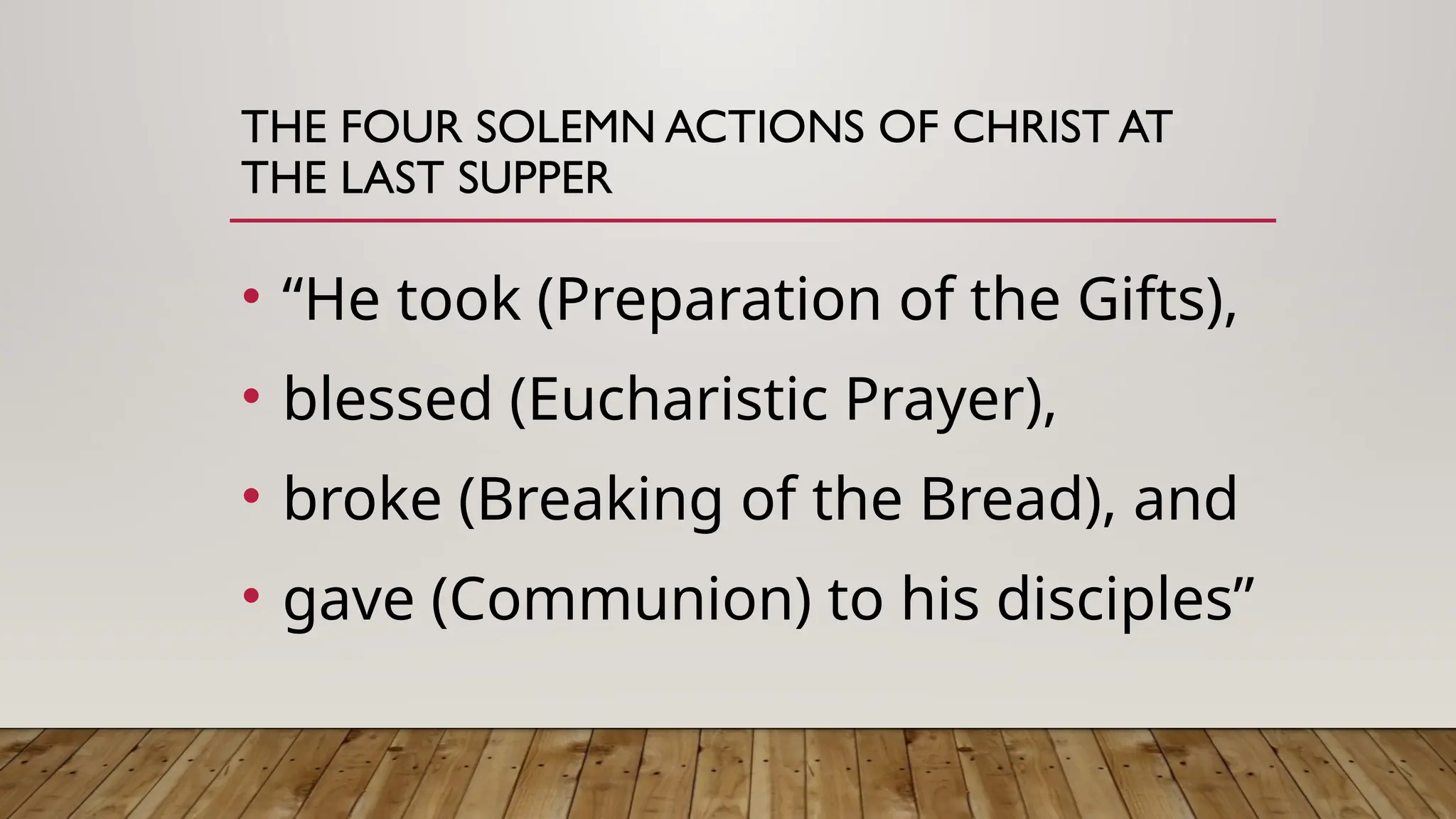
17.
THE FOUR SOLEMNACTIONS OF CHRIST AT
THE LAST SUPPER
• “He took (Preparation of the Gifts),
• blessed (Eucharistic Prayer),
• broke (Breaking of the Bread), and
• gave (Communion) to his disciples”
Editor's Notes
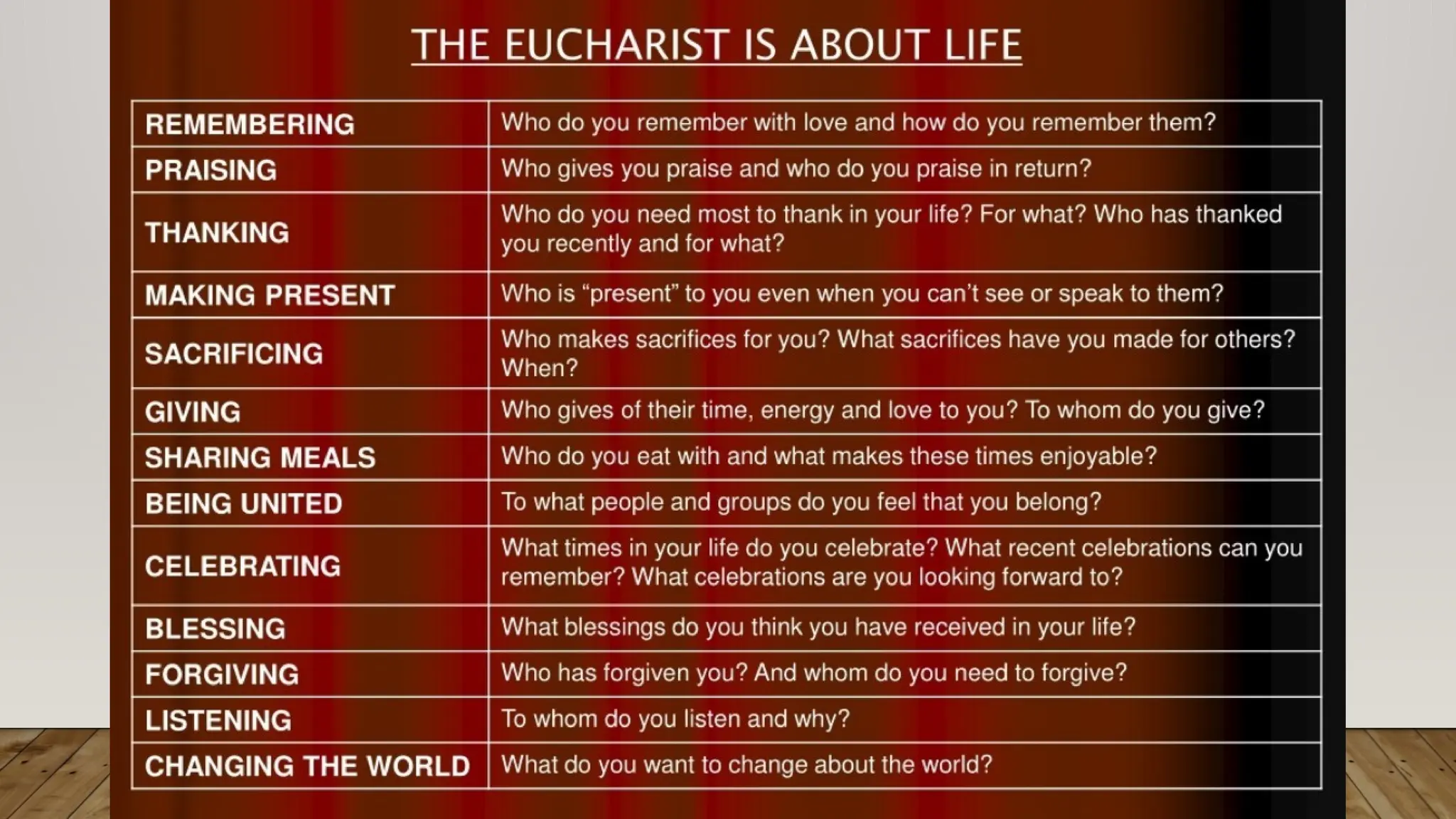
#2 welcome, participation
Call to bring closer to God
Talk and listen – praising, thanking, listening
Freedom to be the person God wants us
Sacrificing, union with God
Be like Christ, center of life
Being united, to belong
Forgiving and reconciliation
We are the church
Need to change follow Christ – mission
commitment
#5 The Mass or Eucharistic celebration has become perhaps the most familiar religious activity in Filipino society __ some would say so familiar that at times it has become routine or taken for granted.
#6 Kailangang magsimba -maiwasan ang kasalanang mortal
-sundin ang mga magulang
Nakagawian na
makasama ang barkada
Ipagpasikat o pabinyagan ang bagong kasuotan
Ritwal para matamo ang pabor na hiniling sa Diyos
Wag mong gawing washing machine ang Diyos
#7 Lord's Supper, because of its connection with the supper on the eve of his Passion
Breaking of Bread because Jesus used this rite at the Last Supper
Holy Sacrifice, because it makes present the one sacrifice of Christ
Holy and Divine Liturgy, because the Church's whole liturgy finds its center and most intense expression in the celebration
Holy Communion, because by this sacrament we unite ourselves to Christ
#9 the memorial is not merely the recollection of past events but the proclamation of the mighty works wrought by God for men
In the Eucharist Christ gives us the very body which he gave up for us on the cross, the very blood which he "poured out for many for the forgiveness of sins
#10 Here the three meanings of “present” come together: Christ in the Eucharist is
present, not absent, but really here;
present, not past, but happening now; and
presented as a gift (a “present”), really given; offered, not withheld.
#11 The greatness of the Eucharist is known only to faith, not to the feelings or the senses or the sciences
#12 The Eucharist doesn’t look like Christ; thus, it tests not only our sight but also our faith: do we believe God’s word or our human senses?
Just as the Eucharist doesn’t look like Christ to our outer senses, it doesn’t feel like Christ to our emotions.
Here again it tests our faith.
A faith that does not go beyond human feelings is not faith at all, just as a faith that does not go beyond seeing – a faith that says,“seeing is believing” – is no faith at all.
#13 To receive communion is to receive Christ himself who has offered himself for us.
#15 The principal fruit of receiving the Eucharist in Holy Communion is an intimate union with Christ Jesus. Indeed, the Lord said: "He who eats my flesh and drinks my blood abides in me, and I in him.
shed for the many for the forgiveness of sins.
Because there is one bread, we who are many are one body, for we all partake of the one bread:
#19 welcome, participation
Call to bring closer to God
Talk and listen – praising, thanking, listening
Freedom to be the person God wants us
Sacrificing, union with God
Be like Christ, center of life
Being united, to belong
Forgiving and reconciliation
We are the church
Need to change follow Christ – mission
commitment