The Sacraments of Christ
Lesson Objectives
Doctrine:
Discuss intelligently the Seven
Sacraments, its significance, effects and
necessity
Morals:
Participate actively in the discussion
Worship:
Create an action plan to show how can
live the values from each sacrament
Saint Augustine
says;
O Sacrament of love, sign
of our unity, bond of our
fraternity, whoever long
for life have here its very
source. Let them come
here and believe; unite
with You and live.
(Sermon on John 26, 13)
Sign, Symbol, Sacrament
 St. Thomas
Aquinas taught
that human
development is
marked by seven
stages which
parallel the seven
sacraments.
 We are born: Baptism
 We grow: Confirmation
 We are fed: Eucharist
 We are healed:
Penance
 We recover: Anointing
of the Sick
 We need and form
family: Matrimony
 We need and respond
to leaders: Holy Orders
Signs and Symbols
Three definitions of Sacrament
 St. Paul – sacramentum = mysterion
God’s hidden plan to fulfill all things in
Christ.
 St. Augustine stressed sign and symbol
(something concrete that points to
something else.)
 St. Thomas Aquinas added that
sacraments are efficacious signs or
symbols of grace. They effect, cause, and
are what they signify.
Sacraments ARE what they symbolize
 To be a sacrament, a sign or symbol must
do the following:
 Lead us to God
 Come from God
 Be an action of God
The best example
of a sacrament is
Jesus Christ himself.
The Primordial Sacrament
 Jesus is the
starting point of all
sacraments.
 Jesus is the perfect
sign of God’s great
love for us.
 The fundamental
nature of a
sacrament is
revealed in Jesus.
Liturgy (the Work of the People)
 The first and most important work
of the Church is to make present
Christ’s Paschal Mystery here and
now. We do this in liturgy.
 All the sacraments are liturgy – the
work of the people…none are
private affairs.
 Every sacrament is a community
affair – an affair of the Church.
Jesus is really present in Eucharist
 Jesus is present in the priest, the minister
of the sacrament.
 Jesus is present when the Holy Scriptures
are read.
 Jesus is present in the community
assembled
 Jesus is really present in the consecrated
species of bread and wine.
The Church as Sacrament
 The Church is a
mystery.
 The Church is
beloved of Christ.
 The Church is an
efficacious symbol.
Council of Florence
 Proper matter – the prescribed
materials.
 Correct words or form – the
prescribed words and gestures.
 Designated minister – the
prescribed minister.
The Seven Sacraments
 The Sacraments of Initiation –
Baptism, Confirmation, Eucharist.
 The Sacraments of Healing –
Reconciliation (Penance), Anointing of
the Sick.
 The Sacraments at the Service
of Communion – Matrimony,
Holy Orders.
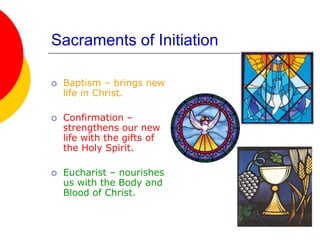
Sacraments of Initiation
 Baptism – brings new
life in Christ.
 Confirmation –
strengthens our new
life with the gifts of
the Holy Spirit.
 Eucharist – nourishes
us with the Body and
Blood of Christ.
Baptism Rites
 Rite of Christian
Initiation of Adults
(RCIA) - A process for
adults culminating in the
celebration of all three
sacraments of initiation at
the Easter Vigil.
 Rite of Baptism of
Children - People did not
want their children to wait
until adulthood to be re-
born in Christ’s life…infant
baptism became prevalent.
Four Steps of RCIA
 Evangelization – a person hears the word of
God and responds to it. It is followed by a rite
of acceptance
 Catechumenate – over the course of a year,
catechumens study the faith in special parish
classes, are mentored by a sponsor, do
service, and participate in the Liturgy of the
Word at Mass. On the first Sunday of Lent,
candidates are enrolled in the Book of the
Elect by the bishop.
Four Steps of RCIA
 Purification and Enlightenment – During Lent,
catechumens scrutinize their lives and do
penance. They receive the Lord’s Prayer and the
Creed on which to center their lives. At the end of
this period they receive the three sacraments of
initiation at the Easter Vigil Mass.
 Mystagogia – The newly baptized neophytes
continue to meet with one another after Easter
until Pentecost, gradually taking their place in the
Church.
“Cradle Catholics”
 Most Catholics are initiated into the
Church as infants through the Rite of
Baptism of Children.
 The child’s parents and godparents
speak in the name of the child.
 Catechesis takes place after baptism.
 Formation is gradual as the child grows
 The other sacraments of initiation are
received at a later time.
The Essential Rite of Baptism
 Proper matter: Water
 Correct words or
form: Triple pouring
of or immersion in
water with the words,
“I baptize you in the
name of the Father,
and of the Son, and of
the Holy Spirit.”
 Designated minister:
bishop, priest, or
deacon
Effects of Baptism
 Washes away original sin and any
other sins and the punishment due.
 Makes us children of God and temples
of the Holy Spirit.
 Welcomes us as members of the
Church, the Body of Christ.
 Marks us forever as sharers in the
common priesthood of all believers,
and in Christ’s mission of justice and
peace.
Celebration of the Sacrament of Baptism
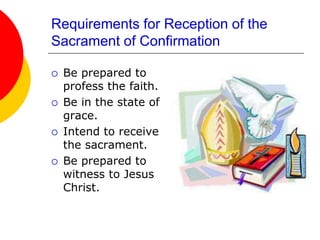
Requirements for Reception of the
Sacrament of Confirmation
 Be prepared to
profess the faith.
 Be in the state of
grace.
 Intend to receive
the sacrament.
 Be prepared to
witness to Jesus
Christ.
The Essential Rite of Confirmation
 Proper matter: Chrism
 Correct words or
form: Laying on of
hands and anointing
with chrism on the
forehead with the
words: "(Name), be
sealed with the gift of
the Holy Spirit."
 Designated minister:
Bishop
The Sacrament of the
Eucharist was instituted
by Christ during the Last
Supper (Luke 22: 19).
On the same night, Jesus
also instituted the
Sacrament of
Ordination, because
Eucharist and Priesthood
are complementary.
WHO INSTITUTED THE
SACRAMENT OF THE EUCHARIST?
Sons of Holy Mary Immaculate
The Eucharist, from the Greek word “eucharistein”
meaning thanksgiving, is the Sacrament that:
1. gives us the Body and Blood of Christ;
2. reenacts his Sacrifice on the Cross.
WHAT IS THE EUCHARIST?
Sons of Holy Mary Immaculate
Jesus instituted the
Eucharist for two
reasons:
1. to perpetuate the
Sacrifice of the
Cross until he will
come again;
2. to give us his
Body and Blood.
WHY DID JESUS
INSTITUTE THE EUCHARIST?
Sons of Holy Mary Immaculate
The Eucharist is the
memorial of the
Sacrifice of Christ
because, whenever we
celebrate the Mass, we
sacramentally
reenact his passion,
death, and
resurrection.
WHY IS THE
EUCHARIST THE
"MEMORIAL" OF THE
SACRIFICE OF CHRIST?
Sons of Holy Mary Immaculate
The Eucharist is the
source and summit
of the life of the
Church because it
contains the whole
spiritual wealth of the
Church - namely
Christ himself.
WHY IS THE
EUCHARIST THE
"SOURCE AND
SUMMIT"
OF THE LIFE OF THE
CHURCH?
Sons of Holy Mary Immaculate
This Sacrament is known by 5 different names in accordance with the
various perspectives:
1. EUCHARIST - from the Greek word “eucharistein” meaning
thanksgiving, to emphasize that the reason for the Sacrament is to give
thanks to God for the beauty of creation and the wonder of redemption.
2. THE LORD’S SUPPER - to recall that the institution of the Sacrament
was done when he was at table in the Cenacle with his Apostles.
3. THE BREAKING OF BREAD - to underline the action through which
Christ distributed the consecrated Bread during the Last Supper.
4. THE HOLY SACRIFICE OF THE MASS - to profess that the
Sacrament is a memorial, or reenactment, of the Lord's passion, death,
and resurrection.
5. THE MOST BLESSED SACRAMENT - to remind that the real
presence of Jesus in the Sacred Species does not end with the Mass, but
continues when they are preserved in the Tabernacle.
WHAT IS THIS SACRAMENT CALLED?
Sons of Holy Mary Immaculate
The Sacred Vestments are the clothing used by
ordained persons, or by acolytes and ministers,
during liturgical celebrations.
SACRED VESTMENTS
Cassock
& Cotta
Alb
& Stole
Chasuble Cope Deacon’s
Stole
Dalmatic
Sons of Holy Mary Immaculate
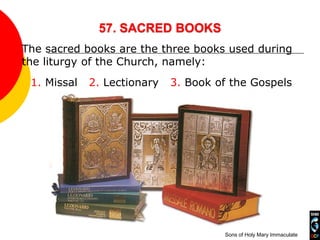
57. SACRED BOOKS
The sacred books are the three books used during
the liturgy of the Church, namely:
1. Missal 2. Lectionary 3. Book of the Gospels
Sons of Holy Mary Immaculate
The Missal is
the book
containing all
the prayers and
rites used by
the priest
during the
Mass, and it is
kept on the
altar.
MISSAL
Sons of Holy Mary Immaculate
 The Lectionary is the book that contains all the
readings used during the Mass.
 First Reading, Responsorial Psalm, and Second
Reading are read by lay people; while the Gospel is
reserved for the priest or the deacon.
 The Lectionary is kept on the ambo.
LECTIONARY
Sons of Holy Mary Immaculate
 The Book of the
Gospels, also called
“Evangelarium,” is the
book that contains only
the readings of the
Gospel.
 It is brought in during
the entrance procession
and placed on the altar.
After the Alleluia, it is
brought to the ambo
for the proclamation of
the Gospel.
BOOK OF THE GOSPELS
Sons of Holy Mary Immaculate
The Sacred Vessels are the vessels used for the
liturgical celebrations.
SACRED VESSELS
Thurible &
Incense Boat
Paten &
Chalice
Ciborium Cruets Monstrance
Sons of Holy Mary Immaculate
 The Paten is the small
plate of precious metal
that holds the big
host.
 The Chalice is the cup
of precious metal,
whose inside must be
gold or gold-plated,
that holds the wine
consecrated at Mass.
PATEN AND CHALICE
Sons of Holy Mary Immaculate
CIBORIUM AND CRUETS
 The Ciborium is
the vessel
containing the
hosts for
distribution to the
faithful.
 The Cruets are
the two vessels
containing the
wine and the water
for the Eucharist.
Sons of Holy Mary Immaculate
The Monstrance is the vessel
in which the consecrated Host
is exposed for the adoration.
MONSTRANCE
Sons of Holy Mary Immaculate
 The Thurible, or censer, is a covered
incense burner swung on chains during the
Mass, procession, and Eucharistic adoration.
 The incense-boat is the container of the
incense to be offered.
THURIBLE AND INCENSE-BOAT
Sons of Holy Mary Immaculate
Development of the Eucharist
Christ instituted the Eucharist during a Passover
meal held at the Last Supper as a memorial of his
Death and Resurrection.
At the Council of Trent (1545 – 1563) the doctrine
of transubstantiation was defined and the Roman
Missal was published by Pope Pius V.
The Essential Rite of Eucharist
 Proper matter: unleavened bread and
wine
 Correct words or form: Changing bread
and wine into the Body and Blood of
Christ by the words: "Take this, all of you,
and eat it: this is my body which will be
given up for you . . . Take this, all of you,
and drink from it: this is the cup of my
blood of the new and everlasting
covenant. It will be shed for you and for
all so that sins may be forgiven. Do this in
memory of me.“
 Designated minister: Bishop or priest
Parts of the Eucharistic Liturgy
 Introductory Rites
 Sign of the Cross
 Penitential Rite
 Gloria
 Opening Prayer
 Liturgy of the Word
 First Reading
 Psalm Response
 Second Reading
 Gospel
 Homily
 Creed
 General Intercessions
 Liturgy of the Eucharist
 Preparation of the Altar
 Presentation of the Gifts
 Eucharistic Prayer
 Great Amen
 Communion Rite
 Our Father
 Lamb of God
 Reception of Holy
Communion
 Prayer after
Communion
 Concluding Rite
Sacraments of Healing
Our new life in Christ can be weakened by
suffering, illness, death, and the effects of sin.
Anointing of the Sick Penance / Reconciliation
Penance – Reconciliation - Confession
 Penance renews,
restores, and strengthens
our relationship with God
and the community after
it has been damaged by
sin.
 Penance shows that
God’s love is without
limits
Healing and Forgiveness
Essential Elements of Reconciliation
 The acts of the person
who undergoes conversion
 Contrition
 Confession
 Satisfaction
 The intervention of the
Church
 Absolution from the priest
 All Catholics are required to go to
confession at least once per year to
confess serious sins
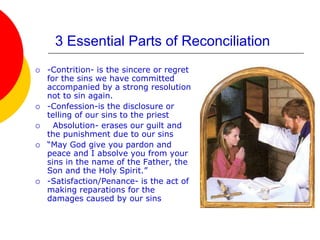
3 Essential Parts of Reconciliation
 -Contrition- is the sincere or regret
for the sins we have committed
accompanied by a strong resolution
not to sin again.
 -Confession-is the disclosure or
telling of our sins to the priest
 Absolution- erases our guilt and
the punishment due to our sins
 “May God give you pardon and
peace and I absolve you from your
sins in the name of the Father, the
Son and the Holy Spirit.”
 -Satisfaction/Penance- is the act of
making reparations for the
damages caused by our sins
God Alone Forgives Sin
 Christian life is marked by
lifelong conversion
 Even though forgiveness is
expressed through the
Church and this
Sacrament, God alone
forgives sin
Anointing of the Sick
 Jesus instituted this
sacrament when He
told His apostles to
cure the
sick,lepers,blind,lame
and expel demons
(Mt.10:8)
 Jesus continues to bring
healing through the
prayers of the Church,
and through the
sacraments, especially
the Eucharist and the
Anointing of the Sick
History of Anointing of the Sick
 In the Middle Ages the sacrament was
administered only to the dying and was
called Extreme Unction – “the Last
Anointing.”
 Viaticum – is the final reception of the
Eucharist.
 Since Vatican II, this sacrament is
celebrated for those suffering from
serious illness, for the elderly, for those
facing major surgery -- and for the dying.
Essential Elements of
Anointing of the Sick
The priest or bishop
• lays his hands on the sick person
 prays for the person in the faith of the Church
 anoints the forehead and hands of the sick
person with oil previously blessed by a bishop
Sacraments at the
Service of Communion
 These
sacraments
are directed
toward the
salvation of
others, not
toward those
receiving the
sacraments.
Matrimony
Holy Orders
Holy Orders
 The ministerial priesthood
 Sacramental ordination consecrates certain baptized
men to one of three degrees of a sacred order:
 Episcopate – bishops(He is a successor to the
apostles, is in union with the Pope. Responsible
for the welfare of the whole Church
 Presbyterate – priests-helps the bishop(religious
order and diocesan)
 He presides the 5 sacraments except Holy Orders
and Confirmation
 Diaconate – deacons/friars- assisting the bishops
and priests in administering the sacraments
 Reading the bible
 Doing works of charity
 Doing church administration work
Essential Rite of Holy Orders
 A call by God to serve
the Church in a very
special way.
 Essential rite includes:
the laying on of hands
by the bishop
accompanied by a
special prayer of
consecration.
 An indelible spiritual
character is conferred
on the ordained man.
Matrimony
 Marriage is a
sacred covenant --
that is an
agreement
between the
husband and wife,
and between the
couple and God.
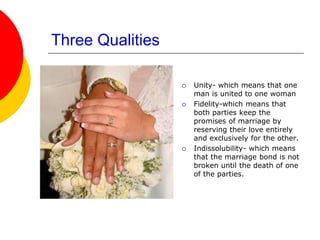
Three Qualities
 Unity- which means that one
man is united to one woman
 Fidelity-which means that
both parties keep the
promises of marriage by
reserving their love entirely
and exclusively for the other.
 Indissolubility- which means
that the marriage bond is not
broken until the death of one
of the parties.
Matrimony
 From the time of creation, marriage has
been an institution established by God,
not by man. ( Gn.2:18-24)
 Sacramental marriage was modeled on
the relationship between Christ and the
Church
 The goodness of Marriage includes:
 The procreation of children.
 The chastity of the spouses and their
fidelity to each other.
 The indissoluble union of marriage.
The Essential Rite of Matrimony
 The essential element of Matrimony is
the mutual consent to marry.
 The words of consent must be freely
given.
 Catholics must marry in the presence
of a priest or a deacon, and in the
presence of two witnesses.
 The spouses themselves are the
ministers of the sacrament.
Impediments to Matrimony
 Bigamy-existing marriage
 Coercion
 Below Age requirement
 Blood Relationship
 Spiritual Affinity
 Holy Orders/Solemn Vows
 Legal relationships
 Homosexuality
 Psychological disorder
 Abusive
Matrimony
 The family is called
“the domestic
Church.” The family is
a living witness and
testimony of eternal,
unbreakable, and
boundless love that
the couple (and their
children) give to one
another and to the
world.
The Seven Sacraments
 The sacraments celebrate Jesus as the Way, the Truth,
and the Life.
 The sacraments are a way for us to live life to the
fullest.
 The sacraments are the way to allow Jesus to touch our
lives.
 Graded recitation
 Choose at least one sacrament and
give or explain its
importance,matters, symbols with
meaning, necessity, effects

7_Sacraments.ppt

  • 1.
  • 2.
    Lesson Objectives Doctrine: Discuss intelligentlythe Seven Sacraments, its significance, effects and necessity Morals: Participate actively in the discussion Worship: Create an action plan to show how can live the values from each sacrament
  • 3.
    Saint Augustine says; O Sacramentof love, sign of our unity, bond of our fraternity, whoever long for life have here its very source. Let them come here and believe; unite with You and live. (Sermon on John 26, 13)
  • 4.
    Sign, Symbol, Sacrament St. Thomas Aquinas taught that human development is marked by seven stages which parallel the seven sacraments.  We are born: Baptism  We grow: Confirmation  We are fed: Eucharist  We are healed: Penance  We recover: Anointing of the Sick  We need and form family: Matrimony  We need and respond to leaders: Holy Orders
  • 5.
  • 6.
    Three definitions ofSacrament  St. Paul – sacramentum = mysterion God’s hidden plan to fulfill all things in Christ.  St. Augustine stressed sign and symbol (something concrete that points to something else.)  St. Thomas Aquinas added that sacraments are efficacious signs or symbols of grace. They effect, cause, and are what they signify.
  • 7.
    Sacraments ARE whatthey symbolize  To be a sacrament, a sign or symbol must do the following:  Lead us to God  Come from God  Be an action of God The best example of a sacrament is Jesus Christ himself.
  • 8.
    The Primordial Sacrament Jesus is the starting point of all sacraments.  Jesus is the perfect sign of God’s great love for us.  The fundamental nature of a sacrament is revealed in Jesus.
  • 9.
    Liturgy (the Workof the People)  The first and most important work of the Church is to make present Christ’s Paschal Mystery here and now. We do this in liturgy.  All the sacraments are liturgy – the work of the people…none are private affairs.  Every sacrament is a community affair – an affair of the Church.
  • 10.
    Jesus is reallypresent in Eucharist  Jesus is present in the priest, the minister of the sacrament.  Jesus is present when the Holy Scriptures are read.  Jesus is present in the community assembled  Jesus is really present in the consecrated species of bread and wine.
  • 11.
    The Church asSacrament  The Church is a mystery.  The Church is beloved of Christ.  The Church is an efficacious symbol.
  • 12.
    Council of Florence Proper matter – the prescribed materials.  Correct words or form – the prescribed words and gestures.  Designated minister – the prescribed minister.
  • 13.
    The Seven Sacraments The Sacraments of Initiation – Baptism, Confirmation, Eucharist.  The Sacraments of Healing – Reconciliation (Penance), Anointing of the Sick.  The Sacraments at the Service of Communion – Matrimony, Holy Orders.
  • 14.
    Sacraments of Initiation Baptism – brings new life in Christ.  Confirmation – strengthens our new life with the gifts of the Holy Spirit.  Eucharist – nourishes us with the Body and Blood of Christ.
  • 15.
    Baptism Rites  Riteof Christian Initiation of Adults (RCIA) - A process for adults culminating in the celebration of all three sacraments of initiation at the Easter Vigil.  Rite of Baptism of Children - People did not want their children to wait until adulthood to be re- born in Christ’s life…infant baptism became prevalent.
  • 16.
    Four Steps ofRCIA  Evangelization – a person hears the word of God and responds to it. It is followed by a rite of acceptance  Catechumenate – over the course of a year, catechumens study the faith in special parish classes, are mentored by a sponsor, do service, and participate in the Liturgy of the Word at Mass. On the first Sunday of Lent, candidates are enrolled in the Book of the Elect by the bishop.
  • 17.
    Four Steps ofRCIA  Purification and Enlightenment – During Lent, catechumens scrutinize their lives and do penance. They receive the Lord’s Prayer and the Creed on which to center their lives. At the end of this period they receive the three sacraments of initiation at the Easter Vigil Mass.  Mystagogia – The newly baptized neophytes continue to meet with one another after Easter until Pentecost, gradually taking their place in the Church.
  • 18.
    “Cradle Catholics”  MostCatholics are initiated into the Church as infants through the Rite of Baptism of Children.  The child’s parents and godparents speak in the name of the child.  Catechesis takes place after baptism.  Formation is gradual as the child grows  The other sacraments of initiation are received at a later time.
  • 19.
    The Essential Riteof Baptism  Proper matter: Water  Correct words or form: Triple pouring of or immersion in water with the words, “I baptize you in the name of the Father, and of the Son, and of the Holy Spirit.”  Designated minister: bishop, priest, or deacon
  • 20.
    Effects of Baptism Washes away original sin and any other sins and the punishment due.  Makes us children of God and temples of the Holy Spirit.  Welcomes us as members of the Church, the Body of Christ.  Marks us forever as sharers in the common priesthood of all believers, and in Christ’s mission of justice and peace.
  • 21.
    Celebration of theSacrament of Baptism
  • 22.
    Requirements for Receptionof the Sacrament of Confirmation  Be prepared to profess the faith.  Be in the state of grace.  Intend to receive the sacrament.  Be prepared to witness to Jesus Christ.
  • 23.
    The Essential Riteof Confirmation  Proper matter: Chrism  Correct words or form: Laying on of hands and anointing with chrism on the forehead with the words: "(Name), be sealed with the gift of the Holy Spirit."  Designated minister: Bishop
  • 24.
    The Sacrament ofthe Eucharist was instituted by Christ during the Last Supper (Luke 22: 19). On the same night, Jesus also instituted the Sacrament of Ordination, because Eucharist and Priesthood are complementary. WHO INSTITUTED THE SACRAMENT OF THE EUCHARIST? Sons of Holy Mary Immaculate
  • 25.
    The Eucharist, fromthe Greek word “eucharistein” meaning thanksgiving, is the Sacrament that: 1. gives us the Body and Blood of Christ; 2. reenacts his Sacrifice on the Cross. WHAT IS THE EUCHARIST? Sons of Holy Mary Immaculate
  • 26.
    Jesus instituted the Eucharistfor two reasons: 1. to perpetuate the Sacrifice of the Cross until he will come again; 2. to give us his Body and Blood. WHY DID JESUS INSTITUTE THE EUCHARIST? Sons of Holy Mary Immaculate
  • 27.
    The Eucharist isthe memorial of the Sacrifice of Christ because, whenever we celebrate the Mass, we sacramentally reenact his passion, death, and resurrection. WHY IS THE EUCHARIST THE "MEMORIAL" OF THE SACRIFICE OF CHRIST? Sons of Holy Mary Immaculate
  • 28.
    The Eucharist isthe source and summit of the life of the Church because it contains the whole spiritual wealth of the Church - namely Christ himself. WHY IS THE EUCHARIST THE "SOURCE AND SUMMIT" OF THE LIFE OF THE CHURCH? Sons of Holy Mary Immaculate
  • 29.
    This Sacrament isknown by 5 different names in accordance with the various perspectives: 1. EUCHARIST - from the Greek word “eucharistein” meaning thanksgiving, to emphasize that the reason for the Sacrament is to give thanks to God for the beauty of creation and the wonder of redemption. 2. THE LORD’S SUPPER - to recall that the institution of the Sacrament was done when he was at table in the Cenacle with his Apostles. 3. THE BREAKING OF BREAD - to underline the action through which Christ distributed the consecrated Bread during the Last Supper. 4. THE HOLY SACRIFICE OF THE MASS - to profess that the Sacrament is a memorial, or reenactment, of the Lord's passion, death, and resurrection. 5. THE MOST BLESSED SACRAMENT - to remind that the real presence of Jesus in the Sacred Species does not end with the Mass, but continues when they are preserved in the Tabernacle. WHAT IS THIS SACRAMENT CALLED? Sons of Holy Mary Immaculate
  • 30.
    The Sacred Vestmentsare the clothing used by ordained persons, or by acolytes and ministers, during liturgical celebrations. SACRED VESTMENTS Cassock & Cotta Alb & Stole Chasuble Cope Deacon’s Stole Dalmatic Sons of Holy Mary Immaculate
  • 31.
    57. SACRED BOOKS Thesacred books are the three books used during the liturgy of the Church, namely: 1. Missal 2. Lectionary 3. Book of the Gospels Sons of Holy Mary Immaculate
  • 32.
    The Missal is thebook containing all the prayers and rites used by the priest during the Mass, and it is kept on the altar. MISSAL Sons of Holy Mary Immaculate
  • 33.
     The Lectionaryis the book that contains all the readings used during the Mass.  First Reading, Responsorial Psalm, and Second Reading are read by lay people; while the Gospel is reserved for the priest or the deacon.  The Lectionary is kept on the ambo. LECTIONARY Sons of Holy Mary Immaculate
  • 34.
     The Bookof the Gospels, also called “Evangelarium,” is the book that contains only the readings of the Gospel.  It is brought in during the entrance procession and placed on the altar. After the Alleluia, it is brought to the ambo for the proclamation of the Gospel. BOOK OF THE GOSPELS Sons of Holy Mary Immaculate
  • 35.
    The Sacred Vesselsare the vessels used for the liturgical celebrations. SACRED VESSELS Thurible & Incense Boat Paten & Chalice Ciborium Cruets Monstrance Sons of Holy Mary Immaculate
  • 36.
     The Patenis the small plate of precious metal that holds the big host.  The Chalice is the cup of precious metal, whose inside must be gold or gold-plated, that holds the wine consecrated at Mass. PATEN AND CHALICE Sons of Holy Mary Immaculate
  • 37.
    CIBORIUM AND CRUETS The Ciborium is the vessel containing the hosts for distribution to the faithful.  The Cruets are the two vessels containing the wine and the water for the Eucharist. Sons of Holy Mary Immaculate
  • 38.
    The Monstrance isthe vessel in which the consecrated Host is exposed for the adoration. MONSTRANCE Sons of Holy Mary Immaculate
  • 39.
     The Thurible,or censer, is a covered incense burner swung on chains during the Mass, procession, and Eucharistic adoration.  The incense-boat is the container of the incense to be offered. THURIBLE AND INCENSE-BOAT Sons of Holy Mary Immaculate
  • 40.
    Development of theEucharist Christ instituted the Eucharist during a Passover meal held at the Last Supper as a memorial of his Death and Resurrection. At the Council of Trent (1545 – 1563) the doctrine of transubstantiation was defined and the Roman Missal was published by Pope Pius V.
  • 41.
    The Essential Riteof Eucharist  Proper matter: unleavened bread and wine  Correct words or form: Changing bread and wine into the Body and Blood of Christ by the words: "Take this, all of you, and eat it: this is my body which will be given up for you . . . Take this, all of you, and drink from it: this is the cup of my blood of the new and everlasting covenant. It will be shed for you and for all so that sins may be forgiven. Do this in memory of me.“  Designated minister: Bishop or priest
  • 42.
    Parts of theEucharistic Liturgy  Introductory Rites  Sign of the Cross  Penitential Rite  Gloria  Opening Prayer  Liturgy of the Word  First Reading  Psalm Response  Second Reading  Gospel  Homily  Creed  General Intercessions  Liturgy of the Eucharist  Preparation of the Altar  Presentation of the Gifts  Eucharistic Prayer  Great Amen  Communion Rite  Our Father  Lamb of God  Reception of Holy Communion  Prayer after Communion  Concluding Rite
  • 43.
    Sacraments of Healing Ournew life in Christ can be weakened by suffering, illness, death, and the effects of sin. Anointing of the Sick Penance / Reconciliation
  • 44.
    Penance – Reconciliation- Confession  Penance renews, restores, and strengthens our relationship with God and the community after it has been damaged by sin.  Penance shows that God’s love is without limits
  • 45.
  • 46.
    Essential Elements ofReconciliation  The acts of the person who undergoes conversion  Contrition  Confession  Satisfaction  The intervention of the Church  Absolution from the priest  All Catholics are required to go to confession at least once per year to confess serious sins
  • 47.
    3 Essential Partsof Reconciliation  -Contrition- is the sincere or regret for the sins we have committed accompanied by a strong resolution not to sin again.  -Confession-is the disclosure or telling of our sins to the priest  Absolution- erases our guilt and the punishment due to our sins  “May God give you pardon and peace and I absolve you from your sins in the name of the Father, the Son and the Holy Spirit.”  -Satisfaction/Penance- is the act of making reparations for the damages caused by our sins
  • 48.
    God Alone ForgivesSin  Christian life is marked by lifelong conversion  Even though forgiveness is expressed through the Church and this Sacrament, God alone forgives sin
  • 49.
    Anointing of theSick  Jesus instituted this sacrament when He told His apostles to cure the sick,lepers,blind,lame and expel demons (Mt.10:8)  Jesus continues to bring healing through the prayers of the Church, and through the sacraments, especially the Eucharist and the Anointing of the Sick
  • 50.
    History of Anointingof the Sick  In the Middle Ages the sacrament was administered only to the dying and was called Extreme Unction – “the Last Anointing.”  Viaticum – is the final reception of the Eucharist.  Since Vatican II, this sacrament is celebrated for those suffering from serious illness, for the elderly, for those facing major surgery -- and for the dying.
  • 51.
    Essential Elements of Anointingof the Sick The priest or bishop • lays his hands on the sick person  prays for the person in the faith of the Church  anoints the forehead and hands of the sick person with oil previously blessed by a bishop
  • 52.
    Sacraments at the Serviceof Communion  These sacraments are directed toward the salvation of others, not toward those receiving the sacraments. Matrimony Holy Orders
  • 53.
    Holy Orders  Theministerial priesthood  Sacramental ordination consecrates certain baptized men to one of three degrees of a sacred order:  Episcopate – bishops(He is a successor to the apostles, is in union with the Pope. Responsible for the welfare of the whole Church  Presbyterate – priests-helps the bishop(religious order and diocesan)  He presides the 5 sacraments except Holy Orders and Confirmation  Diaconate – deacons/friars- assisting the bishops and priests in administering the sacraments  Reading the bible  Doing works of charity  Doing church administration work
  • 54.
    Essential Rite ofHoly Orders  A call by God to serve the Church in a very special way.  Essential rite includes: the laying on of hands by the bishop accompanied by a special prayer of consecration.  An indelible spiritual character is conferred on the ordained man.
  • 55.
    Matrimony  Marriage isa sacred covenant -- that is an agreement between the husband and wife, and between the couple and God.
  • 56.
    Three Qualities  Unity-which means that one man is united to one woman  Fidelity-which means that both parties keep the promises of marriage by reserving their love entirely and exclusively for the other.  Indissolubility- which means that the marriage bond is not broken until the death of one of the parties.
  • 57.
    Matrimony  From thetime of creation, marriage has been an institution established by God, not by man. ( Gn.2:18-24)  Sacramental marriage was modeled on the relationship between Christ and the Church  The goodness of Marriage includes:  The procreation of children.  The chastity of the spouses and their fidelity to each other.  The indissoluble union of marriage.
  • 58.
    The Essential Riteof Matrimony  The essential element of Matrimony is the mutual consent to marry.  The words of consent must be freely given.  Catholics must marry in the presence of a priest or a deacon, and in the presence of two witnesses.  The spouses themselves are the ministers of the sacrament.
  • 59.
    Impediments to Matrimony Bigamy-existing marriage  Coercion  Below Age requirement  Blood Relationship  Spiritual Affinity  Holy Orders/Solemn Vows  Legal relationships  Homosexuality  Psychological disorder  Abusive
  • 60.
    Matrimony  The familyis called “the domestic Church.” The family is a living witness and testimony of eternal, unbreakable, and boundless love that the couple (and their children) give to one another and to the world.
  • 61.
    The Seven Sacraments The sacraments celebrate Jesus as the Way, the Truth, and the Life.  The sacraments are a way for us to live life to the fullest.  The sacraments are the way to allow Jesus to touch our lives.
  • 62.
     Graded recitation Choose at least one sacrament and give or explain its importance,matters, symbols with meaning, necessity, effects