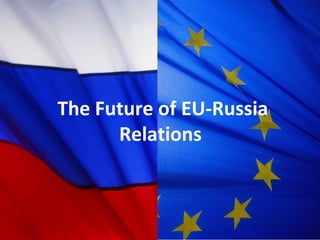
The Future of EU-Russia
Relations
Russia’s ‘Eternal Questions’







Is Russia a European country?
Is Russia a unique Eurasian country which should
look for its own way of development?
Should it carefully protect its sovereignty as an
independent center of the multi-polar world?
Is Russia the leader of the specific Eurasian
civilization – should it seek to reintegrate the postSoviet space and at what price?
Legislative base
 Agreement

of the USSR and EU "About trade,
economic and commercial cooperation“ – 1989
 the Partnership and Cooperation Agreement –
1994(1997)
 4 road maps:
 On

the space of freedom, safety and justice
 On a Common Economic Space
 On a Common Space of External Security
 On the common space of science and education
The Partnership of Modernization (PoM)

Main goal and objectives of the Partnership
“to implement a concrete modernization of the most important sectors of Russian
economy and society, in order to promote international multilateralism and benefit to
both parts in the long run”

European Union









Increase business and cooperation
opportunities with Russia
increase commitment in international
institutions
concrete projects with a modernized
partner
improve situation of EU countries,
along Russian borders

Russian Federation










standard alignment (economy,
bureaucracy, policy etc.)
develop internal sectors
increase commitment in
international institutions
increase trade
attract western investments
improve commitment with border
countries
Implementation of the PoM

Possibilities of implementation in the four spheres
Technology











energy efficiency
energy conservation
new fuels
nuclear technologies
space technologies
telecommunication
medical technologies
pharmaceuticals
IT

Six projects selected by
Russian Government,
with high potential of
cooperation for EU.

Policy and
governance

Economy
















stimulate investments
stimulate growth of
small and medium
enterprises
attract venture capitals
reform the very large
public sector
(privatization)
listing of mayor
companies
improve financial
market
standards (IAS/IFRS)
corporate law
(premium)
taxation












reduction of state
controls
corruption
clarify tasks of
public administration
transparency
reform bureaucracy
simplify registration
procedures for
foreign companies
visa deal (with EU)

Research and
education











high level research
centers
new modern
universities in
strategic areas
cooperation with EU
universities
shared research
projects with EU
attract EU experts
Zastoi in EU-Russia relations



No evident crisis, but a perpetual stalemate
3 gaps






between EU-Russia interdependence and the actual state of
relations
between political rhetoric the level of implementation
between ‘strategic partnership’ and the lack of strategic
thinking

Zastoi = stagnation, muddling through (a word from
the Brezhnev era)
supported by massive energy flows
 concealed by increased semiotic activity (strategies,
partnerships, summits)

The structural impediment


No mega-incentive of Russian membership of the EU





EU political machinery not suited for dealing with nonacceding “partners”
ENP a watered-down derivative of enlargement, “common
spaces” a watered-down version of the ENP

Russia not sure about the way to deal with the EU




EU a new political animal, a bureaucratic/technical, rather
than strategic way of policy-making
Russia defaults into tried and tested bilateralism
The negativist strategy: “no intention to join the EU” as the
main stated strategy… but is it enough?
Modern circumstances






Russia joined the WTO
Russia is planning to join the OECD
Russia started the processes in the Framework of the
Custom Union
Russia launched the negotiations on the FTA with the
EFTA countries
Russia is proposing the concept of the common market
from Lisbon to Vladivostok
Core areas of cooperation
between Russia and the EU


Commodity trade



Investments in technologies



Energy cooperation



Humanitarian contacts (tourism, science, culture, etc.)

 However, there are both optimistic and

pessimistic scenarios in each area

9
Commodity trade
Optimistic scenario:
EU + Eurasian
Union
Free trade
agreement after
Russian
adaptation to
WTO’s accession

Для правки структуры
Pessimistic scenario:
щелкните мышью
EU’s expansion in
− Второй уровень
Ukraine and
структуры
Belarus




Третий уровень
структуры

Trade wars between
− Четвёртый
Russia and other
уровень
European countries
структуры


Пятый
10
уровень
Investments in technologies


Optimistic scenario:
Competitive EU-Russian
global value chains
Modernization of Russian
economy
Growth of efficiency and
sustainability in the
EU’s and Russian
economies

Для правки структуры
щелкните мышью

Pessimistic scenario:
− Второй уровень
Only market-seeking and
структуры
resource-seeking EU’s direct
investments in Russia


Третий уровень
структуры

Investment protectionism
− Четвёртый
against Russian high-tech
уровень
MNEs in the EU

структуры

Пятый
11
уровень
Direct investment, stock,
2012 mln USD
Russia

1989

123
17023

France

2152

3724

China

769

Source: Bank of Russia, 2013. China Statistical Yearbook 2013.

12
Current Russia-EU energy ties
Russia supplies

31 percent of EU gas imports,
27 percent of crude oil imports,
24 percent of EU coal imports,
30 percent of total EU uranium imports
The EU is the market for 88 percent of Russia’s oil exports,
70 percent of its gas exports,
50 percent of its coal exports
Gazprom (51%)

Gazprom (50%) *

Wintershall (15.5%)
E.ON Ruhrgas (15.5%)
N. V. Nederlandse Gasunie (9%)
GDF Suez (9%)

Eni (20%)
Wintershall (15%)
EdF (15%)
*interest in the offshore section

Significant investment cooperation in the energy field
The EU investor

Russian company

Value

E.ON (Germany)

OGK-4

USD 6 billion

Enel (Italy)

OGK-5, Rusenergosbyt

USD 5,85 billion

Fortum (Finland)

TGK-10

USD 4 billion

At the same time Russian companies
invest in European refineries

13
Energy cooperation

Optimistic scenario:



Current achievements will produce a solid
base for new fields of cooperation under
EU/Russia Roadmap for Energy
Cooperation until 2050 (signed in March
2013)


Energy efficiency



Renewables



Remote oil and gas fields
exploration



Investments in LNG-projects

Для правки структуры
Pessimistic scenario:
щелкните мышью
Key challenges for
cooperation will weigh
− Второй уровень
down all opportunities

структуры
Different goals for the
Третий уровень lead
energy markets will
to extreme
структурыpoliticization
of energy issues by both
− Четвёртый
sides



уровень
The lack of legal basis for
структуры
Russian long-term

Пятый
investment projects
14
уровень
Humanitarian contacts
Для правки структуры
Pessimistic scenario:
щелкните мышью


Optimistic scenario:
Common Eurasian
higher educational
and scientific areas
and Pan-European
touristic boom
Various cultural
contacts as a base for
strategic political and
economic EU-Russia
partnership

Visa regime against
− Второй уровень
Russia and the growth
структуры
of xenophobia in the EU


Третий уровень
структуры

Significant Четвёртый the
− decrease of
EU’s global
уровень
competitiveness; Crisis
структуры
of multiculturalism


Пятый
15
уровень
Opportunities
(what can be done to support further cooperation)



Development and adoption of new PCA.
Should be not a nominative document, as “four common
spaces” is, but a detailed one, delivering common strategic
vision for future cooperation



Acceptance of Russia into WTO - enlargement
and further development of economical relations .



Creation of free travel zone with Europe –
visas as huge barrier for business and cultural cooperation
of Russia-EU (in discussion).
Threats
(what can ruin further cooperation)








EU continues to act inconsistently towards Russia
Mutual Mistrust and/or Misunderstanding over the
Eastern Partnership
New problems with Ukraine
EU suspicions on the Eurasian Union Project
Slow Progress on visa free regime
Ways to future


EU’s view

Basis for a better EU-Russia relationship = neither confrontation, nor isolation, nor
unconditional cooperation, but a policy based on solidarity and the rule of law”. Let’s

act together and influence our relationships with Russia.


Russia’s view

Vladimir Putin: “Our joint attempt at achieving success and
competitiveness in the modern world,”





Common economic policy: free trade zone, joint projects
“RU resources & EU technology”, common European
energy complex (to avoid gas transit countries)
Supporting science and education
Removing barriers: visa-free regime for business and
educational cooperation
Ways to future


Creation of Alliance of Europe in order to
oppose 2 existing poles:

Ukraine

USA

=

Russia

=

Alliance of
Europe
Turkey

Kazakhstan

China
Russian scenarios


R1: Authoritarian modernization




R2: Liberal modernization




Model: South Korea in the 1960s-1980s
Model: East Central Europe in the 1990s

R3: Bureaucratic capitalism


Model: Mexico, Indonesia
EU scenarios


E1: Global actor




E2: Common Market Plus




Political Union (French concept)
Economic Union Plus (British concept)

E3: Fortress Europe


Isolationist view
EU-Russia scenario matrix

Russia

Liberal
Modernization

Authoritarian
Modernization

Bureaucratic
Capitalism

Global Actor

Partnership

Zastoi

Zastoi

Common
Market +

Partnership

Zastoi

Zastoi

Fortress
Europe

Cold Peace

Cold Peace

Cold Peace

Europe
Facilitating EU-Russia
Partnership




A liberal modernization scenario in Russia
A global vision for the EU
A special role for the bilateral relations





Traditional partnerships (Germany, France)
Improving ties with the Baltic States

Externalities to the EU-Russia relations


A drop in the oil prices?
Negative trends prevail?


Perpetuation of the current system in Russia




This system is tolerated by the West, due to






Reproduced in the 2011-12 election cycle
Russia’s territory / position/ geopolitics of size
Oil/resources / geopolitics of energy
Security/ geopolitics of terrorism

Uncertainty in Europe




Euro-pessimism, future of enlargement uncertain
Russia not on top of the priority list
No instruments, no leverage, no cohesion in EU’s Russiapolicy
Thank You for Attention!

The future of EU-Russia relations

  • 1.
    The Future ofEU-Russia Relations
  • 2.
    Russia’s ‘Eternal Questions’     IsRussia a European country? Is Russia a unique Eurasian country which should look for its own way of development? Should it carefully protect its sovereignty as an independent center of the multi-polar world? Is Russia the leader of the specific Eurasian civilization – should it seek to reintegrate the postSoviet space and at what price?
  • 3.
    Legislative base  Agreement ofthe USSR and EU "About trade, economic and commercial cooperation“ – 1989  the Partnership and Cooperation Agreement – 1994(1997)  4 road maps:  On the space of freedom, safety and justice  On a Common Economic Space  On a Common Space of External Security  On the common space of science and education
  • 4.
    The Partnership ofModernization (PoM) Main goal and objectives of the Partnership “to implement a concrete modernization of the most important sectors of Russian economy and society, in order to promote international multilateralism and benefit to both parts in the long run” European Union     Increase business and cooperation opportunities with Russia increase commitment in international institutions concrete projects with a modernized partner improve situation of EU countries, along Russian borders Russian Federation       standard alignment (economy, bureaucracy, policy etc.) develop internal sectors increase commitment in international institutions increase trade attract western investments improve commitment with border countries
  • 5.
    Implementation of thePoM Possibilities of implementation in the four spheres Technology          energy efficiency energy conservation new fuels nuclear technologies space technologies telecommunication medical technologies pharmaceuticals IT Six projects selected by Russian Government, with high potential of cooperation for EU. Policy and governance Economy          stimulate investments stimulate growth of small and medium enterprises attract venture capitals reform the very large public sector (privatization) listing of mayor companies improve financial market standards (IAS/IFRS) corporate law (premium) taxation        reduction of state controls corruption clarify tasks of public administration transparency reform bureaucracy simplify registration procedures for foreign companies visa deal (with EU) Research and education      high level research centers new modern universities in strategic areas cooperation with EU universities shared research projects with EU attract EU experts
  • 6.
    Zastoi in EU-Russiarelations   No evident crisis, but a perpetual stalemate 3 gaps     between EU-Russia interdependence and the actual state of relations between political rhetoric the level of implementation between ‘strategic partnership’ and the lack of strategic thinking Zastoi = stagnation, muddling through (a word from the Brezhnev era) supported by massive energy flows  concealed by increased semiotic activity (strategies, partnerships, summits) 
  • 7.
    The structural impediment  Nomega-incentive of Russian membership of the EU    EU political machinery not suited for dealing with nonacceding “partners” ENP a watered-down derivative of enlargement, “common spaces” a watered-down version of the ENP Russia not sure about the way to deal with the EU    EU a new political animal, a bureaucratic/technical, rather than strategic way of policy-making Russia defaults into tried and tested bilateralism The negativist strategy: “no intention to join the EU” as the main stated strategy… but is it enough?
  • 8.
    Modern circumstances      Russia joinedthe WTO Russia is planning to join the OECD Russia started the processes in the Framework of the Custom Union Russia launched the negotiations on the FTA with the EFTA countries Russia is proposing the concept of the common market from Lisbon to Vladivostok
  • 9.
    Core areas ofcooperation between Russia and the EU  Commodity trade  Investments in technologies  Energy cooperation  Humanitarian contacts (tourism, science, culture, etc.)  However, there are both optimistic and pessimistic scenarios in each area 9
  • 10.
    Commodity trade Optimistic scenario: EU+ Eurasian Union Free trade agreement after Russian adaptation to WTO’s accession Для правки структуры Pessimistic scenario: щелкните мышью EU’s expansion in − Второй уровень Ukraine and структуры Belarus   Третий уровень структуры Trade wars between − Четвёртый Russia and other уровень European countries структуры  Пятый 10 уровень
  • 11.
    Investments in technologies  Optimisticscenario: Competitive EU-Russian global value chains Modernization of Russian economy Growth of efficiency and sustainability in the EU’s and Russian economies Для правки структуры щелкните мышью Pessimistic scenario: − Второй уровень Only market-seeking and структуры resource-seeking EU’s direct investments in Russia  Третий уровень структуры Investment protectionism − Четвёртый against Russian high-tech уровень MNEs in the EU структуры  Пятый 11 уровень
  • 12.
    Direct investment, stock, 2012mln USD Russia 1989 123 17023 France 2152 3724 China 769 Source: Bank of Russia, 2013. China Statistical Yearbook 2013. 12
  • 13.
    Current Russia-EU energyties Russia supplies 31 percent of EU gas imports, 27 percent of crude oil imports, 24 percent of EU coal imports, 30 percent of total EU uranium imports The EU is the market for 88 percent of Russia’s oil exports, 70 percent of its gas exports, 50 percent of its coal exports Gazprom (51%) Gazprom (50%) * Wintershall (15.5%) E.ON Ruhrgas (15.5%) N. V. Nederlandse Gasunie (9%) GDF Suez (9%) Eni (20%) Wintershall (15%) EdF (15%) *interest in the offshore section Significant investment cooperation in the energy field The EU investor Russian company Value E.ON (Germany) OGK-4 USD 6 billion Enel (Italy) OGK-5, Rusenergosbyt USD 5,85 billion Fortum (Finland) TGK-10 USD 4 billion At the same time Russian companies invest in European refineries 13
  • 14.
    Energy cooperation Optimistic scenario:  Currentachievements will produce a solid base for new fields of cooperation under EU/Russia Roadmap for Energy Cooperation until 2050 (signed in March 2013)  Energy efficiency  Renewables  Remote oil and gas fields exploration  Investments in LNG-projects Для правки структуры Pessimistic scenario: щелкните мышью Key challenges for cooperation will weigh − Второй уровень down all opportunities структуры Different goals for the Третий уровень lead energy markets will to extreme структурыpoliticization of energy issues by both − Четвёртый sides  уровень The lack of legal basis for структуры Russian long-term  Пятый investment projects 14 уровень
  • 15.
    Humanitarian contacts Для правкиструктуры Pessimistic scenario: щелкните мышью  Optimistic scenario: Common Eurasian higher educational and scientific areas and Pan-European touristic boom Various cultural contacts as a base for strategic political and economic EU-Russia partnership Visa regime against − Второй уровень Russia and the growth структуры of xenophobia in the EU  Третий уровень структуры Significant Четвёртый the − decrease of EU’s global уровень competitiveness; Crisis структуры of multiculturalism  Пятый 15 уровень
  • 16.
    Opportunities (what can bedone to support further cooperation)  Development and adoption of new PCA. Should be not a nominative document, as “four common spaces” is, but a detailed one, delivering common strategic vision for future cooperation  Acceptance of Russia into WTO - enlargement and further development of economical relations .  Creation of free travel zone with Europe – visas as huge barrier for business and cultural cooperation of Russia-EU (in discussion).
  • 17.
    Threats (what can ruinfurther cooperation)      EU continues to act inconsistently towards Russia Mutual Mistrust and/or Misunderstanding over the Eastern Partnership New problems with Ukraine EU suspicions on the Eurasian Union Project Slow Progress on visa free regime
  • 18.
    Ways to future  EU’sview Basis for a better EU-Russia relationship = neither confrontation, nor isolation, nor unconditional cooperation, but a policy based on solidarity and the rule of law”. Let’s act together and influence our relationships with Russia.  Russia’s view Vladimir Putin: “Our joint attempt at achieving success and competitiveness in the modern world,”    Common economic policy: free trade zone, joint projects “RU resources & EU technology”, common European energy complex (to avoid gas transit countries) Supporting science and education Removing barriers: visa-free regime for business and educational cooperation
  • 19.
    Ways to future  Creationof Alliance of Europe in order to oppose 2 existing poles: Ukraine USA = Russia = Alliance of Europe Turkey Kazakhstan China
  • 20.
    Russian scenarios  R1: Authoritarianmodernization   R2: Liberal modernization   Model: South Korea in the 1960s-1980s Model: East Central Europe in the 1990s R3: Bureaucratic capitalism  Model: Mexico, Indonesia
  • 21.
    EU scenarios  E1: Globalactor   E2: Common Market Plus   Political Union (French concept) Economic Union Plus (British concept) E3: Fortress Europe  Isolationist view
  • 22.
    EU-Russia scenario matrix Russia Liberal Modernization Authoritarian Modernization Bureaucratic Capitalism GlobalActor Partnership Zastoi Zastoi Common Market + Partnership Zastoi Zastoi Fortress Europe Cold Peace Cold Peace Cold Peace Europe
  • 23.
    Facilitating EU-Russia Partnership    A liberalmodernization scenario in Russia A global vision for the EU A special role for the bilateral relations    Traditional partnerships (Germany, France) Improving ties with the Baltic States Externalities to the EU-Russia relations  A drop in the oil prices?
  • 24.
    Negative trends prevail?  Perpetuationof the current system in Russia   This system is tolerated by the West, due to     Reproduced in the 2011-12 election cycle Russia’s territory / position/ geopolitics of size Oil/resources / geopolitics of energy Security/ geopolitics of terrorism Uncertainty in Europe    Euro-pessimism, future of enlargement uncertain Russia not on top of the priority list No instruments, no leverage, no cohesion in EU’s Russiapolicy
  • 25.
    Thank You forAttention!