ETHICAL HACKING
Contents
• Introduction to hacking
• Types of hackers
• Classification of hackers
• Steps performed by a hacker
• IP address ranges
• Tracing of IP address
• Email Protocol
• Proxy Servers
• Security
• Conclusion
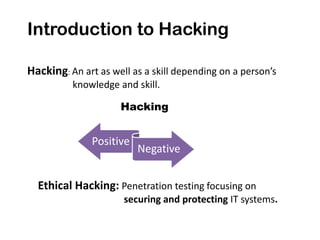
Introduction to Hacking
Hacking: An art as well as a skill depending on a person’s
knowledge and skill.
Hacking
Positive
Negative
Ethical Hacking: Penetration testing focusing on
securing and protecting IT systems.
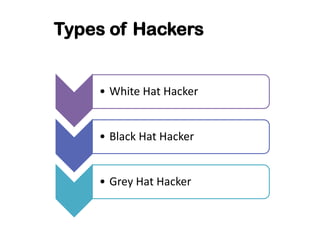
• White Hat Hacker
• Black Hat Hacker
• Grey Hat Hacker
Types of Hackers
White Hat Hacker
• Perform Ethical Hacking
• Have knowledge of hacking and hacker
toolset
• Locate security weaknesses and implement
countermeasures
• Also known as Penetration Tester
• Focus on securing and protecting IT systems
Black Hat Hacker
• Perform unethical hacking
• Are criminal hackers or crackers
• Use their skills for illegal or malicious purposes
• Focus on Security Cracking and Data Stealing
Grey Hat Hacker
• Sometimes acts legally and sometimes not
• Do not hack for personal gain
• Do not have malicious intentions
• May occasionally commit crimes
• Are hybrid between White Hat and Black Hat
Hackers
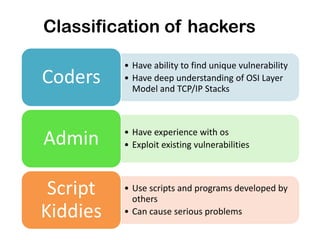
Classification of hackers
• Have ability to find unique vulnerability
• Have deep understanding of OSI Layer
Model and TCP/IP Stacks
Coders
• Have experience with os
• Exploit existing vulnerabilities
Admin
• Use scripts and programs developed by
others
• Can cause serious problems
Script
Kiddies
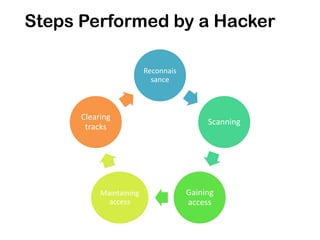
Steps Performed by a Hacker
Reconnais
sance
Scanning
Gaining
access
Maintaining
access
Clearing
tracks
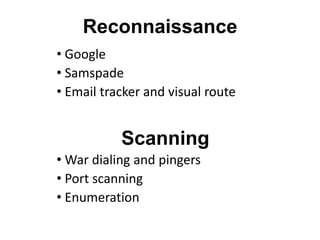
Reconnaissance
• Google
• Samspade
• Email tracker and visual route
Scanning
• War dialing and pingers
• Port scanning
• Enumeration
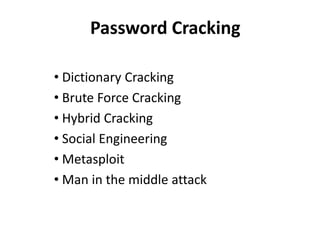
Password Cracking
• Dictionary Cracking
• Brute Force Cracking
• Hybrid Cracking
• Social Engineering
• Metasploit
• Man in the middle attack
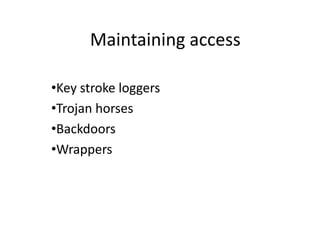
Maintaining access
•Key stroke loggers
•Trojan horses
•Backdoors
•Wrappers
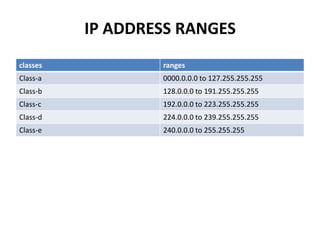
classes ranges
Class-a 0000.0.0.0 to 127.255.255.255
Class-b 128.0.0.0 to 191.255.255.255
Class-c 192.0.0.0 to 223.255.255.255
Class-d 224.0.0.0 to 239.255.255.255
Class-e 240.0.0.0 to 255.255.255
IP ADDRESS RANGES
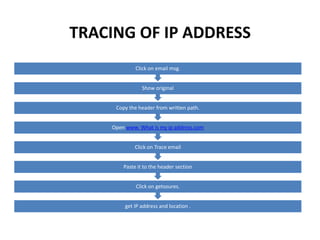
get IP address and location .
Click on getsoures.
Paste it to the header section
Click on Trace email
Open www. What is my ip address.com
Copy the header from written path.
Show original
Click on email msg.
TRACING OF IP ADDRESS
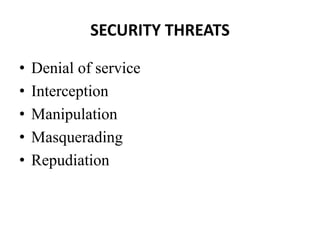
• Denial of service
• Interception
• Manipulation
• Masquerading
• Repudiation
SECURITY THREATS
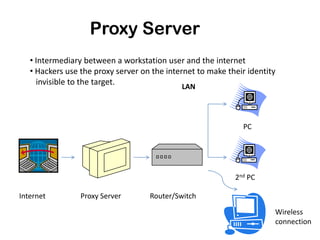
Proxy Server
• Intermediary between a workstation user and the internet
• Hackers use the proxy server on the internet to make their identity
invisible to the target.
Internet Proxy Server Router/Switch
LAN
PC
2nd PC
Wireless
connection
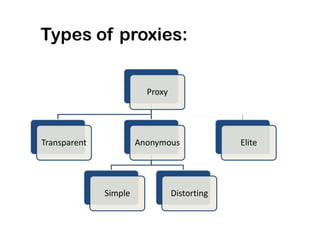
Types of proxies:
Proxy
Anonymous
Simple Distorting
Transparent Elite
• Confidentiality
• Integrity
• Availability
• Use antivirus.
• Proper logout after use of email id.
• Don’t open spam.
• Password protected admin account.
SECURITY
• “To catch a thief think like a thief
similarly To catch a hacker think
like a hacker”.
CONCLUSION

ethicalhacking-1

  • 1.
  • 2.
    Contents • Introduction tohacking • Types of hackers • Classification of hackers • Steps performed by a hacker • IP address ranges • Tracing of IP address • Email Protocol • Proxy Servers • Security • Conclusion
  • 3.
    Introduction to Hacking Hacking:An art as well as a skill depending on a person’s knowledge and skill. Hacking Positive Negative Ethical Hacking: Penetration testing focusing on securing and protecting IT systems.
  • 4.
    • White HatHacker • Black Hat Hacker • Grey Hat Hacker Types of Hackers
  • 5.
    White Hat Hacker •Perform Ethical Hacking • Have knowledge of hacking and hacker toolset • Locate security weaknesses and implement countermeasures • Also known as Penetration Tester • Focus on securing and protecting IT systems
  • 6.
    Black Hat Hacker •Perform unethical hacking • Are criminal hackers or crackers • Use their skills for illegal or malicious purposes • Focus on Security Cracking and Data Stealing
  • 7.
    Grey Hat Hacker •Sometimes acts legally and sometimes not • Do not hack for personal gain • Do not have malicious intentions • May occasionally commit crimes • Are hybrid between White Hat and Black Hat Hackers
  • 8.
    Classification of hackers •Have ability to find unique vulnerability • Have deep understanding of OSI Layer Model and TCP/IP Stacks Coders • Have experience with os • Exploit existing vulnerabilities Admin • Use scripts and programs developed by others • Can cause serious problems Script Kiddies
  • 9.
    Steps Performed bya Hacker Reconnais sance Scanning Gaining access Maintaining access Clearing tracks
  • 10.
    Reconnaissance • Google • Samspade •Email tracker and visual route Scanning • War dialing and pingers • Port scanning • Enumeration
  • 11.
    Password Cracking • DictionaryCracking • Brute Force Cracking • Hybrid Cracking • Social Engineering • Metasploit • Man in the middle attack
  • 12.
    Maintaining access •Key strokeloggers •Trojan horses •Backdoors •Wrappers
  • 13.
    classes ranges Class-a 0000.0.0.0to 127.255.255.255 Class-b 128.0.0.0 to 191.255.255.255 Class-c 192.0.0.0 to 223.255.255.255 Class-d 224.0.0.0 to 239.255.255.255 Class-e 240.0.0.0 to 255.255.255 IP ADDRESS RANGES
  • 14.
    get IP addressand location . Click on getsoures. Paste it to the header section Click on Trace email Open www. What is my ip address.com Copy the header from written path. Show original Click on email msg. TRACING OF IP ADDRESS
  • 15.
    • Denial ofservice • Interception • Manipulation • Masquerading • Repudiation SECURITY THREATS
  • 16.
    Proxy Server • Intermediarybetween a workstation user and the internet • Hackers use the proxy server on the internet to make their identity invisible to the target. Internet Proxy Server Router/Switch LAN PC 2nd PC Wireless connection
  • 17.
    Types of proxies: Proxy Anonymous SimpleDistorting Transparent Elite
  • 18.
    • Confidentiality • Integrity •Availability • Use antivirus. • Proper logout after use of email id. • Don’t open spam. • Password protected admin account. SECURITY
  • 19.
    • “To catcha thief think like a thief similarly To catch a hacker think like a hacker”. CONCLUSION