06/01/2025 Institutional Human Ethical Committee, Chitkara University, Pu
njab
1
Title
EFFECTIVENESS OF POSITIONAL RELEASE TECHNIQUE VERSUS
MAITLAND MOBILIZATION ON PAIN AND CERVICAL RANGE OF
MOTION IN INDIVIDUALS WITH NECK PAIN
Presented By- Sujan Dhanta
Roll number-2340981309
Guide- Dr. Arpit Bansal
Co Guide- Dr. Sahana A
06/01/2025 2
Research Gap
Gap: While both Maitland Mobilization and Positional Release Therapy have been studied
individually for their effectiveness in treating neck pain, there is a lack of direct comparative studies that
assess their efficacy against each other.
Implication: This gap indicates a need for research that directly compares these two commonly used
techniques, providing a clearer understanding of which method may be more effective in non specific pain.
Institutional Human Ethical Committee, Chitkara University,
Punjab
Institutional Human Ethical Committee, Chitkara University, Pu
njab
3
Aim & Objectives
Aim
The aim of the study is to compare the effectiveness of positional release technique and Maitland
mobilisation on pain and cervical range of motion in individuals with neck pain.
Objectives
1. To evaluate the effect of Maitland Mobilization on cervical range of motion, pain and quality of life in
individuals with neck pain.
2. To evaluate the effects of Positional Release Technique on cervical range of motion, pain and quality of
life in individuals with neck pain.
3. To compare the effects of Maitland mobilization versus Positional Release Technique on cervical range
of motion, pain and quality of life in individuals with neck pain.
06/01/2025
06/01/2025 Institutional Human Ethical Committee, Chitkara University, Pu
njab
4
Methodology
Study Design: An experimental study
Sample Size: 46( Group A=23 and Group B=23.
Sampling Technique: Convenience Sampling.
Inclusion criteria:
• Presence of pain on cervical region without radicular symptoms
• Duration of pain- sub-acute.
• Age group- 20-45 years.
• Both males and females.
06/01/2025 5
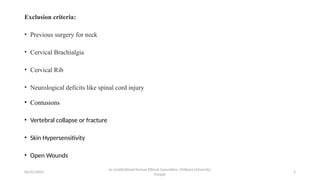
Exclusion criteria:
• Previous surgery for neck
• Cervical Brachialgia
• Cervical Rib
• Neurological deficits like spinal cord injury
• Contusions
• Vertebral collapse or fracture
• Skin Hypersensitivity
• Open Wounds
In cerstitutional Human Ethical Committee, Chitkara University,
Punjab
06/01/2025 Institutional Human Ethical Committee, Chitkara University, Pu
njab
6
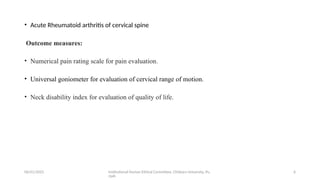
• Acute Rheumatoid arthritis of cervical spine
Outcome measures:
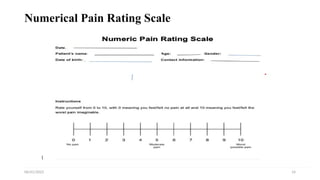
• Numerical pain rating scale for pain evaluation.
• Universal goniometer for evaluation of cervical range of motion.
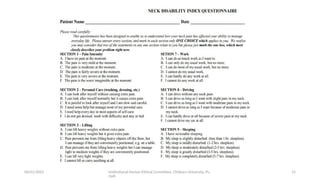
• Neck disability index for evaluation of quality of life.
06/01/2025 Institutional Human Ethical Committee, Chitkara University, Pu
njab
7
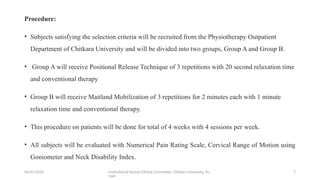
Procedure:
• Subjects satisfying the selection criteria will be recruited from the Physiotherapy Outpatient
Department of Chitkara University and will be divided into two groups, Group A and Group B.
• Group A will receive Positional Release Technique of 3 repetitions with 20 second relaxation time
and conventional therapy
• Group B will receive Maitland Mobilization of 3 repetitions for 2 minutes each with 1 minute
relaxation time and conventional therapy.
• This procedure on patients will be done for total of 4 weeks with 4 sessions per week.
• All subjects will be evaluated with Numerical Pain Rating Scale, Cervical Range of Motion using
Goniometer and Neck Disability Index.
06/01/2025 Institutional Human Ethical Committee, Chitkara University, Pu
njab
8
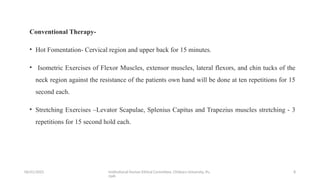
Conventional Therapy-
• Hot Fomentation- Cervical region and upper back for 15 minutes.
• Isometric Exercises of Flexor Muscles, extensor muscles, lateral flexors, and chin tucks of the
neck region against the resistance of the patients own hand will be done at ten repetitions for 15
second each.
• Stretching Exercises –Levator Scapulae, Splenius Capitus and Trapezius muscles stretching - 3
repetitions for 15 second hold each.
06/01/2025 Institutional Human Ethical Committee, Chitkara University, Pu
njab
9
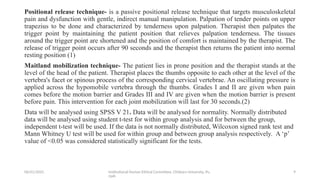
Positional release technique- is a passive positional release technique that targets musculoskeletal
pain and dysfunction with gentle, indirect manual manipulation. Palpation of tender points on upper
trapezius to be done and characterized by tenderness upon palpation. Therapist then palpates the
trigger point by maintaining the patient position that relieves palpation tenderness. The tissues
around the trigger point are shortened and the position of comfort is maintained by the therapist. The
release of trigger point occurs after 90 seconds and the therapist then returns the patient into normal
resting position (1)
Maitland mobilization technique- The patient lies in prone position and the therapist stands at the
level of the head of the patient. Therapist places the thumbs opposite to each other at the level of the
vertebra's facet or spinous process of the corresponding cervical vertebrae. An oscillating pressure is
applied across the hypomobile vertebra through the thumbs. Grades I and II are given when pain
comes before the motion barrier and Grades III and IV are given when the motion barrier is present
before pain. This intervention for each joint mobilization will last for 30 seconds.(2)
Data will be analysed using SPSS V 21. Data will be analysed for normality. Normally distributed
data will be analysed using student t-test for within group analysis and for between the group,
independent t-test will be used. If the data is not normally distributed, Wilcoxon signed rank test and
Mann Whitney U test will be used for within group and between group analysis respectively. A ‘p’
value of <0.05 was considered statistically significant for the tests.
06/01/2025 Institutional Human Ethical Committee, Chitkara University, Pu
njab
10
Risk and Benefits
To my best knowledge there is minimal risk involved as these techniques are non
invasive.
06/01/2025 Institutional Human Ethical Committee, Chitkara University, Pu
njab
11
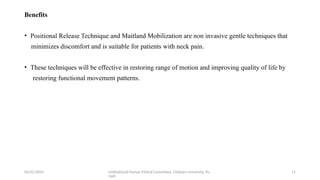
Benefits
• Positional Release Technique and Maitland Mobilization are non invasive gentle techniques that
minimizes discomfort and is suitable for patients with neck pain.

• These techniques will be effective in restoring range of motion and improving quality of life by
restoring functional movement patterns.
06/01/2025 12
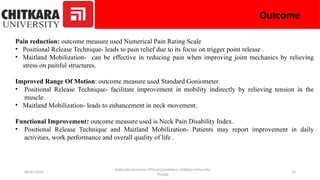
Outcome
Pain reduction: outcome measure used Numerical Pain Rating Scale
• Positional Release Technique- leads to pain relief due to its focus on trigger point release .
• Maitland Mobilization- can be effective in reducing pain when improving joint mechanics by relieving
stress on painful structures.
Improved Range Of Motion: outcome measure used Standard Goniometer.
• Positional Release Technique- facilitate improvement in mobility indirectly by relieving tension in the
muscle.
• Maitland Mobilization- leads to enhancement in neck movement.
Functional Improvement: outcome measure used is Neck Pain Disability Index.
• Positional Release Technique and Maitland Mobilization- Patients may report improvement in daily
activities, work performance and overall quality of life .
Institutional Human Ethical Committee, Chitkara University,
Punjab
06/01/2025 Institutional Human Ethical Committee, Chitkara University, Pu
njab
13
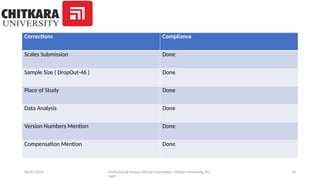
Corrections Compliance
Scales Submission Done
Sample Size ( DropOut-46 ) Done
Place of Study Done
Data Analysis Done
Version Numbers Mention Done
Compensation Mention Done
06/01/2025 14
Numerical Pain Rating Scale
06/01/2025 Institutional Human Ethical Committee, Chitkara University, Pu
njab
15
06/01/2025 Institutional Human Ethical Committee, Chitkara University, Pu
njab
16
06/01/2025 Institutional Human Ethical Committee, Chitkara University, Pu
njab
17
No Objection Certificate
06/01/2025 Institutional Human Ethical Committee, Chitkara University, Pu
njab
18
Patient Information Sheet
06/01/2025 Institutional Human Ethical Committee, Chitkara University, Pu
njab
19
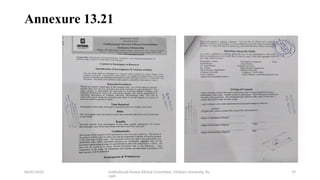
Annexure 13.21
06/01/2025 Institutional Human Ethical Committee, Chitkara University, Pu
njab
20
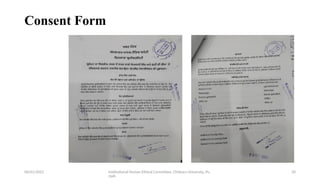
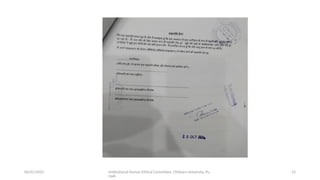
Consent Form
06/01/2025 Institutional Human Ethical Committee, Chitkara University, Pu
njab
21
06/01/2025 Institutional Human Ethical Committee, Chitkara University, Pu
njab
22
06/01/2025 Institutional Human Ethical Committee, Chitkara University, Pu
njab
23
06/01/2025 Institutional Human Ethical Committee, Chitkara University, Pu
njab
24
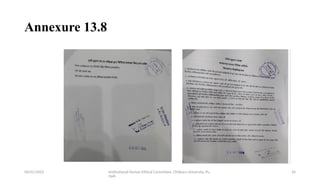
Annexure 13.8
06/01/2025 Institutional Human Ethical Committee, Chitkara University, Pu
njab
25
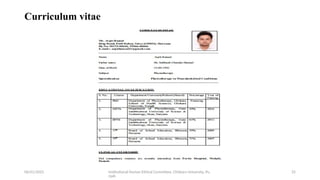
Curriculum vitae
06/01/2025 Institutional Human Ethical Committee, Chitkara University, Pu
njab
26
06/01/2025 Institutional Human Ethical Committee, Chitkara University, Pu
njab
27
06/01/2025 Institutional Human Ethical Committee, Chitkara University, Pu
njab
28
06/01/2025 Institutional Human Ethical Committee, Chitkara University, Pu
njab
29
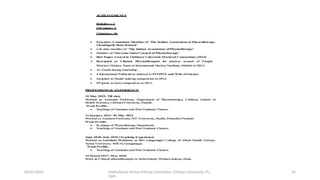
Curriculum Vitae
06/01/2025 Institutional Human Ethical Committee, Chitkara University, Pu
njab
30
Curriculum Vitae
06/01/2025 Institutional Human Ethical Committee, Chitkara University, Pu
njab
31
Reference
1. Wong CK. Strain counter strain: current concepts and clinical evidence. Man Ther. 2012
Feb;17(1):2-8. doi: 10.1016/j.math.2011.10.001. Epub 2011 Oct 24. PMID: 22030379.
2. Inderpreet, Kaur & Arunmozhi, R & Arfath, Umer. (2013). EFFECT OF MAITLAND VS
MULLIGAN MOBILISATION TECHNIQUE ON UPPER THORACIC SPINE IN PATIENTS
WITH NON-SPECIFIC NECK PAIN-A COMPARATIVE STUDY. Int J Physiotherapy Res. 1.
214-18.
06/01/2025 Institutional Human Ethical Committee, Chitkara University, Pu
njab
32
THANKYOU

ethical ppt (1) for physiotherapy in MPT

  • 1.
    06/01/2025 Institutional HumanEthical Committee, Chitkara University, Pu njab 1 Title EFFECTIVENESS OF POSITIONAL RELEASE TECHNIQUE VERSUS MAITLAND MOBILIZATION ON PAIN AND CERVICAL RANGE OF MOTION IN INDIVIDUALS WITH NECK PAIN Presented By- Sujan Dhanta Roll number-2340981309 Guide- Dr. Arpit Bansal Co Guide- Dr. Sahana A
  • 2.
    06/01/2025 2 Research Gap Gap:While both Maitland Mobilization and Positional Release Therapy have been studied individually for their effectiveness in treating neck pain, there is a lack of direct comparative studies that assess their efficacy against each other. Implication: This gap indicates a need for research that directly compares these two commonly used techniques, providing a clearer understanding of which method may be more effective in non specific pain. Institutional Human Ethical Committee, Chitkara University, Punjab
  • 3.
    Institutional Human EthicalCommittee, Chitkara University, Pu njab 3 Aim & Objectives Aim The aim of the study is to compare the effectiveness of positional release technique and Maitland mobilisation on pain and cervical range of motion in individuals with neck pain. Objectives 1. To evaluate the effect of Maitland Mobilization on cervical range of motion, pain and quality of life in individuals with neck pain. 2. To evaluate the effects of Positional Release Technique on cervical range of motion, pain and quality of life in individuals with neck pain. 3. To compare the effects of Maitland mobilization versus Positional Release Technique on cervical range of motion, pain and quality of life in individuals with neck pain. 06/01/2025
  • 4.
    06/01/2025 Institutional HumanEthical Committee, Chitkara University, Pu njab 4 Methodology Study Design: An experimental study Sample Size: 46( Group A=23 and Group B=23. Sampling Technique: Convenience Sampling. Inclusion criteria: • Presence of pain on cervical region without radicular symptoms • Duration of pain- sub-acute. • Age group- 20-45 years. • Both males and females.
  • 5.
    06/01/2025 5 Exclusion criteria: •Previous surgery for neck • Cervical Brachialgia • Cervical Rib • Neurological deficits like spinal cord injury • Contusions • Vertebral collapse or fracture • Skin Hypersensitivity • Open Wounds In cerstitutional Human Ethical Committee, Chitkara University, Punjab
  • 6.
    06/01/2025 Institutional HumanEthical Committee, Chitkara University, Pu njab 6 • Acute Rheumatoid arthritis of cervical spine Outcome measures: • Numerical pain rating scale for pain evaluation. • Universal goniometer for evaluation of cervical range of motion. • Neck disability index for evaluation of quality of life.
  • 7.
    06/01/2025 Institutional HumanEthical Committee, Chitkara University, Pu njab 7 Procedure: • Subjects satisfying the selection criteria will be recruited from the Physiotherapy Outpatient Department of Chitkara University and will be divided into two groups, Group A and Group B. • Group A will receive Positional Release Technique of 3 repetitions with 20 second relaxation time and conventional therapy • Group B will receive Maitland Mobilization of 3 repetitions for 2 minutes each with 1 minute relaxation time and conventional therapy. • This procedure on patients will be done for total of 4 weeks with 4 sessions per week. • All subjects will be evaluated with Numerical Pain Rating Scale, Cervical Range of Motion using Goniometer and Neck Disability Index.
  • 8.
    06/01/2025 Institutional HumanEthical Committee, Chitkara University, Pu njab 8 Conventional Therapy- • Hot Fomentation- Cervical region and upper back for 15 minutes. • Isometric Exercises of Flexor Muscles, extensor muscles, lateral flexors, and chin tucks of the neck region against the resistance of the patients own hand will be done at ten repetitions for 15 second each. • Stretching Exercises –Levator Scapulae, Splenius Capitus and Trapezius muscles stretching - 3 repetitions for 15 second hold each.
  • 9.
    06/01/2025 Institutional HumanEthical Committee, Chitkara University, Pu njab 9 Positional release technique- is a passive positional release technique that targets musculoskeletal pain and dysfunction with gentle, indirect manual manipulation. Palpation of tender points on upper trapezius to be done and characterized by tenderness upon palpation. Therapist then palpates the trigger point by maintaining the patient position that relieves palpation tenderness. The tissues around the trigger point are shortened and the position of comfort is maintained by the therapist. The release of trigger point occurs after 90 seconds and the therapist then returns the patient into normal resting position (1) Maitland mobilization technique- The patient lies in prone position and the therapist stands at the level of the head of the patient. Therapist places the thumbs opposite to each other at the level of the vertebra's facet or spinous process of the corresponding cervical vertebrae. An oscillating pressure is applied across the hypomobile vertebra through the thumbs. Grades I and II are given when pain comes before the motion barrier and Grades III and IV are given when the motion barrier is present before pain. This intervention for each joint mobilization will last for 30 seconds.(2) Data will be analysed using SPSS V 21. Data will be analysed for normality. Normally distributed data will be analysed using student t-test for within group analysis and for between the group, independent t-test will be used. If the data is not normally distributed, Wilcoxon signed rank test and Mann Whitney U test will be used for within group and between group analysis respectively. A ‘p’ value of <0.05 was considered statistically significant for the tests.
  • 10.
    06/01/2025 Institutional HumanEthical Committee, Chitkara University, Pu njab 10 Risk and Benefits To my best knowledge there is minimal risk involved as these techniques are non invasive.
  • 11.
    06/01/2025 Institutional HumanEthical Committee, Chitkara University, Pu njab 11 Benefits • Positional Release Technique and Maitland Mobilization are non invasive gentle techniques that minimizes discomfort and is suitable for patients with neck pain. • These techniques will be effective in restoring range of motion and improving quality of life by restoring functional movement patterns.
  • 12.
    06/01/2025 12 Outcome Pain reduction:outcome measure used Numerical Pain Rating Scale • Positional Release Technique- leads to pain relief due to its focus on trigger point release . • Maitland Mobilization- can be effective in reducing pain when improving joint mechanics by relieving stress on painful structures. Improved Range Of Motion: outcome measure used Standard Goniometer. • Positional Release Technique- facilitate improvement in mobility indirectly by relieving tension in the muscle. • Maitland Mobilization- leads to enhancement in neck movement. Functional Improvement: outcome measure used is Neck Pain Disability Index. • Positional Release Technique and Maitland Mobilization- Patients may report improvement in daily activities, work performance and overall quality of life . Institutional Human Ethical Committee, Chitkara University, Punjab
  • 13.
    06/01/2025 Institutional HumanEthical Committee, Chitkara University, Pu njab 13 Corrections Compliance Scales Submission Done Sample Size ( DropOut-46 ) Done Place of Study Done Data Analysis Done Version Numbers Mention Done Compensation Mention Done
  • 14.
  • 15.
    06/01/2025 Institutional HumanEthical Committee, Chitkara University, Pu njab 15
  • 16.
    06/01/2025 Institutional HumanEthical Committee, Chitkara University, Pu njab 16
  • 17.
    06/01/2025 Institutional HumanEthical Committee, Chitkara University, Pu njab 17 No Objection Certificate
  • 18.
    06/01/2025 Institutional HumanEthical Committee, Chitkara University, Pu njab 18 Patient Information Sheet
  • 19.
    06/01/2025 Institutional HumanEthical Committee, Chitkara University, Pu njab 19 Annexure 13.21
  • 20.
    06/01/2025 Institutional HumanEthical Committee, Chitkara University, Pu njab 20 Consent Form
  • 21.
    06/01/2025 Institutional HumanEthical Committee, Chitkara University, Pu njab 21
  • 22.
    06/01/2025 Institutional HumanEthical Committee, Chitkara University, Pu njab 22
  • 23.
    06/01/2025 Institutional HumanEthical Committee, Chitkara University, Pu njab 23
  • 24.
    06/01/2025 Institutional HumanEthical Committee, Chitkara University, Pu njab 24 Annexure 13.8
  • 25.
    06/01/2025 Institutional HumanEthical Committee, Chitkara University, Pu njab 25 Curriculum vitae
  • 26.
    06/01/2025 Institutional HumanEthical Committee, Chitkara University, Pu njab 26
  • 27.
    06/01/2025 Institutional HumanEthical Committee, Chitkara University, Pu njab 27
  • 28.
    06/01/2025 Institutional HumanEthical Committee, Chitkara University, Pu njab 28
  • 29.
    06/01/2025 Institutional HumanEthical Committee, Chitkara University, Pu njab 29 Curriculum Vitae
  • 30.
    06/01/2025 Institutional HumanEthical Committee, Chitkara University, Pu njab 30 Curriculum Vitae
  • 31.
    06/01/2025 Institutional HumanEthical Committee, Chitkara University, Pu njab 31 Reference 1. Wong CK. Strain counter strain: current concepts and clinical evidence. Man Ther. 2012 Feb;17(1):2-8. doi: 10.1016/j.math.2011.10.001. Epub 2011 Oct 24. PMID: 22030379. 2. Inderpreet, Kaur & Arunmozhi, R & Arfath, Umer. (2013). EFFECT OF MAITLAND VS MULLIGAN MOBILISATION TECHNIQUE ON UPPER THORACIC SPINE IN PATIENTS WITH NON-SPECIFIC NECK PAIN-A COMPARATIVE STUDY. Int J Physiotherapy Res. 1. 214-18.
  • 32.
    06/01/2025 Institutional HumanEthical Committee, Chitkara University, Pu njab 32 THANKYOU