Effect of hamstring
stretching and nerve
mobilisation in the patients
of low back pain
Submitted To :
Dr Manoj Malik
Submitted By :
Anshu Yadav
220172670003
Mpt 1st yr
SPORTS
 Chronic back pain is determined by the persistence of back pain for more
than three months of symptom. The intervertebral disc usually cause back
pain and radicular symptoms. Radiculopathy is common condition in which
pain radiated towards lower extremity. The causes of lower back pain, such as
traumatic, inflammatory, degenerative, metabolic and changes to body
alignment and continuous movement are general risks of lower back pain
 Decreases of flexibility in hamstring muscles risk of injury and stress on the
spine during the bending posture lower back pain increases when lower spine
muscles and hamstring muscles contract, hamstring flexibility exercises are
good treatment options to alleviate lower back pain.
Clinical viewpoint, nerve mobilization is effective for
various musculoskeletal diseases, such as carpal
tunnel syndrome, brachial nerve pain in the neck, and
lateral epicondylitis.
hamstring stretching and nerve mobilization are
conducted on patients with radicular lower back pain,
and changes to pain levels, pressure thresholds,
disorder levels of lower back pain were studied.
Neural mobilization (NM) constitutes the most effective, common method
for assessing and treating several neuromuscular disorders,
Combinations of joint movements that promote either sliding, or neural
tensioning,
Mobilization techniques relieve the damaged sciatic nerve structure and
improve range of motion in the joint structure.
Extracorporeal shockwave therapy are applied to particular lesions to
activate revascularization and stimulate the process of connective tissue
generation and healing of the bone. The pain is removed, and the
function is improved.
ESWT plays an important role in pain relief and muscle strength
improvement through appropriate motor simulation of the muscles and
tendons with extracorporeal shockwaves.
The purpose of LSE(Lumbar or core stabilization exercises) is to improve the
neural and muscular control of the central musculature while maintaining
stability in and around the spine and trunk
Including
studies
Design Sample size
with
characteristi
cs
Purpose of
the study
Outcome
measures
conclusion
Dr Salem F.
Alatwi.2019
Randomised
controlled
study
30
participants
(Group A-NM
with LSE and
rESWT
Group B- LSE
and rESWT)
Effectiveness
of neural
mobilisation
technique
compared to
LSE and
rESWTin PT
mangement
of chronic
back pain
with
radiculopathy
Numberical
pain rating
scale
Lumbar
flexion ROM
by Schober
method
NM with LSE
and RESWT
is more
effective in
chronic back
pain
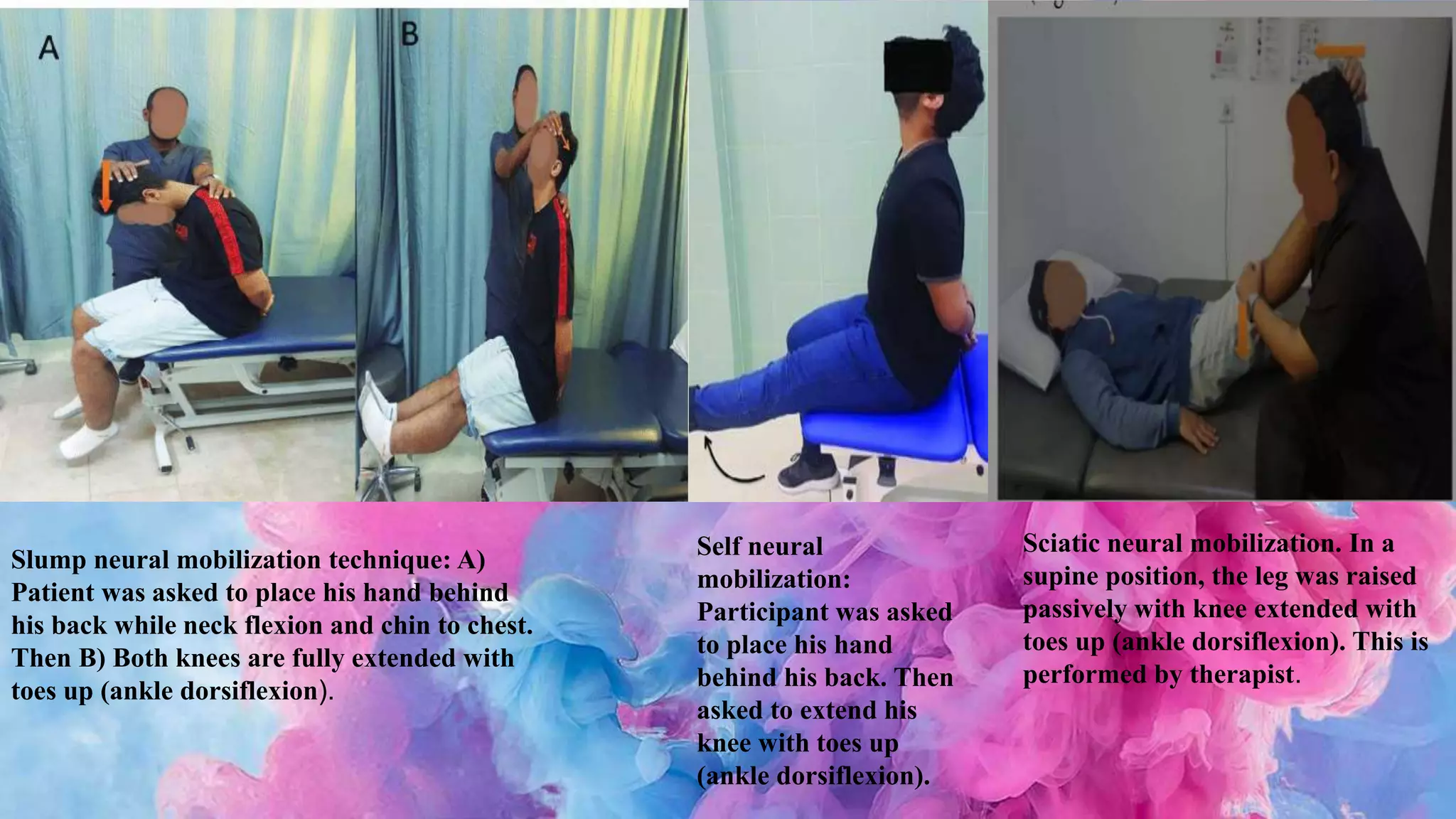
Sciatic neural mobilization. In a
supine position, the leg was raised
passively with knee extended with
toes up (ankle dorsiflexion). This is
performed by therapist.
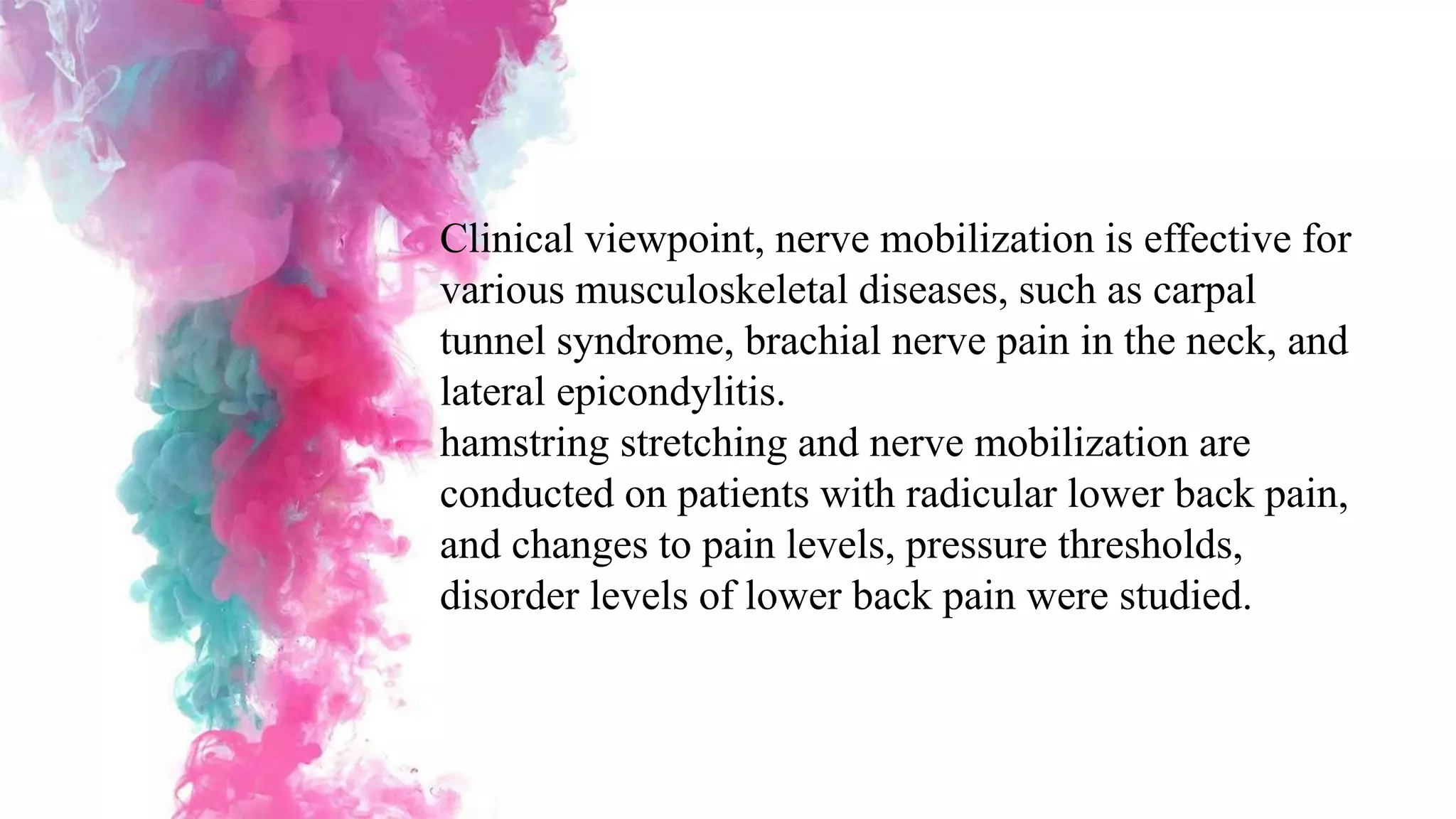
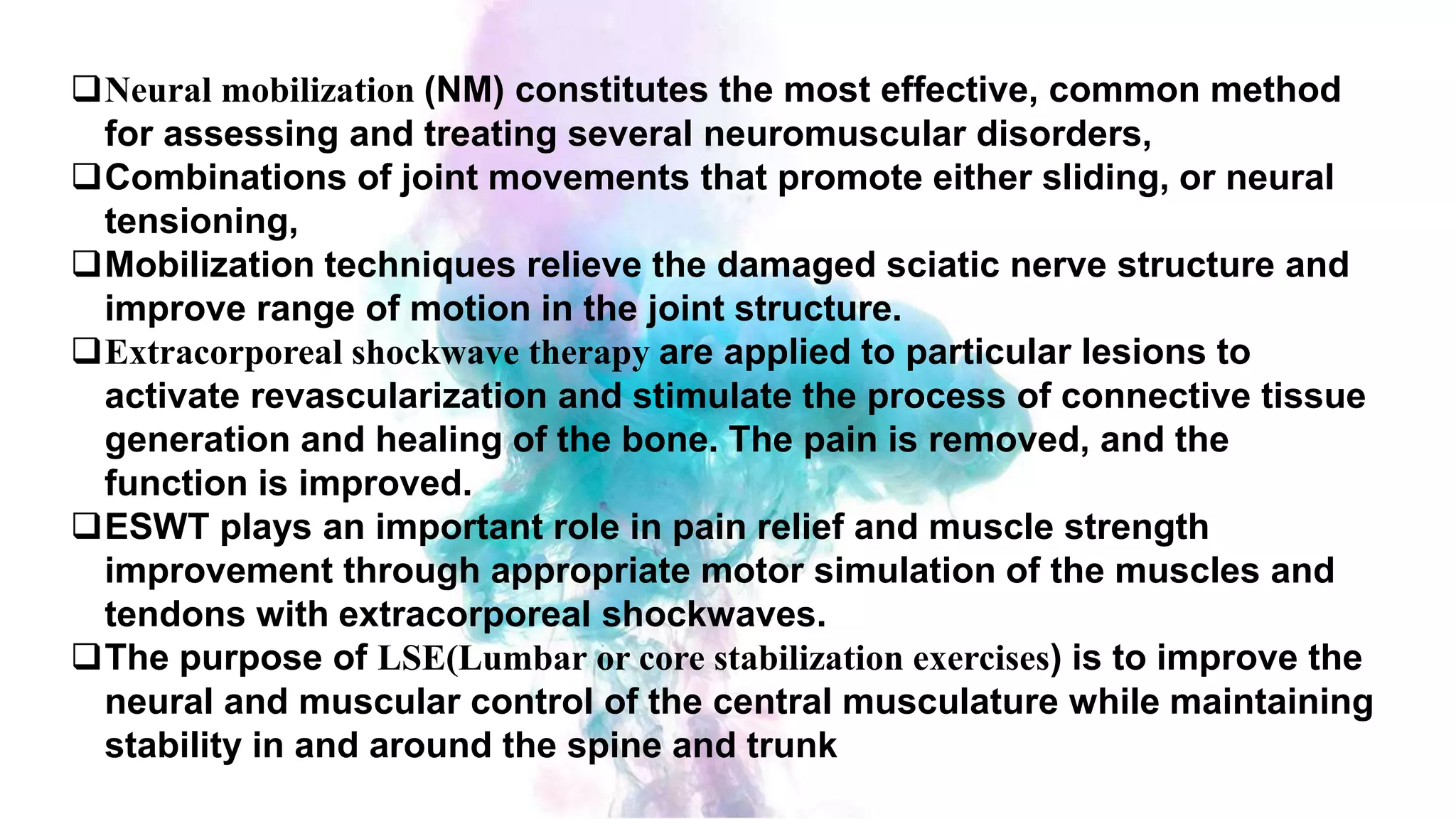
Slump neural mobilization technique: A)
Patient was asked to place his hand behind
his back while neck flexion and chin to chest.
Then B) Both knees are fully extended with
toes up (ankle dorsiflexion).
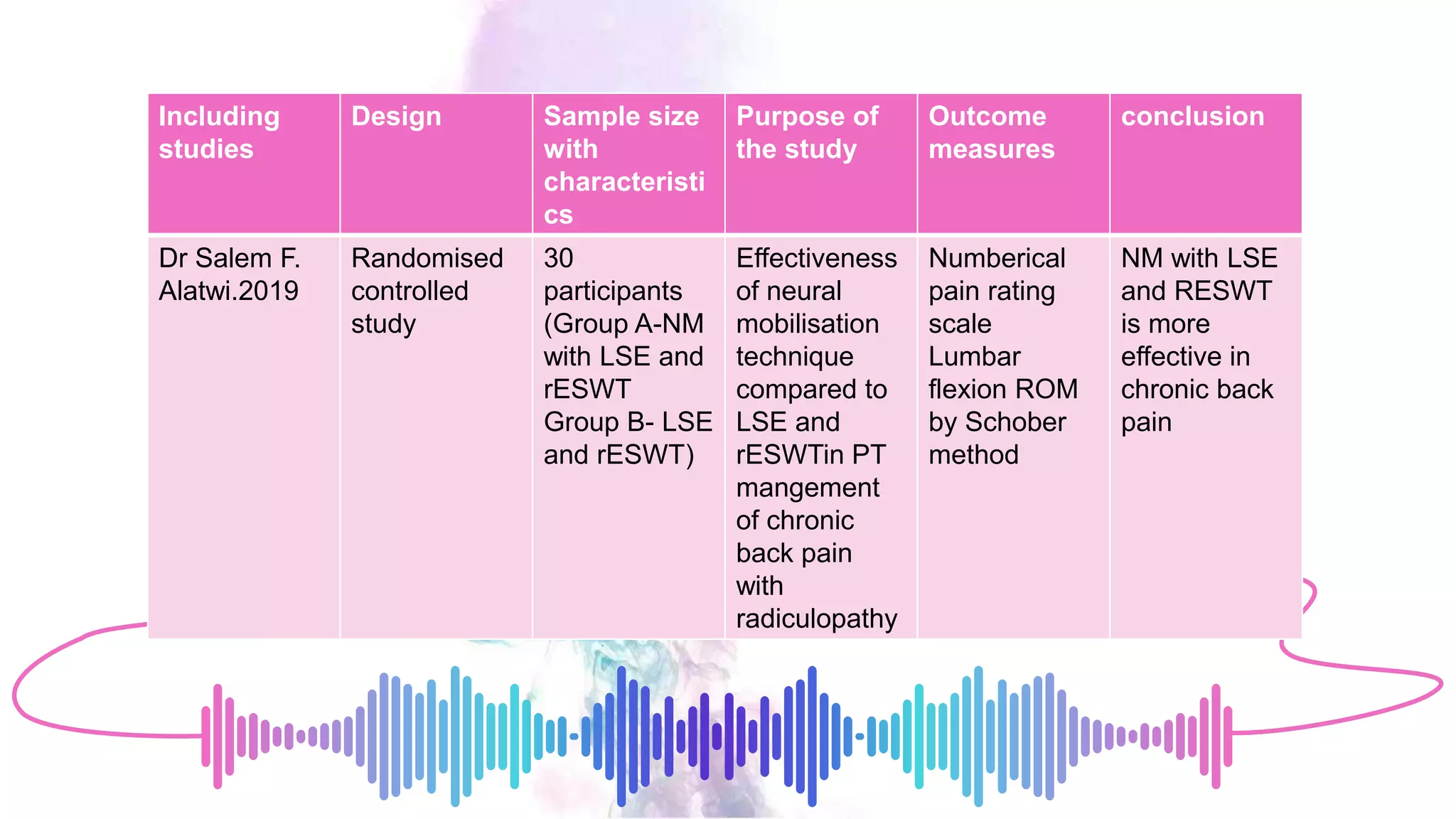
Self neural
mobilization:
Participant was asked
to place his hand
behind his back. Then
asked to extend his
knee with toes up
(ankle dorsiflexion).
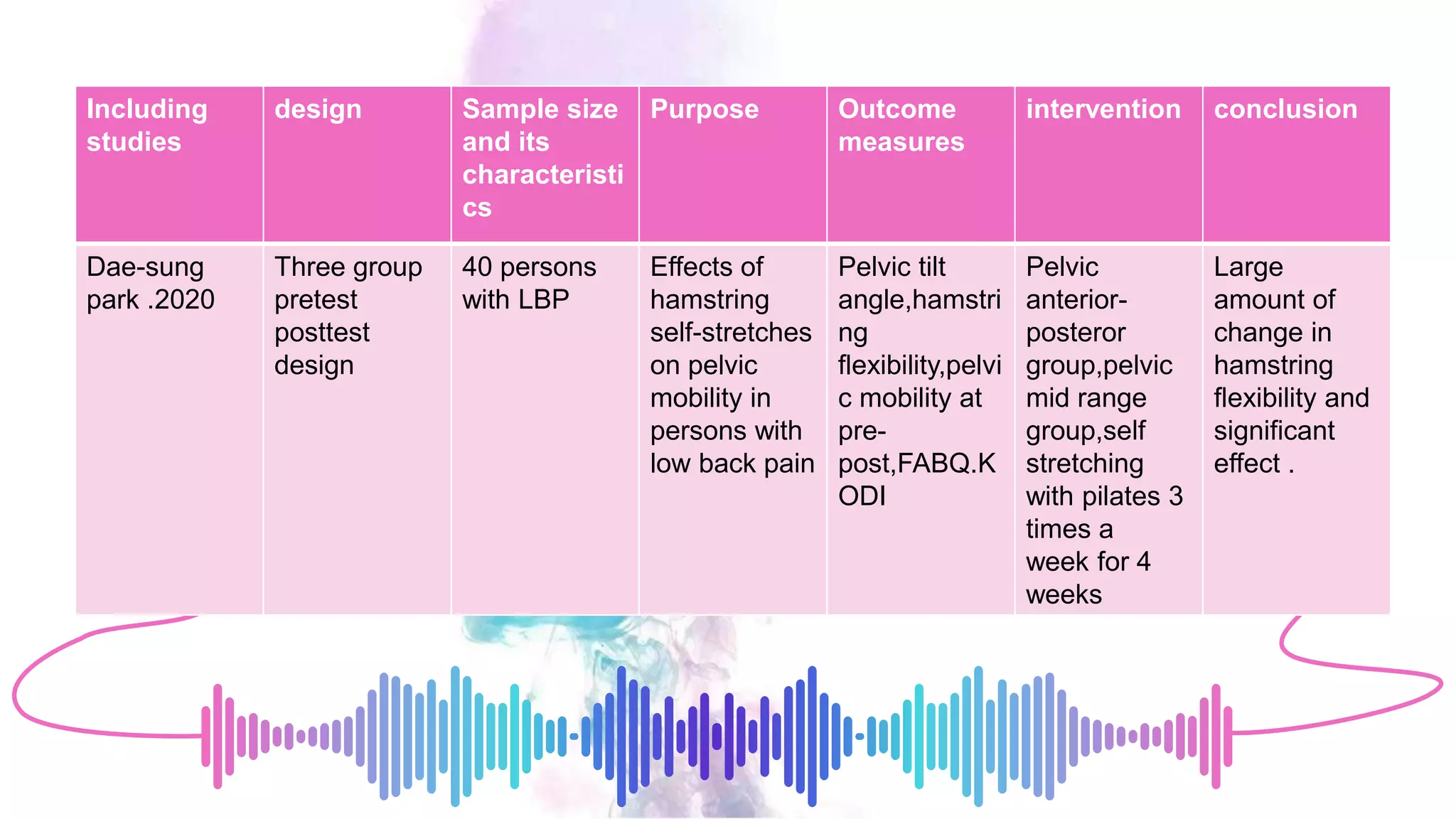
Including
studies
design Sample size
and its
characteristi
cs
Purpose Outcome
measures
intervention conclusion
Dae-sung
park .2020
Three group
pretest
posttest
design
40 persons
with LBP
Effects of
hamstring
self-stretches
on pelvic
mobility in
persons with
low back pain
Pelvic tilt
angle,hamstri
ng
flexibility,pelvi
c mobility at
pre-
post,FABQ.K
ODI
Pelvic
anterior-
posteror
group,pelvic
mid range
group,self
stretching
with pilates 3
times a
week for 4
weeks
Large
amount of
change in
hamstring
flexibility and
significant
effect .
Hamstrings flexibility test using an
inclinometer
Including
studies
design Sample size
and its
characteristi
cs
Purpose Outcome
measures
conclusion
Ju-hyun
lee.2017
Experimental
study
22 subjects
with radicular
pain
The
treatment
effect of
hamstring
stretching
and nerve
mobilization
for patients
with radicular
lower back
pain
Visual
analoque
scale,index
of backache
disorder
before and
after,digital
algometer
Hamstring
stretching and
nerve
mobilisation can
be applied for
the therapy of
patient with
radicular lower
back pain .
CONCLUSION
Based on the study review the application of
neural mobilization techniques and radial
extracorporeal shock wave therapy with
lumbar stabilization exercise have a strong
effect on chronic low back pain with
radiculopathy and the hamstring flexibility
also have the significant effect on the lower
back pain and pelvic stability.
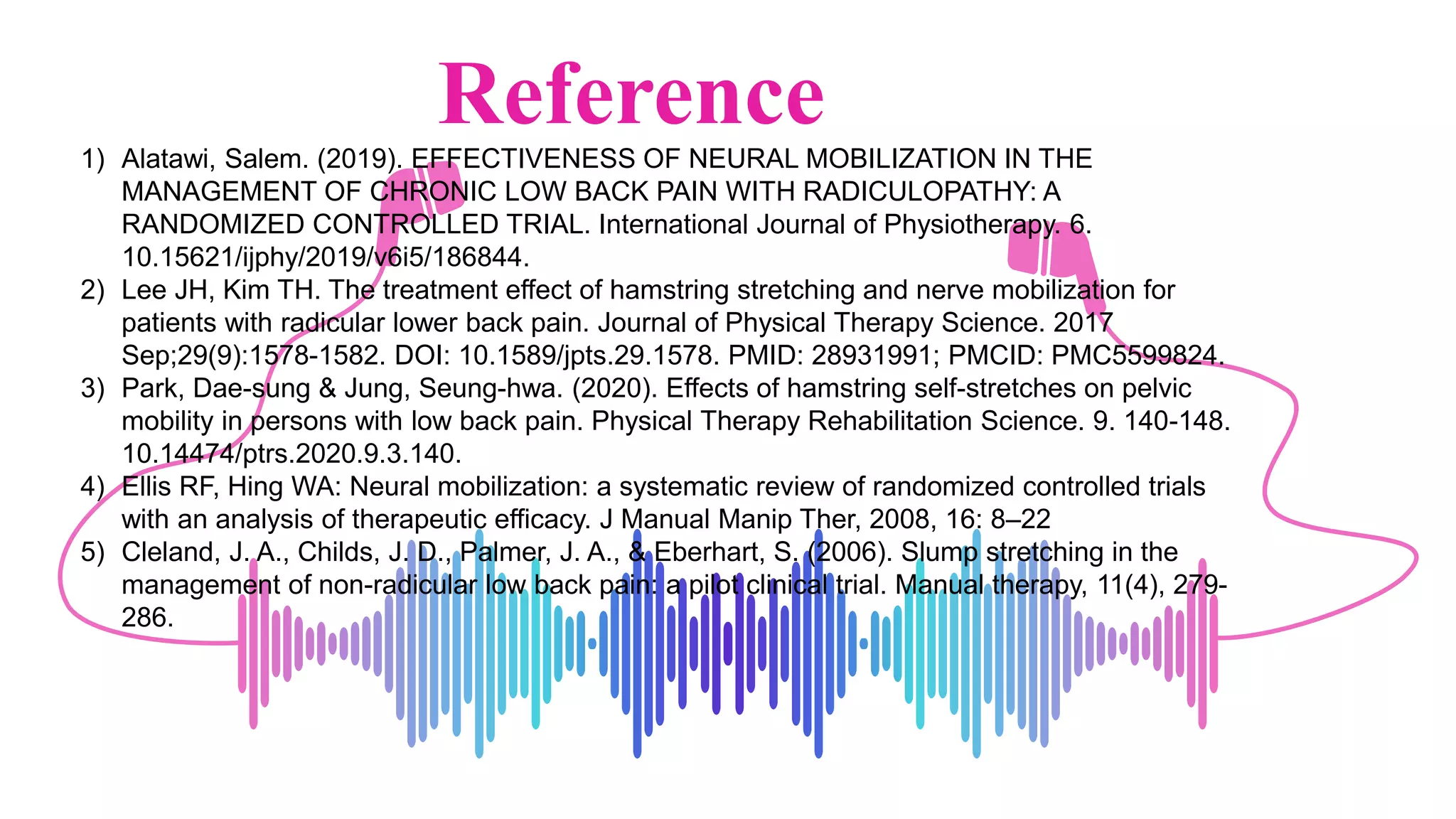
1) Alatawi, Salem. (2019). EFFECTIVENESS OF NEURAL MOBILIZATION IN THE
MANAGEMENT OF CHRONIC LOW BACK PAIN WITH RADICULOPATHY: A
RANDOMIZED CONTROLLED TRIAL. International Journal of Physiotherapy. 6.
10.15621/ijphy/2019/v6i5/186844.
2) Lee JH, Kim TH. The treatment effect of hamstring stretching and nerve mobilization for
patients with radicular lower back pain. Journal of Physical Therapy Science. 2017
Sep;29(9):1578-1582. DOI: 10.1589/jpts.29.1578. PMID: 28931991; PMCID: PMC5599824.
3) Park, Dae-sung & Jung, Seung-hwa. (2020). Effects of hamstring self-stretches on pelvic
mobility in persons with low back pain. Physical Therapy Rehabilitation Science. 9. 140-148.
10.14474/ptrs.2020.9.3.140.
4) Ellis RF, Hing WA: Neural mobilization: a systematic review of randomized controlled trials
with an analysis of therapeutic efficacy. J Manual Manip Ther, 2008, 16: 8–22
5) Cleland, J. A., Childs, J. D., Palmer, J. A., & Eberhart, S. (2006). Slump stretching in the
management of non-radicular low back pain: a pilot clinical trial. Manual therapy, 11(4), 279-
286.
Reference
THANK YOU

Effect of hamstring stretching and neural mobilization.pptx

  • 1.
    Effect of hamstring stretchingand nerve mobilisation in the patients of low back pain Submitted To : Dr Manoj Malik Submitted By : Anshu Yadav 220172670003 Mpt 1st yr SPORTS
  • 2.
     Chronic backpain is determined by the persistence of back pain for more than three months of symptom. The intervertebral disc usually cause back pain and radicular symptoms. Radiculopathy is common condition in which pain radiated towards lower extremity. The causes of lower back pain, such as traumatic, inflammatory, degenerative, metabolic and changes to body alignment and continuous movement are general risks of lower back pain  Decreases of flexibility in hamstring muscles risk of injury and stress on the spine during the bending posture lower back pain increases when lower spine muscles and hamstring muscles contract, hamstring flexibility exercises are good treatment options to alleviate lower back pain.
  • 3.
    Clinical viewpoint, nervemobilization is effective for various musculoskeletal diseases, such as carpal tunnel syndrome, brachial nerve pain in the neck, and lateral epicondylitis. hamstring stretching and nerve mobilization are conducted on patients with radicular lower back pain, and changes to pain levels, pressure thresholds, disorder levels of lower back pain were studied.
  • 4.
    Neural mobilization (NM)constitutes the most effective, common method for assessing and treating several neuromuscular disorders, Combinations of joint movements that promote either sliding, or neural tensioning, Mobilization techniques relieve the damaged sciatic nerve structure and improve range of motion in the joint structure. Extracorporeal shockwave therapy are applied to particular lesions to activate revascularization and stimulate the process of connective tissue generation and healing of the bone. The pain is removed, and the function is improved. ESWT plays an important role in pain relief and muscle strength improvement through appropriate motor simulation of the muscles and tendons with extracorporeal shockwaves. The purpose of LSE(Lumbar or core stabilization exercises) is to improve the neural and muscular control of the central musculature while maintaining stability in and around the spine and trunk
  • 5.
    Including studies Design Sample size with characteristi cs Purposeof the study Outcome measures conclusion Dr Salem F. Alatwi.2019 Randomised controlled study 30 participants (Group A-NM with LSE and rESWT Group B- LSE and rESWT) Effectiveness of neural mobilisation technique compared to LSE and rESWTin PT mangement of chronic back pain with radiculopathy Numberical pain rating scale Lumbar flexion ROM by Schober method NM with LSE and RESWT is more effective in chronic back pain
  • 6.
    Sciatic neural mobilization.In a supine position, the leg was raised passively with knee extended with toes up (ankle dorsiflexion). This is performed by therapist. Slump neural mobilization technique: A) Patient was asked to place his hand behind his back while neck flexion and chin to chest. Then B) Both knees are fully extended with toes up (ankle dorsiflexion). Self neural mobilization: Participant was asked to place his hand behind his back. Then asked to extend his knee with toes up (ankle dorsiflexion).
  • 7.
    Including studies design Sample size andits characteristi cs Purpose Outcome measures intervention conclusion Dae-sung park .2020 Three group pretest posttest design 40 persons with LBP Effects of hamstring self-stretches on pelvic mobility in persons with low back pain Pelvic tilt angle,hamstri ng flexibility,pelvi c mobility at pre- post,FABQ.K ODI Pelvic anterior- posteror group,pelvic mid range group,self stretching with pilates 3 times a week for 4 weeks Large amount of change in hamstring flexibility and significant effect .
  • 8.
    Hamstrings flexibility testusing an inclinometer
  • 9.
    Including studies design Sample size andits characteristi cs Purpose Outcome measures conclusion Ju-hyun lee.2017 Experimental study 22 subjects with radicular pain The treatment effect of hamstring stretching and nerve mobilization for patients with radicular lower back pain Visual analoque scale,index of backache disorder before and after,digital algometer Hamstring stretching and nerve mobilisation can be applied for the therapy of patient with radicular lower back pain .
  • 10.
    CONCLUSION Based on thestudy review the application of neural mobilization techniques and radial extracorporeal shock wave therapy with lumbar stabilization exercise have a strong effect on chronic low back pain with radiculopathy and the hamstring flexibility also have the significant effect on the lower back pain and pelvic stability.
  • 11.
    1) Alatawi, Salem.(2019). EFFECTIVENESS OF NEURAL MOBILIZATION IN THE MANAGEMENT OF CHRONIC LOW BACK PAIN WITH RADICULOPATHY: A RANDOMIZED CONTROLLED TRIAL. International Journal of Physiotherapy. 6. 10.15621/ijphy/2019/v6i5/186844. 2) Lee JH, Kim TH. The treatment effect of hamstring stretching and nerve mobilization for patients with radicular lower back pain. Journal of Physical Therapy Science. 2017 Sep;29(9):1578-1582. DOI: 10.1589/jpts.29.1578. PMID: 28931991; PMCID: PMC5599824. 3) Park, Dae-sung & Jung, Seung-hwa. (2020). Effects of hamstring self-stretches on pelvic mobility in persons with low back pain. Physical Therapy Rehabilitation Science. 9. 140-148. 10.14474/ptrs.2020.9.3.140. 4) Ellis RF, Hing WA: Neural mobilization: a systematic review of randomized controlled trials with an analysis of therapeutic efficacy. J Manual Manip Ther, 2008, 16: 8–22 5) Cleland, J. A., Childs, J. D., Palmer, J. A., & Eberhart, S. (2006). Slump stretching in the management of non-radicular low back pain: a pilot clinical trial. Manual therapy, 11(4), 279- 286. Reference
  • 12.