Ethical Hacking
Prepared by,
Samip Shah
15012011045
Sem-5, CE
UVPCE
Contents
• What is hacking?
• How it came to picture?
• What are hackers?
• Phases of hacking.
• Basic Tools.
• Its advantages & disadvantages.
What is HACKING??
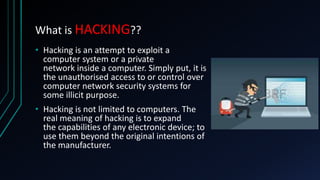
• Hacking is an attempt to exploit a
computer system or a private
network inside a computer. Simply put, it is
the unauthorised access to or control over
computer network security systems for
some illicit purpose.
• Hacking is not limited to computers. The
real meaning of hacking is to expand
the capabilities of any electronic device; to
use them beyond the original intentions of
the manufacturer.
Some more Questions
• What is purpose of ethical hacking?
• What gives hacker motivation?
• What actually ethical hackers do?
How it all started?
• The first hackers appeared in the 1960's at the
Massachusetts Institute of Technology (MIT), and their first victims
were electric trains.
• During the 1970's, a different kind of hacker appeared. They
learned ways to hack the telephonic system and make phone calls
for free.
• By the 1980's, phreaks started to migrate to computers, hackers
specialized in tips on how to break into computers, how to use
stolen credit card numbers and share stolen computer passwords.
Continued…
• It wasn't until 1986 that the US government realized the danger
that hackers represented to the national security.
• The Congress passed the Computer Fraud and Abuse Act, making
computer breaking a crime across the nation
• During the 1990's, when the use of the internet widespread around
the world, hackers multiplied.
• Today, we are accustomed to hackers, crackers, viruses, Trojans,
worms.
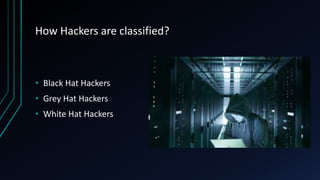
How Hackers are classified?
• Black Hat Hackers
• Grey Hat Hackers
• White Hat Hackers
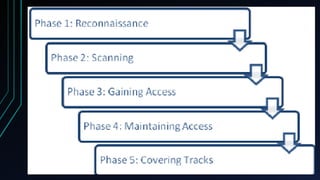
Phases of Hacking
• Passive and Active Reconnaissance
Passive reconnaissance involves gathering information regarding a
potential target without the targeted individual’s or company’s
knowledge.
Active reconnaissance involves probing the network to discover
individual hosts, IP addresses, and services on the network.
• Scanning
It involves taking the information discovered during reconnaissance
and using it to examine the network.
continued..
• Gaining Access
This is the phase where the real hacking takes place. Vulnerabilities
discovered during the reconnaissance and scanning phase are now
exploited to gain access.
• Maintaining Access
Once a hacker has gained access, they want to keep that access for
future exploitation and attacks. Sometimes, hackers harden the
system from other hackers or security personnel by securing their
exclusive access with backdoors, rootkits, and Trojans.
continued…
• Covering Tracks
Once hackers have been able to gain and maintain access, they cover
their tracks to avoid detection by security personnel, to continue to
use the owned system, to remove evidence of hacking, or to avoid
legal action.
Some of widely used tools
• Nmap (Network Mapper)
Nmap is basically a network security mapper capable of discovering
services and hosts on a network, thereby creating a network map.
• Nessus
Nessus is the world’s most well-known vulnerability scanner, which was
designed by tenable network security. It is free and is chiefly recommended
for non-enterprise usage.
• Nikto
Nikto is a web scanner that scans and tests several web servers for
identifying software that are outdated, dangerous CGIs or files and other
problems.
Continued..
• Kismet
Kismet is basically a sniffer and wireless-network detector that works
with other wireless cards and supports raw-monitoring mode.
• NetStumbler
This is also a tool used to prevent wardriving, which works on
operating systems based on windows. A newer version of this called
MiniStumbler is now available.
Advantages
• Can be used to recover lost
information where the
computer password has been
lost
• Hacking makes us aware about
the possible loopholes of the
any system .
• Teaches u that no technology is
100% secure
• To test how good security is on
your own network.
Disadvantages
• Criminals can use it to their
advantage. It can harm
someone's privacy
• Very confidential information
can fall in the hands of the
hackers who can use it
maliciously.
• Viruses, malware and other
destructive and harmful things
on a computer can be sent
remotely.
What next?
• Future of hacking
• Scope as an Ethical Hacker

Ethical hacking

  • 1.
    Ethical Hacking Prepared by, SamipShah 15012011045 Sem-5, CE UVPCE
  • 2.
    Contents • What ishacking? • How it came to picture? • What are hackers? • Phases of hacking. • Basic Tools. • Its advantages & disadvantages.
  • 3.
    What is HACKING?? •Hacking is an attempt to exploit a computer system or a private network inside a computer. Simply put, it is the unauthorised access to or control over computer network security systems for some illicit purpose. • Hacking is not limited to computers. The real meaning of hacking is to expand the capabilities of any electronic device; to use them beyond the original intentions of the manufacturer.
  • 4.
    Some more Questions •What is purpose of ethical hacking? • What gives hacker motivation? • What actually ethical hackers do?
  • 5.
    How it allstarted? • The first hackers appeared in the 1960's at the Massachusetts Institute of Technology (MIT), and their first victims were electric trains. • During the 1970's, a different kind of hacker appeared. They learned ways to hack the telephonic system and make phone calls for free. • By the 1980's, phreaks started to migrate to computers, hackers specialized in tips on how to break into computers, how to use stolen credit card numbers and share stolen computer passwords.
  • 6.
    Continued… • It wasn'tuntil 1986 that the US government realized the danger that hackers represented to the national security. • The Congress passed the Computer Fraud and Abuse Act, making computer breaking a crime across the nation • During the 1990's, when the use of the internet widespread around the world, hackers multiplied. • Today, we are accustomed to hackers, crackers, viruses, Trojans, worms.
  • 7.
    How Hackers areclassified? • Black Hat Hackers • Grey Hat Hackers • White Hat Hackers
  • 8.
    Phases of Hacking •Passive and Active Reconnaissance Passive reconnaissance involves gathering information regarding a potential target without the targeted individual’s or company’s knowledge. Active reconnaissance involves probing the network to discover individual hosts, IP addresses, and services on the network. • Scanning It involves taking the information discovered during reconnaissance and using it to examine the network.
  • 9.
    continued.. • Gaining Access Thisis the phase where the real hacking takes place. Vulnerabilities discovered during the reconnaissance and scanning phase are now exploited to gain access. • Maintaining Access Once a hacker has gained access, they want to keep that access for future exploitation and attacks. Sometimes, hackers harden the system from other hackers or security personnel by securing their exclusive access with backdoors, rootkits, and Trojans.
  • 10.
    continued… • Covering Tracks Oncehackers have been able to gain and maintain access, they cover their tracks to avoid detection by security personnel, to continue to use the owned system, to remove evidence of hacking, or to avoid legal action.
  • 12.
    Some of widelyused tools • Nmap (Network Mapper) Nmap is basically a network security mapper capable of discovering services and hosts on a network, thereby creating a network map. • Nessus Nessus is the world’s most well-known vulnerability scanner, which was designed by tenable network security. It is free and is chiefly recommended for non-enterprise usage. • Nikto Nikto is a web scanner that scans and tests several web servers for identifying software that are outdated, dangerous CGIs or files and other problems.
  • 13.
    Continued.. • Kismet Kismet isbasically a sniffer and wireless-network detector that works with other wireless cards and supports raw-monitoring mode. • NetStumbler This is also a tool used to prevent wardriving, which works on operating systems based on windows. A newer version of this called MiniStumbler is now available.
  • 14.
    Advantages • Can beused to recover lost information where the computer password has been lost • Hacking makes us aware about the possible loopholes of the any system . • Teaches u that no technology is 100% secure • To test how good security is on your own network.
  • 15.
    Disadvantages • Criminals canuse it to their advantage. It can harm someone's privacy • Very confidential information can fall in the hands of the hackers who can use it maliciously. • Viruses, malware and other destructive and harmful things on a computer can be sent remotely.
  • 16.
    What next? • Futureof hacking • Scope as an Ethical Hacker