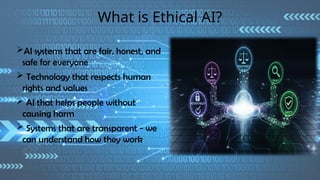
What is EthicalAI?
AI systems that are fair, honest, and
safe for everyone
Technology that respects human
rights and values
AI that helps people without
causing harm
Systems that are transparent - we
can understand how they work
3.
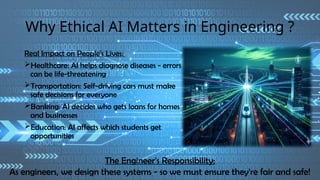
Why Ethical AIMatters in Engineering ?
Real Impact on People's Lives:
Healthcare: AI helps diagnose diseases - errors
can be life-threatening
Transportation: Self-driving cars must make
safe decisions for everyone
Banking: AI decides who gets loans for homes
and businesses
Education: AI affects which students get
opportunities
The Engineer's Responsibility:
As engineers, we design these systems - so we must ensure they're fair and safe!
4.
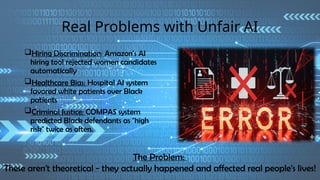
Real Problems withUnfair AI
Hiring Discrimination: Amazon's AI
hiring tool rejected women candidates
automatically
Healthcare Bias: Hospital AI system
favored white patients over Black
patients
Criminal Justice: COMPAS system
predicted Black defendants as "high
risk" twice as often.
The Problem:
These aren't theoretical - they actually happened and affected real people's lives!
5.
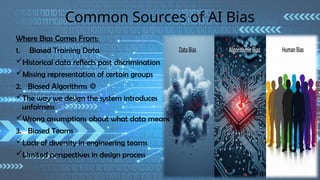
Common Sources ofAI Bias
Where Bias Comes From:
1. Biased Training Data
Historical data reflects past discrimination
Missing representation of certain groups
2. Biased Algorithms ⚙
The way we design the system introduces
unfairness
Wrong assumptions about what data means
3. Biased Teams
Lack of diversity in engineering teams
Limited perspectives in design process
6.
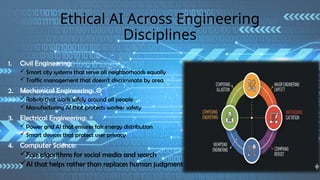
Ethical AI AcrossEngineering
Disciplines
1. Civil Engineering:
Smart city systems that serve all neighborhoods equally
Traffic management that doesn't discriminate by area
2. Mechanical Engineering: ⚙
Robots that work safely around all people
Manufacturing AI that protects worker safety
3. Electrical Engineering: ⚡
Power grid AI that ensures fair energy distribution
Smart devices that protect user privacy
4. Computer Science:
Fair algorithms for social media and search
AI that helps rather than replaces human judgment
7.
How to BuildEthical AI Systems
Step 1 : Build Diverse Teams
Step 2 : Use Fair Data
Step 3 : Make It Transparent
Step 4 : Test Continuously
8.
Case Study -Smart City Traffic System
The Challenge: A city wants to use AI to manage traffic lights and reduce congestion
Potential Problems:
AI might prioritize wealthy neighborhoods
Could ignore pedestrian safety in certain areas
Ethical Solutions Applied:
Collect data
Include pedestrians and cyclists
Test the system
Results:
Better traffic flow for everyone
Safer streets in all neighborhoods
9.
Tools and Benefitsof Ethical AI
Helpful Tools:
IBM AI Fairness 360: Detects and reduces bias in datasets
Google What-If Tool: Tests different scenarios for fairness
Microsoft Fair learn: Builds fairer machine learning
models
Benefits for Everyone:
For Society: Equal opportunities, better healthcare, safer
systems
For Engineers: Build trust, avoid legal problems,
professional pride
For Companies: Avoid expensive mistakes, reach more
customers, attract talent
Key Message:
Ethical AI isn't just the right thing to do - it's also good business and leads to better engineering solutions!
10.
Action Steps forStudents
• What You Can Do Right Now
Take online courses in AI ethics (many are free!)
Practice with bias detection tools
• In Your Projects
Include diverse perspectives in team projects
Test your projects with different types of users
• In Your Future Career
Choose employers who value ethical AI practices
Speak up when you see unfair systems being developed
Key Takeaway:
"As engineers, we have the power and responsibility to build AI that benefits everyone. The
choices we make today will shape the world of tomorrow. Let's make sure it's a fair and just
world for all."








![[DSC Adria 23] Muthu Ramachandran AI Ethics Framework for Generative AI such ...](https://cdn.slidesharecdn.com/ss_thumbnails/muthuramachandranaiethicsframeworkforgenerativeaisuchaschatgptdscmay2023-230530191644-0a1125e3-thumbnail.jpg?width=640&height=640&fit=bounds)

![Research_Presentation_sample[1]_for Business Ethics in AI.pptx](https://cdn.slidesharecdn.com/ss_thumbnails/researchpresentationsample1-250415100105-502f4811-thumbnail.jpg?width=640&height=640&fit=bounds)
![Research_Presentation_sample filled in the like of art[1].pptx](https://cdn.slidesharecdn.com/ss_thumbnails/researchpresentationsample1-250415100708-7f86453c-thumbnail.jpg?width=640&height=640&fit=bounds)


![[DSC Europe 23] Heiko Hotz - Ethics by Design.pptx](https://cdn.slidesharecdn.com/ss_thumbnails/hpwcj7jntb2wohwzm2kn-dsc-europe-2023-heiko-hotz-231129143608-bb0157c0-thumbnail.jpg?width=640&height=640&fit=bounds)


