Agile Group – DIEE, Università degli studi di Cagliari ESUG 2004 – 06 09 2004
Power Laws in Smalltalk
Nicola Serra, nicola.serra@diee.unica.it
Stefano Tuveri, stefano.tuveri@diee.unica.it
DIEE
Università di Cagliari
Cagliari, Italy
Agile Group – DIEE, Università degli studi di Cagliari ESUG 2004 – 06 09 2004
Summary
• Introduction:
Random Graphs and Scale Free Networks
• Software Systems as Complex Networks
• The Smalltalk Graph
• Results
• Conclusions and Further Works
• Question(s)
Agile Group – DIEE, Università degli studi di Cagliari ESUG 2004 – 06 09 2004
Introduction
• Networks: Node and Connections
• Real Systems as Complex Networks: the Web, the North
American Power Grid, Biological Systems, Social
Networks…
… Software Systems
Agile Group – DIEE, Università degli studi di Cagliari ESUG 2004 – 06 09 2004
Introduction
Traditional Models
A Random Graph is made starting from a set of n nodes
and connecting each pair independently with a given
probability p
Many real systems in fact behave according to laws
significantly different from those predicted by Erdos and
Renyi theory
Agile Group – DIEE, Università degli studi di Cagliari ESUG 2004 – 06 09 2004
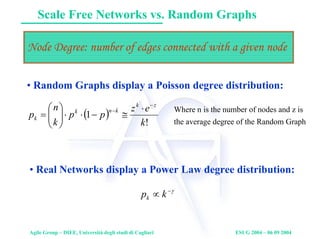
Scale Free Networks vs. Random Graphs
Node Degree: number of edges connected with a given node
• Random Graphs display a Poisson degree distribution:
( )
!
1
k
ez
pp
k
n
p
zk
knk
k
−
− ⋅
≅−⋅⋅





=
Where n is the number of nodes and z is
the average degree of the Random Graph
• Real Networks display a Power Law degree distribution:
γ−
∝ kpk
Agile Group – DIEE, Università degli studi di Cagliari ESUG 2004 – 06 09 2004
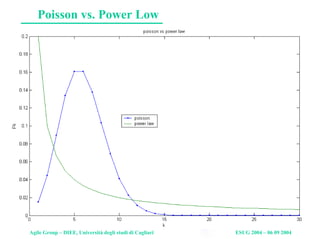
Poisson vs. Power Low
Agile Group – DIEE, Università degli studi di Cagliari ESUG 2004 – 06 09 2004
Software Systems as Complex Networks
• Very recently, some studies have been performed
representing OO systems as complex networks, where
nodes are representations of classes and connections are
representation of relationships between them
• These experiences show that run-time objects and static
class structures of object oriented systems are in fact
governed by scale free power law distributions
• Most of these studies of complex software systems are
based on C++ and Java code
Agile Group – DIEE, Università degli studi di Cagliari ESUG 2004 – 06 09 2004
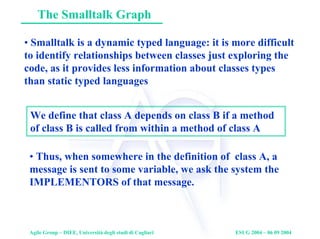
The Smalltalk Graph
• Smalltalk is a dynamic typed language: it is more difficult
to identify relationships between classes just exploring the
code, as it provides less information about classes types
than static typed languages
We define that class A depends on class B if a method
of class B is called from within a method of class A
• Thus, when somewhere in the definition of class A, a
message is sent to some variable, we ask the system the
IMPLEMENTORS of that message.
Agile Group – DIEE, Università degli studi di Cagliari ESUG 2004 – 06 09 2004
The Smalltalk Graph
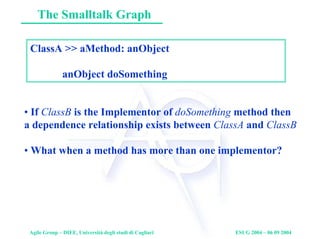
ClassA >> aMethod: anObject
anObject doSomething
• If ClassB is the Implementor of doSomething method then
a dependence relationship exists between ClassA and ClassB
• What when a method has more than one implementor?
Agile Group – DIEE, Università degli studi di Cagliari ESUG 2004 – 06 09 2004
The Experiment
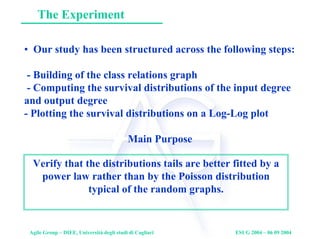
• Our study has been structured across the following steps:
- Building of the class relations graph
- Computing the survival distributions of the input degree
and output degree
- Plotting the survival distributions on a Log-Log plot
Main Purpose
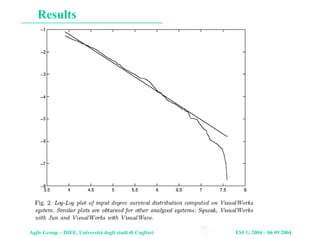
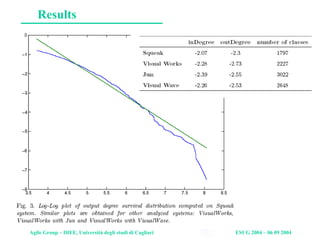
Verify that the distributions tails are better fitted by a
power law rather than by the Poisson distribution
typical of the random graphs.
Agile Group – DIEE, Università degli studi di Cagliari ESUG 2004 – 06 09 2004
Results
Agile Group – DIEE, Università degli studi di Cagliari ESUG 2004 – 06 09 2004
Results
Agile Group – DIEE, Università degli studi di Cagliari ESUG 2004 – 06 09 2004
Conclusions
• We have studied distribution laws related to object-oriented
class relationships of four Smalltalk systems
• Statistical distributions of the class-relationship graph
exhibit scale-free and heavy-tailed degree distributions
• Moreover, these distributions show strong regularities in
their characteristic exponents.
Agile Group – DIEE, Università degli studi di Cagliari ESUG 2004 – 06 09 2004
Further Works
• Is it possible to correlate statistical graph properties with
software quality?
• Is it possible to develop a growth theory of software graphs,
which in turn could be used to model evolution and
maintenance of software systems?

Power Laws in Smalltalk

  • 1.
    Agile Group –DIEE, Università degli studi di Cagliari ESUG 2004 – 06 09 2004 Power Laws in Smalltalk Nicola Serra, nicola.serra@diee.unica.it Stefano Tuveri, stefano.tuveri@diee.unica.it DIEE Università di Cagliari Cagliari, Italy
  • 2.
    Agile Group –DIEE, Università degli studi di Cagliari ESUG 2004 – 06 09 2004 Summary • Introduction: Random Graphs and Scale Free Networks • Software Systems as Complex Networks • The Smalltalk Graph • Results • Conclusions and Further Works • Question(s)
  • 3.
    Agile Group –DIEE, Università degli studi di Cagliari ESUG 2004 – 06 09 2004 Introduction • Networks: Node and Connections • Real Systems as Complex Networks: the Web, the North American Power Grid, Biological Systems, Social Networks… … Software Systems
  • 4.
    Agile Group –DIEE, Università degli studi di Cagliari ESUG 2004 – 06 09 2004 Introduction Traditional Models A Random Graph is made starting from a set of n nodes and connecting each pair independently with a given probability p Many real systems in fact behave according to laws significantly different from those predicted by Erdos and Renyi theory
  • 5.
    Agile Group –DIEE, Università degli studi di Cagliari ESUG 2004 – 06 09 2004 Scale Free Networks vs. Random Graphs Node Degree: number of edges connected with a given node • Random Graphs display a Poisson degree distribution: ( ) ! 1 k ez pp k n p zk knk k − − ⋅ ≅−⋅⋅      = Where n is the number of nodes and z is the average degree of the Random Graph • Real Networks display a Power Law degree distribution: γ− ∝ kpk
  • 6.
    Agile Group –DIEE, Università degli studi di Cagliari ESUG 2004 – 06 09 2004 Poisson vs. Power Low
  • 7.
    Agile Group –DIEE, Università degli studi di Cagliari ESUG 2004 – 06 09 2004 Software Systems as Complex Networks • Very recently, some studies have been performed representing OO systems as complex networks, where nodes are representations of classes and connections are representation of relationships between them • These experiences show that run-time objects and static class structures of object oriented systems are in fact governed by scale free power law distributions • Most of these studies of complex software systems are based on C++ and Java code
  • 8.
    Agile Group –DIEE, Università degli studi di Cagliari ESUG 2004 – 06 09 2004 The Smalltalk Graph • Smalltalk is a dynamic typed language: it is more difficult to identify relationships between classes just exploring the code, as it provides less information about classes types than static typed languages We define that class A depends on class B if a method of class B is called from within a method of class A • Thus, when somewhere in the definition of class A, a message is sent to some variable, we ask the system the IMPLEMENTORS of that message.
  • 9.
    Agile Group –DIEE, Università degli studi di Cagliari ESUG 2004 – 06 09 2004 The Smalltalk Graph ClassA >> aMethod: anObject anObject doSomething • If ClassB is the Implementor of doSomething method then a dependence relationship exists between ClassA and ClassB • What when a method has more than one implementor?
  • 10.
    Agile Group –DIEE, Università degli studi di Cagliari ESUG 2004 – 06 09 2004 The Experiment • Our study has been structured across the following steps: - Building of the class relations graph - Computing the survival distributions of the input degree and output degree - Plotting the survival distributions on a Log-Log plot Main Purpose Verify that the distributions tails are better fitted by a power law rather than by the Poisson distribution typical of the random graphs.
  • 11.
    Agile Group –DIEE, Università degli studi di Cagliari ESUG 2004 – 06 09 2004 Results
  • 12.
    Agile Group –DIEE, Università degli studi di Cagliari ESUG 2004 – 06 09 2004 Results
  • 13.
    Agile Group –DIEE, Università degli studi di Cagliari ESUG 2004 – 06 09 2004 Conclusions • We have studied distribution laws related to object-oriented class relationships of four Smalltalk systems • Statistical distributions of the class-relationship graph exhibit scale-free and heavy-tailed degree distributions • Moreover, these distributions show strong regularities in their characteristic exponents.
  • 14.
    Agile Group –DIEE, Università degli studi di Cagliari ESUG 2004 – 06 09 2004 Further Works • Is it possible to correlate statistical graph properties with software quality? • Is it possible to develop a growth theory of software graphs, which in turn could be used to model evolution and maintenance of software systems?