Essential Questions and UnderstandingsElizabeth Namba and Stacy StephensSept. 7th, 2009
Today’s AgendaUbD Review - 15 minsEssential Questions - 25Break - 10Understandings - 25Design - 20Reflection - 10
Activity OneMaking meaning of UbD
UbD in a NutShellBased on principal of backward designYou start with your goals in mindDesign assessments that meet your goalsKey is transfer of skillsPrimary goal is student understanding and meaning making of big ideasRegular review of curriculum against design standards for quality and effectiveness
GoalsStandards and benchmarksAlso any additional aims you have for the classCan be school-wideDepartment based
Essential QuestionsDoes a “good read” differ from a “great book”?What’s the pattern?  How can I best represent it?By what criteria should I judge this performance?What does this audience demand of me as a writer, speaker?What is the author’s point?When is proper English absolutely essential and when would it be too stuffy and inappropriate in context?What is a valid interpretation of those historical events?What do I need to understand about the culture to understand the language and vice versa?What is the most helpful feedback I can give here?Why do people eat so poorly if we know so much about nutrition?
So, what is an Essential Question?What is your “theory” given these examples?Essential Questions are:Is open ended; has no simple right answerIs meant to be investigated, argued, looked at from different points of viewEncourages active “meaning making”Raises other important questions
Self Test on Essential QuestionsWhat is estivation?To what extent is geography destiny?What is a linear equation?How real and pressing is global warming?What is a “true” friend?What is the point of a semi-colons?
Understanding: Activity TwoWhat is understanding and how does it differ from knowing?
UnderstandingsNo pain, no gainPrice is a function of supply and demandFriendships can be deepened or undone by hard times.History is the story told by the winners.F = ma – so weight is not massMath models simplify physical relations – and even sometimes distort relations – to deepen our understanding of them.The best writing paints a pictures in the readers mind.A good storyteller rarely tells the meaning of the story.
So, what is an “Understanding”?What’s your theory given these examples?Understandings are:Meaningful big ideas…the moral of the storyCannot be transmitted, must be “earned”Connects the dotsIs transferable to other contextsIs usually not obvious
Self-Test for UnderstandingThe cause and effects of the Civil War.The price of an item is a function of supply and demand.Collaborate is spelled with two L’s. No pain, no gain.The associative property means that (a + b) + c = a + (b + c)
Activity ThreeIndicators of UnderstandingWhat does understanding look like....In your groups, take one question and brainstorm your answers.
Design Drivers Ed 101
ReflectPg. 286Review your handout
Next StepsWhat we can do for you?Consider, what you want from us.Determine your goals for the year.e.g. Evaluate all Essential Questions and Understandinge.g. Participate in a peer review session of a unitWhat can you accomplish today?PE with Elizabeth at 2:15Science with Stacy at 2:15Math with Elizabeth at 3pmHumanities 6 with Stacy at 3pm
CitationsAll images via Microsoft ClipArtAuthentic Education UbD 101 Summer Institute Workbook, 2009McTighe and Wiggins, Understanding by Design. Professional Workbook, ASCD 2004

Essential Questions and Enduring Understandings

  • 1.
    Essential Questions andUnderstandingsElizabeth Namba and Stacy StephensSept. 7th, 2009
  • 2.
    Today’s AgendaUbD Review- 15 minsEssential Questions - 25Break - 10Understandings - 25Design - 20Reflection - 10
  • 3.
  • 4.
    UbD in aNutShellBased on principal of backward designYou start with your goals in mindDesign assessments that meet your goalsKey is transfer of skillsPrimary goal is student understanding and meaning making of big ideasRegular review of curriculum against design standards for quality and effectiveness
  • 5.
    GoalsStandards and benchmarksAlsoany additional aims you have for the classCan be school-wideDepartment based
  • 6.
    Essential QuestionsDoes a“good read” differ from a “great book”?What’s the pattern? How can I best represent it?By what criteria should I judge this performance?What does this audience demand of me as a writer, speaker?What is the author’s point?When is proper English absolutely essential and when would it be too stuffy and inappropriate in context?What is a valid interpretation of those historical events?What do I need to understand about the culture to understand the language and vice versa?What is the most helpful feedback I can give here?Why do people eat so poorly if we know so much about nutrition?
  • 7.
    So, what isan Essential Question?What is your “theory” given these examples?Essential Questions are:Is open ended; has no simple right answerIs meant to be investigated, argued, looked at from different points of viewEncourages active “meaning making”Raises other important questions
  • 8.
    Self Test onEssential QuestionsWhat is estivation?To what extent is geography destiny?What is a linear equation?How real and pressing is global warming?What is a “true” friend?What is the point of a semi-colons?
  • 9.
    Understanding: Activity TwoWhatis understanding and how does it differ from knowing?
  • 10.
    UnderstandingsNo pain, nogainPrice is a function of supply and demandFriendships can be deepened or undone by hard times.History is the story told by the winners.F = ma – so weight is not massMath models simplify physical relations – and even sometimes distort relations – to deepen our understanding of them.The best writing paints a pictures in the readers mind.A good storyteller rarely tells the meaning of the story.
  • 11.
    So, what isan “Understanding”?What’s your theory given these examples?Understandings are:Meaningful big ideas…the moral of the storyCannot be transmitted, must be “earned”Connects the dotsIs transferable to other contextsIs usually not obvious
  • 12.
    Self-Test for UnderstandingThecause and effects of the Civil War.The price of an item is a function of supply and demand.Collaborate is spelled with two L’s. No pain, no gain.The associative property means that (a + b) + c = a + (b + c)
  • 13.
    Activity ThreeIndicators ofUnderstandingWhat does understanding look like....In your groups, take one question and brainstorm your answers.
  • 14.
  • 17.
  • 18.
    Next StepsWhat wecan do for you?Consider, what you want from us.Determine your goals for the year.e.g. Evaluate all Essential Questions and Understandinge.g. Participate in a peer review session of a unitWhat can you accomplish today?PE with Elizabeth at 2:15Science with Stacy at 2:15Math with Elizabeth at 3pmHumanities 6 with Stacy at 3pm
  • 19.
    CitationsAll images viaMicrosoft ClipArtAuthentic Education UbD 101 Summer Institute Workbook, 2009McTighe and Wiggins, Understanding by Design. Professional Workbook, ASCD 2004

Editor's Notes

  • #4 UbD webbing activityHave participants do it individually Then share at their tables and fill in the chart on the chart paper provided.Place charts up at the front of the room for all to observe and pull the relevant information from.
  • #7 Read these essential questions….next slide asks, if these are essential questions, what then is an essential question?
  • #8 Brainstorm and discuss at tables.Solicit participant feedback.
  • #9 What is estivation? No, just because it is a question, does not make it an essential question. The answer concerns facts. Estivation is summer hibernation.To what extent is geography destiny? Yes, it is debatable, discussable and could have various answersWhat is a linear equation? No, it is a factHow real and pressing is global warming? YesWhat is a “true” friend? YesWhat is the point of a semi-colons? Could go either way. If the unit explores the value of semi-colons rather than just the rules for use, it could be an essential question.
  • #10 At tables, brainstorm on your own and then share out with groups.
  • #12 At their tables, brainstorm and then debrief as a group
  • #13 Civl War – no this is knowledgeSupply and Demand – yes it is something you come to understand through experience, experimentation, demonstration etc. and it is not always true.Collaborate – no, this is a factNo pain/no gain – yes.Associative property – it is a fact.
  • #14 Pg. 268-269 Indicators of Understanding - WorksheetWhat does a classroom look like that teaches for understanding?What types of activities are students engaged in to foster understanding?What is the teacher’s approach in teaching for understanding?What does a unit look like that promotes student understanding?
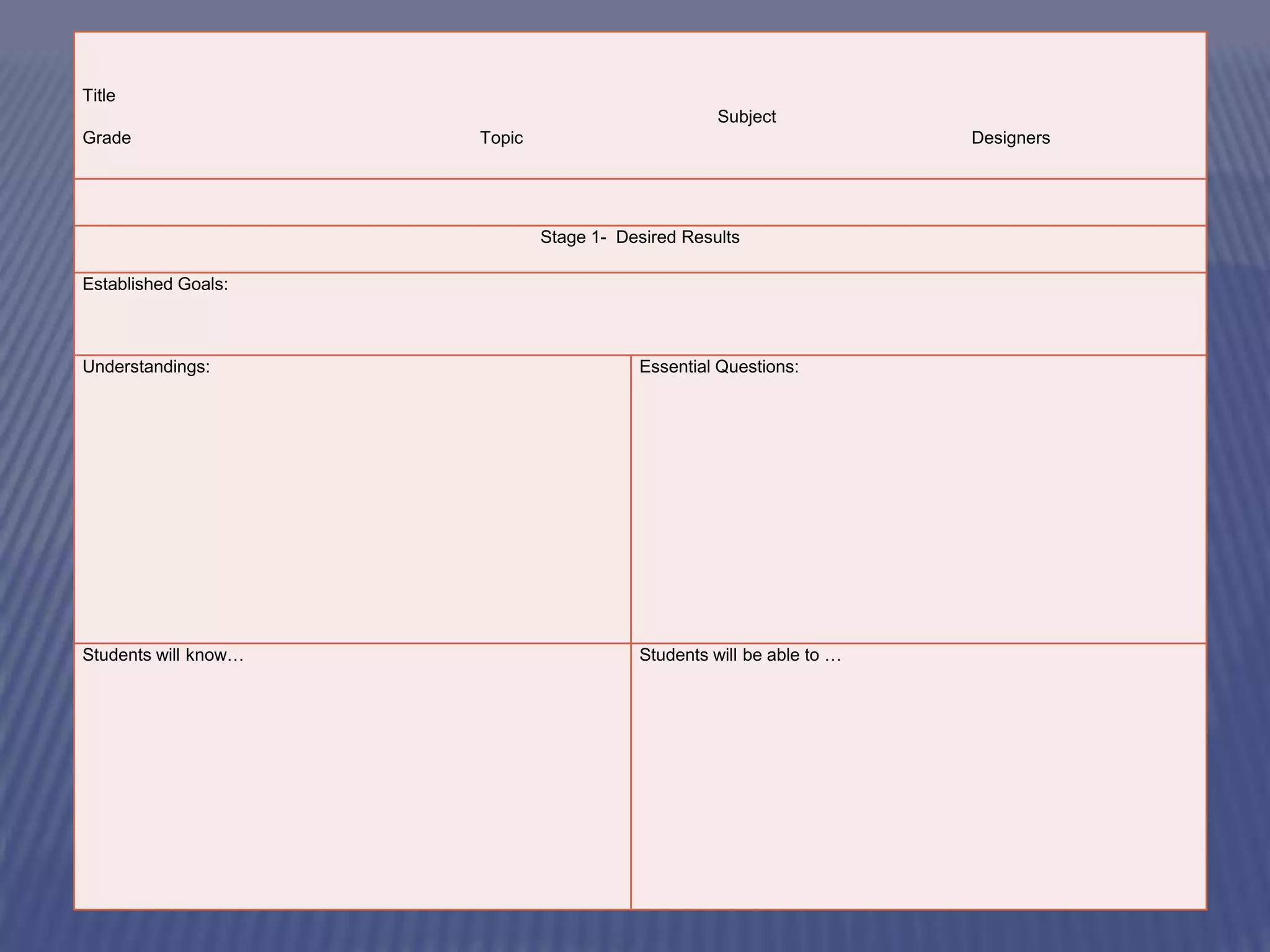
  • #15 Will first explain the design template.Have standards and benchmarks from the state of VA to use as a resource. Teachers will take the standards and benchmarks and using them as a resource fill out the design template.
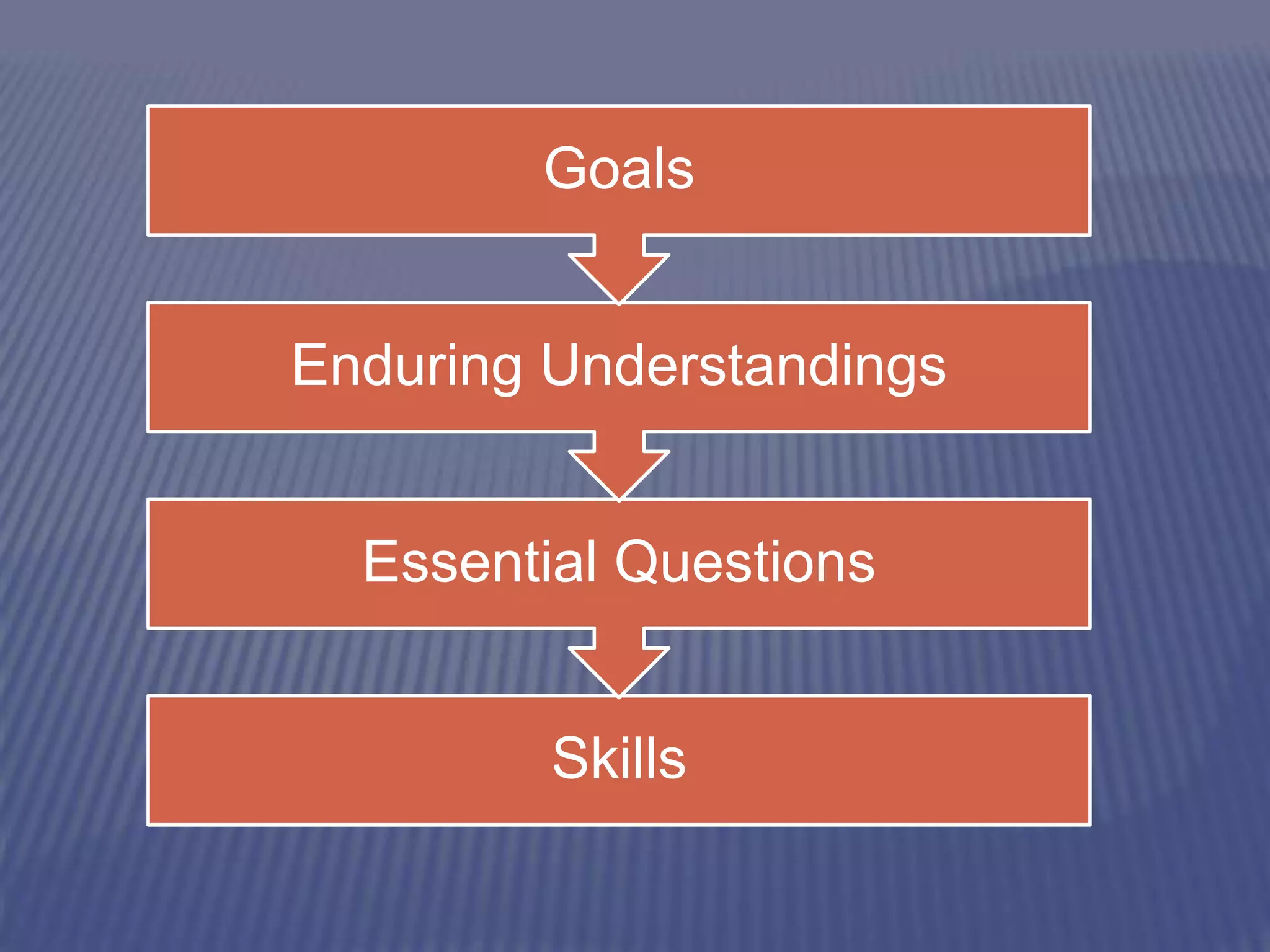
  • #16 Using the provided Standards and Benchmarks from a drivers education course create a stage one on the UbD template.GoalsEssential QuestionsEnduring UnderstandingsSkills