1
EPM Cloud Integration at CareFirst
June 26th, 2019
Saundra Holloway, CareFirst BlueCross BlueShield
Vatsal Gaonkar, Alithya
AGENDA
• Introduction
• Prior State
• Why PCMCS
• Implementation Approach
• Technical Design Considerations
• Demonstration
• Conclusion
• Q&A
SAUNDRA HOLLOWAY
4
• A little about me
• Lead Business Analyst (Non-IT) for Management Accounting Cost Allocation Development
• 32 years with CareFirst and over 30 years of cost allocation experience
• Business area Cost Allocation System Administrator – I AM STRICTLY BUSINESS ☺
• Performed cost allocations on mainframe, Oracle Financial Analyzer (OFA), Oracle Hyperion
Essbase, and now Profitability and Cost Management Cloud Services (PCMCS)
• Speaker at Oracle OAUG and ODTUG KScope conferences
• Project Responsibility Summary
• Business area SME/lead for design, testing, and implementation of new cost allocation
solution
• Contact me at:
• Email: Saundra.Holloway@carefirst.com
CAREFIRST BLUECROSS BLUESHIELD
5
• CareFirst is in its 82nd year of service as a not-for-profit,
independent licensee of the BlueCross and BlueShield
Association, operating in the Mid-Atlantic region covering the
District of Columbia, all of Maryland and a large portion of
Northern VA
• The largest health insurer in our region, serving 3.3 million
members
• Serves more than 625,000 members in the Federal Employees
Health Benefits Program (FEHBP) – one of the largest FEHBP
enrollments in the nation
ABOUT CAREFIRST
6
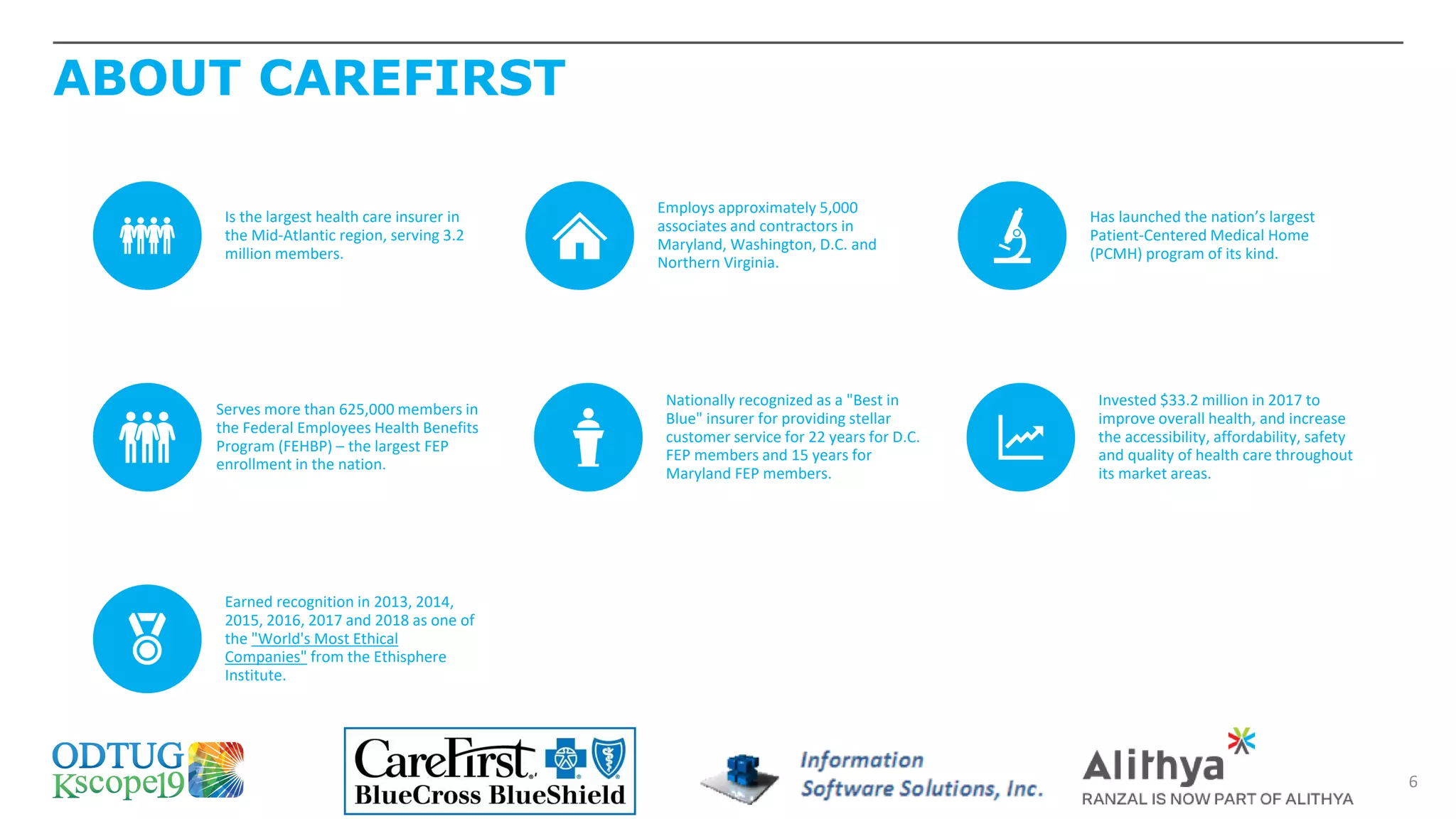
Is the largest health care insurer in
the Mid-Atlantic region, serving 3.2
million members.
Employs approximately 5,000
associates and contractors in
Maryland, Washington, D.C. and
Northern Virginia.
Has launched the nation’s largest
Patient-Centered Medical Home
(PCMH) program of its kind.
Serves more than 625,000 members in
the Federal Employees Health Benefits
Program (FEHBP) – the largest FEP
enrollment in the nation.
Nationally recognized as a "Best in
Blue" insurer for providing stellar
customer service for 22 years for D.C.
FEP members and 15 years for
Maryland FEP members.
Invested $33.2 million in 2017 to
improve overall health, and increase
the accessibility, affordability, safety
and quality of health care throughout
its market areas.
Earned recognition in 2013, 2014,
2015, 2016, 2017 and 2018 as one of
the "World's Most Ethical
Companies" from the Ethisphere
Institute.
CAREFIRST BLUECROSS BLUESHIELD
7
Our reporting requirements are extensive as we must report to the
following entities:
• BlueCross BlueShield Association (BCBSA)
• Insurance Commissioners for MD, DC & VA
• Federal Employee Program Director’s Office
• Office of Personnel Management (OPM)
• Group Administrators
• Medical Loss Ratio (MLR) as mandated by the 2010 Health Care Reform Act
PRIOR STATE – ROADMAP TO EPM
8
In 1998 the BCBS plans of MD and DC merged to form CareFirst and we
installed Oracle Financial Analyzer (OFA) as our joint costing solution
with the assistance of Russ Papparotto.
January 2010 we implemented Oracle Hyperion Essbase to replace OFA
which was being de-supported by Oracle
Essbase was the chosen solution because:
• It was highly customizable to fit our unique needs
• Robust enough to handle complex allocation algorithms
• Could house large amounts of data and multiple hierarchies to satisfy various
reporting requirements
• User friendly reporting with Excel-based Smart View tool
PRIOR STATE
9
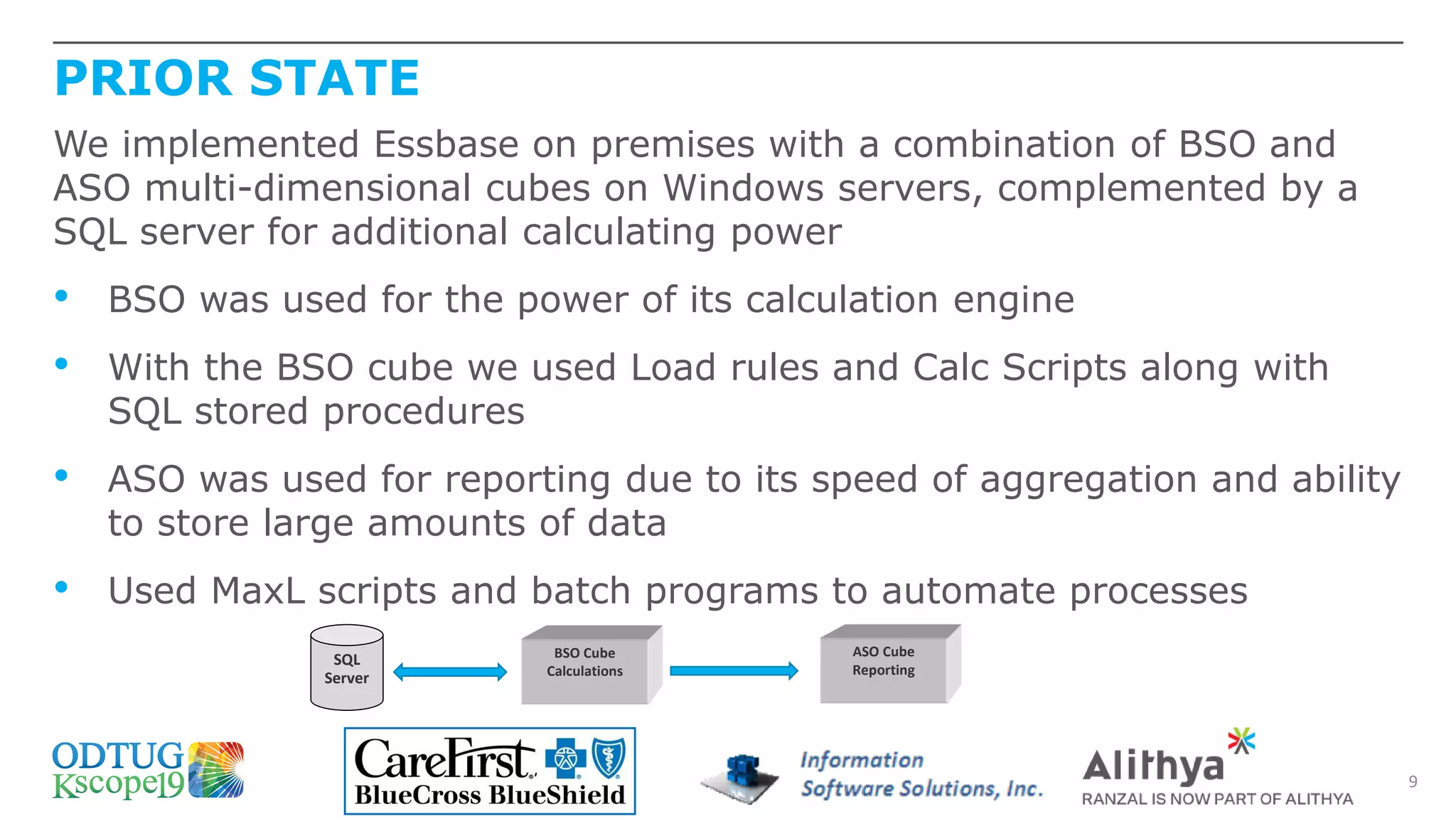
We implemented Essbase on premises with a combination of BSO and
ASO multi-dimensional cubes on Windows servers, complemented by a
SQL server for additional calculating power
• BSO was used for the power of its calculation engine
• With the BSO cube we used Load rules and Calc Scripts along with
SQL stored procedures
• ASO was used for reporting due to its speed of aggregation and ability
to store large amounts of data
• Used MaxL scripts and batch programs to automate processes
SQL
Server
BSO Cube
Calculations
ASO Cube
Reporting
WHY PCMCS
10
We were looking for a Commercial Off-The-Shelf (COTS) cost allocation
product that could be maintained by the business area and required
minimal IT support.
The solution had to be:
• User-friendly, with easy to understand logic, but robust enough to handle
complex allocations without using complex scripts or extensive special coding
languages (i.e. Java, MDX, etc.)
• Flexible enough to accommodate future methodology changes
• Able to Integrate with existing on-prem Oracle EBS application and future
financial applications being considered for implementation
We also wanted to implement a new solution when our next 5 year
federal audit cycle began in order to provide a consistent data source.
WHY PCMCS
11
It was an extremely difficult decision for us to move to the cloud, due to the sensitive
nature of our business, however, since our allocations do not include HIPAA data (PHI or
PII), we ultimately decided to go with a cloud-based product that would minimize our IT
Hardware cost and need for IT programming support in the long run.
Choosing PCMCS:
• Relieves us of the cost and maintenance of on-prem servers
• Software upgrades are managed by Oracle and occur more frequently than for on-
prem products
• Easy to follow load rules and calculation rules maintainable by Business Area
• Able to keep the same file formats for existing data load files
• Provides better traceability of allocations
• Uses Smart View and Financial Reporting Studio
PCMCS FIT GAP
12
PCMCS had to accomplish the following in order to replace Essbase App:
• Have the ability to construct a multi-tiered allocation structure to allocate Indirect
(G&A) support costs based on Tier 1/Direct expenses incurred to serve customers
• Mimic the process of creating multiple statistical data files from a single load file
• Simplify logic to replace complex calc scripting
• Use a default allocation profile to distribute a cost center’s admin expenses
• Develop a solution for allocating expenses directly to specified customers/LOBs
• Isolate and reallocate non-chargeable expenses and residual/unallocated costs
• Replicate or Replace the Look/lag back to prior month’s calculation data for current
allocations
• Provide data reconciliation for audit purposes
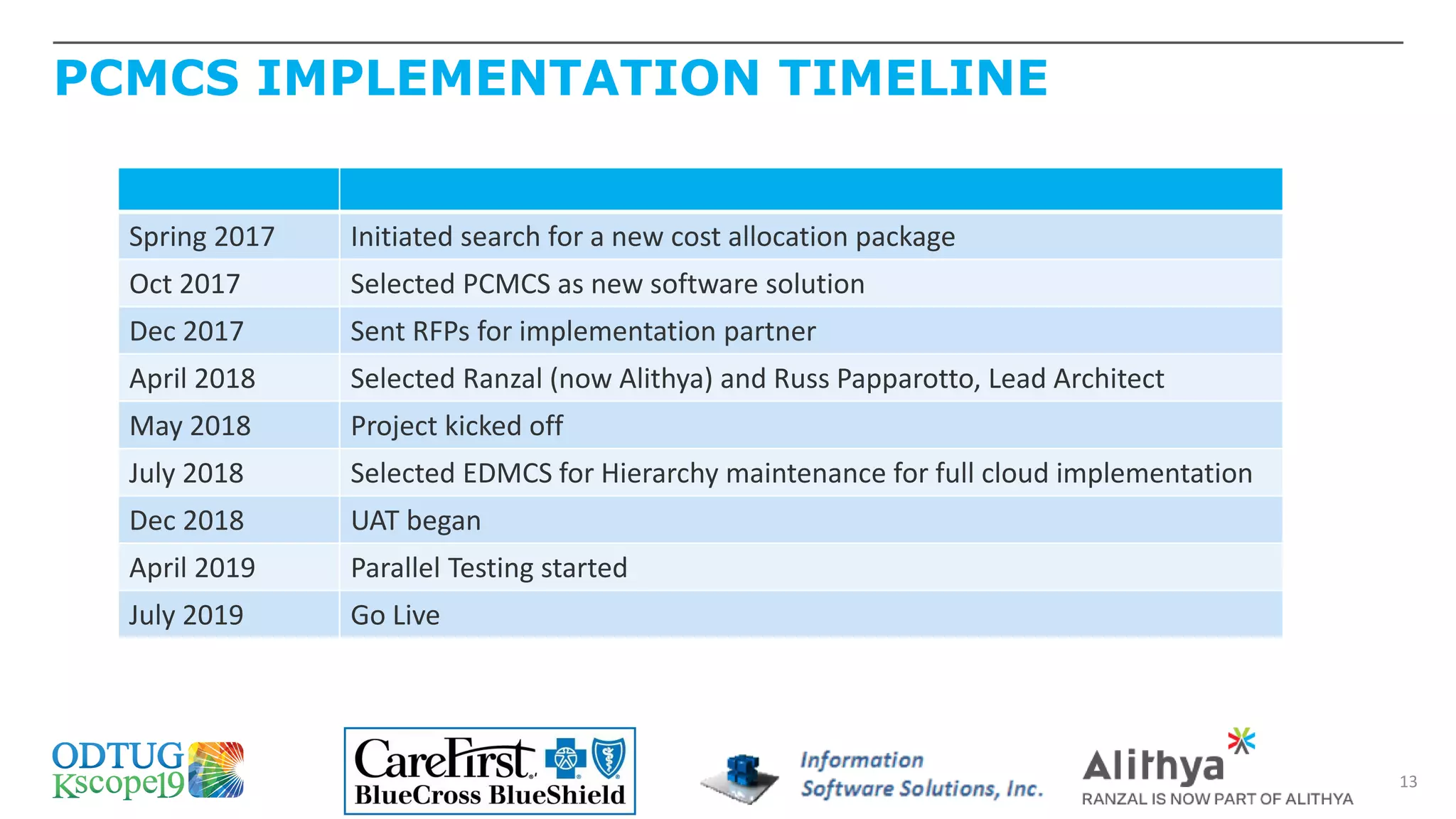
PCMCS IMPLEMENTATION TIMELINE
13
Spring 2017 Initiated search for a new cost allocation package
Oct 2017 Selected PCMCS as new software solution
Dec 2017 Sent RFPs for implementation partner
April 2018 Selected Ranzal (now Alithya) and Russ Papparotto, Lead Architect
May 2018 Project kicked off
July 2018 Selected EDMCS for Hierarchy maintenance for full cloud implementation
Dec 2018 UAT began
April 2019 Parallel Testing started
July 2019 Go Live
VATSAL GAONKAR
14
• Summary
• Product Manager – Enterprise Planning
• Over 13 years of Enterprise Performance Management (EPM) experience across on-
premises, cloud and hybrid deployments
• Design, Development and Deployment roles across approx. 40 projects over the years
• EPM Cloud Credentials – Certified in EPBCS & PCMCS; Design and deployments; EPM Cloud
automation
• Speaker at Oracle / Hyperion conferences such HUGMN, DCOUAG, OAUG, ODTUG and
OpenWorld
• Project Responsibility Summary
• Data Integration and EPM Cloud Automation Design, Development and Rollout
• Visit me at:
• Email: vatsal.gaonkar@alithya.com twitter: @dieselvat
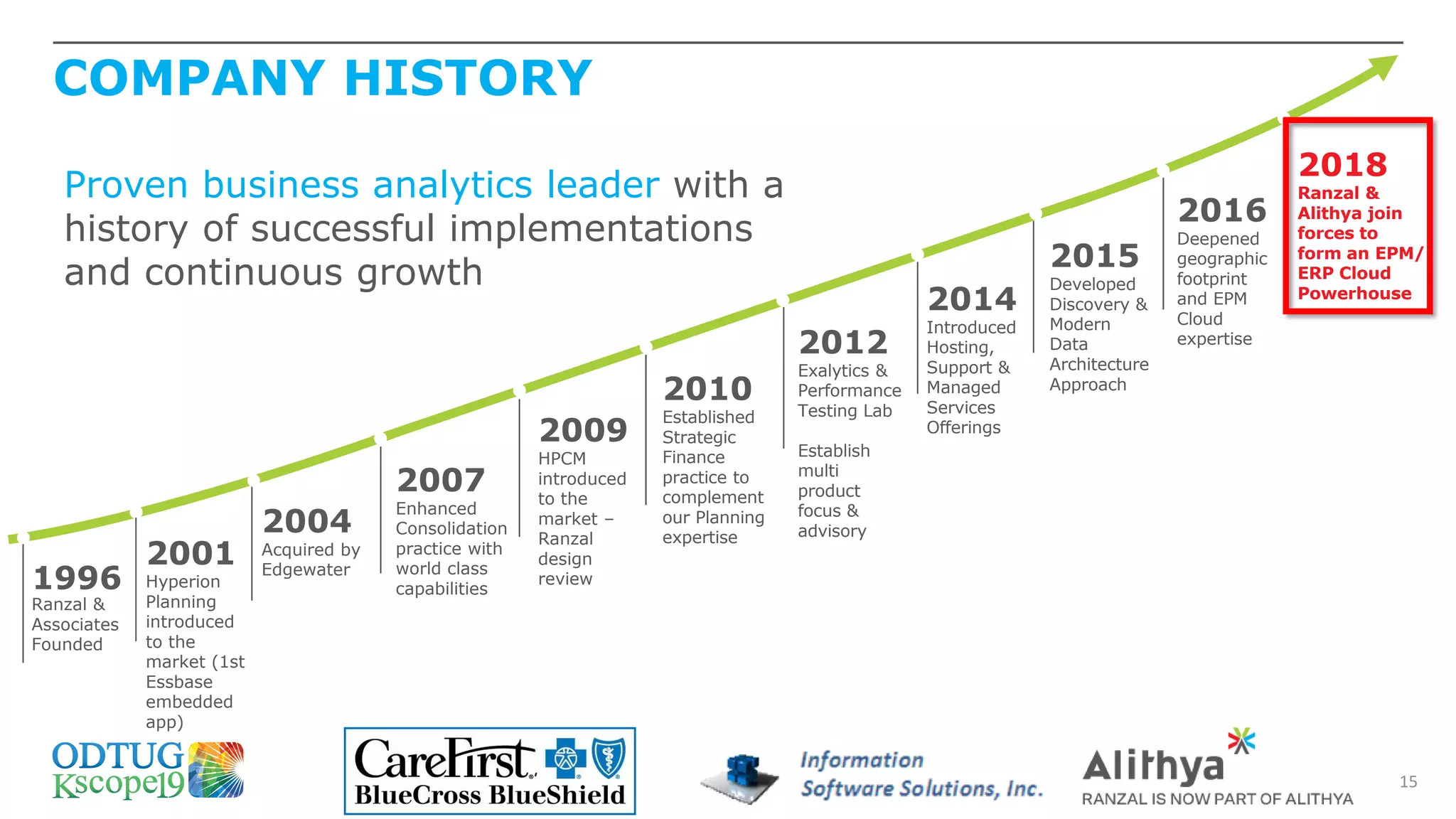
COMPANY HISTORY
15
2001
Hyperion
Planning
introduced
to the
market (1st
Essbase
embedded
app)
2007
Enhanced
Consolidation
practice with
world class
capabilities
2009
HPCM
introduced
to the
market –
Ranzal
design
review
2010
Established
Strategic
Finance
practice to
complement
our Planning
expertise
2012
Exalytics &
Performance
Testing Lab
Establish
multi
product
focus &
advisory
Proven business analytics leader with a
history of successful implementations
and continuous growth
1996
Ranzal &
Associates
Founded
2004
Acquired by
Edgewater
2016
Deepened
geographic
footprint
and EPM
Cloud
expertise
2015
Developed
Discovery &
Modern
Data
Architecture
Approach
2014
Introduced
Hosting,
Support &
Managed
Services
Offerings
2018
Ranzal &
Alithya join
forces to
form an EPM/
ERP Cloud
Powerhouse
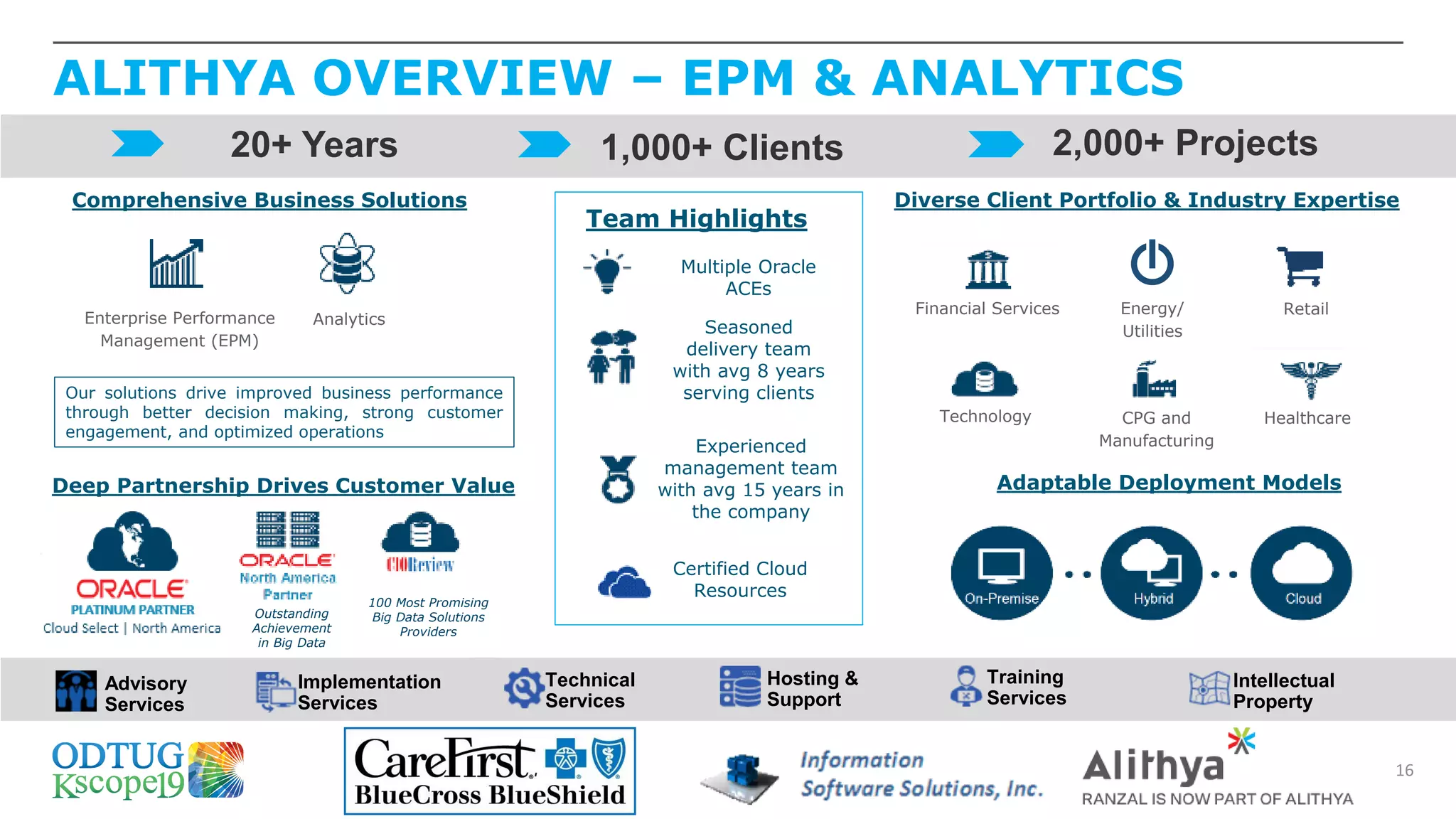
ALITHYA OVERVIEW – EPM & ANALYTICS
16
Comprehensive Business Solutions
Our solutions drive improved business performance
through better decision making, strong customer
engagement, and optimized operations
Deep Partnership Drives Customer Value Adaptable Deployment Models
Diverse Client Portfolio & Industry Expertise
RetailEnergy/
Utilities
Team Highlights
Multiple Oracle
ACEs
Seasoned
delivery team
with avg 8 years
serving clients
Experienced
management team
with avg 15 years in
the company
Certified Cloud
Resources
Enterprise Performance
Management (EPM)
Analytics
Financial Services
Technology CPG and
Manufacturing
Healthcare
Outstanding
Achievement
in Big Data
100 Most Promising
Big Data Solutions
Providers
1,000+ Clients 2,000+ Projects20+ Years
Advisory
Services
Implementation
Services
Technical
Services
Hosting &
Support
Training
Services
Intellectual
Property
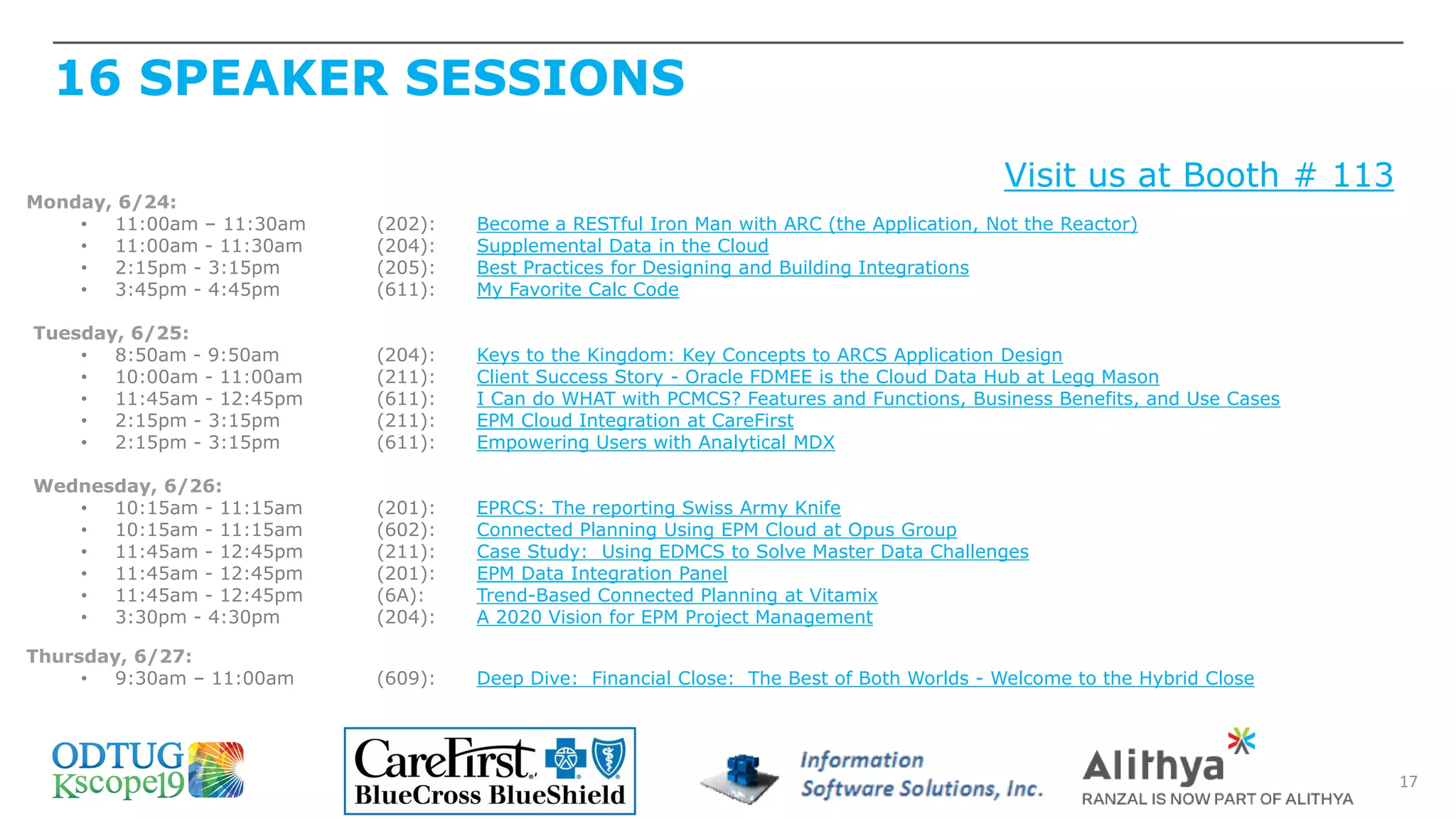
16 SPEAKER SESSIONS
17
Visit us at Booth # 113
Monday, 6/24:
• 11:00am – 11:30am (202): Become a RESTful Iron Man with ARC (the Application, Not the Reactor)
• 11:00am - 11:30am (204): Supplemental Data in the Cloud
• 2:15pm - 3:15pm (205): Best Practices for Designing and Building Integrations
• 3:45pm - 4:45pm (611): My Favorite Calc Code
Tuesday, 6/25:
• 8:50am - 9:50am (204): Keys to the Kingdom: Key Concepts to ARCS Application Design
• 10:00am - 11:00am (211): Client Success Story - Oracle FDMEE is the Cloud Data Hub at Legg Mason
• 11:45am - 12:45pm (611): I Can do WHAT with PCMCS? Features and Functions, Business Benefits, and Use Cases
• 2:15pm - 3:15pm (211): EPM Cloud Integration at CareFirst
• 2:15pm - 3:15pm (611): Empowering Users with Analytical MDX
Wednesday, 6/26:
• 10:15am - 11:15am (201): EPRCS: The reporting Swiss Army Knife
• 10:15am - 11:15am (602): Connected Planning Using EPM Cloud at Opus Group
• 11:45am - 12:45pm (211): Case Study: Using EDMCS to Solve Master Data Challenges
• 11:45am - 12:45pm (201): EPM Data Integration Panel
• 11:45am - 12:45pm (6A): Trend-Based Connected Planning at Vitamix
• 3:30pm - 4:30pm (204): A 2020 Vision for EPM Project Management
Thursday, 6/27:
• 9:30am – 11:00am (609): Deep Dive: Financial Close: The Best of Both Worlds - Welcome to the Hybrid Close
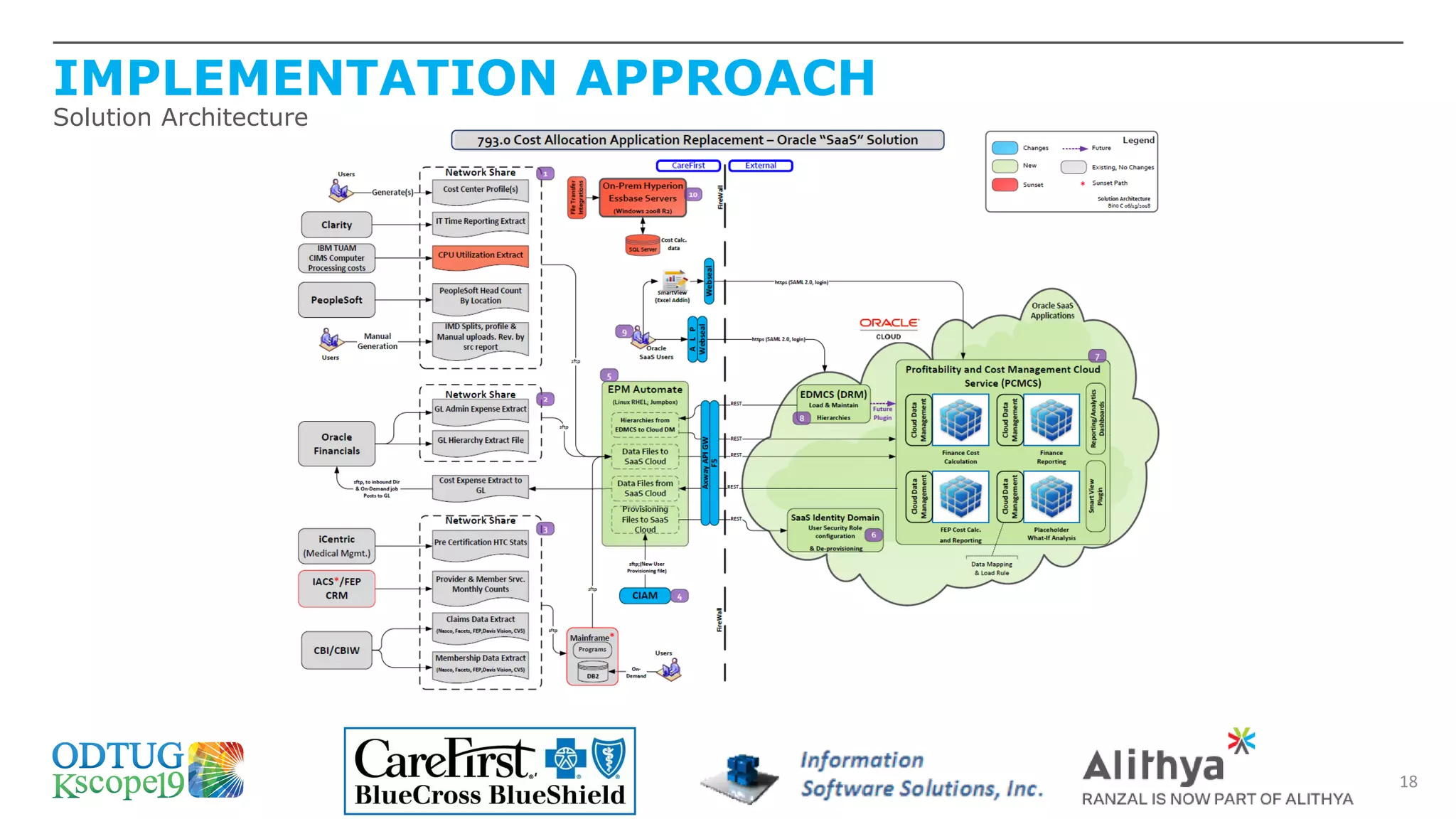
IMPLEMENTATION APPROACH
18
Solution Architecture
IMPLEMENTATION APPROACH
• Metadata build – file based
• Data load – data management
• Allocation processing – PCMCS automation
• Calculation to reporting integration – integration between
PCMCS instances
• Cross Pod integration – between CST And FEP PCMCS
applications
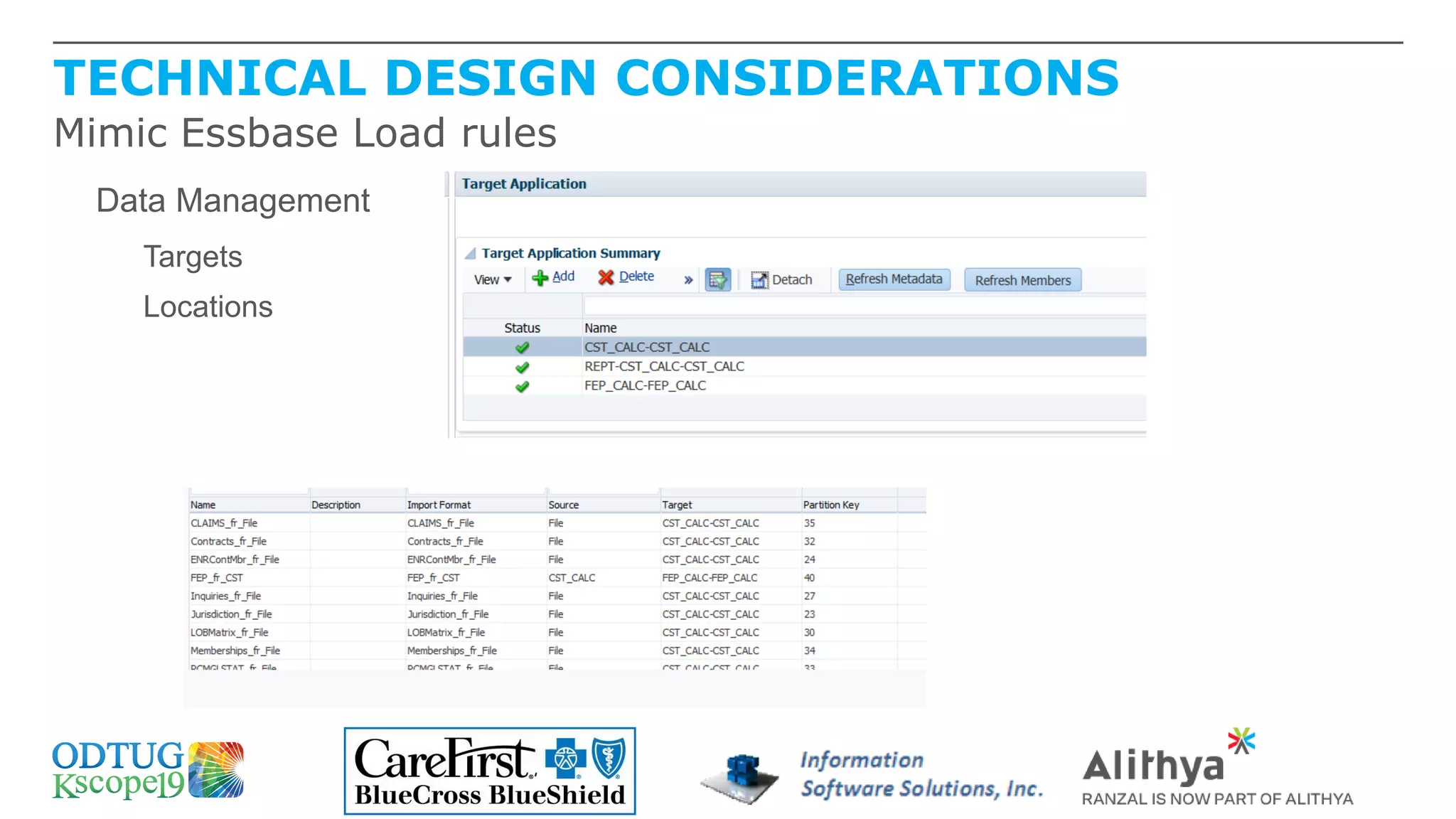
TECHNICAL DESIGN CONSIDERATIONS
Mimic Essbase Load rules
Data Management
Targets
Locations
TECHNICAL DESIGN CONSIDERATIONS
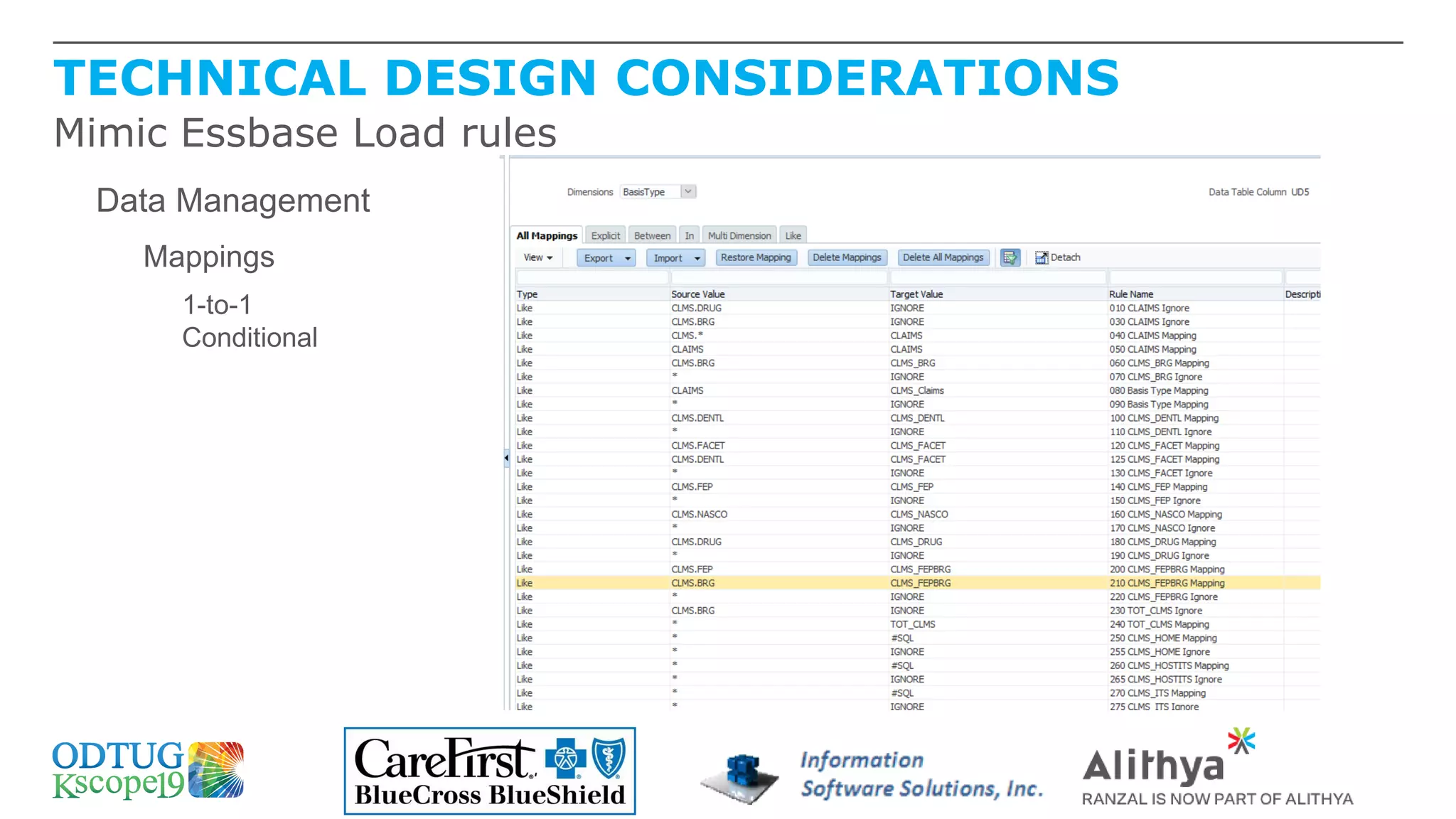
Mimic Essbase Load rules
Data Management
Mappings
1-to-1
Conditional
TECHNICAL DESIGN CONSIDERATIONS
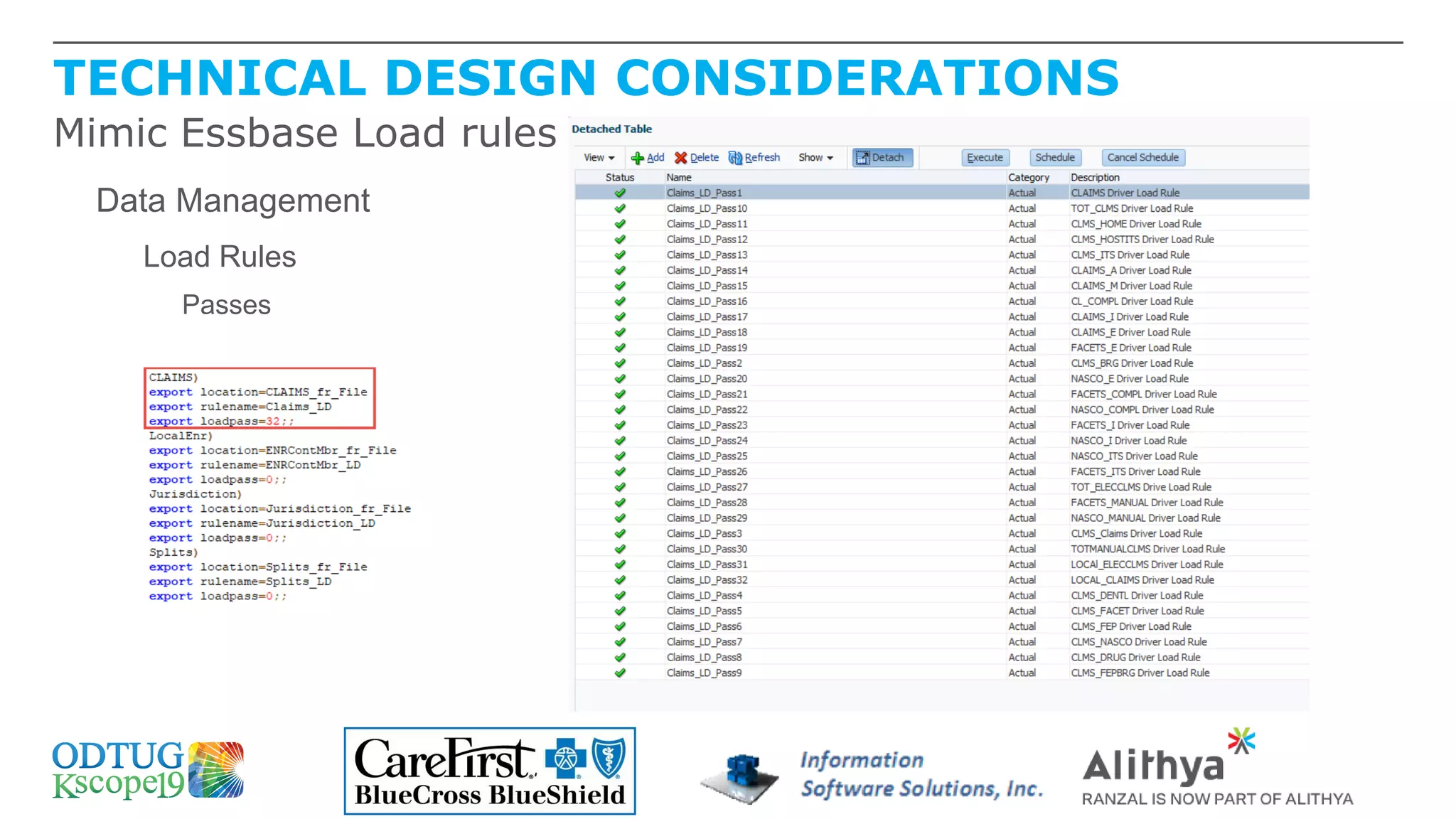
Mimic Essbase Load rules
Data Management
Load Rules
Passes
TECHNICAL DESIGN CONSIDERATIONS
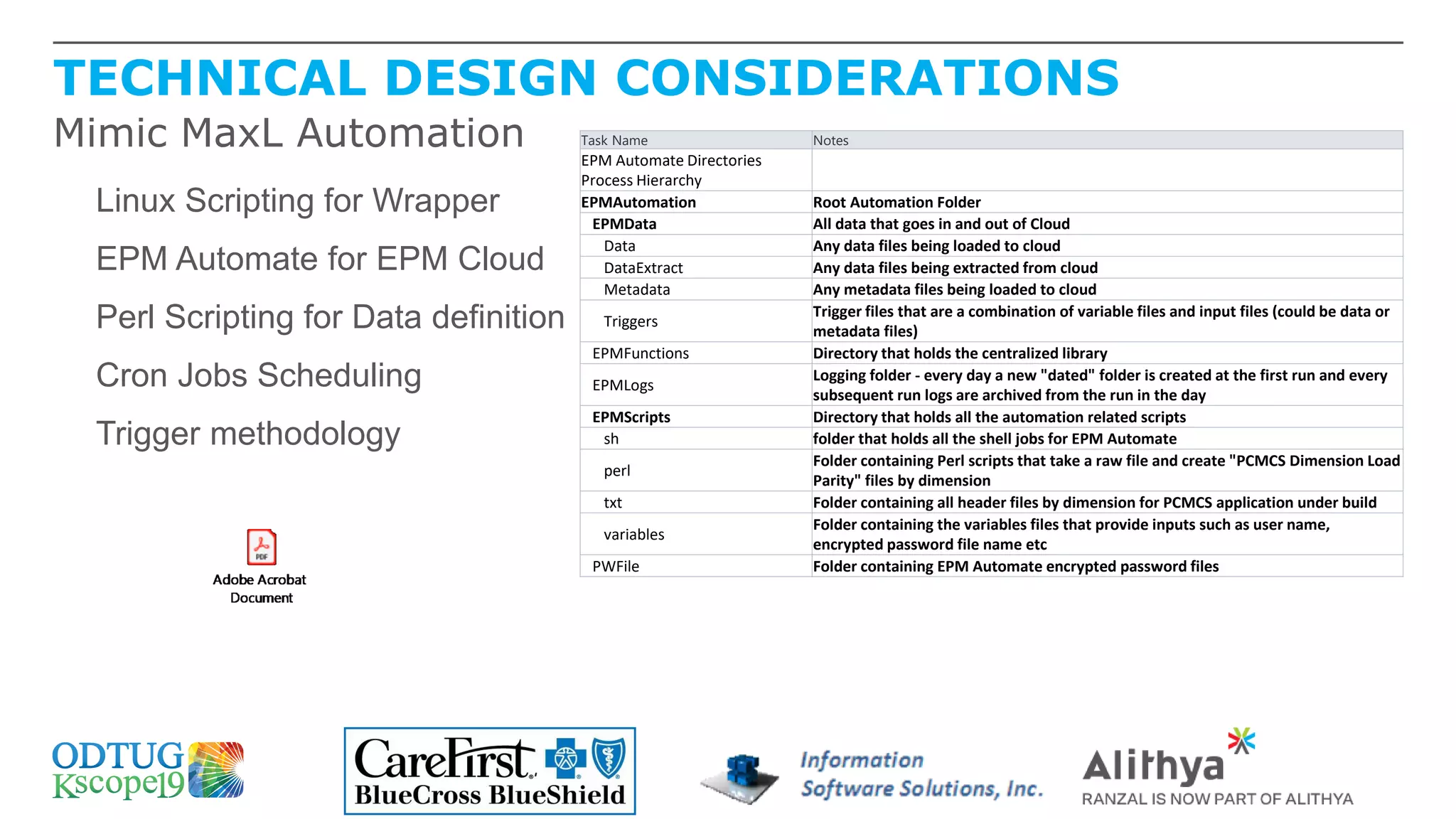
Mimic MaxL Automation
Linux Scripting for Wrapper
EPM Automate for EPM Cloud
Perl Scripting for Data definition
Cron Jobs Scheduling
Trigger methodology
Task Name Notes
EPM Automate Directories
Process Hierarchy
EPMAutomation Root Automation Folder
EPMData All data that goes in and out of Cloud
Data Any data files being loaded to cloud
DataExtract Any data files being extracted from cloud
Metadata Any metadata files being loaded to cloud
Triggers
Trigger files that are a combination of variable files and input files (could be data or
metadata files)
EPMFunctions Directory that holds the centralized library
EPMLogs
Logging folder - every day a new "dated" folder is created at the first run and every
subsequent run logs are archived from the run in the day
EPMScripts Directory that holds all the automation related scripts
sh folder that holds all the shell jobs for EPM Automate
perl
Folder containing Perl scripts that take a raw file and create "PCMCS Dimension Load
Parity" files by dimension
txt Folder containing all header files by dimension for PCMCS application under build
variables
Folder containing the variables files that provide inputs such as user name,
encrypted password file name etc
PWFile Folder containing EPM Automate encrypted password files
DEMO
• Data Management
• Data Integration
• Targets, Locations, Load rules etc
• Pod to Pod integration
• EPM Cloud Automation
• Triggers, Perl and Load
• Jobs and Function library
• PCMCS
• Home Screen and menu options
• Setting the POV
• Dimension Management, Deploying changes
• Rules Walkthrough and running rules manually
CONCLUSION - CHALLENGES
25
• Dimension member names cannot contain special characters (i.e. &, +, [, ], >,<, , /)
• Unable to upload only the deltas for monthly data loads
• Getting acclimated to new dimensions, including the POV
• Keeping within the allowable rule (PCMCS) and member (EDMCS) counts
• Writing rules to accomplish calculations previously done in SQL (look backs to prior period
results)
• Creating and maintaining matrices for support or pooled allocations
• Integrating with other pods (e.g. when, how, and roles and responsibilities)
• Using Linux servers as “Jump box”
• Application development (bugs, maneuverability within screens and between modules,
keeping up with product enhancements)
• No improvement in processing time
CONCLUSION - SUCCESSES
26
PCMCS implementation successes include:
• No long and confusing calc scripts to decipher
• Adding, copying, modifying and disabling rules simplified
• Takes less time to deploy hierarchy moves and re-aggregate data in reporting pod
• Ability to rerun allocations for prior periods easily
• Rule balancing reports provide greater visibility into allocations step-by-step
• Improved auditability for calculations and data/dimension updates
• Monthly application updates/enhancements pushed seamlessly
• Ease of making manual snapshots
Q&A
27
Topic Links:
Prior State
Why PCMCS
Solution Architecture
Design Considerations
EPM Cloud Automation
Challenges
Successes
Saundra.Holloway@carefirst.com
Vatsal.Gaonkar@alithya.com

EPM Cloud Integration at CareFirst

  • 1.
  • 2.
    EPM Cloud Integrationat CareFirst June 26th, 2019 Saundra Holloway, CareFirst BlueCross BlueShield Vatsal Gaonkar, Alithya
  • 3.
    AGENDA • Introduction • PriorState • Why PCMCS • Implementation Approach • Technical Design Considerations • Demonstration • Conclusion • Q&A
  • 4.
    SAUNDRA HOLLOWAY 4 • Alittle about me • Lead Business Analyst (Non-IT) for Management Accounting Cost Allocation Development • 32 years with CareFirst and over 30 years of cost allocation experience • Business area Cost Allocation System Administrator – I AM STRICTLY BUSINESS ☺ • Performed cost allocations on mainframe, Oracle Financial Analyzer (OFA), Oracle Hyperion Essbase, and now Profitability and Cost Management Cloud Services (PCMCS) • Speaker at Oracle OAUG and ODTUG KScope conferences • Project Responsibility Summary • Business area SME/lead for design, testing, and implementation of new cost allocation solution • Contact me at: • Email: Saundra.Holloway@carefirst.com
  • 5.
    CAREFIRST BLUECROSS BLUESHIELD 5 •CareFirst is in its 82nd year of service as a not-for-profit, independent licensee of the BlueCross and BlueShield Association, operating in the Mid-Atlantic region covering the District of Columbia, all of Maryland and a large portion of Northern VA • The largest health insurer in our region, serving 3.3 million members • Serves more than 625,000 members in the Federal Employees Health Benefits Program (FEHBP) – one of the largest FEHBP enrollments in the nation
  • 6.
    ABOUT CAREFIRST 6 Is thelargest health care insurer in the Mid-Atlantic region, serving 3.2 million members. Employs approximately 5,000 associates and contractors in Maryland, Washington, D.C. and Northern Virginia. Has launched the nation’s largest Patient-Centered Medical Home (PCMH) program of its kind. Serves more than 625,000 members in the Federal Employees Health Benefits Program (FEHBP) – the largest FEP enrollment in the nation. Nationally recognized as a "Best in Blue" insurer for providing stellar customer service for 22 years for D.C. FEP members and 15 years for Maryland FEP members. Invested $33.2 million in 2017 to improve overall health, and increase the accessibility, affordability, safety and quality of health care throughout its market areas. Earned recognition in 2013, 2014, 2015, 2016, 2017 and 2018 as one of the "World's Most Ethical Companies" from the Ethisphere Institute.
  • 7.
    CAREFIRST BLUECROSS BLUESHIELD 7 Ourreporting requirements are extensive as we must report to the following entities: • BlueCross BlueShield Association (BCBSA) • Insurance Commissioners for MD, DC & VA • Federal Employee Program Director’s Office • Office of Personnel Management (OPM) • Group Administrators • Medical Loss Ratio (MLR) as mandated by the 2010 Health Care Reform Act
  • 8.
    PRIOR STATE –ROADMAP TO EPM 8 In 1998 the BCBS plans of MD and DC merged to form CareFirst and we installed Oracle Financial Analyzer (OFA) as our joint costing solution with the assistance of Russ Papparotto. January 2010 we implemented Oracle Hyperion Essbase to replace OFA which was being de-supported by Oracle Essbase was the chosen solution because: • It was highly customizable to fit our unique needs • Robust enough to handle complex allocation algorithms • Could house large amounts of data and multiple hierarchies to satisfy various reporting requirements • User friendly reporting with Excel-based Smart View tool
  • 9.
    PRIOR STATE 9 We implementedEssbase on premises with a combination of BSO and ASO multi-dimensional cubes on Windows servers, complemented by a SQL server for additional calculating power • BSO was used for the power of its calculation engine • With the BSO cube we used Load rules and Calc Scripts along with SQL stored procedures • ASO was used for reporting due to its speed of aggregation and ability to store large amounts of data • Used MaxL scripts and batch programs to automate processes SQL Server BSO Cube Calculations ASO Cube Reporting
  • 10.
    WHY PCMCS 10 We werelooking for a Commercial Off-The-Shelf (COTS) cost allocation product that could be maintained by the business area and required minimal IT support. The solution had to be: • User-friendly, with easy to understand logic, but robust enough to handle complex allocations without using complex scripts or extensive special coding languages (i.e. Java, MDX, etc.) • Flexible enough to accommodate future methodology changes • Able to Integrate with existing on-prem Oracle EBS application and future financial applications being considered for implementation We also wanted to implement a new solution when our next 5 year federal audit cycle began in order to provide a consistent data source.
  • 11.
    WHY PCMCS 11 It wasan extremely difficult decision for us to move to the cloud, due to the sensitive nature of our business, however, since our allocations do not include HIPAA data (PHI or PII), we ultimately decided to go with a cloud-based product that would minimize our IT Hardware cost and need for IT programming support in the long run. Choosing PCMCS: • Relieves us of the cost and maintenance of on-prem servers • Software upgrades are managed by Oracle and occur more frequently than for on- prem products • Easy to follow load rules and calculation rules maintainable by Business Area • Able to keep the same file formats for existing data load files • Provides better traceability of allocations • Uses Smart View and Financial Reporting Studio
  • 12.
    PCMCS FIT GAP 12 PCMCShad to accomplish the following in order to replace Essbase App: • Have the ability to construct a multi-tiered allocation structure to allocate Indirect (G&A) support costs based on Tier 1/Direct expenses incurred to serve customers • Mimic the process of creating multiple statistical data files from a single load file • Simplify logic to replace complex calc scripting • Use a default allocation profile to distribute a cost center’s admin expenses • Develop a solution for allocating expenses directly to specified customers/LOBs • Isolate and reallocate non-chargeable expenses and residual/unallocated costs • Replicate or Replace the Look/lag back to prior month’s calculation data for current allocations • Provide data reconciliation for audit purposes
  • 13.
    PCMCS IMPLEMENTATION TIMELINE 13 Spring2017 Initiated search for a new cost allocation package Oct 2017 Selected PCMCS as new software solution Dec 2017 Sent RFPs for implementation partner April 2018 Selected Ranzal (now Alithya) and Russ Papparotto, Lead Architect May 2018 Project kicked off July 2018 Selected EDMCS for Hierarchy maintenance for full cloud implementation Dec 2018 UAT began April 2019 Parallel Testing started July 2019 Go Live
  • 14.
    VATSAL GAONKAR 14 • Summary •Product Manager – Enterprise Planning • Over 13 years of Enterprise Performance Management (EPM) experience across on- premises, cloud and hybrid deployments • Design, Development and Deployment roles across approx. 40 projects over the years • EPM Cloud Credentials – Certified in EPBCS & PCMCS; Design and deployments; EPM Cloud automation • Speaker at Oracle / Hyperion conferences such HUGMN, DCOUAG, OAUG, ODTUG and OpenWorld • Project Responsibility Summary • Data Integration and EPM Cloud Automation Design, Development and Rollout • Visit me at: • Email: vatsal.gaonkar@alithya.com twitter: @dieselvat
  • 15.
    COMPANY HISTORY 15 2001 Hyperion Planning introduced to the market(1st Essbase embedded app) 2007 Enhanced Consolidation practice with world class capabilities 2009 HPCM introduced to the market – Ranzal design review 2010 Established Strategic Finance practice to complement our Planning expertise 2012 Exalytics & Performance Testing Lab Establish multi product focus & advisory Proven business analytics leader with a history of successful implementations and continuous growth 1996 Ranzal & Associates Founded 2004 Acquired by Edgewater 2016 Deepened geographic footprint and EPM Cloud expertise 2015 Developed Discovery & Modern Data Architecture Approach 2014 Introduced Hosting, Support & Managed Services Offerings 2018 Ranzal & Alithya join forces to form an EPM/ ERP Cloud Powerhouse
  • 16.
    ALITHYA OVERVIEW –EPM & ANALYTICS 16 Comprehensive Business Solutions Our solutions drive improved business performance through better decision making, strong customer engagement, and optimized operations Deep Partnership Drives Customer Value Adaptable Deployment Models Diverse Client Portfolio & Industry Expertise RetailEnergy/ Utilities Team Highlights Multiple Oracle ACEs Seasoned delivery team with avg 8 years serving clients Experienced management team with avg 15 years in the company Certified Cloud Resources Enterprise Performance Management (EPM) Analytics Financial Services Technology CPG and Manufacturing Healthcare Outstanding Achievement in Big Data 100 Most Promising Big Data Solutions Providers 1,000+ Clients 2,000+ Projects20+ Years Advisory Services Implementation Services Technical Services Hosting & Support Training Services Intellectual Property
  • 17.
    16 SPEAKER SESSIONS 17 Visitus at Booth # 113 Monday, 6/24: • 11:00am – 11:30am (202): Become a RESTful Iron Man with ARC (the Application, Not the Reactor) • 11:00am - 11:30am (204): Supplemental Data in the Cloud • 2:15pm - 3:15pm (205): Best Practices for Designing and Building Integrations • 3:45pm - 4:45pm (611): My Favorite Calc Code Tuesday, 6/25: • 8:50am - 9:50am (204): Keys to the Kingdom: Key Concepts to ARCS Application Design • 10:00am - 11:00am (211): Client Success Story - Oracle FDMEE is the Cloud Data Hub at Legg Mason • 11:45am - 12:45pm (611): I Can do WHAT with PCMCS? Features and Functions, Business Benefits, and Use Cases • 2:15pm - 3:15pm (211): EPM Cloud Integration at CareFirst • 2:15pm - 3:15pm (611): Empowering Users with Analytical MDX Wednesday, 6/26: • 10:15am - 11:15am (201): EPRCS: The reporting Swiss Army Knife • 10:15am - 11:15am (602): Connected Planning Using EPM Cloud at Opus Group • 11:45am - 12:45pm (211): Case Study: Using EDMCS to Solve Master Data Challenges • 11:45am - 12:45pm (201): EPM Data Integration Panel • 11:45am - 12:45pm (6A): Trend-Based Connected Planning at Vitamix • 3:30pm - 4:30pm (204): A 2020 Vision for EPM Project Management Thursday, 6/27: • 9:30am – 11:00am (609): Deep Dive: Financial Close: The Best of Both Worlds - Welcome to the Hybrid Close
  • 18.
  • 19.
    IMPLEMENTATION APPROACH • Metadatabuild – file based • Data load – data management • Allocation processing – PCMCS automation • Calculation to reporting integration – integration between PCMCS instances • Cross Pod integration – between CST And FEP PCMCS applications
  • 20.
    TECHNICAL DESIGN CONSIDERATIONS MimicEssbase Load rules Data Management Targets Locations
  • 21.
    TECHNICAL DESIGN CONSIDERATIONS MimicEssbase Load rules Data Management Mappings 1-to-1 Conditional
  • 22.
    TECHNICAL DESIGN CONSIDERATIONS MimicEssbase Load rules Data Management Load Rules Passes
  • 23.
    TECHNICAL DESIGN CONSIDERATIONS MimicMaxL Automation Linux Scripting for Wrapper EPM Automate for EPM Cloud Perl Scripting for Data definition Cron Jobs Scheduling Trigger methodology Task Name Notes EPM Automate Directories Process Hierarchy EPMAutomation Root Automation Folder EPMData All data that goes in and out of Cloud Data Any data files being loaded to cloud DataExtract Any data files being extracted from cloud Metadata Any metadata files being loaded to cloud Triggers Trigger files that are a combination of variable files and input files (could be data or metadata files) EPMFunctions Directory that holds the centralized library EPMLogs Logging folder - every day a new "dated" folder is created at the first run and every subsequent run logs are archived from the run in the day EPMScripts Directory that holds all the automation related scripts sh folder that holds all the shell jobs for EPM Automate perl Folder containing Perl scripts that take a raw file and create "PCMCS Dimension Load Parity" files by dimension txt Folder containing all header files by dimension for PCMCS application under build variables Folder containing the variables files that provide inputs such as user name, encrypted password file name etc PWFile Folder containing EPM Automate encrypted password files
  • 24.
    DEMO • Data Management •Data Integration • Targets, Locations, Load rules etc • Pod to Pod integration • EPM Cloud Automation • Triggers, Perl and Load • Jobs and Function library • PCMCS • Home Screen and menu options • Setting the POV • Dimension Management, Deploying changes • Rules Walkthrough and running rules manually
  • 25.
    CONCLUSION - CHALLENGES 25 •Dimension member names cannot contain special characters (i.e. &, +, [, ], >,<, , /) • Unable to upload only the deltas for monthly data loads • Getting acclimated to new dimensions, including the POV • Keeping within the allowable rule (PCMCS) and member (EDMCS) counts • Writing rules to accomplish calculations previously done in SQL (look backs to prior period results) • Creating and maintaining matrices for support or pooled allocations • Integrating with other pods (e.g. when, how, and roles and responsibilities) • Using Linux servers as “Jump box” • Application development (bugs, maneuverability within screens and between modules, keeping up with product enhancements) • No improvement in processing time
  • 26.
    CONCLUSION - SUCCESSES 26 PCMCSimplementation successes include: • No long and confusing calc scripts to decipher • Adding, copying, modifying and disabling rules simplified • Takes less time to deploy hierarchy moves and re-aggregate data in reporting pod • Ability to rerun allocations for prior periods easily • Rule balancing reports provide greater visibility into allocations step-by-step • Improved auditability for calculations and data/dimension updates • Monthly application updates/enhancements pushed seamlessly • Ease of making manual snapshots
  • 27.
    Q&A 27 Topic Links: Prior State WhyPCMCS Solution Architecture Design Considerations EPM Cloud Automation Challenges Successes Saundra.Holloway@carefirst.com Vatsal.Gaonkar@alithya.com