James Fowler
AEP 3.1 Writing
February 17, 2015
Format May Be More Important Than You Think
There are many factors that affect students’ grades on
their written work. Organization and content are obvious.
Grammar and punctuation are also important. Style and
register are important too, and they depend on the author’s
purpose and the intended audience. With all these things
to consider, it’s easy for students to overlook formatting
until it’s too late. Good formatting is important because
it gives the reader a good impression, it makes reading
more predictable, and it show’s the student’s ability to
conform the essay to a set of requirements.
The first impression a reader gets of an essay comes
from the formatting. The spacing, the font, and the
blocking all combine to present the essay in a sort of
packaging. Academic essays are usually in uniform
conservative formatting. Academic essay formatting is
analogous to plain brown paper wrapping. It presents the
essay in a way that does not distract the reader from the
content. Academic formatting leaves a professional
impression.
Professionals are often busy. Academic formatting
respects others’ time by presenting the content in a way
that is predictable. This predictability makes the essay
easier to read and easier to use as a reference. Strange
fonts, spacing, blocking, or indentation may distract or
confuse the reader. Surprises take time to evaluate and
interpret, while routine and predictability are efficient.
Efficient delivery of the content saves the reader’s time.
Not all readers have the same formatting preferences.
Various magazines, journals, professors, or scholarship
applications will specify the formatting preferences of the
readers. It is important for students to learn the habit
of conforming their essays to the requirements of the
reader. For example, when I was in law school, I had one
professor who preferred Times New Roman font, and another
professor required Courier New font. I had to adjust the
font and other aspects of formatting to fit the
requirements and preferences of many different readers.
Now, before I begin typing, I check the instructions very
carefully to be sure I know and follow them.
In conclusion, there are many reasons a student may
want to be careful about format. Ignoring formatting
requirements may give a bad impression of the student and
put the reader in a bad mood. Poor or unexpected
formatting can make an essay more difficult to read and
understand. It can also indicate that a student is unable
or unwilling to follow directions. Considering all these
things, it shouldn’t come as a surprise that formatting has
an effect on your grade.

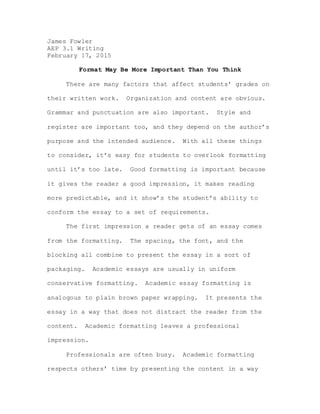
Essay formatting example

  • 1.
    James Fowler AEP 3.1Writing February 17, 2015 Format May Be More Important Than You Think There are many factors that affect students’ grades on their written work. Organization and content are obvious. Grammar and punctuation are also important. Style and register are important too, and they depend on the author’s purpose and the intended audience. With all these things to consider, it’s easy for students to overlook formatting until it’s too late. Good formatting is important because it gives the reader a good impression, it makes reading more predictable, and it show’s the student’s ability to conform the essay to a set of requirements. The first impression a reader gets of an essay comes from the formatting. The spacing, the font, and the blocking all combine to present the essay in a sort of packaging. Academic essays are usually in uniform conservative formatting. Academic essay formatting is analogous to plain brown paper wrapping. It presents the essay in a way that does not distract the reader from the content. Academic formatting leaves a professional impression. Professionals are often busy. Academic formatting respects others’ time by presenting the content in a way
  • 2.
    that is predictable.This predictability makes the essay easier to read and easier to use as a reference. Strange fonts, spacing, blocking, or indentation may distract or confuse the reader. Surprises take time to evaluate and interpret, while routine and predictability are efficient. Efficient delivery of the content saves the reader’s time. Not all readers have the same formatting preferences. Various magazines, journals, professors, or scholarship applications will specify the formatting preferences of the readers. It is important for students to learn the habit of conforming their essays to the requirements of the reader. For example, when I was in law school, I had one professor who preferred Times New Roman font, and another professor required Courier New font. I had to adjust the font and other aspects of formatting to fit the requirements and preferences of many different readers. Now, before I begin typing, I check the instructions very carefully to be sure I know and follow them. In conclusion, there are many reasons a student may want to be careful about format. Ignoring formatting requirements may give a bad impression of the student and put the reader in a bad mood. Poor or unexpected formatting can make an essay more difficult to read and understand. It can also indicate that a student is unable
  • 3.
    or unwilling tofollow directions. Considering all these things, it shouldn’t come as a surprise that formatting has an effect on your grade.