lot has appearedin recent issueso n the subject 
of the ESR (equivalent series resistance) of an 
electrolytic capacitor. The Capacitor Wizard 
was reviewed by Martin Pickering in June 1998. It's 
designed to measure a capacitor's ESR in-circuit while 
' 
ignoring any components that are connected to it. The. 
unit described'in this. artible performs the same task, .. 
and a lot of work has been put into achieving the end ' 
result. Even if you don't get around to building the 
meter, this article will give you insight into the design 
criteria and the way in which the instrument works. But 
build it if you can: it's effective, very useful and inex-pensive. 
ESR : . , ' 
' In view of Martin's review and also the articles by Ray 
Porter on a capacitor's ESR (January and April 1993) I 
won't say a lot about ESR here: it would simply be rep-etition. 
To put it in a nutshell, a capacitor's measured 
ESR (in ohms) is an indicationo f its 'goodness'.T he 
Iower the ohms reading, the better the capacitor. An 
ESR check can give an early indication ofcapacitor fail-ure, 
and is far more useful than a capacitancem easure-ment. 
Indeed many faulty electrolytics show OK when 
checkedw ith a conventionalc apacitancem eter. 
In recent months I've talked to many people who 
don't appreciatet he importanceo f ESR and in what 
senseit differsf rom capacitanceS.o I feel it worthwhile 
including an extract from a technical bulletin on the 
CapacitorW izard writtenb y Doug Jones,t he President 
of IndependencEe lectronicsI nc. It sumsu p the ques-tion 
of ESR well. 
"ESR is the dynamicp urer esistanceo f a capacitort o 
an AC signal.H igh ESRc anc auset ime-constanpt rob-lems, 
c apacitorh eatingc, ircuit loading,t otal failuree tc. 
A switch-modep owers upplym ay not startr eliably- or 
start at all. Slight hum bars appear in the video of a 
The subiecl of qn 
elecfrolytic copocitor's ESR 
hos generqted <r lot of 
interesf in recent issues. 
Alon Witlcox hos tqken it o 
stoge further in designing 
o procticol ESR meler. This 
firsf porf deols wirh the 
operotion of fhe circuitry 
used in fhe meter . 
Design.' ,uohf ''EM$ 6tBr 
VCR ot monitor. A TV display may be pulled in from 
the sideVtop/bottom. Diode and transistor failure can 
occur over a period of time. 
These and many other problems are often caused by 
capacitors , with normal capacit'nce but high ESR, 
which does not exist as a static quantity and therefore 
cannot be measured using a conventional capacitance 
meter or a:DC ohmmeter. ESR exists onlv when alter-nating 
current is applied to a cdpacitorbr when a capac-itor's 
dielebtric charge is changing state. It can be con-sidereda 
s the total in-phaseA C resistanceo fa capaci-tor, 
and includest he DC resistanceo f the leads,t he DC 
resistanceo fthe connCctiont o the dielectric,t he capac-itor 
plate resistancea nd the in-phaseA C resistanc-oef 
the dielectric'material at a panitular frequency (my 
italics) and temperature. ,' , ' r 
The componentc ombinationt hat constitutesE SR can 
be thought ofds a resistor in series with a capacitor: the 
resistor does not exist as a physical entity, so a direct 
measuremenatc rosst he,'ESRr esistor,i s not possible. 
If, however, a method of correcting for the elfects of 
capacitive reactance is provided, aid considering that 
all resistancesa re in phase,t he ESR can be calculated 
and measured using the basic electronics formula E = I 
x R! This is the basis of the design of the Capacitor 
Wizard." 
Design Criterio 
Capacitorm anufacturerqsu oteE SRv aluesm easureda t 
l00kHz. So this is the test frequency I chose. The 
impedanceo f inductorsi n the microhenriesre gionc an 
be measureda t this frequency,e nabljngt he c-ondition 
of video heads to be gauged --as they w6ar and the gap 
deterioratest,h eir inductancefa lls. 
The Wizard has a buzzer that sounds when the ESR 
is below lCl or so. A capacitor with an ESR of less 
than about lC) is generallyc onsideredto be good, so 
r'ii 
r 1 6 March 1999 TELEVISION
- " = ; ; - ; r ; 9 , ; : , 
. : . , i : ; r i l 
: I r. ;; ,. .::,1 it . j . ,. . :..:..:  
this is a very useful feature in situations where you 
waht to cheik a number of suspect components,. it 
means that you need refer to the meter ohly when 
there's no beep. I've incorporated this facility, b'ut you' 
must bear in mind that a lot of the capacitors in which 
we'ire interested have ESR values of less than 0.5C) 
when good. More on this later. 
I'd like to stress this basic point before going any fur-then 
as with the Capacitor Wizard, the meter described 
in this article doein't measure a capacitor's micro-farads. 
It simply lets you know if the capacitor is or 
isn't up to the job. After gaining some practical experi-ence 
with the meter, you will soon get to know"what 
reading to expect from a good capacitor - taking into 
accounti ts capacitancea nd voltage rating. But in'any 
case the reading obtained with a faulty capacitor usual-lf 
lea1e1 little doubt as to its condition. 
The Op-Amp 
The circuit'uses the basic opamp as an oscillator, 
amplifier;' dslsctor, voltage-follower and .'comparator. 
So'it's appropriateto devotes omes pacet o a description' 
of the op-amp and its associated circuitry. Incidentally 
the term'opcrational amplifier' relates to its use in ana-logue 
computers and appeared in a paper by Ragaziuini 
and others in 1947.T he first general-purposeo p-amp, 
with.differential inputs and using the familiar triangular 
symbol 'for circuit rcprcsentation, was :introduced;in. 
1952 r 6Model K2-W, by'.George A. ' Philbrook 
Re.searcheIsn c.). It's sobering to think that almost forty 
years ago an early op-amp, the P2, cost $227 - an eighth' 
of the cost of a VW Beetle at that time: now a superior 
device can tie bought for less than a pound. 
The op-amp is a high-gain (x100,000 or so) amplifi-er 
that usually has two 'inputs, on-e non-inverting 
Qabelled +) and the other inverting (labelled !). For 
practical'purposes.the gain.rcan be considered as 
infinitely high, with no cuirent flow at the inputs. The 
opamp'isr,designed primarily to' operate stably'with 
hcarlr- nefative. feedback' In 'fact from 'the' hisfelisal:; 
poiriio"f:vlcw:de opamp andithe concept of negative' 
feddb4k(the, invention :of fi,S.'r Blach-'workingrforr' 
Bell_'[5t*iratories, in 1927) are synon5rmousB. lack' 
wa5''w6ikihg'on telephones,t' is bu;ective biing to:. 
achieve'stable gain independent of the characteristics': 
of a valve (a thennionically-activated FET to youpg-sterSl). 
When he tried to patent his negative-feedback 
amplifier in 1928-the idea:was ridiculed. Over the 
years however this concept has become one of the 
most important in the field of electronics. Marconi had 
much the same problem. It seems that people often dis-miss 
things they don't understand. 
' 'Anyway, 
I digress. To get back to the point, the op-amp 
usually:requiresa positivea nd a negatives upply 
with respectt o a common earth. These.suppliesa re 
often noi shown on circuit diagrams, being taken for 
granted. Thq common earth (0V line) serves as a refer-eirce 
point for the voltages that are present in the cir-cuit 
and as a'return path to the power supply for any 
currents generated by the device's operation. 
The main point here is that if the voltage at the + input 
increasesw ith respectt o the voltage at the - input, the 
output voltage will be positive-going.C o,nverselyif the 
voliage at the + input decreasews ith respectt o the volt-hge 
at the 1 input the output voltage will be negative-going. 
T hus in normal practicet he outputc orrespondsto 
the difference between the inputs. 
If the op-amp doesn't have any negative feedback 
and the + input is at only 0'lmV above the - input, the 
output voltage will be close to that of the positive sup-ply 
rail. If the + input is lower than the - input by the 
same amount, the output voltage will be close to that of 
the negitive supply rail. Thus the gain is equal to the 
average slope, which is typically l0V/0'1mV = 
100,Q00.T his very sensitive property is used in com-parat< 
ir circuits (it's'used in the ESR meter's buzzei 
circuit). But the op-amp is far more useful when.the 
output is restricted to narrower limits. 
The Precision Inverting Amplifier 
This is one cif the'riiost common opimpapplications 
and is used in the second and third stages of the meter. 
Circuit operation will hopefully be made clear by the 
rather unusudl representation (due to Tom Hornack) 
shown in Fig. l. 
At (a) the op-amp is arranged to provide a voltage 
gain of two. The fact that in this case the output is 
inverted (the gain'is.minus two) is not important. The 
heavy negative.feedback,viaresistoRr f forces the out-put 
to be such that the voltage at the - input is equal to 
that at the + input rjvhich is'oV. Remember that the op- 
::a mp respondst'd the"d ifrerenceb etween its' inputs. As 
;,point X is at earth'potential, there is "lV across Rin' 
',O(lkh0m) 's .and,ther,cirrrdnt flow via Rin, calculated by 
Law;.iS lmA. jTherc is no current flow at the 
input of the op-amii So this lmA flows via Rf (2k0) 
whiih thus has 2V'across it. 
Notice how Rf and Rin behave like a seesaw as the 
input goes from a positive to a negative value, with the 
piVot at the null point X. This point is referred to as a 
virtual earth. There is no current path between point X 
and earth, and point X is always at zero voltage with 
respect to earth. 
The concept of a virtual earth is used as a short-cut 
(ol {bt DSUd 
Fig. 1: Precision inverting op-amp circuit, ia) witn a positive input, (b) with a negative input. Note how Rf 
and Rin behave like a seesaw as the input goes from positive to negative, with the pivot at the null (virtual 
earthl point X. The gain of the stage is RflRin, so the output is Vin x Rfl&in. 
TELEVISIONM arch 1999 317
ESR METER 
Fig.2: Jim Williams'original circuit, the firct 
attempt at combining an op-amp with a Wien 
bridge network to form an oscillator. 
656t1 
Fig. 3: An op-amp Wien bridge oscillator arrange-ment 
with the output set at 6V p-p (positive peak 
shownl. At the resonant frequency points a, b and c 
are in phase and the waveforms at the op-amp's 
inpuF are a third of that at its outpttt. The ratio 
BflRin = 2. 
when the operation of a current-to-voltage converter 
is analysed. From Fig. I you can see that, because of 
the virtual earth, Rf appears to be in parallel with RL. 
So the voltage across Rf appears across the load as the 
output voltage. But although the null point is cortsid-ered 
to be at earth potential, at a microvolt level it's 
very much active. 
It can be seen from Fig. I that the stage gain, within 
the limitations of trhe supply, is determined by the 
ratio of Rf to Rin. Incidentally there's a frequency 
limit on the gain: with common types of op-amp we 
are limited to a gain of about x10 at 100kHz. If the 
resistors in Fig. I are transposed the stage gain will be 
0.5 - the circuit acts as an attenuator. 
Overview 
Before we go further, it would be as well to provide a 
quick introductiont o the meter circuit presentedh ere 
(see Fig. 5). The first stage consists ofa l00kHz oscil-lator, 
whose output is fed to the capacitor being test-ed. 
Put simply, the current flow through the capacitor 
is sensed then amplified as a voltage. It's finally 
detecteda nd measuredb y the meterm ovement. 
The better the capacitor, the lower its ESR and the 
higher the meter indication. It's not quite this simple, 
becauset he meter must ignore the other components 
connectedto the capacitorb eing tested.W e'll come to 
the solution to this problem later. 
The Oscillqtor - History 
At the heart of the meter there's a Wien bridge net-work 
oscillator. This form of oscillator has an inter-esting 
history which is worth a few paragraphs. 
In 1939 William Redington Hewlett (co-founder of 
Hewlett-Packardp) roducedh is Stanfordt hesisA New 
TypeR esistanceC apacityO scillator.It madeu seo f a 
resonantR C networkt hat had beenc onceivedb y Max 
Wien (pronounced Vene) in 1891. The American 
inventor Lee DeForest (yes, we can blame him) had-n't 
started the ball rolling yet with the creation, in 
I 906, of the triode valve. So there had in I 89 I been no 
means of obtaining electronic amplification and Max 
couldn't have got his network to oscillate. That 
wouldn't hav'e troubled him, as he was using the net-work 
for AC bridge measurementA. mazing what peo-ple 
got up to over 100 years ago, isn't it? I think it 
was, once again, something to do with telephones. 
But Hewlett had the pentode valve at his disposal. 
He also had Harold S. Black's pioneering work on 
negative feedback to assist him. In addition there was 
Nyquist's Regenerative;Theory, which described the 
conditions necessary for. oscillation. 
Hewlett showed that the Wien network could be 
made to oscillater A crucial problem had to be 
resolved however, that of stage glin. With a gain of 
less than unity there would be no oscillation. With a 
gain of greater than unity there would be distortion. 
With unity gain there,will be what Hewlett wanted, a 
,'wsianse wave. He had a flash'of inspiration; the solution 
literally staring him in the fate - the electric light 
bulb. : 
Hewlett's oscillator.was a two-valve affair, with a 
6J7 as the oscillator and a 6F6 as the output stage. His 
solution for gain stability was to wire a tungsten bulb 
between the cathode of the 6J7 and earth. The nega-tive 
feedback was applied between the anode of the 
output valve back to the cathode of the triode oscilla-tor 
valve. If the output increases for any reason, so 
does the current flowing through the bulb. As it 
warrns up, its resistancei ncreasesS. o doest he level of 
negative feedback, thereby stabilising the oscillator's 
output. Hewlett's idea of employing a light bulb was 
brilliant in its simplicity. It survived in the Hp200 
series audio oscillator during a fifty-year production 
run - into the mid Eighties. 
About fifty years after Hewlett built his oscillator 
Jim Williams, who was working for Linear 
Technology Corporation, was sitting in his den one 
rainy Sunday trying to think of something to do. His 
old HP200 caught his eye. Peering into the back, he 
saw the light bulb where it had been placed half a cen-tury 
ago, and wondered how Hewlett's oscillator 
would perform using a modern op-amp. He went on to 
knock one up - the original circuit is shown in Fig. 2 
- and was pleased to find that it had a distortion fig-ure 
of only 0.0025 pei cent. 
Perhaps he could improve on it, by eliminating the 
bulb? Jim was the first to use a JFET in place of the 
bulb, but with this device the distortion figure rose to 
a massive 0.15 per cent. Unfortunately there's not 
space to explain why the use of a JFET gives such 
inferior results compared to a bulb. In the event Jim 
discarded the JFET in favour of an optically-driven 
CdS photocell. This, in conjunction with five op-amps 
etc., produceda n analyser-limitedd istortionf igure of 
0'0003 per cent (three parts per million). At one point 
during his quest Jim writes (Analogue Circuit Design, 
Butterworth-Heinemann) "I could almost hear 
Hewlett's little light bulb, which worked so well, 
# 
i. 
":!lt 
''{ 
+if ,i$ 
,.* 
*; # 
;ffi 3 1 8 March 1999 TELEVISION
'i{ii;r-." 
: : ; 
laughinga t me". So no apologiesf or the useo f a light 
bulb'in this design- 
Operotion of the Oscillofor 
Fig. 3 shows the Wien,bridge netwoik oscillator as 
you probably won't have seen it drawn before. It.illus-trates 
the situation at the peak of the positive-going 
half cycle. The positive feedback network consists of 
the series-paralleRl C (lead;lag) network: the negative 
feedback loop consists of the preset Rf and'bulb Rin. 
We'll consider the RC network first. At very high 
frequencies the shunt capacitor in the lower arm of the 
bridge will appear to be a short-circuit and there will 
be no signal at the op-amp's + input. At very low fre-quencies 
the series capacitor will appear to be open-circuit 
and again there will be no input from the feed-back 
network. At some point in between there will be 
maximum output from the network. The frequency at 
which this occurs is equal to ll(2nRC), which is called 
the resonant frequency (fr) of the bridge network. At 
' this point there is no phase shift across the bridge, and 
the upper arm of the network has twice the impedance 
of the lower arm, giving a transmission lgss of 1/3. To 
overcome this loss and achieve the required stage gain 
of unity, the closed-loop voltage gain (ACL), which is 
set by thc ratio of Rf to Rin, must be three. The for-mula 
for the closed-loop gain of a non-inverting 
amplifieris ACL = M/Rin + 1, so Rf/Rin must be two 
in order for ACL to equal three. , .... 
At power up the negative feedback is low, because 
the bulb is at its lowest resistance, and.the gain is 
high. As,a rcsult oscillation begins immediately, aud 
' the bulb is warmed by the current current flow. Within 
a fraction of a second the resultant increase in its 
resistance reduces the oscillator's output. It settles at 
the level at which the bulb's resistance is half that of 
the feedback resistor Rf. So the value.of Rf sets the 
amplitude,of ,the"output.,Notet hat the bulb's thermal 
delay means that it cannot follow oscillations at rela-tively 
high frequencies. It.responds to the RMS.cur- 
. rent,gnly, and phus lehavps,F a.n ordinary resistor. . i ;g 
y. " { " ' 
- - b r ' . , i ] ; , t . r , f + ' i , . ' . . + , j r , ' , j : . 
The Bulb ,: ' .:'. 
. Although the Wien bridge oscillator is the accepted 
statrdard'at frequencies up to say lMHz, the use of a 
bulb for gain control, popular in the USA, has never 
found favour on this side of the Atlantic. I think I. 
know thc rcason for this., In most textbooks things 
begin to get a bit vague iwhen it comes to the actual 
type of light bulb to use. 
It is often said that any low-yoltage, low-current 
bulb can be used. This is not so. I have seen the fol-lowing 
flawed reasoning in some books. Take a l2V, 
50mA bulb-which has a resistance of l2Vl50mA = 
240Q. The feedback resistor must be twice this, i.e. 
480Q or a lk() preset. There's nothing wrong with 
this value for the feedback resistor, but it won't work 
with such a bulb. The point that's been missed is this: 
the bulb must be operated at a current level that gives 
a large change of resistance. 
This occurs when the current is only a few mil-. 
liamperes,a nd nowheren earb ulb incandescenceW. hat 
we requirei s a bulb that hasa resistanceo f about 200f1 
when cold. When the type of bulb normally specified is 
used, the result is overloading of the op-amp, distor-tion, 
heavyc urrentd rain and dependenceo n the supply 
voltage for regulation rather than correct bulb opera-tion. 
I didn't do what Hewlett did, which was to plot the 
1/ characteristicos f variousb ulbs carefully. I simply 
TELEVISIONM arch 1999 
Fig. 1: Pr*ision rectifier circuit, (al with positive input, bl with negative 
input. In (aJ the op-amp's orrtPttt goas as low as required to overcome the 
forward voltage drop acrosli D'| and still satisfy Ohm's law as far as Bf and 
R|n are concerned. D2.is off as the voltage at its anode is 2'6V le*s than 
that at iE cathode. In (b) D.l is off, its cathode voftage being 0'6V higher 
than its anode voltage. The conduction of D2 limits the positive o,ftptlt 8t 
0.6V. This limiting factor speeds up the recovery of the op'amp when the 
input goes positive again. 
I ; : ' r . ; l ; : : i . . ' ' 
measured the resistauce of pulbs that I thought might 
be'iuitable, and found that the cold resistance of a 
28Y,24r.A hulb is l70Q-. fitis soemed to be about 
right. When I tried it -,bingo! So when, in this con-nection, 
you see "any low-voltage, 50mA or so bulb" 
you can in future read "a28Y,24mA bulb". The oscil-lator, 
will work a treat. 
The Prbcision Rectifier 
The final stage of the basic meteruses an op-amp as a 
precision rectifier..Keeping to the type ofrepresenta-tion 
we've used before, Fig. 4 shows its method of 
operation. 
With a conventional rectifier there's the drawback 
that the signal must rise above the diode's forward-voltage 
drop before conduction begins. This can be 
overcome by the use of an op-amp in the circuit. At (a) 
in Fig. 4 the input is positive and the output reduces 
the voltage at the cathode of Dl. This enables the 
input to carry on via Rf to the amplifier's output. As 
in the case of the inverting amplifier circuit, the out-put 
is again Vin x Rf/Rin. The diode's forward volt-age 
drop, which is 0.6V with a silicon diode, is over-come 
becauseth e op-amp'so utputg oesl ower by this 
amount, satisfying Ohm's law as far as Rf and Rin are 
concerned. 
Point X is still held at earth potential by feedback 
action from the output. D2 is off at this time, as the 
voltage at its anode is lower than that at its cathode. 
When the input goes negative however, as shown at 
Yflt - 0v 
D5UO 
Vioa -lY 
3 1 9
ESR MbTER 
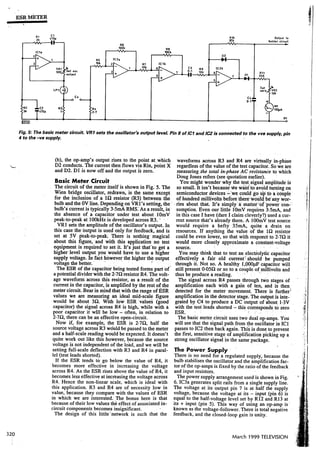
Fig. 5: The basic meter circuit. VBI sets the oscillator's output level. Pin 8 of tCl and tC2 is connected to the +ve suppty, pin 
1 to the -ve supply. 
(b), the op-amp's output rises to the point at, which 
D2 conducts. The current then flows via Rin, point X 
andD2. DI is now off and the output ib zero.- 
Bosic Meter Gircuit 
The circuit of the meter itself is shown in Fig. 5. The 
Wien bridge oscillator, redrawn, is the same except 
for the inclusion of a lf,l resistor (R3) between the 
bulb and the 0V line. Depending,on VRI's setting, the 
bulb's current ii typically 3.5m4 RMS.'As a resriit, in 
the absence of a capacitor under test about lOmV 
peak-to-peak at lOOkHz is developed across R3. " ' ' 
VRI sets the amplitude of the oscillator's ouq)ut. In 
this case the butput is used only for feedback,ind is 
set at 5V feak+o-peak; There is nothing magical 
about this figure, and with this application no test 
equipment is required to set it. It's just that'to get a 
higher level output you would have to use a higher 
supply voltage. In fact however the higher thb output 
voltage the better.' 
The ESR of the'capacitor being tested forms part of 
- 
a potential divider with thez.lQ resistor R4. The volt-age 
waveform across this resistor, as a result of the 
current in the capacitor, is amplified by the rest of the 
meter circuit. Bear in mind thit with the range of ESR 
values we are measuring an ideal mid-scale figure 
would be about 3Q. With low. ESR'value'C (good 
capacitor) the signal across R4 is high, while with a 
poor capacitor it wlll be low - often, in relation to 
2.7d2, there can be an effective open-circuit. 
Now if, for example, the ESR is 2.7Q, half the 
source voltagri across R3 would be passed to the meter 
and a half-scale reading would be expected. It doesn't 
quite work out like. this however, because the source 
voltage is not independent of the lohd, and we will be 
setting full-scale deflection with R3 and R4 in paral-lel 
(test leads shorted). 
If the ESR tends to go below the value of R4, it 
becomes more effective in increasing the voltage 
across R4. As the ESR rises above the value of R4, it 
becomes less effective at incrEasing the voltage across 
R4. Hence the non-linear scale, which is ideal with 
this application. R3 and R4 are of necessity low in 
value, because they compare with the values of ESR 
in which we are interested..The bonus here is that 
becauseo f their low valuest hi effect of associatedin - 
circuit componentsb ecomesi nsignificant. 
The design of this littlernetwork is such that the 
waveforms across R3 and R4,are virtually in-phase 
regardless ofthe value ofthe test capacitor. So we are 
measuring the total in-phase AC resistance to which 
Doug Jones refers (see quotation earlier). 
You might wonder why the test.signal amflitude is 
so small. It isn't because rfe warit tg avoid turning on 
semiconductor devices - we could go up to a'coiple 
of hundred millivolts before there'would- be:any wor-ries 
about thit, It's'similly'i"mattef .bf power con-r 
sumption. Even our tittle iOmV requires 3.5mA, irnd 
in this case I have (dare I claim cleverly?) used a cur-rent 
source thdt's already there. A l00mV test source 
would require a hefty 35mA, quirc a drain on 
resources. If anything the value of the lQ resistor 
could be even lower, so that with respoect to2.7Qit 
would more closely approximate a constant-voltage 
source. 
You may think that to test an electrolytic capacitor 
effectively a fair old currentishould be pumped 
through it. Not so. A healthy l,Q00trrF capacitor will 
still present 0.05C1 or so to a couple of millivolts and 
thus be produce a reading. :1 ': ' 
The signal across R4 passes through two stages of 
amplification each with a gain of ten, and is then 
detected for the meter movement. There is furtheri 
amplification in the detector stage. The output iS inte-gated 
by C4 to produce a DC output of about l.3V 
with the test leads shorted - this corresponds to zero 
E S R . , i : . . r : ' 
The basic meter circuit uses two dual op-amps. you' 
will see that the signal path from the oscillatoi in ICI 
passesto IC2 then back again.f hil is donet o prevent 
the first, sensitive stage of amplification picking up a 
strong oscillator signal in the same package. 
The Power Supply 
There is no need for a regulateds upply, becauseth e 
bulb stabilisesth e oscillatora nd the implification fac-tor 
of the op-amps is fixed by the ratio of the feedback 
and input resistors. 
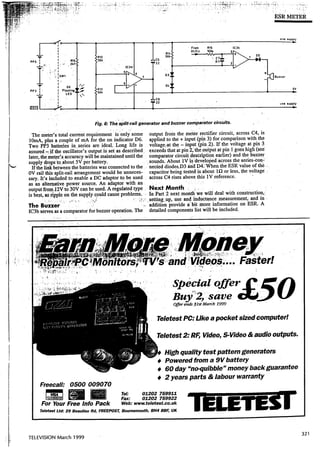
_Thep ower supplya rrangemenut sedi s showni n Fig. 
6. IC3a generates split rails from a single supply line. 
The voltage at its output pin 7 is at half thC iupply 
voltage,b ecauset he voltage ar its - input (pin 6) is 
equal'to the half-voltage level set by R[2 and Rl3 at 
its + input- (pin 5). This way of using an op-amp is' 
known as the voltage-follower.T here is total negaiive 
feedbacka, nd the c-losed-loogpa in is unity. 
i 
. l 
ii 
,+ 
,.1. 
320 March 1999 TELEVISION 
$ 
iq
- i r ' 
_ - ; . , 1 , i , 
: ; : . i : 
R1( 
55k 
2 2 
o l 
oa 
Fig. 6: The..iplit-rail generator and buzzer comPdrator circuits' 
i ? t 
ESR METER 
- 
The meter's total current requirement is only some 
l0mA,.plus a ,couple of mA for the on indicator D6- 
Two PF3 batteries in..series are ideal. Long life is 
assured -. if the oscillator's output is, set-as described . 
later, the meterls accuracy will be maintained until the 
supply drops to-about 5V per battery. 
ti tfrl fnt Uetween the batteries was connected to the , 
0V rail this split-rail arrangement would be unneces-. 
sary. -an 
It's included to enable a DC adaptor to be used 
as 
alternative power source. An adaptor with an 
output from,I2V to 30V can be used. A regulated type 
is best, as ripple on the supply c.puld cause problems. 
i , , ' ' l i t ' 
The Buzzer 
lC3b serves as a comparator forbuzzer operation. The 
output froin the meter rectifier circuit, across C4, is 
appiiea to the + input (pin 3) for comparison with the 
vbitage,at the - input (pin.2). If the voltage 1t pin 3 
e*""Jdi that at pin 2; ttre output at pin I goes high (see 
comparator ciriuit.description earlier) and the buzzer 
soun-dsA. bout lV is developed acrosst he series-con-inecied 
diodes.D3 and D4.rWhen the ESR value of the 
capacitor being tested is about lO or less, the yoltage 
acioss C4 rises above this lV reference. 
Next Month 
In Part2 nextm ontfw, e will dealw ith construction, 
'asdedttiitni-so unD . use and inductance measurement,a nd in 
brovide a bit more information on ESR. A 
detailed cbmponents list will be included. 
TELEVISIONM arch 1999 
321
.7t Suitable 
'ier scale, ,relpro-ced 
full size. 
I n pu.t I lqt month the design criteria were spccified 
I and a full description of the operation of the circuit 
f was provided. The meter i3 simple to build and the 
effort rcqufuedis well worthwhile. , : :::.: 
Construction 
Fig. 8 shows the board layout. For convenience,'0.lin. 
matrix stripboard is used. The most common problem 
qo.l9.".Tsi-lr 9 print cuts. If these are made by rwisting a 
d.itl lit by hanp, as I do, instead of usingthe correct 
tool, it's all too easy for the cut to be incoirplete orfor 
some of the print to spread over qo an adjacent track. 
If a double-pole on/off switch is used, ihis is a cbnve-nient 
point for the connection of an on/off indicator. A 
flashing LED with a l0kQ series resistor does the job 
we-ll: althoughit takes only a couple of mA, the flashing 
light does catch your eye. 
It is best to use screened cable for the test leads, in 
order to avoid pick-up of unwanted radiation from any 
In fhis second pqrt Alon 
Willcox deqls, wirh construc-fion 
ond setting up of rhe 
meter, upgrcides qnd use, 
ond provides oddirionol 
bockground informotion 'bler 
workirg.TV line output stage in the vicinity. Rather than 
use plugs and sockets, solder the test leads to the ICB: 
we are often concemed wittr RSR values of less than 
0.1O, and it doesn't take long for a plug-and-socket 
connectiont o deterioratea nd producer esistance.values 
greater than this. The length ofthe leads is not at all crit-ical. 
I use a 24in. length of screened audio lead termi-nated 
by two 8in. lengths of flexible wire. 
On- a cold, frosty morning, before the workshop has 
reached its normal comfortable, cosy (?) temperature, 
$9 leter's readings may increase,slightly. Alttrougtr 
this_increase may amount to the equivaleniof less thin 
0JO, the fact that accurate low-rciistance readings are 
often required justifies the use of an off-the-board set-zero 
control rather than a preset type as used in the 
Wizard ESR meter. 
This control also comes in handy if you want to 
squeeze the last ounce out of the batteries, but the 
buzzerc an't be relied on when the batteriesp roducel ess 
than 5V T9 th" output from the oscillator begins to fall. 
Also useful in this respectis the ability to alte; the point-er 
position easily at maximum output, to be able to 
observe the operation of the bulb and the correct func-tioning 
of the oscillator. This is covered in the set-up 
notes later. 
Probe clips were used for the all-important probes. The 
hooks were cut off, the internal springs were removed, 
then the plastic was cut back to expose more of the 
probes. They have proved to be ideal in practice, and are 
small enough to often be able to get under the capacitor 
on the component side of the PCB. The probes are not 
polarity conscious, and it doesn't matter which connec-tion 
is used for the screen ofthe test lead. 
The suggestedb oards ize (3 x 2in.) is slightly larger 
7 5 4 3 2 I .5 
ESR al 1OO kHz 
426 
April 1999 TELEVISION
ESR METER 
- 
. . r . : : i i . i + r , . . . . 
_:{:f ' 
than it needs to be to.dccdmmodate the components. 
There arc two reasons ifor this: First, so that it will slot 
into the case that was selected, and secondly to allow 
space for future upgrades. With this in mind the set-zero 
control is offset to the right, allowing space for a modu-lar 
preset shaft. 
The batteries are securcd with self-adhesive Velcro. 
It's a simple solution, and the Vrlcro will transfer sev-eral 
times. 
witli theWizard this meterdoes not dif-feientidte 
between a $hort4ircuit capac. 
itor and a really good one (with an ESR : 
arc-und 0.050). Now although we all 
kiiow ' that a short+ircuit electrolytic 
capacitor is quite rare, it ciio'occur and 
has caught me and others out. Allot of 
time can be wasted when it occurs and is 
missed. So I've been testing an addition 
that gives an audible indication when a 
short-circuit is present. A further refine-ment 
is an auto power-off facility. 
I've not included these extras at pre-sent 
because I feel it best to present as 
simple and economic a pdect as possi-ble 
initially. But space has been left for 
these additions. 
Gomponenl Sources 
I obtained most of the pans used in the 
prototype from Maplin Electronics and 
have included this company's part num-bers 
in the componentsli st. The buzzer 
and meter movement were obtained 
from CPC. For correct operation of the 
oscillator it's vital that Cl and C2 are 
good-quality polystyrene capacitors. 
TELEVISIOANp r i l 1999 
: . ' . , . 
Apart from the bulb, the sp&ifrcation 6f ttre other com-ponents 
is not critical. 
The Mefer Scole 
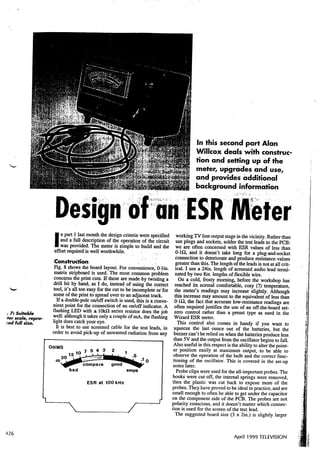
The geometry of the meterls scale (see'Fig. 7) is dictar 
ed by the relative values of R3 and R4. If the value of 
R4 was'inbreased to say 10O, this would be the mid-scale 
reading and R3, being low in comparison, would 
hav,e less effecl Say a capacitorwith -aerESR iriil! 
of l0O is 
connected. Half the signal ai.ross R3 
.be passed on, 
andrtittb'6f ,its curreni will,be' diverteidt6,.reduce R3's 
voltage;.rvhich is the result of i6i ibtii.Ent . ' l * i r * , - . through ' . the 
. .1 . . ! , . . . i r . . ; 
" ' : 
X - lrocl cut! 
Fig.8: Meiel. 
circuit layovt 
on stipboard. 
Board size is 3 
x 2in. lo allow 
for upgrudes. 
See jex]. 
continued on Page 436 
. 4,27 
: 
',nl 
ffi 
lnlernal view oJ ihe meter.
ESR METER 
continued from page 427 
bulb' A mid-scale reading of this order may be more Leave the set-zero control at minimum appropriatef or testing and observe surface-mountede lectrolytic the-operationo f the bulb uy ttit.ting capacitors,w hich seem on with to the have higher ESR va.luei. qrgbei shorted together. vou *iir have no data on see this the pointer type of ! capacitor at the time of deflectrrlcrrtrren"lil;;ir";;;ui"iy.;".pdownrothe 
writing however. stabilised"position. 
Anyway, the value of R4 used here,2'7{1, doesa ffect Once the oscillator's output has the sourcev ciltaget beens et, o adjust an extent vR2 that has to be consid- for full-scale oenectionw -iirri ;;;.;;, ered.T he currentt hat shortedt ogeth- -flows through the bulb is con- er. ninaity, centret he controlk trolled_ nob. by the setting of VRl. R3, being only le, does 
not af-fect$ e operationo f the oscillatoi. Using the Meter 
scale calibration with an 0-100 dial ideally follows nxperi-encew ith the meter provides the rule the bestg uide as to wh;t ESR value to "ip""t oi ;;;; capaciror. Some 
Read=in( Rg3 +R 4v(R+R 34 + E SRx r)0 0. ffiT*iJ,iff:il#t,::tiT'l#Y"""",T#"J,".TTi'; 
Inp ractitchees ignabre comse9rs o ray th ighE SRva r- ;#i%:!E:X'r?l3lY"'[119,1*ft,:"d:d#ti":il"# 
uest hat somen on-linearityin the cjrcuitis apparent, electrolyticc apacitor_.otf0 the resultb 0pF einga oi-over -slightd value, lparnrre you from this rbrmura. a Becausoef readingc lose this,to i t's this and bettert o usee itherf ixed resistors below0 itgtJ^"Id cerrainly .5h. 
to calibrateth e scaleo r copyF ig. 7. If a standard9 0' There * ,orn" moYemenotf exceptionsh owever.a differents I ,ll iif mention is usedi,t is easye nough trremt rerea s they toreduce.olenlargb-thqscalebyphotocopyinE. cani uur" "ooruri;;. A^irih*;lsR- valuei s to be eipectedy rth ltF, ligh-vorh;;ei;- 
letrlnSU n .::'',- 
The first consideratioins .t he oscillator's-outpulet vel. rtutt-up" o.pon"ni. n"iog pc with the 6p"raiJin specifiedl a amp, the context, oscillatorw il its wbrk down Fsi iJil;ilp"rr-r to JV peak-to-qeakB an e-xamplae ut new4 beari 50v.rype n mind that the oscilla- "tlt ;*;;;Uuce 4t a tor's readingo outputs etringi f theb s rdero not importantg f:30f,I ilryt{ At the deflectionissimplyadjustedby-vR2.w.i tt_ruh-.-tshceallee s, toletnaiqd esq:royi rq grhire;;.qonrtgnert.9r iua.oE "e*tir:nppr"pri,ooJo.buprr.,adingof0.le 
sho{9!together'I,owsetting]ofthebircilIator:soutput<iireisiisau}f--:-:.i---:'.l1tr+-.lI 
providesa longer battery-life,'iiedugintgh e livel it Table l, from whicht Dubilier,p rwides he bulb ceasest9 a functiona usefulg uide, l.1 in qery[tor. tests ignalc anh oweverb e so low at highEsR values Stre addition,i r ytu ar" unsurew hat readingto expecitt ,s "ury "nougtiio thata *ut"'u ccuracsyu "o-f*iro" ffersI.practicea *iiri",i-iili;; n no scillatoro utputo about5 V peak-to-peaisk - 
f rr9- yoor?"il-stockedl uy-J"r""t oiyti"r. a goodc om-promise. 
The-meterh as good rf an oscilloscopies protectiona gainstp not availablet,lacingt he h e followings im- probe, u"ros ple u .f,.g"d methodc .upu"it-, anb eu But sed.this C onnect shouldo a 1o f resistorb eiw""n "ourr" u" uuoia"a.thet r fr" estI onryi eadsa eui ndt Juut" urn thes for ^uie",concernis jiiig;: 
et-zeroco ntrolV R2 (shown . the. 'mains mootfrinbgl ock,,i .". u *an, 
incorrectlya s a preseti ri ric, .s*f as1-,g -.tql wise.A dvancbth es cttingo f wil slowly. [ti"r*t: "i;t il*]l'ii-""paciior. we att tnow tr,atn is capacitor. half wayp ointt heo scillatorw ill start Iust:aftetrh e. can abtlnb;" .rrif1f pun.l *n"o " piLr-suppty has,: up andt he meter's faibd l; siilt up. If you are-oft he typew ith a tendency pointerw ill deflect.c 1rry oq.yntil th-e-buzzeior unds ro sucha cciJent,i iwour,l ue steadilyA. r thisp oint the oscillator'so utputs hould fruiiiito wke a couple: be E F"fy ;F;; 6ack-to-babakc rossth e merer,sin pur.,, cloqet o 5v.peak+o-peakN. ote that with eacha dj.ust- rrris stiouta mentt he pointerw ill twitch briefly liotect the meter,b ut it won,t help your as the bulb se[des, heart- ot yo'otp robes- in the evento f sucha misfor- givingt hei mpressiotnh att hep otentiometeisr no5r, tune.rt's gLoJpracticet" al*rr*ga irtit capacitor with 
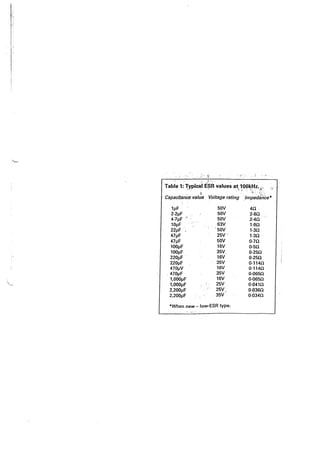
Table 1: Typical ESR values at 100kH2... 
I 
Capacitance value Voltage rating lmpedance* 
ltrF 
2.21tF 
4.7pF 
10pF 
221tF 
471tF 
471tF 
100pF 
100pF 
2201tF 
2201tF 
4701tY 
4701tF 
1,000pF 
1,000pF 
2,2001tF 
2,2001tF 
63V 
50v 
2 5 V ' 
50v 
16V 
35V 
16V 
35V 
16V 
35V 
16V 
25V 
25V, 
35V 
4Q 
2.8A 
2.4A 
1.9c) 
1.3c) 
1.3cr 
o.7a 
0.scr 
0.2scr 
0.25fi 
0.1 14Q 
0.114c) 
0.065fi 
0.0650 
0.041c) 
0.036ct 
0.034f) 
50v 
50v 
50v 
*When new - low-ESR type. 
a mains-type bulb - it is always reassurine to have a 
visual indication that little charge remains. See warning 
note later. 
Inductonce 
As the meter operatesa t l00kHz, any inductancein the 
circuit under test becomes significani. The loudspeaker 
that reads.8C)o n your coqventionalo hmmetera pp"*s 
to be nearly open-circuit wittr ttre ESR meter. 
This propert_yc an be quite useful. When testinga line 
oxtput stage for example you might find that there,s a 
short-circuit across the hansistor. In this event there are 
in general three possibilities, (a) the transistor is short-circuit, 
(b) the line output transformer has a primary-to-secondary 
short, or (c) the HT line has a short-circuit 
across it. If the short-circuit is still present when the 
ESR meter is used, the transistor is almost certainly the 
culprit: in the other two cases the ESR meter will give 
an open-circuitr eadingb ecauseo f the inductanceo f the 
transformer's primaly winding. 
. Video headt esterso perateb y measuring,in effect, the 
inductanceo f the head.I ts impedancef alls as the gap 
deteriorates with wear. Althou;h this meter operates at 
a frequency that's inappropriate for a video heid, it can 
436 
April 1999 TELEVTSTON
give a irelative indication of the head's and considering the fact that ESR is an in-phase com-poient, 
'don1t have,a collection of heads in various states of 
health to be able to confirm any figures, but it seems 
that new heads produce a reading of about 20 while 
worn heads produce a reading ofabout lf). 
Inductors with millihenry values, of the type used in 
EW modulator circuits, normally give an open-circuit 
reading. But ifa shorted turn is present the inductance 
drops dramatically and the meter's pointer will deflect. 
Anotogue v Digitol 
In dealing with the problem of in-circuit ESR measure-ment 
I've used traditional analogue technology. But, as 
is often the case, there's another way of doing things. 
Bob Parker, an engineet,fdown under' who was con-vinced 
of the importance of such an instrument, hrst 
tried analogue circuitry. After "a few fairly unsuccess-ful 
attempts" he opted for a digital approach. His solu-tion'is 
to use a 7)log processor,with, instead of a 
,sinewavea s a test signal,s hortc urrent pulsesa ppliedt o 
the capacitor being tested. The resultant voltage pulses, 
which are.proportionil to the electrolytic's ESR, are 
compared to the level existing on a fttmp generator. 
Time measurement by the 286 processor determines 
the amplitude of the pulses. 
.As far as the power,requirement is concerned, tliere's 
a parallel in the form of a remote-control handset. The 
LED is pulsed with a high currentfor a short period, the 
average curretrt drawl being low. The brief high cur-rent 
is supplied by a reservoir of stored power in an . 
electrolytic capacitor that's wired across the battery's 
connections. 
I have made the assumption in my calculations 
that ESR amounts to the same thing as an equivalent 
fixed resistor. 
Other uses for the meter emerge the more it is used. 
For'example, non-electrolytic capacitois can be mea-sured 
and their capacitance estimatbd. But because of 
' the different types of capacitor construction in use, I 
can't coine up with any hard and fast rule. A lower limit 
for measuremenits about 0:lFF. There seemst o be less 
and less need these days to measure the actual value of 
a capacitor. With line output stage tuning capacitors 
and timing components'a conventional capacitance 
meter is more appropriate. 
The ESR meter is one of those things that, once you 
have one, you wonder how you ever managed without 
it. Hats off to whoever came up with the idea - it's not 
mine. I've just taken this opportunity to share with you 
the course I adopted to end up with the solution pre-sented 
here. I haven't clapped eyes on the Wizard yet - 
we can't afford one down here in Wales. I'd like to 
know how the Wizard designer approached the prob-lem, 
but no information has come my way. 
The idea for my meter was triggered off by the 
Wizard. When I first read about it I was impressed. It 
would test that most troublesome of all components, the 
electrolytic capacitor. Not only that but.it would do so 
in-circuit, ignoring associatedc omponents.t liked the 
'tiod-einat oefr par ecto nventiohalm eter movementw ith its easv-scale, 
also the buzzer feature for quick 
checking. But the meter was shrouded in mystery and 
its price tag was beyond me. So I decided to have a go 
myself. 
Development 
A clear picture formed in my mind as to how to go 
about it. My idea was to supply a low-valuc resistor 
(l0Q) with a constant-current l(X)kHz sinewave, 
amptify and rectify the resultant ;voltage waveform 
acroSs this resistor and feed it to h meter movement. [n 
thii situation thb meter is to be set at full-scale deflec-tion. 
The test leads were to be connected across the 
resistor. Now ifthe capacitor being tested has an ESR 
ofsay 10f,1, the voltage across the resistor would fall by 
half. Thus half-scale deflection would correspond to an 
ESR of 10Q and so on. A very low ESR (good capaci-tor) 
would produce a near-zero reading while a poor 
capacitor would have little effect, the pointer remaining 
at near full-scale deflection. The result is a meter scale 
in opposite sense to that of the Wizard. 
Within a couple of months of the start of development 
work on the project I had a working prototype and 
decided to write an article about it. Then, at the 
eleventh hour, I had second thoughts. Something was 
nagging me. The meter looked OK, did its job, and oth-ers 
were happy with it. But after using it for some time 
I felt that something was not quite right. 
My main concern was that it seemed to be very sensi-tive 
to the inductance of the test leads. This impedance 
meant that even with the test leads shorted the reading 
could not be brought down to zero. I had introduced 
measures to offset this, but in this connection a more 
serious problem emerged after some further use. 
When a capacitor with a very low (near zero) ESR 
was being measured, the pointer would vary about the 
zero point if the distance between the test leads was 
altered. If they were close together, their inductance 
would tend to cancela nd the reading would decreaseI. 
was aware how important it was to be able to differen-tiate 
between say 0.5O and 0. lfl or between 0'lfl and 
Friendly rivalry between the analogue and digital 
camps has existed for a long time. This brings to mind 
an old story that sums it up well. Two male engineers, 
. one specialising in digital design and the other in ana-logue 
design, are working together in a lab. A nude 
.: femalc appeel! at the door, attracting the attention of 
,, both men. This vision of beauty announces.that every - 
trlten'ieconds she'will reduce'the distance betrveen hei-r:: 
l'self and the engineers.by one half. The digital engineer 
,r:lool3S disappginted and cries "that's terrible, she'll 
. never get here". Xhe analogue engineer smiles and then 
rcplies i'that's OK she'll get close enough". 
More on ESR 
,@oPb arke(rE /ear onicsA ustralraF,e bruar1y 996p) uts 
it this way. 
"The electrolyte has an electrigal resistance which, 
along with the (negligible) resistahce of the connecting 
leads and aluminium foil, forms the capacitor's equiva-lcnt 
series resistance. Normally the ESR has a very low 
value, which stays that way for many years unless the 
rubber seal is defective. Then the electrolyte's water 
gradually dries out and the ESR creeps up with time. 
The electro gradually comes to act like a capacitor with 
its own internal series resistor. . . Heat makes it worse. 
If an electro is subjected to high temperatures, espe-cially 
from heat generatedin ternally as a result of large 
ripple currents, the electrolyte will start to decompose 
and the dielectric may deteriorate - the ESR will then 
increasefa r more rapidly. To make things worse,a s the 
ESR increasess o doest he internal heatingp roducedb y 
the ripple current. This can lead to an upward spiral in 
the capacitor'sc ore temperaturef,o llowed by complete 
failure - sometimes even explosive , . ." 
Both Bob (Dick Smith Electronics) and Ray Porter, in 
an article on ESR meter design in this magazine a few 
years back, mention the use of fixed resistors to assist 
with meter calibration. Armed with this information. 
TELEVISIOANp r i l 1999 437
ESR METER 
zero.T his.wasa designw eakness,a nd I was not happy. 
At this time Bob Parker's K7204 ESR meter became 
available. I had one with which I could make a com-parison, 
and noticed the same sensitivity to inductance 
that I was experiencing. Both meters monitor the volr 
age across the capacitor, whereas the Wizard measures 
the current through the capacitor - this was clear from 
its scale. 
I went on to build a little circuit to do just that and, lo 
and behold,t his over-sensitivityd isappearedT. he effec_ 
tive lead impedance dropped dramitically, and that 
which remainedc ould be iimply compensatedf or by 
means of the FSD preset. So it seemed that the Wizard 
yay yas the right way. All rhis can be explained using 
the relevant maths, but I'm not about to brush up on my 
thcory and extend this article longer than it is aieady.' 
. Reluctantly, I-accepted that I had to scrap my original 
ideaand starr all-over aggl Thir was by nbw becoiling 
an obsession with me - I had to come up with the besi 
solution, and it had to be .the simplest. 
Certaiir things had to go. After s-ome use I realised that 
qlugs and sockets for the test leads were out ofthe ques-tion. 
Their increasing contact resistance made low-o-hms 
readings unreliable. I had also been determined that the 
meter should operate with a single pp3 batterv. 
To this end I had built a DC-DC converter io provide 
a negative supply line. This provided operation .iown to 
7V. But it used 7mA and geatly increased the circuit 
complexity. To do away with it meant that I needed a 
higher supply voltage. The use of two pp3s in series to 
obtaint his may seemt o be a backwardss tep,b ut isn,t 
really. The meter now takes half the current used by the 
first prototype, and will regulate down to less than 5V 
per battery. In,fact the T:t9llgadinC remains unchanged 
over the supply range l0-30V with the oscillator set at 
5V peak-to-peak. 
Now,- almost a year after building my first prororype 
andq uitea few versionsla ter,I havep resented'th_is;y 
final (?) solution! 
Worning 
It seems that forgetting to discharge the main smooth_ 
ing block or HT reservoir capacitor before measure_ 
ment is a more frequent occurrence than had been 
expected. When this happens R4 at least will blow. As 
replacing componentso, n stripboard is a messyj ob, I 
strongly recommend that protection is built in. Aimall 
board with two 1N4007 diodes wired back-to-back and 
a lA (N25) circuit protector in series with one of the 
test leads can be mounted on the back of the meter 
movement. 
Thonks 
I have to thank Martin Pickering for his constructive 
comments after testing an earlier, voltage-sensing proto-t)? 
e meter. 
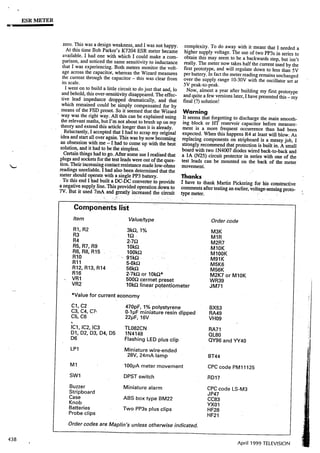
Components list 
Item 
R1, R2 
R3 
R4 
R5, R7, R9 
R6, Rg, Rls 
R10 
R l 1 
R12, R13, R14 
R16 
VR1 
VR2 
*Value for current,economy 
C1,C 2 47OpF,1%p olystyrene 
C3, C4, C7i 0.1!F miniitur'e ri;sin dipped 
c5, c6 22iF,16V 
[c1,l c2,l ca 
D1,D2D, 3,D 4,D 5 
D6 
LP1 
M1 
SW1 
Buzzer 
Stripboard 
Case 
Knob 
Batteries 
Probe clips 
Value/type 
3kQ,1yo 
1Q 
2.70 
1oka 
100kf) 
- 91kO 
5.6kfi 
56kO 
2.7K1or 10kfl* 
500Q cermet preset 
10 kCtl inearp otentiometer 
TL082CN , 
1N4148 
FlashingL EDp lusc lip 
Miniature wire-ended 
28Y,24mAlamp 
100pA meter movement 
DPST switch 
Miniaturea larm 
ABS box type BM22 
Two PP3s plus clips 
Order code 
M3K 
M1R 
M2R7 
MlOK 
MlOOK 
M91K 
M5K6 
M56K 
M2K7 or M10K 
WR39 
JM71 
BX53 
RA49 
VH09 
RA71 
oL80 
OY96 and W40 
BT44 
CPC code PM11125 
RD17 
CPC code LS-M3 
JP47 
cc83 
YXOl 
HF28 
HF21 
Order codes are Maplin,s unless otherwise indicated. 
438 
April 1999 TELEVTSTON
OHMS 
-.oix7 5 4 3 
compa re 
ESR at lOO kHz
The equivolent series resistqnce (ESRI of qn electrolytic 
copocifor is o relicrble indicqtion of its condifion. 
Alon Willcox's firsr ESR mefer".detign, published in these 
pqges some five yeors a9o, wqs very populor. This Mork 2 
version incorporoles severql improvements, in porficulor q 
simpler oscillotor design ond single-botfery operotion 
simplified equivalent circuit 
of an electrolytic capacitoq 
see Fig. l, is usually shown 
when providing a briefexplanation 
of what ESR is all about. In addi-tion 
to the ideal capacitor Xc, a 
secondc omponenti s present.I t has 
a significant effect on the capaci-tor's 
performance, and is referred 
to as the equivalent series resist-ance 
(ESR). Electrolytic capacitors 
are used mainly for decoupling and, 
to a lesser extent, for signal cou-pling. 
This being so it's important 
that, for optimum performancet,h e 
impedance( AC resistance)o f the 
capacitoris as low as possible. 
An electrolytic capacitor's ESR 
is mainly determined by the condi-tion 
of the electrolyte (paste) that 
separatesit s foils. The electrolyte 
increasetsh ec omponent'sc apaci- 
Fig. 1: Simplified equivalent circuit 
of an electrolytic capacitor. Xc 
represents an ideal capacitor. lts 
reactance moves towards zero 
ohms as the frequency increases. 
Xc = l/(Zt fcl. The value of the 
equivalent series resistance ESR is 
determined mainly by the condition 
of the electrolyte. 
tanceb ut, when it deterioratesi,t 
increasesth e impedancep resent. 
The lower the ESR, the better the 
capacitor! 
Electrolytic capacitors used in 
switch-mode (chopper) power sup-plies 
and those mounted close to 
heatsinks tend to run hot. Heat is 
inclined to dry out the electrolyte 
and, in time, a capacitor may devel-op 
a high ESR. This will itself 
introduce a power loss - and more 
heat! The effect offailure ofthis 
type in a power supply can be cata-strophic. 
For example, if the capac-itor 
is in the HT monitoring section 
of a TV set's power supply the HT 
voltage might rise, damaging the 
line output transistor and maybe the 
field output IC. 
This type of problem is more 
significant when a set is started up 
from cold, as the condition of a 
faulty electrolytic capacitor is 
worse when cold. Thus cold checks 
are by far the best approach to test-ing! 
Problemsw ith electrolytic 
capacitorsp, articularlyt hoseu sed 
in switch-modep owers uppliesa, re 
caused not so much by a change of 
capacitancvea luea sb y an increase 
in thec omponent'EsS R.T hus 
removalo f a suspecct apacitort o 
checki t with a conventionacl apac-itance 
meter is largely a waste of 
time-F urthermorea faulty capaci-tor 
may be overlookedb ecauseit s 
capacitancvea lueh ash ardly 
changedA. n ESR meterg ets 
around this problem by using a test 
frequency( or pulser ate)t hat'sh igh 
enoughf or thec apacitivere actance 
to be almost zero ohms, leaving 
just the ESR as the measurement. 
Meosuring ESR 
ESR obviously cannot be measured 
directly,u singa conventionaol hm-meter, 
so a means has to be found 
to 'get to'the ESR that's hidden 
insidet he capacitorA. numbero f 
ready-madem eterd esignsa ndk its 
aren ow availablef or measuringth e 
ESRo f an electrolyticc apacitorin - 
circuit,u singc old checksT. hey 
achieves uccessa nds implicityi n 
varyingd egreesU. seo f a suitable 
meter enables cold checks to be 
made without the risk of any fur-therd 
amageo ccurring.S trictly 
speakingit is the impedanceth at's 
beingm easuredb ut,o ver a particu-lar 
rangeo flest parametersi,t can 
be shown that this presentsm ore or 
Iess the same value. 
It is all too easy to over-compli-cate 
things when it comes to ESR. 
There are those who argue that 
ESRm etersd on't measureth e ESR 
preciselyB. ut, in ther eal world, 
how precise does the reading need 
to be? It really doesn't matter. The 
servicee ngineerjustn eedst o 
know,a s quickly as possiblew, hich 
capacitoris causingt he trouble.A n 
ESR meter does just that! Once 
techniciansh ave becomea ccus-tomed 
to using an ESR meter, they 
wonder how they ever managed 
without one. Although the ESR 
varies somewhat with frequency, 
we cani n practicer egardi t as 
beinga constanitn -phasec ompo-nent, 
a ndc alibrateo ur meteru sing 
fixed resistorsT. his is useful,a st he 
meter will also serve well as a low-ohm 
meter. 
So. if an ESR meter doesn't 
measurec apacitancew, hatr eadings 
can we expect from good and bad 
capacitorsu sings ucha meter? 
How do you know whether a 
capacitoris OK or not?T he curve 
showni n Fig.2 givesa practical 
idea of the sort of ESR readings 
thats houldb e obtainedr vithg ood 
capacitorso f differentv alues. 
Therei s no hard-and-fasrut le horv-ever- 
it's nota n exacts cienceA. ll 
it needsis a bit of gettingu sedt o. 
Thisd oesn't akel ong:j ust meas-ure 
the ESR of a f'ew nerv capacl-tors. 
Try l, 10, 47, t00, 470 and 
1,000pFY. ouw ill find thatv alues 
of 47pFa nda bovem easurqeu ite 
low.0 '5O or less.w ith theb uzzer 
comingo n (theb uzzetru rn-on 
pointc anb e varieds, eel ater)T. he 
7 6 December2 004T ELEVISION
impo.rtanpt oint is just how low ES8(o) 
capacito-iws ith valueso f 47u F and 
abovem easurie A t 47018 and ovr., 
the reading is close to zero'ohms. 
If, in practice, a 1,0004F capacitor 
producesa readinga s high as O.SSI, 
rt's no good! i: 
Anqtd$i,i'ditiin"l , 
d t s P l g ) B . r i , . - . . , 
Digital..methodbsf measurement 
and lisiildy are'generally regarded 
as pro,vldrng& ore accurater esults. 
F9r mpny applicationsr his is true. 
but itjs nqr:,45pessarilsyo wi*r gSn 
measureineriflTheriere two wavs 
of interfacingt he,capacitobr einl 
tested' eiffi the m6tir:ftre capaciicir 
can be connectedin parallel-with 
the test sign4l.g"ourqaes, showni n 
Fis.3 (a);Wiii"i;?:iti#6'bri',e . irbi.' 
_ If a digital ESR readout i; ii;ad. 
the capacitor must shunt the test 
signal.,Witha n deal,capabito4th e 
resultrwill be:z0ro,ohmsa;n d .z&te.,:.t : 
display:.-witha .b adcapacitort here 
will be d hieh rcading;with linle 
s_h_untlnagw ay of. the test-signal. 
We are interbsted in ESR viues of 
3Q or less,rbuat digital meter 
gives readings far higher than this. 
It's not a major problem, but can 
grve nse'to superfluous information 
aSf ar aSE SRtmeasUrementasr e r_j 
concemed; A inore. important factor 
is ftat the:bqraltdmetnoa results in 
a signifiidrftlniiease in,tne read::^ : 
ings obaiiied&ecauiff 'of,ejri:i:Ssive 
i 
sensitifi.df0lttiri[dluctiriie,ofithe,,l 
$! le3+,frf is".ii,ii'b e.overcomtye 
- 
fi tting.twollehds.tor6actlprobe:;It 
provides.cancellation"toi,laige - . 
extent,;but:thissolution.ias U'it .. , 
rmsyi n.r'sea nd'to conshuct.T he ""cries method ofiinterfacing does ,;., 
not sufferrfrom,this.ilrawback; so 
the use of;conventional test leads , 
becomesa' cceptablelll don't know 
yhy thi sef fec toc cur s - I jus:t,. 
found out the hard way. . . 
Although we have 6ecome used 
to_digital readouts nowadays, for 
ESR measurementth ere is-little 
doubt that a moving-coil meter is 
the.bestt ype of display.I t gives a 
raplo, ei$y-to-rnterpreitn dication 
of the condition of the capacitor. 
After somee xperienceo f using it, 
oxe gets to know where the pointer 
should approximately be with good 
capacitorso f different values. 
Indeed a meter scale becomes 
almostu nnecessaryI .k now of 
people who have used this type of 
meter quite satisfactorily without 
I t F * 
,Qgq$anr; 
gl9se 
qf9:3lgt.' 
Rsample. Value 
cfiosen for 
optimum 
meter scale 
ever having taken the trbuble to fit 
a scale dedicated to ESR measure-ment. 
To repeat: it's not an exact sci-ence 
but, with some experience, 
Layoui o( Non willcox's Ma* 2 ESRm eF,ro n stripboard. n" n4z incorporates severol.improyementsin, cludinga simpler" "riil.i";-i;;b" i,ii;igb_bottery operalion.
ptb 
?d anp 
Fig' 4: The basic ESR meter circuiL new version. lcl and IC2 require positive and -negative supplies at pins g Further circuitry is required, and 4 respeaiiely. see nert month, to generate tne sim-riit iujpfu and provide a buzzer comparator. 
one soon gets to knoy whfglr- - lly capacitancew ill providen egli_ , capacitori s causingth e qo.ubleb y .- gible opposition ficjto it. 
knowing roughly where the ESR'': :t '- 
meter's pointer should be with a Waveform: Analysis of a square_ 
good one. one argument that's wave has been used, and l'vL triea 
sometimes put forward against the ,this myself. The results are a bit 
use of a moving-coil movementi s unpredictableh owever.I had a lot 
that the movement will be dam- ofiroubre trying to preserve the 
aged should the meter fall off the waveform intaci at the mv level to 
bench. I have a solution to this give a useful, predictable indica-problem. 
If you are inclined to be tion. It's not *:orth the effort. A 
glumsy,a ttacha piece_ofs tring sinewavei s so easyt o generatea nd 
between the merer and the bench, gnplify that I cannot sJe any.lusti 
Iong enough so that the meter ncition for incorporating square_ 
comes to-a halt just before it hits wave analysis into the dEsien of an 
the deck but not so short that you ESR metei. 
' ' dorittgetabitofajolttoservLas'117'l'*"1*. ( . . 
:a'ieminder. , ' - 
An improved ESR. meter 
Thr meter presented here is similar 
to the one described in the 
March/April 1999 issues of 
Television. Since then the use of an 
ESR meter to check quickly for 
faulty capacitors has Lecome well 
establishedT. he original circuit 
works well and has stood the test 
of time, but feedback from the 
hade has prompted me to make 
some improvements. These include 
single-battery operation and 
improved temperature stability. 
The new circuit remains stable 
down to 6.2Y, and consumes about 
l3mA. Because of the improved 
temperature stability of thl new 
oscillator circuit, there is no need 
for an externally-availables et-zero 
control. 
The oscilloior cirrcuit 
An IIF oscillator or pulse generator 
with a stable output over a reason-able 
supply voltage range is the 
heart of every ESR meter. ICla in 
the new circuit, see Fig. 4, is the 
sinewave oscillator in this design. 
The simplestw ay of generatinga-sinewave. 
ist o incorporatei n the 
oscillator's positive-feedbackp ath 
a network originated by Max Wien 
in 1891.I t ensurest hat the feed-back 
is an in-phase component at 
only one frequency, which is fixed 
by the rRC values used. At very 
high frequenciesC 2 presentsi low-impedance 
path, while at lower fre-quencies 
Cl becomes an effective 
open-circuit. At some point in 
between there will be maximum 
output from the network Cl, Rl, 
C2,R2, which is refened to as a 
Wien bridge. The RC values used 
here'result in oscillation at about 
lfi)kHz. 
There are two simple methods 
of stabilising the output level with 
an op-amp Wien-bridge oscillator. 
The method traditionally used is to 
include a bulb in the nelative-feedback 
path (between-pins I and 
2here). This was the approach 
used in my 1999 design. There 
has been some misunderstandine 
about the bulb, because of ttre Oif-ferent 
specifications used in US 
literature. I went into the maner 
in some detail in the 1999 articles. 
The corrects pecificationis 
28Y,24mA. 
The principle behind the use of 
a tungstenb ulb is that its resist-ance 
increases with the current 
that flows through it. If a bulb's 
resistanceis measuredt,h e small 
current from the ohmmeter will 
increaseit s resistanceW, hen 
employed correctly in this applica-tion 
the bulb does not come anv-wheren 
eari ncandescenceI .d ecid-ed 
to use the lamp then because of 
its elegant simplicity and extreme- 
Iy low distortion figure (0.0025Vo). 
With the new design I wanted to 
reduce the operating voltage of the 
l.)ecemhcr 
,)OO4 
TFI F/lqlr.)l 
TesFsignol porumeteru 
Amplitude: To test for ESR or for 
actual capacitance there are no con-. 
straints on how low the test sisnal 
can be as far as the capaciior ii 
concernedT. aking into account 
power consumption, and the prob-lems 
associatedw ith lowJevel sig-nals 
of the order of microvolts, 
noisec onsiderationse tc., a level of 
about 5mV peak+o-peak seems to 
be a good compromise. 
Frequency: The time period 
should be short enough to zero out 
the capacitiver eactance.1 00kHzi s 
a popular choice. At about this fre-quency 
the ESR and impedance 
converge with the type of capaci-tors 
in which we are interested. 
Apart from that consideration, 
lOOkHz is about the top frequency 
at which a predictable gain of up to 
ten times can be obtained with 
readily-availablel,o w-cost opera-tional- 
amplifier ICs. 
Remember that if the rate-of-change 
of the voltage is fast enough, 
7B
whole mcter so that a single PP3 
battery could be used as the porvcr 
source while still achieving very 
lorv po"vcr consumption. The 
problem '"vith the use of a bulb is 
that in thesec ondi t ionst he bulb's 
temperaturei s not sufficiently far 
away from the ambient tempera-ture 
to ensufe good stability. so 
this time I decided to use the 
brute-force method of diode stabil-isation 
(Dl, D2). 
The idea here is that when the 
output from the oscillator rises 
above the conduction point of the 
diodes the negative feedback 
increasest,h e output settling at an 
amplitude which depends on the 
characteristicso f the diodes.I n 
this case the net result is a 
sinewave source signal across R5 
, with an amplitude of about 6mV 
L peak-to-p"uk. Diod. stabilisation 
introduces greater distortion, but 
this is not important here. To 
maintain oscillation, the value of 
R3 must be over trvice that of R4. 
A preset resistor, adjusted to just 
sustain oscillation (lorvest distor-tion), 
is usually used in the R3 
position. I decided to use a fixed 
value that's a ferv ohms on the 
high side, to ensure reliable oscil-lat 
ionr egardlesosf distor t ion. 
Interfoce with rhe copocitor 
being tesfed 
The interface with the capacitor 
being tested is the crucial part of 
the meter. It took me a long time to 
get this right. See Fig. -5. The wave-form 
across R5 (the source resistor) 
is not an ideal, constant-voltage 
source,b ecauseo f the needt o 
'--,.nclude the sample resistor (R6), 
rvhose value must be comparable to 
the ESR values in rvhich we are 
interestedT. he ESR of the capaci-tor 
being tested forms part of a 
potential divider rvith R6. Thus if, 
for exanrple.a good 1,0007rF 
capaci torrv i tha n ESRo f about 
0' lO is connectedio r test ,R 6 is 
c{ ' fbct ivcl iyn paral lcrl vi thR -5T. his 
Incanst hatt hes upply-signaslo urce 
i  lcs hr ' t 'ausrr'v. l rcrtrr c i lp: rci loiIs 
beingt cstcclt.l lc const i rnt -cur rent 
sourcct o l l5 is shl r rctrlv i t l rt hc 
t:SIl urrd [{6 in p l r a l l c l . 
'['hc 
vol taqcr i ,ur 'cl i r rni lrc vcl 
o p c t la c r o s s1 1 6l t s : rr c s u l to l l h e 
, l r i l , ' i l 1l l t t , ' t t . - llrl r e , l r P i r r ' i t r r t ' 
l r c i r r g{ c s t c t li s l r n r l l l i t i c cul n t l t h c n 
r l c t c c t c cbi y t l r c r c . l o l t l r c c i r c u i t . 
l l t h c t r S I { o l t l r ec r r p a c i t o rb c i r r g 
t e s t e ( li s c q u a l t o t h c v a l u c t r l l { 6 . 
l u r l l ol thc s t r p p l y w a v c l i r r r n r v i l l 
- l ' l r c 
bc passctl orr. 
supply rvavc. 
I r l r rn i s r rot i r r t l cpcnr l c r rot l l l re 
Ioac ll tor v c v c r - .I l thc I :SI t i s l c s s 
than the value of R6, as rn rnost 
cases it is, the lvavefonn voltage 
across R6 increases. 
As the ESR rises above the 
value of R6, the latter becomes 
less effective. The result of all this 
is a non-linear scale, expanded at 
the lolver range and somewhat 
logged out. This is ideal for the 
presenta ppl icat ion,b ecauseI n 
some cases it is important to bc 
able to distinguish benveen a vcry 
low value, close to zero, and onc 
of about 0 -5Q. 
I have achieved low current con-sumption 
and circuit simplicity by 
tusingt he feedbackc urrent and 
comprornisings omervhato n the 
ideal.c onstant-voltageso urce. 
Nexf month 
In thec oncludingi nstalmennt ext 
r r ror r thI ' l l completct hec i rcui t 
description,d eal rvith sonrep racti-cal 
points and protection ntethocls, 
provide a detailedc ontporren ts list 
and a stripboard layor-rt. I 
Internol view 
of the new 
ESR meter. 
fhe test leod 
connections are ol 
the bonom, with 
proteclion diodes 
bet,tveen them. 
6mV p-p under 
0 6V P-P anncr2nr oPen-circuit 
(lCla pin 2) : : ; : : : ' , " condirions 
i Y " " " " ' i / I i t i 
I lR4 1oo() I Esn 
Constant-voltage 
source 
(from osc 
feedback loop) 
Fig.5: The method of test capacitor interface used in this nreter. The source voltage is not a true 
constant voltage because of the need for R6, whose value nrust be cotrtparable to the ESR of the 
capacitors in which we are interested. 
Current economy and circuit simplicity are achieved by using feedback current front the 
'logged' 
oscillator circuit as the source fed to the capacitor under test. The outltttt is inversely 
out in relation to ESR. 
l l l l  ' l  l r r ' ,
This second, concl 
Wittcox's lotest ESR meter, with o suggested stripboqrd loyout ond 
component specificotions 
I n Part I last month I dealt with 
I gSn and its measuremenat,n d 
I describedth e significantf ea-tures 
of my latest ESR meter 
design. I'll start this month with a 
description of the basic circuitry 
used. 
Circuir description 
Fig. 4 (see page 78 last month) 
shows the basic ESR meter circuit. 
The important features of the oscil-lator 
and test interface sections 
were covered last month. There is 
no need for a regulated Power suP-ply. 
Just to remind you, the amPli-tude 
of the HF output waveform 
obtainedf rom the oscillator( ICla) 
is setb y the characteristicws,h ich 
are virtually temperature-stableo,f 
the two diodes Dl and D2 in the 
negative-feedbacPka thb etween 
pins I and2 . The amplificationa nd 
detectionle velsp rovidedb Y the 
others tagesa res etb Y the ratio of 
lhe sourceln d feedbacrke sistor 
valuesu sed.T his is standardo pera-tional- 
amplificprr acticeT. he way 
in whicho pcrationaalm Plifiers 
work rvasc over edi n somed etaili n 
my articlesin theM arch/APril 
1999i ssuess, o only a briefdescrip-tion 
is given here. 
The frequency of the Wien-bridge 
oscillator is approximately 
equal to ll(zfiRq when resistors 
Rl andR 2 andc apacitorsC l and 
C2have equal values. At this fre-quency 
there is no Phase shift 
across the bridge and thus maxi-mum 
positive feedback. At reso-nance, 
the upPer section of the net-work 
(Rl, Cl) has twice the imPed-ance 
of the lower section (R2, C2), 
so there'sa transmissionlo sso f 
1/3.T o sustaino scillation,t he over-all 
gain (ALC) must be greater than 
unitv.T he transmissionlo ss 
through the network is offset by the 
gain determined bY the ratio I + 
(R3/R4). In this circuit the ALC 
would be more than the three times 
requiredw erei t not for diodesD l 
. and D2, which override the effect 
of R3 as mentioneda bove. 
The following two stflgeso f 
amplification( IC2aa nd IClb) are 
straightforward,r vith no needf or 
conectionc ircuitry.C apacitoCr 3 in 
thef eedt o the detectors tage( IC2b) 
is includedto removea nYD C com-oonent 
and also to rctlucc sensitivity 
to low frequencies(m ainsh um or 
whatever). Rl2 sets the gain in the 
detectors tageB. ecauseo fthe high 
intrinsic gain of an operational 
amplifier, the forward voltage droP 
across detector diodes D3 and D4 is 
overcome and detection at even mV 
level is not a problem. 
SpliFroil genetator ond 
buzzer 
That is all there is to the basic cir-cuit. 
But the operationaal mplihers 
require positive and negative sup-plies. 
T his requiremenist provided 
by IC3b, see Fig. 6, which is config-ured 
as a voltage-followerT. herei s 
100 per cent negative feedback (pins 
7-6), so the output voltage must set-tle 
at half the supply voltage, set by 
the equal ratio of Rl4 and Rl5. I 
wasp leasedto find thatt hec ircuit 
remainss tablew ith outputsa sl orv 
as +3'lV. This lower supply voltage 
range is quite consistent. 
IC3a is configureda s a voltage 
comparatoWr. hent heE SRr cading 
is less than 0'5Q, the output from 
thed etectogr oesh ighert hant he 
forrvardv oltaged rop acrossD 8. 
The output at pin I of IC3 thcrcfore 
1 5 8 J r ruar y2 005T i l EVISION
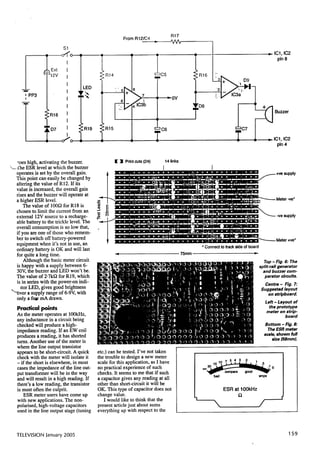
:oes high, activating the buzzer. 
.-fhe ESR level at which the buzzer 
operatesis set by the overall gain. 
This point can'easily be changed by 
altering the value of Rl2. If its 
value is increasedt,h e overall gain 
rises and the buzzer will operate at 
a higher ESR level. 
The value of l00Q for Rl8 is 
chosen to limit the current from an 
external 12V source to a recharge-able 
battery to the trickle level. The 
overall consumption is so low that, 
if you are one of those who remem-ber 
to switch off battery-powered 
equipment when it's not in use, an 
ordinary battery is OK and will last 
for quite a long time. 
Although the basic meter circuit 
is happy with a supply between 6- 
30Y the buzzer and LED won't be. 
The value of 2'7kf,J for R19, which 
is in series with the power-on indi- 
. rtor LED, gives good brightness 
ver a supply range of 6-9V with 
only a feg mA drawn. 
Prqcficol points 
As the meter operates at 100kHz, 
any inductancein a circuit being 
checked will produce a high-impedance 
reading. If an EW coil 
produces a reading, it has shorted 
turns. Another use of the meter is 
where the line output transistor 
appearsto be short-circuit.A quick 
check with the meter will isolate it 
- if the short is elsewhere,in most 
cases the impedance of the line out-put 
transformer will be in the way 
and will result in a high reading. If 
there's a low reading, the transistor 
is most often the culprit. 
ESR meter users have come up 
with new applicationsT. he non-polarised, 
high-voltage capacitors 
used in the line output stage (tuning 
FromRl2lC4 
f I Prlntcuts(24) 
etc.) can be tested. I've not taken 
the trouble to design a new meter 
scale for this application, as I have 
no practicale xperienceo f such 
checks. It seems to me that if such 
a capacitor gives any reading at all 
other than short-circuit it will be 
OK. This type of capacitor does not 
change value. 
I would like to think that the 
present article just about sums 
everything up with resPecto the 
lcl,lcz 
pin I 
l c l , l c 2 
pln 4 
+ve supply 
Meter +ve' 
Top - Fig. 6: The 
split-rail generator 
and buzzer com-parator 
circuits. 
Centre- Fig.7: 
Suggested layout 
on stripboard, 
Left - Layout of 
the prototype 
meter on strip-board 
Bottom - Fig.8: 
The ESB meter 
scale, shown full 
size l58mml. 
'Connecl to track slde of board 
t 5 t ! 2 
o 
ESR at 100kHz 
Cr 
TELEVISIOJNan uar2y0 05 1 5 9
Parts list 
Item 
R l , 2 
R3 
R4 
R5 
R6 
R 7 , 9 , 1 1 , 1 6 , 1 7 
R8, 10 
R12 
R13 
R14, 15 
R18 
R19 
... 
 
Valueftype 
3ka 
220A 
100a 
1A 
2.7A 
10kc2 
100ka 
*68kQ 
3.9kA 
56kO 
*100Q 
*2.7kf2 
CPC order code 
REMFR4fo l lowedb y the value 
Al l0.5W1, %m etal f i lm 
VR1 
c't,2 
c3,4 
c5, 6,7 
1OkQ cermet preset 
470pF low-loss high-stability*r 
0.1 p F cer-amicm ultilayer 
221tF,1 6V 
RE01881 
cA02068 
cAo2098 
cAo1613 
sc1N4't48 
sc1 N4004 
sc1N4002 
scTL802. 
sc00023 
PM11119 
sw-z201lz 
1S00654 
EN55030. 
1N00772. 
PC00046 
PC00066 
8T02187 
PWo0037. 
D1 , 2 , 34, , 9 , 9 
D5,6 
D7 
l c 1 , 2 , 3 
LED 
1N4148 
1 N4004 
1 N4002 
TLO82CN 
3mm Superbright 
M1 
S1 
100pA moving-coil 
Miniature toggle switch 
Buzzer 5V DC 
Case ABS box 
Test leads 2mm plug to probes 
Veroboard 
Spot face cutter for Veroboard 
PP3b atteryc lip lead 
High-currenptr otectionc hoke 
See text 
See text 
See text 
quick in-circuit location of faulty 
electrolyticc apacitors.I f anyone 
contemplatetsh e designo f a PCB 
for the project, it is important that 
separateo perational-amplifei r chips 
are used for the oscillator and the 
first amplifier stage - to avoid 
interferencbee tweent he oscillator 
andt he sensitivefi rst amplifier 
stageF. ig. 7 showsa stripboard 
layout for the meter's circuitry. Fig. 
8 shows the meter scale. 
Don't be temptedt o usep lugs 
ands ocketsfo r the testl eads- you 
wouldi n timeg etp roblemsin the 
low-ohmsr ange.S olderedc onnec-tionss 
houldb c usedt hroughouIt. 
use2 mmt estl eadsw ith thep lugs 
cut off. Make surc that you file the 
probesto gives harpp ointsT. he 
coatingth at'so n then.hra sa signifi-cant 
resistance. 
Thec ases pccificdin thep arts 
list is a bit on thed ccps ide.T o 
achievea slimmera ppearanceI , 
boughta notherc ase,t ypeE N55029 
(too slim), andc ombinedt he 
halvesT. his might sounde xtrava-gant, 
but you still end up with two 
casesa ndt heyc osto nly aboutf 2. 
Protection mefhods 
In a letter in the August issue this 
yearJ im Littler suggestewd iring 
an inductora crossth e testl eadt er-minals 
to protect the meter should 
it be connectedto a chargedc apaci-tor. 
I can see no problem with this, 
andf ollowedu p with a letteri n the 
Scptembeisr sueI.f a values ome-rvhat 
lower than the l5(i7rH rccom-rnendedth 
erei s used,p roducinga 
readingo f say3 0Q,t hisr cading 
rvill bep resenet acht irre then teter 
is srvi tcheodn andy ou rvi l lk now 
thlt it is workingc orrectlyI.t will 
not al'fectt he useo f thc ntcter.W e 
l r reo nlyi nteresteind vulucsth at 
are much lower. 
If this methodo f protectionis 
used with a digital meter, the dis-play 
will settle at a fixed reading. 
This will show that all is well with 
the meter and will also eliminate 
superfluourse adingsI.n the caseo f 
a moving-coild isplay,it will dou-ble- 
upa s a power-oni ndicator. 
The useo f a circuitp rotectori n 
series with the test leads has been 
suggestedT.h e problemi s that it 
would tend to blow too easily and 
requiref requentr eplacement. 
To reitcrated, iodep rotection 
(D5, D6) shoulda lwaysb e incluclcd. 
Any contmentasb outh igh-cLrr-rentc 
hokep rotectionw, hichs eenrs 
to be a r"rniqri.dree a,a ndo n ESR 
measurcntcirn)t g enerawl ouldb e 
welconrc. 
You can reach me by email at 
alancsr(hlro trnal.ic om 
I thinkt hatc overse verythinqt . 
r 6 0 J ,uruar2y0 05T ELEVISION
Table 1: T.yRicaEl SRv alues at,1Q0(Hz.r. ,", 
... t 
Capacilaicb vatie Voltage rating tmpedih'ce* 
: 
lttF 
2-21tF 
4.71tF' ' 
. 
10ttF , 
221tF 
471tF 
471tF 
100pF 
100pF 
2201tF 
22O1tF 
47OpY 
. a7O1tF 
1,000pF 
1,000pF 
2,2001tF 
2,2O0pF : . 
50v 
50v 
50v 
' 5603Vv 
25V' 
50v 
16V 
35V. 
16V 
35V 
16V 
35V 
16V 
25V 
25V', 
35V 
4rl 
2.8cr 
2.4A 
1.gfi 
1.3cl 
1.3fi 
0.7ct 
0.5c) 
0.2scr 
0.25cl 
0.1 14cl 
0.1 14ct 
0.065cl 
0.06sfi 
0.041rt 
0.036rl 
0.034cl 
*When new - low-ESR tYPe.
Anologupeo neml eters I 
t - . # 
I o n o e r s 
s t * i l r e r i c . 
FAnuetc zz 9 8 2 7 8 
?*,rrlrrrrlrtrurrllttrr t l r, o 
r ' r r ' 4 
^ 1 t , t t l ' l ' l ' l r r r 7 , , 
a 
a 
a 
a 
a 
Attrocfive md modern dextign 
Clxfce of printed scdes 
4 popdqr sizes 
"Eosy-frf'scdes 
Chss eO 
A moderna nd attractiver angeo f qualityd c moMngc oil metersa vailblea t 
veryc ompetitlvep rices. 
Therea re4 populasr izesw hichc an be eithers urface or flushm ounted 
behindt he panel througha rectangulacru tout.T he metersu tilisea well 
proven and robust, 90 degree deflection, pivot and jewel moving coil 
movemenl. 
Meters are suppliedi n sensitivitieso f 100 microamps,1 00-0-100 
microamps(c entrez ero),1 milliampso r as 4-20 milliamps( supressed 
zero)f or signapl rocessin dication. 
Pre-printesdc alesa rea vailablsee peratelgyr aduateda ndn umbered0 -10, 
0-30,0 -100a nd1 00-0-100. 
{ _ f i + 
Fixing studs on all meters (Dimension G)are M3 x 12mm 
Dimensions in mm 
M o dA eB l c D E F H I J W S c a | e 
Length 
CV-15X 57 48 43 24 40 35 1.5 14.5 28.5 50x23.5 40 
CV-16X 68 58 45 31.5 48 48 1.5 14.5 28.5 61.5x28 50 
cv-18x 80 67 50 38.5 64 48 5 14.5 28.5 72 x35 63 
CV-20X 100 83 50 51.5 80 64 1.5 14.5 28.5 92x45 78.5 
Crder Code Size Range Rec. Price €: 
1+ 5+ 10+ 25+ 50+ 
METERS 
3V15X1MA CV-15X 0-1mA 
:V15X100UA CV-15X 0-100F4 
:Vl5XGZ100UA CV-15X 100-0-100!A 
3Vi5XSZ20MA CV-15X 1004-1004 
3V'OXIMA CV-16X 0-1mA 
3Vi6X100UA CV-16X 0-100ttA 
3V16XCZ100UA CV-16X 1004-100A4 
M6XSZ20MA CV-16X 4-2OmA 
;V18X1MA CV-18X 0-1mA 
3V18X100UA CV-18X 0-100rA 
;Vl8XCZ100UA CV-18X 100-0-100FA 
3V18XSZ20MA CV-18X 4-20mA 
3V20X1MA CV-20X 0-1mA 
CV20X100UA CV-20X 0-100!A 
3V20XCZ100UA CV-20X 1004-100pA 
3V20XSZ20MA CV-20X 4-20mA 
METER SCALES 
S/CVISXB CV-15X Blank 
s/cv15x10 cv-15x 0-10 
s/cv15x30 cv-15x 0-30 
s/cvr5x100 cv- 5X 0-100 
s/cv15xczt00 cv 5X 100-0-100 
9/CV16XB CV 6X 
s/cv16x10 cv 6X Blank 
s/cv16x30 CV 6X 0-30 
s/cv16x100 cv 6X 0-100 
s/cvl6xczl00 cv 6X 100-0-100 
s/cv18xB cv- 8X Blank 
s/cvl8x10 CV 8X 0-10 
s/cv18x30 cv- 8X 0-30 
s/cv18x100 cv- 8X 0-100 
s/cvl8xcz100 cv 8X 100-0-100 
S/CV20XB CV-20X Blank 
s/cv20x10 cv-20x 0{0 
s/cv20x30 cv-20x 0-30 
s/cv20x100 cv-20x 0-100 
s/cv20xcz100 cv-20x 100-0-100 
AVA1ASIE FRort NATKta,lA!O lglRlBUtORs OR DIRECTF aOl ANO*S SUEJECTrO A mOQ OF 25 PC$ ANALOGUECVl Revision4 03/06/04 
Onders electronicpsl c BayhamP laceL, ondonN Wl OEU UK 
Tel: +44 (0)20 7380 8167 Fax: +44 (0)207874 1908 wwwmeters.anders.co.uk
SD80/0-100UAI M ULTICOMP I PanelM etersI ElectricaIl Farnell 
Page I of I 
2OO7/0 8/08 
SDSOIO- IOOU-A MULTTCOM-P METER8, 1X81MMO - IOOUA 
4S 60 
Manufacturer: MULTICOMP 
Order Code: 4433932 
Manufacturer Part No: SD80/0- 
lOOUA 
Rol15 : 
Description 
, A v a i l a b i l i t y 
Availability: 1 
Price For: 1 
Minimum Order Quantity: 1 
Order Multiple : 1 
U*it ?rice: 99"5$ 
Image is for illustrative purposes 
only. 
Please refer to product description 
Technical Specifications 
r*l Product Rang;e 
Catalogue Page: 
58s / UK2 
ffirech::ical Oata $heet {i.95 kBi 
Product Attributes 
Weight (kg): 0.12 
Approximate weight in primary packaging 
Tariff No.: 90303399 
Country of Origin: TW Taiwan 
Country in which last significant manufacturing process was carried out 
a 
a 
a 
a 
a 
a 
METER8, 1XB1MMO - lOOUA 
Depth,e xterna:l 3 6.5mm 
Diameter, panel cut-out: 
63.5mm 
Length / Height, 
external:81mm 
Meter Movement 
FSD:100pA 
Pitch:34mm 
Resistan ce, coil: 15 00R 
Width, external:81mm 
_ _Qtv .._ . -^:": 
O r i r e 
: 
i L - 4 
. t - n 
. L O - 2 4 
: 2 5 - 4 9 
List Price 
€9.5B 
f 9.38 
89.t9 
€8.96 
E7.37 
fi0ierL*qc 
p:i,/acy $l:atcme nt I Site rflep j Te rrrs cf Prrchase I Te rmS lf Acce r : 
Cc;:iTrlght ii-; 2307 l:rer*:er Ferne il UK Llmite d ALL R:Gli15 
Copy! - rghti n t i l r whoie ar rd every par t of l | i is !1i r t isi le* el rn;s ic Prer : ier ?anet l i )4.L arni f . : l 
i i cen$edt, r ans fer i -edc,o piei o. rep: 'oduleciin whole oT in 3a! - li n al y manner or : ' : t t : l ' : ; i r ' ; 
acccrcancey , , l tht he terms of i re O'^ner 's agreer :ef l | , wi tno, , r tl n* pr t i ) t wr t ' 
Fainell is a d:vision of pren'r;er f*rnell UK Limited. Regist*:'*d in fnciard and Waies fi.: C{.}8( 
Lecd:, i..gl: 2QQ. 
Prcd ucer R cg lstration l'l u *r be r : '! f.f. I AK t), 4117. 
http://uk.farnell.com/jsplElectricaliPanel+MeteTsAvIULTICOMP/SD80/0-100UA/dis0p8..1. 08/2007

Esr capacitor-meter-project

  • 1.
    lot has appearedinrecent issueso n the subject of the ESR (equivalent series resistance) of an electrolytic capacitor. The Capacitor Wizard was reviewed by Martin Pickering in June 1998. It's designed to measure a capacitor's ESR in-circuit while ' ignoring any components that are connected to it. The. unit described'in this. artible performs the same task, .. and a lot of work has been put into achieving the end ' result. Even if you don't get around to building the meter, this article will give you insight into the design criteria and the way in which the instrument works. But build it if you can: it's effective, very useful and inex-pensive. ESR : . , ' ' In view of Martin's review and also the articles by Ray Porter on a capacitor's ESR (January and April 1993) I won't say a lot about ESR here: it would simply be rep-etition. To put it in a nutshell, a capacitor's measured ESR (in ohms) is an indicationo f its 'goodness'.T he Iower the ohms reading, the better the capacitor. An ESR check can give an early indication ofcapacitor fail-ure, and is far more useful than a capacitancem easure-ment. Indeed many faulty electrolytics show OK when checkedw ith a conventionalc apacitancem eter. In recent months I've talked to many people who don't appreciatet he importanceo f ESR and in what senseit differsf rom capacitanceS.o I feel it worthwhile including an extract from a technical bulletin on the CapacitorW izard writtenb y Doug Jones,t he President of IndependencEe lectronicsI nc. It sumsu p the ques-tion of ESR well. "ESR is the dynamicp urer esistanceo f a capacitort o an AC signal.H igh ESRc anc auset ime-constanpt rob-lems, c apacitorh eatingc, ircuit loading,t otal failuree tc. A switch-modep owers upplym ay not startr eliably- or start at all. Slight hum bars appear in the video of a The subiecl of qn elecfrolytic copocitor's ESR hos generqted <r lot of interesf in recent issues. Alon Witlcox hos tqken it o stoge further in designing o procticol ESR meler. This firsf porf deols wirh the operotion of fhe circuitry used in fhe meter . Design.' ,uohf ''EM$ 6tBr VCR ot monitor. A TV display may be pulled in from the sideVtop/bottom. Diode and transistor failure can occur over a period of time. These and many other problems are often caused by capacitors , with normal capacit'nce but high ESR, which does not exist as a static quantity and therefore cannot be measured using a conventional capacitance meter or a:DC ohmmeter. ESR exists onlv when alter-nating current is applied to a cdpacitorbr when a capac-itor's dielebtric charge is changing state. It can be con-sidereda s the total in-phaseA C resistanceo fa capaci-tor, and includest he DC resistanceo f the leads,t he DC resistanceo fthe connCctiont o the dielectric,t he capac-itor plate resistancea nd the in-phaseA C resistanc-oef the dielectric'material at a panitular frequency (my italics) and temperature. ,' , ' r The componentc ombinationt hat constitutesE SR can be thought ofds a resistor in series with a capacitor: the resistor does not exist as a physical entity, so a direct measuremenatc rosst he,'ESRr esistor,i s not possible. If, however, a method of correcting for the elfects of capacitive reactance is provided, aid considering that all resistancesa re in phase,t he ESR can be calculated and measured using the basic electronics formula E = I x R! This is the basis of the design of the Capacitor Wizard." Design Criterio Capacitorm anufacturerqsu oteE SRv aluesm easureda t l00kHz. So this is the test frequency I chose. The impedanceo f inductorsi n the microhenriesre gionc an be measureda t this frequency,e nabljngt he c-ondition of video heads to be gauged --as they w6ar and the gap deterioratest,h eir inductancefa lls. The Wizard has a buzzer that sounds when the ESR is below lCl or so. A capacitor with an ESR of less than about lC) is generallyc onsideredto be good, so r'ii r 1 6 March 1999 TELEVISION
  • 2.
    - " =; ; - ; r ; 9 , ; : , . : . , i : ; r i l : I r. ;; ,. .::,1 it . j . ,. . :..:..: this is a very useful feature in situations where you waht to cheik a number of suspect components,. it means that you need refer to the meter ohly when there's no beep. I've incorporated this facility, b'ut you' must bear in mind that a lot of the capacitors in which we'ire interested have ESR values of less than 0.5C) when good. More on this later. I'd like to stress this basic point before going any fur-then as with the Capacitor Wizard, the meter described in this article doein't measure a capacitor's micro-farads. It simply lets you know if the capacitor is or isn't up to the job. After gaining some practical experi-ence with the meter, you will soon get to know"what reading to expect from a good capacitor - taking into accounti ts capacitancea nd voltage rating. But in'any case the reading obtained with a faulty capacitor usual-lf lea1e1 little doubt as to its condition. The Op-Amp The circuit'uses the basic opamp as an oscillator, amplifier;' dslsctor, voltage-follower and .'comparator. So'it's appropriateto devotes omes pacet o a description' of the op-amp and its associated circuitry. Incidentally the term'opcrational amplifier' relates to its use in ana-logue computers and appeared in a paper by Ragaziuini and others in 1947.T he first general-purposeo p-amp, with.differential inputs and using the familiar triangular symbol 'for circuit rcprcsentation, was :introduced;in. 1952 r 6Model K2-W, by'.George A. ' Philbrook Re.searcheIsn c.). It's sobering to think that almost forty years ago an early op-amp, the P2, cost $227 - an eighth' of the cost of a VW Beetle at that time: now a superior device can tie bought for less than a pound. The op-amp is a high-gain (x100,000 or so) amplifi-er that usually has two 'inputs, on-e non-inverting Qabelled +) and the other inverting (labelled !). For practical'purposes.the gain.rcan be considered as infinitely high, with no cuirent flow at the inputs. The opamp'isr,designed primarily to' operate stably'with hcarlr- nefative. feedback' In 'fact from 'the' hisfelisal:; poiriio"f:vlcw:de opamp andithe concept of negative' feddb4k(the, invention :of fi,S.'r Blach-'workingrforr' Bell_'[5t*iratories, in 1927) are synon5rmousB. lack' wa5''w6ikihg'on telephones,t' is bu;ective biing to:. achieve'stable gain independent of the characteristics': of a valve (a thennionically-activated FET to youpg-sterSl). When he tried to patent his negative-feedback amplifier in 1928-the idea:was ridiculed. Over the years however this concept has become one of the most important in the field of electronics. Marconi had much the same problem. It seems that people often dis-miss things they don't understand. ' 'Anyway, I digress. To get back to the point, the op-amp usually:requiresa positivea nd a negatives upply with respectt o a common earth. These.suppliesa re often noi shown on circuit diagrams, being taken for granted. Thq common earth (0V line) serves as a refer-eirce point for the voltages that are present in the cir-cuit and as a'return path to the power supply for any currents generated by the device's operation. The main point here is that if the voltage at the + input increasesw ith respectt o the voltage at the - input, the output voltage will be positive-going.C o,nverselyif the voliage at the + input decreasews ith respectt o the volt-hge at the 1 input the output voltage will be negative-going. T hus in normal practicet he outputc orrespondsto the difference between the inputs. If the op-amp doesn't have any negative feedback and the + input is at only 0'lmV above the - input, the output voltage will be close to that of the positive sup-ply rail. If the + input is lower than the - input by the same amount, the output voltage will be close to that of the negitive supply rail. Thus the gain is equal to the average slope, which is typically l0V/0'1mV = 100,Q00.T his very sensitive property is used in com-parat< ir circuits (it's'used in the ESR meter's buzzei circuit). But the op-amp is far more useful when.the output is restricted to narrower limits. The Precision Inverting Amplifier This is one cif the'riiost common opimpapplications and is used in the second and third stages of the meter. Circuit operation will hopefully be made clear by the rather unusudl representation (due to Tom Hornack) shown in Fig. l. At (a) the op-amp is arranged to provide a voltage gain of two. The fact that in this case the output is inverted (the gain'is.minus two) is not important. The heavy negative.feedback,viaresistoRr f forces the out-put to be such that the voltage at the - input is equal to that at the + input rjvhich is'oV. Remember that the op- ::a mp respondst'd the"d ifrerenceb etween its' inputs. As ;,point X is at earth'potential, there is "lV across Rin' ',O(lkh0m) 's .and,ther,cirrrdnt flow via Rin, calculated by Law;.iS lmA. jTherc is no current flow at the input of the op-amii So this lmA flows via Rf (2k0) whiih thus has 2V'across it. Notice how Rf and Rin behave like a seesaw as the input goes from a positive to a negative value, with the piVot at the null point X. This point is referred to as a virtual earth. There is no current path between point X and earth, and point X is always at zero voltage with respect to earth. The concept of a virtual earth is used as a short-cut (ol {bt DSUd Fig. 1: Precision inverting op-amp circuit, ia) witn a positive input, (b) with a negative input. Note how Rf and Rin behave like a seesaw as the input goes from positive to negative, with the pivot at the null (virtual earthl point X. The gain of the stage is RflRin, so the output is Vin x Rfl&in. TELEVISIONM arch 1999 317
  • 3.
    ESR METER Fig.2:Jim Williams'original circuit, the firct attempt at combining an op-amp with a Wien bridge network to form an oscillator. 656t1 Fig. 3: An op-amp Wien bridge oscillator arrange-ment with the output set at 6V p-p (positive peak shownl. At the resonant frequency points a, b and c are in phase and the waveforms at the op-amp's inpuF are a third of that at its outpttt. The ratio BflRin = 2. when the operation of a current-to-voltage converter is analysed. From Fig. I you can see that, because of the virtual earth, Rf appears to be in parallel with RL. So the voltage across Rf appears across the load as the output voltage. But although the null point is cortsid-ered to be at earth potential, at a microvolt level it's very much active. It can be seen from Fig. I that the stage gain, within the limitations of trhe supply, is determined by the ratio of Rf to Rin. Incidentally there's a frequency limit on the gain: with common types of op-amp we are limited to a gain of about x10 at 100kHz. If the resistors in Fig. I are transposed the stage gain will be 0.5 - the circuit acts as an attenuator. Overview Before we go further, it would be as well to provide a quick introductiont o the meter circuit presentedh ere (see Fig. 5). The first stage consists ofa l00kHz oscil-lator, whose output is fed to the capacitor being test-ed. Put simply, the current flow through the capacitor is sensed then amplified as a voltage. It's finally detecteda nd measuredb y the meterm ovement. The better the capacitor, the lower its ESR and the higher the meter indication. It's not quite this simple, becauset he meter must ignore the other components connectedto the capacitorb eing tested.W e'll come to the solution to this problem later. The Oscillqtor - History At the heart of the meter there's a Wien bridge net-work oscillator. This form of oscillator has an inter-esting history which is worth a few paragraphs. In 1939 William Redington Hewlett (co-founder of Hewlett-Packardp) roducedh is Stanfordt hesisA New TypeR esistanceC apacityO scillator.It madeu seo f a resonantR C networkt hat had beenc onceivedb y Max Wien (pronounced Vene) in 1891. The American inventor Lee DeForest (yes, we can blame him) had-n't started the ball rolling yet with the creation, in I 906, of the triode valve. So there had in I 89 I been no means of obtaining electronic amplification and Max couldn't have got his network to oscillate. That wouldn't hav'e troubled him, as he was using the net-work for AC bridge measurementA. mazing what peo-ple got up to over 100 years ago, isn't it? I think it was, once again, something to do with telephones. But Hewlett had the pentode valve at his disposal. He also had Harold S. Black's pioneering work on negative feedback to assist him. In addition there was Nyquist's Regenerative;Theory, which described the conditions necessary for. oscillation. Hewlett showed that the Wien network could be made to oscillater A crucial problem had to be resolved however, that of stage glin. With a gain of less than unity there would be no oscillation. With a gain of greater than unity there would be distortion. With unity gain there,will be what Hewlett wanted, a ,'wsianse wave. He had a flash'of inspiration; the solution literally staring him in the fate - the electric light bulb. : Hewlett's oscillator.was a two-valve affair, with a 6J7 as the oscillator and a 6F6 as the output stage. His solution for gain stability was to wire a tungsten bulb between the cathode of the 6J7 and earth. The nega-tive feedback was applied between the anode of the output valve back to the cathode of the triode oscilla-tor valve. If the output increases for any reason, so does the current flowing through the bulb. As it warrns up, its resistancei ncreasesS. o doest he level of negative feedback, thereby stabilising the oscillator's output. Hewlett's idea of employing a light bulb was brilliant in its simplicity. It survived in the Hp200 series audio oscillator during a fifty-year production run - into the mid Eighties. About fifty years after Hewlett built his oscillator Jim Williams, who was working for Linear Technology Corporation, was sitting in his den one rainy Sunday trying to think of something to do. His old HP200 caught his eye. Peering into the back, he saw the light bulb where it had been placed half a cen-tury ago, and wondered how Hewlett's oscillator would perform using a modern op-amp. He went on to knock one up - the original circuit is shown in Fig. 2 - and was pleased to find that it had a distortion fig-ure of only 0.0025 pei cent. Perhaps he could improve on it, by eliminating the bulb? Jim was the first to use a JFET in place of the bulb, but with this device the distortion figure rose to a massive 0.15 per cent. Unfortunately there's not space to explain why the use of a JFET gives such inferior results compared to a bulb. In the event Jim discarded the JFET in favour of an optically-driven CdS photocell. This, in conjunction with five op-amps etc., produceda n analyser-limitedd istortionf igure of 0'0003 per cent (three parts per million). At one point during his quest Jim writes (Analogue Circuit Design, Butterworth-Heinemann) "I could almost hear Hewlett's little light bulb, which worked so well, # i. ":!lt ''{ +if ,i$ ,.* *; # ;ffi 3 1 8 March 1999 TELEVISION
  • 4.
    'i{ii;r-." : :; laughinga t me". So no apologiesf or the useo f a light bulb'in this design- Operotion of the Oscillofor Fig. 3 shows the Wien,bridge netwoik oscillator as you probably won't have seen it drawn before. It.illus-trates the situation at the peak of the positive-going half cycle. The positive feedback network consists of the series-paralleRl C (lead;lag) network: the negative feedback loop consists of the preset Rf and'bulb Rin. We'll consider the RC network first. At very high frequencies the shunt capacitor in the lower arm of the bridge will appear to be a short-circuit and there will be no signal at the op-amp's + input. At very low fre-quencies the series capacitor will appear to be open-circuit and again there will be no input from the feed-back network. At some point in between there will be maximum output from the network. The frequency at which this occurs is equal to ll(2nRC), which is called the resonant frequency (fr) of the bridge network. At ' this point there is no phase shift across the bridge, and the upper arm of the network has twice the impedance of the lower arm, giving a transmission lgss of 1/3. To overcome this loss and achieve the required stage gain of unity, the closed-loop voltage gain (ACL), which is set by thc ratio of Rf to Rin, must be three. The for-mula for the closed-loop gain of a non-inverting amplifieris ACL = M/Rin + 1, so Rf/Rin must be two in order for ACL to equal three. , .... At power up the negative feedback is low, because the bulb is at its lowest resistance, and.the gain is high. As,a rcsult oscillation begins immediately, aud ' the bulb is warmed by the current current flow. Within a fraction of a second the resultant increase in its resistance reduces the oscillator's output. It settles at the level at which the bulb's resistance is half that of the feedback resistor Rf. So the value.of Rf sets the amplitude,of ,the"output.,Notet hat the bulb's thermal delay means that it cannot follow oscillations at rela-tively high frequencies. It.responds to the RMS.cur- . rent,gnly, and phus lehavps,F a.n ordinary resistor. . i ;g y. " { " ' - - b r ' . , i ] ; , t . r , f + ' i , . ' . . + , j r , ' , j : . The Bulb ,: ' .:'. . Although the Wien bridge oscillator is the accepted statrdard'at frequencies up to say lMHz, the use of a bulb for gain control, popular in the USA, has never found favour on this side of the Atlantic. I think I. know thc rcason for this., In most textbooks things begin to get a bit vague iwhen it comes to the actual type of light bulb to use. It is often said that any low-yoltage, low-current bulb can be used. This is not so. I have seen the fol-lowing flawed reasoning in some books. Take a l2V, 50mA bulb-which has a resistance of l2Vl50mA = 240Q. The feedback resistor must be twice this, i.e. 480Q or a lk() preset. There's nothing wrong with this value for the feedback resistor, but it won't work with such a bulb. The point that's been missed is this: the bulb must be operated at a current level that gives a large change of resistance. This occurs when the current is only a few mil-. liamperes,a nd nowheren earb ulb incandescenceW. hat we requirei s a bulb that hasa resistanceo f about 200f1 when cold. When the type of bulb normally specified is used, the result is overloading of the op-amp, distor-tion, heavyc urrentd rain and dependenceo n the supply voltage for regulation rather than correct bulb opera-tion. I didn't do what Hewlett did, which was to plot the 1/ characteristicos f variousb ulbs carefully. I simply TELEVISIONM arch 1999 Fig. 1: Pr*ision rectifier circuit, (al with positive input, bl with negative input. In (aJ the op-amp's orrtPttt goas as low as required to overcome the forward voltage drop acrosli D'| and still satisfy Ohm's law as far as Bf and R|n are concerned. D2.is off as the voltage at its anode is 2'6V le*s than that at iE cathode. In (b) D.l is off, its cathode voftage being 0'6V higher than its anode voltage. The conduction of D2 limits the positive o,ftptlt 8t 0.6V. This limiting factor speeds up the recovery of the op'amp when the input goes positive again. I ; : ' r . ; l ; : : i . . ' ' measured the resistauce of pulbs that I thought might be'iuitable, and found that the cold resistance of a 28Y,24r.A hulb is l70Q-. fitis soemed to be about right. When I tried it -,bingo! So when, in this con-nection, you see "any low-voltage, 50mA or so bulb" you can in future read "a28Y,24mA bulb". The oscil-lator, will work a treat. The Prbcision Rectifier The final stage of the basic meteruses an op-amp as a precision rectifier..Keeping to the type ofrepresenta-tion we've used before, Fig. 4 shows its method of operation. With a conventional rectifier there's the drawback that the signal must rise above the diode's forward-voltage drop before conduction begins. This can be overcome by the use of an op-amp in the circuit. At (a) in Fig. 4 the input is positive and the output reduces the voltage at the cathode of Dl. This enables the input to carry on via Rf to the amplifier's output. As in the case of the inverting amplifier circuit, the out-put is again Vin x Rf/Rin. The diode's forward volt-age drop, which is 0.6V with a silicon diode, is over-come becauseth e op-amp'so utputg oesl ower by this amount, satisfying Ohm's law as far as Rf and Rin are concerned. Point X is still held at earth potential by feedback action from the output. D2 is off at this time, as the voltage at its anode is lower than that at its cathode. When the input goes negative however, as shown at Yflt - 0v D5UO Vioa -lY 3 1 9
  • 5.
    ESR MbTER Fig.5: The basic meter circuit. VBI sets the oscillator's output level. Pin 8 of tCl and tC2 is connected to the +ve suppty, pin 1 to the -ve supply. (b), the op-amp's output rises to the point at, which D2 conducts. The current then flows via Rin, point X andD2. DI is now off and the output ib zero.- Bosic Meter Gircuit The circuit of the meter itself is shown in Fig. 5. The Wien bridge oscillator, redrawn, is the same except for the inclusion of a lf,l resistor (R3) between the bulb and the 0V line. Depending,on VRI's setting, the bulb's current ii typically 3.5m4 RMS.'As a resriit, in the absence of a capacitor under test about lOmV peak-to-peak at lOOkHz is developed across R3. " ' ' VRI sets the amplitude of the oscillator's ouq)ut. In this case the butput is used only for feedback,ind is set at 5V feak+o-peak; There is nothing magical about this figure, and with this application no test equipment is required to set it. It's just that'to get a higher level output you would have to use a higher supply voltage. In fact however the higher thb output voltage the better.' The ESR of the'capacitor being tested forms part of - a potential divider with thez.lQ resistor R4. The volt-age waveform across this resistor, as a result of the current in the capacitor, is amplified by the rest of the meter circuit. Bear in mind thit with the range of ESR values we are measuring an ideal mid-scale figure would be about 3Q. With low. ESR'value'C (good capacitor) the signal across R4 is high, while with a poor capacitor it wlll be low - often, in relation to 2.7d2, there can be an effective open-circuit. Now if, for example, the ESR is 2.7Q, half the source voltagri across R3 would be passed to the meter and a half-scale reading would be expected. It doesn't quite work out like. this however, because the source voltage is not independent of the lohd, and we will be setting full-scale deflection with R3 and R4 in paral-lel (test leads shorted). If the ESR tends to go below the value of R4, it becomes more effective in increasing the voltage across R4. As the ESR rises above the value of R4, it becomes less effective at incrEasing the voltage across R4. Hence the non-linear scale, which is ideal with this application. R3 and R4 are of necessity low in value, because they compare with the values of ESR in which we are interested..The bonus here is that becauseo f their low valuest hi effect of associatedin - circuit componentsb ecomesi nsignificant. The design of this littlernetwork is such that the waveforms across R3 and R4,are virtually in-phase regardless ofthe value ofthe test capacitor. So we are measuring the total in-phase AC resistance to which Doug Jones refers (see quotation earlier). You might wonder why the test.signal amflitude is so small. It isn't because rfe warit tg avoid turning on semiconductor devices - we could go up to a'coiple of hundred millivolts before there'would- be:any wor-ries about thit, It's'similly'i"mattef .bf power con-r sumption. Even our tittle iOmV requires 3.5mA, irnd in this case I have (dare I claim cleverly?) used a cur-rent source thdt's already there. A l00mV test source would require a hefty 35mA, quirc a drain on resources. If anything the value of the lQ resistor could be even lower, so that with respoect to2.7Qit would more closely approximate a constant-voltage source. You may think that to test an electrolytic capacitor effectively a fair old currentishould be pumped through it. Not so. A healthy l,Q00trrF capacitor will still present 0.05C1 or so to a couple of millivolts and thus be produce a reading. :1 ': ' The signal across R4 passes through two stages of amplification each with a gain of ten, and is then detected for the meter movement. There is furtheri amplification in the detector stage. The output iS inte-gated by C4 to produce a DC output of about l.3V with the test leads shorted - this corresponds to zero E S R . , i : . . r : ' The basic meter circuit uses two dual op-amps. you' will see that the signal path from the oscillatoi in ICI passesto IC2 then back again.f hil is donet o prevent the first, sensitive stage of amplification picking up a strong oscillator signal in the same package. The Power Supply There is no need for a regulateds upply, becauseth e bulb stabilisesth e oscillatora nd the implification fac-tor of the op-amps is fixed by the ratio of the feedback and input resistors. _Thep ower supplya rrangemenut sedi s showni n Fig. 6. IC3a generates split rails from a single supply line. The voltage at its output pin 7 is at half thC iupply voltage,b ecauset he voltage ar its - input (pin 6) is equal'to the half-voltage level set by R[2 and Rl3 at its + input- (pin 5). This way of using an op-amp is' known as the voltage-follower.T here is total negaiive feedbacka, nd the c-losed-loogpa in is unity. i . l ii ,+ ,.1. 320 March 1999 TELEVISION $ iq
  • 6.
    - i r' _ - ; . , 1 , i , : ; : . i : R1( 55k 2 2 o l oa Fig. 6: The..iplit-rail generator and buzzer comPdrator circuits' i ? t ESR METER - The meter's total current requirement is only some l0mA,.plus a ,couple of mA for the on indicator D6- Two PF3 batteries in..series are ideal. Long life is assured -. if the oscillator's output is, set-as described . later, the meterls accuracy will be maintained until the supply drops to-about 5V per battery. ti tfrl fnt Uetween the batteries was connected to the , 0V rail this split-rail arrangement would be unneces-. sary. -an It's included to enable a DC adaptor to be used as alternative power source. An adaptor with an output from,I2V to 30V can be used. A regulated type is best, as ripple on the supply c.puld cause problems. i , , ' ' l i t ' The Buzzer lC3b serves as a comparator forbuzzer operation. The output froin the meter rectifier circuit, across C4, is appiiea to the + input (pin 3) for comparison with the vbitage,at the - input (pin.2). If the voltage 1t pin 3 e*""Jdi that at pin 2; ttre output at pin I goes high (see comparator ciriuit.description earlier) and the buzzer soun-dsA. bout lV is developed acrosst he series-con-inecied diodes.D3 and D4.rWhen the ESR value of the capacitor being tested is about lO or less, the yoltage acioss C4 rises above this lV reference. Next Month In Part2 nextm ontfw, e will dealw ith construction, 'asdedttiitni-so unD . use and inductance measurement,a nd in brovide a bit more information on ESR. A detailed cbmponents list will be included. TELEVISIONM arch 1999 321
  • 7.
    .7t Suitable 'ierscale, ,relpro-ced full size. I n pu.t I lqt month the design criteria were spccified I and a full description of the operation of the circuit f was provided. The meter i3 simple to build and the effort rcqufuedis well worthwhile. , : :::.: Construction Fig. 8 shows the board layout. For convenience,'0.lin. matrix stripboard is used. The most common problem qo.l9.".Tsi-lr 9 print cuts. If these are made by rwisting a d.itl lit by hanp, as I do, instead of usingthe correct tool, it's all too easy for the cut to be incoirplete orfor some of the print to spread over qo an adjacent track. If a double-pole on/off switch is used, ihis is a cbnve-nient point for the connection of an on/off indicator. A flashing LED with a l0kQ series resistor does the job we-ll: althoughit takes only a couple of mA, the flashing light does catch your eye. It is best to use screened cable for the test leads, in order to avoid pick-up of unwanted radiation from any In fhis second pqrt Alon Willcox deqls, wirh construc-fion ond setting up of rhe meter, upgrcides qnd use, ond provides oddirionol bockground informotion 'bler workirg.TV line output stage in the vicinity. Rather than use plugs and sockets, solder the test leads to the ICB: we are often concemed wittr RSR values of less than 0.1O, and it doesn't take long for a plug-and-socket connectiont o deterioratea nd producer esistance.values greater than this. The length ofthe leads is not at all crit-ical. I use a 24in. length of screened audio lead termi-nated by two 8in. lengths of flexible wire. On- a cold, frosty morning, before the workshop has reached its normal comfortable, cosy (?) temperature, $9 leter's readings may increase,slightly. Alttrougtr this_increase may amount to the equivaleniof less thin 0JO, the fact that accurate low-rciistance readings are often required justifies the use of an off-the-board set-zero control rather than a preset type as used in the Wizard ESR meter. This control also comes in handy if you want to squeeze the last ounce out of the batteries, but the buzzerc an't be relied on when the batteriesp roducel ess than 5V T9 th" output from the oscillator begins to fall. Also useful in this respectis the ability to alte; the point-er position easily at maximum output, to be able to observe the operation of the bulb and the correct func-tioning of the oscillator. This is covered in the set-up notes later. Probe clips were used for the all-important probes. The hooks were cut off, the internal springs were removed, then the plastic was cut back to expose more of the probes. They have proved to be ideal in practice, and are small enough to often be able to get under the capacitor on the component side of the PCB. The probes are not polarity conscious, and it doesn't matter which connec-tion is used for the screen ofthe test lead. The suggestedb oards ize (3 x 2in.) is slightly larger 7 5 4 3 2 I .5 ESR al 1OO kHz 426 April 1999 TELEVISION
  • 8.
    ESR METER - . . r . : : i i . i + r , . . . . _:{:f ' than it needs to be to.dccdmmodate the components. There arc two reasons ifor this: First, so that it will slot into the case that was selected, and secondly to allow space for future upgrades. With this in mind the set-zero control is offset to the right, allowing space for a modu-lar preset shaft. The batteries are securcd with self-adhesive Velcro. It's a simple solution, and the Vrlcro will transfer sev-eral times. witli theWizard this meterdoes not dif-feientidte between a $hort4ircuit capac. itor and a really good one (with an ESR : arc-und 0.050). Now although we all kiiow ' that a short+ircuit electrolytic capacitor is quite rare, it ciio'occur and has caught me and others out. Allot of time can be wasted when it occurs and is missed. So I've been testing an addition that gives an audible indication when a short-circuit is present. A further refine-ment is an auto power-off facility. I've not included these extras at pre-sent because I feel it best to present as simple and economic a pdect as possi-ble initially. But space has been left for these additions. Gomponenl Sources I obtained most of the pans used in the prototype from Maplin Electronics and have included this company's part num-bers in the componentsli st. The buzzer and meter movement were obtained from CPC. For correct operation of the oscillator it's vital that Cl and C2 are good-quality polystyrene capacitors. TELEVISIOANp r i l 1999 : . ' . , . Apart from the bulb, the sp&ifrcation 6f ttre other com-ponents is not critical. The Mefer Scole The geometry of the meterls scale (see'Fig. 7) is dictar ed by the relative values of R3 and R4. If the value of R4 was'inbreased to say 10O, this would be the mid-scale reading and R3, being low in comparison, would hav,e less effecl Say a capacitorwith -aerESR iriil! of l0O is connected. Half the signal ai.ross R3 .be passed on, andrtittb'6f ,its curreni will,be' diverteidt6,.reduce R3's voltage;.rvhich is the result of i6i ibtii.Ent . ' l * i r * , - . through ' . the . .1 . . ! , . . . i r . . ; " ' : X - lrocl cut! Fig.8: Meiel. circuit layovt on stipboard. Board size is 3 x 2in. lo allow for upgrudes. See jex]. continued on Page 436 . 4,27 : ',nl ffi lnlernal view oJ ihe meter.
  • 9.
    ESR METER continuedfrom page 427 bulb' A mid-scale reading of this order may be more Leave the set-zero control at minimum appropriatef or testing and observe surface-mountede lectrolytic the-operationo f the bulb uy ttit.ting capacitors,w hich seem on with to the have higher ESR va.luei. qrgbei shorted together. vou *iir have no data on see this the pointer type of ! capacitor at the time of deflectrrlcrrtrren"lil;;ir";;;ui"iy.;".pdownrothe writing however. stabilised"position. Anyway, the value of R4 used here,2'7{1, doesa ffect Once the oscillator's output has the sourcev ciltaget beens et, o adjust an extent vR2 that has to be consid- for full-scale oenectionw -iirri ;;;.;;, ered.T he currentt hat shortedt ogeth- -flows through the bulb is con- er. ninaity, centret he controlk trolled_ nob. by the setting of VRl. R3, being only le, does not af-fect$ e operationo f the oscillatoi. Using the Meter scale calibration with an 0-100 dial ideally follows nxperi-encew ith the meter provides the rule the bestg uide as to wh;t ESR value to "ip""t oi ;;;; capaciror. Some Read=in( Rg3 +R 4v(R+R 34 + E SRx r)0 0. ffiT*iJ,iff:il#t,::tiT'l#Y"""",T#"J,".TTi'; Inp ractitchees ignabre comse9rs o ray th ighE SRva r- ;#i%:!E:X'r?l3lY"'[119,1*ft,:"d:d#ti":il"# uest hat somen on-linearityin the cjrcuitis apparent, electrolyticc apacitor_.otf0 the resultb 0pF einga oi-over -slightd value, lparnrre you from this rbrmura. a Becausoef readingc lose this,to i t's this and bettert o usee itherf ixed resistors below0 itgtJ^"Id cerrainly .5h. to calibrateth e scaleo r copyF ig. 7. If a standard9 0' There * ,orn" moYemenotf exceptionsh owever.a differents I ,ll iif mention is usedi,t is easye nough trremt rerea s they toreduce.olenlargb-thqscalebyphotocopyinE. cani uur" "ooruri;;. A^irih*;lsR- valuei s to be eipectedy rth ltF, ligh-vorh;;ei;- letrlnSU n .::'',- The first consideratioins .t he oscillator's-outpulet vel. rtutt-up" o.pon"ni. n"iog pc with the 6p"raiJin specifiedl a amp, the context, oscillatorw il its wbrk down Fsi iJil;ilp"rr-r to JV peak-to-qeakB an e-xamplae ut new4 beari 50v.rype n mind that the oscilla- "tlt ;*;;;Uuce 4t a tor's readingo outputs etringi f theb s rdero not importantg f:30f,I ilryt{ At the deflectionissimplyadjustedby-vR2.w.i tt_ruh-.-tshceallee s, toletnaiqd esq:royi rq grhire;;.qonrtgnert.9r iua.oE "e*tir:nppr"pri,ooJo.buprr.,adingof0.le sho{9!together'I,owsetting]ofthebircilIator:soutput<iireisiisau}f--:-:.i---:'.l1tr+-.lI providesa longer battery-life,'iiedugintgh e livel it Table l, from whicht Dubilier,p rwides he bulb ceasest9 a functiona usefulg uide, l.1 in qery[tor. tests ignalc anh oweverb e so low at highEsR values Stre addition,i r ytu ar" unsurew hat readingto expecitt ,s "ury "nougtiio thata *ut"'u ccuracsyu "o-f*iro" ffersI.practicea *iiri",i-iili;; n no scillatoro utputo about5 V peak-to-peaisk - f rr9- yoor?"il-stockedl uy-J"r""t oiyti"r. a goodc om-promise. The-meterh as good rf an oscilloscopies protectiona gainstp not availablet,lacingt he h e followings im- probe, u"ros ple u .f,.g"d methodc .upu"it-, anb eu But sed.this C onnect shouldo a 1o f resistorb eiw""n "ourr" u" uuoia"a.thet r fr" estI onryi eadsa eui ndt Juut" urn thes for ^uie",concernis jiiig;: et-zeroco ntrolV R2 (shown . the. 'mains mootfrinbgl ock,,i .". u *an, incorrectlya s a preseti ri ric, .s*f as1-,g -.tql wise.A dvancbth es cttingo f wil slowly. [ti"r*t: "i;t il*]l'ii-""paciior. we att tnow tr,atn is capacitor. half wayp ointt heo scillatorw ill start Iust:aftetrh e. can abtlnb;" .rrif1f pun.l *n"o " piLr-suppty has,: up andt he meter's faibd l; siilt up. If you are-oft he typew ith a tendency pointerw ill deflect.c 1rry oq.yntil th-e-buzzeior unds ro sucha cciJent,i iwour,l ue steadilyA. r thisp oint the oscillator'so utputs hould fruiiiito wke a couple: be E F"fy ;F;; 6ack-to-babakc rossth e merer,sin pur.,, cloqet o 5v.peak+o-peakN. ote that with eacha dj.ust- rrris stiouta mentt he pointerw ill twitch briefly liotect the meter,b ut it won,t help your as the bulb se[des, heart- ot yo'otp robes- in the evento f sucha misfor- givingt hei mpressiotnh att hep otentiometeisr no5r, tune.rt's gLoJpracticet" al*rr*ga irtit capacitor with Table 1: Typical ESR values at 100kH2... I Capacitance value Voltage rating lmpedance* ltrF 2.21tF 4.7pF 10pF 221tF 471tF 471tF 100pF 100pF 2201tF 2201tF 4701tY 4701tF 1,000pF 1,000pF 2,2001tF 2,2001tF 63V 50v 2 5 V ' 50v 16V 35V 16V 35V 16V 35V 16V 25V 25V, 35V 4Q 2.8A 2.4A 1.9c) 1.3c) 1.3cr o.7a 0.scr 0.2scr 0.25fi 0.1 14Q 0.114c) 0.065fi 0.0650 0.041c) 0.036ct 0.034f) 50v 50v 50v *When new - low-ESR type. a mains-type bulb - it is always reassurine to have a visual indication that little charge remains. See warning note later. Inductonce As the meter operatesa t l00kHz, any inductancein the circuit under test becomes significani. The loudspeaker that reads.8C)o n your coqventionalo hmmetera pp"*s to be nearly open-circuit wittr ttre ESR meter. This propert_yc an be quite useful. When testinga line oxtput stage for example you might find that there,s a short-circuit across the hansistor. In this event there are in general three possibilities, (a) the transistor is short-circuit, (b) the line output transformer has a primary-to-secondary short, or (c) the HT line has a short-circuit across it. If the short-circuit is still present when the ESR meter is used, the transistor is almost certainly the culprit: in the other two cases the ESR meter will give an open-circuitr eadingb ecauseo f the inductanceo f the transformer's primaly winding. . Video headt esterso perateb y measuring,in effect, the inductanceo f the head.I ts impedancef alls as the gap deteriorates with wear. Althou;h this meter operates at a frequency that's inappropriate for a video heid, it can 436 April 1999 TELEVTSTON
  • 10.
    give a irelativeindication of the head's and considering the fact that ESR is an in-phase com-poient, 'don1t have,a collection of heads in various states of health to be able to confirm any figures, but it seems that new heads produce a reading of about 20 while worn heads produce a reading ofabout lf). Inductors with millihenry values, of the type used in EW modulator circuits, normally give an open-circuit reading. But ifa shorted turn is present the inductance drops dramatically and the meter's pointer will deflect. Anotogue v Digitol In dealing with the problem of in-circuit ESR measure-ment I've used traditional analogue technology. But, as is often the case, there's another way of doing things. Bob Parker, an engineet,fdown under' who was con-vinced of the importance of such an instrument, hrst tried analogue circuitry. After "a few fairly unsuccess-ful attempts" he opted for a digital approach. His solu-tion'is to use a 7)log processor,with, instead of a ,sinewavea s a test signal,s hortc urrent pulsesa ppliedt o the capacitor being tested. The resultant voltage pulses, which are.proportionil to the electrolytic's ESR, are compared to the level existing on a fttmp generator. Time measurement by the 286 processor determines the amplitude of the pulses. .As far as the power,requirement is concerned, tliere's a parallel in the form of a remote-control handset. The LED is pulsed with a high currentfor a short period, the average curretrt drawl being low. The brief high cur-rent is supplied by a reservoir of stored power in an . electrolytic capacitor that's wired across the battery's connections. I have made the assumption in my calculations that ESR amounts to the same thing as an equivalent fixed resistor. Other uses for the meter emerge the more it is used. For'example, non-electrolytic capacitois can be mea-sured and their capacitance estimatbd. But because of ' the different types of capacitor construction in use, I can't coine up with any hard and fast rule. A lower limit for measuremenits about 0:lFF. There seemst o be less and less need these days to measure the actual value of a capacitor. With line output stage tuning capacitors and timing components'a conventional capacitance meter is more appropriate. The ESR meter is one of those things that, once you have one, you wonder how you ever managed without it. Hats off to whoever came up with the idea - it's not mine. I've just taken this opportunity to share with you the course I adopted to end up with the solution pre-sented here. I haven't clapped eyes on the Wizard yet - we can't afford one down here in Wales. I'd like to know how the Wizard designer approached the prob-lem, but no information has come my way. The idea for my meter was triggered off by the Wizard. When I first read about it I was impressed. It would test that most troublesome of all components, the electrolytic capacitor. Not only that but.it would do so in-circuit, ignoring associatedc omponents.t liked the 'tiod-einat oefr par ecto nventiohalm eter movementw ith its easv-scale, also the buzzer feature for quick checking. But the meter was shrouded in mystery and its price tag was beyond me. So I decided to have a go myself. Development A clear picture formed in my mind as to how to go about it. My idea was to supply a low-valuc resistor (l0Q) with a constant-current l(X)kHz sinewave, amptify and rectify the resultant ;voltage waveform acroSs this resistor and feed it to h meter movement. [n thii situation thb meter is to be set at full-scale deflec-tion. The test leads were to be connected across the resistor. Now ifthe capacitor being tested has an ESR ofsay 10f,1, the voltage across the resistor would fall by half. Thus half-scale deflection would correspond to an ESR of 10Q and so on. A very low ESR (good capaci-tor) would produce a near-zero reading while a poor capacitor would have little effect, the pointer remaining at near full-scale deflection. The result is a meter scale in opposite sense to that of the Wizard. Within a couple of months of the start of development work on the project I had a working prototype and decided to write an article about it. Then, at the eleventh hour, I had second thoughts. Something was nagging me. The meter looked OK, did its job, and oth-ers were happy with it. But after using it for some time I felt that something was not quite right. My main concern was that it seemed to be very sensi-tive to the inductance of the test leads. This impedance meant that even with the test leads shorted the reading could not be brought down to zero. I had introduced measures to offset this, but in this connection a more serious problem emerged after some further use. When a capacitor with a very low (near zero) ESR was being measured, the pointer would vary about the zero point if the distance between the test leads was altered. If they were close together, their inductance would tend to cancela nd the reading would decreaseI. was aware how important it was to be able to differen-tiate between say 0.5O and 0. lfl or between 0'lfl and Friendly rivalry between the analogue and digital camps has existed for a long time. This brings to mind an old story that sums it up well. Two male engineers, . one specialising in digital design and the other in ana-logue design, are working together in a lab. A nude .: femalc appeel! at the door, attracting the attention of ,, both men. This vision of beauty announces.that every - trlten'ieconds she'will reduce'the distance betrveen hei-r:: l'self and the engineers.by one half. The digital engineer ,r:lool3S disappginted and cries "that's terrible, she'll . never get here". Xhe analogue engineer smiles and then rcplies i'that's OK she'll get close enough". More on ESR ,@oPb arke(rE /ear onicsA ustralraF,e bruar1y 996p) uts it this way. "The electrolyte has an electrigal resistance which, along with the (negligible) resistahce of the connecting leads and aluminium foil, forms the capacitor's equiva-lcnt series resistance. Normally the ESR has a very low value, which stays that way for many years unless the rubber seal is defective. Then the electrolyte's water gradually dries out and the ESR creeps up with time. The electro gradually comes to act like a capacitor with its own internal series resistor. . . Heat makes it worse. If an electro is subjected to high temperatures, espe-cially from heat generatedin ternally as a result of large ripple currents, the electrolyte will start to decompose and the dielectric may deteriorate - the ESR will then increasefa r more rapidly. To make things worse,a s the ESR increasess o doest he internal heatingp roducedb y the ripple current. This can lead to an upward spiral in the capacitor'sc ore temperaturef,o llowed by complete failure - sometimes even explosive , . ." Both Bob (Dick Smith Electronics) and Ray Porter, in an article on ESR meter design in this magazine a few years back, mention the use of fixed resistors to assist with meter calibration. Armed with this information. TELEVISIOANp r i l 1999 437
  • 11.
    ESR METER zero.This.wasa designw eakness,a nd I was not happy. At this time Bob Parker's K7204 ESR meter became available. I had one with which I could make a com-parison, and noticed the same sensitivity to inductance that I was experiencing. Both meters monitor the volr age across the capacitor, whereas the Wizard measures the current through the capacitor - this was clear from its scale. I went on to build a little circuit to do just that and, lo and behold,t his over-sensitivityd isappearedT. he effec_ tive lead impedance dropped dramitically, and that which remainedc ould be iimply compensatedf or by means of the FSD preset. So it seemed that the Wizard yay yas the right way. All rhis can be explained using the relevant maths, but I'm not about to brush up on my thcory and extend this article longer than it is aieady.' . Reluctantly, I-accepted that I had to scrap my original ideaand starr all-over aggl Thir was by nbw becoiling an obsession with me - I had to come up with the besi solution, and it had to be .the simplest. Certaiir things had to go. After s-ome use I realised that qlugs and sockets for the test leads were out ofthe ques-tion. Their increasing contact resistance made low-o-hms readings unreliable. I had also been determined that the meter should operate with a single pp3 batterv. To this end I had built a DC-DC converter io provide a negative supply line. This provided operation .iown to 7V. But it used 7mA and geatly increased the circuit complexity. To do away with it meant that I needed a higher supply voltage. The use of two pp3s in series to obtaint his may seemt o be a backwardss tep,b ut isn,t really. The meter now takes half the current used by the first prototype, and will regulate down to less than 5V per battery. In,fact the T:t9llgadinC remains unchanged over the supply range l0-30V with the oscillator set at 5V peak-to-peak. Now,- almost a year after building my first prororype andq uitea few versionsla ter,I havep resented'th_is;y final (?) solution! Worning It seems that forgetting to discharge the main smooth_ ing block or HT reservoir capacitor before measure_ ment is a more frequent occurrence than had been expected. When this happens R4 at least will blow. As replacing componentso, n stripboard is a messyj ob, I strongly recommend that protection is built in. Aimall board with two 1N4007 diodes wired back-to-back and a lA (N25) circuit protector in series with one of the test leads can be mounted on the back of the meter movement. Thonks I have to thank Martin Pickering for his constructive comments after testing an earlier, voltage-sensing proto-t)? e meter. Components list Item R1, R2 R3 R4 R5, R7, R9 R6, Rg, Rls R10 R l 1 R12, R13, R14 R16 VR1 VR2 *Value for current,economy C1,C 2 47OpF,1%p olystyrene C3, C4, C7i 0.1!F miniitur'e ri;sin dipped c5, c6 22iF,16V [c1,l c2,l ca D1,D2D, 3,D 4,D 5 D6 LP1 M1 SW1 Buzzer Stripboard Case Knob Batteries Probe clips Value/type 3kQ,1yo 1Q 2.70 1oka 100kf) - 91kO 5.6kfi 56kO 2.7K1or 10kfl* 500Q cermet preset 10 kCtl inearp otentiometer TL082CN , 1N4148 FlashingL EDp lusc lip Miniature wire-ended 28Y,24mAlamp 100pA meter movement DPST switch Miniaturea larm ABS box type BM22 Two PP3s plus clips Order code M3K M1R M2R7 MlOK MlOOK M91K M5K6 M56K M2K7 or M10K WR39 JM71 BX53 RA49 VH09 RA71 oL80 OY96 and W40 BT44 CPC code PM11125 RD17 CPC code LS-M3 JP47 cc83 YXOl HF28 HF21 Order codes are Maplin,s unless otherwise indicated. 438 April 1999 TELEVTSTON
  • 12.
    OHMS -.oix7 54 3 compa re ESR at lOO kHz
  • 13.
    The equivolent seriesresistqnce (ESRI of qn electrolytic copocifor is o relicrble indicqtion of its condifion. Alon Willcox's firsr ESR mefer".detign, published in these pqges some five yeors a9o, wqs very populor. This Mork 2 version incorporoles severql improvements, in porficulor q simpler oscillotor design ond single-botfery operotion simplified equivalent circuit of an electrolytic capacitoq see Fig. l, is usually shown when providing a briefexplanation of what ESR is all about. In addi-tion to the ideal capacitor Xc, a secondc omponenti s present.I t has a significant effect on the capaci-tor's performance, and is referred to as the equivalent series resist-ance (ESR). Electrolytic capacitors are used mainly for decoupling and, to a lesser extent, for signal cou-pling. This being so it's important that, for optimum performancet,h e impedance( AC resistance)o f the capacitoris as low as possible. An electrolytic capacitor's ESR is mainly determined by the condi-tion of the electrolyte (paste) that separatesit s foils. The electrolyte increasetsh ec omponent'sc apaci- Fig. 1: Simplified equivalent circuit of an electrolytic capacitor. Xc represents an ideal capacitor. lts reactance moves towards zero ohms as the frequency increases. Xc = l/(Zt fcl. The value of the equivalent series resistance ESR is determined mainly by the condition of the electrolyte. tanceb ut, when it deterioratesi,t increasesth e impedancep resent. The lower the ESR, the better the capacitor! Electrolytic capacitors used in switch-mode (chopper) power sup-plies and those mounted close to heatsinks tend to run hot. Heat is inclined to dry out the electrolyte and, in time, a capacitor may devel-op a high ESR. This will itself introduce a power loss - and more heat! The effect offailure ofthis type in a power supply can be cata-strophic. For example, if the capac-itor is in the HT monitoring section of a TV set's power supply the HT voltage might rise, damaging the line output transistor and maybe the field output IC. This type of problem is more significant when a set is started up from cold, as the condition of a faulty electrolytic capacitor is worse when cold. Thus cold checks are by far the best approach to test-ing! Problemsw ith electrolytic capacitorsp, articularlyt hoseu sed in switch-modep owers uppliesa, re caused not so much by a change of capacitancvea luea sb y an increase in thec omponent'EsS R.T hus removalo f a suspecct apacitort o checki t with a conventionacl apac-itance meter is largely a waste of time-F urthermorea faulty capaci-tor may be overlookedb ecauseit s capacitancvea lueh ash ardly changedA. n ESR meterg ets around this problem by using a test frequency( or pulser ate)t hat'sh igh enoughf or thec apacitivere actance to be almost zero ohms, leaving just the ESR as the measurement. Meosuring ESR ESR obviously cannot be measured directly,u singa conventionaol hm-meter, so a means has to be found to 'get to'the ESR that's hidden insidet he capacitorA. numbero f ready-madem eterd esignsa ndk its aren ow availablef or measuringth e ESRo f an electrolyticc apacitorin - circuit,u singc old checksT. hey achieves uccessa nds implicityi n varyingd egreesU. seo f a suitable meter enables cold checks to be made without the risk of any fur-therd amageo ccurring.S trictly speakingit is the impedanceth at's beingm easuredb ut,o ver a particu-lar rangeo flest parametersi,t can be shown that this presentsm ore or Iess the same value. It is all too easy to over-compli-cate things when it comes to ESR. There are those who argue that ESRm etersd on't measureth e ESR preciselyB. ut, in ther eal world, how precise does the reading need to be? It really doesn't matter. The servicee ngineerjustn eedst o know,a s quickly as possiblew, hich capacitoris causingt he trouble.A n ESR meter does just that! Once techniciansh ave becomea ccus-tomed to using an ESR meter, they wonder how they ever managed without one. Although the ESR varies somewhat with frequency, we cani n practicer egardi t as beinga constanitn -phasec ompo-nent, a ndc alibrateo ur meteru sing fixed resistorsT. his is useful,a st he meter will also serve well as a low-ohm meter. So. if an ESR meter doesn't measurec apacitancew, hatr eadings can we expect from good and bad capacitorsu sings ucha meter? How do you know whether a capacitoris OK or not?T he curve showni n Fig.2 givesa practical idea of the sort of ESR readings thats houldb e obtainedr vithg ood capacitorso f differentv alues. Therei s no hard-and-fasrut le horv-ever- it's nota n exacts cienceA. ll it needsis a bit of gettingu sedt o. Thisd oesn't akel ong:j ust meas-ure the ESR of a f'ew nerv capacl-tors. Try l, 10, 47, t00, 470 and 1,000pFY. ouw ill find thatv alues of 47pFa nda bovem easurqeu ite low.0 '5O or less.w ith theb uzzer comingo n (theb uzzetru rn-on pointc anb e varieds, eel ater)T. he 7 6 December2 004T ELEVISION
  • 14.
    impo.rtanpt oint isjust how low ES8(o) capacito-iws ith valueso f 47u F and abovem easurie A t 47018 and ovr., the reading is close to zero'ohms. If, in practice, a 1,0004F capacitor producesa readinga s high as O.SSI, rt's no good! i: Anqtd$i,i'ditiin"l , d t s P l g ) B . r i , . - . . , Digital..methodbsf measurement and lisiildy are'generally regarded as pro,vldrng& ore accurater esults. F9r mpny applicationsr his is true. but itjs nqr:,45pessarilsyo wi*r gSn measureineriflTheriere two wavs of interfacingt he,capacitobr einl tested' eiffi the m6tir:ftre capaciicir can be connectedin parallel-with the test sign4l.g"ourqaes, showni n Fis.3 (a);Wiii"i;?:iti#6'bri',e . irbi.' _ If a digital ESR readout i; ii;ad. the capacitor must shunt the test signal.,Witha n deal,capabito4th e resultrwill be:z0ro,ohmsa;n d .z&te.,:.t : display:.-witha .b adcapacitort here will be d hieh rcading;with linle s_h_untlnagw ay of. the test-signal. We are interbsted in ESR viues of 3Q or less,rbuat digital meter gives readings far higher than this. It's not a major problem, but can grve nse'to superfluous information aSf ar aSE SRtmeasUrementasr e r_j concemed; A inore. important factor is ftat the:bqraltdmetnoa results in a signifiidrftlniiease in,tne read::^ : ings obaiiied&ecauiff 'of,ejri:i:Ssive i sensitifi.df0lttiri[dluctiriie,ofithe,,l $! le3+,frf is".ii,ii'b e.overcomtye - fi tting.twollehds.tor6actlprobe:;It provides.cancellation"toi,laige - . extent,;but:thissolution.ias U'it .. , rmsyi n.r'sea nd'to conshuct.T he ""cries method ofiinterfacing does ,;., not sufferrfrom,this.ilrawback; so the use of;conventional test leads , becomesa' cceptablelll don't know yhy thi sef fec toc cur s - I jus:t,. found out the hard way. . . Although we have 6ecome used to_digital readouts nowadays, for ESR measurementth ere is-little doubt that a moving-coil meter is the.bestt ype of display.I t gives a raplo, ei$y-to-rnterpreitn dication of the condition of the capacitor. After somee xperienceo f using it, oxe gets to know where the pointer should approximately be with good capacitorso f different values. Indeed a meter scale becomes almostu nnecessaryI .k now of people who have used this type of meter quite satisfactorily without I t F * ,Qgq$anr; gl9se qf9:3lgt.' Rsample. Value cfiosen for optimum meter scale ever having taken the trbuble to fit a scale dedicated to ESR measure-ment. To repeat: it's not an exact sci-ence but, with some experience, Layoui o( Non willcox's Ma* 2 ESRm eF,ro n stripboard. n" n4z incorporates severol.improyementsin, cludinga simpler" "riil.i";-i;;b" i,ii;igb_bottery operalion.
  • 15.
    ptb ?d anp Fig' 4: The basic ESR meter circuiL new version. lcl and IC2 require positive and -negative supplies at pins g Further circuitry is required, and 4 respeaiiely. see nert month, to generate tne sim-riit iujpfu and provide a buzzer comparator. one soon gets to knoy whfglr- - lly capacitancew ill providen egli_ , capacitori s causingth e qo.ubleb y .- gible opposition ficjto it. knowing roughly where the ESR'': :t '- meter's pointer should be with a Waveform: Analysis of a square_ good one. one argument that's wave has been used, and l'vL triea sometimes put forward against the ,this myself. The results are a bit use of a moving-coil movementi s unpredictableh owever.I had a lot that the movement will be dam- ofiroubre trying to preserve the aged should the meter fall off the waveform intaci at the mv level to bench. I have a solution to this give a useful, predictable indica-problem. If you are inclined to be tion. It's not *:orth the effort. A glumsy,a ttacha piece_ofs tring sinewavei s so easyt o generatea nd between the merer and the bench, gnplify that I cannot sJe any.lusti Iong enough so that the meter ncition for incorporating square_ comes to-a halt just before it hits wave analysis into the dEsien of an the deck but not so short that you ESR metei. ' ' dorittgetabitofajolttoservLas'117'l'*"1*. ( . . :a'ieminder. , ' - An improved ESR. meter Thr meter presented here is similar to the one described in the March/April 1999 issues of Television. Since then the use of an ESR meter to check quickly for faulty capacitors has Lecome well establishedT. he original circuit works well and has stood the test of time, but feedback from the hade has prompted me to make some improvements. These include single-battery operation and improved temperature stability. The new circuit remains stable down to 6.2Y, and consumes about l3mA. Because of the improved temperature stability of thl new oscillator circuit, there is no need for an externally-availables et-zero control. The oscilloior cirrcuit An IIF oscillator or pulse generator with a stable output over a reason-able supply voltage range is the heart of every ESR meter. ICla in the new circuit, see Fig. 4, is the sinewave oscillator in this design. The simplestw ay of generatinga-sinewave. ist o incorporatei n the oscillator's positive-feedbackp ath a network originated by Max Wien in 1891.I t ensurest hat the feed-back is an in-phase component at only one frequency, which is fixed by the rRC values used. At very high frequenciesC 2 presentsi low-impedance path, while at lower fre-quencies Cl becomes an effective open-circuit. At some point in between there will be maximum output from the network Cl, Rl, C2,R2, which is refened to as a Wien bridge. The RC values used here'result in oscillation at about lfi)kHz. There are two simple methods of stabilising the output level with an op-amp Wien-bridge oscillator. The method traditionally used is to include a bulb in the nelative-feedback path (between-pins I and 2here). This was the approach used in my 1999 design. There has been some misunderstandine about the bulb, because of ttre Oif-ferent specifications used in US literature. I went into the maner in some detail in the 1999 articles. The corrects pecificationis 28Y,24mA. The principle behind the use of a tungstenb ulb is that its resist-ance increases with the current that flows through it. If a bulb's resistanceis measuredt,h e small current from the ohmmeter will increaseit s resistanceW, hen employed correctly in this applica-tion the bulb does not come anv-wheren eari ncandescenceI .d ecid-ed to use the lamp then because of its elegant simplicity and extreme- Iy low distortion figure (0.0025Vo). With the new design I wanted to reduce the operating voltage of the l.)ecemhcr ,)OO4 TFI F/lqlr.)l TesFsignol porumeteru Amplitude: To test for ESR or for actual capacitance there are no con-. straints on how low the test sisnal can be as far as the capaciior ii concernedT. aking into account power consumption, and the prob-lems associatedw ith lowJevel sig-nals of the order of microvolts, noisec onsiderationse tc., a level of about 5mV peak+o-peak seems to be a good compromise. Frequency: The time period should be short enough to zero out the capacitiver eactance.1 00kHzi s a popular choice. At about this fre-quency the ESR and impedance converge with the type of capaci-tors in which we are interested. Apart from that consideration, lOOkHz is about the top frequency at which a predictable gain of up to ten times can be obtained with readily-availablel,o w-cost opera-tional- amplifier ICs. Remember that if the rate-of-change of the voltage is fast enough, 7B
  • 16.
    whole mcter sothat a single PP3 battery could be used as the porvcr source while still achieving very lorv po"vcr consumption. The problem '"vith the use of a bulb is that in thesec ondi t ionst he bulb's temperaturei s not sufficiently far away from the ambient tempera-ture to ensufe good stability. so this time I decided to use the brute-force method of diode stabil-isation (Dl, D2). The idea here is that when the output from the oscillator rises above the conduction point of the diodes the negative feedback increasest,h e output settling at an amplitude which depends on the characteristicso f the diodes.I n this case the net result is a sinewave source signal across R5 , with an amplitude of about 6mV L peak-to-p"uk. Diod. stabilisation introduces greater distortion, but this is not important here. To maintain oscillation, the value of R3 must be over trvice that of R4. A preset resistor, adjusted to just sustain oscillation (lorvest distor-tion), is usually used in the R3 position. I decided to use a fixed value that's a ferv ohms on the high side, to ensure reliable oscil-lat ionr egardlesosf distor t ion. Interfoce with rhe copocitor being tesfed The interface with the capacitor being tested is the crucial part of the meter. It took me a long time to get this right. See Fig. -5. The wave-form across R5 (the source resistor) is not an ideal, constant-voltage source,b ecauseo f the needt o '--,.nclude the sample resistor (R6), rvhose value must be comparable to the ESR values in rvhich we are interestedT. he ESR of the capaci-tor being tested forms part of a potential divider rvith R6. Thus if, for exanrple.a good 1,0007rF capaci torrv i tha n ESRo f about 0' lO is connectedio r test ,R 6 is c{ ' fbct ivcl iyn paral lcrl vi thR -5T. his Incanst hatt hes upply-signaslo urce i lcs hr ' t 'ausrr'v. l rcrtrr c i lp: rci loiIs beingt cstcclt.l lc const i rnt -cur rent sourcct o l l5 is shl r rctrlv i t l rt hc t:SIl urrd [{6 in p l r a l l c l . '['hc vol taqcr i ,ur 'cl i r rni lrc vcl o p c t la c r o s s1 1 6l t s : rr c s u l to l l h e , l r i l , ' i l 1l l t t , ' t t . - llrl r e , l r P i r r ' i t r r t ' l r c i r r g{ c s t c t li s l r n r l l l i t i c cul n t l t h c n r l c t c c t c cbi y t l r c r c . l o l t l r c c i r c u i t . l l t h c t r S I { o l t l r ec r r p a c i t o rb c i r r g t e s t e ( li s c q u a l t o t h c v a l u c t r l l { 6 . l u r l l ol thc s t r p p l y w a v c l i r r r n r v i l l - l ' l r c bc passctl orr. supply rvavc. I r l r rn i s r rot i r r t l cpcnr l c r rot l l l re Ioac ll tor v c v c r - .I l thc I :SI t i s l c s s than the value of R6, as rn rnost cases it is, the lvavefonn voltage across R6 increases. As the ESR rises above the value of R6, the latter becomes less effective. The result of all this is a non-linear scale, expanded at the lolver range and somewhat logged out. This is ideal for the presenta ppl icat ion,b ecauseI n some cases it is important to bc able to distinguish benveen a vcry low value, close to zero, and onc of about 0 -5Q. I have achieved low current con-sumption and circuit simplicity by tusingt he feedbackc urrent and comprornisings omervhato n the ideal.c onstant-voltageso urce. Nexf month In thec oncludingi nstalmennt ext r r ror r thI ' l l completct hec i rcui t description,d eal rvith sonrep racti-cal points and protection ntethocls, provide a detailedc ontporren ts list and a stripboard layor-rt. I Internol view of the new ESR meter. fhe test leod connections are ol the bonom, with proteclion diodes bet,tveen them. 6mV p-p under 0 6V P-P anncr2nr oPen-circuit (lCla pin 2) : : ; : : : ' , " condirions i Y " " " " ' i / I i t i I lR4 1oo() I Esn Constant-voltage source (from osc feedback loop) Fig.5: The method of test capacitor interface used in this nreter. The source voltage is not a true constant voltage because of the need for R6, whose value nrust be cotrtparable to the ESR of the capacitors in which we are interested. Current economy and circuit simplicity are achieved by using feedback current front the 'logged' oscillator circuit as the source fed to the capacitor under test. The outltttt is inversely out in relation to ESR. l l l l ' l l r r ' ,
  • 17.
    This second, concl Wittcox's lotest ESR meter, with o suggested stripboqrd loyout ond component specificotions I n Part I last month I dealt with I gSn and its measuremenat,n d I describedth e significantf ea-tures of my latest ESR meter design. I'll start this month with a description of the basic circuitry used. Circuir description Fig. 4 (see page 78 last month) shows the basic ESR meter circuit. The important features of the oscil-lator and test interface sections were covered last month. There is no need for a regulated Power suP-ply. Just to remind you, the amPli-tude of the HF output waveform obtainedf rom the oscillator( ICla) is setb y the characteristicws,h ich are virtually temperature-stableo,f the two diodes Dl and D2 in the negative-feedbacPka thb etween pins I and2 . The amplificationa nd detectionle velsp rovidedb Y the others tagesa res etb Y the ratio of lhe sourceln d feedbacrke sistor valuesu sed.T his is standardo pera-tional- amplificprr acticeT. he way in whicho pcrationaalm Plifiers work rvasc over edi n somed etaili n my articlesin theM arch/APril 1999i ssuess, o only a briefdescrip-tion is given here. The frequency of the Wien-bridge oscillator is approximately equal to ll(zfiRq when resistors Rl andR 2 andc apacitorsC l and C2have equal values. At this fre-quency there is no Phase shift across the bridge and thus maxi-mum positive feedback. At reso-nance, the upPer section of the net-work (Rl, Cl) has twice the imPed-ance of the lower section (R2, C2), so there'sa transmissionlo sso f 1/3.T o sustaino scillation,t he over-all gain (ALC) must be greater than unitv.T he transmissionlo ss through the network is offset by the gain determined bY the ratio I + (R3/R4). In this circuit the ALC would be more than the three times requiredw erei t not for diodesD l . and D2, which override the effect of R3 as mentioneda bove. The following two stflgeso f amplification( IC2aa nd IClb) are straightforward,r vith no needf or conectionc ircuitry.C apacitoCr 3 in thef eedt o the detectors tage( IC2b) is includedto removea nYD C com-oonent and also to rctlucc sensitivity to low frequencies(m ainsh um or whatever). Rl2 sets the gain in the detectors tageB. ecauseo fthe high intrinsic gain of an operational amplifier, the forward voltage droP across detector diodes D3 and D4 is overcome and detection at even mV level is not a problem. SpliFroil genetator ond buzzer That is all there is to the basic cir-cuit. But the operationaal mplihers require positive and negative sup-plies. T his requiremenist provided by IC3b, see Fig. 6, which is config-ured as a voltage-followerT. herei s 100 per cent negative feedback (pins 7-6), so the output voltage must set-tle at half the supply voltage, set by the equal ratio of Rl4 and Rl5. I wasp leasedto find thatt hec ircuit remainss tablew ith outputsa sl orv as +3'lV. This lower supply voltage range is quite consistent. IC3a is configureda s a voltage comparatoWr. hent heE SRr cading is less than 0'5Q, the output from thed etectogr oesh ighert hant he forrvardv oltaged rop acrossD 8. The output at pin I of IC3 thcrcfore 1 5 8 J r ruar y2 005T i l EVISION
  • 18.
    :oes high, activatingthe buzzer. .-fhe ESR level at which the buzzer operatesis set by the overall gain. This point can'easily be changed by altering the value of Rl2. If its value is increasedt,h e overall gain rises and the buzzer will operate at a higher ESR level. The value of l00Q for Rl8 is chosen to limit the current from an external 12V source to a recharge-able battery to the trickle level. The overall consumption is so low that, if you are one of those who remem-ber to switch off battery-powered equipment when it's not in use, an ordinary battery is OK and will last for quite a long time. Although the basic meter circuit is happy with a supply between 6- 30Y the buzzer and LED won't be. The value of 2'7kf,J for R19, which is in series with the power-on indi- . rtor LED, gives good brightness ver a supply range of 6-9V with only a feg mA drawn. Prqcficol points As the meter operates at 100kHz, any inductancein a circuit being checked will produce a high-impedance reading. If an EW coil produces a reading, it has shorted turns. Another use of the meter is where the line output transistor appearsto be short-circuit.A quick check with the meter will isolate it - if the short is elsewhere,in most cases the impedance of the line out-put transformer will be in the way and will result in a high reading. If there's a low reading, the transistor is most often the culprit. ESR meter users have come up with new applicationsT. he non-polarised, high-voltage capacitors used in the line output stage (tuning FromRl2lC4 f I Prlntcuts(24) etc.) can be tested. I've not taken the trouble to design a new meter scale for this application, as I have no practicale xperienceo f such checks. It seems to me that if such a capacitor gives any reading at all other than short-circuit it will be OK. This type of capacitor does not change value. I would like to think that the present article just about sums everything up with resPecto the lcl,lcz pin I l c l , l c 2 pln 4 +ve supply Meter +ve' Top - Fig. 6: The split-rail generator and buzzer com-parator circuits. Centre- Fig.7: Suggested layout on stripboard, Left - Layout of the prototype meter on strip-board Bottom - Fig.8: The ESB meter scale, shown full size l58mml. 'Connecl to track slde of board t 5 t ! 2 o ESR at 100kHz Cr TELEVISIOJNan uar2y0 05 1 5 9
  • 19.
    Parts list Item R l , 2 R3 R4 R5 R6 R 7 , 9 , 1 1 , 1 6 , 1 7 R8, 10 R12 R13 R14, 15 R18 R19 ... Valueftype 3ka 220A 100a 1A 2.7A 10kc2 100ka *68kQ 3.9kA 56kO *100Q *2.7kf2 CPC order code REMFR4fo l lowedb y the value Al l0.5W1, %m etal f i lm VR1 c't,2 c3,4 c5, 6,7 1OkQ cermet preset 470pF low-loss high-stability*r 0.1 p F cer-amicm ultilayer 221tF,1 6V RE01881 cA02068 cAo2098 cAo1613 sc1N4't48 sc1 N4004 sc1N4002 scTL802. sc00023 PM11119 sw-z201lz 1S00654 EN55030. 1N00772. PC00046 PC00066 8T02187 PWo0037. D1 , 2 , 34, , 9 , 9 D5,6 D7 l c 1 , 2 , 3 LED 1N4148 1 N4004 1 N4002 TLO82CN 3mm Superbright M1 S1 100pA moving-coil Miniature toggle switch Buzzer 5V DC Case ABS box Test leads 2mm plug to probes Veroboard Spot face cutter for Veroboard PP3b atteryc lip lead High-currenptr otectionc hoke See text See text See text quick in-circuit location of faulty electrolyticc apacitors.I f anyone contemplatetsh e designo f a PCB for the project, it is important that separateo perational-amplifei r chips are used for the oscillator and the first amplifier stage - to avoid interferencbee tweent he oscillator andt he sensitivefi rst amplifier stageF. ig. 7 showsa stripboard layout for the meter's circuitry. Fig. 8 shows the meter scale. Don't be temptedt o usep lugs ands ocketsfo r the testl eads- you wouldi n timeg etp roblemsin the low-ohmsr ange.S olderedc onnec-tionss houldb c usedt hroughouIt. use2 mmt estl eadsw ith thep lugs cut off. Make surc that you file the probesto gives harpp ointsT. he coatingth at'so n then.hra sa signifi-cant resistance. Thec ases pccificdin thep arts list is a bit on thed ccps ide.T o achievea slimmera ppearanceI , boughta notherc ase,t ypeE N55029 (too slim), andc ombinedt he halvesT. his might sounde xtrava-gant, but you still end up with two casesa ndt heyc osto nly aboutf 2. Protection mefhods In a letter in the August issue this yearJ im Littler suggestewd iring an inductora crossth e testl eadt er-minals to protect the meter should it be connectedto a chargedc apaci-tor. I can see no problem with this, andf ollowedu p with a letteri n the Scptembeisr sueI.f a values ome-rvhat lower than the l5(i7rH rccom-rnendedth erei s used,p roducinga readingo f say3 0Q,t hisr cading rvill bep resenet acht irre then teter is srvi tcheodn andy ou rvi l lk now thlt it is workingc orrectlyI.t will not al'fectt he useo f thc ntcter.W e l r reo nlyi nteresteind vulucsth at are much lower. If this methodo f protectionis used with a digital meter, the dis-play will settle at a fixed reading. This will show that all is well with the meter and will also eliminate superfluourse adingsI.n the caseo f a moving-coild isplay,it will dou-ble- upa s a power-oni ndicator. The useo f a circuitp rotectori n series with the test leads has been suggestedT.h e problemi s that it would tend to blow too easily and requiref requentr eplacement. To reitcrated, iodep rotection (D5, D6) shoulda lwaysb e incluclcd. Any contmentasb outh igh-cLrr-rentc hokep rotectionw, hichs eenrs to be a r"rniqri.dree a,a ndo n ESR measurcntcirn)t g enerawl ouldb e welconrc. You can reach me by email at alancsr(hlro trnal.ic om I thinkt hatc overse verythinqt . r 6 0 J ,uruar2y0 05T ELEVISION
  • 20.
    Table 1: T.yRicaElSRv alues at,1Q0(Hz.r. ,", ... t Capacilaicb vatie Voltage rating tmpedih'ce* : lttF 2-21tF 4.71tF' ' . 10ttF , 221tF 471tF 471tF 100pF 100pF 2201tF 22O1tF 47OpY . a7O1tF 1,000pF 1,000pF 2,2001tF 2,2O0pF : . 50v 50v 50v ' 5603Vv 25V' 50v 16V 35V. 16V 35V 16V 35V 16V 25V 25V', 35V 4rl 2.8cr 2.4A 1.gfi 1.3cl 1.3fi 0.7ct 0.5c) 0.2scr 0.25cl 0.1 14cl 0.1 14ct 0.065cl 0.06sfi 0.041rt 0.036rl 0.034cl *When new - low-ESR tYPe.
  • 21.
    Anologupeo neml etersI t - . # I o n o e r s s t * i l r e r i c . FAnuetc zz 9 8 2 7 8 ?*,rrlrrrrlrtrurrllttrr t l r, o r ' r r ' 4 ^ 1 t , t t l ' l ' l ' l r r r 7 , , a a a a a Attrocfive md modern dextign Clxfce of printed scdes 4 popdqr sizes "Eosy-frf'scdes Chss eO A moderna nd attractiver angeo f qualityd c moMngc oil metersa vailblea t veryc ompetitlvep rices. Therea re4 populasr izesw hichc an be eithers urface or flushm ounted behindt he panel througha rectangulacru tout.T he metersu tilisea well proven and robust, 90 degree deflection, pivot and jewel moving coil movemenl. Meters are suppliedi n sensitivitieso f 100 microamps,1 00-0-100 microamps(c entrez ero),1 milliampso r as 4-20 milliamps( supressed zero)f or signapl rocessin dication. Pre-printesdc alesa rea vailablsee peratelgyr aduateda ndn umbered0 -10, 0-30,0 -100a nd1 00-0-100. { _ f i + Fixing studs on all meters (Dimension G)are M3 x 12mm Dimensions in mm M o dA eB l c D E F H I J W S c a | e Length CV-15X 57 48 43 24 40 35 1.5 14.5 28.5 50x23.5 40 CV-16X 68 58 45 31.5 48 48 1.5 14.5 28.5 61.5x28 50 cv-18x 80 67 50 38.5 64 48 5 14.5 28.5 72 x35 63 CV-20X 100 83 50 51.5 80 64 1.5 14.5 28.5 92x45 78.5 Crder Code Size Range Rec. Price €: 1+ 5+ 10+ 25+ 50+ METERS 3V15X1MA CV-15X 0-1mA :V15X100UA CV-15X 0-100F4 :Vl5XGZ100UA CV-15X 100-0-100!A 3Vi5XSZ20MA CV-15X 1004-1004 3V'OXIMA CV-16X 0-1mA 3Vi6X100UA CV-16X 0-100ttA 3V16XCZ100UA CV-16X 1004-100A4 M6XSZ20MA CV-16X 4-2OmA ;V18X1MA CV-18X 0-1mA 3V18X100UA CV-18X 0-100rA ;Vl8XCZ100UA CV-18X 100-0-100FA 3V18XSZ20MA CV-18X 4-20mA 3V20X1MA CV-20X 0-1mA CV20X100UA CV-20X 0-100!A 3V20XCZ100UA CV-20X 1004-100pA 3V20XSZ20MA CV-20X 4-20mA METER SCALES S/CVISXB CV-15X Blank s/cv15x10 cv-15x 0-10 s/cv15x30 cv-15x 0-30 s/cvr5x100 cv- 5X 0-100 s/cv15xczt00 cv 5X 100-0-100 9/CV16XB CV 6X s/cv16x10 cv 6X Blank s/cv16x30 CV 6X 0-30 s/cv16x100 cv 6X 0-100 s/cvl6xczl00 cv 6X 100-0-100 s/cv18xB cv- 8X Blank s/cvl8x10 CV 8X 0-10 s/cv18x30 cv- 8X 0-30 s/cv18x100 cv- 8X 0-100 s/cvl8xcz100 cv 8X 100-0-100 S/CV20XB CV-20X Blank s/cv20x10 cv-20x 0{0 s/cv20x30 cv-20x 0-30 s/cv20x100 cv-20x 0-100 s/cv20xcz100 cv-20x 100-0-100 AVA1ASIE FRort NATKta,lA!O lglRlBUtORs OR DIRECTF aOl ANO*S SUEJECTrO A mOQ OF 25 PC$ ANALOGUECVl Revision4 03/06/04 Onders electronicpsl c BayhamP laceL, ondonN Wl OEU UK Tel: +44 (0)20 7380 8167 Fax: +44 (0)207874 1908 wwwmeters.anders.co.uk
  • 22.
    SD80/0-100UAI M ULTICOMPI PanelM etersI ElectricaIl Farnell Page I of I 2OO7/0 8/08 SDSOIO- IOOU-A MULTTCOM-P METER8, 1X81MMO - IOOUA 4S 60 Manufacturer: MULTICOMP Order Code: 4433932 Manufacturer Part No: SD80/0- lOOUA Rol15 : Description , A v a i l a b i l i t y Availability: 1 Price For: 1 Minimum Order Quantity: 1 Order Multiple : 1 U*it ?rice: 99"5$ Image is for illustrative purposes only. Please refer to product description Technical Specifications r*l Product Rang;e Catalogue Page: 58s / UK2 ffirech::ical Oata $heet {i.95 kBi Product Attributes Weight (kg): 0.12 Approximate weight in primary packaging Tariff No.: 90303399 Country of Origin: TW Taiwan Country in which last significant manufacturing process was carried out a a a a a a METER8, 1XB1MMO - lOOUA Depth,e xterna:l 3 6.5mm Diameter, panel cut-out: 63.5mm Length / Height, external:81mm Meter Movement FSD:100pA Pitch:34mm Resistan ce, coil: 15 00R Width, external:81mm _ _Qtv .._ . -^:": O r i r e : i L - 4 . t - n . L O - 2 4 : 2 5 - 4 9 List Price €9.5B f 9.38 89.t9 €8.96 E7.37 fi0ierL*qc p:i,/acy $l:atcme nt I Site rflep j Te rrrs cf Prrchase I Te rmS lf Acce r : Cc;:iTrlght ii-; 2307 l:rer*:er Ferne il UK Llmite d ALL R:Gli15 Copy! - rghti n t i l r whoie ar rd every par t of l | i is !1i r t isi le* el rn;s ic Prer : ier ?anet l i )4.L arni f . : l i i cen$edt, r ans fer i -edc,o piei o. rep: 'oduleciin whole oT in 3a! - li n al y manner or : ' : t t : l ' : ; i r ' ; acccrcancey , , l tht he terms of i re O'^ner 's agreer :ef l | , wi tno, , r tl n* pr t i ) t wr t ' Fainell is a d:vision of pren'r;er f*rnell UK Limited. Regist*:'*d in fnciard and Waies fi.: C{.}8( Lecd:, i..gl: 2QQ. Prcd ucer R cg lstration l'l u *r be r : '! f.f. I AK t), 4117. http://uk.farnell.com/jsplElectricaliPanel+MeteTsAvIULTICOMP/SD80/0-100UA/dis0p8..1. 08/2007