CHAPTER II
CORPORATION, STANDING COMMITTEE AND MEDICAL BENEFIT
COUNCIL
 ESTABLISHMENT OF EMPLOYEES’ STATE INSURANCE
CORPORATION. [Section 3]
central government establishes the Corporation to be known
as the Employees' State Insurance Corporation. This
corporation will be having following characteristics
 separate corporate body.
 Having perpetual succession. (no death)
 Have a common seal.
 Employees' State Insurance Corporation can sue. (file a suit
in court on other)
 Other can sue Employees' State Insurance Corporation.
THE CORPORATION SHALL CONSIST OF THE FOLLOWING MEMBERS. [Section
4]
(a) Chairman, Vice-Chairman to be appointed by the Central Government;
(b) not more than 5 persons to be appointed by the Central Government;
(c) one person each representing each of the States in which this Act is in
force to be appointed by the State Government concerned;
(d) one person to be appointed by the Central Government to represent the
3Union Territories;
(e) 10 persons representing employers to be appointed by the Central
Government in consultation with such organisations of employers.
(f) 10 persons representing employees to be appointed by the Central
Government in consultation with such organisations of employees.
(g) 2 persons representing the medical profession to be appointed by the
Central Government in consultation with such organisation of medical
practitioners.
(h) 3 members of Parliament of whom two shall be members of the House of
the People (Lok Sabha) and one shall be a member of the Council of States
(Rajya Sabha) elected respectively by the members of the House of the
People and the members of the Council of States; and
(i) The Director-General of the Corporation ex-officio.
 CONSTITUTION OF STANDING COMMITTEE. [Section 8]
Standing Committee of the Corporation shall be constituted from among
its members, consisting of
(a) A Chairman, appointed by the Central Government;
(b) three members of the Corporation appointed by the Central
Government;
(bb) three members of the Corporation representing such three State
Governments thereon as the Central Government may, by notification
Gazette, specify from time to time;
(c) eight members elected by the Corporation as follows-
(ii) 3 members from among the members of the Corporation representing
employers;
(iii) 3 members from among the members of the Corporation
representing employees;
(iv) 1 member from among the members of the Corporation representing
the medical profession; and
(v) 1 member from among the members of the Corporation elected by
Parliament;
(d) the Director General of the Corporation, ex officio
 MEDICAL BENEFIT COUNCIL. [Section 10](2010
AMENDMENT)
 (a) the Director General, the Employees' State
Insurance Corporation, ex officio as Chairman;
(b) The Director General, Health Services, ex officio as
Co-chairman;".
(c) one member each representing each of the States
(d) 3 members representing employers to be appointed
by the Central Government in consultation with such
organisations of employers.
(e) 3 members representing employees to be appointed
by the Central Government in consultation with such
organisations of employees.
(f) 3 members, of whom not less than one shall be a
woman, representing the medical profession, to be
appointed by the Central Government.
CHAPTER IV- CONTRIBUTIONS
ALL EMPLOYEES TO BE INSURED. [Section 38]
Factory or establishment having more than 10 employees should
be insured under the Employee State Insurance Act
CONTRIBUTION [Section 39]
 Employer and employer liable for payment of the contribution to
the Employee State Insurance Corporation.
 The rate of contribution paid by employer and employee will be
decided by the central government.
 Currently, the employee’s contribution rate (w.e.f. 1.1.97) is
1.75% of the wages and that of employer’s is 4.75% of the wages
paid/payable in respect of the employees in every wage period.
 If wage is received every month by employee, the Contribution to
the ESI Corporation should be made by employer and employee
every month without fail.
 @ 12% of interest per year should be paid If employer delays in
payment of the contribution to ESI corporation
EMPLOYERS TO FURNISH RETURNS AND MAINTAIN REGISTERS IN CERTAIN
CASES. [Section 44]
SOCIAL SECURITY OFFICERS, THEIR FUNCTIONS AND DUTIES. [SECTION 45] (2010
amendment)
 Enquiring into the correctness of any of the particulars stated in any return referred to in
Section 44.
 Social Security Officers can demand any principal or immediate employer to furnish to
him such information as he may consider necessary for the purposes of this Act.
 Social Security Officers can at any reasonable time enter any office, establishment,
factory or other premises for inspection of examine such accounts, books and other
documents relating to the employment of persons and payment of wages or to furnish to
him such information as he may consider necessary.
 He can examine the employer, his agent or servant or any person found in such factory,
establishment, and office.
 He can make copies of, or take extracts from, any register, account book or other
document maintained in such factory, establishment, office or other premises.
 He can do re-inspection whether the records and returns submitted under Section 44 are
correct or not.
CHAPTER V- BENEFITS
 Social Security Benefits
Various benefits that the insured employees
and their dependents are entitled to are as follows
 Medical Benefits
 Sickness Benefits
 Maternity Benefits
 Disablement Benefits
 Dependent Benefits
 Other Benefits (like funeral expenses, vocational
rehabilitations, free supply of physical aids etc.)
CONTINUE…..
 The following benefits will be paid to insured persons or
to their dependents [Section 46]
 Periodical payments to any insured person in case of his
sickness certified by a duly appointed medical
practitioner.
 Periodical payments to an insured woman in case of
confinement or miscarriage or sickness arising out of
pregnancy, confinement, premature birth of child or
miscarriage, such woman being certified to be eligible
for such payments.
 periodical payments to an insured person suffering from
disablement as a result of an employment injury
 periodical payments to such dependants of an insured
person who dies as a result of an employment injury
 medical benefits
 FUNERAL BENEFIT. [Section 46]
As prescribed by the central government,
an amount of Rs. 5000/- is payable to the dependents or to the person
who performs last rites from day one of entering insurable employment.
SICKNESS BENEFIT. [Section 49]
As prescribed by the central government,
Sickness Benefit represents periodical cash payments made to an IP
during the period of certified sickness occurring in a benefit period when
IP requires medical treatment and attendance with abstention from work
on medical grounds. Sickness benefit is roughly 60% of the average
daily wages and is payable for 91 days during 2 consecutive benefit
periods.
Qualifying Conditions
 To become eligible to Sickness Benefit, an Insured Person should have
paid contribution for not less than 78 days during the corresponding
contribution period.
 A person who has entered into insurable employment for the first time
has to wait for nearly 9 months before becoming eligible to sickness
benefit, because his corresponding benefit period starts only after that
interval.
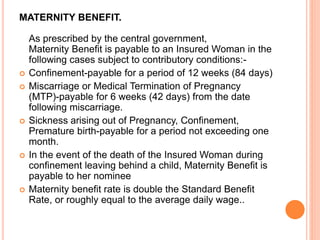
MATERNITY BENEFIT.
As prescribed by the central government,
Maternity Benefit is payable to an Insured Woman in the
following cases subject to contributory conditions:-
 Confinement-payable for a period of 12 weeks (84 days)
 Miscarriage or Medical Termination of Pregnancy
(MTP)-payable for 6 weeks (42 days) from the date
following miscarriage.
 Sickness arising out of Pregnancy, Confinement,
Premature birth-payable for a period not exceeding one
month.
 In the event of the death of the Insured Woman during
confinement leaving behind a child, Maternity Benefit is
payable to her nominee
 Maternity benefit rate is double the Standard Benefit
Rate, or roughly equal to the average daily wage..
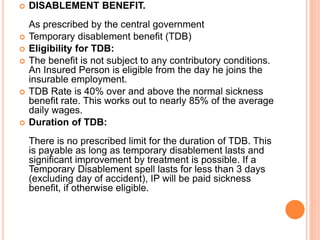
 DISABLEMENT BENEFIT.
As prescribed by the central government
 Temporary disablement benefit (TDB)
 Eligibility for TDB:
 The benefit is not subject to any contributory conditions.
An Insured Person is eligible from the day he joins the
insurable employment.
 TDB Rate is 40% over and above the normal sickness
benefit rate. This works out to nearly 85% of the average
daily wages.
 Duration of TDB:
There is no prescribed limit for the duration of TDB. This
is payable as long as temporary disablement lasts and
significant improvement by treatment is possible. If a
Temporary Disablement spell lasts for less than 3 days
(excluding day of accident), IP will be paid sickness
benefit, if otherwise eligible.
 Permanent Disablement Benefit (PDB)
PDB is payable to an Insured Person who suffers permanent
residual disablement as a result of EI (including Occupational
Diseases) and results in loss of earning capacity. The PDB rate is
calculated as percentage of loss of earning capacity as assessed
by the Medical Board.
Employer will be liable for the accidents caused to his employer
in the following circumstance
 Accident caused to an employee even if he obeyed the safety
instruction of his employer [Section 51B]
 Accident caused to employee while travelling in employer’s
transportation vehicles. [Section 51C]
 At the time of employment the accident caused to the employee
while protection or rescuing other employer from occurring
accident. [Section 51D]
 An accident occurring to an employee while commuting from his
residence to the place of employment for duty or from the place
of employment to his residence after performing duty, shall be
deemed to have arisen out of and in the course of employment.
[Section 51E] (2010 amendment)
 DEPENDANTS' BENEFIT. [Section 52]
As prescribed by the central government,
the dependants’ benefit is payable to the
dependants in cases where an Insured Person dies
as result of Employment Injury. The minimum rate
of dependants’ benefit w.e.f 1.1.90 is Rs.14/- per
day and these rates of the dependants’ benefit are
increased from time to time. The latest
enhancement is with effect from 01.08.2002
 MEDICAL BENEFIT. [Section 56]
As prescribed by the central government,
Employer or his family members are entitled to the
medical benefit. In case of the retirement of the
employer his spouse shall be eligible to receive
medical benefit subject to payment of contribution.
In case of permanent disablement by the employee,
he can get medical benefit till the date of his
retirement. Maximum age for the retirement is 60
years.
 EMPLOYER NOT TO DISMISS OR PUNISH
EMPLOYEE DURING PERIOD OF SICKNESS,
ETC. [Section 73]
No employer shall dismiss, discharge, or reduce or
otherwise punish an employee during the following
circumstances
 sickness
 maternity leave
 pregnancy or confinement
 under the treatment in the hospital
 temporary disablement

Esi act

  • 1.
    CHAPTER II CORPORATION, STANDINGCOMMITTEE AND MEDICAL BENEFIT COUNCIL  ESTABLISHMENT OF EMPLOYEES’ STATE INSURANCE CORPORATION. [Section 3] central government establishes the Corporation to be known as the Employees' State Insurance Corporation. This corporation will be having following characteristics  separate corporate body.  Having perpetual succession. (no death)  Have a common seal.  Employees' State Insurance Corporation can sue. (file a suit in court on other)  Other can sue Employees' State Insurance Corporation.
  • 2.
    THE CORPORATION SHALLCONSIST OF THE FOLLOWING MEMBERS. [Section 4] (a) Chairman, Vice-Chairman to be appointed by the Central Government; (b) not more than 5 persons to be appointed by the Central Government; (c) one person each representing each of the States in which this Act is in force to be appointed by the State Government concerned; (d) one person to be appointed by the Central Government to represent the 3Union Territories; (e) 10 persons representing employers to be appointed by the Central Government in consultation with such organisations of employers. (f) 10 persons representing employees to be appointed by the Central Government in consultation with such organisations of employees. (g) 2 persons representing the medical profession to be appointed by the Central Government in consultation with such organisation of medical practitioners. (h) 3 members of Parliament of whom two shall be members of the House of the People (Lok Sabha) and one shall be a member of the Council of States (Rajya Sabha) elected respectively by the members of the House of the People and the members of the Council of States; and (i) The Director-General of the Corporation ex-officio.
  • 3.
     CONSTITUTION OFSTANDING COMMITTEE. [Section 8] Standing Committee of the Corporation shall be constituted from among its members, consisting of (a) A Chairman, appointed by the Central Government; (b) three members of the Corporation appointed by the Central Government; (bb) three members of the Corporation representing such three State Governments thereon as the Central Government may, by notification Gazette, specify from time to time; (c) eight members elected by the Corporation as follows- (ii) 3 members from among the members of the Corporation representing employers; (iii) 3 members from among the members of the Corporation representing employees; (iv) 1 member from among the members of the Corporation representing the medical profession; and (v) 1 member from among the members of the Corporation elected by Parliament; (d) the Director General of the Corporation, ex officio
  • 4.
     MEDICAL BENEFITCOUNCIL. [Section 10](2010 AMENDMENT)  (a) the Director General, the Employees' State Insurance Corporation, ex officio as Chairman; (b) The Director General, Health Services, ex officio as Co-chairman;". (c) one member each representing each of the States (d) 3 members representing employers to be appointed by the Central Government in consultation with such organisations of employers. (e) 3 members representing employees to be appointed by the Central Government in consultation with such organisations of employees. (f) 3 members, of whom not less than one shall be a woman, representing the medical profession, to be appointed by the Central Government.
  • 5.
    CHAPTER IV- CONTRIBUTIONS ALLEMPLOYEES TO BE INSURED. [Section 38] Factory or establishment having more than 10 employees should be insured under the Employee State Insurance Act CONTRIBUTION [Section 39]  Employer and employer liable for payment of the contribution to the Employee State Insurance Corporation.  The rate of contribution paid by employer and employee will be decided by the central government.  Currently, the employee’s contribution rate (w.e.f. 1.1.97) is 1.75% of the wages and that of employer’s is 4.75% of the wages paid/payable in respect of the employees in every wage period.  If wage is received every month by employee, the Contribution to the ESI Corporation should be made by employer and employee every month without fail.  @ 12% of interest per year should be paid If employer delays in payment of the contribution to ESI corporation
  • 6.
    EMPLOYERS TO FURNISHRETURNS AND MAINTAIN REGISTERS IN CERTAIN CASES. [Section 44] SOCIAL SECURITY OFFICERS, THEIR FUNCTIONS AND DUTIES. [SECTION 45] (2010 amendment)  Enquiring into the correctness of any of the particulars stated in any return referred to in Section 44.  Social Security Officers can demand any principal or immediate employer to furnish to him such information as he may consider necessary for the purposes of this Act.  Social Security Officers can at any reasonable time enter any office, establishment, factory or other premises for inspection of examine such accounts, books and other documents relating to the employment of persons and payment of wages or to furnish to him such information as he may consider necessary.  He can examine the employer, his agent or servant or any person found in such factory, establishment, and office.  He can make copies of, or take extracts from, any register, account book or other document maintained in such factory, establishment, office or other premises.  He can do re-inspection whether the records and returns submitted under Section 44 are correct or not.
  • 7.
    CHAPTER V- BENEFITS Social Security Benefits Various benefits that the insured employees and their dependents are entitled to are as follows  Medical Benefits  Sickness Benefits  Maternity Benefits  Disablement Benefits  Dependent Benefits  Other Benefits (like funeral expenses, vocational rehabilitations, free supply of physical aids etc.)
  • 8.
    CONTINUE…..  The followingbenefits will be paid to insured persons or to their dependents [Section 46]  Periodical payments to any insured person in case of his sickness certified by a duly appointed medical practitioner.  Periodical payments to an insured woman in case of confinement or miscarriage or sickness arising out of pregnancy, confinement, premature birth of child or miscarriage, such woman being certified to be eligible for such payments.  periodical payments to an insured person suffering from disablement as a result of an employment injury  periodical payments to such dependants of an insured person who dies as a result of an employment injury  medical benefits
  • 9.
     FUNERAL BENEFIT.[Section 46] As prescribed by the central government, an amount of Rs. 5000/- is payable to the dependents or to the person who performs last rites from day one of entering insurable employment. SICKNESS BENEFIT. [Section 49] As prescribed by the central government, Sickness Benefit represents periodical cash payments made to an IP during the period of certified sickness occurring in a benefit period when IP requires medical treatment and attendance with abstention from work on medical grounds. Sickness benefit is roughly 60% of the average daily wages and is payable for 91 days during 2 consecutive benefit periods. Qualifying Conditions  To become eligible to Sickness Benefit, an Insured Person should have paid contribution for not less than 78 days during the corresponding contribution period.  A person who has entered into insurable employment for the first time has to wait for nearly 9 months before becoming eligible to sickness benefit, because his corresponding benefit period starts only after that interval.
  • 10.
    MATERNITY BENEFIT. As prescribedby the central government, Maternity Benefit is payable to an Insured Woman in the following cases subject to contributory conditions:-  Confinement-payable for a period of 12 weeks (84 days)  Miscarriage or Medical Termination of Pregnancy (MTP)-payable for 6 weeks (42 days) from the date following miscarriage.  Sickness arising out of Pregnancy, Confinement, Premature birth-payable for a period not exceeding one month.  In the event of the death of the Insured Woman during confinement leaving behind a child, Maternity Benefit is payable to her nominee  Maternity benefit rate is double the Standard Benefit Rate, or roughly equal to the average daily wage..
  • 11.
     DISABLEMENT BENEFIT. Asprescribed by the central government  Temporary disablement benefit (TDB)  Eligibility for TDB:  The benefit is not subject to any contributory conditions. An Insured Person is eligible from the day he joins the insurable employment.  TDB Rate is 40% over and above the normal sickness benefit rate. This works out to nearly 85% of the average daily wages.  Duration of TDB: There is no prescribed limit for the duration of TDB. This is payable as long as temporary disablement lasts and significant improvement by treatment is possible. If a Temporary Disablement spell lasts for less than 3 days (excluding day of accident), IP will be paid sickness benefit, if otherwise eligible.
  • 12.
     Permanent DisablementBenefit (PDB) PDB is payable to an Insured Person who suffers permanent residual disablement as a result of EI (including Occupational Diseases) and results in loss of earning capacity. The PDB rate is calculated as percentage of loss of earning capacity as assessed by the Medical Board. Employer will be liable for the accidents caused to his employer in the following circumstance  Accident caused to an employee even if he obeyed the safety instruction of his employer [Section 51B]  Accident caused to employee while travelling in employer’s transportation vehicles. [Section 51C]  At the time of employment the accident caused to the employee while protection or rescuing other employer from occurring accident. [Section 51D]  An accident occurring to an employee while commuting from his residence to the place of employment for duty or from the place of employment to his residence after performing duty, shall be deemed to have arisen out of and in the course of employment. [Section 51E] (2010 amendment)
  • 13.
     DEPENDANTS' BENEFIT.[Section 52] As prescribed by the central government, the dependants’ benefit is payable to the dependants in cases where an Insured Person dies as result of Employment Injury. The minimum rate of dependants’ benefit w.e.f 1.1.90 is Rs.14/- per day and these rates of the dependants’ benefit are increased from time to time. The latest enhancement is with effect from 01.08.2002
  • 14.
     MEDICAL BENEFIT.[Section 56] As prescribed by the central government, Employer or his family members are entitled to the medical benefit. In case of the retirement of the employer his spouse shall be eligible to receive medical benefit subject to payment of contribution. In case of permanent disablement by the employee, he can get medical benefit till the date of his retirement. Maximum age for the retirement is 60 years.
  • 15.
     EMPLOYER NOTTO DISMISS OR PUNISH EMPLOYEE DURING PERIOD OF SICKNESS, ETC. [Section 73] No employer shall dismiss, discharge, or reduce or otherwise punish an employee during the following circumstances  sickness  maternity leave  pregnancy or confinement  under the treatment in the hospital  temporary disablement