An Introduction to ESG Investing
Mike Seagrove & Calum Butt
1
INTRODUCTION
• Being part of the solution
• Sustainability
The World Needs to Change
• Environmental
• Social
• Governance
What is ESG Investing?
• Impact Portfolio
• Thematic Portfolio
• Systematic Portfolio
Types of ESG Investment?
• Systematic ESG Portfolio
• Overweight ‘Best in Class’
• Performance
• The destination is worth it
AG Approach to ESG Investment
2
Introduction to ESG Investing
The world is facing many real challenges, important and in some cases urgent.
3
The World Needs to Change
4
Consumer Purchasing
• Avoid companies with poor reputations
• Favour good companies
• Animal testing choices
Housing
• Better insulation
• Appliance ratings
• Recycling
Sustainable Investing
• Favour good companies
• Avoid worse companies
• Underweight ‘less good’ companies
Travel
• Carbon off-set for flights
• E-cars and fuel efficiency
• Methods of travel
Energy Supply
• Sourcing greener energy
• Solar panels
• Smart meters
Food & Agriculture
• Better animal welfare
• Food miles
• Avoiding deforestation (palm oil).
Being Part
of the
Solution
4
The World Needs to Change
Sustainability – Balancing the claims of the present, against the claims of the
future.
5
The World Needs to Change
Source: United Nations
Making the world a better place
• Defining a more balanced use of natural resources
• Tackling climate change and caring for the environment
• Building a fairer society
• Driving better corporate governance
• ESG Investing can assist with all of these factors
Environmental
• Biodiversity loss
• Greenhouse gas emissions
• Energy efficiency
• Renewable energy
• Resource depletion
• Ocean acidification
• Ozone depletion
Social
• Mass migration
• Wealth distribution
• Access to healthcare
• Workplace health and safety
• Diversity
• Employment rights, child
labour and slavery
• Controversial weapons such
as cluster bombs
Governance
• Executive compensation
• Bribery and corruption
• Independent directors
• Ethics in business
• Transparent disclosure of
ESG criteria
• Whistle-blowing policies
• Implications of business
strategy on social and
sustainability issues
6
What is ESG Investing?
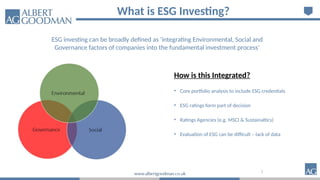
ESG investing can be broadly defined as ‘integrating Environmental, Social and
Governance factors of companies into the fundamental investment process’
7
What is ESG Investing?
How is this Integrated?
• Core portfolio analysis to include ESG credentials
• ESG ratings form part of decision
• Ratings Agencies (e.g. MSCI & Sustainaltics)
• Evaluation of ESG can be difficult – lack of data
8
Thematic Portfolio
Impact Portfolio Systematic Portfolio
• Often private markets
• Direct involvement
• Return of capital +
• Concentration risks
• Liquidity and exit risk
• Impact closely measured
• Seeking capital market returns
• Public and private markets
• Themes e.g. renewable energy
farms
• Company size tends to be smaller
• More highly concentrated
• Impact implied in theme choice
• Seeking broad capital market
returns
• From public markets
• Risk and return similar to
traditional portfolio
• Remain broadly diversified
• Tilt toward better ESG credentials
• Impact harder to quantify
Types of ESG Investment
Low cost – Passive options
available
Well diversified portfolios to
reduce risk
Suitable for large proportion of
investors
Steps in the right direction
Retain Sector Weightings
Capture broad market returns
9
Our Preferred Approach to ESG Investment
Systematic
ESG
Portfolio
Systematic ESG Portfolios in practice – Improving the ESG Credentials of a portfolio.
10
Our Preferred Approach to ESG Investment
Key Notes
• Moves from market cap to ESG Rating
• Oil & Gas – Not excluded - Why?
• Production of ‘Cluster Munitions’ excluded
• Building a fairer society
• Strong ESG Credentials – Better long term prospects
60%
100%
The AG ESG
Model
Portfolio
range
AG ESG Balanced Portfolio
AG ESG Moderately
Adventurous Portfolio
AG ESG Adventurous Portfolio
AG ESG Cautious Portfolio
AG ESG Moderately Cautious
Portfolio
11
Our Preferred Approach to ESG Investment
40%
20%
80%
The Albert Goodman ESG Model Portfolio Performance
12
Our Preferred Approach to ESG Investment
*Returns are net of fund costs
**Historic returns from 31/03/2021
Past performance is not indicative of future results and no
representation is made that the stated results will be
replicated.
• Long term returns in line with
broad global market
• Higher ESG credentials – better
longer term prospects
• Positive impact on the world
• 1 Year returns – post pandemic
recovery
Comparison against non ESG investment
13
Our Preferred Approach to ESG Investment
*Returns are net of fund costs
**Historic returns from 31/03/2021
Past performance is not indicative of future results and no
representation is made that the stated results will be
replicated.
Returns Comparison Risk Comparison
1 2
• Use a sensible ESG approach where available
• Maintain portfolio risk
• Better, more robust ESG Metrics
• A more consistent approach
• Great impact understanding
3
• Wider product choices
• Better index construction
• Full asset class coverage
4
14
Our Preferred Approach to ESG Investment
The destination is worth it………….
A better World
15
Important Notes
This is a purely educational document to discuss some general investment related issues. It does
not in any way constitute investment advice or arranging investments. It is for information
purposes only; any information contained within them is the opinion of the authors, which can
change without notice. All information is based on sources that the firm believes to be reliable. No
responsibility can be accepted for actions taken as a result of reading this document.
Past performance is not indicative of future results and no representation is made that the stated
results will be replicated.
Errors and omissions excepted.
Thank
You
Calum Butt
Consultant
calum.butt@albertgoodman.co.uk
Mike Seagrove
Chartered Financial Planner
michael.seagrove@albertgoodman.co.
uk

ESG-Presentation. On the changes and and

  • 1.
    An Introduction toESG Investing Mike Seagrove & Calum Butt 1
  • 2.
    INTRODUCTION • Being partof the solution • Sustainability The World Needs to Change • Environmental • Social • Governance What is ESG Investing? • Impact Portfolio • Thematic Portfolio • Systematic Portfolio Types of ESG Investment? • Systematic ESG Portfolio • Overweight ‘Best in Class’ • Performance • The destination is worth it AG Approach to ESG Investment 2 Introduction to ESG Investing
  • 3.
    The world isfacing many real challenges, important and in some cases urgent. 3 The World Needs to Change
  • 4.
    4 Consumer Purchasing • Avoidcompanies with poor reputations • Favour good companies • Animal testing choices Housing • Better insulation • Appliance ratings • Recycling Sustainable Investing • Favour good companies • Avoid worse companies • Underweight ‘less good’ companies Travel • Carbon off-set for flights • E-cars and fuel efficiency • Methods of travel Energy Supply • Sourcing greener energy • Solar panels • Smart meters Food & Agriculture • Better animal welfare • Food miles • Avoiding deforestation (palm oil). Being Part of the Solution 4 The World Needs to Change
  • 5.
    Sustainability – Balancingthe claims of the present, against the claims of the future. 5 The World Needs to Change Source: United Nations Making the world a better place • Defining a more balanced use of natural resources • Tackling climate change and caring for the environment • Building a fairer society • Driving better corporate governance • ESG Investing can assist with all of these factors
  • 6.
    Environmental • Biodiversity loss •Greenhouse gas emissions • Energy efficiency • Renewable energy • Resource depletion • Ocean acidification • Ozone depletion Social • Mass migration • Wealth distribution • Access to healthcare • Workplace health and safety • Diversity • Employment rights, child labour and slavery • Controversial weapons such as cluster bombs Governance • Executive compensation • Bribery and corruption • Independent directors • Ethics in business • Transparent disclosure of ESG criteria • Whistle-blowing policies • Implications of business strategy on social and sustainability issues 6 What is ESG Investing?
  • 7.
    ESG investing canbe broadly defined as ‘integrating Environmental, Social and Governance factors of companies into the fundamental investment process’ 7 What is ESG Investing? How is this Integrated? • Core portfolio analysis to include ESG credentials • ESG ratings form part of decision • Ratings Agencies (e.g. MSCI & Sustainaltics) • Evaluation of ESG can be difficult – lack of data
  • 8.
    8 Thematic Portfolio Impact PortfolioSystematic Portfolio • Often private markets • Direct involvement • Return of capital + • Concentration risks • Liquidity and exit risk • Impact closely measured • Seeking capital market returns • Public and private markets • Themes e.g. renewable energy farms • Company size tends to be smaller • More highly concentrated • Impact implied in theme choice • Seeking broad capital market returns • From public markets • Risk and return similar to traditional portfolio • Remain broadly diversified • Tilt toward better ESG credentials • Impact harder to quantify Types of ESG Investment
  • 9.
    Low cost –Passive options available Well diversified portfolios to reduce risk Suitable for large proportion of investors Steps in the right direction Retain Sector Weightings Capture broad market returns 9 Our Preferred Approach to ESG Investment Systematic ESG Portfolio
  • 10.
    Systematic ESG Portfoliosin practice – Improving the ESG Credentials of a portfolio. 10 Our Preferred Approach to ESG Investment Key Notes • Moves from market cap to ESG Rating • Oil & Gas – Not excluded - Why? • Production of ‘Cluster Munitions’ excluded • Building a fairer society • Strong ESG Credentials – Better long term prospects
  • 11.
    60% 100% The AG ESG Model Portfolio range AGESG Balanced Portfolio AG ESG Moderately Adventurous Portfolio AG ESG Adventurous Portfolio AG ESG Cautious Portfolio AG ESG Moderately Cautious Portfolio 11 Our Preferred Approach to ESG Investment 40% 20% 80%
  • 12.
    The Albert GoodmanESG Model Portfolio Performance 12 Our Preferred Approach to ESG Investment *Returns are net of fund costs **Historic returns from 31/03/2021 Past performance is not indicative of future results and no representation is made that the stated results will be replicated. • Long term returns in line with broad global market • Higher ESG credentials – better longer term prospects • Positive impact on the world • 1 Year returns – post pandemic recovery
  • 13.
    Comparison against nonESG investment 13 Our Preferred Approach to ESG Investment *Returns are net of fund costs **Historic returns from 31/03/2021 Past performance is not indicative of future results and no representation is made that the stated results will be replicated. Returns Comparison Risk Comparison
  • 14.
    1 2 • Usea sensible ESG approach where available • Maintain portfolio risk • Better, more robust ESG Metrics • A more consistent approach • Great impact understanding 3 • Wider product choices • Better index construction • Full asset class coverage 4 14 Our Preferred Approach to ESG Investment The destination is worth it…………. A better World
  • 15.
    15 Important Notes This isa purely educational document to discuss some general investment related issues. It does not in any way constitute investment advice or arranging investments. It is for information purposes only; any information contained within them is the opinion of the authors, which can change without notice. All information is based on sources that the firm believes to be reliable. No responsibility can be accepted for actions taken as a result of reading this document. Past performance is not indicative of future results and no representation is made that the stated results will be replicated. Errors and omissions excepted.
  • 16.