COURSE NAME: EMBEDDED
SYSTEM DESIGN
COURSE CODE: U14EC804B
• D.Santhosh Kumar
• Assistant Professor,
• Dept of ECE,KITSW
Learning Objectives
Major application areas of embedded systems
Purpose Of Embedded Systems
MAJOR
APPLICATION
AREAS OF
EMBEDDED
SYSTEMS
Major
Application
Areas of
Embedded
Systems
• Consumer Electronics: Camcorders, Cameras
etc.
• Household Appliances: Television, DVD
players, Washing machine, Fridge, Microwave
Oven etc.
• Home Automation and Security Systems: Air
conditioners, sprinklers, Intruder detection
alarms, Closed Circuit Television Cameras,
Fire alarms etc.
• Automotive Industry: Anti-lock breaking
systems (ABS), Engine Control, Ignition
Systems, Automatic Navigation Systems etc.
• Telecom: Cellular Telephones, Telephone
switches, Handset Multimedia Applications etc.
MAJOR APPLICATION AREAS OF
EMBEDDED SYSTEMS CONTD…
• Computer Peripherals: Printers, Scanners, Fax machines etc.
• Computer Networking Systems: Network Routers, Switches, Hubs, Firewalls etc.
• Health Care: Different Kinds of Scanners, EEG, ECG Machines etc.
• Measurement & Instrumentation: Digital multi meters, Digital CROs, Logic Analyzers
PLC systems etc.
• Banking & Retail: Automatic Teller Machines (ATM) and Currency counters, Point of
Sales (POS)
• Card Readers: Barcode, Smart Card Readers, Hand held Devices etc.
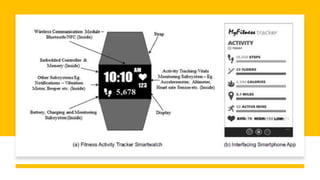
• Wearable Devices: Health and Fitness Trackers, Smartphone Screen extension for
notifications, etc.
• Cloud Computing and Internet of Things (IOT)
PURPOSE OF
EMBEDDED
SYSTEMS
Each embedded system is designed to serve the purpose
of any one or a combination of the following tasks:
 Data Collection/Storage/Representation
 Data Communication
 Data (Signal) Processing
 Monitoring
 Control
 Application Specific User Interface
Purpose of Embedded Systems – Data
Collection/Storage/Representation
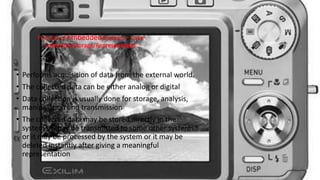
• Performs acquisition of data from the external world.
• The collected data can be either analog or digital
• Data collection is usually done for storage, analysis,
manipulation and transmission
• The collected data may be stored directly in the
system or may be transmitted to some other systems
or it may be processed by the system or it may be
deleted instantly after giving a meaningful
representation
Purpose of Embedded
Systems – Data
Communication
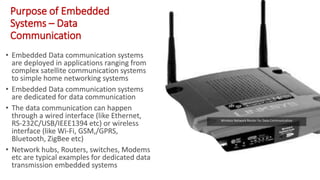
Wireless Network Router for Data Communication
Purpose of Embedded Systems –
Data (Signal) Processing
• Embedded systems with Signal
processing functionalities are
employed in applications
demanding signal processing like
Speech coding, synthesis, audio
video codec, transmission
applications etc
• Computational intensive systems
• Employs Digital Signal Processors
(DSPs).
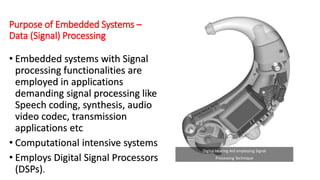
Digital hearing Aid employing Signal
Processing Technique
Purpose of Embedded Systems - Monitoring
• Embedded systems coming under this category are specifically
designed for monitoring purpose
• They are used for determining the state of some variables using input
sensors
• They cannot impose control over variables.
• Electro Cardiogram (ECG) machine for monitoring the heart beat of a
patient is a typical example for this
• The sensors used in ECG are the different Electrodes connected to the
patient’s body
• Measuring instruments like Digital CRO, Digital Multi meter, Logic
Analyzer etc used in Control & Instrumentation applications are also
examples of embedded systems for monitoring purpose
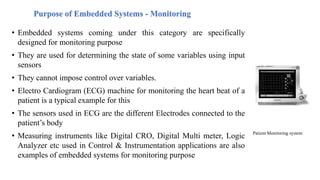
Patient Monitoring system
Purpose of Embedded
Systems – Control
• Embedded systems with control functionalities are used for
imposing control over some variables according to the changes
in input variables
• Embedded system with control functionality contains both
sensors and actuators
• Sensors are connected to the input port for capturing the changes
in environmental variable or measuring variable
• The actuators connected to the output port are controlled
according to the changes in input variable to put an impact on
the controlling variable to bring the controlled variable to the
specified range
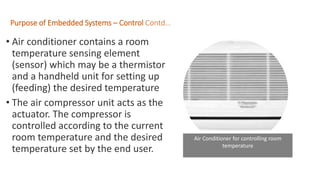
• Air conditioner for controlling room temperature is a typical
example for embedded system with ‘Control’functionality
Purpose of Embedded Systems – Control Contd…
Air Conditioner for controlling room
temperature
Purpose of Embedded
Systems – Application
Specific User Interface
• Embedded systems which are
designed for a specific application
• Contains Application Specific User
interface (rather than general
standard UI ) like key board, Display
units etc
• Aimed at a specific target group of
users
• Mobile handsets, Control units in
industrial applications etc are
examples for this
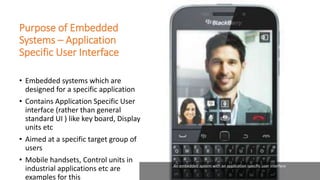
An embedded system with an application specific user interface
‘Smart’ running shoes from Adidas – The Innovative bonding of Life Style
with Embedded Technology
• Shoe developed by Adidas, which constantly adapts its shock-
absorbing characteristics to customize its value to the individual
runner, depending on running style, pace, body weight, and running
surface
• It contains sensors, actuators and a microprocessor unit which runs
the algorithm for adapting the shock-absorbing characteristics of the
shoe.
• A ‘Hall effect sensor’ placed at the top of the “cushioning element”
senses the compression and passes it to the Microprocessor
• A micro motor actuator controls the cushioning as per the commands
from the MPU, based on the compression sensed by the ‘Hall effect
sensor’
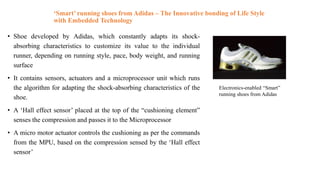
Electronics-enabled “Smart”
running shoes from Adidas
WEARABLE
DEVICES—THE
INNOVATIVE
BONDING OF
LIFESTYLE WITH
EMBEDDED
TECHNOLOGIES
ESD_Class 3.pptx

ESD_Class 3.pptx

  • 1.
    COURSE NAME: EMBEDDED SYSTEMDESIGN COURSE CODE: U14EC804B • D.Santhosh Kumar • Assistant Professor, • Dept of ECE,KITSW
  • 2.
    Learning Objectives Major applicationareas of embedded systems Purpose Of Embedded Systems
  • 3.
  • 4.
    Major Application Areas of Embedded Systems • ConsumerElectronics: Camcorders, Cameras etc. • Household Appliances: Television, DVD players, Washing machine, Fridge, Microwave Oven etc. • Home Automation and Security Systems: Air conditioners, sprinklers, Intruder detection alarms, Closed Circuit Television Cameras, Fire alarms etc. • Automotive Industry: Anti-lock breaking systems (ABS), Engine Control, Ignition Systems, Automatic Navigation Systems etc. • Telecom: Cellular Telephones, Telephone switches, Handset Multimedia Applications etc.
  • 5.
    MAJOR APPLICATION AREASOF EMBEDDED SYSTEMS CONTD… • Computer Peripherals: Printers, Scanners, Fax machines etc. • Computer Networking Systems: Network Routers, Switches, Hubs, Firewalls etc. • Health Care: Different Kinds of Scanners, EEG, ECG Machines etc. • Measurement & Instrumentation: Digital multi meters, Digital CROs, Logic Analyzers PLC systems etc. • Banking & Retail: Automatic Teller Machines (ATM) and Currency counters, Point of Sales (POS) • Card Readers: Barcode, Smart Card Readers, Hand held Devices etc. • Wearable Devices: Health and Fitness Trackers, Smartphone Screen extension for notifications, etc. • Cloud Computing and Internet of Things (IOT)
  • 6.
  • 7.
    Each embedded systemis designed to serve the purpose of any one or a combination of the following tasks:  Data Collection/Storage/Representation  Data Communication  Data (Signal) Processing  Monitoring  Control  Application Specific User Interface
  • 8.
    Purpose of EmbeddedSystems – Data Collection/Storage/Representation • Performs acquisition of data from the external world. • The collected data can be either analog or digital • Data collection is usually done for storage, analysis, manipulation and transmission • The collected data may be stored directly in the system or may be transmitted to some other systems or it may be processed by the system or it may be deleted instantly after giving a meaningful representation
  • 9.
    Purpose of Embedded Systems– Data Communication Wireless Network Router for Data Communication
  • 10.
    Purpose of EmbeddedSystems – Data (Signal) Processing • Embedded systems with Signal processing functionalities are employed in applications demanding signal processing like Speech coding, synthesis, audio video codec, transmission applications etc • Computational intensive systems • Employs Digital Signal Processors (DSPs). Digital hearing Aid employing Signal Processing Technique
  • 11.
    Purpose of EmbeddedSystems - Monitoring • Embedded systems coming under this category are specifically designed for monitoring purpose • They are used for determining the state of some variables using input sensors • They cannot impose control over variables. • Electro Cardiogram (ECG) machine for monitoring the heart beat of a patient is a typical example for this • The sensors used in ECG are the different Electrodes connected to the patient’s body • Measuring instruments like Digital CRO, Digital Multi meter, Logic Analyzer etc used in Control & Instrumentation applications are also examples of embedded systems for monitoring purpose Patient Monitoring system
  • 12.
    Purpose of Embedded Systems– Control • Embedded systems with control functionalities are used for imposing control over some variables according to the changes in input variables • Embedded system with control functionality contains both sensors and actuators • Sensors are connected to the input port for capturing the changes in environmental variable or measuring variable • The actuators connected to the output port are controlled according to the changes in input variable to put an impact on the controlling variable to bring the controlled variable to the specified range • Air conditioner for controlling room temperature is a typical example for embedded system with ‘Control’functionality
  • 13.
    Purpose of EmbeddedSystems – Control Contd… Air Conditioner for controlling room temperature
  • 14.
    Purpose of Embedded Systems– Application Specific User Interface • Embedded systems which are designed for a specific application • Contains Application Specific User interface (rather than general standard UI ) like key board, Display units etc • Aimed at a specific target group of users • Mobile handsets, Control units in industrial applications etc are examples for this An embedded system with an application specific user interface
  • 15.
    ‘Smart’ running shoesfrom Adidas – The Innovative bonding of Life Style with Embedded Technology • Shoe developed by Adidas, which constantly adapts its shock- absorbing characteristics to customize its value to the individual runner, depending on running style, pace, body weight, and running surface • It contains sensors, actuators and a microprocessor unit which runs the algorithm for adapting the shock-absorbing characteristics of the shoe. • A ‘Hall effect sensor’ placed at the top of the “cushioning element” senses the compression and passes it to the Microprocessor • A micro motor actuator controls the cushioning as per the commands from the MPU, based on the compression sensed by the ‘Hall effect sensor’ Electronics-enabled “Smart” running shoes from Adidas
  • 16.