ERP VENDORS-
EDUCATION INDUSTRY
EDUCATION INDUSTRY -
INDIA
Education and training sector - $100 billion market
Private education network alone - $50 billion
Major employment driver in India
No. Of higher educational institutions – 44,668
(china – 4192, US – 6500)
No.of students pursuing higher education is also high.
New opportunities – to improve the quality of education.
BENEFITS – ERP –
EDUCATION SECTOR
Improving the organisation of teachers, students, lectures etc.
Systemising various educational processes
Simplify student management
Reinforcing relationships with parents and stakeholders
Reducing expenses, saving energy and time
Organising the data in the order you need and want
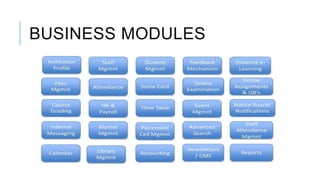
BUSINESS MODULES
BUSINESS PROCESSES
Some of the business processes are as follows :
Timetable management system
Admission management system
Grades and exam operation system
Hostel management system
Asset and inventory management
Budget and cost control module
Biometrics and payroll management system
Fees management system
Recruitment operation system
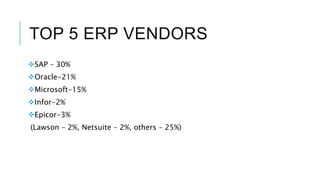
TOP 5 ERP VENDORS
SAP – 30%
Oracle-21%
Microsoft-15%
Infor-2%
Epicor-3%
(Lawson – 2%, Netsuite – 2%, others – 25%)
ORACLE PEOPLESOFT
ERP
SELECTION CRITERIA
SELECTION CRITERIA – ERP
VENDORS
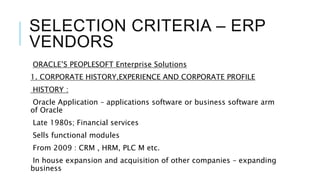
ORACLE’S PEOPLESOFT Enterprise Solutions
1. CORPORATE HISTORY,EXPERIENCE AND CORPORATE PROFILE
HISTORY :
Oracle Application – applications software or business software arm
of Oracle
Late 1980s; Financial services
Sells functional modules
From 2009 : CRM , HRM, PLC M etc.
In house expansion and acquisition of other companies – expanding
business
SELECTION CRITERIA – ERP
VENDORS
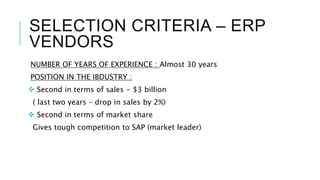
NUMBER OF YEARS OF EXPERIENCE : Almost 30 years
POSITION IN THE IBDUSTRY :
 Second in terms of sales - $3 billion
( last two years – drop in sales by 2%)
 Second in terms of market share
Gives tough competition to SAP (market leader)
SELECTION CRITERIA – ERP
VENDORS
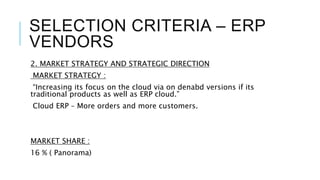
2. MARKET STRATEGY AND STRATEGIC DIRECTION
MARKET STRATEGY :
“Increasing its focus on the cloud via on denabd versions if its
traditional products as well as ERP cloud.”
Cloud ERP – More orders and more customers.
MARKET SHARE :
16 % ( Panorama)
PRODUCT LINE OF ORACLE
ERP
ATG
Agile
AutoVue
JD Edwards
Endeca
Hyperion
E business suite
Oracle Policy Automation
PeopleSoft
Primavera
Rightnow
Siebel
Taelo
EDUCUBE SELECTION CRITERIA
SELECTION CRITERIA – ERP
VENDORS
EDUCUBE – EducationERP.net
1. CORPORATE HISTORY,EXPERIENCE AND CORPORATE PROFILE
HISTORY :
Formerly known as EducationERP.net
Web based, cloud based and SaaS solution
Used in over 11 countries
strives to offer outstanding quality solutions for educational institutions
with its focus of empowering educators to achieve their objectives
SELECTION CRITERIA – ERP
VENDORS
NUMBER OF YEARS OF EXPERIENCE : 16 years (2000)
POSITION IN THE INDUSTRY :
 The only Indian vendor thats in the top 5 position in India for
education ERP.
SELECTION CRITERIA – ERP
VENDORS
2. MARKET STRATEGY AND STRATEGIC DIRECTION
MARKET STRATEGY :
 Currently focusing only on Education ERP ; Trying to provide ERP
solutions for different levels of education right from kinder garden to
higher education; Tries to develop a software that can help research
scholars.
MARKET SHARE :
Leading school management solutions in India.
MICROSOFT
DYNAMICS AX
SELECTION CRITERIA
SELECTION CRITERIA – ERP
VENDORS
MICROSOFT DYNAMICS AX
1. CORPORATE HISTORY,EXPERIENCE AND CORPORATE PROFILE
HISTORY :
was originally developed as a collaboration between IBM and Danish Daamagard
Data as IBM Axapta.
 Microsoft acquired the combined company in July 2002
Helps in making smarter decisions, redesign business processes faster and fuel
business growth.
supports a hybrid cloud environment is essential to meeting the real needs of
customers
Microsoft AX is also used in IT, Finance, commerce and operations.
SELECTION CRITERIA – ERP
VENDORS
NUMBER OF YEARS OF EXPERIENCE : 14 years (2002)
POSITION IN THE INDUSTRY :
Second in the world next to Oracle.
One among the top 5 in India.
SELECTION CRITERIA – ERP
VENDORS
2. MARKET STRATEGY AND STRATEGIC DIRECTION
It’s available and supported in more than 30 countries and 25
languages.
The newest version was released in February 2016
MARKET STRATEGY :
Strives to provide easy-to-learn and easy-to-use business solutions
tailored to the market, designed for every business size, and
dedicated to growing the business through happy customers.
MARKET SHARE :
 15% (in the world in the entire ERP industry)
MODULES OF MICROSOFT
DYNAMICS ERP (BASIC
VERSION)General Ledger – ledger, sales tax, currency, and fixed assets features
Bank Management – receives and pays cash
Customer Relationship Management (CRM) – business relations contact and maintenance (customers, vendors, and leads)
Accounts Receivable – order entry, shipping, and invoicing
Accounts Payable – purchase orders, goods received into inventory
Inventory Management – inventory management and valuation
Master Planning(Resources)– purchase and production planning
Production – bills of materials, manufacturing tracking
Product Builder – product mode creation and maintenance
Human Resources – employee information
Project Accounting – projects creation and tracking (primarily from an accounting perspective)
Basic – data configuration
Administration Module – system configuration
Procurement and Sourcing
Sales and Marketing
THANKYOU !!

Erp vendor study education industry

  • 1.
  • 2.
    EDUCATION INDUSTRY - INDIA Educationand training sector - $100 billion market Private education network alone - $50 billion Major employment driver in India No. Of higher educational institutions – 44,668 (china – 4192, US – 6500) No.of students pursuing higher education is also high. New opportunities – to improve the quality of education.
  • 3.
    BENEFITS – ERP– EDUCATION SECTOR Improving the organisation of teachers, students, lectures etc. Systemising various educational processes Simplify student management Reinforcing relationships with parents and stakeholders Reducing expenses, saving energy and time Organising the data in the order you need and want
  • 4.
  • 5.
    BUSINESS PROCESSES Some ofthe business processes are as follows : Timetable management system Admission management system Grades and exam operation system Hostel management system Asset and inventory management Budget and cost control module Biometrics and payroll management system Fees management system Recruitment operation system
  • 6.
    TOP 5 ERPVENDORS SAP – 30% Oracle-21% Microsoft-15% Infor-2% Epicor-3% (Lawson – 2%, Netsuite – 2%, others – 25%)
  • 7.
  • 8.
    SELECTION CRITERIA –ERP VENDORS ORACLE’S PEOPLESOFT Enterprise Solutions 1. CORPORATE HISTORY,EXPERIENCE AND CORPORATE PROFILE HISTORY : Oracle Application – applications software or business software arm of Oracle Late 1980s; Financial services Sells functional modules From 2009 : CRM , HRM, PLC M etc. In house expansion and acquisition of other companies – expanding business
  • 9.
    SELECTION CRITERIA –ERP VENDORS NUMBER OF YEARS OF EXPERIENCE : Almost 30 years POSITION IN THE IBDUSTRY :  Second in terms of sales - $3 billion ( last two years – drop in sales by 2%)  Second in terms of market share Gives tough competition to SAP (market leader)
  • 10.
    SELECTION CRITERIA –ERP VENDORS 2. MARKET STRATEGY AND STRATEGIC DIRECTION MARKET STRATEGY : “Increasing its focus on the cloud via on denabd versions if its traditional products as well as ERP cloud.” Cloud ERP – More orders and more customers. MARKET SHARE : 16 % ( Panorama)
  • 11.
    PRODUCT LINE OFORACLE ERP ATG Agile AutoVue JD Edwards Endeca Hyperion E business suite Oracle Policy Automation PeopleSoft Primavera Rightnow Siebel Taelo
  • 12.
  • 13.
    SELECTION CRITERIA –ERP VENDORS EDUCUBE – EducationERP.net 1. CORPORATE HISTORY,EXPERIENCE AND CORPORATE PROFILE HISTORY : Formerly known as EducationERP.net Web based, cloud based and SaaS solution Used in over 11 countries strives to offer outstanding quality solutions for educational institutions with its focus of empowering educators to achieve their objectives
  • 14.
    SELECTION CRITERIA –ERP VENDORS NUMBER OF YEARS OF EXPERIENCE : 16 years (2000) POSITION IN THE INDUSTRY :  The only Indian vendor thats in the top 5 position in India for education ERP.
  • 15.
    SELECTION CRITERIA –ERP VENDORS 2. MARKET STRATEGY AND STRATEGIC DIRECTION MARKET STRATEGY :  Currently focusing only on Education ERP ; Trying to provide ERP solutions for different levels of education right from kinder garden to higher education; Tries to develop a software that can help research scholars. MARKET SHARE : Leading school management solutions in India.
  • 16.
  • 17.
    SELECTION CRITERIA –ERP VENDORS MICROSOFT DYNAMICS AX 1. CORPORATE HISTORY,EXPERIENCE AND CORPORATE PROFILE HISTORY : was originally developed as a collaboration between IBM and Danish Daamagard Data as IBM Axapta.  Microsoft acquired the combined company in July 2002 Helps in making smarter decisions, redesign business processes faster and fuel business growth. supports a hybrid cloud environment is essential to meeting the real needs of customers Microsoft AX is also used in IT, Finance, commerce and operations.
  • 18.
    SELECTION CRITERIA –ERP VENDORS NUMBER OF YEARS OF EXPERIENCE : 14 years (2002) POSITION IN THE INDUSTRY : Second in the world next to Oracle. One among the top 5 in India.
  • 19.
    SELECTION CRITERIA –ERP VENDORS 2. MARKET STRATEGY AND STRATEGIC DIRECTION It’s available and supported in more than 30 countries and 25 languages. The newest version was released in February 2016 MARKET STRATEGY : Strives to provide easy-to-learn and easy-to-use business solutions tailored to the market, designed for every business size, and dedicated to growing the business through happy customers. MARKET SHARE :  15% (in the world in the entire ERP industry)
  • 20.
    MODULES OF MICROSOFT DYNAMICSERP (BASIC VERSION)General Ledger – ledger, sales tax, currency, and fixed assets features Bank Management – receives and pays cash Customer Relationship Management (CRM) – business relations contact and maintenance (customers, vendors, and leads) Accounts Receivable – order entry, shipping, and invoicing Accounts Payable – purchase orders, goods received into inventory Inventory Management – inventory management and valuation Master Planning(Resources)– purchase and production planning Production – bills of materials, manufacturing tracking Product Builder – product mode creation and maintenance Human Resources – employee information Project Accounting – projects creation and tracking (primarily from an accounting perspective) Basic – data configuration Administration Module – system configuration Procurement and Sourcing Sales and Marketing
  • 21.