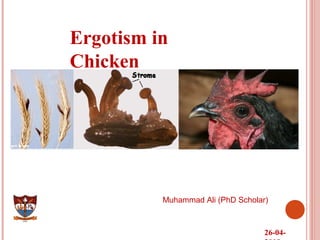
Ergotism in
Chicken
26-04-
Muhammad Ali (PhD Scholar)
MYCOTOXICOSIS:- DISEASE CAUSED BY A FUNGAL
TOXIN
Sr.# Fungus Mycotoxins Major Classes
1. Claviceps purpurea Ergot alkaloids
2. Aspergillus flavus, A parasiticus Aflatoxins. Cyclopiazonic
3. Fusarium Trichothecene, Zearalenone
4. P. viridicatum, A. ochraceus Ochratoxins
5. Penicillium & Aspergillus Citrinin
6. Chaetomium Oosporein
Toxin-producing fungi grow in grain and feed. Hundreds of mycotoxins
identified, and many are pathogenic.
ERGOTISM: RYE ERGOT MYCOTOXICOSIS
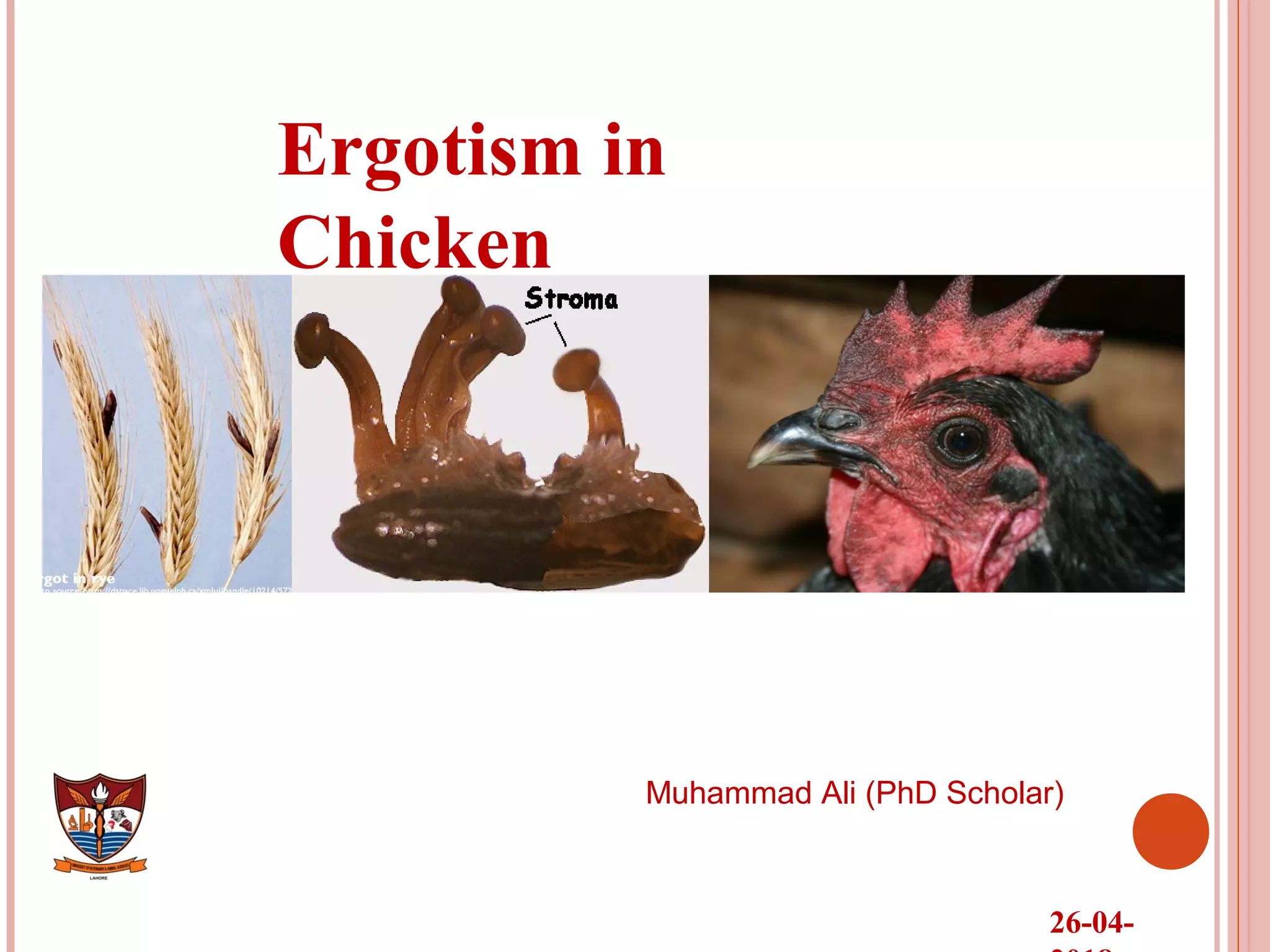
 Claviceps purpurea (total 35 spp), attack cereal grains (Rye as most
common host, wheat, triticale, barley, oats, grass). .
Sclerotium;- a visible, hard, dark purple mass of mycelium that
replaces the grain tissue is in which the mycotoxins forms.
 Within the sclerotium are the ergot alkaloids, which affect the nervous
system and vasoconstriction.
Risk Factor.
 Cool and wet climate favor Clavicep to grow in rye flower which
remain open for longer time in cool wet environment.
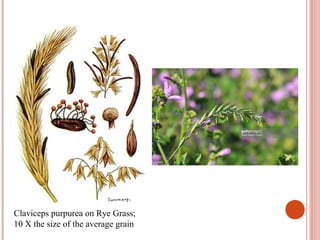
Claviceps purpurea on Rye Grass;
10 X the size of the average grain
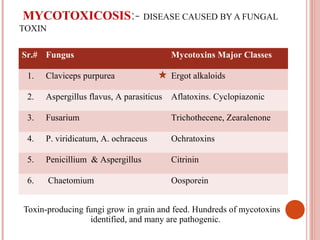
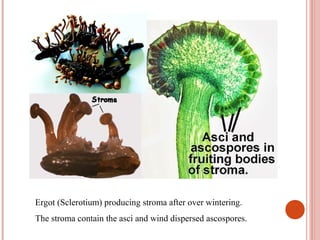
Ergot (Sclerotium) producing stroma after over wintering.
The stroma contain the asci and wind dispersed ascospores.
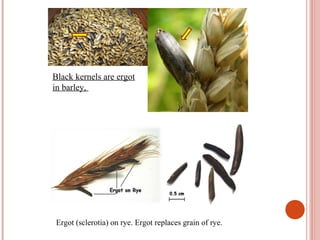
Black kernels are ergot
in barley,
Ergot (sclerotia) on rye. Ergot replaces grain of rye.
ERGOTISM: CLINICAL
SIGN
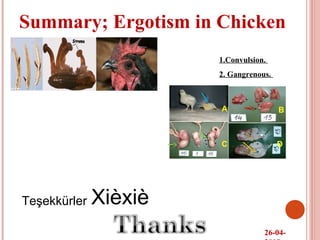
 1.Convulsion.
convulsive, fit, wry neck, and sensory neurologic disorders;
 2. Gangrenous.
Vasoconstriction and gangrene of the extremities
 In chicks
 Loss of coordination, Nervousness, Inability to stand,
Convulsions, Trembling Neck twisting,
 Abnormal feathering, Blisters on shanks and tops of toes. In
laying hens, feed consumption and egg production are reduced
,
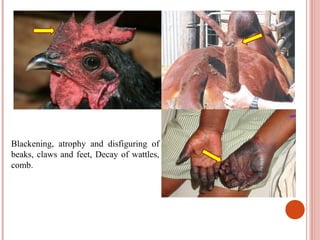
Blackening, atrophy and disfiguring of
beaks, claws and feet, Decay of wattles,
comb.
ERGOT TOXICITY IN
POULTRY
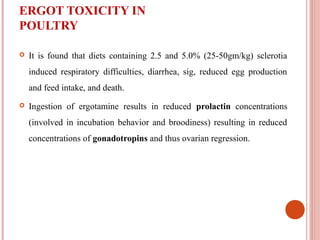
 It is found that diets containing 2.5 and 5.0% (25-50gm/kg) sclerotia
induced respiratory difficulties, diarrhea, sig, reduced egg production
and feed intake, and death.
 Ingestion of ergotamine results in reduced prolactin concentrations
(involved in incubation behavior and broodiness) resulting in reduced
concentrations of gonadotropins and thus ovarian regression.
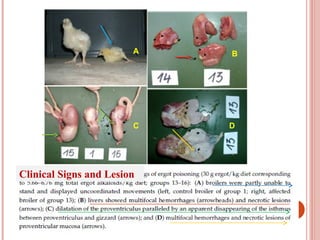
A B
C D
Clinical Signs and Lesion
DIAGNOSIS OF ERGOTISM /SOD DISEASE, VESICULAR DERMATITIS
 History, Clinical signs, Necropsy
 Forage or feed testing i.e. quantitation of the toxin. Samples of 500 g in
labeled paper bags promptly from multiple sites. Feed and grain
deteriorate in airtight plastic./glass containers.
1. Discard suspected feed source
2. Supplemental vitamins and minerals
3. Probiotics
4. Supportive care (Isolate bird from the flock, place in a safe, comfortable, warm
location , Limit stress.
TREATMEN
T
PREVENTION OF ERGOTISM /SOD DISEASE, VESICULAR
DERMATITIS
 Purchase and feed quality feedstuff from reputable source
 Treat Rye is under floatation to remove floating sclerotium
 Rotation cropping to break cycle of fungus,
 Deep plough to stop fungus germination.
 Testing. sclerotia weighing 0.1-0.3% of grain DM is considered
sufficient contamination of grain that is not to be used for feed
ERGOTISM:
HISTORY
 Termed as Holy Fire (5th
century). Fire due to burning by gangene.
Holy due to belief that it is punishment from GOD.
 Discovery.
often patient were found to use rye on table instead bean, meat etc.
Ergot Alkloids / medicinal products extracted from Ergot:-
Ergotamine for various causes of headaches, including migraines.
Ergonovine control postpartum hemorrhage, cause uterus
contraction
Other imp are ergocristine, ergosine, ergocornine, ergocryptine
REVIEW OF LITERATURE.
 The current upper limits for feedstuffs are set to 1000 mg ergot per kg
ungrounded cereal grains as specified by Directive 2002/32/EC
(Dänicke S. 2017).
 For poultry, safe dietary ergot concentration is 0.3 to 0.8% (Leeson et
al. 1995)
REFERENC
ES
 Dänicke S. 2017. Ergot Alkaloids in Fattening Chickens (Broilers): Toxic
Effects and Carry over Depending on Dietary Fat Proportion and
Supplementation with Non-Starch-Polysaccharide (NSP) Hydrolyzing
Enzymes. Toxins 9; 118.
 Leeson, S., G. Diaz, and J. D. Summers, 1995. Poultry Metabolic Disorders
and Mycotoxins. University Books, Guelph, ON, Canada.
 Overview of Mycotoxicosis in Poultry. Merck Vety. Manual.
 http://www.botany.hawaii.edu
 http://www.poultrydvm.com
Summary; Ergotism in Chicken
26-04-
Xièxiè
A B
C D
1.Convulsion.
2. Gangrenous.
Teşekkürler

Ergotism

  • 1.
  • 2.
    MYCOTOXICOSIS:- DISEASE CAUSEDBY A FUNGAL TOXIN Sr.# Fungus Mycotoxins Major Classes 1. Claviceps purpurea Ergot alkaloids 2. Aspergillus flavus, A parasiticus Aflatoxins. Cyclopiazonic 3. Fusarium Trichothecene, Zearalenone 4. P. viridicatum, A. ochraceus Ochratoxins 5. Penicillium & Aspergillus Citrinin 6. Chaetomium Oosporein Toxin-producing fungi grow in grain and feed. Hundreds of mycotoxins identified, and many are pathogenic.
  • 3.
    ERGOTISM: RYE ERGOTMYCOTOXICOSIS  Claviceps purpurea (total 35 spp), attack cereal grains (Rye as most common host, wheat, triticale, barley, oats, grass). . Sclerotium;- a visible, hard, dark purple mass of mycelium that replaces the grain tissue is in which the mycotoxins forms.  Within the sclerotium are the ergot alkaloids, which affect the nervous system and vasoconstriction. Risk Factor.  Cool and wet climate favor Clavicep to grow in rye flower which remain open for longer time in cool wet environment.
  • 4.
    Claviceps purpurea onRye Grass; 10 X the size of the average grain
  • 5.
    Ergot (Sclerotium) producingstroma after over wintering. The stroma contain the asci and wind dispersed ascospores.
  • 6.
    Black kernels areergot in barley, Ergot (sclerotia) on rye. Ergot replaces grain of rye.
  • 7.
    ERGOTISM: CLINICAL SIGN  1.Convulsion. convulsive,fit, wry neck, and sensory neurologic disorders;  2. Gangrenous. Vasoconstriction and gangrene of the extremities  In chicks  Loss of coordination, Nervousness, Inability to stand, Convulsions, Trembling Neck twisting,  Abnormal feathering, Blisters on shanks and tops of toes. In laying hens, feed consumption and egg production are reduced
  • 8.
    , Blackening, atrophy anddisfiguring of beaks, claws and feet, Decay of wattles, comb.
  • 9.
    ERGOT TOXICITY IN POULTRY It is found that diets containing 2.5 and 5.0% (25-50gm/kg) sclerotia induced respiratory difficulties, diarrhea, sig, reduced egg production and feed intake, and death.  Ingestion of ergotamine results in reduced prolactin concentrations (involved in incubation behavior and broodiness) resulting in reduced concentrations of gonadotropins and thus ovarian regression.
  • 10.
    A B C D ClinicalSigns and Lesion
  • 11.
    DIAGNOSIS OF ERGOTISM/SOD DISEASE, VESICULAR DERMATITIS  History, Clinical signs, Necropsy  Forage or feed testing i.e. quantitation of the toxin. Samples of 500 g in labeled paper bags promptly from multiple sites. Feed and grain deteriorate in airtight plastic./glass containers. 1. Discard suspected feed source 2. Supplemental vitamins and minerals 3. Probiotics 4. Supportive care (Isolate bird from the flock, place in a safe, comfortable, warm location , Limit stress. TREATMEN T
  • 12.
    PREVENTION OF ERGOTISM/SOD DISEASE, VESICULAR DERMATITIS  Purchase and feed quality feedstuff from reputable source  Treat Rye is under floatation to remove floating sclerotium  Rotation cropping to break cycle of fungus,  Deep plough to stop fungus germination.  Testing. sclerotia weighing 0.1-0.3% of grain DM is considered sufficient contamination of grain that is not to be used for feed
  • 13.
    ERGOTISM: HISTORY  Termed asHoly Fire (5th century). Fire due to burning by gangene. Holy due to belief that it is punishment from GOD.  Discovery. often patient were found to use rye on table instead bean, meat etc. Ergot Alkloids / medicinal products extracted from Ergot:- Ergotamine for various causes of headaches, including migraines. Ergonovine control postpartum hemorrhage, cause uterus contraction Other imp are ergocristine, ergosine, ergocornine, ergocryptine
  • 14.
    REVIEW OF LITERATURE. The current upper limits for feedstuffs are set to 1000 mg ergot per kg ungrounded cereal grains as specified by Directive 2002/32/EC (Dänicke S. 2017).  For poultry, safe dietary ergot concentration is 0.3 to 0.8% (Leeson et al. 1995)
  • 15.
    REFERENC ES  Dänicke S.2017. Ergot Alkaloids in Fattening Chickens (Broilers): Toxic Effects and Carry over Depending on Dietary Fat Proportion and Supplementation with Non-Starch-Polysaccharide (NSP) Hydrolyzing Enzymes. Toxins 9; 118.  Leeson, S., G. Diaz, and J. D. Summers, 1995. Poultry Metabolic Disorders and Mycotoxins. University Books, Guelph, ON, Canada.  Overview of Mycotoxicosis in Poultry. Merck Vety. Manual.  http://www.botany.hawaii.edu  http://www.poultrydvm.com
  • 16.
    Summary; Ergotism inChicken 26-04- Xièxiè A B C D 1.Convulsion. 2. Gangrenous. Teşekkürler

Editor's Notes

  • #14 Not occur in urban community having unhygiene and dense crowd. Not contagious. Not through water as urban and rural both use same water source so it was thought to be from food. And
  • #15 Ergot alkaloids varying tremendously between 0- 10,400 mg/kg ergot (=1.04%) depending on geographic region, harvesting year, cereal species, variety and genotype.