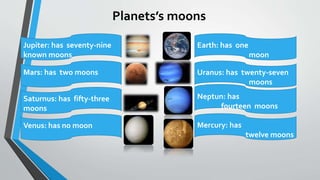
Planets’s moons
Jupiter: has seventy-nine
known moons
Earth: has one
moon
Venus: has no moon
Mars: has two moons
Saturnus: has fifty-three
moons
Mercury: has
twelve moons
Neptun: has
fourteen moons
Uranus: has twenty-seven
moons
About the Moon in general:
• The Moon is an astronomical body that
orbits the Earth as its only permanent
natural satellite.
• It is the fifth-largest satellite in the Solar System,
and the largest among planetary satellites
relative to the size of the planet that it orbits
(its primary).
The impact of the moon on our lives
Each phase of the moon affects our health and mood.
You must have heard of the tide phenomenon.
A feast in relation with the moon
• Religion is practically as old as humanity.
• Easter is also a holiday that is not entirely religious, but linked with the astronomy.
The feast falls on the Sunday following the first lunar charge after March 31.Then
we celebrate the resurrection of Christ.
“Puzzle”
OTHER
LD
EVER
HELL
Thanks
for
watching

Erasmus +the moon

  • 2.
    Planets’s moons Jupiter: hasseventy-nine known moons Earth: has one moon Venus: has no moon Mars: has two moons Saturnus: has fifty-three moons Mercury: has twelve moons Neptun: has fourteen moons Uranus: has twenty-seven moons
  • 3.
    About the Moonin general: • The Moon is an astronomical body that orbits the Earth as its only permanent natural satellite. • It is the fifth-largest satellite in the Solar System, and the largest among planetary satellites relative to the size of the planet that it orbits (its primary).
  • 4.
    The impact ofthe moon on our lives Each phase of the moon affects our health and mood. You must have heard of the tide phenomenon.
  • 5.
    A feast inrelation with the moon • Religion is practically as old as humanity. • Easter is also a holiday that is not entirely religious, but linked with the astronomy. The feast falls on the Sunday following the first lunar charge after March 31.Then we celebrate the resurrection of Christ.
  • 6.
  • 7.