Equity in Accounting: Meaning, Types, Valuation & Practical Examples
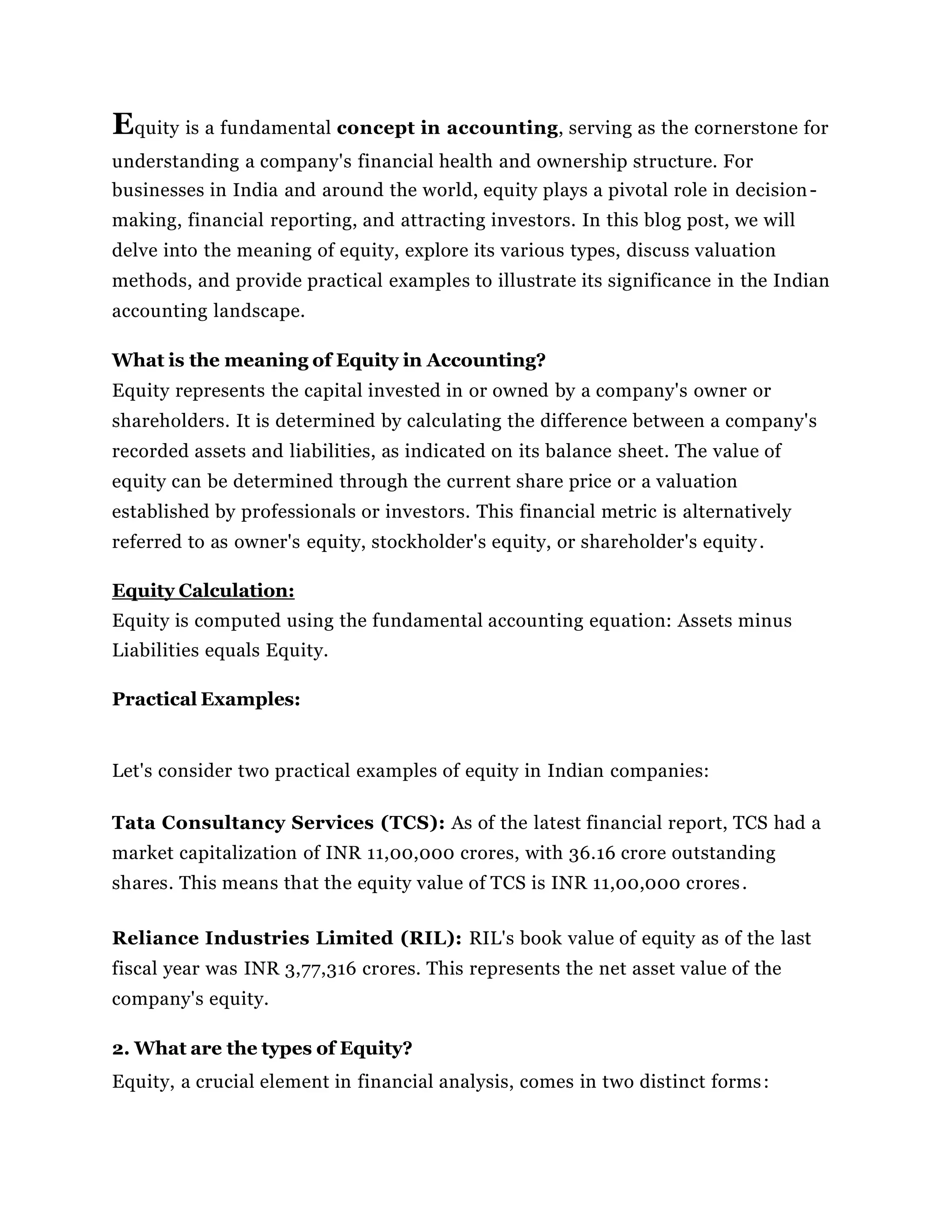
Equity is a fundamental concept in accounting, serving as the cornerstone for
understanding a company's financial health and ownership structure. For
businesses in India and around the world, equity plays a pivotal role in decision-
making, financial reporting, and attracting investors. In this blog post, we will
delve into the meaning of equity, explore its various types, discuss valuation
methods, and provide practical examples to illustrate its significance in the Indian
accounting landscape.
What is the meaning of Equity in Accounting?
Equity represents the capital invested in or owned by a company's owner or
shareholders. It is determined by calculating the difference between a company's
recorded assets and liabilities, as indicated on its balance sheet. The value of
equity can be determined through the current share price or a valuation
established by professionals or investors. This financial metric is alternatively
referred to as owner's equity, stockholder's equity, or shareholder's equity.
Equity Calculation:
Equity is computed using the fundamental accounting equation: Assets minus
Liabilities equals Equity.
Practical Examples:
Let's consider two practical examples of equity in Indian companies:
Tata Consultancy Services (TCS): As of the latest financial report, TCS had a
market capitalization of INR 11,00,000 crores, with 36.16 crore outstanding
shares. This means that the equity value of TCS is INR 11,00,000 crores.
Reliance Industries Limited (RIL): RIL's book value of equity as of the last
fiscal year was INR 3,77,316 crores. This represents the net asset value of the
company's equity.
2. What are the types of Equity?
Equity, a crucial element in financial analysis, comes in two distinct forms:
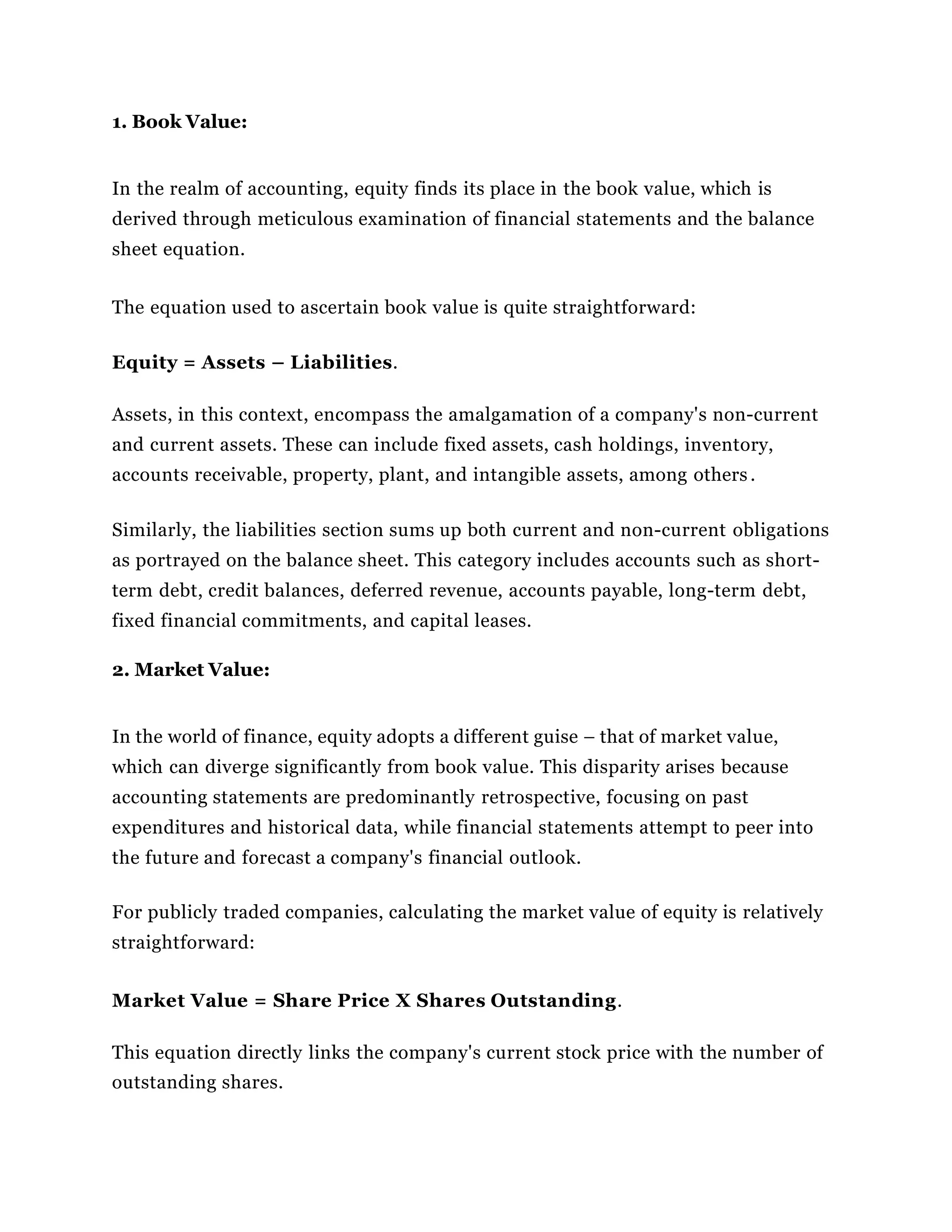
1. Book Value:
In the realm of accounting, equity finds its place in the book value, which is
derived through meticulous examination of financial statements and the balance
sheet equation.
The equation used to ascertain book value is quite straightforward:
Equity = Assets – Liabilities.
Assets, in this context, encompass the amalgamation of a company's non-current
and current assets. These can include fixed assets, cash holdings, inventory,
accounts receivable, property, plant, and intangible assets, among others .
Similarly, the liabilities section sums up both current and non-current obligations
as portrayed on the balance sheet. This category includes accounts such as short-
term debt, credit balances, deferred revenue, accounts payable, long-term debt,
fixed financial commitments, and capital leases.
2. Market Value:
In the world of finance, equity adopts a different guise – that of market value,
which can diverge significantly from book value. This disparity arises because
accounting statements are predominantly retrospective, focusing on past
expenditures and historical data, while financial statements attempt to peer into
the future and forecast a company's financial outlook.
For publicly traded companies, calculating the market value of equity is relatively
straightforward:
Market Value = Share Price X Shares Outstanding.
This equation directly links the company's current stock price with the number of
outstanding shares.
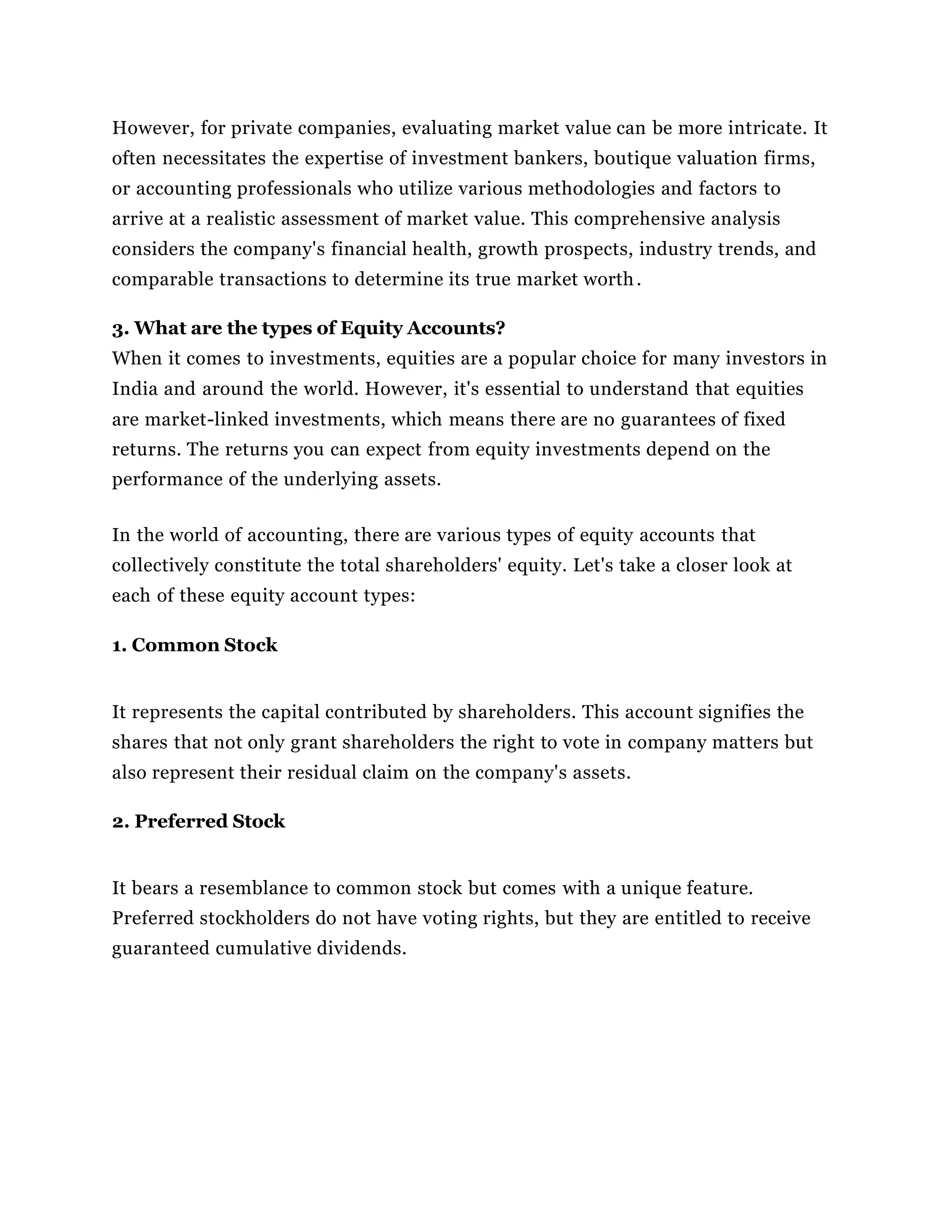
However, for private companies, evaluating market value can be more intricate. It
often necessitates the expertise of investment bankers, boutique valuation firms,
or accounting professionals who utilize various methodologies and factors to
arrive at a realistic assessment of market value. This comprehensive analysis
considers the company's financial health, growth prospects, industry trends, and
comparable transactions to determine its true market worth.
3. What are the types of Equity Accounts?
When it comes to investments, equities are a popular choice for many investors in
India and around the world. However, it's essential to understand that equities
are market-linked investments, which means there are no guarantees of fixed
returns. The returns you can expect from equity investments depend on the
performance of the underlying assets.
In the world of accounting, there are various types of equity accounts that
collectively constitute the total shareholders' equity. Let's take a closer look at
each of these equity account types:
1. Common Stock
It represents the capital contributed by shareholders. This account signifies the
shares that not only grant shareholders the right to vote in company matters but
also represent their residual claim on the company's assets.
2. Preferred Stock
It bears a resemblance to common stock but comes with a unique feature.
Preferred stockholders do not have voting rights, but they are entitled to receive
guaranteed cumulative dividends.
3. Retained Earnings
Retained earnings are the portion of net income that a company chooses not to
distribute as dividends. Instead, this amount is retained within the company for
reinvestment in business growth or for covering future obligations.
4. Other Comprehensive Income
Other comprehensive income is distinct from net income on the income
statement. It includes income that has not been realized yet, reflecting unrealized
gains or losses.
5. Treasury Stock (Contra-Equity Account)
Treasury stock represents the common stock that a company has repurchased
from its investors. This account is unique because it is treated as a contra-equity
account, which means it is subtracted from the total equity on the company's
books.
4. The Equity Valuation Process :
Equity valuation is not a one-size-fits-all procedure; it varies among individuals
and professionals. While there is no universally standardized approach, it
generally involves a series of steps, categorized into 4 or 5 broad areas. Despite
the differing methods, the ultimate objectives remain consistent. Anyone engaged
in equity valuation must, in one way or another, consider these key parameters:
Comprehend Macroeconomic Factors and Industry Dynamics:
Companies do not exist in isolation; their performance is intricately linked to
broader economic conditions and industry-specific trends. Before attempting to
value a business, one must account for macroeconomic factors. A solid grasp of
these variables forms the foundation for accurate valuation.
Create a Sound Company Performance Forecast:
A reliable forecast of a company's future performance goes beyond mere
extrapolation of its current financial statements. It entails a deep understanding
of how the company plans to scale its production in the near future and how these
changes will impact costs. Costs and sales rarely follow linear patterns, making it
essential for analysts to have an in-depth knowledge of the company's operations.
Select the Appropriate Valuation Model:
Valuation is as much art as it is science, with numerous valuation models at one's
disposal. Not all models yield identical results, and their suitability depends on
the quality and type of data available. Analysts must carefully evaluate which
model best fits the circumstances.
Determine a Valuation Figure Based on the Forecast:
This step involves applying the chosen valuation model to arrive at a specific
numerical value, defining the business's worth. The outcome may be a single
estimated figure or a range. Investors often prefer a range to establish clear upper
and lower bounds for their investment decisions.
Take Informed Action Based on the Valuation:
In the final stage, the analyst assesses whether to recommend buying, selling, or
holding the company's stock based on the calculated intrinsic value and the
prevailing market price. This decision provides investors with guidance on how to
align their investment strategies with the business's perceived worth.
For more information, Visit us at: https://academy.tax4wealth.com/

Equity in Accounting: Meaning, Types, & Practical Examples | Academy Tax4wealth

  • 1.
    Equity in Accounting:Meaning, Types, Valuation & Practical Examples
  • 2.
    Equity is afundamental concept in accounting, serving as the cornerstone for understanding a company's financial health and ownership structure. For businesses in India and around the world, equity plays a pivotal role in decision- making, financial reporting, and attracting investors. In this blog post, we will delve into the meaning of equity, explore its various types, discuss valuation methods, and provide practical examples to illustrate its significance in the Indian accounting landscape. What is the meaning of Equity in Accounting? Equity represents the capital invested in or owned by a company's owner or shareholders. It is determined by calculating the difference between a company's recorded assets and liabilities, as indicated on its balance sheet. The value of equity can be determined through the current share price or a valuation established by professionals or investors. This financial metric is alternatively referred to as owner's equity, stockholder's equity, or shareholder's equity. Equity Calculation: Equity is computed using the fundamental accounting equation: Assets minus Liabilities equals Equity. Practical Examples: Let's consider two practical examples of equity in Indian companies: Tata Consultancy Services (TCS): As of the latest financial report, TCS had a market capitalization of INR 11,00,000 crores, with 36.16 crore outstanding shares. This means that the equity value of TCS is INR 11,00,000 crores. Reliance Industries Limited (RIL): RIL's book value of equity as of the last fiscal year was INR 3,77,316 crores. This represents the net asset value of the company's equity. 2. What are the types of Equity? Equity, a crucial element in financial analysis, comes in two distinct forms:
  • 3.
    1. Book Value: Inthe realm of accounting, equity finds its place in the book value, which is derived through meticulous examination of financial statements and the balance sheet equation. The equation used to ascertain book value is quite straightforward: Equity = Assets – Liabilities. Assets, in this context, encompass the amalgamation of a company's non-current and current assets. These can include fixed assets, cash holdings, inventory, accounts receivable, property, plant, and intangible assets, among others . Similarly, the liabilities section sums up both current and non-current obligations as portrayed on the balance sheet. This category includes accounts such as short- term debt, credit balances, deferred revenue, accounts payable, long-term debt, fixed financial commitments, and capital leases. 2. Market Value: In the world of finance, equity adopts a different guise – that of market value, which can diverge significantly from book value. This disparity arises because accounting statements are predominantly retrospective, focusing on past expenditures and historical data, while financial statements attempt to peer into the future and forecast a company's financial outlook. For publicly traded companies, calculating the market value of equity is relatively straightforward: Market Value = Share Price X Shares Outstanding. This equation directly links the company's current stock price with the number of outstanding shares.
  • 4.
    However, for privatecompanies, evaluating market value can be more intricate. It often necessitates the expertise of investment bankers, boutique valuation firms, or accounting professionals who utilize various methodologies and factors to arrive at a realistic assessment of market value. This comprehensive analysis considers the company's financial health, growth prospects, industry trends, and comparable transactions to determine its true market worth. 3. What are the types of Equity Accounts? When it comes to investments, equities are a popular choice for many investors in India and around the world. However, it's essential to understand that equities are market-linked investments, which means there are no guarantees of fixed returns. The returns you can expect from equity investments depend on the performance of the underlying assets. In the world of accounting, there are various types of equity accounts that collectively constitute the total shareholders' equity. Let's take a closer look at each of these equity account types: 1. Common Stock It represents the capital contributed by shareholders. This account signifies the shares that not only grant shareholders the right to vote in company matters but also represent their residual claim on the company's assets. 2. Preferred Stock It bears a resemblance to common stock but comes with a unique feature. Preferred stockholders do not have voting rights, but they are entitled to receive guaranteed cumulative dividends.
  • 5.
    3. Retained Earnings Retainedearnings are the portion of net income that a company chooses not to distribute as dividends. Instead, this amount is retained within the company for reinvestment in business growth or for covering future obligations. 4. Other Comprehensive Income Other comprehensive income is distinct from net income on the income statement. It includes income that has not been realized yet, reflecting unrealized gains or losses. 5. Treasury Stock (Contra-Equity Account) Treasury stock represents the common stock that a company has repurchased from its investors. This account is unique because it is treated as a contra-equity account, which means it is subtracted from the total equity on the company's books. 4. The Equity Valuation Process : Equity valuation is not a one-size-fits-all procedure; it varies among individuals and professionals. While there is no universally standardized approach, it generally involves a series of steps, categorized into 4 or 5 broad areas. Despite the differing methods, the ultimate objectives remain consistent. Anyone engaged in equity valuation must, in one way or another, consider these key parameters: Comprehend Macroeconomic Factors and Industry Dynamics: Companies do not exist in isolation; their performance is intricately linked to broader economic conditions and industry-specific trends. Before attempting to value a business, one must account for macroeconomic factors. A solid grasp of these variables forms the foundation for accurate valuation.
  • 6.
    Create a SoundCompany Performance Forecast: A reliable forecast of a company's future performance goes beyond mere extrapolation of its current financial statements. It entails a deep understanding of how the company plans to scale its production in the near future and how these changes will impact costs. Costs and sales rarely follow linear patterns, making it essential for analysts to have an in-depth knowledge of the company's operations. Select the Appropriate Valuation Model: Valuation is as much art as it is science, with numerous valuation models at one's disposal. Not all models yield identical results, and their suitability depends on the quality and type of data available. Analysts must carefully evaluate which model best fits the circumstances. Determine a Valuation Figure Based on the Forecast: This step involves applying the chosen valuation model to arrive at a specific numerical value, defining the business's worth. The outcome may be a single estimated figure or a range. Investors often prefer a range to establish clear upper and lower bounds for their investment decisions. Take Informed Action Based on the Valuation: In the final stage, the analyst assesses whether to recommend buying, selling, or holding the company's stock based on the calculated intrinsic value and the prevailing market price. This decision provides investors with guidance on how to align their investment strategies with the business's perceived worth. For more information, Visit us at: https://academy.tax4wealth.com/