REVERSIBLE AND
EQUILIBRIUM REACTIONS
Senior II Chemsitry
EQUILIBRIUM REACTIONS:
• A reversible reaction in a closed system is at
equilibrium when the rate of forward reaction
is equal to the rate of reverse reaction, and the
concentrations are no longer changing.
• Rf = Rr
• Reversible reaction is denoted by this arrow:
CONDITIONS FOR DIRECTIONS OF
EQUILIBRIUM REACTIONS:
• COBALT (II) CHLORIDE:
• It exists in two forms:
1. Hydrated cobalt (II) chloride (pink)
2. Anhydrous cobalt (II) chloride (blue)
hydrated cobalt (II) chloride ⇌ anhydrous cobalt (II) chloride +
water
HYDRATION AND DEHYDRATION OF
COBALT (II) CHLORIDE:
HYDRATION AND DEHYDRATION
• When anhydrous blue cobalt(II) chloride crystals are
added to water they turn pink and the reaction
is reversible.
• When the cobalt(II) chloride crystals are heated in a
test tube, the pink crystals turn back to
the blue colour again as the water of crystallization is
lost.
• CoCl2.6H2O (s) ⇌ CoCl2 (s) + 6H2O (l)
HYDRATION AND DEHYDRATION OF
COPPER (II) SULPAHTE:
• COPPER (II) SULPAHTE:
• It exists in two forms:
1. Hydrated copper (II) sulphate (blue)
hydrated copper(II) sulfate ⇌ +
water
HYDRATION AND DEHYDRATION OF
COPPER (II) SULPHATE:
HYDRATION AND DEHYDRATION:
• When crystals are added
to water they turn blue and heat is given off
(exothermic); this reaction is reversible.
• When copper(II) sulfate crystals are heated in a test
tube, the blue crystals turn into a and a
clear, colourless liquid (water) collects at the top of
the test tube.
• CuSO4.5H2O (s) ⇌ + 5H2O (l)
FACTORS AFFECTING EQUILIBRIUM
POSITIONS:
• This principle was given by Le-Chatelier.
• The position of equilibrium can be affected by the
following factors:
1. Change in Concentration
2. Change in Temperature
3. Change in Pressure
4. Addition of a Catalyst
CHANGE IN CONCENTRATION:
• When concentration is increased, equilibrium shifts
towards the opposite of the reaction.
• When the concentration is decreased, the equilibrium
will move towards the same side of the reaction.
EXAMPLE:
• Let’s look at this example of a reversible reaction, involving
the formation of ammonia.
N2 + 3H2 ⇌ 2NH3
• If we increase the amount of nitrogen, the forward
reaction is favored. This causes an increase in formation
of ammonia, NH3.
• If we increase the amount of ammonia, then the reverse
reaction is favored.
CHANGE IN PRESSURE:
• Increase in pressure favors the side with fewer number
of moles.
• Decrease in pressure favors the side with more
number of moles.
EXAMPLE:
N2 + 3H2 ⇌ 2NH3
• In this reaction, there are 4 moles of molecules on the left and
2 moles of molecules on the right hand side.
• If we increase the pressure of this reaction, then the reaction
with the fewest number of molecules is favored, which leads
to the formation of NH3.
• If we decrease the pressure of this reaction, then the reaction
with the largest number of molecules is favored, which leads
to the formation of N2 and H2.
CHANGE IN TEMPERATURE:
• Increase in temperature means endothermic reaction
would be favored to counter act the excess heat.
• Decrease in temperature means exothermic reaction
would be favored to produce more energy.
EXAMPLE:
N2 + 3H2 ⇌ 2NH3 ∆H = -92 KJ/mol
• In this instance, the forward reaction is exothermic.
• If we increase the temperature in this reaction, then the
reverse reaction is favored, which leads to the formation of
N2 and H2.
• If we decrease the temperature in this reaction, then the
forward reaction is favored, which leads to the formation of
NH3.
CATALYST:
• The presence of a catalyst does not affect the position
of equilibrium but it does increase the rate at which
equilibrium is reached.
• This is because the catalyst increases the rate
of both the forward and backward reactions by the
same amount (by providing an alternative pathway
requiring lower activation energy).
HABER PROCESS:
• Nitrogen from air is used to manufacture ammonia.
The major process for ammonia is The Haber
Process.
• Ammonia is used in the manufacture of explosives,
nitric acid and fertilizers.
N2 (g) + 3H2 (g) ⇌ 2NH3 (g) ∆H = -92 KJ/mol
• SOURCES OF NITROGEN AND HYDROGEN:
• Nitrogen is obtained from the atmosphere by fractional distillation of
liquid air.
• Hydrogen is obtained from the reaction between methane and steam.
CH4 (g) + H2O (g) → CO (g) + 3H2 (g)
• This process is known as steam reforming and it is a reversible reaction.
• CONDITIONS OF HABER PROCESS:
• The process is carried out at:
1. Temperature of 450˚C.
2. Pressure of 20,000 kPa (200 atm)
3. Catalyst (Iron)
4. Nitrogen and Hydrogen in a ratio of 1:3
• PROCEDURE:
1. Ammonia is manufactured in an exothermic reaction called the Haber
process which occurs in five stages:
2. Stage 1: H2 and N2 are obtained from natural gas and the air respectively and are
pumped into the compressor through pipe.
3. Stage 2: The gases are compressed to about 200 atmospheres inside the
compressor.
4. Stage 3: The pressurized gases are pumped into a tank containing layers of
catalytic iron beds at a temperature of 450 °C. Some of the hydrogen and
nitrogen react to form ammonia: N2 (g) + 3H2 (g) ⇌ 2NH3 (g)
5. Stage 4: Unreacted H2 and N2 and the product ammonia pass into a cooling tank.
The ammonia is liquefied and removed to pressurized storage vessels.
6. Stage 5: The unreacted H2 and N2 gases are recycled back into the system and
start over again.
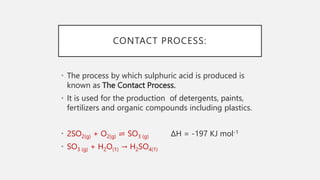
CONTACT PROCESS:
• The process by which sulphuric acid is produced is
known as The Contact Process.
• It is used for the production of detergents, paints,
fertilizers and organic compounds including plastics.
• 2SO2(g) + O2(g) ⇌ SO3 (g) ΔH = -197 KJ mol-1
• SO3 (g) + H2O(1) → H2SO4(1)
• SOURCES OF SULPHUR DIOXIDE AND OXYGEN:
• Sulphur dioxide is produced by sulfide ores / burning Sulphur with an excess of
oxygen in the air.
S (s) + O2 (g) → SO2 (g)
• Air is the source of oxygen in the contact process.
• CONDITIONS OF CONTACT PROCESS:
• Temperature of 450˚C
• Pressure of 200 kPa (2 atm)
• Catalyst Vanadium (V) Oxide (V₂O₅)
WHY TYPICAL CONDITIONS USED IN
HABER AND CONTACT PROCESS?
• The Haber process is a reversible reaction. As we’ve seen, the
Haber process is a reversible reaction. This means that the
product (ammonia) can re-form the reactants (nitrogen and
hydrogen). A point will be reached where dynamic equilibrium is
reached and the rate of the forward reaction equal the rate of
the reverse reaction.
• In the Haber process, we could increase the temperature of the
reaction to increase the rate of the reaction. However, an increase
in temperature would shift the equilibrium to favor
the endothermic reaction (the backwards reaction), to reduce the
temperature, which would produce nitrogen and hydrogen.
• Low temperatures favor the production of ammonia. If we decrease the
temperature at equilibrium, the exothermic, forward reaction is favored to
oppose the reduction temperature. A high yield of ammonia is produced.
However, low temperatures have a very slow rate of reaction.
• High pressures increase the yield of ammonia. In the Haber process, an increase
in pressure would favor the production of ammonia, as there are fewer molecules
on the right hand side of the reaction. The equilibrium will shift to favor the
reduction in pressure. Therefore, high pressure leads to a high yield of ammonia.
• High pressures can be dangerous. Using high pressures can be very dangerous,
as this can lead to explosions, due to the hydrogen gas being used.
THANK YOU

Equilibrium reactions.pptx

  • 1.
  • 2.
    EQUILIBRIUM REACTIONS: • Areversible reaction in a closed system is at equilibrium when the rate of forward reaction is equal to the rate of reverse reaction, and the concentrations are no longer changing. • Rf = Rr • Reversible reaction is denoted by this arrow:
  • 3.
    CONDITIONS FOR DIRECTIONSOF EQUILIBRIUM REACTIONS: • COBALT (II) CHLORIDE: • It exists in two forms: 1. Hydrated cobalt (II) chloride (pink) 2. Anhydrous cobalt (II) chloride (blue) hydrated cobalt (II) chloride ⇌ anhydrous cobalt (II) chloride + water
  • 4.
    HYDRATION AND DEHYDRATIONOF COBALT (II) CHLORIDE:
  • 5.
    HYDRATION AND DEHYDRATION •When anhydrous blue cobalt(II) chloride crystals are added to water they turn pink and the reaction is reversible. • When the cobalt(II) chloride crystals are heated in a test tube, the pink crystals turn back to the blue colour again as the water of crystallization is lost. • CoCl2.6H2O (s) ⇌ CoCl2 (s) + 6H2O (l)
  • 6.
    HYDRATION AND DEHYDRATIONOF COPPER (II) SULPAHTE: • COPPER (II) SULPAHTE: • It exists in two forms: 1. Hydrated copper (II) sulphate (blue) hydrated copper(II) sulfate ⇌ + water
  • 7.
    HYDRATION AND DEHYDRATIONOF COPPER (II) SULPHATE:
  • 8.
    HYDRATION AND DEHYDRATION: •When crystals are added to water they turn blue and heat is given off (exothermic); this reaction is reversible. • When copper(II) sulfate crystals are heated in a test tube, the blue crystals turn into a and a clear, colourless liquid (water) collects at the top of the test tube. • CuSO4.5H2O (s) ⇌ + 5H2O (l)
  • 9.
    FACTORS AFFECTING EQUILIBRIUM POSITIONS: •This principle was given by Le-Chatelier. • The position of equilibrium can be affected by the following factors: 1. Change in Concentration 2. Change in Temperature 3. Change in Pressure 4. Addition of a Catalyst
  • 10.
    CHANGE IN CONCENTRATION: •When concentration is increased, equilibrium shifts towards the opposite of the reaction. • When the concentration is decreased, the equilibrium will move towards the same side of the reaction.
  • 11.
    EXAMPLE: • Let’s lookat this example of a reversible reaction, involving the formation of ammonia. N2 + 3H2 ⇌ 2NH3 • If we increase the amount of nitrogen, the forward reaction is favored. This causes an increase in formation of ammonia, NH3. • If we increase the amount of ammonia, then the reverse reaction is favored.
  • 12.
    CHANGE IN PRESSURE: •Increase in pressure favors the side with fewer number of moles. • Decrease in pressure favors the side with more number of moles.
  • 13.
    EXAMPLE: N2 + 3H2⇌ 2NH3 • In this reaction, there are 4 moles of molecules on the left and 2 moles of molecules on the right hand side. • If we increase the pressure of this reaction, then the reaction with the fewest number of molecules is favored, which leads to the formation of NH3. • If we decrease the pressure of this reaction, then the reaction with the largest number of molecules is favored, which leads to the formation of N2 and H2.
  • 14.
    CHANGE IN TEMPERATURE: •Increase in temperature means endothermic reaction would be favored to counter act the excess heat. • Decrease in temperature means exothermic reaction would be favored to produce more energy.
  • 15.
    EXAMPLE: N2 + 3H2⇌ 2NH3 ∆H = -92 KJ/mol • In this instance, the forward reaction is exothermic. • If we increase the temperature in this reaction, then the reverse reaction is favored, which leads to the formation of N2 and H2. • If we decrease the temperature in this reaction, then the forward reaction is favored, which leads to the formation of NH3.
  • 16.
    CATALYST: • The presenceof a catalyst does not affect the position of equilibrium but it does increase the rate at which equilibrium is reached. • This is because the catalyst increases the rate of both the forward and backward reactions by the same amount (by providing an alternative pathway requiring lower activation energy).
  • 18.
    HABER PROCESS: • Nitrogenfrom air is used to manufacture ammonia. The major process for ammonia is The Haber Process. • Ammonia is used in the manufacture of explosives, nitric acid and fertilizers. N2 (g) + 3H2 (g) ⇌ 2NH3 (g) ∆H = -92 KJ/mol
  • 19.
    • SOURCES OFNITROGEN AND HYDROGEN: • Nitrogen is obtained from the atmosphere by fractional distillation of liquid air. • Hydrogen is obtained from the reaction between methane and steam. CH4 (g) + H2O (g) → CO (g) + 3H2 (g) • This process is known as steam reforming and it is a reversible reaction. • CONDITIONS OF HABER PROCESS: • The process is carried out at: 1. Temperature of 450˚C. 2. Pressure of 20,000 kPa (200 atm) 3. Catalyst (Iron) 4. Nitrogen and Hydrogen in a ratio of 1:3
  • 20.
    • PROCEDURE: 1. Ammoniais manufactured in an exothermic reaction called the Haber process which occurs in five stages: 2. Stage 1: H2 and N2 are obtained from natural gas and the air respectively and are pumped into the compressor through pipe. 3. Stage 2: The gases are compressed to about 200 atmospheres inside the compressor. 4. Stage 3: The pressurized gases are pumped into a tank containing layers of catalytic iron beds at a temperature of 450 °C. Some of the hydrogen and nitrogen react to form ammonia: N2 (g) + 3H2 (g) ⇌ 2NH3 (g) 5. Stage 4: Unreacted H2 and N2 and the product ammonia pass into a cooling tank. The ammonia is liquefied and removed to pressurized storage vessels. 6. Stage 5: The unreacted H2 and N2 gases are recycled back into the system and start over again.
  • 23.
    CONTACT PROCESS: • Theprocess by which sulphuric acid is produced is known as The Contact Process. • It is used for the production of detergents, paints, fertilizers and organic compounds including plastics. • 2SO2(g) + O2(g) ⇌ SO3 (g) ΔH = -197 KJ mol-1 • SO3 (g) + H2O(1) → H2SO4(1)
  • 24.
    • SOURCES OFSULPHUR DIOXIDE AND OXYGEN: • Sulphur dioxide is produced by sulfide ores / burning Sulphur with an excess of oxygen in the air. S (s) + O2 (g) → SO2 (g) • Air is the source of oxygen in the contact process. • CONDITIONS OF CONTACT PROCESS: • Temperature of 450˚C • Pressure of 200 kPa (2 atm) • Catalyst Vanadium (V) Oxide (V₂O₅)
  • 27.
    WHY TYPICAL CONDITIONSUSED IN HABER AND CONTACT PROCESS? • The Haber process is a reversible reaction. As we’ve seen, the Haber process is a reversible reaction. This means that the product (ammonia) can re-form the reactants (nitrogen and hydrogen). A point will be reached where dynamic equilibrium is reached and the rate of the forward reaction equal the rate of the reverse reaction. • In the Haber process, we could increase the temperature of the reaction to increase the rate of the reaction. However, an increase in temperature would shift the equilibrium to favor the endothermic reaction (the backwards reaction), to reduce the temperature, which would produce nitrogen and hydrogen.
  • 28.
    • Low temperaturesfavor the production of ammonia. If we decrease the temperature at equilibrium, the exothermic, forward reaction is favored to oppose the reduction temperature. A high yield of ammonia is produced. However, low temperatures have a very slow rate of reaction. • High pressures increase the yield of ammonia. In the Haber process, an increase in pressure would favor the production of ammonia, as there are fewer molecules on the right hand side of the reaction. The equilibrium will shift to favor the reduction in pressure. Therefore, high pressure leads to a high yield of ammonia. • High pressures can be dangerous. Using high pressures can be very dangerous, as this can lead to explosions, due to the hydrogen gas being used.
  • 29.