Chemical
Equilibria
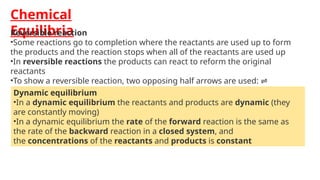
Reversible reaction
•Some reactionsgo to completion where the reactants are used up to form
the products and the reaction stops when all of the reactants are used up
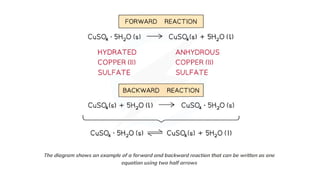
•In reversible reactions the products can react to reform the original
reactants
•To show a reversible reaction, two opposing half arrows are used: ⇌
Dynamic equilibrium
•In a dynamic equilibrium the reactants and products are dynamic (they
are constantly moving)
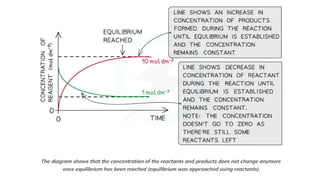
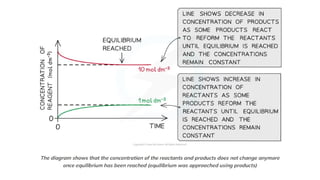
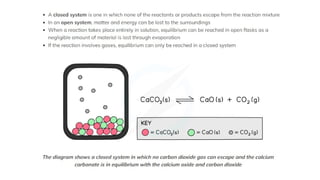
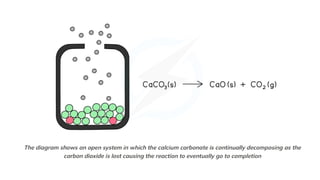
•In a dynamic equilibrium the rate of the forward reaction is the same as
the rate of the backward reaction in a closed system, and
the concentrations of the reactants and products is constant
8.
Le Chaterlier's
Principle
Position ofthe equilibrium
•The position of the equilibrium refers to the relative amounts of products
and reactants in an equilibrium mixture.
•When the position of equilibrium shifts to the left, it means the
concentration of reactants increases
•When the position of equilibrium shifts to the right, it means the
concentration of products increases
Le Chatelier’s principle
•Le Chatelier’s principle says that if a change is made to a system at dynamic
equilibrium, the position of the equilibrium moves to minimise this change
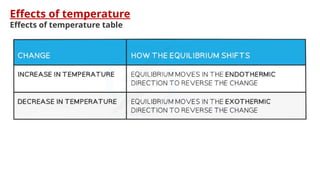
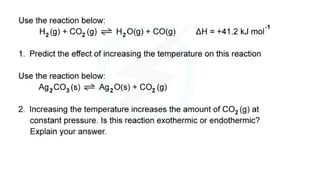
•The principle is used to predict changes to the position of equilibrium when
there are changes in temperature, pressure or concentration
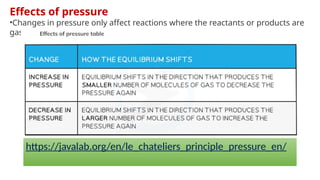
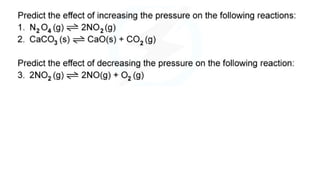
Effects of pressure
•Changesin pressure only affect reactions where the reactants or products are
gases
https://javalab.org/en/le_chateliers_principle_pressure_en/
Effects of catalysts
•Acatalyst is a substance that increases the rate of a chemical reaction (they
increase the rate of the forward and reverse reaction equally)
•Catalysts only cause a reaction to reach its equilibrium faster
•Catalysts therefore have no effect on the position of the
equilibrium once this is reached
15.
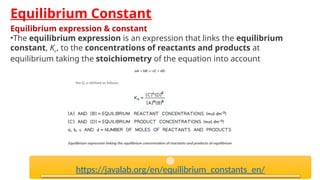
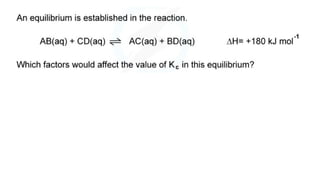
Equilibrium Constant
Equilibrium expression& constant
•The equilibrium expression is an expression that links the equilibrium
constant, Kc, to the concentrations of reactants and products at
equilibrium taking the stoichiometry of the equation into account
https://javalab.org/en/equilibrium_constants_en/
17.
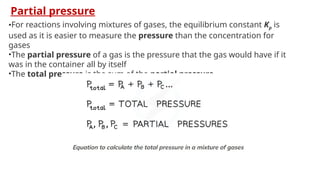
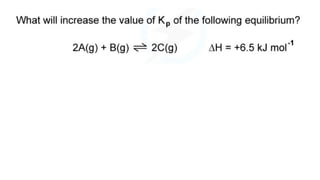
Partial pressure
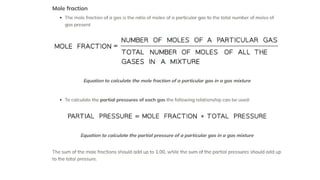
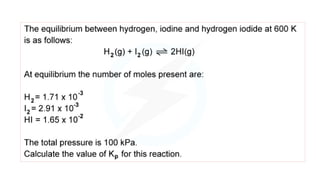
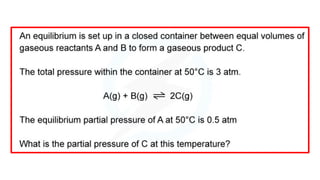
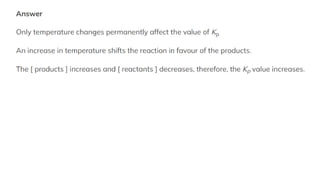
•For reactionsinvolving mixtures of gases, the equilibrium constant Kp is
used as it is easier to measure the pressure than the concentration for
gases
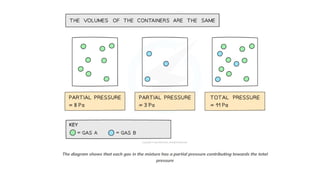
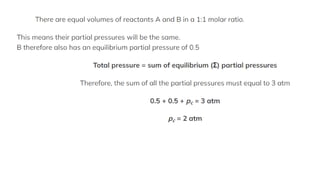
•The partial pressure of a gas is the pressure that the gas would have if it
was in the container all by itself
•The total pressure is the sum of the partial pressure
20.
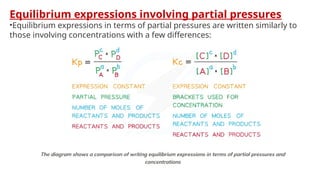
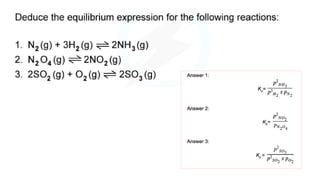
Equilibrium expressions involvingpartial pressures
•Equilibrium expressions in terms of partial pressures are written similarly to
those involving concentrations with a few differences:
22.
Equilibrium Constant
Calculations
Calculations involvingKc
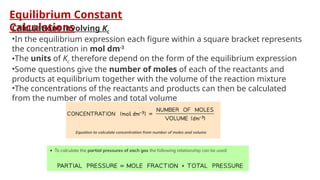
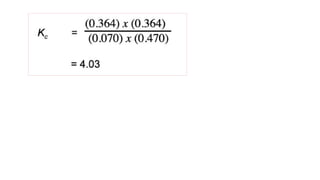
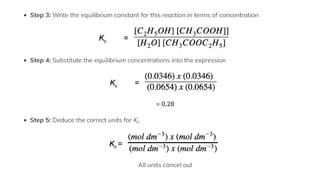
•In the equilibrium expression each figure within a square bracket represents
the concentration in mol dm-3
•The units of Kc therefore depend on the form of the equilibrium expression
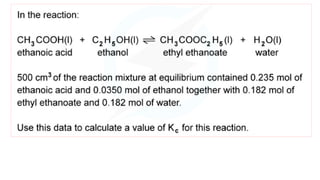
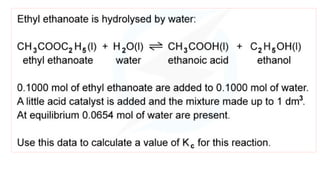
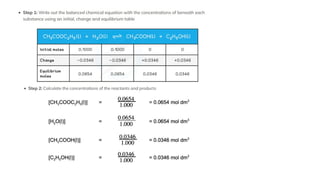
•Some questions give the number of moles of each of the reactants and
products at equilibrium together with the volume of the reaction mixture
•The concentrations of the reactants and products can then be calculated
from the number of moles and total volume
28.
Calculations involving Kp
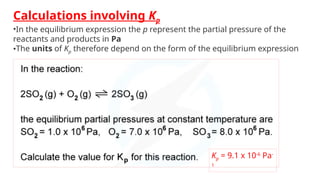
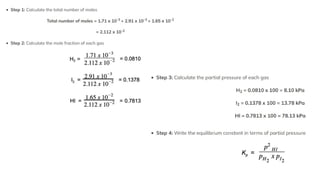
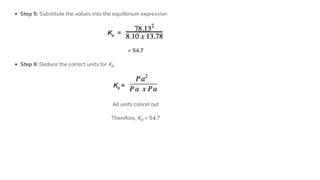
•Inthe equilibrium expression the p represent the partial pressure of the
reactants and products in Pa
•The units of Kp therefore depend on the form of the equilibrium expression
Kp = 9.1 x 10⁻⁶
Pa-
1
37.
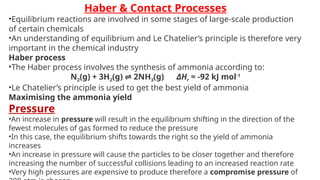
Haber & ContactProcesses
•Equilibrium reactions are involved in some stages of large-scale production
of certain chemicals
•An understanding of equilibrium and Le Chatelier’s principle is therefore very
important in the chemical industry
Haber process
•The Haber process involves the synthesis of ammonia according to:
N
2(g) + 3H2(g) 2NH
⇌ 3(g) ΔHr = -92 kJ mol-1
•Le Chatelier’s principle is used to get the best yield of ammonia
Maximising the ammonia yield
Pressure
•An increase in pressure will result in the equilibrium shifting in the direction of the
fewest molecules of gas formed to reduce the pressure
•In this case, the equilibrium shifts towards the right so the yield of ammonia
increases
•An increase in pressure will cause the particles to be closer together and therefore
increasing the number of successful collisions leading to an increased reaction rate
•Very high pressures are expensive to produce therefore a compromise pressure of
38.
Temperature
•To get themaximum yield of ammonia the position of equilibrium should be
shifted as far as possible to the right as possible
•Since the Haber process is an exothermic reaction, according to Le
Chatelier’s principle the equilibrium will shift to the right if the temperature is
lowered
•A decrease in temperature will decrease the energy of the surroundings so
the reaction will go in the direction in which energy is released to counteract
this
•Since the reaction is exothermic, the equilibrium shifts to the right
•However, at a low temperature the gases won’t have enough kinetic energy
to collide and react and therefore equilibrium would not be reached
therefore compromise temperature of 400-450 o
C is used in the Haber
process
•A heat exchanger warms the incoming gas mixture to give molecules
39.
Catalysts
•In the absenceof a catalyst the reaction is so slow that hardly anything happens in a
reasonable time!
•Adding an iron catalyst speeds up the rate of reaction
Contact process
•The Contact process involves the synthesis of sulfuric acid according to:
2SO
2(g) + O2(g) 2SO
⇌ 3(g) ΔHr = -197 kJ mol-1
•Le Chatelier’s principle is used to get the best yield of sulfuric acid
Maximising the sulfuric acid yield
1. Pressure
•An increase in pressure will result in the equilibrium shifting in the
direction of the fewest molecules of gas formed to reduce the pressure
•In this case, the equilibrium shifts towards the right so the yield of
sulfuric acid increases
•In practice, the reaction is carried out at only 1 atm
•This is because Kp for this reaction is already very high meaning that the
position of the equilibrium is already far over to the right
•Higher pressures than 1 atm will be unnecessary and expensive
40.
2. Temperature
•The sameprinciple applies to increasing the temperature in the Contact
process as in the Haber process
•A compromise temperature of 450 o
C is used
3. Removing sulfuric acid
•SO3 is removed by absorbing it in 98% sulfuric acid
•The SO3 reacts with the solution and more H2SO4 is formed
4. Catalysts
•The Contact process uses vanadium(V) oxide as a catalyst to increase the
rate of reaction
Brønsted–Lowry Theory
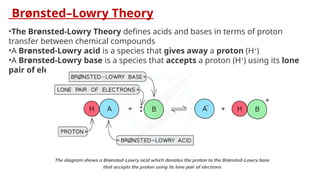
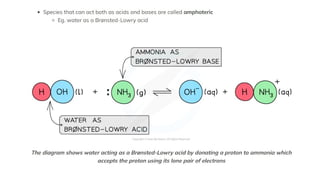
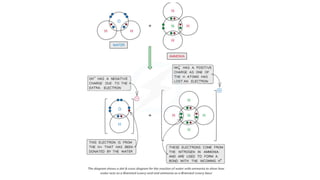
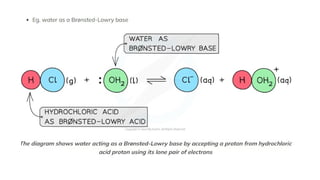
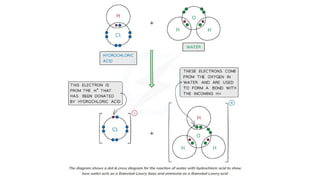
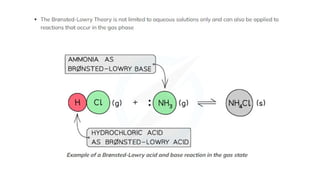
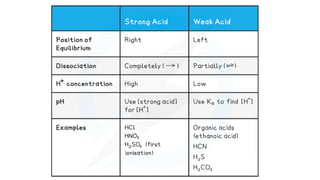
•The Brønsted-LowryTheory defines acids and bases in terms of proton
transfer between chemical compounds
•A Brønsted-Lowry acid is a species that gives away a proton (H+
)
•A Brønsted-Lowry base is a species that accepts a proton (H+
) using its lone
pair of electrons
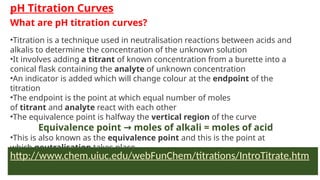
pH Titration Curves
Whatare pH titration curves?
•Titration is a technique used in neutralisation reactions between acids and
alkalis to determine the concentration of the unknown solution
•It involves adding a titrant of known concentration from a burette into a
conical flask containing the analyte of unknown concentration
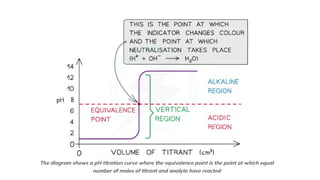
•An indicator is added which will change colour at the endpoint of the
titration
•The endpoint is the point at which equal number of moles
of titrant and analyte react with each other
•The equivalence point is halfway the vertical region of the curve
Equivalence point moles of alkali = moles of acid
→
•This is also known as the equivalence point and this is the point at
which neutralisation takes place
http://www.chem.uiuc.edu/webFunChem/titrations/IntroTitrate.htm
78.
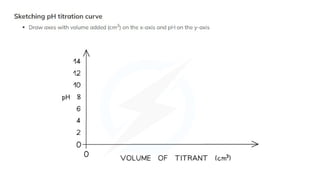
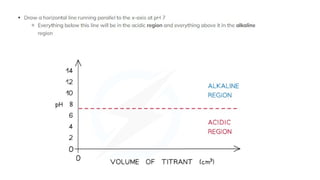
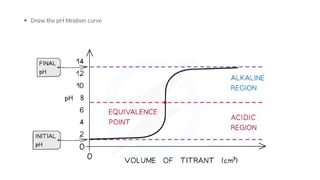
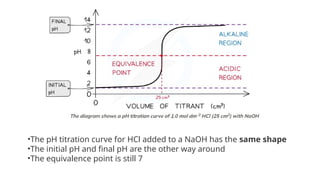
Strong acid +strong alkali pH titration curve
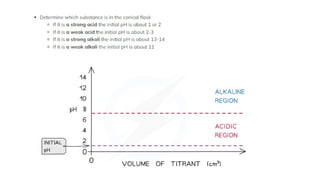
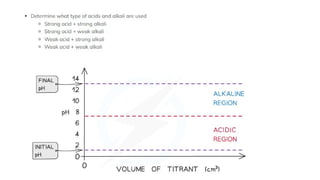
•Initially there are only H+
ions present in solution from the dissociation of the
strong acid (HCl) (initial pH about 1-2)
•As the volume of strong alkali (NaOH) added increases, the pH of the HCl
solution slightly increases too as more and more H+
ions react with the
OH-
from the NaOH to form water
•The change in pH is not that much until the volume added gets close to the
equivalence point
•The pH surges upwards very steeply
•The equivalence point is the point at which all H+
ions have been neutralised
(therefore pH is 7 at equivalence point)
•Adding more NaOH will increase the pH as now there is an excess in
OH-
ions (final pH about 13-14)
79.
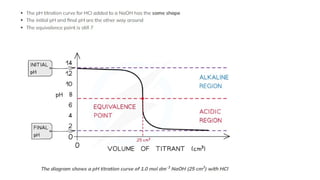
•The pH titrationcurve for HCl added to a NaOH has the same shape
•The initial pH and final pH are the other way around
•The equivalence point is still 7
81.
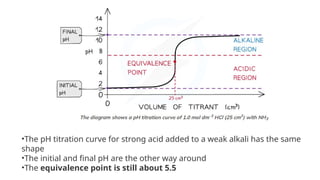
Strong acid +weak alkali pH titration curve
•Initially, there are only H+
ions present in solution from the dissociation of
the strong acid (HCl) (initial pH about 1-2)
•As the volume of weak alkali (NH3) added increases, the pH of the analyte
solution slightly increases too as more and more H+
ions react with the
NH3
•The change in pH is not that much until the volume added gets close to the
equivalence point
•The equivalence point is the point at which all H+
ions have been
neutralised by the NH3 however the equivalence point is not neutral, but
the solution is still acidic (pH about 5.5)
•This is because all H+
have reacted with NH3 to form NH4
+
which is a
relatively strong acid, causing the solution to be acidic
•As more of the NH3 is added, the pH increases to above 7 but below that of
a strong alkali as NH3 is a weak alkali
82.
•The pH titrationcurve for strong acid added to a weak alkali has the same
shape
•The initial and final pH are the other way around
•The equivalence point is still about 5.5
83.
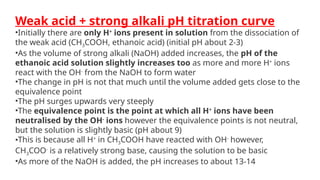
Weak acid +strong alkali pH titration curve
•Initially there are only H+
ions present in solution from the dissociation of
the weak acid (CH3COOH, ethanoic acid) (initial pH about 2-3)
•As the volume of strong alkali (NaOH) added increases, the pH of the
ethanoic acid solution slightly increases too as more and more H+
ions
react with the OH-
from the NaOH to form water
•The change in pH is not that much until the volume added gets close to the
equivalence point
•The pH surges upwards very steeply
•The equivalence point is the point at which all H+
ions have been
neutralised by the OH-
ions however the equivalence points is not neutral,
but the solution is slightly basic (pH about 9)
•This is because all H+
in CH3COOH have reacted with OH-
however,
CH3COO-
is a relatively strong base, causing the solution to be basic
•As more of the NaOH is added, the pH increases to about 13-14
84.
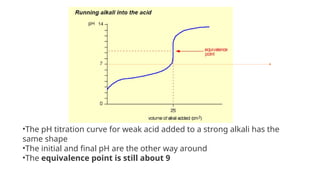
•The pH titrationcurve for weak acid added to a strong alkali has the
same shape
•The initial and final pH are the other way around
•The equivalence point is still about 9
85.
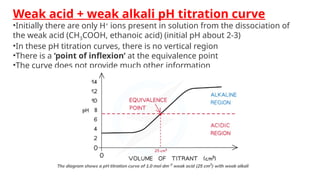
Weak acid +weak alkali pH titration curve
•Initially there are only H+
ions present in solution from the dissociation of
the weak acid (CH3COOH, ethanoic acid) (initial pH about 2-3)
•In these pH titration curves, there is no vertical region
•There is a ‘point of inflexion’ at the equivalence point
•The curve does not provide much other information
86.
Indicators used in
Titration
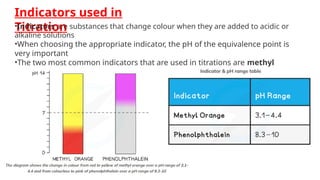
•Indicatorsare substances that change colour when they are added to acidic or
alkaline solutions
•When choosing the appropriate indicator, the pH of the equivalence point is
very important
•The two most common indicators that are used in titrations are methyl
orange and phenolphthalein
•Both indicators change colour over a specific pH range
87.
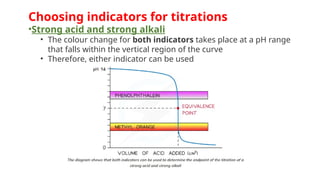
Choosing indicators fortitrations
•Strong acid and strong alkali
• The colour change for both indicators takes place at a pH range
that falls within the vertical region of the curve
• Therefore, either indicator can be used
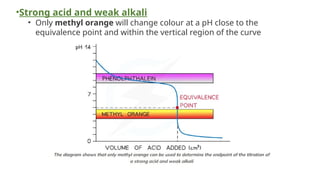
88.
•Strong acid andweak alkali
• Only methyl orange will change colour at a pH close to the
equivalence point and within the vertical region of the curve
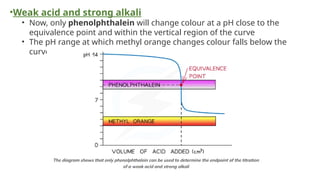
89.
•Weak acid andstrong alkali
• Now, only phenolphthalein will change colour at a pH close to the
equivalence point and within the vertical region of the curve
• The pH range at which methyl orange changes colour falls below the
curve
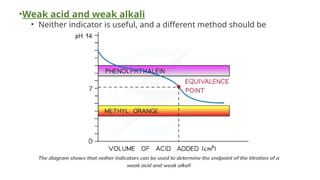
90.
•Weak acid andweak alkali
• Neither indicator is useful, and a different method should be
considered