MCA
Homogeneity of Equations
Relationships and Graphs
05.09.2021
MCA
Learning Objectives
11.1.1.3 - use SI base units to check the homogeneity of physical
equations;
11.1.1.5 - analyse relationships in the forms of y=axn and y=aekx;
11.1.1.6 - analyse logarithmic relationships;
11.1.2.5 - derive a relationship between two variables or recognise a
constant;
MCA
Homogeneity of Equations
 An equation is homogeneous only if all terms in the equation have
the same combination of SI base units
• A valid equation must be homogeneous
• A homogeneous equation is not necessarily valid
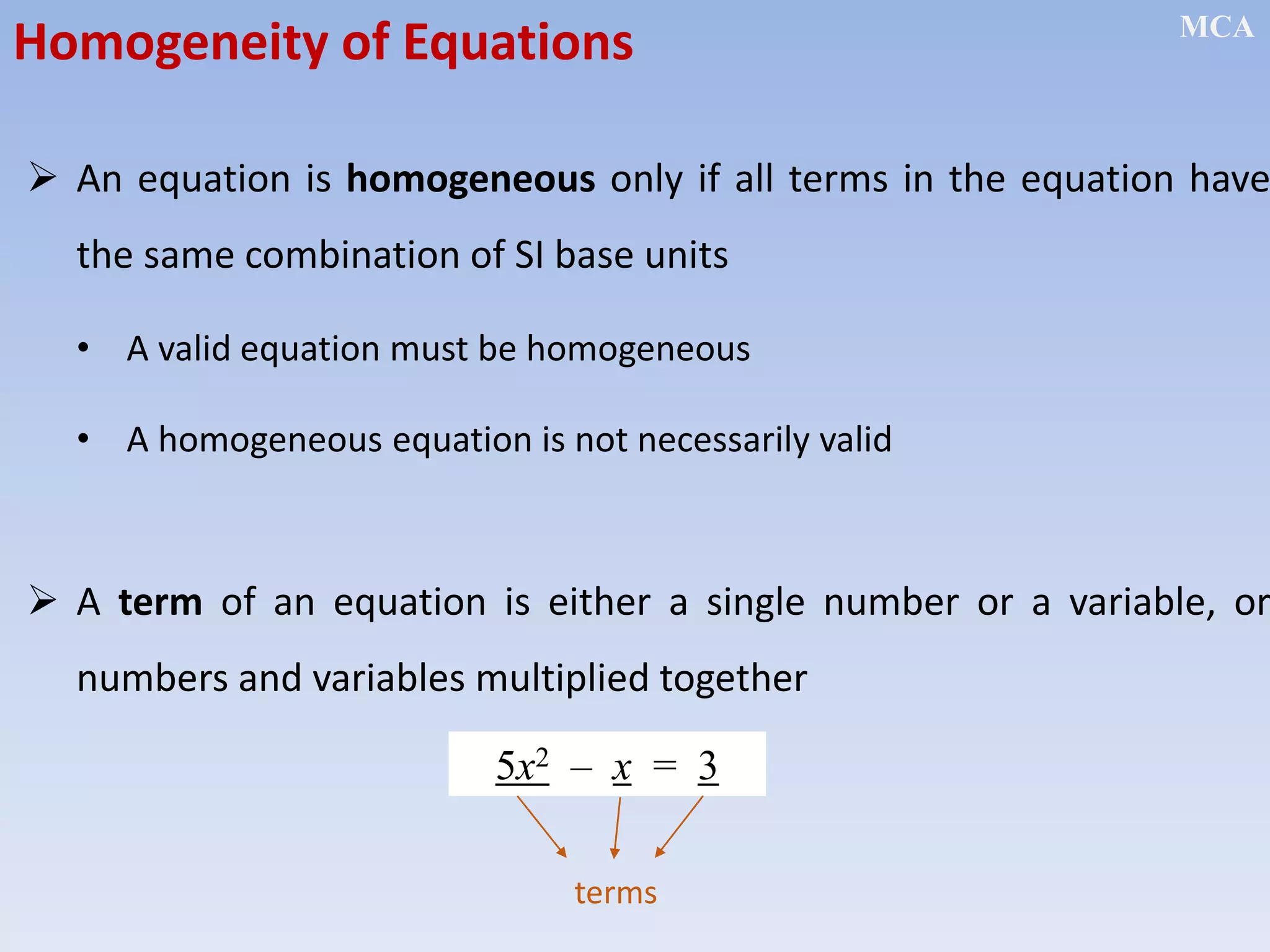
 A term of an equation is either a single number or a variable, or
numbers and variables multiplied together
5x2 – x = 3
terms
MCA
Homogeneity of Equations
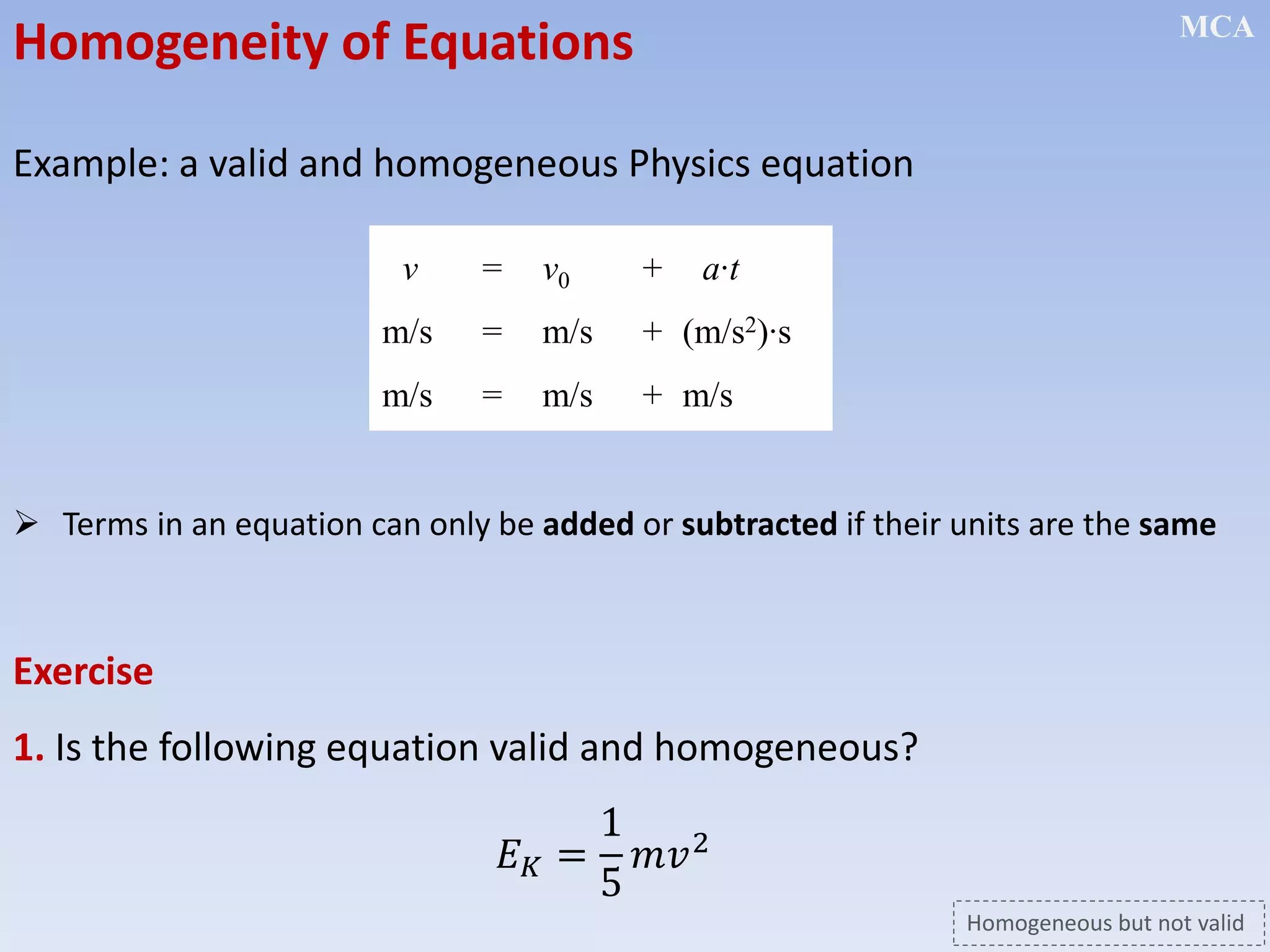
Example: a valid and homogeneous Physics equation
 Terms in an equation can only be added or subtracted if their units are the same
Exercise
1. Is the following equation valid and homogeneous?
v = v0 + a∙t
m/s = m/s + (m/s2)∙s
m/s = m/s + m/s
𝐸𝐾 =
1
5
𝑚𝑣2
Homogeneous but not valid
MCA
Exercises & Problems
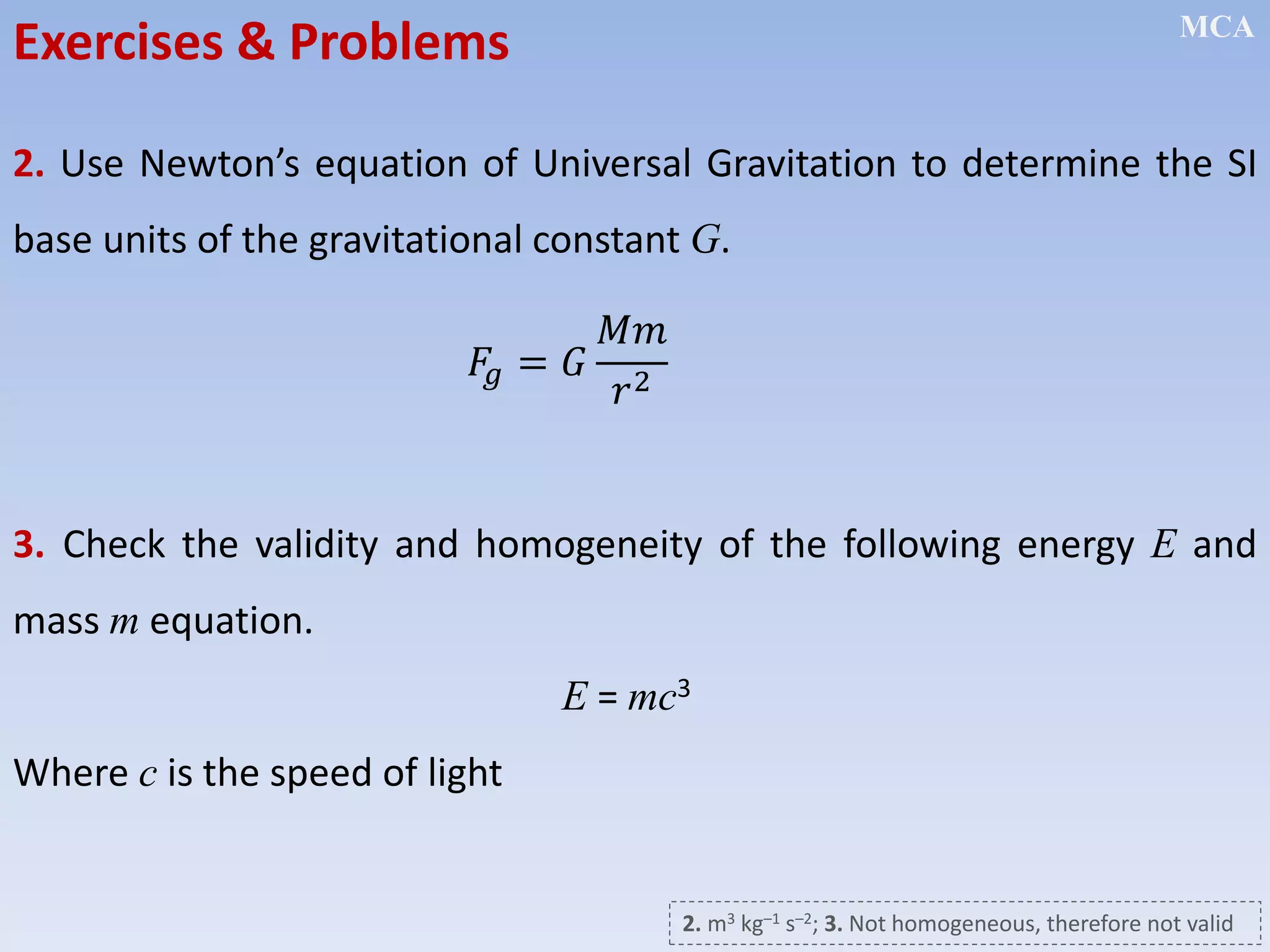
2. Use Newton’s equation of Universal Gravitation to determine the SI
base units of the gravitational constant G.
3. Check the validity and homogeneity of the following energy E and
mass m equation.
E = mc3
Where c is the speed of light
2. m3 kg–1 s–2; 3. Not homogeneous, therefore not valid
𝐹
𝑔 = 𝐺
𝑀𝑚
𝑟2
MCA
Exercises & Problems
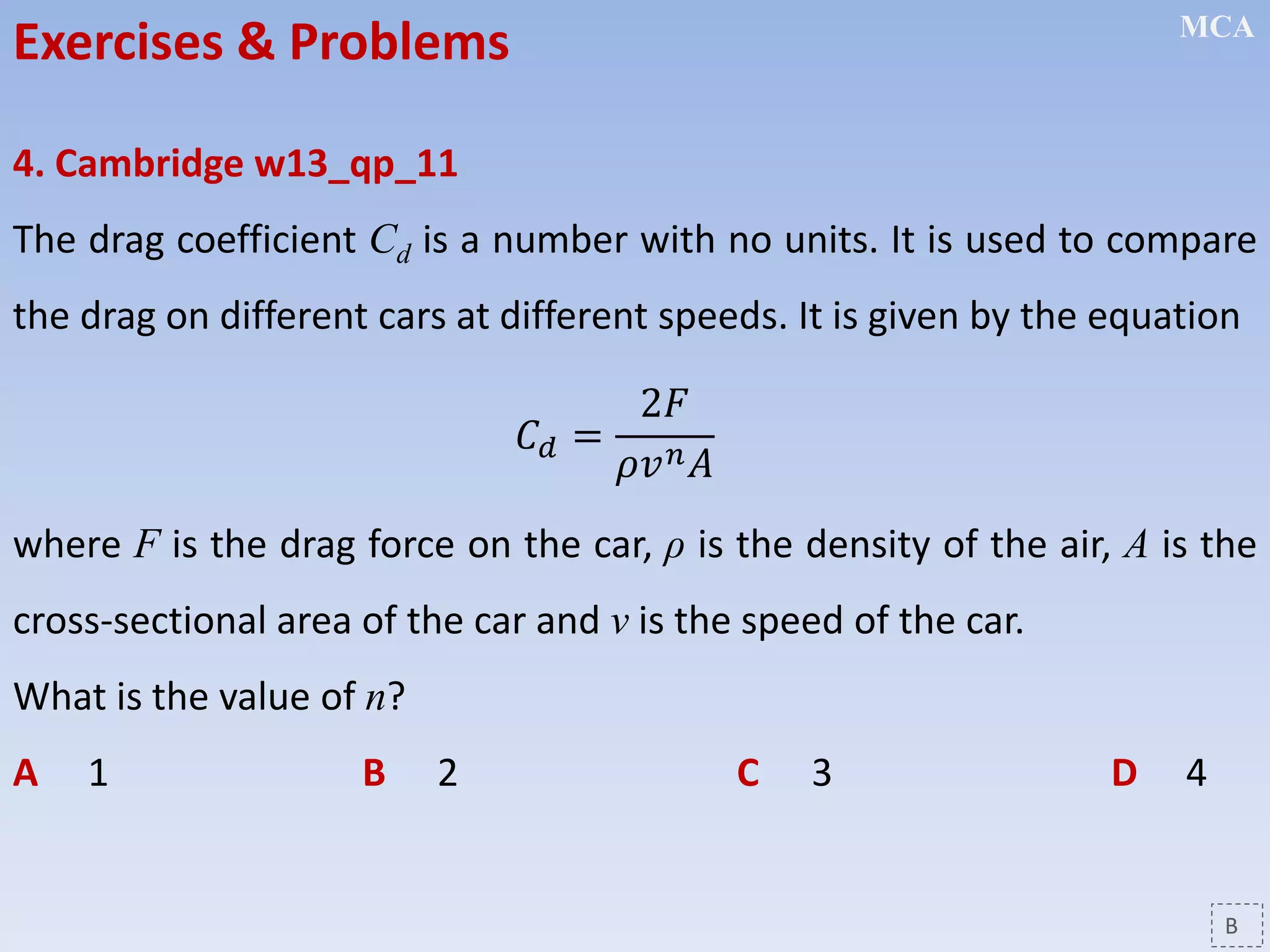
4. Cambridge w13_qp_11
The drag coefficient Cd is a number with no units. It is used to compare
the drag on different cars at different speeds. It is given by the equation
where F is the drag force on the car, ρ is the density of the air, A is the
cross-sectional area of the car and v is the speed of the car.
What is the value of n?
A 1 B 2 C 3 D 4
B
𝐶𝑑 =
2𝐹
𝜌𝑣𝑛𝐴
MCA
Exercises & Problems
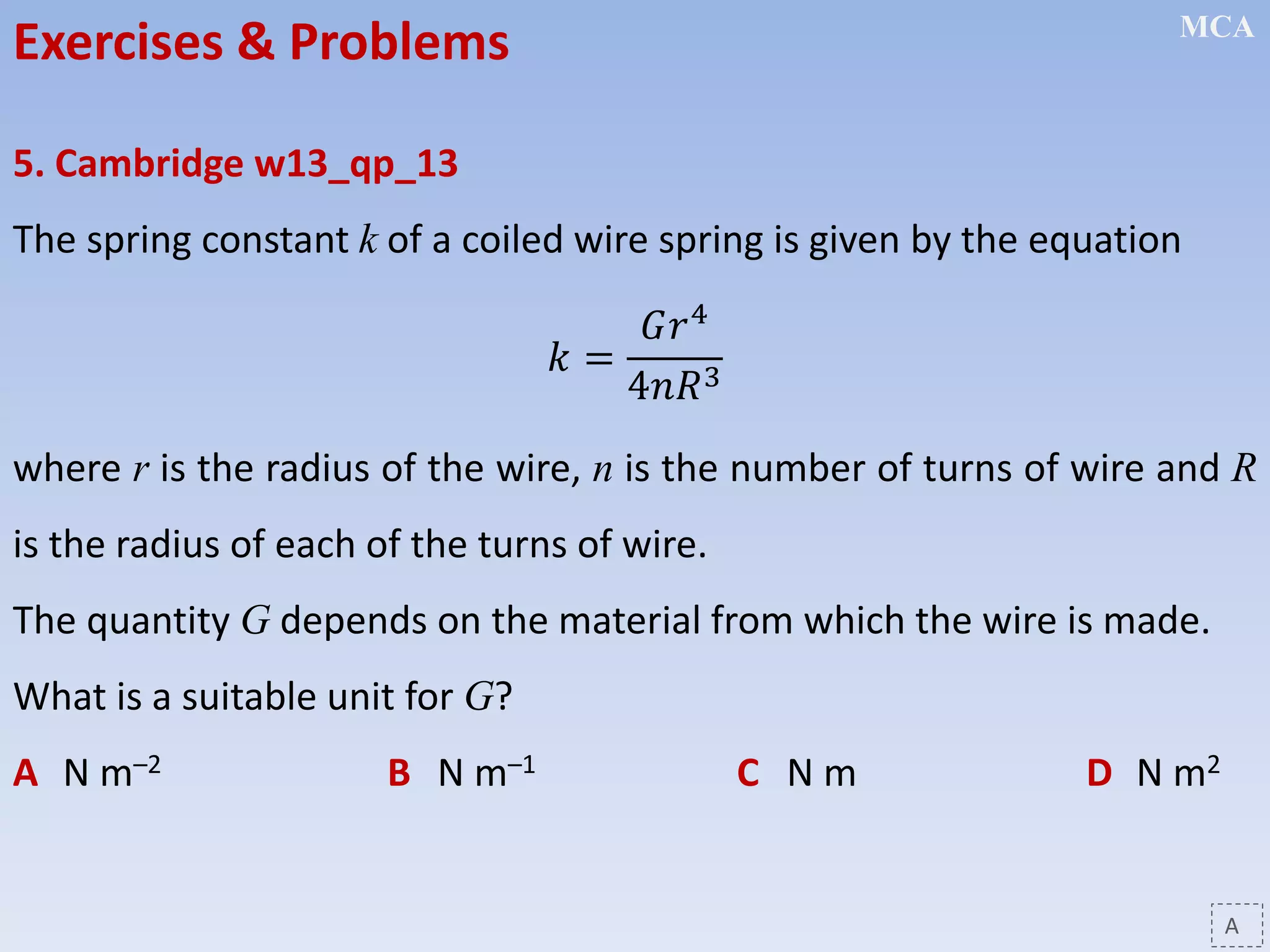
5. Cambridge w13_qp_13
The spring constant k of a coiled wire spring is given by the equation
where r is the radius of the wire, n is the number of turns of wire and R
is the radius of each of the turns of wire.
The quantity G depends on the material from which the wire is made.
What is a suitable unit for G?
A N m–2 B N m–1 C N m D N m2
A
𝑘 =
𝐺𝑟4
4𝑛𝑅3
MCA
Exercises & Problems
6. Cambridge w14_qp_21
A mass m is placed on the end of a spring that
is hanging vertically, as shown in Fig. 1.1.
The mass is made to oscillate vertically.
The time period of the oscillations of the
mass is T.
The period T is given by
𝑇 = 𝐶
𝑚
𝑘
where C is a constant and k is the spring constant.
Show that C has no units.
MCA
Graphs in Physics
 Graphs, and understanding the mathematical equation and physical
relationship between the dependent and independent variables are
of extreme importance in Physics and are widely used throughout
our programme
 In Physics, common graphs include direct and inverse
proportionalities, and logarithmic and exponential laws
We must understand the Mathematics and Physics behind these relationships
MCA
Exercises & Problems
7. a) Sketch a x-y graph which shows that
i) quantities x and y are directly proportional;
ii) quantities x and y are inversely proportional.
b) Give one example of a Physics formula for each graph on a).
8. A car is moving on a straight line with a velocity v given by
v = 4 – 2t (m s–1)
a) Sketch a graph of v as a function of time t.
b) State the gradient and the y-intercept of the graph on a).
8. b) y = 4 m/s; gradient = –2 m/s2
MCA
Exercises & Problems
9. The graph represents a linear relationship
between two physical quantities, x and y.
Explain the physical meaning of the gradient
in the following cases.
a) Mass; b) 1/k; c) Acceleration; d) Velocity; e) 1/R
a) Studying Newton’s Second Law, where y = force and x = acceleration.
b) Studying Hooke’s Law, where y = elongation and x = force.
c) Representing the motion of a car, where y = velocity and x = time.
d) Representing the motion of a car, where y = position and x = time.
e) Measuring the resistance, where y = current and x = p.d..
y
x
MCA
Exercises & Problems
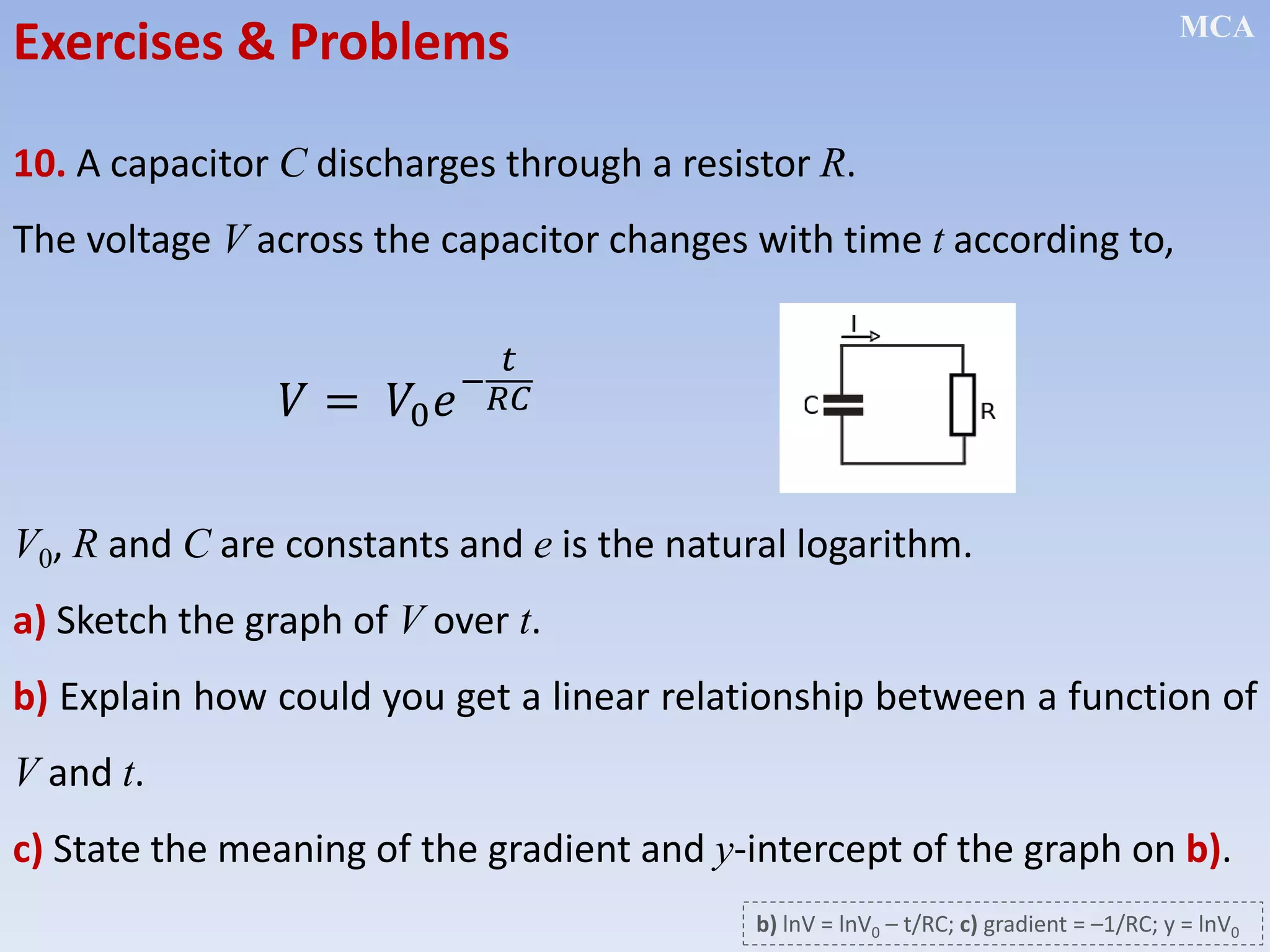
10. A capacitor C discharges through a resistor R.
The voltage V across the capacitor changes with time t according to,
V0, R and C are constants and e is the natural logarithm.
a) Sketch the graph of V over t.
b) Explain how could you get a linear relationship between a function of
V and t.
c) State the meaning of the gradient and y-intercept of the graph on b).
b) lnV = lnV0 – t/RC; c) gradient = –1/RC; y = lnV0
𝑉 = 𝑉0𝑒−
𝑡
𝑅𝐶
MCA
Exercises & Problems
11. Explain how can you plot a straight line graph of x over t from the
equation
x = At + Bt3
A and B are constants.
x/t against t2

Equations, Homogeneity, Graphs.pptx

  • 1.
  • 2.
    MCA Learning Objectives 11.1.1.3 -use SI base units to check the homogeneity of physical equations; 11.1.1.5 - analyse relationships in the forms of y=axn and y=aekx; 11.1.1.6 - analyse logarithmic relationships; 11.1.2.5 - derive a relationship between two variables or recognise a constant;
  • 3.
    MCA Homogeneity of Equations An equation is homogeneous only if all terms in the equation have the same combination of SI base units • A valid equation must be homogeneous • A homogeneous equation is not necessarily valid  A term of an equation is either a single number or a variable, or numbers and variables multiplied together 5x2 – x = 3 terms
  • 4.
    MCA Homogeneity of Equations Example:a valid and homogeneous Physics equation  Terms in an equation can only be added or subtracted if their units are the same Exercise 1. Is the following equation valid and homogeneous? v = v0 + a∙t m/s = m/s + (m/s2)∙s m/s = m/s + m/s 𝐸𝐾 = 1 5 𝑚𝑣2 Homogeneous but not valid
  • 5.
    MCA Exercises & Problems 2.Use Newton’s equation of Universal Gravitation to determine the SI base units of the gravitational constant G. 3. Check the validity and homogeneity of the following energy E and mass m equation. E = mc3 Where c is the speed of light 2. m3 kg–1 s–2; 3. Not homogeneous, therefore not valid 𝐹 𝑔 = 𝐺 𝑀𝑚 𝑟2
  • 6.
    MCA Exercises & Problems 4.Cambridge w13_qp_11 The drag coefficient Cd is a number with no units. It is used to compare the drag on different cars at different speeds. It is given by the equation where F is the drag force on the car, ρ is the density of the air, A is the cross-sectional area of the car and v is the speed of the car. What is the value of n? A 1 B 2 C 3 D 4 B 𝐶𝑑 = 2𝐹 𝜌𝑣𝑛𝐴
  • 7.
    MCA Exercises & Problems 5.Cambridge w13_qp_13 The spring constant k of a coiled wire spring is given by the equation where r is the radius of the wire, n is the number of turns of wire and R is the radius of each of the turns of wire. The quantity G depends on the material from which the wire is made. What is a suitable unit for G? A N m–2 B N m–1 C N m D N m2 A 𝑘 = 𝐺𝑟4 4𝑛𝑅3
  • 8.
    MCA Exercises & Problems 6.Cambridge w14_qp_21 A mass m is placed on the end of a spring that is hanging vertically, as shown in Fig. 1.1. The mass is made to oscillate vertically. The time period of the oscillations of the mass is T. The period T is given by 𝑇 = 𝐶 𝑚 𝑘 where C is a constant and k is the spring constant. Show that C has no units.
  • 9.
    MCA Graphs in Physics Graphs, and understanding the mathematical equation and physical relationship between the dependent and independent variables are of extreme importance in Physics and are widely used throughout our programme  In Physics, common graphs include direct and inverse proportionalities, and logarithmic and exponential laws We must understand the Mathematics and Physics behind these relationships
  • 10.
    MCA Exercises & Problems 7.a) Sketch a x-y graph which shows that i) quantities x and y are directly proportional; ii) quantities x and y are inversely proportional. b) Give one example of a Physics formula for each graph on a). 8. A car is moving on a straight line with a velocity v given by v = 4 – 2t (m s–1) a) Sketch a graph of v as a function of time t. b) State the gradient and the y-intercept of the graph on a). 8. b) y = 4 m/s; gradient = –2 m/s2
  • 11.
    MCA Exercises & Problems 9.The graph represents a linear relationship between two physical quantities, x and y. Explain the physical meaning of the gradient in the following cases. a) Mass; b) 1/k; c) Acceleration; d) Velocity; e) 1/R a) Studying Newton’s Second Law, where y = force and x = acceleration. b) Studying Hooke’s Law, where y = elongation and x = force. c) Representing the motion of a car, where y = velocity and x = time. d) Representing the motion of a car, where y = position and x = time. e) Measuring the resistance, where y = current and x = p.d.. y x
  • 12.
    MCA Exercises & Problems 10.A capacitor C discharges through a resistor R. The voltage V across the capacitor changes with time t according to, V0, R and C are constants and e is the natural logarithm. a) Sketch the graph of V over t. b) Explain how could you get a linear relationship between a function of V and t. c) State the meaning of the gradient and y-intercept of the graph on b). b) lnV = lnV0 – t/RC; c) gradient = –1/RC; y = lnV0 𝑉 = 𝑉0𝑒− 𝑡 𝑅𝐶
  • 13.
    MCA Exercises & Problems 11.Explain how can you plot a straight line graph of x over t from the equation x = At + Bt3 A and B are constants. x/t against t2