A m e r i c a n C o n s t i t u t i o n a l L a w
Equal Protection
Blue linksBlue links lead to additional information
Words in Red are vocabulary you should know
L e c t u r e O v e r v i e w
●
Goals
– Provide a basic
understanding of how
U.S. law looks at
discrimination
– Explain the analysis
steps used by courts to
determine whether is
discrimination violates
the Constitution.
●
Structure
– Types of
discrimination
– Determining Level of
Scrutiny
– Applying the Level of
Scrutiny
1 4 t h A m e n d m e n t E q u a l i t y
●
Equal Protection ClauseEqual Protection Clause is
found in the 14th Amendment.
– “No state shall . . . deny to any
person within its jurisdiction the
equal protection of the laws.”
●
NOTE - “any person”
●
NOTE - “no state”
●
We commonly think of Equal
Protection cases as “discrimination”
cases.
●
Also applies to Federal Government
via the 5th Amendment.
– Reverse incorporationReverse incorporation
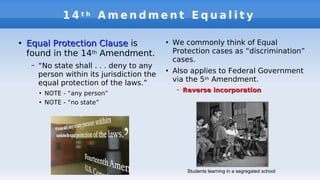
Students learning in a segregated school
Z u s a t z a r t i k e l X I V & V
●
Keiner der Einzelstaaten darf .
. . irgend jemandem
innerhalb seines
Hoheitsbereiches den
gleichen Schutz durch das
Gesetz versagen.
– Zusatzartikel XIV
●
Niemand darf . . . der
Freiheit oder des Eigentums
ohne vorheriges ordentliches
Gerichtsverfahren nach
Recht und Gesetz beraubt
werden.
– Zusatzartikel V
T h e M e a n i n g o f E q u a l P r o t e c t i o n
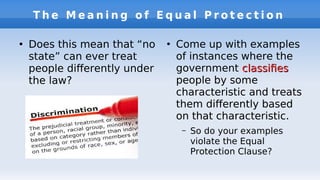
●
Does this mean that “no
state” can ever treat
people diferently under
the law?
●
Come up with examples
of instances where the
government classifesclassifes
people by some
characteristic and treats
them diferently based
on that characteristic.
– So do your examples
violate the Equal
Protection Clause?
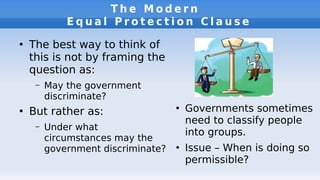
T h e M o d e r n
E q u a l P r o t e c t i o n C l a u s e
●
The best way to think of
this is not by framing the
question as:
– May the government
discriminate?
●
But rather as:
– Under what
circumstances may the
government discriminate?
●
Governments sometimes
need to classify people
into groups.
●
Issue – When is doing so
permissible?
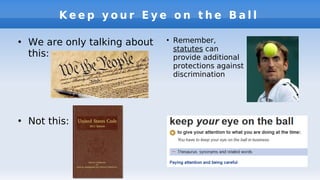
K e e p y o u r E y e o n t h e B a l l
●
We are only talking about
this:
●
Not this:
●
Remember,
statutes can
provide additional
protections against
discrimination
S t e p s i n E q u a l P r o t e c t i o n B a l a n c i n g
●
Step 1: What is the ClassifcationClassifcation and is it
discriminatory?
●
Step 2: What is the Appropriate Level of ScrutinyLevel of Scrutiny?
– Strict
– Intermediate
– Rational Basis
●
Step 3: Does the Government Classifcation Meet
the Level of ScrutinyLevel of Scrutiny?
– The Court will look at the ends and means
S t e p 1 : I s t h e c l a s s i f c a t i o n
d i s c r i m i n a t o r y ?
●
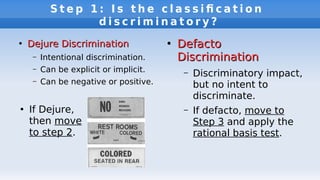
Dejure DiscriminationDejure Discrimination
– Intentional discrimination.
– Can be explicit or implicit.
– Can be negative or positive.
●
DefactoDefacto
DiscriminationDiscrimination
– Discriminatory impact,
but no intent to
discriminate.
– If defacto, move to
Step 3 and apply the
rational basis test.
●
If Dejure,
then move
to step 2.
K o r e m a t s u v . U n i t e d S t a t e s
●
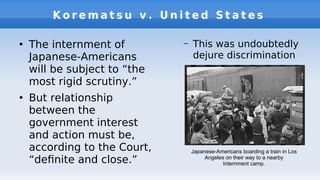
The internment of
Japanese-Americans
will be subject to “the
most rigid scrutiny.”
●
But relationship
between the
government interest
and action must be,
according to the Court,
“defnite and close.”
– This was undoubtedly
dejure discrimination
Japanese-Americans boarding a train in Los
Angeles on their way to a nearby
Internment camp.
I m p l i c i t D i s c r i m i n a t i o n : E n a c t m e n t
●
ImplicitImplicit = appears
neutral but motivated by
discriminatory intent.
●
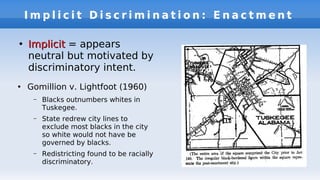
Gomillion v. Lightfoot (1960)
– Blacks outnumbers whites in
Tuskegee.
– State redrew city lines to
exclude most blacks in the city
so white would not have be
governed by blacks.
– Redistricting found to be racially
discriminatory.
I m p l i c i t D i s c r i m i n a t i o n : E n f o r c e m e n t
●
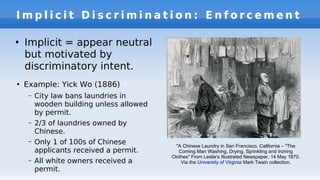
Example: Yick Wo (1886)
– City law bans laundries in
wooden building unless allowed
by permit.
– 2/3 of laundries owned by
Chinese.
– Only 1 of 100s of Chinese
applicants received a permit.
– All white owners received a
permit.
●
Implicit = appear neutral
but motivated by
discriminatory intent.
"A Chinese Laundry in San Francisco, California – "The
Coming Man Washing, Drying, Sprinkling and Ironing
Clothes" From Leslie's Illustrated Newspaper, 14 May 1870.
Via the University of Virginia Mark Twain collection.
D e f a c t o D i s c r i m i n a t i o n
●
Washington v. Davis -
black applicants were four
times more likely to fail
test to become a police
ofcer.
●
“Disproportionate impactDisproportionate impact is
not irrelevant, but it is not
the sole touchstone of . . .
racial discrimination
forbidden by the
Constitution. Standing alone,
it does not trigger the rule
that racial classifcations are
to be subjected to the
strictest scrutinystrictest scrutiny . . . .”
– But it will still be subject to
the rational basis test.
C l i q r Q u e s t i o n s
●
Dejure Discrimination is:
a) Anytime government
discriminates.
b) When government
discriminates based on
race or ethnicity.
c) When the efect
government actions is
discriminatory.
d) When government
intentionally discriminates
against a group.
●
In order to a police
ofcer, candidates have
to take a written test. A
study shows that
Africans-Americans
score poorly on the
exam. This is an
example of:
– Dejure Discrimination
– Defacto Discrimination
●
Answering this question
will help us determine
what level of scrutiny
should be applied.
S t e p 2 : I s t h e C l a s s i f c a t i o n
“ S u s p e c t ”
●
“Suspect ClassifcationsSuspect Classifcations”
– Strict Scrutiny
– Classifcations based upon race,
national origin, religion, and
alienage when states try to
classify.
●
“Quasi Suspect ClassifcationsQuasi Suspect Classifcations”
– Intermediate Scrutiny
– Gender, legitimacy,
●
None of the above (default)
– Rational Basis
S t r i c t S c r u t i n y
●
Does the state have a compelling interestcompelling interest?
– There is no bright line test
– Examples include national security and remedying past
discrimination by the state.
●
Is the classifcation necessarynecessary to meet this interest?
– If there are other means to achieve the state's goal, the
state loses.
●
Sometimes the Court talks about the classifcation being narrowly
tailored?
●
the analysis is basically the same, though
J u s t i f c a t i o n s f o r S t r i c t S c r u t i n y
●
the group singled out sufered from a history of discrimination;
●
the trait upon which the classifcation is based generally has no
relationship to a person's ability to contribute to society;
●
the trait is often singled out to reinforce prejudice against the
group or label the group as inferior;
●
the group is politically powerless by its numbers in the
population, by under-representation in government, or by its
inability to infuence the legislative agenda; and
●
the trait shared by the group is a distinct trait and one over
which its members have no control, an immutable or
unalterable characteristic, or a trait that is central to personal
identity.
W h a t A b o u t “ P o s i t i v e ”
D i s c r i m i n a t i o n ?
●
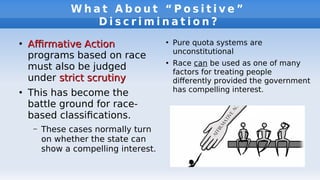
Afrmative ActionAfrmative Action
programs based on race
must also be judged
under strict scrutinystrict scrutiny
●
This has become the
battle ground for race-
based classifcations.
– These cases normally turn
on whether the state can
show a compelling interest.
●
Pure quota systems are
unconstitutional
●
Race can be used as one of many
factors for treating people
diferently provided the government
has compelling interest.
Positive Discrimination
●
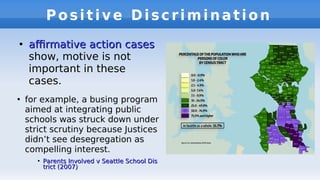
afrmative action casesafrmative action cases
show, motive is not
important in these
cases.
●
for example, a busing program
aimed at integrating public
schools was struck down under
strict scrutiny because Justices
didn’t see desegregation as
compelling interest.
●
Parents Involved v Seattle School DisParents Involved v Seattle School Dis
trict (2007)trict (2007)
W h y R a c e B a l a n c i n g W a s R e j e c t e d
●
Plurality of 4 Justices
– No compelling interest
●
"[a]t the heart of the
Constitution's guarantee
of equal protection lies the
simple command that the
Government must treat
citizens as individuals, not
as simply components of a
racial, religious, sexual or
national class."
●
Ultimate goal must be
color blindness.
●
Concurring
– Diversity is compelling interest
– Plan is not necessary to meet this
interest.
– Less racially charged alternatives
exist.
●
Dissent (4 Justices)
– Diversity is compelling interest
– The plan was necessary to meet
this interest.
– NOTE – together with concurring
opinion, 5 Justices believed
diversity is compelling interest!
I n t e r m e d i a t e S c r u t i n y
●
Quasi-Suspect Classifcations
– Gender
– Legitimacy (children of non-married parents)
●
Substantially related to important government
interest.
– NOTE – afrmative action programs based on gender
are judged using intermediate scrutiny.
G e n d e r D i s c r i m i n a t i o n
●
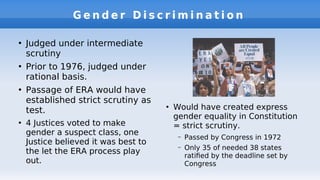
Judged under intermediate
scrutiny
●
Prior to 1976, judged under
rational basis.
●
Passage of ERA would have
established strict scrutiny as
test.
●
4 Justices voted to make
gender a suspect class, one
Justice believed it was best to
the let the ERA process play
out.
●
Would have created express
gender equality in Constitution
= strict scrutiny.
– Passed by Congress in 1972
– Only 35 of needed 38 states
ratifed by the deadline set by
Congress
G e n d e r C l a s s i f c a t i o n s B a s e d o n
S t e r e o t y p e s
●
Orr v. Orr (1979)
– Court struck
down law that
only allowed
women to receive
alimony because
it was based on
stereotype that
men are always
the breadwinner.
– See also
United States v.
Virginia
●
Mississippi University for
Women v. Hogan (1982) –
Court struck down admission
policy that only allowed
women into nursing school.
Based on stereotype that
women, not men, should be
nurses.
T h e D e f a u l t R u l e
●
Rational basis test –
reasonably related to a
legitimate government
interest.
– This is a very low standard
– if the court can merely
hypothesize a "legitimate"
interest served by the
challenged action, it will
likely withstand the
rational basis review
●
If the group is not “suspect”
or “quasi-suspect” then
classifcation will be judged
under rational basis test.
T h e L i m i t s t o R a t i o n a l B a s i s
●
Laws cannot be motivated by an animosity toward a group
of people.
– Romer v. Evans (1996) – Amendment to Colorado constitution
prohibiting cities from passing anti gay discrimination laws
deemed unconstitutional.
– Lawrence v. Texas (2003) - Texas law prohibiting homosexual
conduct is unconstitutional
– United States v. Windsor (2013) - federal law prohibiting the
recognition of same sex marriages was unconstitutional.
●
Because they were motivated by animosity toward
homosexuals and such laws cannot meet legitimate state
interest test.
T r u m p ’ s T r a v e l B a n
●
Issue: Whether President’s
order banning entry to citizens
from seven countries (many
predominately Muslim) amounts
to religious discrimination.
●
Are Trump’s statements
evidence of intent to
discriminate on basis of
religion?
●
“I think Islam hates us…. We have to
be very careful. And we can’t allow
people coming into this country who
have this hatred of the United
States... [a]nd of people that are not
Muslim.”
– Candidate Trump in a 2016
interview with Anderson Cooper
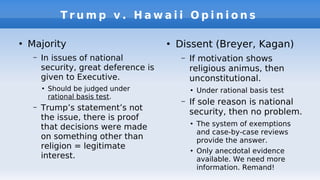
T r u m p v . H a w a i i O p i n i o n s
●
Majority
– In issues of national
security, great deference is
given to Executive.
●
Should be judged under
rational basis test.
– Trump’s statement’s not
the issue, there is proof
that decisions were made
on something other than
religion = legitimate
interest.
●
Dissent (Breyer, Kagan)
– If motivation shows
religious animus, then
unconstitutional.
●
Under rational basis test
– If sole reason is national
security, then no problem.
●
The system of exemptions
and case-by-case reviews
provide the answer.
●
Only anecdotal evidence
available. We need more
information. Remand!
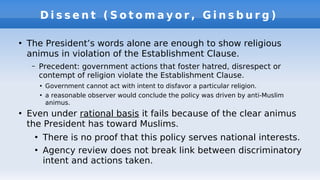
D i s s e n t ( S o t o m a y o r , G i n s b u r g )
●
The President’s words alone are enough to show religious
animus in violation of the Establishment Clause.
– Precedent: government actions that foster hatred, disrespect or
contempt of religion violate the Establishment Clause.
●
Government cannot act with intent to disfavor a particular religion.
●
a reasonable observer would conclude the policy was driven by anti-Muslim
animus.
●
Even under rational basis it fails because of the clear animus
the President has toward Muslims.
●
There is no proof that this policy serves national interests.
●
Agency review does not break link between discriminatory
intent and actions taken.
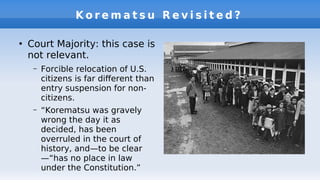
K o r e m a t s u R e v i s i t e d ?
●
Court Majority: this case is
not relevant.
– Forcible relocation of U.S.
citizens is far diferent than
entry suspension for non-
citizens.
– “Korematsu was gravely
wrong the day it as
decided, has been
overruled in the court of
history, and—to be clear
—“has no place in law
under the Constitution.”
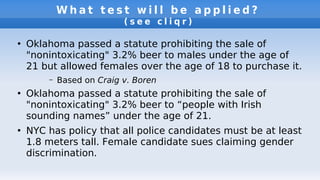
W h a t t e s t w i l l b e a p p l i e d ?
( s e e c l i q r )
●
Oklahoma passed a statute prohibiting the sale of
"nonintoxicating" 3.2% beer to males under the age of
21 but allowed females over the age of 18 to purchase it.
– Based on Craig v. Boren
●
Oklahoma passed a statute prohibiting the sale of
"nonintoxicating" 3.2% beer to “people with Irish
sounding names” under the age of 21.
●
NYC has policy that all police candidates must be at least
1.8 meters tall. Female candidate sues claiming gender
discrimination.
W h a t a r e t h e C l a s s i f c a t i o n s ?
●
Group home for mentally disabled was denied
building permit on the basis that it was a “hospital
for the feebly minded".
– Based on City of Cleburne v. Cleburne Living Center, Inc.
●
School district had policy that if it had to lay of
(Entlassung) teachers, it would do so in a manor that
protected the racial make-up of the teaching staf.
Thus, some black teachers with lower seniority might
be protected from layof because of their race.
– Based on Wygant v. Jackson Board of Education

Equal Protection Clause

  • 1.
    A m er i c a n C o n s t i t u t i o n a l L a w Equal Protection Blue linksBlue links lead to additional information Words in Red are vocabulary you should know
  • 2.
    L e ct u r e O v e r v i e w ● Goals – Provide a basic understanding of how U.S. law looks at discrimination – Explain the analysis steps used by courts to determine whether is discrimination violates the Constitution. ● Structure – Types of discrimination – Determining Level of Scrutiny – Applying the Level of Scrutiny
  • 3.
    1 4 th A m e n d m e n t E q u a l i t y ● Equal Protection ClauseEqual Protection Clause is found in the 14th Amendment. – “No state shall . . . deny to any person within its jurisdiction the equal protection of the laws.” ● NOTE - “any person” ● NOTE - “no state” ● We commonly think of Equal Protection cases as “discrimination” cases. ● Also applies to Federal Government via the 5th Amendment. – Reverse incorporationReverse incorporation Students learning in a segregated school
  • 4.
    Z u sa t z a r t i k e l X I V & V ● Keiner der Einzelstaaten darf . . . irgend jemandem innerhalb seines Hoheitsbereiches den gleichen Schutz durch das Gesetz versagen. – Zusatzartikel XIV ● Niemand darf . . . der Freiheit oder des Eigentums ohne vorheriges ordentliches Gerichtsverfahren nach Recht und Gesetz beraubt werden. – Zusatzartikel V
  • 5.
    T h eM e a n i n g o f E q u a l P r o t e c t i o n ● Does this mean that “no state” can ever treat people diferently under the law? ● Come up with examples of instances where the government classifesclassifes people by some characteristic and treats them diferently based on that characteristic. – So do your examples violate the Equal Protection Clause?
  • 6.
    T h eM o d e r n E q u a l P r o t e c t i o n C l a u s e ● The best way to think of this is not by framing the question as: – May the government discriminate? ● But rather as: – Under what circumstances may the government discriminate? ● Governments sometimes need to classify people into groups. ● Issue – When is doing so permissible?
  • 7.
    K e ep y o u r E y e o n t h e B a l l ● We are only talking about this: ● Not this: ● Remember, statutes can provide additional protections against discrimination
  • 8.
    S t ep s i n E q u a l P r o t e c t i o n B a l a n c i n g ● Step 1: What is the ClassifcationClassifcation and is it discriminatory? ● Step 2: What is the Appropriate Level of ScrutinyLevel of Scrutiny? – Strict – Intermediate – Rational Basis ● Step 3: Does the Government Classifcation Meet the Level of ScrutinyLevel of Scrutiny? – The Court will look at the ends and means
  • 9.
    S t ep 1 : I s t h e c l a s s i f c a t i o n d i s c r i m i n a t o r y ? ● Dejure DiscriminationDejure Discrimination – Intentional discrimination. – Can be explicit or implicit. – Can be negative or positive. ● DefactoDefacto DiscriminationDiscrimination – Discriminatory impact, but no intent to discriminate. – If defacto, move to Step 3 and apply the rational basis test. ● If Dejure, then move to step 2.
  • 10.
    K o re m a t s u v . U n i t e d S t a t e s ● The internment of Japanese-Americans will be subject to “the most rigid scrutiny.” ● But relationship between the government interest and action must be, according to the Court, “defnite and close.” – This was undoubtedly dejure discrimination Japanese-Americans boarding a train in Los Angeles on their way to a nearby Internment camp.
  • 11.
    I m pl i c i t D i s c r i m i n a t i o n : E n a c t m e n t ● ImplicitImplicit = appears neutral but motivated by discriminatory intent. ● Gomillion v. Lightfoot (1960) – Blacks outnumbers whites in Tuskegee. – State redrew city lines to exclude most blacks in the city so white would not have be governed by blacks. – Redistricting found to be racially discriminatory.
  • 12.
    I m pl i c i t D i s c r i m i n a t i o n : E n f o r c e m e n t ● Example: Yick Wo (1886) – City law bans laundries in wooden building unless allowed by permit. – 2/3 of laundries owned by Chinese. – Only 1 of 100s of Chinese applicants received a permit. – All white owners received a permit. ● Implicit = appear neutral but motivated by discriminatory intent. "A Chinese Laundry in San Francisco, California – "The Coming Man Washing, Drying, Sprinkling and Ironing Clothes" From Leslie's Illustrated Newspaper, 14 May 1870. Via the University of Virginia Mark Twain collection.
  • 13.
    D e fa c t o D i s c r i m i n a t i o n ● Washington v. Davis - black applicants were four times more likely to fail test to become a police ofcer. ● “Disproportionate impactDisproportionate impact is not irrelevant, but it is not the sole touchstone of . . . racial discrimination forbidden by the Constitution. Standing alone, it does not trigger the rule that racial classifcations are to be subjected to the strictest scrutinystrictest scrutiny . . . .” – But it will still be subject to the rational basis test.
  • 14.
    C l iq r Q u e s t i o n s ● Dejure Discrimination is: a) Anytime government discriminates. b) When government discriminates based on race or ethnicity. c) When the efect government actions is discriminatory. d) When government intentionally discriminates against a group. ● In order to a police ofcer, candidates have to take a written test. A study shows that Africans-Americans score poorly on the exam. This is an example of: – Dejure Discrimination – Defacto Discrimination
  • 15.
    ● Answering this question willhelp us determine what level of scrutiny should be applied. S t e p 2 : I s t h e C l a s s i f c a t i o n “ S u s p e c t ” ● “Suspect ClassifcationsSuspect Classifcations” – Strict Scrutiny – Classifcations based upon race, national origin, religion, and alienage when states try to classify. ● “Quasi Suspect ClassifcationsQuasi Suspect Classifcations” – Intermediate Scrutiny – Gender, legitimacy, ● None of the above (default) – Rational Basis
  • 16.
    S t ri c t S c r u t i n y ● Does the state have a compelling interestcompelling interest? – There is no bright line test – Examples include national security and remedying past discrimination by the state. ● Is the classifcation necessarynecessary to meet this interest? – If there are other means to achieve the state's goal, the state loses. ● Sometimes the Court talks about the classifcation being narrowly tailored? ● the analysis is basically the same, though
  • 17.
    J u st i f c a t i o n s f o r S t r i c t S c r u t i n y ● the group singled out sufered from a history of discrimination; ● the trait upon which the classifcation is based generally has no relationship to a person's ability to contribute to society; ● the trait is often singled out to reinforce prejudice against the group or label the group as inferior; ● the group is politically powerless by its numbers in the population, by under-representation in government, or by its inability to infuence the legislative agenda; and ● the trait shared by the group is a distinct trait and one over which its members have no control, an immutable or unalterable characteristic, or a trait that is central to personal identity.
  • 18.
    W h at A b o u t “ P o s i t i v e ” D i s c r i m i n a t i o n ? ● Afrmative ActionAfrmative Action programs based on race must also be judged under strict scrutinystrict scrutiny ● This has become the battle ground for race- based classifcations. – These cases normally turn on whether the state can show a compelling interest. ● Pure quota systems are unconstitutional ● Race can be used as one of many factors for treating people diferently provided the government has compelling interest.
  • 19.
    Positive Discrimination ● afrmative actioncasesafrmative action cases show, motive is not important in these cases. ● for example, a busing program aimed at integrating public schools was struck down under strict scrutiny because Justices didn’t see desegregation as compelling interest. ● Parents Involved v Seattle School DisParents Involved v Seattle School Dis trict (2007)trict (2007)
  • 20.
    W h yR a c e B a l a n c i n g W a s R e j e c t e d ● Plurality of 4 Justices – No compelling interest ● "[a]t the heart of the Constitution's guarantee of equal protection lies the simple command that the Government must treat citizens as individuals, not as simply components of a racial, religious, sexual or national class." ● Ultimate goal must be color blindness. ● Concurring – Diversity is compelling interest – Plan is not necessary to meet this interest. – Less racially charged alternatives exist. ● Dissent (4 Justices) – Diversity is compelling interest – The plan was necessary to meet this interest. – NOTE – together with concurring opinion, 5 Justices believed diversity is compelling interest!
  • 21.
    I n te r m e d i a t e S c r u t i n y ● Quasi-Suspect Classifcations – Gender – Legitimacy (children of non-married parents) ● Substantially related to important government interest. – NOTE – afrmative action programs based on gender are judged using intermediate scrutiny.
  • 22.
    G e nd e r D i s c r i m i n a t i o n ● Judged under intermediate scrutiny ● Prior to 1976, judged under rational basis. ● Passage of ERA would have established strict scrutiny as test. ● 4 Justices voted to make gender a suspect class, one Justice believed it was best to the let the ERA process play out. ● Would have created express gender equality in Constitution = strict scrutiny. – Passed by Congress in 1972 – Only 35 of needed 38 states ratifed by the deadline set by Congress
  • 23.
    G e nd e r C l a s s i f c a t i o n s B a s e d o n S t e r e o t y p e s ● Orr v. Orr (1979) – Court struck down law that only allowed women to receive alimony because it was based on stereotype that men are always the breadwinner. – See also United States v. Virginia ● Mississippi University for Women v. Hogan (1982) – Court struck down admission policy that only allowed women into nursing school. Based on stereotype that women, not men, should be nurses.
  • 24.
    T h eD e f a u l t R u l e ● Rational basis test – reasonably related to a legitimate government interest. – This is a very low standard – if the court can merely hypothesize a "legitimate" interest served by the challenged action, it will likely withstand the rational basis review ● If the group is not “suspect” or “quasi-suspect” then classifcation will be judged under rational basis test.
  • 25.
    T h eL i m i t s t o R a t i o n a l B a s i s ● Laws cannot be motivated by an animosity toward a group of people. – Romer v. Evans (1996) – Amendment to Colorado constitution prohibiting cities from passing anti gay discrimination laws deemed unconstitutional. – Lawrence v. Texas (2003) - Texas law prohibiting homosexual conduct is unconstitutional – United States v. Windsor (2013) - federal law prohibiting the recognition of same sex marriages was unconstitutional. ● Because they were motivated by animosity toward homosexuals and such laws cannot meet legitimate state interest test.
  • 26.
    T r um p ’ s T r a v e l B a n ● Issue: Whether President’s order banning entry to citizens from seven countries (many predominately Muslim) amounts to religious discrimination. ● Are Trump’s statements evidence of intent to discriminate on basis of religion? ● “I think Islam hates us…. We have to be very careful. And we can’t allow people coming into this country who have this hatred of the United States... [a]nd of people that are not Muslim.” – Candidate Trump in a 2016 interview with Anderson Cooper
  • 27.
    T r um p v . H a w a i i O p i n i o n s ● Majority – In issues of national security, great deference is given to Executive. ● Should be judged under rational basis test. – Trump’s statement’s not the issue, there is proof that decisions were made on something other than religion = legitimate interest. ● Dissent (Breyer, Kagan) – If motivation shows religious animus, then unconstitutional. ● Under rational basis test – If sole reason is national security, then no problem. ● The system of exemptions and case-by-case reviews provide the answer. ● Only anecdotal evidence available. We need more information. Remand!
  • 28.
    D i ss e n t ( S o t o m a y o r , G i n s b u r g ) ● The President’s words alone are enough to show religious animus in violation of the Establishment Clause. – Precedent: government actions that foster hatred, disrespect or contempt of religion violate the Establishment Clause. ● Government cannot act with intent to disfavor a particular religion. ● a reasonable observer would conclude the policy was driven by anti-Muslim animus. ● Even under rational basis it fails because of the clear animus the President has toward Muslims. ● There is no proof that this policy serves national interests. ● Agency review does not break link between discriminatory intent and actions taken.
  • 29.
    K o re m a t s u R e v i s i t e d ? ● Court Majority: this case is not relevant. – Forcible relocation of U.S. citizens is far diferent than entry suspension for non- citizens. – “Korematsu was gravely wrong the day it as decided, has been overruled in the court of history, and—to be clear —“has no place in law under the Constitution.”
  • 30.
    W h at t e s t w i l l b e a p p l i e d ? ( s e e c l i q r ) ● Oklahoma passed a statute prohibiting the sale of "nonintoxicating" 3.2% beer to males under the age of 21 but allowed females over the age of 18 to purchase it. – Based on Craig v. Boren ● Oklahoma passed a statute prohibiting the sale of "nonintoxicating" 3.2% beer to “people with Irish sounding names” under the age of 21. ● NYC has policy that all police candidates must be at least 1.8 meters tall. Female candidate sues claiming gender discrimination.
  • 31.
    W h at a r e t h e C l a s s i f c a t i o n s ? ● Group home for mentally disabled was denied building permit on the basis that it was a “hospital for the feebly minded". – Based on City of Cleburne v. Cleburne Living Center, Inc. ● School district had policy that if it had to lay of (Entlassung) teachers, it would do so in a manor that protected the racial make-up of the teaching staf. Thus, some black teachers with lower seniority might be protected from layof because of their race. – Based on Wygant v. Jackson Board of Education