Topic 7. Technical specifications
The buyer entity shall prepare specific
requirements relating to the goods or services
being procured that are clear
clear, that give a
correct and complete description of what is to
be procured and that allow for fair and open
competition
competition among those who may wish to
participate in the procurement proceedings
Purpose of technical specifications
Define buyer’s requirements;
To foster competition among eligible qualified
bidders:
- group together lots which are technically
similar and can be offered by the same bidder;
- allow bidders to offer one or more lots to attract
bidders who can not offer for all lots
Purpose of technical specifications
Technical specifications should be:
1.
1. Clear
Clear
2.
2. Comprehensive
Comprehensive
3.
3. International standards rather than National
International standards rather than National
standards
standards
Types of specifications
1.Technical (eg. Physical description)
2.Functional (eg. Number of pages printed out
/min)
3.Performance (eg. Fuel consumption per km)
Types of Specification
 Technical specification; describes the physical
characteristics of the material or product being
purchased, such as dimensions, grade of
materials, physical properties, color, finish, and
any other data that define an acceptable product.
Written technical specifications may
supplemented by drawings or samples.
Types of Specification cont’….
 Functional specifications; the function of a product can
be defined in terms of its actual role and what it is
intended to do. It defines the job to be done rather than
the method by which it is to be accomplished. Typically
functional specification do not limit the supplier to
providing a specific solution, as in the case of a technical
specification, thus enabling the supplier to create the
best possible solution. For example, a functional
specification may require the safe and efficient
movement of passengers from Zone A to Zone B at an
airport. Functional specifications are typically used to
solicit suppliers proposals for further evaluation by the
Types of Specification cont’….
 Procurement organization when a specific solution is
not known. they are often combined with
performance specifications, outlined, next to create a
more detailed requirements.
 -Performance specifications; while technical
specifications define the products physical
characteristics, and functional specifications describe
what role the product plays, neither describes just
how well the product must perform. This is the
purpose of performance specification which describe
the parameters of actual performance the item or
service must meet.
Types of Specification cont’….
 With performance specification. You are primarily
interested in results rather than in method. in the
example just given of passengers movement at an
airport. A performance specification might call out
just how many passengers must be moved in any
particular time period, or it may state the number of
hours the device must be operational in any specific
period. Performance specifications can be described
by a virtually unlimited choice criteria. However, they
must be capable of some clearly stated measurement .
some of the more common parameters include.
Types of Specification cont’….
 -Speed; product must travel at 20 miles per hour
 -Output; product must produce 400 acceptable
parts per hour
 - Quality; product must be capable of 2000
operational hours before failure
 -Efficiency; product must reduce rejected parts
by 20%
ICT In procurement and supply chain
management
E-procurement
 Use of information & communication
technologies in conducting procurement
relationship with suppliers for acquisition of
goods, works and services
OR
 Using Internet technology in the purchasing
process
Ways of internet technology access
 Via market places
Market places are specific websites on the
Internet (aimed at e.g. an industry or a
commodity) that bring buyers and sellers
together to facilitate employees of organisations
in applying forms of EP and more in general e-
commerce.
Ways of internet technology access
 Via market intranets
 Intranets can be seen as a number of websites
with information that can only be accessed by
employees of one organization.
Ways of internet technology access
 Via extranets
 Extranets can be seen as a number of websites
that can only be accessed by employees of a
number of known organisations
Forms of E-procurement
 e-MRO
 web-based ERP
 e-sourcing
 e-tendering
 e-reverse auctioning
 e-informing
e-MRO
 Process of creating and approving purchasing
requisitions, placing purchase orders and
receiving goods and services ordered, by using a
software system based on Internet technology
 Goods and services ordered are maintenance,
repair and operation (MRO) supplies (i.e., non-
product related).
e-sourcing
 Process that identifies new suppliers for a
specific purchasing category, using Internet
technology
 By identifying new suppliers a purchaser can
increase the competitiveness during the
tendering process for this purchasing category
 E-sourcing is also a way of decreasing the supply
risk associated with this purchasing category
e-tendering
 Process of sending RFI’s and RFP’s to suppliers
and receiving the responses of suppliers, using
Internet technology
 Sometimes within e-tendering the analysis and
comparison of responses is also supported
 E-tendering does not include closing the deal
with a supplier
web-based ERP
 Goods and services ordered are product related.
Usually only the employees of the purchasing
department (or the planning department) are
using the supporting software system (a web-
based ERP-system (Enterprise Resource
Planning)).
e-informing
 E-informing is the process of gathering and
distributing purchasing information both from
and to internal and external parties, using
Internet technology
Rationale of E-procurement
 Enhance key principle of procurement namel;
transparency, value for money (efficiency) and
timelines
Bringing together procuring entities and bidders
in a virtual environment
With enhanced transparent and fairness brings
increased private practitioners confidence in the
procurement system
Results into increased participation thus good for
competition-good quality & lower prices
Better access to markets
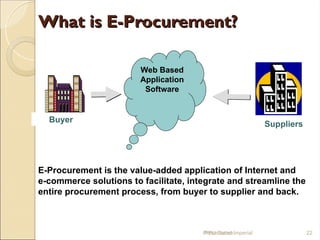
What is E-Procurement?
IPPU Grand Imperial 22
Suppliers
Buyer
Web Based
Application
Software
E-Procurement is the value-added application of Internet and
e-commerce solutions to facilitate, integrate and streamline the
entire procurement process, from buyer to supplier and back.
Presentation
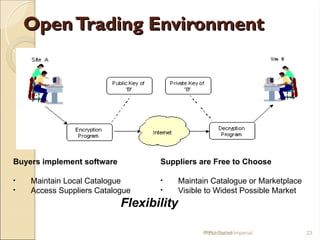
Buyers implement software
• Maintain Local Catalogue
• Access Suppliers Catalogue
OpenTrading Environment
IPPU Grand Imperial 23
Suppliers are Free to Choose
• Maintain Catalogue or Marketplace
• Visible to Widest Possible Market
Flexibility
Presentation
The E-procurement Process
Advantages of the e-Procurement System
Time savings
Cost savings
Accuracy
Real time
Mobility
Tractability
Management
Benefits to the suppliers
IPPU Grand Imperial 24
Presentation
The e-Procurement Process
Continued
Continued
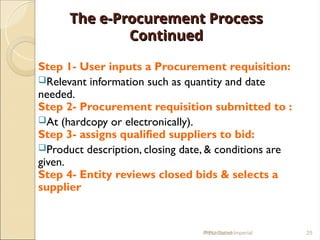
Step 1- User inputs a Procurement requisition:
Relevant information such as quantity and date
needed.
Step 2- Procurement requisition submitted to :
At (hardcopy or electronically).
Step 3- assigns qualified suppliers to bid:
Product description, closing date, & conditions are
given.
Step 4- Entity reviews closed bids & selects a
supplier
IPPU Grand Imperial 25
Presentation
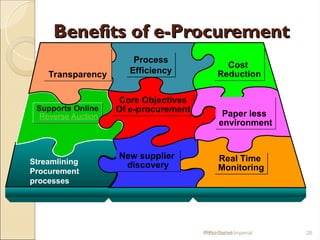
Supports Online
Reverse Auction
Core Objectives
Of e-procurement
Real Time
Monitoring
Process
Efficiency
New supplier
discovery
Cost
Reduction
Paper less
environment
Transparency
Benefits of e-Procurement
IPPU Grand Imperial 26
Streamlining
Procurement
processes
Presentation
Benefits of e-procurement
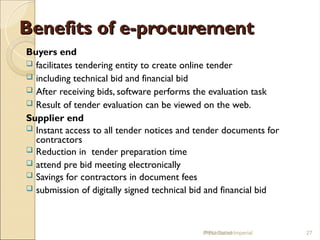
Buyers end
 facilitates tendering entity to create online tender
 including technical bid and financial bid
 After receiving bids, software performs the evaluation task
 Result of tender evaluation can be viewed on the web.
Supplier end
 Instant access to all tender notices and tender documents for
contractors
 Reduction in tender preparation time
 attend pre bid meeting electronically
 Savings for contractors in document fees
 submission of digitally signed technical bid and financial bid
IPPU Grand Imperial 27
Presentation
Benefits Cont’d
Benefits Cont’d
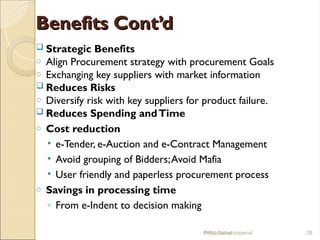
 Strategic Benefits
o Align Procurement strategy with procurement Goals
o Exchanging key suppliers with market information
 Reduces Risks
o Diversify risk with key suppliers for product failure.
 Reduces Spending andTime
o Cost reduction
• e-Tender, e-Auction and e-Contract Management
• Avoid grouping of Bidders;Avoid Mafia
• User friendly and paperless procurement process
o Savings in processing time
◦ From e-Indent to decision making
IPPU Grand Imperial 28
Presentation
E-Procurement - Challenges
 Commitment of Top Management
 Change Management Issues
 Inability to Capture Required Benefits
 Cost & Time Overrun
 Computerized Auditing
IPPU Grand Imperial 29
Presentation
E-Procurement challenges
 Supplier Management
Relationship must be beneficial to suppliers
Providing support & services for suppliers
who are not yet prepared to go online
Working with smaller businesses not enabled
for e-Procurement
Continuing to build and sustain relationships
with suppliers
IPPU Grand Imperial 30
Presentation
E-Procurement challenges
 Integration to Legacy & Back-end systems
Current applications are customized hence
integration – big challenge
Many Govt depts are still running manual systems,
implementation of pre & post procurement
systems and building integration is critical
IT infrastructure readiness in terms of hardware,
software, connectivity/ linkage is below par
Government would intend to leverage existing
investments and hence integration assumes
importance
IPPU Grand Imperial 31
Presentation
E-Procurement challenges
 Buyer Adoption
Strong Leadership , Political support and top-down
approach is critical
Securing high level support to negotiate better prices
through volume aggregation
Commitment to the business model and approach chosen
for roll-out
Commitment in achieving process efficiencies and effecting
changes in legal & regulatory framework to streamline the
process changes
IT readiness -infrastructure & user training
IPPU Grand Imperial 32
Presentation
E-Procurement challenges
 Security & data sharing
◦ Internet enabled procurement means transaction on public
domain ,perception holds contradictory to the confidential
nature of the bidding process
◦ Physical bidding process provides documentary proofs and the
electronic system is assumed to be incapable of providing the
same
◦ e-Procurement process is about data sharing, communication &
is competitive - security of such a system is of paramount
importance
◦ Evolving regulatory frame works
◦ Choice of technology in the rapidly changing technology
landscape
IPPU Grand Imperial 33
Presentation
Suggestions for e-Procurement system
Implementation
Implementation
Suggestions based on experience
Make clear policies to implement e-Procurement
across all the PDEs and communicate to all
concerned stake holders.
Set a road map with time lines for implementing e-
Procurement in terms of applications to PDEs
Conduct a business process study of procurement
to arrive at feature list , best practices model for e-
Procurement that can be rolled across all the
PDEs in the country.
Solicit a suitable vendor who can provide
infrastructure, applications, domain knowledge,
process re-engineering knowledge & consulting
IPPU Grand Imperial 34
Presentation
Suggestions for e-Procurement system
Implementation
Implementation
 be directed to use the applications with specific
incentives for using e-Procurement
Evaluation of computer literacy of the users in , the
task of improving the computer literacy should be
entrusted to a separate set of vendors
Conduct spend analysis and set e-Procurement tools
to address various types of spends to be carried out
Implement e-Procurement in a phase wise manner
addressing major spend in pilot .
Technical specifications in the procurement process

  • 1.
    Topic 7. Technicalspecifications Topic 7. Technical specifications The buyer entity shall prepare specific requirements relating to the goods or services being procured that are clear clear, that give a correct and complete description of what is to correct and complete description of what is to be procured and that allow for fair and open be procured and that allow for fair and open competition competition among those who may wish to participate in the procurement proceedings
  • 2.
    Purpose of technicalspecifications Purpose of technical specifications Define buyer’s requirements; To foster competition among eligible qualified bidders: - group together lots which are technically similar and can be offered by the same bidder; - allow bidders to offer one or more lots to attract bidders who can not offer for all lots
  • 3.
    Purpose of technicalspecifications Purpose of technical specifications Technical specifications should be: Technical specifications should be: 1. 1. Clear Clear 2. 2. Comprehensive Comprehensive 3. 3. International standards rather than National International standards rather than National standards standards
  • 4.
    Types of specifications Typesof specifications 1.Technical (eg. Physical description) 2.Functional (eg. Number of pages printed out /min) 3.Performance (eg. Fuel consumption per km)
  • 5.
    Types of Specification Technical specification; describes the physical characteristics of the material or product being purchased, such as dimensions, grade of materials, physical properties, color, finish, and any other data that define an acceptable product. Written technical specifications may supplemented by drawings or samples.
  • 6.
    Types of Specificationcont’….  Functional specifications; the function of a product can be defined in terms of its actual role and what it is intended to do. It defines the job to be done rather than the method by which it is to be accomplished. Typically functional specification do not limit the supplier to providing a specific solution, as in the case of a technical specification, thus enabling the supplier to create the best possible solution. For example, a functional specification may require the safe and efficient movement of passengers from Zone A to Zone B at an airport. Functional specifications are typically used to solicit suppliers proposals for further evaluation by the
  • 7.
    Types of Specificationcont’….  Procurement organization when a specific solution is not known. they are often combined with performance specifications, outlined, next to create a more detailed requirements.  -Performance specifications; while technical specifications define the products physical characteristics, and functional specifications describe what role the product plays, neither describes just how well the product must perform. This is the purpose of performance specification which describe the parameters of actual performance the item or service must meet.
  • 8.
    Types of Specificationcont’….  With performance specification. You are primarily interested in results rather than in method. in the example just given of passengers movement at an airport. A performance specification might call out just how many passengers must be moved in any particular time period, or it may state the number of hours the device must be operational in any specific period. Performance specifications can be described by a virtually unlimited choice criteria. However, they must be capable of some clearly stated measurement . some of the more common parameters include.
  • 9.
    Types of Specificationcont’….  -Speed; product must travel at 20 miles per hour  -Output; product must produce 400 acceptable parts per hour  - Quality; product must be capable of 2000 operational hours before failure  -Efficiency; product must reduce rejected parts by 20%
  • 10.
    ICT In procurementand supply chain management
  • 11.
    E-procurement  Use ofinformation & communication technologies in conducting procurement relationship with suppliers for acquisition of goods, works and services OR  Using Internet technology in the purchasing process
  • 12.
    Ways of internettechnology access  Via market places Market places are specific websites on the Internet (aimed at e.g. an industry or a commodity) that bring buyers and sellers together to facilitate employees of organisations in applying forms of EP and more in general e- commerce.
  • 13.
    Ways of internettechnology access  Via market intranets  Intranets can be seen as a number of websites with information that can only be accessed by employees of one organization.
  • 14.
    Ways of internettechnology access  Via extranets  Extranets can be seen as a number of websites that can only be accessed by employees of a number of known organisations
  • 15.
    Forms of E-procurement e-MRO  web-based ERP  e-sourcing  e-tendering  e-reverse auctioning  e-informing
  • 16.
    e-MRO  Process ofcreating and approving purchasing requisitions, placing purchase orders and receiving goods and services ordered, by using a software system based on Internet technology  Goods and services ordered are maintenance, repair and operation (MRO) supplies (i.e., non- product related).
  • 17.
    e-sourcing  Process thatidentifies new suppliers for a specific purchasing category, using Internet technology  By identifying new suppliers a purchaser can increase the competitiveness during the tendering process for this purchasing category  E-sourcing is also a way of decreasing the supply risk associated with this purchasing category
  • 18.
    e-tendering  Process ofsending RFI’s and RFP’s to suppliers and receiving the responses of suppliers, using Internet technology  Sometimes within e-tendering the analysis and comparison of responses is also supported  E-tendering does not include closing the deal with a supplier
  • 19.
    web-based ERP  Goodsand services ordered are product related. Usually only the employees of the purchasing department (or the planning department) are using the supporting software system (a web- based ERP-system (Enterprise Resource Planning)).
  • 20.
    e-informing  E-informing isthe process of gathering and distributing purchasing information both from and to internal and external parties, using Internet technology
  • 21.
    Rationale of E-procurement Enhance key principle of procurement namel; transparency, value for money (efficiency) and timelines Bringing together procuring entities and bidders in a virtual environment With enhanced transparent and fairness brings increased private practitioners confidence in the procurement system Results into increased participation thus good for competition-good quality & lower prices Better access to markets
  • 22.
    What is E-Procurement? Whatis E-Procurement? IPPU Grand Imperial 22 Suppliers Buyer Web Based Application Software E-Procurement is the value-added application of Internet and e-commerce solutions to facilitate, integrate and streamline the entire procurement process, from buyer to supplier and back. Presentation
  • 23.
    Buyers implement software •Maintain Local Catalogue • Access Suppliers Catalogue OpenTrading Environment OpenTrading Environment IPPU Grand Imperial 23 Suppliers are Free to Choose • Maintain Catalogue or Marketplace • Visible to Widest Possible Market Flexibility Presentation
  • 24.
    The E-procurement Process TheE-procurement Process Advantages of the e-Procurement System Time savings Cost savings Accuracy Real time Mobility Tractability Management Benefits to the suppliers IPPU Grand Imperial 24 Presentation
  • 25.
    The e-Procurement Process Thee-Procurement Process Continued Continued Step 1- User inputs a Procurement requisition: Relevant information such as quantity and date needed. Step 2- Procurement requisition submitted to : At (hardcopy or electronically). Step 3- assigns qualified suppliers to bid: Product description, closing date, & conditions are given. Step 4- Entity reviews closed bids & selects a supplier IPPU Grand Imperial 25 Presentation
  • 26.
    Supports Online Reverse Auction CoreObjectives Of e-procurement Real Time Monitoring Process Efficiency New supplier discovery Cost Reduction Paper less environment Transparency Benefits of e-Procurement Benefits of e-Procurement IPPU Grand Imperial 26 Streamlining Procurement processes Presentation
  • 27.
    Benefits of e-procurement Benefitsof e-procurement Buyers end  facilitates tendering entity to create online tender  including technical bid and financial bid  After receiving bids, software performs the evaluation task  Result of tender evaluation can be viewed on the web. Supplier end  Instant access to all tender notices and tender documents for contractors  Reduction in tender preparation time  attend pre bid meeting electronically  Savings for contractors in document fees  submission of digitally signed technical bid and financial bid IPPU Grand Imperial 27 Presentation
  • 28.
    Benefits Cont’d Benefits Cont’d Strategic Benefits o Align Procurement strategy with procurement Goals o Exchanging key suppliers with market information  Reduces Risks o Diversify risk with key suppliers for product failure.  Reduces Spending andTime o Cost reduction • e-Tender, e-Auction and e-Contract Management • Avoid grouping of Bidders;Avoid Mafia • User friendly and paperless procurement process o Savings in processing time ◦ From e-Indent to decision making IPPU Grand Imperial 28 Presentation
  • 29.
    E-Procurement - Challenges E-Procurement- Challenges  Commitment of Top Management  Change Management Issues  Inability to Capture Required Benefits  Cost & Time Overrun  Computerized Auditing IPPU Grand Imperial 29 Presentation
  • 30.
    E-Procurement challenges E-Procurement challenges Supplier Management Relationship must be beneficial to suppliers Providing support & services for suppliers who are not yet prepared to go online Working with smaller businesses not enabled for e-Procurement Continuing to build and sustain relationships with suppliers IPPU Grand Imperial 30 Presentation
  • 31.
    E-Procurement challenges E-Procurement challenges Integration to Legacy & Back-end systems Current applications are customized hence integration – big challenge Many Govt depts are still running manual systems, implementation of pre & post procurement systems and building integration is critical IT infrastructure readiness in terms of hardware, software, connectivity/ linkage is below par Government would intend to leverage existing investments and hence integration assumes importance IPPU Grand Imperial 31 Presentation
  • 32.
    E-Procurement challenges E-Procurement challenges Buyer Adoption Strong Leadership , Political support and top-down approach is critical Securing high level support to negotiate better prices through volume aggregation Commitment to the business model and approach chosen for roll-out Commitment in achieving process efficiencies and effecting changes in legal & regulatory framework to streamline the process changes IT readiness -infrastructure & user training IPPU Grand Imperial 32 Presentation
  • 33.
    E-Procurement challenges E-Procurement challenges Security & data sharing ◦ Internet enabled procurement means transaction on public domain ,perception holds contradictory to the confidential nature of the bidding process ◦ Physical bidding process provides documentary proofs and the electronic system is assumed to be incapable of providing the same ◦ e-Procurement process is about data sharing, communication & is competitive - security of such a system is of paramount importance ◦ Evolving regulatory frame works ◦ Choice of technology in the rapidly changing technology landscape IPPU Grand Imperial 33 Presentation
  • 34.
    Suggestions for e-Procurementsystem Suggestions for e-Procurement system Implementation Implementation Suggestions based on experience Make clear policies to implement e-Procurement across all the PDEs and communicate to all concerned stake holders. Set a road map with time lines for implementing e- Procurement in terms of applications to PDEs Conduct a business process study of procurement to arrive at feature list , best practices model for e- Procurement that can be rolled across all the PDEs in the country. Solicit a suitable vendor who can provide infrastructure, applications, domain knowledge, process re-engineering knowledge & consulting IPPU Grand Imperial 34 Presentation
  • 35.
    Suggestions for e-Procurementsystem Suggestions for e-Procurement system Implementation Implementation  be directed to use the applications with specific incentives for using e-Procurement Evaluation of computer literacy of the users in , the task of improving the computer literacy should be entrusted to a separate set of vendors Conduct spend analysis and set e-Procurement tools to address various types of spends to be carried out Implement e-Procurement in a phase wise manner addressing major spend in pilot .