Institut
Latihan
Kementerian
Kesihatan
Malaysia
(ILKKM)
Prog
:
Diploma
in
Medical
And
Health
Science
(DPMH)
Year
1
Sem
I
MHBE 2013
BASIC EPIDEMIOLOGY ;
Epidemiology Triad
(2 Hour)
Learning outcome (LO) ;
1. Describe epidemiology triad.
2. Interpret the relationship between host ,
agent and environment.
3. Discuss concept of intervention related
to host , agent and environment.
9/10/2020 2
ILKKM ; DPMH ; MHBE 2013 Basic Epidemiology
1. Definition of term.
2. Model of triad.
3. Model of Relationship
between triad and prevention.
4. Model of intervention in triad.
9/10/2020 3
ILKKM ; DPMH ; MHBE 2013 Basic Epidemiology
Content outline :
History epidemiology;
9/10/2020 4
ILKKM ; DPMH ; MHBE 2013 Basic Epidemiology
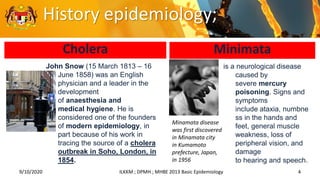
John Snow (15 March 1813 – 16
June 1858) was an English
physician and a leader in the
development
of anaesthesia and
medical hygiene. He is
considered one of the founders
of modern epidemiology, in
part because of his work in
tracing the source of a cholera
outbreak in Soho, London, in
1854.
Cholera Minimata
is a neurological disease
caused by
severe mercury
poisoning. Signs and
symptoms
include ataxia, numbne
ss in the hands and
feet, general muscle
weakness, loss of
peripheral vision, and
damage
to hearing and speech.
Minamata disease
was first discovered
in Minamata city
in Kumamoto
prefecture, Japan,
in 1956
9/10/2020 5
ILKKM ; DPMH ; MHBE 2013 Basic Epidemiology
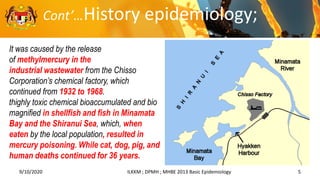
It was caused by the release
of methylmercury in the
industrial wastewater from the Chisso
Corporation’s chemical factory, which
continued from 1932 to 1968.
thighly toxic chemical bioaccumulated and bio
magnified in shellfish and fish in Minamata
Bay and the Shiranui Sea, which, when
eaten by the local population, resulted in
mercury poisoning. While cat, dog, pig, and
human deaths continued for 36 years.
Cont’…History epidemiology;
9/10/2020 6
ILKKM ; DPMH ; MHBE 2013 Basic Epidemiology
Simplest of these is the epidemiologic triad or triangle, the
traditional model for infectious disease.
The triad consists of an external AGENT, a susceptible HOST, and
an ENVIRONMENT that brings the host and agent together.
In this model, disease results from the interaction between the agent and
the susceptible host in an environment that supports transmission of the
agent from a source to that host
Source ; https://www.cdc.gov/csels/dsepd/ss1978/lesson1/section8.html
Definition of term;
9/10/2020
ILKKM ; DPMH ; MHBE 2013 Basic
Epidemiology
7
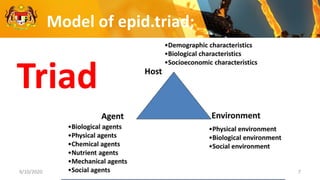
Model of epid.triad;
Triad
9/10/2020 ILKKM ; DPMH ; MHBE 2013 Basic Epidemiology 8
Cont’..Model of epid.triad;
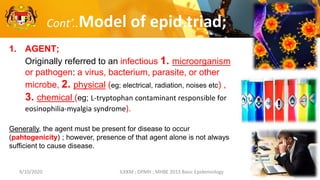
1. AGENT;
Originally referred to an infectious 1. microorganism
or pathogen: a virus, bacterium, parasite, or other
microbe, 2. physical (eg; electrical, radiation, noises etc) ,
3. chemical (eg; L-tryptophan contaminant responsible for
eosinophilia-myalgia syndrome).
Generally, the agent must be present for disease to occur
(pahtogenicity) ; however, presence of that agent alone is not always
sufficient to cause disease.
9/10/2020 ILKKM ; DPMH ; MHBE 2013 Basic Epidemiology 9
Cont’..Model of epid.triad;
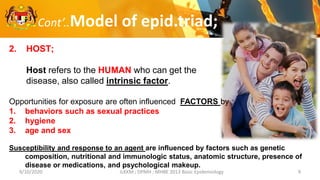
2. HOST;
Host refers to the HUMAN who can get the
disease, also called intrinsic factor.
Opportunities for exposure are often influenced FACTORS by ;
1. behaviors such as sexual practices
2. hygiene
3. age and sex
Susceptibility and response to an agent are influenced by factors such as genetic
composition, nutritional and immunologic status, anatomic structure, presence of
disease or medications, and psychological makeup.
9/10/2020 ILKKM ; DPMH ; MHBE 2013 Basic Epidemiology 10
Cont’..Model of epid.triad;
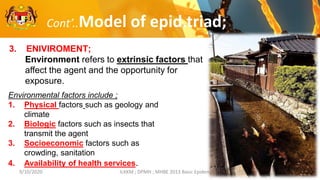
3. ENIVIROMENT;
Environment refers to extrinsic factors that
affect the agent and the opportunity for
exposure.
Environmental factors include ;
1. Physical factors such as geology and
climate
2. Biologic factors such as insects that
transmit the agent
3. Socioeconomic factors such as
crowding, sanitation
4. Availability of health services.
9/10/2020
ILKKM ; DPMH ; MHBE 2013 Basic
Epidemiology
11
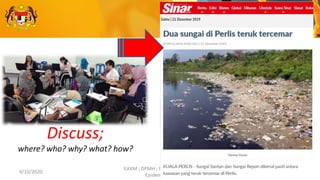
Discuss;
where? who? why? what? how?
9/10/2020 ILKKM ; DPMH ; MHBE 2013 Basic Epidemiology 12
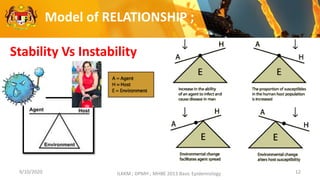
Model of RELATIONSHIP ;
Stability Vs Instability
9/10/2020 ILKKM ; DPMH ; MHBE 2013 Basic Epidemiology 13
Model of RELATIONSHIP ;
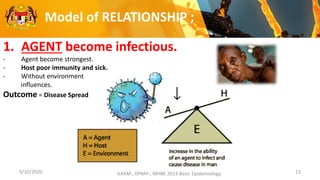
1. AGENT become infectious.
- Agent become strongest.
- Host poor immunity and sick.
- Without environment
influences.
Outcome = Disease Spread
9/10/2020 ILKKM ; DPMH ; MHBE 2013 Basic Epidemiology 14
Model of
RELATIONSHIP ;
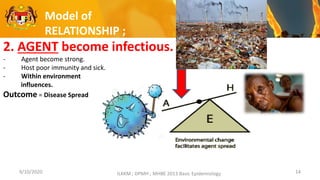
2. AGENT become infectious.
- Agent become strong.
- Host poor immunity and sick.
- Within environment
influences.
Outcome = Disease Spread
9/10/2020 ILKKM ; DPMH ; MHBE 2013 Basic Epidemiology 15
Model of
RELATIONSHIP ;
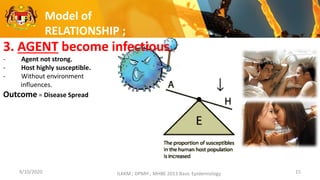
3. AGENT become infectious.
- Agent not strong.
- Host highly susceptible.
- Without environment
influences.
Outcome = Disease Spread
9/10/2020 ILKKM ; DPMH ; MHBE 2013 Basic Epidemiology 16
Model of
RELATIONSHIP ;
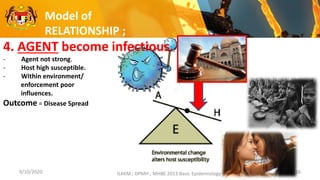
4. AGENT become infectious.
- Agent not strong.
- Host high susceptible.
- Within environment/
enforcement poor
influences.
Outcome = Disease Spread
9/10/2020 ILKKM ; DPMH ; MHBE 2013 Basic Epidemiology 17
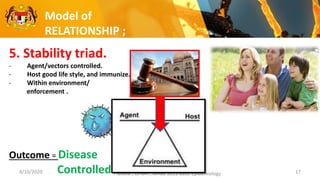
Model of
RELATIONSHIP ;
5. Stability triad.
- Agent/vectors controlled.
- Host good life style, and immunize.
- Within environment/
enforcement .
Outcome = Disease
Controlled
9/10/2020
ILKKM ; DPMH ; MHBE 2013 Basic
Epidemiology
18
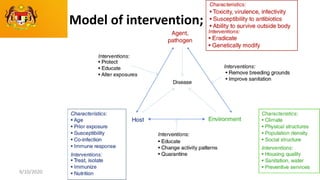
Model of intervention;
9/10/2020
ILKKM ; DPMH ; MHBE 2013 Basic
Epidemiology
19
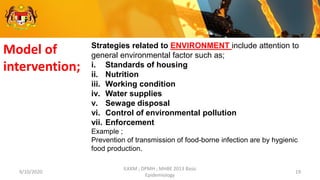
Strategies related to ENVIRONMENT include attention to
general environmental factor such as;
i. Standards of housing
ii. Nutrition
iii. Working condition
iv. Water supplies
v. Sewage disposal
vi. Control of environmental pollution
vii. Enforcement
Example ;
Prevention of transmission of food-borne infection are by hygienic
food production.
Model of
intervention;
9/10/2020
ILKKM ; DPMH ; MHBE 2013 Basic
Epidemiology
20
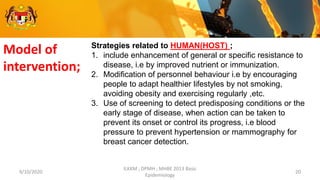
Strategies related to HUMAN(HOST) ;
1. include enhancement of general or specific resistance to
disease, i.e by improved nutrient or immunization.
2. Modification of personnel behaviour i.e by encouraging
people to adapt healthier lifestyles by not smoking,
avoiding obesity and exercising regularly ,etc.
3. Use of screening to detect predisposing conditions or the
early stage of disease, when action can be taken to
prevent its onset or control its progress, i.e blood
pressure to prevent hypertension or mammography for
breast cancer detection.
Model of
intervention;
9/10/2020 ILKKM ; DPMH ; MHBE 2013 Basic Epidemiology 21
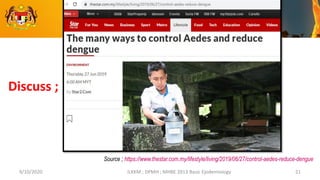
Discuss ;
Source ; https://www.thestar.com.my/lifestyle/living/2019/06/27/control-aedes-reduce-dengue
Student reading/ priority references :
Book / Journal / Article
No References
1. Gordis Leon (2013) Epidemiology, 5th edition,Elsevier
Suander,USA.
2. William C. Cockerham (2016) Medical sociology 13th edition,
Routledge,USA
3. Schneider.M.J(2014),Introduction to public health (4th
Edition),Jones & Bartlett Learning,USA
9/10/2020 ILKKM ; DPMH ; MHBE 2013 Basic Epidemiology 22
Internet/ e book/ online
No References
1. http://www.moh.gov.my/
2. https://www.who.int/
3. https://books.google.com.my/books?id=AXZz6JIV9ikC&pri
ntsec=frontcover#v=onepage&q&f=false
4. https://www.cdc.gov/csels/dsepd/ss1978/lesson1/section9.
html
9/10/2020
ILKKM ; DPMH ; MHBE 2013 Basic
Epidemiology
23
Recommendation for student Independent Learning (IL) ;
Activities Source
1. Search and download https://www.cdc.gov/csels/dsepd/ss1978/lesson1/section8.h
tml
https://www.ncbi.nlm.nih.gov/pmc/articles/PMC260
0290/
2. Reading related topic As above and,
https://www.thestar.com.my/lifestyle/living/2019/06/27/contr
ol-aedes-reduce-dengue
3. Make short note related topic As above and,
https://www.thestar.com.my/lifestyle/living/2019/06/27/contr
ol-aedes-reduce-dengue
4. Discus and answer
Exercise 1.8
https://www.cdc.gov/csels/dsepd/ss1978/lesson1/section8.h
tml
9/10/2020
ILKKM ; DPMH ; MHBE 2013 Basic
Epidemiology
24

Epidemiology triad.pdf

  • 1.
  • 2.
    Learning outcome (LO); 1. Describe epidemiology triad. 2. Interpret the relationship between host , agent and environment. 3. Discuss concept of intervention related to host , agent and environment. 9/10/2020 2 ILKKM ; DPMH ; MHBE 2013 Basic Epidemiology
  • 3.
    1. Definition ofterm. 2. Model of triad. 3. Model of Relationship between triad and prevention. 4. Model of intervention in triad. 9/10/2020 3 ILKKM ; DPMH ; MHBE 2013 Basic Epidemiology Content outline :
  • 4.
    History epidemiology; 9/10/2020 4 ILKKM; DPMH ; MHBE 2013 Basic Epidemiology John Snow (15 March 1813 – 16 June 1858) was an English physician and a leader in the development of anaesthesia and medical hygiene. He is considered one of the founders of modern epidemiology, in part because of his work in tracing the source of a cholera outbreak in Soho, London, in 1854. Cholera Minimata is a neurological disease caused by severe mercury poisoning. Signs and symptoms include ataxia, numbne ss in the hands and feet, general muscle weakness, loss of peripheral vision, and damage to hearing and speech. Minamata disease was first discovered in Minamata city in Kumamoto prefecture, Japan, in 1956
  • 5.
    9/10/2020 5 ILKKM ;DPMH ; MHBE 2013 Basic Epidemiology It was caused by the release of methylmercury in the industrial wastewater from the Chisso Corporation’s chemical factory, which continued from 1932 to 1968. thighly toxic chemical bioaccumulated and bio magnified in shellfish and fish in Minamata Bay and the Shiranui Sea, which, when eaten by the local population, resulted in mercury poisoning. While cat, dog, pig, and human deaths continued for 36 years. Cont’…History epidemiology;
  • 6.
    9/10/2020 6 ILKKM ;DPMH ; MHBE 2013 Basic Epidemiology Simplest of these is the epidemiologic triad or triangle, the traditional model for infectious disease. The triad consists of an external AGENT, a susceptible HOST, and an ENVIRONMENT that brings the host and agent together. In this model, disease results from the interaction between the agent and the susceptible host in an environment that supports transmission of the agent from a source to that host Source ; https://www.cdc.gov/csels/dsepd/ss1978/lesson1/section8.html Definition of term;
  • 7.
    9/10/2020 ILKKM ; DPMH; MHBE 2013 Basic Epidemiology 7 Model of epid.triad; Triad
  • 8.
    9/10/2020 ILKKM ;DPMH ; MHBE 2013 Basic Epidemiology 8 Cont’..Model of epid.triad; 1. AGENT; Originally referred to an infectious 1. microorganism or pathogen: a virus, bacterium, parasite, or other microbe, 2. physical (eg; electrical, radiation, noises etc) , 3. chemical (eg; L-tryptophan contaminant responsible for eosinophilia-myalgia syndrome). Generally, the agent must be present for disease to occur (pahtogenicity) ; however, presence of that agent alone is not always sufficient to cause disease.
  • 9.
    9/10/2020 ILKKM ;DPMH ; MHBE 2013 Basic Epidemiology 9 Cont’..Model of epid.triad; 2. HOST; Host refers to the HUMAN who can get the disease, also called intrinsic factor. Opportunities for exposure are often influenced FACTORS by ; 1. behaviors such as sexual practices 2. hygiene 3. age and sex Susceptibility and response to an agent are influenced by factors such as genetic composition, nutritional and immunologic status, anatomic structure, presence of disease or medications, and psychological makeup.
  • 10.
    9/10/2020 ILKKM ;DPMH ; MHBE 2013 Basic Epidemiology 10 Cont’..Model of epid.triad; 3. ENIVIROMENT; Environment refers to extrinsic factors that affect the agent and the opportunity for exposure. Environmental factors include ; 1. Physical factors such as geology and climate 2. Biologic factors such as insects that transmit the agent 3. Socioeconomic factors such as crowding, sanitation 4. Availability of health services.
  • 11.
    9/10/2020 ILKKM ; DPMH; MHBE 2013 Basic Epidemiology 11 Discuss; where? who? why? what? how?
  • 12.
    9/10/2020 ILKKM ;DPMH ; MHBE 2013 Basic Epidemiology 12 Model of RELATIONSHIP ; Stability Vs Instability
  • 13.
    9/10/2020 ILKKM ;DPMH ; MHBE 2013 Basic Epidemiology 13 Model of RELATIONSHIP ; 1. AGENT become infectious. - Agent become strongest. - Host poor immunity and sick. - Without environment influences. Outcome = Disease Spread
  • 14.
    9/10/2020 ILKKM ;DPMH ; MHBE 2013 Basic Epidemiology 14 Model of RELATIONSHIP ; 2. AGENT become infectious. - Agent become strong. - Host poor immunity and sick. - Within environment influences. Outcome = Disease Spread
  • 15.
    9/10/2020 ILKKM ;DPMH ; MHBE 2013 Basic Epidemiology 15 Model of RELATIONSHIP ; 3. AGENT become infectious. - Agent not strong. - Host highly susceptible. - Without environment influences. Outcome = Disease Spread
  • 16.
    9/10/2020 ILKKM ;DPMH ; MHBE 2013 Basic Epidemiology 16 Model of RELATIONSHIP ; 4. AGENT become infectious. - Agent not strong. - Host high susceptible. - Within environment/ enforcement poor influences. Outcome = Disease Spread
  • 17.
    9/10/2020 ILKKM ;DPMH ; MHBE 2013 Basic Epidemiology 17 Model of RELATIONSHIP ; 5. Stability triad. - Agent/vectors controlled. - Host good life style, and immunize. - Within environment/ enforcement . Outcome = Disease Controlled
  • 18.
    9/10/2020 ILKKM ; DPMH; MHBE 2013 Basic Epidemiology 18 Model of intervention;
  • 19.
    9/10/2020 ILKKM ; DPMH; MHBE 2013 Basic Epidemiology 19 Strategies related to ENVIRONMENT include attention to general environmental factor such as; i. Standards of housing ii. Nutrition iii. Working condition iv. Water supplies v. Sewage disposal vi. Control of environmental pollution vii. Enforcement Example ; Prevention of transmission of food-borne infection are by hygienic food production. Model of intervention;
  • 20.
    9/10/2020 ILKKM ; DPMH; MHBE 2013 Basic Epidemiology 20 Strategies related to HUMAN(HOST) ; 1. include enhancement of general or specific resistance to disease, i.e by improved nutrient or immunization. 2. Modification of personnel behaviour i.e by encouraging people to adapt healthier lifestyles by not smoking, avoiding obesity and exercising regularly ,etc. 3. Use of screening to detect predisposing conditions or the early stage of disease, when action can be taken to prevent its onset or control its progress, i.e blood pressure to prevent hypertension or mammography for breast cancer detection. Model of intervention;
  • 21.
    9/10/2020 ILKKM ;DPMH ; MHBE 2013 Basic Epidemiology 21 Discuss ; Source ; https://www.thestar.com.my/lifestyle/living/2019/06/27/control-aedes-reduce-dengue
  • 22.
    Student reading/ priorityreferences : Book / Journal / Article No References 1. Gordis Leon (2013) Epidemiology, 5th edition,Elsevier Suander,USA. 2. William C. Cockerham (2016) Medical sociology 13th edition, Routledge,USA 3. Schneider.M.J(2014),Introduction to public health (4th Edition),Jones & Bartlett Learning,USA 9/10/2020 ILKKM ; DPMH ; MHBE 2013 Basic Epidemiology 22 Internet/ e book/ online No References 1. http://www.moh.gov.my/ 2. https://www.who.int/ 3. https://books.google.com.my/books?id=AXZz6JIV9ikC&pri ntsec=frontcover#v=onepage&q&f=false 4. https://www.cdc.gov/csels/dsepd/ss1978/lesson1/section9. html
  • 23.
    9/10/2020 ILKKM ; DPMH; MHBE 2013 Basic Epidemiology 23
  • 24.
    Recommendation for studentIndependent Learning (IL) ; Activities Source 1. Search and download https://www.cdc.gov/csels/dsepd/ss1978/lesson1/section8.h tml https://www.ncbi.nlm.nih.gov/pmc/articles/PMC260 0290/ 2. Reading related topic As above and, https://www.thestar.com.my/lifestyle/living/2019/06/27/contr ol-aedes-reduce-dengue 3. Make short note related topic As above and, https://www.thestar.com.my/lifestyle/living/2019/06/27/contr ol-aedes-reduce-dengue 4. Discus and answer Exercise 1.8 https://www.cdc.gov/csels/dsepd/ss1978/lesson1/section8.h tml 9/10/2020 ILKKM ; DPMH ; MHBE 2013 Basic Epidemiology 24