KALNA COLLEGE
Affliliated to
The University of Burdwan
B.Ed , Semster :- IV
Course : EPC-3: Assessment of the Learning Process
Topic : Components and Objectives of National Mission on Education through ICT (NMEICT)
Submitted to: Dr. Aniket sutradhar
Submitted by : Payel Das
Roll No : 220711130038
Session : 2022 – 2024
1. What is ICT ?
2. What is NMEICT ?
3. Components Of NMEICT.
4. Objectives Of NMEICT.
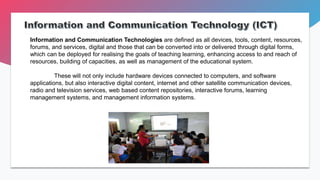
Information and Communication Technologies are defined as all devices, tools, content, resources,
forums, and services, digital and those that can be converted into or delivered through digital forms,
which can be deployed for realising the goals of teaching learning, enhancing access to and reach of
resources, building of capacities, as well as management of the educational system.
These will not only include hardware devices connected to computers, and software
applications, but also interactive digital content, internet and other satellite communication devices,
radio and television services, web based content repositories, interactive forums, learning
management systems, and management information systems.
National Mission On Education Through Information
And Communication Technology (NMEICT)
The National Mission on Education through Information and Communication
Technology (ICT) has been envisaged as a Centrally Sponsored Scheme to leverage
the potential of ICT, in teaching and learning process for the benefit of all the learners in
Higher Education Institutions in any time any where mode. This is expected to be a major
intervention in enhancing the Gross Enrolment Ratio (GER) in Higher Education by 5
percentage points during the XI Five Year Plan period.
Components Of NMEICT :
The three cardinal principles of Education Policy viz., access, equity and quality could be served
well by providing connectivity to all colleges and universities, providing low cost and affordable
access-cum-computing devices to students and teachers and providing high quality e-content
free of cost to all learners in the country. NMEICT encompasses all the three elements. The
Mission has two major components:
A. Providing connectivity, along with provision for access devices, to institutions and learners.
B. Content generation.
Objectives Of NMEICT :
 The objectives of the National Mission on
Education through ICT shall include:
Effective utilization of intellectual resources,
minimizing wastage of time.
 Availability of knowledge for self pace learning.
Platform for sharing of ideas and techniques and
pooling of knowledge resources..
 Systematically building a huge database of the
capabilities.
 Scholarship / Talent management including
identification, nurturing and disbursement
electronically.
 Nurturing of scholars and learners.
 Support to all the learners / workers for any of
their perceived learning needs.
 Extensive leveraging of the advancements in the
field of ICT.
 Capability to handle the user base which would
ultimately be expected to cross50 crore in the
long term.
 Provide for Connectivity & access devices,
content generation, personalization & mentoring,
testing & certification and encouragement of
talent.
 Bringing efforts of different interested agencies
working in the field of e- learning under one
umbrella and establishing logical linkages
between various activities.
 Capacity building in this sphere and utilizing
dormant capacities of various organizations.
 Encouraging research in spheres covered by
Mission activities and creating a large network.
CONTINED..
 Spreading Digital Literacy for teacher
empowerment and encouraging teachers.
 Multi-lingual content development for the
learners more comfortable.
 Voice support for educational material delivery
and interactivity for the content on the portal.
 Development of interfaces for other cognitive
faculties which would also help physically
challenged learners.
 Conversion of existing educational tapes into
indexed formats compliant with the
internationally accepted standards such as
SCORM (Sharable Content Object Reference
Model)
 Development of pedagogical techniques based
on edu-entertainment.
 Content delivery through EduSAT and
narrowcasting of TV signals. Providing 1000
DTH (Direct to Home) channels on 40
transponders.
 Setting up virtual labs and lab centers and
finishing schools for quality enhancement.
 Developing very low cost, low power consuming
wireless mesh.
 Providing e-Learning support to every higher
education institution for technology assisted
learning.
220711130038 Payel Das Components and Objective Of National Mission on Education Through ICT(NMEICT)

220711130038 Payel Das Components and Objective Of National Mission on Education Through ICT(NMEICT)

  • 1.
    KALNA COLLEGE Affliliated to TheUniversity of Burdwan B.Ed , Semster :- IV Course : EPC-3: Assessment of the Learning Process Topic : Components and Objectives of National Mission on Education through ICT (NMEICT) Submitted to: Dr. Aniket sutradhar Submitted by : Payel Das Roll No : 220711130038 Session : 2022 – 2024
  • 2.
    1. What isICT ? 2. What is NMEICT ? 3. Components Of NMEICT. 4. Objectives Of NMEICT.
  • 3.
    Information and CommunicationTechnologies are defined as all devices, tools, content, resources, forums, and services, digital and those that can be converted into or delivered through digital forms, which can be deployed for realising the goals of teaching learning, enhancing access to and reach of resources, building of capacities, as well as management of the educational system. These will not only include hardware devices connected to computers, and software applications, but also interactive digital content, internet and other satellite communication devices, radio and television services, web based content repositories, interactive forums, learning management systems, and management information systems.
  • 4.
    National Mission OnEducation Through Information And Communication Technology (NMEICT) The National Mission on Education through Information and Communication Technology (ICT) has been envisaged as a Centrally Sponsored Scheme to leverage the potential of ICT, in teaching and learning process for the benefit of all the learners in Higher Education Institutions in any time any where mode. This is expected to be a major intervention in enhancing the Gross Enrolment Ratio (GER) in Higher Education by 5 percentage points during the XI Five Year Plan period.
  • 5.
    Components Of NMEICT: The three cardinal principles of Education Policy viz., access, equity and quality could be served well by providing connectivity to all colleges and universities, providing low cost and affordable access-cum-computing devices to students and teachers and providing high quality e-content free of cost to all learners in the country. NMEICT encompasses all the three elements. The Mission has two major components: A. Providing connectivity, along with provision for access devices, to institutions and learners. B. Content generation.
  • 6.
    Objectives Of NMEICT:  The objectives of the National Mission on Education through ICT shall include: Effective utilization of intellectual resources, minimizing wastage of time.  Availability of knowledge for self pace learning. Platform for sharing of ideas and techniques and pooling of knowledge resources..  Systematically building a huge database of the capabilities.  Scholarship / Talent management including identification, nurturing and disbursement electronically.  Nurturing of scholars and learners.  Support to all the learners / workers for any of their perceived learning needs.  Extensive leveraging of the advancements in the field of ICT.  Capability to handle the user base which would ultimately be expected to cross50 crore in the long term.  Provide for Connectivity & access devices, content generation, personalization & mentoring, testing & certification and encouragement of talent.  Bringing efforts of different interested agencies working in the field of e- learning under one umbrella and establishing logical linkages between various activities.  Capacity building in this sphere and utilizing dormant capacities of various organizations.  Encouraging research in spheres covered by Mission activities and creating a large network.
  • 7.
    CONTINED..  Spreading DigitalLiteracy for teacher empowerment and encouraging teachers.  Multi-lingual content development for the learners more comfortable.  Voice support for educational material delivery and interactivity for the content on the portal.  Development of interfaces for other cognitive faculties which would also help physically challenged learners.  Conversion of existing educational tapes into indexed formats compliant with the internationally accepted standards such as SCORM (Sharable Content Object Reference Model)  Development of pedagogical techniques based on edu-entertainment.  Content delivery through EduSAT and narrowcasting of TV signals. Providing 1000 DTH (Direct to Home) channels on 40 transponders.  Setting up virtual labs and lab centers and finishing schools for quality enhancement.  Developing very low cost, low power consuming wireless mesh.  Providing e-Learning support to every higher education institution for technology assisted learning.