The Evolution of Work:
The Changing Nature of the Global Workforce
2
Contents
2
The Evolution of Work | The Changing Nature of the Global Workplace
Executive Summary.  .  .  .  .  .  .  .  . 3
Introduction.  .  .  .  .  .  .  .  .  .  .  .  .  .  .  .  .  .  .  . 5
Methodology.  .  .  .  .  .  .  .  .  .  .  .  .  .  .  .  .  .  . 8
What’s Driving Global
Workplace Trends.  .  .  .  .  .  .  .  .  .  . 10
The Five Basic
Human Needs .  .  .  .  .  .  .  .  .  .  .  .  .  .  .  . 11
The Challenge of
Rapid Change.  .  .  .  .  .  .  .  .  .  .  .  .  .  .  . 12
Emotions Associated
with Each Trend. .  .  .  .  .  .  .  .  .  .  .  . 14
Personal Impact
of Trends.  .  .  .  .  .  .  .  .  .  .  .  .  .  .  .  .  .  .  .  .  .  .  . 16
Expected Timeframe for
Trends .  .  .  .  .  .  .  .  .  .  .  .  .  .  .  .  .  .  .  .  .  .  .  .  .  . 18
Divergent Perspectives.  .  . 19
Regional Differences
North America.  .  .  .  .  .  .  .  .  .  .  .  .  .  .  . 21
Europe.  .  .  .  .  .  .  .  .  .  .  .  .  .  .  .  .  .  .  .  .  .  .  .  .  .  . 22
Latin America.  .  .  .  .  .  .  .  .  .  .  .  .  .  .  . 23
Asia-Pacific. .  .  .  .  .  .  .  .  .  .  .  .  .  .  .  .  .  .  . 24
Looking below the
surface by region
North America.  .  .  .  .  .  .  .  .  .  .  .  .  .  .  . 25
Freedom. .  .  .  .  .  .  .  .  .  .  .  .  .  .  .  .  .  .  .  .  .  .  .  . 27
Knowledge.  .  .  .  .  .  .  .  .  .  .  .  .  .  .  .  .  .  .  .  .  . 28
Stability.  .  .  .  .  .  .  .  .  .  .  .  .  .  .  .  .  .  .  .  .  .  .  .  .  . 29
Self-Management.  .  .  .  .  .  .  .  .  .  .  .  .  . 30
Meaning.  .  .  .  .  .  .  .  .  .  .  .  .  .  .  .  .  .  .  .  .  .  .  .  . 31
Europe.  .  .  .  .  .  .  .  .  .  .  .  .  .  .  .  .  .  .  .  .  .  .  .  .  .  . 32
Freedom. .  .  .  .  .  .  .  .  .  .  .  .  .  .  .  .  .  .  .  .  .  .  .  . 34
Knowledge.  .  .  .  .  .  .  .  .  .  .  .  .  .  .  .  .  .  .  .  .  . 35
Stability.  .  .  .  .  .  .  .  .  .  .  .  .  .  .  .  .  .  .  .  .  .  .  .  .  . 37
Self-Management.  .  .  .  .  .  .  .  .  .  .  .  .  . 38
Meaning.  .  .  .  .  .  .  .  .  .  .  .  .  .  .  .  .  .  .  .  .  .  .  .  . 39
Latin America.  .  .  .  .  .  .  .  .  .  .  .  .  .  .  . 40
Freedom. .  .  .  .  .  .  .  .  .  .  .  .  .  .  .  .  .  .  .  .  .  .  .  . 42
Knowledge.  .  .  .  .  .  .  .  .  .  .  .  .  .  .  .  .  .  .  .  .  . 43
Stability.  .  .  .  .  .  .  .  .  .  .  .  .  .  .  .  .  .  .  .  .  .  .  .  .  . 44
Self-Management.  .  .  .  .  .  .  .  .  .  .  .  .  . 45
Meaning.  .  .  .  .  .  .  .  .  .  .  .  .  .  .  .  .  .  .  .  .  .  .  .  . 46
Asia-Pacific. .  .  .  .  .  .  .  .  .  .  .  .  .  .  .  .  .  .  . 47
Freedom. .  .  .  .  .  .  .  .  .  .  .  .  .  .  .  .  .  .  .  .  .  .  .  . 49
Knowledge.  .  .  .  .  .  .  .  .  .  .  .  .  .  .  .  .  .  .  .  .  . 51
Stability.  .  .  .  .  .  .  .  .  .  .  .  .  .  .  .  .  .  .  .  .  .  .  .  .  . 53
Self-Management.  .  .  .  .  .  .  .  .  .  .  .  .  . 54
Meaning.  .  .  .  .  .  .  .  .  .  .  .  .  .  .  .  .  .  .  .  .  .  .  .  . 56
Conclusion. .  .  .  .  .  .  .  .  .  .  .  .  .  .  .  .  .  .  .  . 57
Executive Summary.  .  .  .  .  .  .  .  . 3
Introduction.  .  .  .  .  .  .  .  .  .  .  .  .  .  .  .  .  .  .  . 5
Methodology.  .  .  .  .  .  .  .  .  .  .  .  .  .  .  .  .  .  . 8
What’s Driving Global
Workplace Trends.  .  .  .  .  .  .  .  .  .  . 10
The Five Basic
Human Needs .  .  .  .  .  .  .  .  .  .  .  .  .  .  .  . 11
The Challenge of
Rapid Change.  .  .  .  .  .  .  .  .  .  .  .  .  .  .  . 12
Emotions Associated
with Each Trend. .  .  .  .  .  .  .  .  .  .  .  . 14
Personal Impact
of Trends.  .  .  .  .  .  .  .  .  .  .  .  .  .  .  .  .  .  .  .  .  .  .  . 16
Expected Timeframe for
Trends .  .  .  .  .  .  .  .  .  .  .  .  .  .  .  .  .  .  .  .  .  .  .  .  .  . 18
Divergent Perspectives.  .  . 19
Regional Differences
North America.  .  .  .  .  .  .  .  .  .  .  .  .  .  .  . 21
Europe.  .  .  .  .  .  .  .  .  .  .  .  .  .  .  .  .  .  .  .  .  .  .  .  .  .  . 22
Latin America.  .  .  .  .  .  .  .  .  .  .  .  .  .  .  . 23
Asia-Pacific. .  .  .  .  .  .  .  .  .  .  .  .  .  .  .  .  .  .  . 24
Looking below the
surface by region
North America.  .  .  .  .  .  .  .  .  .  .  .  .  .  .  . 25
Freedom. .  .  .  .  .  .  .  .  .  .  .  .  .  .  .  .  .  .  .  .  .  .  .  . 27
Knowledge.  .  .  .  .  .  .  .  .  .  .  .  .  .  .  .  .  .  .  .  .  . 28
Stability.  .  .  .  .  .  .  .  .  .  .  .  .  .  .  .  .  .  .  .  .  .  .  .  .  . 29
Self-Management.  .  .  .  .  .  .  .  .  .  .  .  .  . 30
Meaning.  .  .  .  .  .  .  .  .  .  .  .  .  .  .  .  .  .  .  .  .  .  .  .  . 31
Europe.  .  .  .  .  .  .  .  .  .  .  .  .  .  .  .  .  .  .  .  .  .  .  .  .  .  . 32
Freedom. .  .  .  .  .  .  .  .  .  .  .  .  .  .  .  .  .  .  .  .  .  .  .  . 34
Knowledge.  .  .  .  .  .  .  .  .  .  .  .  .  .  .  .  .  .  .  .  .  . 35
Stability.  .  .  .  .  .  .  .  .  .  .  .  .  .  .  .  .  .  .  .  .  .  .  .  .  . 37
Self-Management.  .  .  .  .  .  .  .  .  .  .  .  .  . 38
Meaning.  .  .  .  .  .  .  .  .  .  .  .  .  .  .  .  .  .  .  .  .  .  .  .  . 39
Latin America.  .  .  .  .  .  .  .  .  .  .  .  .  .  .  . 40
Freedom. .  .  .  .  .  .  .  .  .  .  .  .  .  .  .  .  .  .  .  .  .  .  .  . 42
Knowledge.  .  .  .  .  .  .  .  .  .  .  .  .  .  .  .  .  .  .  .  .  . 43
Stability.  .  .  .  .  .  .  .  .  .  .  .  .  .  .  .  .  .  .  .  .  .  .  .  .  . 44
Self-Management.  .  .  .  .  .  .  .  .  .  .  .  .  . 45
Meaning.  .  .  .  .  .  .  .  .  .  .  .  .  .  .  .  .  .  .  .  .  .  .  .  . 46
Asia-Pacific. .  .  .  .  .  .  .  .  .  .  .  .  .  .  .  .  .  .  . 47
Freedom. .  .  .  .  .  .  .  .  .  .  .  .  .  .  .  .  .  .  .  .  .  .  .  . 49
Knowledge.  .  .  .  .  .  .  .  .  .  .  .  .  .  .  .  .  .  .  .  .  . 51
Stability.  .  .  .  .  .  .  .  .  .  .  .  .  .  .  .  .  .  .  .  .  .  .  .  .  . 53
Self-Management.  .  .  .  .  .  .  .  .  .  .  .  .  . 54
Meaning.  .  .  .  .  .  .  .  .  .  .  .  .  .  .  .  .  .  .  .  .  .  .  .  . 56
Conclusion. .  .  .  .  .  .  .  .  .  .  .  .  .  .  .  .  .  .  .  . 57
The Evolution of Work | The Changing Nature of the Global Workplace
3
Executive
Summary
The workplace of the future is arriving now. Changes in
technology, culture, and economies are having an impact
on the way people work at all levels around the world.
4
The Evolution of Work | The Changing Nature of the Global Workplace
These changes have affected both the way employees engage with one
another and the tools they use to get their jobs done. While these shifts
may vary across geographic location, industry, or position, there is no
doubt that employers and employees must adapt as quickly as these
changes are taking place.
In order to understand how workplace trends are impacting the
workplace, ADP Research Institute®
(ADP RI) conducted an original
qualitative and quantitative study among employers and employees in
four major regions: North America, Europe, Latin America, and Asia-
Pacific. This research provided insight not only into understanding
emerging workplace trends but also the needs of employees. This
approach provides a more long-term view than simply reviewing trends
as they are developing today, and it also anticipates and addresses the
new frontier of the global workplace.
• In this study of predominantly white-collar workers, employees around
the world feel positively overall about most workplace trends,
including those emerging now and those predicted to occur in the
future. In the Asia-Pacific region, for example, where the population is
younger and job growth is rapid, employees are fully ready to
embrace new innovations. This is particularly true for those trends
related to increased freedom, such as employees being able to define
their own work schedules. In Latin America, employees are also open
to embracing future trends, but economic setbacks and slow growth
have prevented many from adopting current trends at the same pace
as other parts of the world.
• While most employees in this study remain positive about the future,
there are some trends that are viewed negatively, particularly those
that may threaten an individual’s stability, such as automation
replacing certain jobs.
• Of all organizations that were surveyed, those most likely to adapt to
specific workplace trends include those defined as multinational
corporations, those that have been in business for fewer than 20
years, and those that are located in the Asia-Pacific region.
• In terms of where employees see the greatest impact occurring in
their workplace, most respondents feel that rapidly changing
technology and globalization are the factors that will affect them the
most.
• Results of the study found that employers think more long-term, a
dynamic that will be explored in more depth in this paper, while
employees tended to think more in the short-term.
Understanding various perspectives on workplace trends and how they
impact employees—from Millennials in Europe to Senior Executives in
North America—is at the heart of this paper. Additionally, by
understanding people’s perspectives, business leaders and Human
Resource (HR) departments can be better equipped to stay on the
cutting-edge of trends in the workplace.
The Evolution of Work | The Changing Nature of the Global Workplace
5
Introduction
6
Technological and cultural changes have always pushed
the workplace forward, and now an even faster-paced
global transformation is underway.
6
The Evolution of Work | The Changing Nature of the Global Workplace
This work-based sea change varies among regions, job positions, and
industries. However, the domino effect of rapid advancements in
technology and mass shifts such as globalized competition, corporate
communication, and talent mobility are having a significant impact on
the way people live and work around the world. Technology in
particular—perhaps civilization’s greatest game-changer—has
introduced new flexibility to both employers and employees alike,
allowing employees in some positions a greater sense of freedom,
employers a higher degree of efficiency, and greater connectedness for
both without the traditional limitations of time and place.
Modern work environments stand in stark contrast to days when work
occurred during set hours at a common location. Today, many
employees exercise more control and autonomy over their workplace
conditions, with greater freedom to decide how, when, and where they
work. Other large changes include the fact that more and more tasks
are being replaced by machines, talent is now viewed through both a
local and global lens, and today’s individual career paths tend to be
non-linear. Add to this, today’s workforce is more and more guided by a
search for meaning or doing important work rather than by simply
earning a paycheck with good benefits.
These are just a few of the ways today’s global workplace is evolving.
And these changes provide a useful lens for illuminating many aspects
of the future. How will these trends continue to change over time? Who
will they affect most? Where are they more likely to occur?
To answer these questions and accurately anticipate the workplace of
the future, employees’ needs must be considered. While needs may
vary based on environmental factors, industry, or access to tools such
as computers, they tend to persist over time and apply to most workers,
regardless of job title or location. For example, the term “workplace
security” used to be defined as a regular paycheck with good benefits,
while remaining devoted to one company for 20+ years, and looking
forward to a big retirement party and a pension that would take care of
you after retirement. With today’s changes in the workplace and
employee mindsets, the definition of security is now seen in terms of
the strength of each individual’s professional network and their ability
to tap into that network to find a new job and create a long and varied
career. A needs-centric perspective allows for a more long-term view
into the future, while placing the people who will be impacted by these
changes at the center of focus.
Today’s workforce is more and more guided by a search
for meaning or doing important work rather than by
simply earning a paycheck with good benefits.
As employee needs evolve,
employers must adapt.
7
The Evolution of Work | The Changing Nature of the Global Workplace
While IT departments have already found new ways to meet the
changing needs of employees and the shifting global workplace, HR
departments have some catching up to do. Although HR departments
have embraced the ability to search globally for the best talent, they
still often struggle with onboarding new global employees. In addition,
as organizations offer more flexibility to their employees and
contractors who may work from home or other remote locations, HR
departments haven’t kept up pace with new programs and services to
ensure that teams remain seamlessly connected.
ADP Research Institute conducted this study in order to help HR
departments and employers understand workplace trends in such a
way as to acquire, develop, and retain talent. Ultimately, a needs-first
view provides a more stable platform on which to pave a pathway into
the future. Illuminating this pathway is crucial for companies and
individuals to innovate and strategize, ultimately maximizing the
benefits of the future for the employees these changes affect. This
paper will (1) address where the workplace is headed, and (2) illustrate
how organizations can leverage this future state in decision-making
to meet employees’ needs today, while anticipating the trends
of tomorrow.
8
The Evolution of Work | The Changing Nature of the Global Workplace
Methodology
The ADP Research Institute®
conducted an original
groundbreaking qualitative and quantitative study with
employers and employees around the world.
The Evolution of Work | The Changing Nature of the Global Workplace
9
Throughout this study, significant emphasis was placed on incorporating
diverse perspectives to provide a well-rounded view of how the global
workplace is changing and will continue to change in the future. Some of
the key audiences that were examined include:
• People living and working in the four major developed regions of the
world—especially the emerging markets in Latin America and Asia-
Pacific—to understand how different regions perceive and/or lead the
charge for change.
• Both employers and employees were surveyed to explore the extent to
which the two sides differ in their perspectives.
• A cross-section of age groups, including Millennials (defined in this
study as those aged 18-34 who have been working for fewer than five
years and are in junior to mid-level positions); Career Knowledge
Workers (those aged 30+ who have been working for five or more
years and are in junior to mid-level positions), and Senior Executives
(those who are in senior-level positions, regardless of the number of
years of experience) to gain insight as to how human needs manifest
differently depending on a person’s career tenure or position.
• Employees of smaller companies (250 to 1,000 employees) and larger
companies (1,000+ employees) to examine how company size impacts
the evolution of trends.
• White-collar and non-white-collar workers to explore how trends and
individual needs differ depending on the type of work a person does.
[Note that this study surveyed 90 percent white-collar employees and
10 percent non-white-collar employees, the sample of which provided
a readable base upon which to draw key insights.]
At the onset of this study, an extensive review of existing research on the
future of work, as well as interactive qualitative discussions with
employers and employees from across the globe were conducted. This
helped form the basis of understanding for the full set of workplace
trends already occurring or beginning to take shape. It also provided
initial insight into the deeper human needs driving many of these trends.
To build upon this initial understanding, full-scale quantitative research
was launched to discern the extent to which certain trends are
happening today or are expected to happen in the future, how trends
will impact individuals, and the connection between each trend and
deeper human needs among each audience.
The following reflects the study specifications for the quantitative work:
• 15-minute online survey was conducted from April 16 to May 5, 2015;
ADP was not identified as the study sponsor.
• The sample was n=2,403 interviews across four regions (North
America, Europe, Latin America, and Asia-Pacific).
• The study was translated into the native language of each country.
• The respondent profile included men and women aged 18 or older
with a full- or part-time job at a company with 250 or more employees.
• Countries surveyed included the United States, Canada, Mexico, Brazil,
Chile, the United Kingdom, France, Germany, Netherlands, Australia,
China, India, and Singapore.
What’s Driving Global Workplace Trends
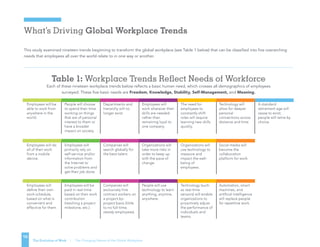
This study examined nineteen trends beginning to transform the global workplace (see Table 1 below) that can be classified into five overarching
needs that employees all over the world relate to in one way or another.
The Evolution of Work | The Changing Nature of the Global Workplace
10
Employees will be
able to work from
anywhere in the
world.
People will choose
to spend their time
working on things
that are of personal
interest to them or
have a broader
impact on society.
Departments and
hierarchy will no
longer exist.
Employees will
work wherever their
skills are needed
rather than
remaining loyal to
one company.
The need for
employees to
constantly shift
roles will require
learning new skills
quickly.
Technology will
allow for deeper
personal
connections across
distance and time.
A standard
retirement age will
cease to exist;
people will retire by
choice.
Employees will do
all of their work
from a mobile
device.
Employees will
primarily rely on
self-service and/or
information from
the Internet to
solve problems and
get their job done.
Companies will
search globally for
the best talent.
Organizations will
take more risks in
order to keep up
with the pace of
change.
Organizations will
use technology to
measure and
impact the well-
being of
employees.
Social media will
become the
collaboration
platform for work.
Employees will
define their own
work schedule,
based on what is
convenient and
effective for them.
Employees will be
paid in real-time
based on their work
contribution
(reaching a project
milestone, etc.).
Companies will
exclusively hire
contract workers on
a project-by-
project basis (little
to no full-time,
steady employees).
People will use
technology to learn
anything, anytime,
anywhere.
Technology (such
as real-time
sensors) will enable
organizations to
proactively adjust
the performance of
individuals and
teams.
Automation, smart
machines, and
artificial intelligence
will replace people
for repetitive work.
Table 1: Workplace Trends Reflect Needs of Workforce
Each of these nineteen workplace trends below reflects a basic human need, which crosses all demographics of employees
surveyed. These five basic needs are Freedom, Knowledge, Stability, Self-Management, and Meaning.
Employees will be
able to work from
anywhere in the
world.
People will choose
to spend their time
working on things
that are of personal
interest to them or
have a broader
impact on society.
Departments and
hierarchy will no
longer exist.
Employees will
work wherever their
skills are needed
rather than
remaining loyal to
one company.
The need for
employees to
constantly shift
roles will require
learning new skills
quickly.
Technology will
allow for deeper
personal
connections across
distance and time.
A standard
retirement age will
cease to exist;
people will retire by
choice.
Employees will do
all of their work
from a mobile
device.
Employees will
primarily rely on
self-service and/or
information from
the Internet to
solve problems and
get their job done.
Companies will
search globally for
the best talent.
Organizations will
take more risks in
order to keep up
with the pace of
change.
Organizations will
use technology to
measure and
impact the well-
being of
employees.
Social media will
become the
collaboration
platform for work.
Employees will
define their own
work schedule,
based on what is
convenient and
effective for them.
Employees will be
paid in real-time
based on their work
contribution
(reaching a project
milestone, etc.).
Companies will
exclusively hire
contract workers on
a project-by-
project basis (little
to no full-time,
steady employees).
People will use
technology to learn
anything, anytime,
anywhere.
Technology (such
as real-time
sensors) will enable
organizations to
proactively adjust
the performance of
individuals and
teams.
Automation, smart
machines, and
artificial intelligence
will replace people
for repetitive work.
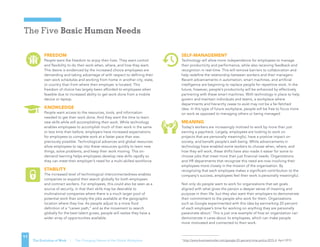
The Five Basic Human Needs
The Evolution of Work | The Changing Nature of the Global Workplace
11
FREEDOM
People want the freedom to enjoy their lives. They want control
and flexibility to do their work when, where, and how they want.
This desire is evidenced by the increased choice employees are
demanding and taking advantage of with respect to defining their
own work schedules and working from home in another city, state,
or country than from where their employer is located. This
freedom of choice has largely been afforded to employees when
feasible due to increased ability to get work done from a mobile
device or laptop.
KNOWLEDGE
People want access to the resources, tools, and information
needed to get their work done. And they want the time to learn
new skills while still accomplishing their work. While technology
enables employees to accomplish much of their work in the same
or less time than before, employers have increased expectations
for employees to complete work at a faster pace than was
previously possible. Technological advances and global resources
allow employees to tap into these resources quickly to learn new
things, solve problems, and keep their work moving. This on-
demand learning helps employees develop new skills rapidly so
they can meet their employer’s need for a multi-skilled workforce.
STABILITY
The increased level of technological interconnectedness enables
companies to expand their search globally for both employees
and contract workers. For employees, this could also be seen as a
source of security, in that their skills may be desirable to
multinational companies where there is a much larger pool of
potential work than simply the jobs available at the geographic
location where they live. As people adjust to a more fluid
definition of a “career path,” and as the movement to search
globally for the best talent grows, people will realize they have a
wider array of opportunities available.
SELF-MANAGEMENT
Technology will allow more independence for employees to manage
their productivity and performance, while also receiving feedback and
recognition in real-time. This will remove barriers to collaboration and
help redefine the relationship between workers and their managers.
Recent advancements in automation, smart machines, and artificial
intelligence are beginning to replace people for repetitive work. In the
future, however, people’s productivity will be enhanced by effectively
partnering with these smart machines. With technology in place to help
govern and maintain individuals and teams, a workplace where
departments and hierarchy cease to exist may not be a far-fetched
idea. In this type of future workplace, people will be free to focus more
on work as opposed to managing others or being managed.
MEANING
Today’s workers are increasingly motived to work by more than just
earning a paycheck. Largely, employees are looking to work on
projects that are personally meaningful, have a positive impact on
society, and benefit people’s well-being. While advancements in
technology have enabled some workers to choose when, where, and
how they will work, these shifts have also made it easier for some to
choose jobs that meet more than just financial needs. Organizations
and HR departments that recognize this need are now involving their
employees more closely in the mission of the organization. By
recognizing that each employee makes a significant contribution to the
company’s success, employees feel their work is personally meaningful.
Not only do people want to work for organizations that set goals
aligned with what gives the person a deeper sense of meaning and
purpose in their life, but they also want their employers to demonstrate
their commitment to the people who work for them. Organizations
such as Google experimented with this idea by earmarking 20 percent
of each employee’s time for working on anything they are personally
passionate about.1
This is just one example of how an organization can
demonstrate it cares about its employees, which can make people
more motivated and connected to their work.
1
http://www.businessinsider.com/google-20-percent-time-policy-2015-4, April 2015
The Challenge of Rapid Change
12
The Evolution of Work | The Changing Nature of the Global Workplace
2
CNN Money, Smarter robots put 50% of jobs at risk, November 2015
3
Fortune, 3 Workplace Trends for 2015 and Beyond, December 2014
4
Alternet, How the Mindfulness Movement Went Mainstream — And the Backlash That Came With It, January 2015
The workplace environment is changing at a rapid speed. Many agree
that these changes are being driven by Millennials, who have recently
reached adulthood and are influencing every facet of work culture—
from demanding increased freedom to choose their own work
schedules and locations, to encouraging more collaboration on an even
playing field, to driving innovation. This is especially the case in places
such as the Asia-Pacific region, where the working population skews
younger, and employees embrace change.
But there are challenges when things change at a rapid pace. For
example, artificial intelligence and smart machines are replacing people
doing repetitive work. Companies are also beginning to find ways to
leverage new technology to augment the work of people in higher
skilled jobs. Automation could threaten around 50 percent of the
workforce, including administrative, clerical, and production jobs.2
This
is a particular concern in Asia, where a key to improving the standard of
living is putting people to work. To the extent that automation limits
that, or restricts wages that drive increased prosperity, this may be
perceived as a risk for the region.
The upside of automation is it could free more people up to work on
creative and interesting projects.3
And, with social platforms like
Google Hangouts, LinkedIn, and internal software such as IBM’s
SocialBlue (previously known as Beehive), new technologies are making
it easier for people to connect and collaborate with others all over the
world. People are increasingly working from home or co-op spaces,
creating hours that work around their schedules as opposed to the
traditional nine-to-five. And employers are beginning to weave meaning
into day-to-day work life. General Motors, for example, has created a
“mindfulness” program for their employees to facilitate positive energy
and reduce stress around the workplace.4
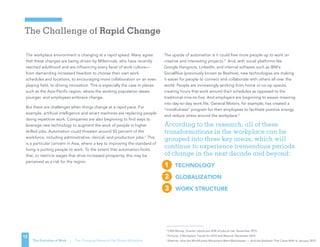
According to the research, all of these
transformations in the workplace can be
grouped into three key areas, which will
continue to experience tremendous periods
of change in the next decade and beyond:
1 TECHNOLOGY
2 GLOBALIZATION
3 WORK STRUCTURE
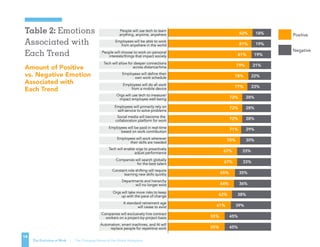
In general, most new workplace trends are perceived
positively with greater than 50 percent positive
emotion attached to each trend (see Table 2).
13
The Evolution of Work | The Changing Nature of the Global Workplace
This is particularly true for trends that create greater flexibility for
employees, such as being able to learn on-demand, to work on projects
that are personally meaningful or impact society, or offer greater choice
over when and where they work. Trends that had the lowest rating of
positive emotion were those that may affect job security, such as the
trend toward automation and smart machines replacing people and the
trend of companies hiring contract workers on a project-by-project basis.
These sentiments, however, vary across regions and among employers
and employees. Regionally speaking, Europe remains the most wary
regarding many of the changes, while Latin America and Asia-Pacific
are optimistic about making changes in the workplace. In addition to
cultural sentiments, some regions such as North America are better
poised to welcome the future than a region such as Latin America, who,
while excited, is also undergoing political and economic
transformations that may hinder rapid growth.
With so many changes happening in the workplace at once, there are
bound to be growing pains. Employers and employees around the
world share several concerns:
• How do we ensure that systems, programs, and tools constantly stay
up-to-date in a world where technology evolves so quickly?
• How can we improve knowledge sharing in an increasingly global
workplace with teams that may shift and change frequently?
• What does a personal career plan or trajectory look like when it is
somewhat expected that people will change jobs several times over
the course of their life?
• With technology and smart machines driving an expectation that each
person will be able to accomplish more work in less time, how do we
ensure people don’t hit workload overload?
• How can we create a true sense of “team” when most people work
remotely on their own schedule?
However, according to the survey, employers and employees have
mixed feelings about many of the trends at play. For the most part, the
latter tend to look at the short term, while the former look at the long
term. Therefore, the focus of employees is much more on the day-to-
day, which has implications for how managers lead their teams.
In one area where employers and employees have differing
perceptions, employees believe that the trends of searching globally for
the best talent, constantly shifting roles, and using tech to learn
anything are all happening today. The survey found that employers, on
the other hand, tend to think that these trends, along with departments
and hierarchies no longer existing are a bit further off in the future.
These are not the only differences. While employees tend to feel more
negatively about the threat that automation, exclusive contract work,
and the lack of a financially secure retirement may have on their careers,
employers look at these trends more favorably. This is likely because
these trends will help them get their job done more effectively and
optimally. But it can leave employees feeling like the loyalty they are
providing their employer is not being returned.
Negative
Employees will be paid in real-time
based on work contribution
Social media will become the
collaboration platform for work
Employees will primarily rely on
self-service to solve problems
Orgs will use tech to measure/
impact employee well-being
Employees will do all work
from a mobile device
Employees will define their
own work schedule
Tech will allow for deeper connections
across distance/time
People will choose to work on personal
interests/things that impact society
Employees will be able to work
from anywhere in the world
People will use tech to learn
anything, anytime, anywhere
Automation, smart machines, and AI will
replace people for repetitive work
Companies will exclusively hire contract
workers on a project-by-project basis
A standard retirement age
will cease to exist
Orgs will take more risks to keep
up with the pace of change
Departments and hierarchy
will no longer exist
Constant role shifting will require
learning new skills quickly
Companies will search globally
for the best talent
Tech will enable orgs to proactively
adjust performance
Employees will work wherever
their skills are needed
AMOUNT OF POSITIVE VS . NEGATIVE EMOTION ASSOCIATED WITH EACH TREND
82% 18%
81% 19%
81% 19%
79% 21%
78% 22%
77% 23%
72% 28%
72% 28%
72% 28%
71% 29%
70% 30%
67% 33%
67% 33%
65% 35%
64% 36%
62% 38%
61% 39%
55% 45%
55% 45%
Positive
Amount of Positive
vs. Negative Emotion
Associated with
Each Trend
14
The Evolution of Work | The Changing Nature of the Global Workplace
Table 2: Emotions
Associated with
Each Trend Negative
Employees will be paid in real-time
based on work contribution
Social media will become the
collaboration platform for work
Employees will primarily rely on
self-service to solve problems
Orgs will use tech to measure/
impact employee well-being
Employees will do all work
from a mobile device
Employees will define their
own work schedule
Tech will allow for deeper connections
across distance/time
People will choose to work on personal
interests/things that impact society
Employees will be able to work
from anywhere in the world
People will use tech to learn
anything, anytime, anywhere
Automation, smart machines, and AI will
replace people for repetitive work
Companies will exclusively hire contract
workers on a project-by-project basis
A standard retirement age
will cease to exist
Orgs will take more risks to keep
up with the pace of change
Departments and hierarchy
will no longer exist
Constant role shifting will require
learning new skills quickly
Companies will search globally
for the best talent
Tech will enable orgs to proactively
adjust performance
Employees will work wherever
their skills are needed
AMOUNT OF POSITIVE VS . NEGATIVE EMOTION ASSOCIATED WITH EACH TREND
82% 18%
81% 19%
81% 19%
79% 21%
78% 22%
77% 23%
72% 28%
72% 28%
72% 28%
71% 29%
70% 30%
67% 33%
67% 33%
65% 35%
64% 36%
62% 38%
61% 39%
55% 45%
55% 45%
Positive
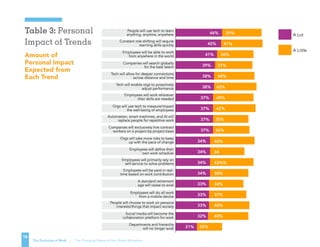
There are trends that could revolutionize not only
people’s work realities at the individual level (see
Table 3), but the workplace as a whole.
15
The Evolution of Work | The Changing Nature of the Global Workplace
The trend thought to have the most impact globally is the ability to use
technology anytime, anywhere. Though technology currently plays a
profound role in most people’s work at the global level, the ability to use
technology for learning on-demand will help people get the information
they need exactly when they need it without depending on a human-
centered training paradigm. A change such as this will have implications
for more people-centered HR departments, as they move away from
human training toward weaving in learning-on-demand technology into
their benefit offerings.
Another trend thought to have great personal impact is the constant
need to shift roles. Connecting to the need for stability, constantly
shifting work roles would be a big change from how many people work
today and have in the past, where roles remained the same from project
to project.
Lastly, working from anywhere in the world is thought to have a great
impact on people’s lives. While this trend is already happening, working
from anywhere will certainly shift the way people interact, communicate,
and collaborate to get work done. It also changes how people will
manage employees.
Related to this, but thought to have less impact, is using social media as
a collaboration platform for work. Social media usage is fairly pervasive
across the globe; however, people are unsure as to how it might be
useful in the realm of work. While social media platforms have evolved
to be more inclusive of work, workplaces struggle to develop an internal
business social media strategy.
Both employers and employees also tend to think that the trend toward
dissolving individual departments and a hierarchical structure will have
little impact on their work, possibly because they do not believe that this
trend will happen. There are signs that the hierarchical organization of
companies may disappear, due largely to technology connecting people
at all levels of an organization, as well as information increasingly being
shared with a broader audience and more junior audiences. In the
Asia-Pacific region, however, a move away from the hierarchical structure
may not take hold as quickly due to social and cultural norms. Countries
like India and China respect hierarchy and the resulting bureaucracy, so
a move away from these norms will take time.5
Survey results showed two other trends which respondents believed
would have little personal impact on them. One is the trend of allowing
employees to work on projects that are of personal interest to them.
Many companies are still very bottom-line driven and have yet to
cultivate employees’ needs for passion and personal-driven work. The
other trend is that of having employees perform all of their work from a
mobile device. Respondents in North America and Europe especially
believe this trend will have very little impact on their work because they
believe this is a bit further off in the future and not as likely to
materialize. Whereas, emerging economies in Asia Pacific and Latin
America have higher penetration for mobile devices than internet, and
thus believe that this trend will impact them a lot.
5
Huffington Post, 5 Trends Shaping the Future of Work, September 2014
A Lot
A Little
Companies will exclusively hire contract
workers on a project-by-project basis
Automation, smart machines, and AI will
replace people for repetitive work
Orgs will use tech to measure/impact
the well-being of employees
Employees will work wherever
their skills are needed
Tech will enable orgs to proactively
adjust performance
Tech will allow for deeper connections
across distance and time
Companies will search globally
for the best talent
Employees will be able to work
from anywhere in the world
Constant role shifting will require
learning skills quickly
People will use tech to learn
anything, anytime, anywhere
Departments and hierarchy
will no longer exist
Social media will become the
collaboration platform for work
People will choose to work on persona
interests/things that impact society
Employees will do all work
from a mobile device
A standard retirement
age will cease to exist
Employees will be paid in real-
time based on work contribution
Employees will primarily rely on
self-service to solve problems
Employees will define their
own work schedule
Orgs will take more risks to keep
up with the pace of change
AMOUNT OF PERSONAL IMPACT EXPECTED FROM EACH TREND
46% 39%
45% 41%
41% 36%
39% 37%
38% 40%
38% 42%
37% 40%
37% 42%
37% 35%
37% 36%
34% 44%
34% 34
34% 43%%
34% 38%
33% 34%
33% 37%
33% 40%
32% 40%
21% 25%
Amount of
Personal Impact
Expected from
Each Trend
Table 3: Personal
Impact of Trends
16
The Evolution of Work | The Changing Nature of the Global Workplace
A Lot
A Little
Companies will exclusively hire contract
workers on a project-by-project basis
Automation, smart machines, and AI will
replace people for repetitive work
Orgs will use tech to measure/impact
the well-being of employees
Employees will work wherever
their skills are needed
Tech will enable orgs to proactively
adjust performance
Tech will allow for deeper connections
across distance and time
Companies will search globally
for the best talent
Employees will be able to work
from anywhere in the world
Constant role shifting will require
learning skills quickly
People will use tech to learn
anything, anytime, anywhere
Departments and hierarchy
will no longer exist
Social media will become the
collaboration platform for work
People will choose to work on persona
interests/things that impact society
Employees will do all work
from a mobile device
A standard retirement
age will cease to exist
Employees will be paid in real-
time based on work contribution
Employees will primarily rely on
self-service to solve problems
Employees will define their
own work schedule
Orgs will take more risks to keep
up with the pace of change
AMOUNT OF PERSONAL IMPACT EXPECTED FROM EACH TREND
46% 39%
45% 41%
41% 36%
39% 37%
38% 40%
38% 42%
37% 40%
37% 42%
37% 35%
37% 36%
34% 44%
34% 34
34% 43%%
34% 38%
33% 34%
33% 37%
33% 40%
32% 40%
21% 25%
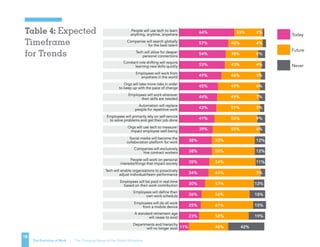
Respondents to our survey had varying perceptions of
when these trends will materialize in the workplace
(see Table 4).
17
The Evolution of Work | The Changing Nature of the Global Workplace
Workplace trends
already being seen
include the use of
Organizations will
take more risks to
keep up with the
TECHNOLOGY RAPID PACE
OF CHANGE
Many of the trends that employees believe are already happening—
particularly in North America, Europe, and Latin America—are
technology-related and tech-enabled. Workplace trends already being
seen include the use of technology to learn anything at anytime and
anywhere, the use of technology to allow for deeper personal
connections across time and space, the ability to search globally for
talent recruitment, and the need to learn new skills rapidly.
Trends projected to take hold soon also center around technology.
These include organizations taking more risks to keep up with the rapid
pace of change; using technology to measure and impact employee
well-being, proactively adjusting performance; and increasingly relying
on self-service to solve problems.
Then there are trends that people, particularly employers, think are a bit
further off in the future. Indeed, this is the case for trends that
emphasize freedom and flexibility for employees to get their work done
in a way that is best suited for them. These trends include people
defining their own work schedules, the standard retirement age
becoming a thing of the past, and the ability to work on things of
personal interest. Each of these potential trends undermines much of
the current sentiment around work being solely a money-driven
endeavor. Other top trends perceived as happening in the future
include people doing most of their work from a mobile device, using
social media as an online collaboration tool, and companies exclusively
hiring contract workers for jobs.
Some organizations are more likely than others to welcome these types
of changes in the workplace. Out of sheer necessity, multinational
corporations will need to stay on top of technological changes, as well
as any change that impacts doing business globally or impacts
recruiting, hiring, and managing global talent. Companies that have
been in business for fewer than twenty years are more likely to adapt to
workplace shifts possibly because of newer systems and less
established processes and procedures. In the Asia-Pacific region, many
organizations are well-positioned to take advantage of many emerging
workplace trends, as they have a younger workforce who is more likely
to adapt quickly to new ways of working. Understanding the regional
intricacies in more depth will illuminate the role HR companies and
departments can play in helping address the evolving nature of the
workplace environment.
Today
Future
Never
Orgs will use tech to measure/
impact employee well-being
Employees will primarily rely on self-service
to solve problems and get their job done
Automation will replace
people for repetitive work
Employees will work wherever
their skills are needed
Orgs will take more risks in order
to keep up with the pace of change
Employees will work from
anywhere in the world
Constant role shifting will require
learning new skills quickly
Tech will allow for deeper
personal connections
Companies will search globally
for the best talent
People will use tech to learn
anything, anytime, anywhere
Departments and hierarchy
will no longer exist
A standard retirement age
will cease to exist
Employees will do all work
from a mobile device
Employees will define their
own work schedule
Employees will be paid in real-time
based on their work contribution
Tech will enable organizations to proactively
adjust individual/team performance
People will work on personal
interests/things that impact society
Companies will exclusively
hire contract workers
Social media will become the
collaboration platform for work
AMOUNT OF PERSONAL IMPACT EXPECTED FROM EACH TREND
64% 33% 2%
57% 40% 4%
54% 38% 8%
53% 43% 4%
49% 46% 5%
45% 49% 6%
44% 49% 7%
43% 51% 5%
41% 50% 9%
39% 55% 6%
38% 50% 12%
38% 50% 12%
35% 54% 11%
34% 61% 5%
30% 57% 12%
26% 56% 18%
25% 61% 15%
23% 58% 19%
11% 46% 42%
Table 4: Expected
Timeframe
for Trends
18
The Evolution of Work | The Changing Nature of the Global Workplace
Today
Future
Never
Orgs will use tech to measure/
impact employee well-being
Employees will primarily rely on self-service
to solve problems and get their job done
Automation will replace
people for repetitive work
Employees will work wherever
their skills are needed
Orgs will take more risks in order
to keep up with the pace of change
Employees will work from
anywhere in the world
Constant role shifting will require
learning new skills quickly
Tech will allow for deeper
personal connections
Companies will search globally
for the best talent
People will use tech to learn
anything, anytime, anywhere
Departments and hierarchy
will no longer exist
A standard retirement age
will cease to exist
Employees will do all work
from a mobile device
Employees will define their
own work schedule
Employees will be paid in real-time
based on their work contribution
Tech will enable organizations to proactively
adjust individual/team performance
People will work on personal
interests/things that impact society
Companies will exclusively
hire contract workers
Social media will become the
collaboration platform for work
AMOUNT OF PERSONAL IMPACT EXPECTED FROM EACH TREND
64% 33% 2%
57% 40% 4%
54% 38% 8%
53% 43% 4%
49% 46% 5%
45% 49% 6%
44% 49% 7%
43% 51% 5%
41% 50% 9%
39% 55% 6%
38% 50% 12%
38% 50% 12%
35% 54% 11%
34% 61% 5%
30% 57% 12%
26% 56% 18%
25% 61% 15%
23% 58% 19%
11% 46% 42%
Divergent Perspectives
19
The Evolution of Work | The Changing Nature of the Global Workplace
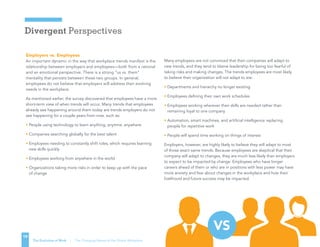
Employers vs. Employees
An important dynamic in the way that workplace trends manifest is the
relationship between employers and employees—both from a rational
and an emotional perspective. There is a strong “us vs. them”
mentality that persists between these two groups. In general,
employees do not believe that employers will address their evolving
needs in the workplace.
As mentioned earlier, the survey discovered that employees have a more
short-term view of when trends will occur. Many trends that employees
already see happening around them today are trends employers do not
see happening for a couple years from now, such as:
• People using technology to learn anything, anytime, anywhere
• Companies searching globally for the best talent
• Employees needing to constantly shift roles, which requires learning
new skills quickly
• Employees working from anywhere in the world
• Organizations taking more risks in order to keep up with the pace
of change
Many employees are not convinced that their companies will adapt to
new trends, and they tend to blame leadership for being too fearful of
taking risks and making changes. The trends employees are most likely
to believe their organization will not adapt to are:
• Departments and hierarchy no longer existing
• Employees defining their own work schedules
• Employees working wherever their skills are needed rather than
remaining loyal to one company
• Automation, smart machines, and artificial intelligence replacing
people for repetitive work
• People will spend time working on things of interest
Employers, however, are highly likely to believe they will adapt to most
of those exact same trends. Because employees are skeptical that their
company will adapt to changes, they are much less likely than employers
to expect to be impacted by change. Employees who have longer
careers ahead of them or who are in positions with less power may have
more anxiety and fear about changes in the workplace and how their
livelihood and future success may be impacted.
VS
Divergent Perspectives
20
The Evolution of Work | The Changing Nature of the Global Workplace
The research suggests that both Millennials and Career Knowledge
Workers (employees who have been in the workforce at least five years,
but fewer than fifteen) feel most negatively about the following trends in
the workplace:
• Companies exclusively hiring contract workers on a project-by-
project basis
• Automation, smart machines, and artificial intelligence replacing
people for repetitive work
In addition, Career Knowledge Workers also perceived the following
trends negatively:
• The standard retirement age ceasing to exist
• Organizations taking more risks in order to keep up with the pace
of change
• Employees shifting roles which requires learning new skills quickly
• Companies searching globally for the best talent
• Technology enabling organizations to proactively adjust the
performance of individuals and teams
The research found that employers, on the other hand, likely feel more
secure about the prospect of changes to the workplace—either because
they are closer to retirement or because, as Senior Executives, they are
in positions with more power or control. Employers therefore had a
much more positive outlook on future changes, especially the changes
employees felt may negatively impact them.
Regional Differences
North America
21
The Evolution of Work | The Changing Nature of the Global Workplace
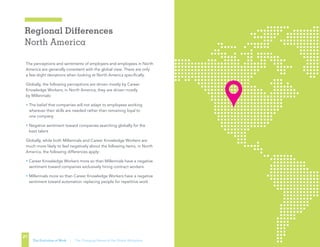
The perceptions and sentiments of employers and employees in North
America are generally consistent with the global view. There are only
a few slight deviations when looking at North America specifically.
Globally, the following perceptions are driven mostly by Career
Knowledge Workers; in North America, they are driven mostly
by Millennials:
• The belief that companies will not adapt to employees working
wherever their skills are needed rather than remaining loyal to
one company
• Negative sentiment toward companies searching globally for the
best talent
Globally, while both Millennials and Career Knowledge Workers are
much more likely to feel negatively about the following items, in North
America, the following differences apply:
• Career Knowledge Workers more so than Millennials have a negative
sentiment toward companies exclusively hiring contract workers
• Millennials more so than Career Knowledge Workers have a negative
sentiment toward automation replacing people for repetitive work
Regional Differences
Europe
22
The Evolution of Work | The Changing Nature of the Global Workplace
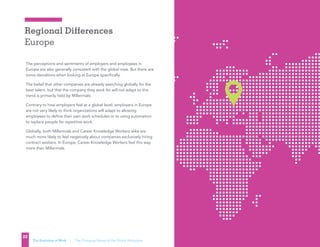
The perceptions and sentiments of employers and employees in
Europe are also generally consistent with the global view. But there are
some deviations when looking at Europe specifically.
The belief that other companies are already searching globally for the
best talent, but that the company they work for will not adapt to this
trend is primarily held by Millennials.
Contrary to how employers feel at a global level, employers in Europe
are not very likely to think organizations will adapt to allowing
employees to define their own work schedules or to using automation
to replace people for repetitive work.
Globally, both Millennials and Career Knowledge Workers alike are
much more likely to feel negatively about companies exclusively hiring
contract workers. In Europe, Career Knowledge Workers feel this way
more than Millennials. 
Regional Differences
Latin America
23
The Evolution of Work | The Changing Nature of the Global Workplace
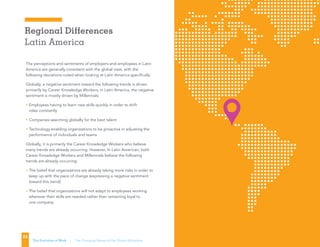
The perceptions and sentiments of employers and employees in Latin
America are generally consistent with the global view, with the
following deviations noted when looking at Latin America specifically.
Globally, a negative sentiment toward the following trends is driven
primarily by Career Knowledge Workers; in Latin America, the negative
sentiment is mostly driven by Millennials:
• Employees having to learn new skills quickly in order to shift
roles constantly
• Companies searching globally for the best talent
• Technology enabling organizations to be proactive in adjusting the
performance of individuals and teams
Globally, it is primarily the Career Knowledge Workers who believe
many trends are already occurring. However, In Latin American, both
Career Knowledge Workers and Millennials believe the following
trends are already occurring:
• The belief that organizations are already taking more risks in order to
keep up with the pace of change (expressing a negative sentiment
toward this trend)
• The belief that organizations will not adapt to employees working
wherever their skills are needed rather than remaining loyal to
one company
Regional Differences
Asia-Pacific
The Evolution of Work | The Changing Nature of the Global Workplace
24
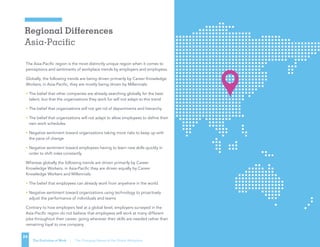
The Asia-Pacific region is the most distinctly unique region when it comes to
perceptions and sentiments of workplace trends by employers and employees.
Globally, the following trends are being driven primarily by Career Knowledge
Workers; in Asia-Pacific, they are mostly being driven by Millennials:
• The belief that other companies are already searching globally for the best
talent, but that the organizations they work for will not adapt to this trend
• The belief that organizations will not get rid of departments and hierarchy
• The belief that organizations will not adapt to allow employees to define their
own work schedules
• Negative sentiment toward organizations taking more risks to keep up with
the pace of change
• Negative sentiment toward employees having to learn new skills quickly in
order to shift roles constantly
Whereas globally the following trends are driven primarily by Career
Knowledge Workers, in Asia-Pacific they are driven equally by Career
Knowledge Workers and Millennials:
• The belief that employees can already work from anywhere in the world
• Negative sentiment toward organizations using technology to proactively
adjust the performance of individuals and teams
Contrary to how employers feel at a global level, employers surveyed in the
Asia-Pacific region do not believe that employees will work at many different
jobs throughout their career, going wherever their skills are needed rather than
remaining loyal to one company.
The Evolution of Work | The Changing Nature of the Global Workplace
25
Looking below the
surface by region
North America
North America: Embracing Change
26
The Evolution of Work | The Changing Nature of the Global Workplace
While the more recent sources of global growth, such as China, are
slowing, the North American economies are poised to accelerate in the
near future with continued impact on the workplace. The region
possesses profound advantages, such as a relatively liberalized business
climate, a strong culture of innovation and entrepreneurialism, agile
capital markets, small firms that can create and capitalize on
technological advances, and a start-up culture that is well-suited to
adapt to the future.6
Canada’s banking system, for example, has proved to be among the
soundest in the world, and its oil and gas sector remains strong, even as
it has been challenged by last year’s downturn in oil prices. Industries in
the entire region, including energy, advanced manufacturing, life
sciences, and information technology are thriving.7
Ultimately, job
growth is projected to remain stable, which can support and fund many
emerging workplace trends such as automation and using technology
for well-being.
Though this outlook looks mostly positive for the future of the
workplace, the region is somewhat challenged by an aging population
who, like in Europe, remain resistant to many of these possible changes
and are weary of their impact. Even so, the younger populations and the
innovation-first attitude has tended to place North America at the
forefront of change historically, so while the region will continue
advancing, the intensity of change will not be as strong as in other parts
of the world.
The research suggests that because of this, North Americans are less
likely to believe they will be impacted by workplace change. People
generally demonstrate positive sentiment toward workplace trends,
especially those related to increased choice of when and where to work
and increased access to information needed to get more done in less
time. In general, this study showed that people in the U.S. are more
receptive to and excited about workplace change, whereas people in
Canada are a bit more reserved.
6
ForeignPolicy.com, North America: the Next Great Emerging Market?, June 2015
7
ForeignPolicy.com, North America: the Next Great Emerging Market?, June 2015
% “Eager or Excited”
Canada
US
I will do all of my
work from a
mobile device
I will be able to work
from anywhere
in the world
I will define my own
work schedule based
on what is convenient
and effective for me
80%
65%
81%
61%
73%
56%
TABLE 5
% “Already Happening”
Millennials
TABLE 6
% “Eager or Excited”
Canada
US
I will do all of my
work from a
mobile device
I will be able to work
from anywhere
in the world
I will define my own
work schedule based
on what is convenient
and effective for me
80%
65%
81%
61%
73%
56%
TABLE 5
% “Already Happening”
Millennials
TABLE 6
8
Business Value Exchange, Marvelous Millennials Don’t Turn Generation Y Into A Commodity, May 2015
9
Bloomberg News, These Are The Top 20 Cities Americans Are Ditching, July 2015
Table 5
Freedom
27
The Evolution of Work | The Changing Nature of the Global Workplace
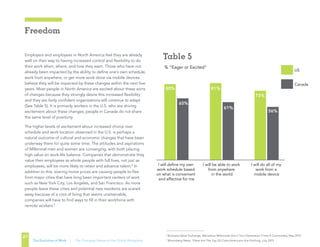
Employers and employees in North America feel they are already
well on their way to having increased control and flexibility to do
their work when, where, and how they want. Those who have not
already been impacted by the ability to define one’s own schedule,
work from anywhere, or get more work done via mobile devices
believe they will be impacted by these changes within the next five
years. Most people in North America are excited about these sorts
of changes because they strongly desire this increased flexibility
and they are fairly confident organizations will continue to adapt
(See Table 5). It is primarily workers in the U.S. who are driving
excitement about these changes; people in Canada do not share
the same level of positivity.
The higher levels of excitement about increased choice over
schedule and work location observed in the U.S. is perhaps a
natural outcome of cultural and economic changes that have been
underway there for quite some time. The attitudes and aspirations
of Millennial men and women are converging, with both placing
high value on work-life balance. Companies that demonstrate they
value their employees as whole people with full lives, not just as
employees, will be more likely to retain and advance talent.8
In
addition to this, soaring home prices are causing people to flee
from major cities that have long been important centers of work
such as New York City, Los Angeles, and San Francisco. As more
people leave these cities and potential new residents are scared
away because of a cost of living that seems unattainable,
companies will have to find ways to fill in their workforce with
remote workers.9
% “Eager or Excited”
Canada
US
I will do all of my
work from a
mobile device
I will be able to work
from anywhere
in the world
I will define my own
work schedule based
on what is convenient
and effective for me
80%
65%
81%
61%
73%
56%
TABLE 5
% “Already Happening”
Millennials
TABLE 6
Table 5
% “Eager or Excited”
Canada
US
I will need to learn
new skills rapidly as
I will be constantly
shifting roles
I will use technology
to learn anything,
anytime, anywhere
Social media will
become my main
collaboration
platform
for work
Technology will allow
me to have deeper
personal connections
with others across
distance and time
TABLE 7
78%
55%
67%
54%
84%
70% 68%
50%
% “Already Happening”
Sr . Execs
Career Knowledge
Workers
Millennials
I need to learn new skills
rapidly as I constantly shift roles
I use technology to learn
anything, anytime, anywhere
64%
75%
62%
61%
TABLE 6
31%
65%
51%
Table 7
Table 6
% “Eager or Excited”
Canada
US
I will need to learn
new skills rapidly as
I will be constantly
shifting roles
I will use technology
to learn anything,
anytime, anywhere
Social media will
become my main
collaboration
platform
for work
Technology will allow
me to have deeper
personal connections
with others across
distance and time
TABLE 7
78%
55%
67%
54%
84%
70% 68%
50%
% “Already Happening”
Sr . Execs
Career Knowledge
Workers
Millennials
I need to learn new skills
rapidly as I constantly shift roles
I use technology to learn
anything, anytime, anywhere
64%
75%
62%
61%
TABLE 6
31%
65%
51%
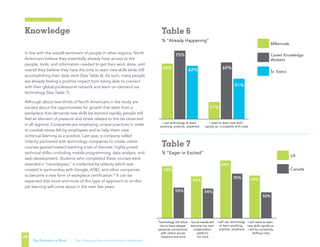
In line with the overall sentiment of people in other regions, North
Americans believe they essentially already have access to the
people, tools, and information needed to get their work done, and
overall they believe they have the time to learn new skills while still
accomplishing their daily work (See Table 6). As such, many people
are already feeling a positive impact from being able to connect
with their global professional network and learn on-demand via
technology (See Table 7).
Although about two-thirds of North Americans in the study are
excited about the opportunities for growth that stem from a
workplace that demands new skills be learned rapidly, people still
feel an element of pressure and stress related to this (as observed
in all regions). Companies are employing unique practices in order
to combat stress felt by employees and to help them view
continual learning as a positive. Last year, a company called
Udacity partnered with technology companies to create online
courses geared toward teaching a set of discrete, highly prized
technical skills—including mobile programming, data analysis, and
web development. Students who completed these courses were
awarded a “nanodegree,” a credential by Udacity which was
created in partnership with Google, ATT, and other companies
to become a new form of workplace certification.10
It can be
expected that more and more of this type of approach to on-the-
job learning will come about in the next few years.
Knowledge
28
The Evolution of Work | The Changing Nature of the Global Workplace
% “Eager or Excited”
Canada
US
I will need to learn
new skills rapidly as
I will be constantly
shifting roles
I will use technology
to learn anything,
anytime, anywhere
Social media will
become my main
collaboration
platform
for work
Technology will allow
me to have deeper
personal connections
with others across
distance and time
TABLE 7
78%
55%
67%
54%
84%
70% 68%
50%
% “Already Happening”
Sr . Execs
Career Knowledge
Workers
Millennials
I need to learn new skills
rapidly as I constantly shift roles
I use technology to learn
anything, anytime, anywhere
64%
75%
62%
61%
TABLE 6
31%
65%
51%
Table 7
Table 6
Table 9Table 8
TABLE 9
55%
TABLE 10
% “Eager or Excited”
Companies will exclusively hire
contract workers on a project-by-project basis
36%
74%
46%
US
Give me instant access to people, 29%
Ways in Which Increased Automation Will Impact You
Sr . Execs
Career Knowledge
Workers
Millennials
I will need to learn
new skills rapidly as
I will be constantly
shifting roles
I will use technology
to learn anything,
anytime, anywhere
Social media will
become my main
collaboration
platform
for work
Technology will allow
me to have deeper
personal connections
with others across
distance and time
55%
67%
54%
70% 68%
50%
% “Eager or Excited”
Companies will search globally for the best talent
84%
64% 63%
59%
Women 40+
Women 18-39
Men 40+
Men 18-39
10
New York Times, Udacity Says It Can Teach Tech Skills To Millions, September 2015
TABLE 9
55%
TABLE 10
% “Eager or Excited”
Companies will exclusively hire
contract workers on a project-by-project basis
36%
74%
46%
US
Give me instant access to people, 29%
Ways in Which Increased Automation Will Impact You
Sr . Execs
Career Knowledge
Workers
Millennials
I will need to learn
new skills rapidly as
I will be constantly
shifting roles
I will use technology
to learn anything,
anytime, anywhere
Social media will
become my main
collaboration
platform
for work
Technology will allow
me to have deeper
personal connections
with others across
distance and time
55%
67%
54%
70% 68%
50%
% “Eager or Excited”
Companies will search globally for the best talent
84%
64% 63%
59%
Women 40+
Women 18-39
Men 40+
Men 18-39
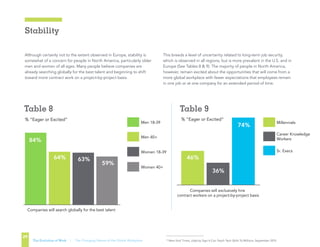
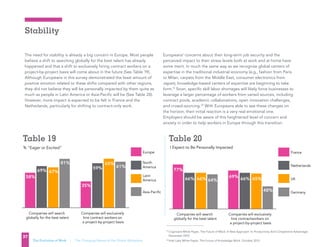
Although certainly not to the extent observed in Europe, stability is
somewhat of a concern for people in North America, particularly older
men and women of all ages. Many people believe companies are
already searching globally for the best talent and beginning to shift
toward more contract work on a project-by-project basis.
This breeds a level of uncertainty related to long-term job security,
which is observed in all regions, but is more prevalent in the U.S. and in
Europe (See Tables 8  9). The majority of people in North America,
however, remain excited about the opportunities that will come from a
more global workplace with fewer expectations that employees remain
in one job or at one company for an extended period of time.
Stability
29
The Evolution of Work | The Changing Nature of the Global Workplace
TABLE 9
55%
TABLE 10
% “Eager or Excited”
Companies will exclusively hire
contract workers on a project-by-project basis
36%
74%
46%
US
Give me instant access to people, 29%
Ways in Which Increased Automation Will Impact You
Sr . Execs
Career Knowledge
Workers
Millennials
I will need to learn
new skills rapidly as
I will be constantly
shifting roles
I will use technology
to learn anything,
anytime, anywhere
Social media will
become my main
collaboration
platform
for work
Technology will allow
me to have deeper
personal connections
with others across
distance and time
55%
67%
54%
70% 68%
50%
% “Eager or Excited”
Companies will search globally for the best talent
84%
64% 63%
59%
Women 40+
Women 18-39
Men 40+
Men 18-39
Table 8 Table 9
TABLE 11
% “Will Never Happen”
Canada
US
Departments and hierarchy
will no longer exist
37%
45%
TABLE 10
Companies will exclusively hire
contract workers on a project-by-project basis
Canada
US
Make my job and life more stressful
Make me afraid that my job
would not be secure long-term
Allow me to get more done in a
shorter time and with less effort
Allow me to contribute
to meaningful work
Give me instant access to people,
tools, and information needed to
get my work done better and faster
29%
26%
26%
24%
12%
16%
14%
19%
33%
33%
Ways in Which Increased Automation Will Impact You
Table 10
Table 11
TABLE 10
Companies will exclusively hire
contract workers on a project-by-project basis
Canada
US
Make my job and life more stressful
Make me afraid that my job
would not be secure long-term
Allow me to get more done in a
shorter time and with less effort
Allow me to contribute
to meaningful work
Give me instant access to people,
tools, and information needed to
get my work done better and faster
29%
26%
26%
24%
12%
16%
14%
19%
33%
33%
Ways in Which Increased Automation Will Impact You
TABLE 11
% “Will Never Happen”
Canada
US
Departments and hierarchy
will no longer exist
37%
45%
TABLE 10
Companies will exclusively hire
contract workers on a project-by-project basis
Canada
US
Make my job and life more stressful
Make me afraid that my job
would not be secure long-term
Allow me to get more done in a
shorter time and with less effort
Allow me to contribute
to meaningful work
Give me instant access to people,
tools, and information needed to
get my work done better and faster
29%
26%
26%
24%
12%
16%
14%
19%
33%
33%
Ways in Which Increased Automation Will Impact You
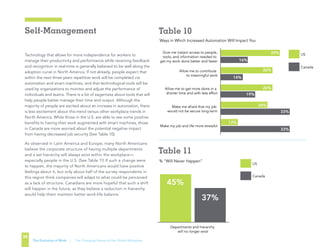
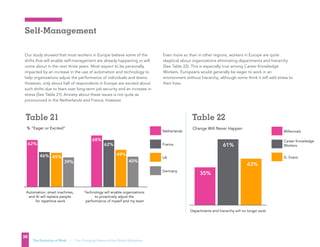
Technology that allows for more independence for workers to
manage their productivity and performance while receiving feedback
and recognition in real-time is generally believed to be well along the
adoption curve in North America. If not already, people expect that
within the next three years repetitive work will be completed via
automation and smart machines, and that technological tools will be
used by organizations to monitor and adjust the performance of
individuals and teams. There is a lot of eagerness about tools that will
help people better manage their time and output. Although the
majority of people are excited about an increase in automation, there
is less excitement about this trend versus other workplace trends in
North America. While those in the U.S. are able to see some positive
benefits to having their work augmented with smart machines, those
in Canada are more worried about the potential negative impact
from having decreased job security (See Table 10).
As observed in Latin America and Europe, many North Americans
believe the corporate structure of having multiple departments
and a set hierarchy will always exist within the workplace—
especially people in the U.S. (See Table 11) If such a change were
to happen, the majority of North Americans would have positive
feelings about it, but only about half of the survey respondents in
this region think companies will adapt to what could be perceived
as a lack of structure. Canadians are more hopeful that such a shift
will happen in the future, as they believe a reduction in hierarchy
would help them maintain better work-life balance.
Self-Management
30
The Evolution of Work | The Changing Nature of the Global Workplace
TABLE 11
% “Will Never Happen”
Canada
US
Departments and hierarchy
will no longer exist
37%
45%
TABLE 10
Companies will exclusively hire
contract workers on a project-by-project basis
Canada
US
Make my job and life more stressful
Make me afraid that my job
would not be secure long-term
Allow me to get more done in a
shorter time and with less effort
Allow me to contribute
to meaningful work
Give me instant access to people,
tools, and information needed to
get my work done better and faster
29%
26%
26%
24%
12%
16%
14%
19%
33%
33%
Ways in Which Increased Automation Will Impact You
Table 10
Table 11
TABLE 10
Companies will exclusively hire
contract workers on a project-by-project basis
Canada
US
Make my job and life more stressful
Make me afraid that my job
would not be secure long-term
Allow me to get more done in a
shorter time and with less effort
Allow me to contribute
to meaningful work
Give me instant access to people,
tools, and information needed to
get my work done better and faster
29%
26%
26%
24%
12%
16%
14%
19%
33%
33%
Ways in Which Increased Automation Will Impact You
TABLE 12
Canada
Canada
US
Departments and hierarchy
will no longer exist
37%
45%
% “Already Happening”
I will work wherever my skills are
needed and have impact rather
than remaining loyal to one company
42%
53%
Organizations will use technology
to measure and impact my well-being
30%
42%
Table 12
11
Tractica White Paper, Enterprise Wearable Technology Case Studies, Q3 2015
TABLE 12
Canada
Canada
US
Departments and hierarchy
will no longer exist
37%
45%
% “Already Happening”
I will work wherever my skills are
needed and have impact rather
than remaining loyal to one company
42%
53%
Organizations will use technology
to measure and impact my well-being
30%
42%
As many North Americans are already gravitating toward opportunities
that align their skills to their growing need for a sense of purpose,
companies in the region are beginning to adapt by increasingly using
tools and technology to impact employee well-being and help people
live healthy, meaningful lives (See Table 12). This is especially true in the
U.S. as compared with Canada. People in North America are excited
about increased opportunities to contribute to meaningful work at
companies that demonstrate a greater commitment to their employees.
One example of how employers can use technology to help employees
maintain their well-being in order to continue to contribute to
meaningful work comes from the oil and gas industry. Baker Hughes, an
oil and gas drilling services contractor based in Texas, is developing a
new smart helmet technology with sensors to track the user’s vital
statistics (heart rate, oxygen levels, blood sugar levels) for safety
purposes. This type of technology could be used in many different jobs
to help ensure workers are at their best and help people learn how to
improve their well-being.11
Meaning
31
The Evolution of Work | The Changing Nature of the Global Workplace
TABLE 12
Canada
Canada
US
Departments and hierarchy
will no longer exist
37%
45%
% “Already Happening”
I will work wherever my skills are
needed and have impact rather
than remaining loyal to one company
42%
53%
Organizations will use technology
to measure and impact my well-being
30%
42%
Table 12
The Evolution of Work | The Changing Nature of the Global Workplace
32
Looking below the
surface by region
Europe
Europe: The “Old World” View
33
The Evolution of Work | The Changing Nature of the Global Workplace
As a region, Europe tends to be most apprehensive about change in
comparison with the rest of the world. Our study shows this is because
of the distinct divide many Europeans have between work and leisure
(and the associated fear that new trends may threaten this), as well as the
resistance to change that is characteristic of much of the region’s large
aging population. Germany, for example, currently enjoys shorter
working hours than many of its European counterparts, but it also has
the most productivity.12
This is due to the working hours being a time of
intense focus and direction. In fact, the German government is even
considering banning work email after the hours of 6:00 p.m.13
Indeed, much of Europe possesses a “work to live” mentality. Like
Germany, the working population in the Netherlands carefully plans their
private and working lives, but their progressive approach to business
makes them well-equipped to take on the tasks of the future
workplace.14
On the other end of the spectrum, working people in the
UK work long hours, and more than a quarter of the population is
reportedly unhappy with their work-life balance, particularly those with
demanding careers such as those in finance, health, law, and teaching.15
Ironically, though fear exists among the region around change, many
European countries are embracing and even leading in technology and
education, inevitably building a workforce for the future. France is on the
cutting-edge of big data and digital technology, and both France and
the UK are avid users of social media.16
Germany, Europe’s powerhouse,
will continue being a leader for exports to developing Asian countries.
Ultimately, how the region utilizes these tools and adapts to its growth
will be key.
As mentioned previously, people in Europe overall are the most
apprehensive about changes in the workplace that are already
happening or are expected to happen in the next few years. Fear or
anxiety is particularly acute for any trends that may bring about
decreased job or financial security. In addition, Europeans feel
somewhat threatened by an increase in competition with people in
Asia-Pacific and Latin America for jobs, as they believe this may alter
their long-standing lifestyles of being able to keep reasonable work
hours and take time off for vacation and family leave.
12
Huffington Post, Why Germans work fewer hours, but produce more: A study in culture, November 2014
13
Huffington Post, Germany to consider ban on late-night work emails, September 2014
14
The Guardian, Going Dutch: why the country is leading the way on sustainable business, September 2013
15
Independent, A quarter of UK professionals are unhappy with their work-life balance, survey finds
16
Gouvernment.Fr, 9 things you didn’t know about France and #digitaltechnology, March 2015
TABLE 14
I will define my own work schedule
Never
Already
happening
In the future
Netherlands
UK
France
Germany 19% 54%27%
21% 54%25%
28% 55%17%
44% 44%
I will do all of my work from a mobile device
Never
Already
happening
In the future
Netherlands
UK
France
Germany 23% 56%21%
25% 56%19%
18% 58%24%
34% 43%23%
12%
TABLE 13
TABLE 14
I will define my own work schedule
Never
Already
happening
In the future
Netherlands
UK
France
Germany 19% 54%27%
21% 54%25%
28% 55%17%
44% 44%
I will do all of my work from a mobile device
Never
Already
happening
In the future
UK
France
Germany 23% 56%21%
25% 56%19%
18% 58%24%
12%
TABLE 13
TABLE 14
I will define my own work schedule
Never
Already
happening
In the future
Netherlands
UK
France
Germany 19% 54%27%
21% 54%25%
28% 55%17%
44% 44%
I will do all of my work from a mobile device
Never
Already
happening
In the future
UK
France
Germany 23% 56%21%
25% 56%19%
18% 58%24%
12%
TABLE 14
I will define my own work schedule
Never
Already
happening
In the future
Netherlands
UK
France
Germany 19% 54%27%
21% 54%25%
28% 55%17%
44% 44%
I will do all of my work from a mobile device
Never
Already
happening
In the future
Netherlands
UK
France
Germany 23% 56%21%
25% 56%19%
18% 58%24%
34% 43%23%
12%
Table 13
Table 14
17
Intel Labs White Paper, The Future of Knowledge Work, October 2012
TABLE 13
TABLE 14
I will define my own work schedule
Never
Already
happening
In the future
Netherlands
UK
France
Germany 19% 54%27%
21% 54%25%
28% 55%17%
44% 44%
I will do all of my work from a mobile device
Never
Already
happening
In the future
UK
France
Germany 23% 56%21%
25% 56%19%
18% 58%24%
12%
TABLE 14
I will define my own work schedule
Never
Already
happening
In the future
Netherlands
UK
France
Germany 19% 54%27%
21% 54%25%
28% 55%17%
44% 44%
I will do all of my work from a mobile device
Never
Already
happening
In the future
Netherlands
UK
France
Germany 23% 56%21%
25% 56%19%
18% 58%24%
34% 43%23%
12%
Freedom
34
The Evolution of Work | The Changing Nature of the Global Workplace
In line with other regions, most Europeans in our study believe people can
either already work from anywhere in the world or will be able to do so in
the next five years. While about three-quarters of survey respondents in
Europe expect to be impacted by this increased choice of work location,
most of them only expect to be impacted “a little.” This is more akin to
how their North American counterparts view this trend and is very
different from how it is viewed in Asia-Pacific and Latin America where
a greater impact is expected to be felt.
There is mixed opinion in Europe related to whether or not people will
be able to define their own work schedules or get all of their work done
via mobile device (See Table 13). While nearly one-quarter of Europeans
believe these changes will never happen, roughly the same proportion of
people believe these changes are already happening. Fewer Europeans
expect to be impacted by this trend when compared with those in other
regions, especially those in Germany.
Although most Europeans surveyed are eager or excited about having
increased choice in work location and schedule, as well as being able to
get all of their work done from a mobile device, their level of excitement
is still the lowest among all regions. Most believe companies will adapt to
providing increased choice in work location and the ability to get work done
from a mobile device, but there is a bit more skepticism when it comes to
defining one’s own work schedule—especially in the UK (See Table 14).
Regardless of how people in Europe feel about these changes, new
technology will have a dramatic effect on how and where work is done
and on how Europeans will be effected. The accelerating adoption of
mobile technologies and the migration to cloud computing will provide
a transition point to “empty” or “thin” office space. The proliferation of
data warehouses will enable corporations to centralize computing to
large offsite facilities or to leverage external cloud services dynamically
for needed computing capability (for example, Amazon Cloud).17
TABLE 13
TABLE 14
I will define my own work schedule
Never
Already
happening
In the future
Netherlands
UK
France
Germany 19% 54%27%
21% 54%25%
28% 55%17%
44% 44%
I will do all of my work from a mobile device
Never
Already
happening
In the future
UK
France
Germany 23% 56%21%
25% 56%19%
18% 58%24%
12%
TABLE 14
I will define my own work schedule
Never
Already
happening
In the future
Netherlands
UK
France
Germany 19% 54%27%
21% 54%25%
28% 55%17%
44% 44%
I will do all of my work from a mobile device
Never
Already
happening
In the future
Netherlands
UK
France
Germany 23% 56%21%
25% 56%19%
18% 58%24%
34% 43%23%
12%
Table 13
Table 14
TABLE 13
TABLE 14
I will define my own work schedule
Never
Already
happening
In the future
Netherlands
UK
France
Germany 19% 54%27%
21% 54%25%
28% 55%17%
44% 44%
I will do all of my work from a mobile device
Never
Already
happening
In the future
UK
France
Germany 23% 56%21%
25% 56%19%
18% 58%24%
12%
TABLE 14
I will define my own work schedule
Never
Already
happening
In the future
Netherlands
UK
France
Germany 19% 54%27%
21% 54%25%
28% 55%17%
44% 44%
I will do all of my work from a mobile device
Never
Already
happening
In the future
Netherlands
UK
France
Germany 23% 56%21%
25% 56%19%
18% 58%24%
34% 43%23%
12%
% Expected to be Impacted “A Lot”
Technology will allow me to have
deeper personal connection with
others across distance and time
44%
24%
I will use technology to learn
anything, anytime, anywhere
50%
35%
TABLE 15
TABLE 16
Social media will become my main collaboration platform for work
Other
Regions
Europe
Technology will allow me to have
deeper personal connection with
others across distance and time
44%
24%
I will use technology to learn
anything, anytime, anywhere
35%
TABLE 16
Social media will become my main collaboration platform for work
Never
Already
happening
In the future
UK
France
Germany
Netherlands 28% 47%25%
31% 48%21%
29% 52%19%
21% 64%15%
Other
Regions
Table 15 Table 16
Technology will allow me to have
deeper personal connection with
others across distance and time
44%
24%
I will use technology to learn
anything, anytime, anywhere
35%
TABLE 16
Social media will become my main collaboration platform for work
Never
Already
happening
In the future
UK
France
Germany
Netherlands 28% 47%25%
31% 48%21%
29% 52%19%
21% 64%15%
Other
Regions
% Expected to be Impacted “A Lot”
Technology will allow me to have
deeper personal connection with
others across distance and time
44%
24%
I will use technology to learn
anything, anytime, anywhere
50%
35%
TABLE 15
TABLE 16
Social media will become my main collaboration platform for work
Other
Regions
Europe
Technology will allow me to have
deeper personal connection with
others across distance and time
44%
24%
I will use technology to learn
anything, anytime, anywhere
35%
TABLE 16
Social media will become my main collaboration platform for work
Never
Already
happening
In the future
UK
France
Germany
Netherlands 28% 47%25%
31% 48%21%
29% 52%19%
21% 64%15%
Other
Regions
Knowledge
35
The Evolution of Work | The Changing Nature of the Global Workplace
The majority of Europeans in the study believe that technology is
already allowing them to have deeper personal connections with others
across distance and time, and is also allowing them to learn anything,
anytime, anywhere. Since many workers have already adapted to these
shifts, the level of impact and excitement felt by Europeans is a bit less
than when compared with workers in other regions (See Table 15). While
most survey respondents in Europe believe social media will be used as
a collaborative tool for work at some point in the future, a sizeable
proportion is skeptical that such a change will ever come about
(See Table 16).
% Expected to be Impacted “A Lot”
Technology will allow me to have
deeper personal connection with
others across distance and time
44%
24%
I will use technology to learn
anything, anytime, anywhere
50%
35%
TABLE 15
TABLE 16
Social media will become my main collaboration platform for work
Other
Regions
Europe
Technology will allow me to have
deeper personal connection with
others across distance and time
44%
24%
I will use technology to learn
anything, anytime, anywhere
35%
TABLE 16
Social media will become my main collaboration platform for work
Never
Already
happening
In the future
UK
France
Germany
Netherlands 28% 47%25%
31% 48%21%
29% 52%19%
21% 64%15%
Other
Regions
Table 15 Table 16
Technology will allow me to have
deeper personal connection with
others across distance and time
44%
24%
I will use technology to learn
anything, anytime, anywhere
35%
TABLE 16
Social media will become my main collaboration platform for work
Never
Already
happening
In the future
UK
France
Germany
Netherlands 28% 47%25%
31% 48%21%
29% 52%19%
21% 64%15%
Other
Regions
Social media will become
my main collaboration platform
75%
57%
Europe
52%
% “Eager or Excited”
TABLE 17
16%
% “Anxious or Fearful”
TABLE 18
Other
Regions
Europe
Social media will become
my main collaboration platform
57%
Asia-Pacific
Latin America
North America
Europe
I will need to learn new skills rapidly,
as I will be constantly shifting roles
52%
16%
% “Anxious or Fearful”
TABLE 18
33% 31%
19%
Regions
Table 17
Table 18
18
Singularity Hub, Finland’s Latest Educational Move Will Produce A Generation of Entrepreneurs, April 2015
Social media will become
my main collaboration platform
75%
57%
Europe
52%
% “Eager or Excited”
TABLE 17
16%
% “Anxious or Fearful”
TABLE 18
Other
Regions
Europe
Social media will become
my main collaboration platform
57%
Asia-Pacific
Latin America
North America
Europe
I will need to learn new skills rapidly,
as I will be constantly shifting roles
52%
16%
% “Anxious or Fearful”
TABLE 18
33% 31%
19%
Regions
This skepticism is driving somewhat lower excitement about the
possibility of using social media to collaborate for work among
Europeans when compared with those in other regions (see Table 17).
With increased access to the people, tools, and information needed
to get work done in less time and effort comes an increased
expectation from employers that employees will be able to learn new
skills rapidly in order to move fluidly between roles. This will lead to
reformed approaches to education from a very early age in order to
properly prepare students for life and careers in the technology-
driven 21st century. In France, Germany, and the UK, younger
students are being groomed as a generation of entrepreneurs as
curricula focus on the four Cs—communication, creativity, critical
thinking, and collaboration. These skills will be central to working in
teams, and flatter teams comprised of people able to think about
issues from a variety of perspectives will be the go-to structure in
modern working environments.18
More than half of Europeans in our study feel anxious or fearful when
thinking about having to learn new skills rapidly in order to shift roles
constantly (See Table 18). Such emotion in this area strongly
differentiates people in Europe from people in other regions of the
world where the overriding sentiment is positive. The thought of
constantly having to learn new skills and move fluidly between roles
brings up concerns for those in Europe that they will have increased
stress in their job and life and that, if they are not able to keep up
with their peers in an increasingly global talent pool, they will have
decreased long-term job security.
Knowledge
36
The Evolution of Work | The Changing Nature of the Global Workplace
Social media will become
my main collaboration platform
75%
57%
Europe
52%
% “Eager or Excited”
TABLE 17
16%
% “Anxious or Fearful”
TABLE 18
Other
Regions
Europe
Social media will become
my main collaboration platform
57%
Asia-Pacific
Latin America
North America
Europe
I will need to learn new skills rapidly,
as I will be constantly shifting roles
52%
16%
% “Anxious or Fearful”
TABLE 18
33% 31%
19%
Regions
Table 17
Table 18
Companies will search
globally for the best talent
69% 67%
81%
58%
Asia-Pacific
Latin
America
North
America
Companies will exclusively
hire contract workers on
a project-by-project basis
59%
65%
61%
35%
Companies will search
globally for the best talent
66% 66% 64%
77%
Companies will exclusively
hire contractworkers on
a project-by-project basis
66% 65%
48%
69%
I Expect to Be Personally Impacted
TABLE 20
Germany
UK
Netherlands
France
Companies will search
globally for the best talent
69% 67%
81%
58%
Asia-Pacific
Latin
America
North
America
Europe
Companies will exclusively
hire contract workers on
a project-by-project basis
59%
65%
61%
35%
% “Eager or Excited”
TABLE 19
Table 19 Table 20
19 
Cognizant White Paper, The Future of Work: A New Approach To Productivity And Competitive Advantage,
December 2010
20
Intel Labs White Paper, The Future of Knowledge Work, October 2012
Companies will search
globally for the best talent
69% 67%
81%
58%
Asia-Pacific
Latin
America
North
America
Companies will exclusively
hire contract workers on
a project-by-project basis
59%
65%
61%
35%
Companies will search
globally for the best talent
66% 66% 64%
77%
Companies will exclusively
hire contractworkers on
a project-by-project basis
66% 65%
48%
69%
I Expect to Be Personally Impacted
TABLE 20
Germany
UK
Netherlands
France
Companies will search
globally for the best talent
69% 67%
81%
58%
Asia-Pacific
Latin
America
North
America
Europe
Companies will exclusively
hire contract workers on
a project-by-project basis
59%
65%
61%
35%
% “Eager or Excited”
TABLE 19
Stability
37
The Evolution of Work | The Changing Nature of the Global Workplace
The need for stability is already a big concern in Europe. Most people
believe a shift to searching globally for the best talent has already
happened and that a shift to exclusively hiring contract workers on a
project-by-project basis will come about in the future (See Table 19).
Although Europeans in this survey demonstrated the least amount of
positive emotion related to these shifts compared with other regions,
they did not believe they will be personally impacted by them quite as
much as people in Latin America or Asia-Pacific will be (See Table 20).
However, more impact is expected to be felt in France and the
Netherlands, particularly for shifting to contract-only work.
Europeans’ concerns about their long-term job security and the
perceived impact to their stress levels both at work and at home have
some merit. In much the same way as we recognize global centers of
expertise in the traditional industrial economy (e.g., fashion from Paris
or Milan, carpets from the Middle East, consumer electronics from
Japan), knowledge-based centers of expertise are beginning to take
form.19
Soon, specific skill labor shortages will likely force businesses to
leverage a larger percentage of workers from varied sources, including
contract pools, academic collaborations, open innovation challenges,
and crowd-sourcing.20
With Europeans able to see these changes on
the horizon, their initial reaction is a very real emotional one.
Employers should be aware of this heightened level of concern and
anxiety in order to help workers in Europe through this transition.
Companies will search
globally for the best talent
69% 67%
81%
58%
Asia-Pacific
Latin
America
North
America
Companies will exclusively
hire contract workers on
a project-by-project basis
59%
65%
61%
35%
Companies will search
globally for the best talent
66% 66% 64%
77%
Companies will exclusively
hire contractworkers on
a project-by-project basis
66% 65%
48%
69%
I Expect to Be Personally Impacted
TABLE 20
Germany
UK
Netherlands
France
Companies will search
globally for the best talent
69% 67%
81%
58%
Asia-Pacific
Latin
America
North
America
Europe
Companies will exclusively
hire contract workers on
a project-by-project basis
59%
65%
61%
35%
% “Eager or Excited”
TABLE 19
Table 19 Table 20
Automation, smart machines,
and AI will replace people
for repetitive work
46% 45%
39%
62%
Germany
UK
France
Netherlands
Technology will enable organizations
to proactively adjust the
performance of myself and my team
62%
49%
40%
68%
% “Eager or Excited”
TABLE 21
Change Will Never Happen
TABLE 22
Millennials
Career Knowledge
Workers
Sr . Execs
Departments and hierarchy will no longer exist
35%
61%
43%
Table 21 Table 22
Automation, smart machines,
and AI will replace people
for repetitive work
46% 45%
39%
62%
Germany
UK
France
Netherlands
Technology will enable organizations
to proactively adjust the
performance of myself and my team
62%
49%
40%
68%
% “Eager or Excited”
TABLE 21
Change Will Never Happen
TABLE 22
Millennials
Career Knowledge
Workers
Sr . Execs
Departments and hierarchy will no longer exist
35%
61%
43%
Self-Management
38
The Evolution of Work | The Changing Nature of the Global Workplace
Our study showed that most workers in Europe believe some of the
shifts that will enable self-management are already happening or will
come about in the next three years. Most expect to be personally
impacted by an increase in the use of automation and technology to
help organizations adjust the performance of individuals and teams.
However, only about half of respondents in Europe are excited about
such shifts due to fears over long-term job security and an increase in
stress (See Table 21). Anxiety about these issues is not quite as
pronounced in the Netherlands and France, however.
Even more so than in other regions, workers in Europe are quite
skeptical about organizations eliminating departments and hierarchy
(See Table 22). This is especially true among Career Knowledge
Workers. Europeans would generally be eager to work in an
environment without hierarchy, although some think it will add stress to
their lives.
Automation, smart machines,
and AI will replace people
for repetitive work
46% 45%
39%
62%
Germany
UK
France
Netherlands
Technology will enable organizations
to proactively adjust the
performance of myself and my team
62%
49%
40%
68%
% “Eager or Excited”
TABLE 21
Change Will Never Happen
TABLE 22
Millennials
Career Knowledge
Workers
Sr . Execs
Departments and hierarchy will no longer exist
35%
61%
43%
Table 21 Table 22
Never
Already happening
In the future
I will work wherever my skills are
needed and have impact rather than
remaining loyal to one company
Organizations will use technology to
measure and impact my well-being
I will spend my time working
on things that personally
interest me or impact society
Expected Timeframe For Each Trend
18% 32% 50%
9% 32% 59%
8% 42% 50%
TABLE 23
Departments and hierarchy will no longer exist
35%
Table 23
Never
Already happening
In the future
I will work wherever my skills are
needed and have impact rather than
remaining loyal to one company
Organizations will use technology to
measure and impact my well-being
I will spend my time working
on things that personally
interest me or impact society
Expected Timeframe For Each Trend
18% 32% 50%
9% 32% 59%
8% 42% 50%
TABLE 23
Departments and hierarchy will no longer exist
35%
43%
Meaning
39
The Evolution of Work | The Changing Nature of the Global Workplace
Most survey respondents in Europe believe a shift is already happening
toward finding work that gives people a deeper sense of purpose, as
well as working for companies that care about the people who work for
them. Most respondents believe these trends will continue over the next
five years (See Table 23). In line with how Europeans feel about these
workplace trends, most expect to be impacted by these changes but to
a lesser degree than people from other regions. While Europeans are
very excited about being able to choose work that personally interests
them and impacts society, they have less excitement than other regions
about shifting jobs often in search of such meaning. In addition,
Europeans have less excitement than workers in other regions about
companies leveraging technology to help people maintain their well-
being (See Table 23).
Never
Already happening
In the future
I will work wherever my skills are
needed and have impact rather than
remaining loyal to one company
Organizations will use technology to
measure and impact my well-being
I will spend my time working
on things that personally
interest me or impact society
Expected Timeframe For Each Trend
18% 32% 50%
9% 32% 59%
8% 42% 50%
TABLE 23
Departments and hierarchy will no longer exist
35%
Never
Already happening
In the future
I will work wherever my skills are
needed and have impact rather than
remaining loyal to one company
Organizations will use technology to
measure and impact my well-being
I will spend my time working
on things that personally
interest me or impact society
Expected Timeframe For Each Trend
18% 32% 50%
9% 32% 59%
8% 42% 50%
TABLE 23
Departments and hierarchy will no longer exist
35%
Table 23
Never
Already happening
In the future
I will work wherever my skills are
needed and have impact rather than
remaining loyal to one company
Organizations will use technology to
measure and impact my well-being
I will spend my time working
on things that personally
interest me or impact society
Expected Timeframe For Each Trend
18% 32% 50%
9% 32% 59%
8% 42% 50%
TABLE 23
Departments and hierarchy will no longer exist
35%
Never
Already happening
In the future
I will work wherever my skills are
needed and have impact rather than
remaining loyal to one company
Organizations will use technology to
measure and impact my well-being
I will spend my time working
on things that personally
interest me or impact society
Expected Timeframe For Each Trend
18% 32% 50%
9% 32% 59%
8% 42% 50%
TABLE 23
Departments and hierarchy will no longer exist
35%
43%
The Evolution of Work | The Changing Nature of the Global Workplace
40
Looking below the
surface by region
Latin America
Latin America: Hopeful but Skeptical
41
The Evolution of Work | The Changing Nature of the Global Workplace
Though Latin America appeared to be particularly well-poised for
growth over the last decade, a steady decline in economic growth over
the last several years—particularly in Brazil—poses a challenge to the
region today. Once the region’s economic beacons, Brazil and Argentina
have witnessed slow paces in growth largely due to decreasing
commodity prices, a slower Chinese economy, and shrinking
investments, which have an impact both on technology infrastructure
and adoption of workplace trends.
The region is not all characterized by a poor outlook, however. In the
past decade alone, Latin America has managed to lift more than 70
million people out of poverty while expanding the middle class by more
than 50 percent.21
Better quality education, infrastructure, security, and
healthcare services have become part of the core demands of Latin
America’s rising middle class. Chile, for one, a globally integrated,
entrepreneurial country, is set to become the region’s tech hub with
burgeoning start-ups and an increasing exports industry.22
Similarly,
Mexico is emerging as Latin America’s economic winner.23
Manufacturing in Mexico remains a bright spot for the country.
Additionally, Mexico’s unique proximity to the U.S. works in the country’s
favor. The weak peso makes exports more competitive, and Mexico is
aided by imported technology. Companies such as Ford and Coca-Cola
are projected to continue thriving in the region along with other
industries that contribute to job growth and hiring.24
Even in places such
as Brazil, where the economy has plummeted, workers continue to be
well-cared for and enjoy many labor-friendly protections.
So, even though the region as a whole remains a bit slower to growth
compared with the rest of the world, changes are still facilitating growth
toward the future, and workers’ sentiments reflect that. Respondents to
our study are excited about the increased sense of understanding and
freedom to be gained from rapidly accelerating technology and flexible
work locations. Compared with other regions, those in Latin America are
generally more likely to expect to be strongly impacted by workplace
change. Even though almost two-thirds of people believe organizations
in the region will adapt to shifting employee needs, Latin America is the
most skeptical about organizations changing along with the times.
Countries within Latin America tend to share similar views on the future
of the workplace. Where differences occur, however, it is usually Mexico
that shows the most excitement about upcoming changes and the most
confidence that organizations will adapt.
21
Worldbank.Org, Latin America Overview, 2015
22
Stanford.edu, Technology trends in Latin America
23
CNN Money, Mexico is Latin America’s success story as Brazil stumbles, September 2015
24
Forbes, Expert Opinion: How Stable Is Mexico’s Economy? September 2015
TABLE 25
Will never happen
Already happening
In the futurePeople will define
their own work schedule
20% 22% 58%
TABLE 24
Asia-Pacific
Latin America
78%
67%
TABLE 25
Will never happen
Already happening
In the futurePeople will define
their own work schedule
20% 22% 58%
TABLE 24
Europe
North America
Asia-Pacific
Latin America
Organizations definitely or probably will adapt to
letting people define their own work schedule
52%
78%
67%
55%
Table 24 Table 25
Freedom
More than half of those surveyed in Latin America believe that workers
can already make the choice to work from anywhere in the world, and
(along with Asia-Pacific) they are much more likely than workers from
North America and Europe to be feeling a strong impact from this.
Interestingly, feelings are much more mixed with respect to whether or
not people will be able to choose their own work schedules. Roughly
the same proportion of Latin Americans believe they can already do
this as those who believe such a shift will never happen (See Tables 24
 25). Latin Americans are generally excited about the prospect of
choosing their own schedule, particularly in Brazil, even though they
are least likely among all regions to believe organizations will allow it.
Such skepticism is especially true of Millennials in the region. In
general, workers in Mexico are the most excited about an increase in
choice of location and schedule when compared with other Latin
American countries.
Many of those surveyed in Latin America believe that doing all work
from a mobile device is something that either already can be done or
will come to fruition in the next three years. While those in Latin
America are much more eager and excited about this change than
workers in North America and Europe, they are still far less excited
about it than people in the Asia-Pacific region. A dip in the level of
excitement is likely due to a fair amount of skepticism that organizations
in the region will adapt to allowing employees to complete work on a
mobile device. Additionally, in places such as Brazil, while mobile phone
usage is pervasive, smartphone adoption is still growing.
42
The Evolution of Work | The Changing Nature of the Global Workplace
TABLE 25
Will never happen
Already happening
In the futurePeople will define
their own work schedule
20% 22% 58%
TABLE 24
Asia-Pacific
Latin America
78%
67%
TABLE 25
Will never happen
Already happening
In the futurePeople will define
their own work schedule
20% 22% 58%
TABLE 24
Europe
North America
Asia-Pacific
Latin America
Organizations definitely or probably will adapt to
letting people define their own work schedule
52%
78%
67%
55%
TABLE 25
Will never happen
Already happening
In the futurePeople will define
their own work schedule
20% 22% 58%
TABLE 24
Asia-Pacific
Latin America
78%
67%
TABLE 25
Will never happen
Already happening
In the futurePeople will define
their own work schedule
20% 22% 58%
TABLE 24
Europe
North America
Asia-Pacific
Latin America
Organizations definitely or probably will adapt to
letting people define their own work schedule
52%
78%
67%
55%
Table 24 Table 25
% “Eager or Excited”
Brazil
Chile
Mexico
I will use technology to learn anything,
anytime, anywhere
95% 95%
TABLE 27
80%
% “Already Happening”
Social media has become
my main collaboration
platform for work
Technology allows me to have
deeper personal connections with
others across distance and time
61%
46%
55%
47%
56%
43%
31%
28%
TABLE 26
letting people define their own work schedule
Europe
North America
Asia-Pacific
Latin America
Table 26
Table 27
25
McAfee and Intel Security Report, Intel Security: Safeguarding the Future of Digital Australia in 2025, 2014
% “Eager or Excited”
Brazil
Chile
Mexico
I will use technology to learn anything,
anytime, anywhere
95% 95%
TABLE 27
80%
% “Already Happening”
Social media has become
my main collaboration
platform for work
Technology allows me to have
deeper personal connections with
others across distance and time
61%
46%
55%
47%
56%
43%
31%
28%
TABLE 26
letting people define their own work schedule
Europe
North America
Asia-Pacific
Latin America
Knowledge
43
The Evolution of Work | The Changing Nature of the Global Workplace
Most people in Latin America—far more so than people in other
regions—believe that technology is already creating opportunities for
deeper connections across distance and time (See Table 26). This may
not be all that surprising, given that countries such as Costa Rica have
declared Internet access to be a basic human right.25
Interestingly, Latin
Americans are also significantly more likely than people in other
regions to believe that social media has already become a
collaboration platform for work—especially Millennials. As such, the
Latin American region is more likely than other regions to feeling
personally impacted by these changes. While those in Latin America
are generally a bit less excited about such changes than people in the
Asia-Pacific region, those in Mexico feel particularly eager to take
advantage of them.
Along with people in North America, Latin Americans are much more
likely to believe that they can already learn on-demand (See Table 27).
And, similarly to workers in the Asia-Pacific region, those in Latin
America expect to feel a much stronger impact from this ability than
people in other regions. Those in Brazil are less enthusiastic about
on-demand learning than those in other Latin American countries.
With an increased ability to learn new skills and information rapidly
through better technological platforms comes an increased
expectation from employers that employees will be able to shift roles
constantly. This expectation is something that over half of Latin
Americans believe is already happening, with another quarter believing
constant role shifting will be the norm in the next three years. Like
people in all other regions, nearly everyone in Latin America expects to
feel a strong impact from such a shift in expectations.
% “Eager or Excited”
Brazil
Chile
Mexico
I will use technology to learn anything,
anytime, anywhere
95% 95%
TABLE 27
80%
% “Already Happening”
Social media has become
my main collaboration
platform for work
Technology allows me to have
deeper personal connections with
others across distance and time
61%
46%
55%
47%
56%
43%
31%
28%
TABLE 26
letting people define their own work schedule
Europe
North America
Asia-Pacific
Latin America
Table 26
Table 27
Table 28
Brazil
I will use technology to learn anything,
anytime, anywhere
80%
Never
6+ years
Next 4-5 yrs
Next 3 yrs
Already
happening
Chile
Brazil
Mexico
Companies will exclusively hire contract workers
45% 23%
36% 25%
27% 22%
17%
21%
15%
11%
11%
17%
4%
7%
19%
Amount of Positivity Toward Each
Brazil
Chile
Mexico
Companies will exclusively
hire contract workers
on a project-by-project basis
Companies will search globally
for the best talent
70%
67% 66%
56% 55%
69%
TABLE 29
Table 29
Brazil
I will use technology to learn anything,
anytime, anywhere
80%
Never
6+ years
Next 4-5 yrs
Next 3 yrs
Already
happening
Chile
Brazil
Mexico
Companies will exclusively hire contract workers
45% 23%
36% 25%
27% 22%
17%
21%
15%
11%
11%
17%
4%
7%
19%
Stability
Along with those in Europe, our study shows that people in Latin
America are more likely than those in other regions (especially Asia-
Pacific) to believe companies are already searching globally for the best
talent. And like all other regions, Latin Americans believe a shift to
contract-only work is something that will come about, but likely not for
at least three to five years. Mexico is the only exception to this. More
people in the country are already seeing contract jobs, likely because of
the growing economy, which is largely based in manufacturing (See
Table 28). In many cases, companies prefer to contract people by job
rather than pay employees a salary over a long period of time. Latin
Americans are more likely than others to believe they will personally be
impacted by these changes—although they just barely edge out
people in the Asia-Pacific region in that respect. Most are excited about
competing globally for jobs and doing contract work, especially in
Brazil where the economy is beginning to slow and contract work
provides new opportunities (see Table 29).
44
The Evolution of Work | The Changing Nature of the Global Workplace
Brazil
I will use technology to learn anything,
anytime, anywhere
80%
Never
6+ years
Next 4-5 yrs
Next 3 yrs
Already
happening
Chile
Brazil
Mexico
Companies will exclusively hire contract workers
45% 23%
36% 25%
27% 22%
17%
21%
15%
11%
11%
17%
4%
7%
19%
Amount of Positivity Toward Each
Brazil
Chile
Mexico
Companies will exclusively
hire contract workers
on a project-by-project basis
Companies will search globally
for the best talent
70%
67% 66%
56% 55%
69%
TABLE 29
Table 28
Brazil
I will use technology to learn anything,
anytime, anywhere
80%
Never
6+ years
Next 4-5 yrs
Next 3 yrs
Already
happening
Chile
Brazil
Mexico
Companies will exclusively hire contract workers
45% 23%
36% 25%
27% 22%
17%
21%
15%
11%
11%
17%
4%
7%
19%
Amount of Positivity Toward Each
Brazil
Chile
Mexico
Companies will exclusively
hire contract workers
on a project-by-project basis
Companies will search globally
for the best talent
70%
67% 66%
56% 55%
69%
TABLE 29
Table 29
Brazil
I will use technology to learn anything,
anytime, anywhere
80%
Never
6+ years
Next 4-5 yrs
Next 3 yrs
Already
happening
Chile
Brazil
Mexico
Companies will exclusively hire contract workers
45% 23%
36% 25%
27% 22%
17%
21%
15%
11%
11%
17%
4%
7%
19%
Table 30
Companies will exclusively
hire contract workers
on a project-by-project basis
Companies will search globally
for the best talent
Never
Already
happening
In the future
Mexico
Brazil
Chile
Departments and hierarchy will no longer exist
54% 10%
46% 11%
38% 10%
36%
43%
52%
TABLE 30
Companies will exclusively
hire contract workers
on a project-by-project basis
Companies will search globally
for the best talent
Never
Already
happening
In the future
Mexico
Brazil
Chile
Departments and hierarchy will no longer exist
54% 10%
46% 11%
38% 10%
36%
43%
52%
TABLE 30
Companies will exclusively
hire contract workers
on a project-by-project basis
Companies will search globally
for the best talent
Never
Already
happening
In the future
Mexico
Brazil
Chile
Departments and hierarchy will no longer exist
54% 10%
46% 11%
38% 10%
36%
43%
52%
TABLE 30
Self-Management
45
The Evolution of Work | The Changing Nature of the Global Workplace
In line with those in North America and Europe, about half of Latin
Americans believe departments and hierarchy will always exist—
although those in Mexico are slightly more likely to believe such
structure may not exist at some point in the future (see Table 30).
While the majority of Latin Americans have positive emotions toward
the possibility of this change in the workplace, this region is the least
likely to believe that companies will adapt to such a change.
Latin America is the most likely of all regions to believe organizations
are already being proactive in using technology to adjust the
performance of individuals and teams. This is especially true for Chile,
where nearly everyone is feeling or expects to feel personally
impacted by it. While only about two-thirds of Latin Americans are
excited about the use of this type of technology, people generally
feel it will be useful to help them get more done in less time or with
less effort.
Similarly to how those in North America and Europe feel, about half
of those in Latin America believe automation, smart machines, and
artificial intelligence are already replacing people for repetitive work.
Latin Americans, however, are much more likely than those in other
regions to think they will be personally impacted by such a shift. This
may lead to anxiety or fear about long-term job security for about
half of Latin Americans.
Table 30
Companies will exclusively
hire contract workers
on a project-by-project basis
Companies will search globally
for the best talent
Never
Already
happening
In the future
Mexico
Brazil
Chile
Departments and hierarchy will no longer exist
54% 10%
46% 11%
38% 10%
36%
43%
52%
TABLE 30
Companies will exclusively
hire contract workers
on a project-by-project basis
Companies will search globally
for the best talent
Never
Already
happening
In the future
Mexico
Brazil
Chile
Departments and hierarchy will no longer exist
54% 10%
46% 11%
38% 10%
36%
43%
52%
TABLE 30
People will choose to work on things
that personally interest them or impact society
51%
% “Already Happening”
Females
Males
Organizations are using technology
to measure and impact my well-being
47%
TABLE 32
38%
Companies “Definitely” or “Probably” Will Adapt
Other Regions
Latin America
People will choose to work on things
that personally interest them or impact society
51%
TABLE 31
70%
% “Already Happening”
TABLE 32
Table 31
Table 32
People will choose to work on things
that personally interest them or impact society
51%
% “Already Happening”
Females
Males
Organizations are using technology
to measure and impact my well-being
47%
TABLE 32
38%
Companies “Definitely” or “Probably” Will Adapt
Other Regions
Latin America
People will choose to work on things
that personally interest them or impact society
51%
TABLE 31
70%
% “Already Happening”
TABLE 32
Meaning
46
The Evolution of Work | The Changing Nature of the Global Workplace
As with other regions, about one-third of Latin Americans believe
people are already choosing to work on things that personally interest
them or will have an impact on society. An additional quarter of people
believe this will be widespread within the next three years. Although
the Latin American region is more likely than other regions to think
they will be personally impacted by such a shift, they are least likely to
think organizations will adapt, which makes it more difficult for them to
feel a benefit (See Table 31).
More than two-thirds of Latin Americans, especially males, believe
organizations are either already using technology to measure and
impact the well-being of their employees or will be doing so in the next
three years (See Table 32). Most expect to be personally impacted by
this change and they are excited about it, especially Millennials.
While many Latin Americans believe people are already starting to
work wherever their skills are needed rather than remaining loyal to
one company, this region (along with Asia-Pacific) is more likely than
other regions to think this won’t really be widespread until sometime
within the next three years. Latin Americans, like their Asia-Pacific
counterparts, are more likely than those in North America and Europe
to believe they will be personally impacted by this and to be excited
about it. The Latin American region is the least likely, however, to
believe companies will willingly adapt to such an environment,
although those in Mexico are slightly more likely to believe that
companies will change.
People will choose to work on things
that personally interest them or impact society
51%
% “Already Happening”
Females
Males
Organizations are using technology
to measure and impact my well-being
47%
TABLE 32
38%
Companies “Definitely” or “Probably” Will Adapt
Other Regions
Latin America
People will choose to work on things
that personally interest them or impact society
51%
TABLE 31
70%
% “Already Happening”
TABLE 32
Table 31
Table 32
The Evolution of Work | The Changing Nature of the Global Workplace
47
Looking below the
surface by region
Asia Pacific
Asia-Pacific: The Young and the Restless
48
The Evolution of Work | The Changing Nature of the Global Workplace
Today, Asia-Pacific is defined by continued rapid economic growth,
technological development, and large populations of workers who tend
to skew younger. This makes the region not only excited about
workplace changes, but also largely well-equipped to handle them. For
the past decade and more, China has led regional growth, but the
country’s growth will likely begin to taper after the next year as it shifts
to a model more dominated by domestic consumption and services.
This change will most likely impact the workplace both in the region and
around the world. India is moving to take the lead over China as the
region’s most quickly growing country with continued large investments
in science, technology, and telecommunications industries. Even with
China’s slowing economy, the developing Asia-Pacific countries will
continue to offer the world’s highest and most rapid growth rate for the
next ten years, which will greatly affect the way work transpires in the
region. In Singapore alone, where nearly all citizens own smartphones,
high tech infrastructure will continue evolving.26
Similarly, the growth of
biotech, manufacturing, and mining industries in Australia will continue
innovating against many of the trends mentioned in this study.27
It is no surprise then that people and organizations in the Asia-Pacific
region are particularly well-poised to adapt to this rapid growth in the
workplace. This region is more excited about workplace changes and
people are even more likely to believe they will be positively impacted
by change than people in other regions. In particular, people in Asia-
Pacific are excited about technological growth and increased personal
choice, which will provide them with more freedom, meaning, and
greater ability for self-management. It is interesting that people in
Asia-Pacific see this type of future, as significant changes in many
countries will be required in order to realize it. Rigid hierarchies, family-
led conglomerates, and traditional cultures that impact business norms
are all environmental forces that would favor the status quo remaining
dominant in the future.28
26
TodayOnline, Smartphone penetration in Singapore the highest globally: Survey, February 2015
27
BusinessInsider, 6 trends that will define the workplace in 2015, January 2015
28
WorldBank.org, East Asia Pacific Economic Update, October 2015
Level of eagerness or excitement about various trends related to freedom:
I will be able to work from
anywhere in the world
Australia
India
Singapore
China
I will be able to define
my own work schedule
Australia
India
Singapore
China
I will be able to do all my work
on a mobile device
Australia
India
Singapore
China
80%
91%
92%
74%
78%
96%
73%
79%
82%
95%
83%
69%
TABLE 34
(note that there is no chart for table 33 and should be incorporated with typography into the document)
Table 34
Table 33
Already happening: 	 Will happen in the next three years:
› Australia		 › China
› India
› Singapore	
“I will be able to work from
anywhere in the world.”
Freedom
Most people surveyed in the Asia-Pacific region believe that the ability to
work from anywhere in the world, the ability to define their own schedules,
and the ability to do work from a mobile device are trends that are already
occurring or will occur in the next three to five years (see Table 33). Nearly
all respondents expect to be impacted by these changes, and they are
eager and excited about the prospect (see Table 34).
Contrary to other regions, Asia-Pacific Career Knowledge Workers and
Senior Executives are more likely than Millennials to believe that
increased freedom is already being given to workers and that
companies will adapt and feel very positively about it. Companies that
have been in business for fewer than twenty years are more likely to
adapt to giving people more freedom because, as the data from this
study shows, those organizations were built on modern IT/connectivity
systems that enable greater coordination across distance and time.
The Evolution of Work | The Changing Nature of the Global Workplace
49
Level of eagerness or excitement about various trends related to freedom:
I will be able to work from
anywhere in the world
Australia
India
Singapore
China
I will be able to define
my own work schedule
Australia
India
Singapore
China
I will be able to do all my work
on a mobile device
Australia
India
Singapore
China
80%
91%
92%
74%
78%
96%
73%
79%
82%
95%
83%
69%
TABLE 34
(note that there is no chart for table 33 and should be incorporated with typography into the document)
Table 34
Already happening: 	 Will happen in the next three years:
› Australia		 › China
› India
› Singapore	
“I will be able to work from
anywhere in the world.”
Freedom
The Evolution of Work | The Changing Nature of the Global Workplace
50
The demand for increased choice and mobility among those in Asia-
Pacific should not be a surprise. In Japan, younger people are unaware
of the once-prominent corporate employee who was fiercely devoted
to his employer. This helps demonstrate the difference in work
attitudes between older people in Japan, who were brought up to
believe private time should be sacrificed for the good of the company,
and the young, who place more importance on achieving a work-life
balance.29
And across Asia-Pacific, the youth of the population
(particularly in markets such as Indonesia and the Philippines) is a key
differentiator compared with other parts of the world. These younger
populations have already been and will continue to push the
boundaries of how mobility can impact every facet of their lives.30
Another factor that will undoubtedly force employers to accommodate
employees’ desire for increased flexibility will be shifts in the supply
and demand of labor. By 2030, many countries in Asia-Pacific
(including China, Australia, and South Korea) will be faced with specific
skill labor shortages, whereas other regions (such as the U.S. and
South Africa) will have a specific skill labor surplus.31
As such,
employers will resort to using advancements in technology to recruit
and manage a global workforce.32
The legacy of labor arbitrage from
North America and Europe to Asia-Pacific will continue to impact how
countries manage these shortages. As labor costs rise in countries
such as China, multinational companies are exploring new markets
where costs remain low. Operating more remote plants across the
Asia-Pacific region will increase the need for talent mobility from the
home country to manage operations, which will require more flexibility
in how and where people work.
29
Japan Times, Almost 30% of Young People Don’t Want To Work For A Company, August 2015
30
McKinsey  Company, Microsoft’s ASEAN Experience, August 2015
31
Boston Consulting Group, The Global Workforce Crisis, July 2014
32
Intel Labs, The Future of Knowledge Work, October 2012
“Technology already
allows me to have
deeper personal
connections with
others across
distance and time.”	
“I already use
technology to
learn anything,
anytime,
anywhere.”
65% Singapore
47% India
56% Australia
45% China
73% Singapore
55% India
68% Australia
52% China
Level of eagerness or excitement about various trends related to freedom:
I will be able to work from
anywhere in the world
Australia
India
Singapore
China
I will be able to define
my own work schedule
Australia
India
Singapore
China
I will be able to do all my work
on a mobile device
Australia
India
Singapore
China
80%
91%
92%
74%
78%
96%
73%
79%
82%
95%
83%
69%
Level of eagerness or excitement about various trends related to knowledge:
Technology will allow me to have
deeper personal connections with
others across distance and time
Australia
India
Singapore
China
Social media will be my main
collaboration platform for work
Australia
India
Singapore
China
I will use technology to learn
anything,anytime, anywhere
Australia
India
Singapore
China
79%
91%
87%
71%
79%
92%
82%
61%
84%
93%
85%
75%
TABLE 36
(note that there is no chart for table 35 and should be incorporated with typography into the document)
Table 35
Table 36
The Evolution of Work | The Changing Nature of the Global Workplace
Knowledge
Most people in Asia-Pacific believe they already have increased
access to the people, tools, and information needed to get their work
done (see Table 35). They are already being impacted by these
changes and are very excited about them (see Table 36)—although
the increased expectation of contributing in multiple ways is viewed
slightly less positively.
51
“Technology already
allows me to have
deeper personal
connections with
others across
distance and time.”	
“I already use
technology to
learn anything,
anytime,
anywhere.”
65% Singapore
47% India
56% Australia
45% China
73% Singapore
55% India
68% Australia
52% China
Level of eagerness or excitement about various trends related to freedom:
I will be able to work from
anywhere in the world
Australia
India
Singapore
China
I will be able to define
my own work schedule
Australia
India
Singapore
China
I will be able to do all my work
on a mobile device
Australia
India
Singapore
China
80%
91%
92%
74%
78%
96%
73%
79%
82%
95%
83%
69%
Level of eagerness or excitement about various trends related to knowledge:
Technology will allow me to have
deeper personal connections with
others across distance and time
Australia
India
Singapore
China
Social media will be my main
collaboration platform for work
Australia
India
Singapore
China
I will use technology to learn
anything,anytime, anywhere
Australia
India
Singapore
China
79%
91%
87%
71%
79%
92%
82%
61%
84%
93%
85%
75%
TABLE 36
(note that there is no chart for table 35 and should be incorporated with typography into the document)
Table 35
Table 36
“Definitely” or “Probably” Will Adapt To Each Trend
Small
Companies
Large
Companies
People will need to learn
new skills rapidly to
constantly shift roles
People will use technology
to learn anything, anytime,
anywhere
86%
93%
83%
90%
TABLE 37
TABLE 38
Table 37
33
Tractica, Enterprise Wearable Technology Case Studies, Q3 2015
“Definitely” or “Probably” Will Adapt To Each Trend
Small
Companies
Large
Companies
People will need to learn
new skills rapidly to
constantly shift roles
People will use technology
to learn anything, anytime,
anywhere
86%
93%
83%
90%
TABLE 37
TABLE 38
The Evolution of Work | The Changing Nature of the Global Workplace
Knowledge
Countries in Asia-Pacific are at the forefront of carrying on-demand
learning through technology into the future. Larger companies with
greater resources are more likely to adapt to investing in giving
employees increased access to people, tools, and information
needed to get more work done in less time (see Table 37). As might
be expected, Senior Executives are driving the need for people to
learn quickly and contribute in multiple ways.
One example of how Asia-Pacific has begun to set a precedent for
pushing on-demand learning and more efficient access to
information can be found by looking at Mitsubishi Electric’s air
conditioning division. They use Augmented Reality (AR) glasses
technology to show instructions within the field technician’s field of
view so that they no longer have to carry manuals for hundreds of
models of air conditioners with them everywhere they go.33
52
“Definitely” or “Probably” Will Adapt To Each Trend
Small
Companies
Large
Companies
People will need to learn
new skills rapidly to
constantly shift roles
People will use technology
to learn anything, anytime,
anywhere
86%
93%
83%
90%
TABLE 37
TABLE 38
Table 37
People will need to learn
new skills rapidly to
constantly shift roles
People will use technology
to learn anything, anytime,
anywhere
Amount of Positivity Toward Each
Singapore
India
China
Australia
Companies will exclusively
hire contract workers on a
project-by-project
Companies will search
globally for the best talent
53%
65%
81%82%
33%
55%
62% 60%
TABLE 38
Table 38
The technology-enabled ability to search globally for talent and hire
contract workers instead of long-term employees is largely perceived
by people in Asia-Pacific to already be happening. While people,
especially Senior Executives, feel very positively about the ability to
compete for jobs across the globe, there are more mixed emotions
about an increase in contract-only work—particularly among older
males and Millennials of both genders (See Table 38). Survey
respondents in Asia-Pacific believe that in the future people will have
their own “brands” and will sell their skills to companies that need
them. This could potentially lead to a world where workers view
themselves as members of a particular skill or professional network
rather than as an employee of a specific company.34
The Evolution of Work | The Changing Nature of the Global Workplace
Stability
53
34
Pricewaterhouse Coopers Report, The Future of Work: A Journey to 2022, 2014
People will need to learn
new skills rapidly to
constantly shift roles
People will use technology
to learn anything, anytime,
anywhere
Amount of Positivity Toward Each
Singapore
India
China
Australia
Companies will exclusively
hire contract workers on a
project-by-project
Companies will search
globally for the best talent
53%
65%
81%82%
33%
55%
62% 60%
TABLE 38
Table 38
People will need to learn
new skills rapidly to
constantly shift roles
People will use technology
to learn anything, anytime,
anywhere
Amount of Positivity Toward Each
Singapore
India
China
Australia
Companies will exclusively
hire contract workers on a
project-by-project
Companies will search
globally for the best talent
53%
65%
81%82%
33%
55%
62% 60%
TABLE 38
Table 40
Believe departments and hierarchy
will no longer exist at some point
Asia-Pacific
Other Regions
80%
54%
TABLE 40
“Technology will enable organizations to proactively
adjust the performance of myself and my team”
“Technology will enable organizations to proactively adjust the
performance of myself and my team”
TABLE 39
Happening Now In 3 Years In 5 Years
Australia ChinaIndia Singapore
Table 39
35
Financial Times Magazine, How Long Can The Communist Party Survive In China?, September 2013The Evolution of Work | The Changing Nature of the Global Workplace
Self-Management
The technology needed to enable workers to have more
independence, better manage their productivity and performance,
and receive feedback and recognition in real-time (through
productivity sensors, automated smart machines, etc.) is believed to
either already exist or to be imminent within the next three to five
years (See Table 39).
Contrary to other regions, most people in Asia-Pacific believe that the
current structure of having many departments and a distinct hierarchy
will dissolve at some point in the future (see Table 40). This is an
interesting statistic, because many countries in Asia-Pacific are more
culturally hierarchical than those in Europe and North America. Some
people believe such a change could come in as soon as three years.
Those in China are very excited about a shift to less hierarchy. For
some, a decreasing faith in the hierarchical Communist Party amongst
the wealthy and a rapidly growing middle class is likely driving this
excitement. Many of these individuals do not believe in the state
ideology, yet still comply with it. And many wealthy Chinese are
acquiring offshore assets, property, and bank accounts, while sending
their children to Western universities.35
54
Table 40
Believe departments and hierarchy
will no longer exist at some point
Asia-Pacific
Other Regions
80%
54%
TABLE 40
“Technology will enable organizations to proactively
adjust the performance of myself and my team”
“Technology will enable organizations to proactively adjust the
performance of myself and my team”
TABLE 39
Happening Now In 3 Years In 5 Years
Australia ChinaIndia Singapore
Table 39
Average Amount of Positivity Toward Each Asia-
Pacific
Other
Regions
MeaningStabilityKnowledgeFreedomSelf-Mgmt
75% 76%
60%
89%
86%
60%
72% 71%
82%
73%
TABLE 41
In business
 10 years
In business
10+ years
“Definitely” or “Probably” Will Adapt To Each
TABLE 42
87%
80%
86%
78% 79%
Table 41
36
McKinsey Quarterly, Manager and Machine: The New Leadership Equation, September 2014
37
Bloomberg, India Robot Invasation Undercuts Modi’s Quest to Put Poor to Work, August 2015
Average Amount of Positivity Toward Each Asia-
Pacific
Other
Regions
MeaningStabilityKnowledgeFreedomSelf-Mgmt
75% 76%
60%
89%
86%
60%
72% 71%
82%
73%
TABLE 41
In business
 10 years
In business
10+ years
“Definitely” or “Probably” Will Adapt To Each
TABLE 42
87%
80%
86%
78% 79%
The Evolution of Work | The Changing Nature of the Global Workplace
Self-Management
Although most people are excited about the impact these changes
will have on them, and while those feelings of excitement are much
greater than the level of positivity observed in the rest of the world,
Asia-Pacific is not as excited about self-management as they are
about other changes (see Table 41). This could be because people
are unsure of exactly how to navigate a work environment where
they have significantly increased their reliance on technology and
smart machines to augment their work and have reduced their
reliance on a set hierarchy to define their roles.
There are, however, many examples of self-management already at
work in Asia-Pacific. Deep Knowledge Ventures, a venture capital
firm in Hong Kong, has appointed a decision-making algorithm to
its board of directors.36
Police departments in China may begin to
use robots to direct traffic. Royal Enfield Motors Ltd.’s factory in
India replaced human painters with robots that can do nearly four
times the work of humans while using less paint and making zero
mistakes.37
InfoBeans, an Indian company, uses a software system
called Buddy to analyze exactly how employees are spending their
time to help them eliminate distractions and cut down on the
number of necessary meetings.
55
Average Amount of Positivity Toward Each Asia-
Pacific
Other
Regions
MeaningStabilityKnowledgeFreedomSelf-Mgmt
75% 76%
60%
89%
86%
60%
72% 71%
82%
73%
TABLE 41
In business
 10 years
In business
10+ years
“Definitely” or “Probably” Will Adapt To Each
TABLE 42
87%
80%
86%
78% 79%
Table 41
MeaningStabilityKnowledgeFreedomSelf-Mgmt
In business
 10 years
In business
10+ years
Organizations will use
technology to measure
and impact the
well-being
of employees
People will work
wherever
their skills are
needed rather than
remaining loyal to
one company
People will spend their
time working on things
that personally interest
them or have a broader
impact on society
“Definitely” or “Probably” Will Adapt To Each
TABLE 42
87%
80%
86%
61%
78% 79%
Table 42
MeaningStabilityKnowledgeFreedomSelf-Mgmt
In business
 10 years
In business
10+ years
Organizations will use
technology to measure
and impact the
well-being
of employees
People will work
wherever
their skills are
needed rather than
remaining loyal to
one company
People will spend their
time working on things
that personally interest
them or have a broader
impact on society
“Definitely” or “Probably” Will Adapt To Each
TABLE 42
87%
80%
86%
61%
78% 79%
The Evolution of Work | The Changing Nature of the Global Workplace
Meaning
Across Asia-Pacific, the traditional cultural values of contributing to
the greater good are now coinciding with global trends among the
younger generation. Three ways the Asia-Pacific workplace may be
affected by this broader global shift are:
• People may gravitate toward opportunities that match their need
for meaning
• Companies will need to adapt their organizational goals to reflect
the increasing need for meaning
• While adapting to people’s needs to contribute to meaningful
work, companies should also begin to focus on their employees’
well-being
The vast majority of people in Asia-Pacific are excited about being
able to do work that is personally meaningful. Most are also excited
about the ability to search for work at organizations that show a
commitment to the well-being of their employees.
Younger, smaller companies in the region are more likely to adapt to
aligning organizational goals to aspects that create individual
purpose (See Table 42). Older, more established companies are less
likely to adapt and expect to feel a greater impact from this change.
Senior Executives across Asia-Pacific, particularly those working for
larger companies, are more likely to adapt to using technology to
measure and impact the well-being of their employees.
56
MeaningStabilityKnowledgeFreedomSelf-Mgmt
In business
 10 years
In business
10+ years
Organizations will use
technology to measure
and impact the
well-being
of employees
People will work
wherever
their skills are
needed rather than
remaining loyal to
one company
People will spend their
time working on things
that personally interest
them or have a broader
impact on society
“Definitely” or “Probably” Will Adapt To Each
TABLE 42
87%
80%
86%
61%
78% 79%
Table 42
The Evolution of Work | The Changing Nature of the Global Workplace
57
Conclusion
The Evolution of Work | The Changing Nature of the Global Workplace
Conclusion
58
The findings in this paper help point HR departments and companies
toward solutions that can benefit both employers and employees today
and in the long-term. In understanding people’s needs around the
world, strategies can be developed to help people navigate changes in
the workplace and help them feel equipped to embrace them. While
the pace of change may vary across regions and industry, rapid
evolutions in technology can be expected to trickle down and
eventually impact workers in nearly every region of the world.
All of the basic workplace needs discussed in this paper will likely
transform people’s work realities in the not-too-distant future, but the
following needs and their corresponding workplace trends present rich
areas of inquiry for how to help address each of them. By exploring
the following areas around these particular needs and trends, HR
leaders can begin to understand how these changes may be
addressed, in order to usher in a more productive, contented, and
successful workforce.
The most pervasive and overarching workplace need—the need for
freedom—has undoubtedly increased the desire for workers around
the world to define their own schedules, work from anywhere they
want, and do a majority of their work from a mobile device. While
employees desire more freedom, employers need to find a way to hold
people accountable for their work. Thus, there may be a disconnect
between an employee’s desire for freedom and what may be feasible
for efficiency. On one hand, employers could offer to pay less for jobs
that offer increased freedom. Or, on the other, employers who provide
more freedom to their employees may recognize added benefits for
providing more freedom to their employees—benefits such as having
happier, more dedicated, and satisfied employees, as well as the added
benefit of enjoying a sustainable talent pool.
Ultimately increased workplace freedom is likely to be made available
more to workers in white-collar positions than in blue-collar positions,
which could create an even wider disparity between these two groups.
In order to help people incorporate freedom into their careers over
time, employers should consider how to help employees work around a
need for flexibility in regards to schedule, location, and working from a
mobile device. How can the concept of workplace freedom be offered
to those in service or manual labor jobs? How can employers balance
work schedules such that employee contributions are fairly and equally
distributed? How can collaboration occur effectively among people
with different work schedules? How can collaboration tools be utilized
to help teams feel like they are working together in real-time? In regard
to location, can all types of jobs in different industries be performed
remotely? How can “working from home” increase productivity for both
employers and employees? Additionally, workplace flexibility and
working from anywhere present concerns about corporate data
security. How does the ability to work “anywhere” impact security?
Lastly, how can employers ensure data security when work is done
exclusively from a mobile device?
When thinking about the workplace need for knowledge, the way
employers and employees accrue knowledge in the workplace is
quickly changing due to the increase of tools and platforms available to
people at their jobs. Perhaps the most pervasive of these tools is social
media, which is largely used today for personal communication. There
is already a movement toward customer and partner management
The Evolution of Work | The Changing Nature of the Global Workplace
Conclusion
59
social media, as well as increased movement toward industry/special
interest platforms that are external to the employer but approved by
the employer for employee use. Given this, how can current social
media platforms be leveraged to increase day-to-day collaboration
between teams? Additionally, rules around proprietary information will
become important and need to be managed, which begs the question
of who will be managing this information to best meet the needs of the
organization and its employees?
In regard to the need for stability—the need most associated with
current fears in the workplace—workers need a sense of understanding
how they can remain relevant over time. With competition for jobs
moving increasingly to a global level, it will be important to understand
exactly what this means for individual employees. While workplace
competition is certainly moving toward being worldwide, a
consideration for employers will be to understand how to weave culture
into the global search, and perhaps, more important, whether this can
be facilitated to allay employee fears around increased competition.
Arguably, the workplace need having the greatest impact on current
trends may be that of self-management. This need is increasingly
important, particularly in regard to trends such as automation, which
may eventually replace a large number of people doing repetitive work,
as well as some work that requires complex decisions that involve more
critical thinking. The result is that there will be fewer jobs available for
individual employees, while the impact on a company’s profits could be
great in regard to increasing productivity and lowering costs. From a
more positive perspective to the employee, however, self-management
can empower individuals to grow and learn. To navigate these
opposing ends, employers should consider the following: How can
employers retain employees in an atmosphere of uncertainty while
keeping them productive? How will initiatives such as new laws around
automation or supply and demand of labor shape what employers can
do with this trend? Can employers truly adopt automation completely?
Can departments and hierarchy be truly lessened, phased out, or
abandoned?
Lastly, the need for meaning has certainly evolved over the years.
Today, the younger generation of Millennials places more of an
emphasis on a search for meaning within their jobs than previous
generations, who tended to look for meaning outside of work. With this
generational difference in mind, questions to consider before
implementing initiatives to provide a more meaningful workplace
include: how can employers keep the up and coming Generation Z
(post-millennials not yet in the workforce) engaged as today’s currently
employed generations move up in their careers? Will individuals in
Generation Z and Millennials require a different business model? If so,
what will that look like?
The above considerations provide a useful platform for companies and
employers to understand how employee needs are driving workplace
trends. By aligning the organization’s work paradigm with the basic
needs of its workforce, instead of insisting that employees fit the
corporate mold, employers can better anticipate how the workplace
culture can continue to evolve in order to build a more dynamic,
productive workplace. The better that companies, organizations, and
employers position themselves to attract a global-oriented, age-
diverse, agile workforce, the better it will be able to thrive in the future.
ABOUT ADP
Powerful technology plus a human touch. Companies of all types and sizes around the world rely on ADP’s cloud
software and expert insights to help unlock the potential of their people. HR. Talent. Benefits. Payroll. Compliance.
Working together to build a better workforce. For more information, visit ADP.com.
ABOUT THE ADP RESEARCH INSTITUTE®
The ADP Research Institute provides insights to leaders in both the private and public sectors regarding
issues in human capital management, employment trends, and workforce strategy. ADP.com/research
The ADP logo, and ADP are registered trademarks of ADP, LLC. All other marks are the property of their respective owners.
Copyright © 2016 ADP, LLC.

EoW_WP_VF

  • 1.
    The Evolution ofWork: The Changing Nature of the Global Workforce
  • 2.
    2 Contents 2 The Evolution ofWork | The Changing Nature of the Global Workplace Executive Summary. . . . . . . . . 3 Introduction. . . . . . . . . . . . . . . . . . . . 5 Methodology. . . . . . . . . . . . . . . . . . . 8 What’s Driving Global Workplace Trends. . . . . . . . . . . 10 The Five Basic Human Needs . . . . . . . . . . . . . . . . 11 The Challenge of Rapid Change. . . . . . . . . . . . . . . . 12 Emotions Associated with Each Trend. . . . . . . . . . . . . 14 Personal Impact of Trends. . . . . . . . . . . . . . . . . . . . . . . . 16 Expected Timeframe for Trends . . . . . . . . . . . . . . . . . . . . . . . . . . 18 Divergent Perspectives. . . 19 Regional Differences North America. . . . . . . . . . . . . . . . 21 Europe. . . . . . . . . . . . . . . . . . . . . . . . . . . 22 Latin America. . . . . . . . . . . . . . . . 23 Asia-Pacific. . . . . . . . . . . . . . . . . . . . 24 Looking below the surface by region North America. . . . . . . . . . . . . . . . 25 Freedom. . . . . . . . . . . . . . . . . . . . . . . . . 27 Knowledge. . . . . . . . . . . . . . . . . . . . . . 28 Stability. . . . . . . . . . . . . . . . . . . . . . . . . . 29 Self-Management. . . . . . . . . . . . . . 30 Meaning. . . . . . . . . . . . . . . . . . . . . . . . . 31 Europe. . . . . . . . . . . . . . . . . . . . . . . . . . . 32 Freedom. . . . . . . . . . . . . . . . . . . . . . . . . 34 Knowledge. . . . . . . . . . . . . . . . . . . . . . 35 Stability. . . . . . . . . . . . . . . . . . . . . . . . . . 37 Self-Management. . . . . . . . . . . . . . 38 Meaning. . . . . . . . . . . . . . . . . . . . . . . . . 39 Latin America. . . . . . . . . . . . . . . . 40 Freedom. . . . . . . . . . . . . . . . . . . . . . . . . 42 Knowledge. . . . . . . . . . . . . . . . . . . . . . 43 Stability. . . . . . . . . . . . . . . . . . . . . . . . . . 44 Self-Management. . . . . . . . . . . . . . 45 Meaning. . . . . . . . . . . . . . . . . . . . . . . . . 46 Asia-Pacific. . . . . . . . . . . . . . . . . . . . 47 Freedom. . . . . . . . . . . . . . . . . . . . . . . . . 49 Knowledge. . . . . . . . . . . . . . . . . . . . . . 51 Stability. . . . . . . . . . . . . . . . . . . . . . . . . . 53 Self-Management. . . . . . . . . . . . . . 54 Meaning. . . . . . . . . . . . . . . . . . . . . . . . . 56 Conclusion. . . . . . . . . . . . . . . . . . . . . 57 Executive Summary. . . . . . . . . 3 Introduction. . . . . . . . . . . . . . . . . . . . 5 Methodology. . . . . . . . . . . . . . . . . . . 8 What’s Driving Global Workplace Trends. . . . . . . . . . . 10 The Five Basic Human Needs . . . . . . . . . . . . . . . . 11 The Challenge of Rapid Change. . . . . . . . . . . . . . . . 12 Emotions Associated with Each Trend. . . . . . . . . . . . . 14 Personal Impact of Trends. . . . . . . . . . . . . . . . . . . . . . . . 16 Expected Timeframe for Trends . . . . . . . . . . . . . . . . . . . . . . . . . . 18 Divergent Perspectives. . . 19 Regional Differences North America. . . . . . . . . . . . . . . . 21 Europe. . . . . . . . . . . . . . . . . . . . . . . . . . . 22 Latin America. . . . . . . . . . . . . . . . 23 Asia-Pacific. . . . . . . . . . . . . . . . . . . . 24 Looking below the surface by region North America. . . . . . . . . . . . . . . . 25 Freedom. . . . . . . . . . . . . . . . . . . . . . . . . 27 Knowledge. . . . . . . . . . . . . . . . . . . . . . 28 Stability. . . . . . . . . . . . . . . . . . . . . . . . . . 29 Self-Management. . . . . . . . . . . . . . 30 Meaning. . . . . . . . . . . . . . . . . . . . . . . . . 31 Europe. . . . . . . . . . . . . . . . . . . . . . . . . . . 32 Freedom. . . . . . . . . . . . . . . . . . . . . . . . . 34 Knowledge. . . . . . . . . . . . . . . . . . . . . . 35 Stability. . . . . . . . . . . . . . . . . . . . . . . . . . 37 Self-Management. . . . . . . . . . . . . . 38 Meaning. . . . . . . . . . . . . . . . . . . . . . . . . 39 Latin America. . . . . . . . . . . . . . . . 40 Freedom. . . . . . . . . . . . . . . . . . . . . . . . . 42 Knowledge. . . . . . . . . . . . . . . . . . . . . . 43 Stability. . . . . . . . . . . . . . . . . . . . . . . . . . 44 Self-Management. . . . . . . . . . . . . . 45 Meaning. . . . . . . . . . . . . . . . . . . . . . . . . 46 Asia-Pacific. . . . . . . . . . . . . . . . . . . . 47 Freedom. . . . . . . . . . . . . . . . . . . . . . . . . 49 Knowledge. . . . . . . . . . . . . . . . . . . . . . 51 Stability. . . . . . . . . . . . . . . . . . . . . . . . . . 53 Self-Management. . . . . . . . . . . . . . 54 Meaning. . . . . . . . . . . . . . . . . . . . . . . . . 56 Conclusion. . . . . . . . . . . . . . . . . . . . . 57
  • 3.
    The Evolution ofWork | The Changing Nature of the Global Workplace 3 Executive Summary
  • 4.
    The workplace ofthe future is arriving now. Changes in technology, culture, and economies are having an impact on the way people work at all levels around the world. 4 The Evolution of Work | The Changing Nature of the Global Workplace These changes have affected both the way employees engage with one another and the tools they use to get their jobs done. While these shifts may vary across geographic location, industry, or position, there is no doubt that employers and employees must adapt as quickly as these changes are taking place. In order to understand how workplace trends are impacting the workplace, ADP Research Institute® (ADP RI) conducted an original qualitative and quantitative study among employers and employees in four major regions: North America, Europe, Latin America, and Asia- Pacific. This research provided insight not only into understanding emerging workplace trends but also the needs of employees. This approach provides a more long-term view than simply reviewing trends as they are developing today, and it also anticipates and addresses the new frontier of the global workplace. • In this study of predominantly white-collar workers, employees around the world feel positively overall about most workplace trends, including those emerging now and those predicted to occur in the future. In the Asia-Pacific region, for example, where the population is younger and job growth is rapid, employees are fully ready to embrace new innovations. This is particularly true for those trends related to increased freedom, such as employees being able to define their own work schedules. In Latin America, employees are also open to embracing future trends, but economic setbacks and slow growth have prevented many from adopting current trends at the same pace as other parts of the world. • While most employees in this study remain positive about the future, there are some trends that are viewed negatively, particularly those that may threaten an individual’s stability, such as automation replacing certain jobs. • Of all organizations that were surveyed, those most likely to adapt to specific workplace trends include those defined as multinational corporations, those that have been in business for fewer than 20 years, and those that are located in the Asia-Pacific region. • In terms of where employees see the greatest impact occurring in their workplace, most respondents feel that rapidly changing technology and globalization are the factors that will affect them the most. • Results of the study found that employers think more long-term, a dynamic that will be explored in more depth in this paper, while employees tended to think more in the short-term. Understanding various perspectives on workplace trends and how they impact employees—from Millennials in Europe to Senior Executives in North America—is at the heart of this paper. Additionally, by understanding people’s perspectives, business leaders and Human Resource (HR) departments can be better equipped to stay on the cutting-edge of trends in the workplace.
  • 5.
    The Evolution ofWork | The Changing Nature of the Global Workplace 5 Introduction
  • 6.
    6 Technological and culturalchanges have always pushed the workplace forward, and now an even faster-paced global transformation is underway. 6 The Evolution of Work | The Changing Nature of the Global Workplace This work-based sea change varies among regions, job positions, and industries. However, the domino effect of rapid advancements in technology and mass shifts such as globalized competition, corporate communication, and talent mobility are having a significant impact on the way people live and work around the world. Technology in particular—perhaps civilization’s greatest game-changer—has introduced new flexibility to both employers and employees alike, allowing employees in some positions a greater sense of freedom, employers a higher degree of efficiency, and greater connectedness for both without the traditional limitations of time and place. Modern work environments stand in stark contrast to days when work occurred during set hours at a common location. Today, many employees exercise more control and autonomy over their workplace conditions, with greater freedom to decide how, when, and where they work. Other large changes include the fact that more and more tasks are being replaced by machines, talent is now viewed through both a local and global lens, and today’s individual career paths tend to be non-linear. Add to this, today’s workforce is more and more guided by a search for meaning or doing important work rather than by simply earning a paycheck with good benefits. These are just a few of the ways today’s global workplace is evolving. And these changes provide a useful lens for illuminating many aspects of the future. How will these trends continue to change over time? Who will they affect most? Where are they more likely to occur? To answer these questions and accurately anticipate the workplace of the future, employees’ needs must be considered. While needs may vary based on environmental factors, industry, or access to tools such as computers, they tend to persist over time and apply to most workers, regardless of job title or location. For example, the term “workplace security” used to be defined as a regular paycheck with good benefits, while remaining devoted to one company for 20+ years, and looking forward to a big retirement party and a pension that would take care of you after retirement. With today’s changes in the workplace and employee mindsets, the definition of security is now seen in terms of the strength of each individual’s professional network and their ability to tap into that network to find a new job and create a long and varied career. A needs-centric perspective allows for a more long-term view into the future, while placing the people who will be impacted by these changes at the center of focus. Today’s workforce is more and more guided by a search for meaning or doing important work rather than by simply earning a paycheck with good benefits.
  • 7.
    As employee needsevolve, employers must adapt. 7 The Evolution of Work | The Changing Nature of the Global Workplace While IT departments have already found new ways to meet the changing needs of employees and the shifting global workplace, HR departments have some catching up to do. Although HR departments have embraced the ability to search globally for the best talent, they still often struggle with onboarding new global employees. In addition, as organizations offer more flexibility to their employees and contractors who may work from home or other remote locations, HR departments haven’t kept up pace with new programs and services to ensure that teams remain seamlessly connected. ADP Research Institute conducted this study in order to help HR departments and employers understand workplace trends in such a way as to acquire, develop, and retain talent. Ultimately, a needs-first view provides a more stable platform on which to pave a pathway into the future. Illuminating this pathway is crucial for companies and individuals to innovate and strategize, ultimately maximizing the benefits of the future for the employees these changes affect. This paper will (1) address where the workplace is headed, and (2) illustrate how organizations can leverage this future state in decision-making to meet employees’ needs today, while anticipating the trends of tomorrow.
  • 8.
    8 The Evolution ofWork | The Changing Nature of the Global Workplace Methodology
  • 9.
    The ADP ResearchInstitute® conducted an original groundbreaking qualitative and quantitative study with employers and employees around the world. The Evolution of Work | The Changing Nature of the Global Workplace 9 Throughout this study, significant emphasis was placed on incorporating diverse perspectives to provide a well-rounded view of how the global workplace is changing and will continue to change in the future. Some of the key audiences that were examined include: • People living and working in the four major developed regions of the world—especially the emerging markets in Latin America and Asia- Pacific—to understand how different regions perceive and/or lead the charge for change. • Both employers and employees were surveyed to explore the extent to which the two sides differ in their perspectives. • A cross-section of age groups, including Millennials (defined in this study as those aged 18-34 who have been working for fewer than five years and are in junior to mid-level positions); Career Knowledge Workers (those aged 30+ who have been working for five or more years and are in junior to mid-level positions), and Senior Executives (those who are in senior-level positions, regardless of the number of years of experience) to gain insight as to how human needs manifest differently depending on a person’s career tenure or position. • Employees of smaller companies (250 to 1,000 employees) and larger companies (1,000+ employees) to examine how company size impacts the evolution of trends. • White-collar and non-white-collar workers to explore how trends and individual needs differ depending on the type of work a person does. [Note that this study surveyed 90 percent white-collar employees and 10 percent non-white-collar employees, the sample of which provided a readable base upon which to draw key insights.] At the onset of this study, an extensive review of existing research on the future of work, as well as interactive qualitative discussions with employers and employees from across the globe were conducted. This helped form the basis of understanding for the full set of workplace trends already occurring or beginning to take shape. It also provided initial insight into the deeper human needs driving many of these trends. To build upon this initial understanding, full-scale quantitative research was launched to discern the extent to which certain trends are happening today or are expected to happen in the future, how trends will impact individuals, and the connection between each trend and deeper human needs among each audience. The following reflects the study specifications for the quantitative work: • 15-minute online survey was conducted from April 16 to May 5, 2015; ADP was not identified as the study sponsor. • The sample was n=2,403 interviews across four regions (North America, Europe, Latin America, and Asia-Pacific). • The study was translated into the native language of each country. • The respondent profile included men and women aged 18 or older with a full- or part-time job at a company with 250 or more employees. • Countries surveyed included the United States, Canada, Mexico, Brazil, Chile, the United Kingdom, France, Germany, Netherlands, Australia, China, India, and Singapore.
  • 10.
    What’s Driving GlobalWorkplace Trends This study examined nineteen trends beginning to transform the global workplace (see Table 1 below) that can be classified into five overarching needs that employees all over the world relate to in one way or another. The Evolution of Work | The Changing Nature of the Global Workplace 10 Employees will be able to work from anywhere in the world. People will choose to spend their time working on things that are of personal interest to them or have a broader impact on society. Departments and hierarchy will no longer exist. Employees will work wherever their skills are needed rather than remaining loyal to one company. The need for employees to constantly shift roles will require learning new skills quickly. Technology will allow for deeper personal connections across distance and time. A standard retirement age will cease to exist; people will retire by choice. Employees will do all of their work from a mobile device. Employees will primarily rely on self-service and/or information from the Internet to solve problems and get their job done. Companies will search globally for the best talent. Organizations will take more risks in order to keep up with the pace of change. Organizations will use technology to measure and impact the well- being of employees. Social media will become the collaboration platform for work. Employees will define their own work schedule, based on what is convenient and effective for them. Employees will be paid in real-time based on their work contribution (reaching a project milestone, etc.). Companies will exclusively hire contract workers on a project-by- project basis (little to no full-time, steady employees). People will use technology to learn anything, anytime, anywhere. Technology (such as real-time sensors) will enable organizations to proactively adjust the performance of individuals and teams. Automation, smart machines, and artificial intelligence will replace people for repetitive work. Table 1: Workplace Trends Reflect Needs of Workforce Each of these nineteen workplace trends below reflects a basic human need, which crosses all demographics of employees surveyed. These five basic needs are Freedom, Knowledge, Stability, Self-Management, and Meaning. Employees will be able to work from anywhere in the world. People will choose to spend their time working on things that are of personal interest to them or have a broader impact on society. Departments and hierarchy will no longer exist. Employees will work wherever their skills are needed rather than remaining loyal to one company. The need for employees to constantly shift roles will require learning new skills quickly. Technology will allow for deeper personal connections across distance and time. A standard retirement age will cease to exist; people will retire by choice. Employees will do all of their work from a mobile device. Employees will primarily rely on self-service and/or information from the Internet to solve problems and get their job done. Companies will search globally for the best talent. Organizations will take more risks in order to keep up with the pace of change. Organizations will use technology to measure and impact the well- being of employees. Social media will become the collaboration platform for work. Employees will define their own work schedule, based on what is convenient and effective for them. Employees will be paid in real-time based on their work contribution (reaching a project milestone, etc.). Companies will exclusively hire contract workers on a project-by- project basis (little to no full-time, steady employees). People will use technology to learn anything, anytime, anywhere. Technology (such as real-time sensors) will enable organizations to proactively adjust the performance of individuals and teams. Automation, smart machines, and artificial intelligence will replace people for repetitive work.
  • 11.
    The Five BasicHuman Needs The Evolution of Work | The Changing Nature of the Global Workplace 11 FREEDOM People want the freedom to enjoy their lives. They want control and flexibility to do their work when, where, and how they want. This desire is evidenced by the increased choice employees are demanding and taking advantage of with respect to defining their own work schedules and working from home in another city, state, or country than from where their employer is located. This freedom of choice has largely been afforded to employees when feasible due to increased ability to get work done from a mobile device or laptop. KNOWLEDGE People want access to the resources, tools, and information needed to get their work done. And they want the time to learn new skills while still accomplishing their work. While technology enables employees to accomplish much of their work in the same or less time than before, employers have increased expectations for employees to complete work at a faster pace than was previously possible. Technological advances and global resources allow employees to tap into these resources quickly to learn new things, solve problems, and keep their work moving. This on- demand learning helps employees develop new skills rapidly so they can meet their employer’s need for a multi-skilled workforce. STABILITY The increased level of technological interconnectedness enables companies to expand their search globally for both employees and contract workers. For employees, this could also be seen as a source of security, in that their skills may be desirable to multinational companies where there is a much larger pool of potential work than simply the jobs available at the geographic location where they live. As people adjust to a more fluid definition of a “career path,” and as the movement to search globally for the best talent grows, people will realize they have a wider array of opportunities available. SELF-MANAGEMENT Technology will allow more independence for employees to manage their productivity and performance, while also receiving feedback and recognition in real-time. This will remove barriers to collaboration and help redefine the relationship between workers and their managers. Recent advancements in automation, smart machines, and artificial intelligence are beginning to replace people for repetitive work. In the future, however, people’s productivity will be enhanced by effectively partnering with these smart machines. With technology in place to help govern and maintain individuals and teams, a workplace where departments and hierarchy cease to exist may not be a far-fetched idea. In this type of future workplace, people will be free to focus more on work as opposed to managing others or being managed. MEANING Today’s workers are increasingly motived to work by more than just earning a paycheck. Largely, employees are looking to work on projects that are personally meaningful, have a positive impact on society, and benefit people’s well-being. While advancements in technology have enabled some workers to choose when, where, and how they will work, these shifts have also made it easier for some to choose jobs that meet more than just financial needs. Organizations and HR departments that recognize this need are now involving their employees more closely in the mission of the organization. By recognizing that each employee makes a significant contribution to the company’s success, employees feel their work is personally meaningful. Not only do people want to work for organizations that set goals aligned with what gives the person a deeper sense of meaning and purpose in their life, but they also want their employers to demonstrate their commitment to the people who work for them. Organizations such as Google experimented with this idea by earmarking 20 percent of each employee’s time for working on anything they are personally passionate about.1 This is just one example of how an organization can demonstrate it cares about its employees, which can make people more motivated and connected to their work. 1 http://www.businessinsider.com/google-20-percent-time-policy-2015-4, April 2015
  • 12.
    The Challenge ofRapid Change 12 The Evolution of Work | The Changing Nature of the Global Workplace 2 CNN Money, Smarter robots put 50% of jobs at risk, November 2015 3 Fortune, 3 Workplace Trends for 2015 and Beyond, December 2014 4 Alternet, How the Mindfulness Movement Went Mainstream — And the Backlash That Came With It, January 2015 The workplace environment is changing at a rapid speed. Many agree that these changes are being driven by Millennials, who have recently reached adulthood and are influencing every facet of work culture— from demanding increased freedom to choose their own work schedules and locations, to encouraging more collaboration on an even playing field, to driving innovation. This is especially the case in places such as the Asia-Pacific region, where the working population skews younger, and employees embrace change. But there are challenges when things change at a rapid pace. For example, artificial intelligence and smart machines are replacing people doing repetitive work. Companies are also beginning to find ways to leverage new technology to augment the work of people in higher skilled jobs. Automation could threaten around 50 percent of the workforce, including administrative, clerical, and production jobs.2 This is a particular concern in Asia, where a key to improving the standard of living is putting people to work. To the extent that automation limits that, or restricts wages that drive increased prosperity, this may be perceived as a risk for the region. The upside of automation is it could free more people up to work on creative and interesting projects.3 And, with social platforms like Google Hangouts, LinkedIn, and internal software such as IBM’s SocialBlue (previously known as Beehive), new technologies are making it easier for people to connect and collaborate with others all over the world. People are increasingly working from home or co-op spaces, creating hours that work around their schedules as opposed to the traditional nine-to-five. And employers are beginning to weave meaning into day-to-day work life. General Motors, for example, has created a “mindfulness” program for their employees to facilitate positive energy and reduce stress around the workplace.4 According to the research, all of these transformations in the workplace can be grouped into three key areas, which will continue to experience tremendous periods of change in the next decade and beyond: 1 TECHNOLOGY 2 GLOBALIZATION 3 WORK STRUCTURE
  • 13.
    In general, mostnew workplace trends are perceived positively with greater than 50 percent positive emotion attached to each trend (see Table 2). 13 The Evolution of Work | The Changing Nature of the Global Workplace This is particularly true for trends that create greater flexibility for employees, such as being able to learn on-demand, to work on projects that are personally meaningful or impact society, or offer greater choice over when and where they work. Trends that had the lowest rating of positive emotion were those that may affect job security, such as the trend toward automation and smart machines replacing people and the trend of companies hiring contract workers on a project-by-project basis. These sentiments, however, vary across regions and among employers and employees. Regionally speaking, Europe remains the most wary regarding many of the changes, while Latin America and Asia-Pacific are optimistic about making changes in the workplace. In addition to cultural sentiments, some regions such as North America are better poised to welcome the future than a region such as Latin America, who, while excited, is also undergoing political and economic transformations that may hinder rapid growth. With so many changes happening in the workplace at once, there are bound to be growing pains. Employers and employees around the world share several concerns: • How do we ensure that systems, programs, and tools constantly stay up-to-date in a world where technology evolves so quickly? • How can we improve knowledge sharing in an increasingly global workplace with teams that may shift and change frequently? • What does a personal career plan or trajectory look like when it is somewhat expected that people will change jobs several times over the course of their life? • With technology and smart machines driving an expectation that each person will be able to accomplish more work in less time, how do we ensure people don’t hit workload overload? • How can we create a true sense of “team” when most people work remotely on their own schedule? However, according to the survey, employers and employees have mixed feelings about many of the trends at play. For the most part, the latter tend to look at the short term, while the former look at the long term. Therefore, the focus of employees is much more on the day-to- day, which has implications for how managers lead their teams. In one area where employers and employees have differing perceptions, employees believe that the trends of searching globally for the best talent, constantly shifting roles, and using tech to learn anything are all happening today. The survey found that employers, on the other hand, tend to think that these trends, along with departments and hierarchies no longer existing are a bit further off in the future. These are not the only differences. While employees tend to feel more negatively about the threat that automation, exclusive contract work, and the lack of a financially secure retirement may have on their careers, employers look at these trends more favorably. This is likely because these trends will help them get their job done more effectively and optimally. But it can leave employees feeling like the loyalty they are providing their employer is not being returned.
  • 14.
    Negative Employees will bepaid in real-time based on work contribution Social media will become the collaboration platform for work Employees will primarily rely on self-service to solve problems Orgs will use tech to measure/ impact employee well-being Employees will do all work from a mobile device Employees will define their own work schedule Tech will allow for deeper connections across distance/time People will choose to work on personal interests/things that impact society Employees will be able to work from anywhere in the world People will use tech to learn anything, anytime, anywhere Automation, smart machines, and AI will replace people for repetitive work Companies will exclusively hire contract workers on a project-by-project basis A standard retirement age will cease to exist Orgs will take more risks to keep up with the pace of change Departments and hierarchy will no longer exist Constant role shifting will require learning new skills quickly Companies will search globally for the best talent Tech will enable orgs to proactively adjust performance Employees will work wherever their skills are needed AMOUNT OF POSITIVE VS . NEGATIVE EMOTION ASSOCIATED WITH EACH TREND 82% 18% 81% 19% 81% 19% 79% 21% 78% 22% 77% 23% 72% 28% 72% 28% 72% 28% 71% 29% 70% 30% 67% 33% 67% 33% 65% 35% 64% 36% 62% 38% 61% 39% 55% 45% 55% 45% Positive Amount of Positive vs. Negative Emotion Associated with Each Trend 14 The Evolution of Work | The Changing Nature of the Global Workplace Table 2: Emotions Associated with Each Trend Negative Employees will be paid in real-time based on work contribution Social media will become the collaboration platform for work Employees will primarily rely on self-service to solve problems Orgs will use tech to measure/ impact employee well-being Employees will do all work from a mobile device Employees will define their own work schedule Tech will allow for deeper connections across distance/time People will choose to work on personal interests/things that impact society Employees will be able to work from anywhere in the world People will use tech to learn anything, anytime, anywhere Automation, smart machines, and AI will replace people for repetitive work Companies will exclusively hire contract workers on a project-by-project basis A standard retirement age will cease to exist Orgs will take more risks to keep up with the pace of change Departments and hierarchy will no longer exist Constant role shifting will require learning new skills quickly Companies will search globally for the best talent Tech will enable orgs to proactively adjust performance Employees will work wherever their skills are needed AMOUNT OF POSITIVE VS . NEGATIVE EMOTION ASSOCIATED WITH EACH TREND 82% 18% 81% 19% 81% 19% 79% 21% 78% 22% 77% 23% 72% 28% 72% 28% 72% 28% 71% 29% 70% 30% 67% 33% 67% 33% 65% 35% 64% 36% 62% 38% 61% 39% 55% 45% 55% 45% Positive
  • 15.
    There are trendsthat could revolutionize not only people’s work realities at the individual level (see Table 3), but the workplace as a whole. 15 The Evolution of Work | The Changing Nature of the Global Workplace The trend thought to have the most impact globally is the ability to use technology anytime, anywhere. Though technology currently plays a profound role in most people’s work at the global level, the ability to use technology for learning on-demand will help people get the information they need exactly when they need it without depending on a human- centered training paradigm. A change such as this will have implications for more people-centered HR departments, as they move away from human training toward weaving in learning-on-demand technology into their benefit offerings. Another trend thought to have great personal impact is the constant need to shift roles. Connecting to the need for stability, constantly shifting work roles would be a big change from how many people work today and have in the past, where roles remained the same from project to project. Lastly, working from anywhere in the world is thought to have a great impact on people’s lives. While this trend is already happening, working from anywhere will certainly shift the way people interact, communicate, and collaborate to get work done. It also changes how people will manage employees. Related to this, but thought to have less impact, is using social media as a collaboration platform for work. Social media usage is fairly pervasive across the globe; however, people are unsure as to how it might be useful in the realm of work. While social media platforms have evolved to be more inclusive of work, workplaces struggle to develop an internal business social media strategy. Both employers and employees also tend to think that the trend toward dissolving individual departments and a hierarchical structure will have little impact on their work, possibly because they do not believe that this trend will happen. There are signs that the hierarchical organization of companies may disappear, due largely to technology connecting people at all levels of an organization, as well as information increasingly being shared with a broader audience and more junior audiences. In the Asia-Pacific region, however, a move away from the hierarchical structure may not take hold as quickly due to social and cultural norms. Countries like India and China respect hierarchy and the resulting bureaucracy, so a move away from these norms will take time.5 Survey results showed two other trends which respondents believed would have little personal impact on them. One is the trend of allowing employees to work on projects that are of personal interest to them. Many companies are still very bottom-line driven and have yet to cultivate employees’ needs for passion and personal-driven work. The other trend is that of having employees perform all of their work from a mobile device. Respondents in North America and Europe especially believe this trend will have very little impact on their work because they believe this is a bit further off in the future and not as likely to materialize. Whereas, emerging economies in Asia Pacific and Latin America have higher penetration for mobile devices than internet, and thus believe that this trend will impact them a lot. 5 Huffington Post, 5 Trends Shaping the Future of Work, September 2014
  • 16.
    A Lot A Little Companieswill exclusively hire contract workers on a project-by-project basis Automation, smart machines, and AI will replace people for repetitive work Orgs will use tech to measure/impact the well-being of employees Employees will work wherever their skills are needed Tech will enable orgs to proactively adjust performance Tech will allow for deeper connections across distance and time Companies will search globally for the best talent Employees will be able to work from anywhere in the world Constant role shifting will require learning skills quickly People will use tech to learn anything, anytime, anywhere Departments and hierarchy will no longer exist Social media will become the collaboration platform for work People will choose to work on persona interests/things that impact society Employees will do all work from a mobile device A standard retirement age will cease to exist Employees will be paid in real- time based on work contribution Employees will primarily rely on self-service to solve problems Employees will define their own work schedule Orgs will take more risks to keep up with the pace of change AMOUNT OF PERSONAL IMPACT EXPECTED FROM EACH TREND 46% 39% 45% 41% 41% 36% 39% 37% 38% 40% 38% 42% 37% 40% 37% 42% 37% 35% 37% 36% 34% 44% 34% 34 34% 43%% 34% 38% 33% 34% 33% 37% 33% 40% 32% 40% 21% 25% Amount of Personal Impact Expected from Each Trend Table 3: Personal Impact of Trends 16 The Evolution of Work | The Changing Nature of the Global Workplace A Lot A Little Companies will exclusively hire contract workers on a project-by-project basis Automation, smart machines, and AI will replace people for repetitive work Orgs will use tech to measure/impact the well-being of employees Employees will work wherever their skills are needed Tech will enable orgs to proactively adjust performance Tech will allow for deeper connections across distance and time Companies will search globally for the best talent Employees will be able to work from anywhere in the world Constant role shifting will require learning skills quickly People will use tech to learn anything, anytime, anywhere Departments and hierarchy will no longer exist Social media will become the collaboration platform for work People will choose to work on persona interests/things that impact society Employees will do all work from a mobile device A standard retirement age will cease to exist Employees will be paid in real- time based on work contribution Employees will primarily rely on self-service to solve problems Employees will define their own work schedule Orgs will take more risks to keep up with the pace of change AMOUNT OF PERSONAL IMPACT EXPECTED FROM EACH TREND 46% 39% 45% 41% 41% 36% 39% 37% 38% 40% 38% 42% 37% 40% 37% 42% 37% 35% 37% 36% 34% 44% 34% 34 34% 43%% 34% 38% 33% 34% 33% 37% 33% 40% 32% 40% 21% 25%
  • 17.
    Respondents to oursurvey had varying perceptions of when these trends will materialize in the workplace (see Table 4). 17 The Evolution of Work | The Changing Nature of the Global Workplace Workplace trends already being seen include the use of Organizations will take more risks to keep up with the TECHNOLOGY RAPID PACE OF CHANGE Many of the trends that employees believe are already happening— particularly in North America, Europe, and Latin America—are technology-related and tech-enabled. Workplace trends already being seen include the use of technology to learn anything at anytime and anywhere, the use of technology to allow for deeper personal connections across time and space, the ability to search globally for talent recruitment, and the need to learn new skills rapidly. Trends projected to take hold soon also center around technology. These include organizations taking more risks to keep up with the rapid pace of change; using technology to measure and impact employee well-being, proactively adjusting performance; and increasingly relying on self-service to solve problems. Then there are trends that people, particularly employers, think are a bit further off in the future. Indeed, this is the case for trends that emphasize freedom and flexibility for employees to get their work done in a way that is best suited for them. These trends include people defining their own work schedules, the standard retirement age becoming a thing of the past, and the ability to work on things of personal interest. Each of these potential trends undermines much of the current sentiment around work being solely a money-driven endeavor. Other top trends perceived as happening in the future include people doing most of their work from a mobile device, using social media as an online collaboration tool, and companies exclusively hiring contract workers for jobs. Some organizations are more likely than others to welcome these types of changes in the workplace. Out of sheer necessity, multinational corporations will need to stay on top of technological changes, as well as any change that impacts doing business globally or impacts recruiting, hiring, and managing global talent. Companies that have been in business for fewer than twenty years are more likely to adapt to workplace shifts possibly because of newer systems and less established processes and procedures. In the Asia-Pacific region, many organizations are well-positioned to take advantage of many emerging workplace trends, as they have a younger workforce who is more likely to adapt quickly to new ways of working. Understanding the regional intricacies in more depth will illuminate the role HR companies and departments can play in helping address the evolving nature of the workplace environment.
  • 18.
    Today Future Never Orgs will usetech to measure/ impact employee well-being Employees will primarily rely on self-service to solve problems and get their job done Automation will replace people for repetitive work Employees will work wherever their skills are needed Orgs will take more risks in order to keep up with the pace of change Employees will work from anywhere in the world Constant role shifting will require learning new skills quickly Tech will allow for deeper personal connections Companies will search globally for the best talent People will use tech to learn anything, anytime, anywhere Departments and hierarchy will no longer exist A standard retirement age will cease to exist Employees will do all work from a mobile device Employees will define their own work schedule Employees will be paid in real-time based on their work contribution Tech will enable organizations to proactively adjust individual/team performance People will work on personal interests/things that impact society Companies will exclusively hire contract workers Social media will become the collaboration platform for work AMOUNT OF PERSONAL IMPACT EXPECTED FROM EACH TREND 64% 33% 2% 57% 40% 4% 54% 38% 8% 53% 43% 4% 49% 46% 5% 45% 49% 6% 44% 49% 7% 43% 51% 5% 41% 50% 9% 39% 55% 6% 38% 50% 12% 38% 50% 12% 35% 54% 11% 34% 61% 5% 30% 57% 12% 26% 56% 18% 25% 61% 15% 23% 58% 19% 11% 46% 42% Table 4: Expected Timeframe for Trends 18 The Evolution of Work | The Changing Nature of the Global Workplace Today Future Never Orgs will use tech to measure/ impact employee well-being Employees will primarily rely on self-service to solve problems and get their job done Automation will replace people for repetitive work Employees will work wherever their skills are needed Orgs will take more risks in order to keep up with the pace of change Employees will work from anywhere in the world Constant role shifting will require learning new skills quickly Tech will allow for deeper personal connections Companies will search globally for the best talent People will use tech to learn anything, anytime, anywhere Departments and hierarchy will no longer exist A standard retirement age will cease to exist Employees will do all work from a mobile device Employees will define their own work schedule Employees will be paid in real-time based on their work contribution Tech will enable organizations to proactively adjust individual/team performance People will work on personal interests/things that impact society Companies will exclusively hire contract workers Social media will become the collaboration platform for work AMOUNT OF PERSONAL IMPACT EXPECTED FROM EACH TREND 64% 33% 2% 57% 40% 4% 54% 38% 8% 53% 43% 4% 49% 46% 5% 45% 49% 6% 44% 49% 7% 43% 51% 5% 41% 50% 9% 39% 55% 6% 38% 50% 12% 38% 50% 12% 35% 54% 11% 34% 61% 5% 30% 57% 12% 26% 56% 18% 25% 61% 15% 23% 58% 19% 11% 46% 42%
  • 19.
    Divergent Perspectives 19 The Evolutionof Work | The Changing Nature of the Global Workplace Employers vs. Employees An important dynamic in the way that workplace trends manifest is the relationship between employers and employees—both from a rational and an emotional perspective. There is a strong “us vs. them” mentality that persists between these two groups. In general, employees do not believe that employers will address their evolving needs in the workplace. As mentioned earlier, the survey discovered that employees have a more short-term view of when trends will occur. Many trends that employees already see happening around them today are trends employers do not see happening for a couple years from now, such as: • People using technology to learn anything, anytime, anywhere • Companies searching globally for the best talent • Employees needing to constantly shift roles, which requires learning new skills quickly • Employees working from anywhere in the world • Organizations taking more risks in order to keep up with the pace of change Many employees are not convinced that their companies will adapt to new trends, and they tend to blame leadership for being too fearful of taking risks and making changes. The trends employees are most likely to believe their organization will not adapt to are: • Departments and hierarchy no longer existing • Employees defining their own work schedules • Employees working wherever their skills are needed rather than remaining loyal to one company • Automation, smart machines, and artificial intelligence replacing people for repetitive work • People will spend time working on things of interest Employers, however, are highly likely to believe they will adapt to most of those exact same trends. Because employees are skeptical that their company will adapt to changes, they are much less likely than employers to expect to be impacted by change. Employees who have longer careers ahead of them or who are in positions with less power may have more anxiety and fear about changes in the workplace and how their livelihood and future success may be impacted. VS
  • 20.
    Divergent Perspectives 20 The Evolutionof Work | The Changing Nature of the Global Workplace The research suggests that both Millennials and Career Knowledge Workers (employees who have been in the workforce at least five years, but fewer than fifteen) feel most negatively about the following trends in the workplace: • Companies exclusively hiring contract workers on a project-by- project basis • Automation, smart machines, and artificial intelligence replacing people for repetitive work In addition, Career Knowledge Workers also perceived the following trends negatively: • The standard retirement age ceasing to exist • Organizations taking more risks in order to keep up with the pace of change • Employees shifting roles which requires learning new skills quickly • Companies searching globally for the best talent • Technology enabling organizations to proactively adjust the performance of individuals and teams The research found that employers, on the other hand, likely feel more secure about the prospect of changes to the workplace—either because they are closer to retirement or because, as Senior Executives, they are in positions with more power or control. Employers therefore had a much more positive outlook on future changes, especially the changes employees felt may negatively impact them.
  • 21.
    Regional Differences North America 21 TheEvolution of Work | The Changing Nature of the Global Workplace The perceptions and sentiments of employers and employees in North America are generally consistent with the global view. There are only a few slight deviations when looking at North America specifically. Globally, the following perceptions are driven mostly by Career Knowledge Workers; in North America, they are driven mostly by Millennials: • The belief that companies will not adapt to employees working wherever their skills are needed rather than remaining loyal to one company • Negative sentiment toward companies searching globally for the best talent Globally, while both Millennials and Career Knowledge Workers are much more likely to feel negatively about the following items, in North America, the following differences apply: • Career Knowledge Workers more so than Millennials have a negative sentiment toward companies exclusively hiring contract workers • Millennials more so than Career Knowledge Workers have a negative sentiment toward automation replacing people for repetitive work
  • 22.
    Regional Differences Europe 22 The Evolutionof Work | The Changing Nature of the Global Workplace The perceptions and sentiments of employers and employees in Europe are also generally consistent with the global view. But there are some deviations when looking at Europe specifically. The belief that other companies are already searching globally for the best talent, but that the company they work for will not adapt to this trend is primarily held by Millennials. Contrary to how employers feel at a global level, employers in Europe are not very likely to think organizations will adapt to allowing employees to define their own work schedules or to using automation to replace people for repetitive work. Globally, both Millennials and Career Knowledge Workers alike are much more likely to feel negatively about companies exclusively hiring contract workers. In Europe, Career Knowledge Workers feel this way more than Millennials. 
  • 23.
    Regional Differences Latin America 23 TheEvolution of Work | The Changing Nature of the Global Workplace The perceptions and sentiments of employers and employees in Latin America are generally consistent with the global view, with the following deviations noted when looking at Latin America specifically. Globally, a negative sentiment toward the following trends is driven primarily by Career Knowledge Workers; in Latin America, the negative sentiment is mostly driven by Millennials: • Employees having to learn new skills quickly in order to shift roles constantly • Companies searching globally for the best talent • Technology enabling organizations to be proactive in adjusting the performance of individuals and teams Globally, it is primarily the Career Knowledge Workers who believe many trends are already occurring. However, In Latin American, both Career Knowledge Workers and Millennials believe the following trends are already occurring: • The belief that organizations are already taking more risks in order to keep up with the pace of change (expressing a negative sentiment toward this trend) • The belief that organizations will not adapt to employees working wherever their skills are needed rather than remaining loyal to one company
  • 24.
    Regional Differences Asia-Pacific The Evolutionof Work | The Changing Nature of the Global Workplace 24 The Asia-Pacific region is the most distinctly unique region when it comes to perceptions and sentiments of workplace trends by employers and employees. Globally, the following trends are being driven primarily by Career Knowledge Workers; in Asia-Pacific, they are mostly being driven by Millennials: • The belief that other companies are already searching globally for the best talent, but that the organizations they work for will not adapt to this trend • The belief that organizations will not get rid of departments and hierarchy • The belief that organizations will not adapt to allow employees to define their own work schedules • Negative sentiment toward organizations taking more risks to keep up with the pace of change • Negative sentiment toward employees having to learn new skills quickly in order to shift roles constantly Whereas globally the following trends are driven primarily by Career Knowledge Workers, in Asia-Pacific they are driven equally by Career Knowledge Workers and Millennials: • The belief that employees can already work from anywhere in the world • Negative sentiment toward organizations using technology to proactively adjust the performance of individuals and teams Contrary to how employers feel at a global level, employers surveyed in the Asia-Pacific region do not believe that employees will work at many different jobs throughout their career, going wherever their skills are needed rather than remaining loyal to one company.
  • 25.
    The Evolution ofWork | The Changing Nature of the Global Workplace 25 Looking below the surface by region North America
  • 26.
    North America: EmbracingChange 26 The Evolution of Work | The Changing Nature of the Global Workplace While the more recent sources of global growth, such as China, are slowing, the North American economies are poised to accelerate in the near future with continued impact on the workplace. The region possesses profound advantages, such as a relatively liberalized business climate, a strong culture of innovation and entrepreneurialism, agile capital markets, small firms that can create and capitalize on technological advances, and a start-up culture that is well-suited to adapt to the future.6 Canada’s banking system, for example, has proved to be among the soundest in the world, and its oil and gas sector remains strong, even as it has been challenged by last year’s downturn in oil prices. Industries in the entire region, including energy, advanced manufacturing, life sciences, and information technology are thriving.7 Ultimately, job growth is projected to remain stable, which can support and fund many emerging workplace trends such as automation and using technology for well-being. Though this outlook looks mostly positive for the future of the workplace, the region is somewhat challenged by an aging population who, like in Europe, remain resistant to many of these possible changes and are weary of their impact. Even so, the younger populations and the innovation-first attitude has tended to place North America at the forefront of change historically, so while the region will continue advancing, the intensity of change will not be as strong as in other parts of the world. The research suggests that because of this, North Americans are less likely to believe they will be impacted by workplace change. People generally demonstrate positive sentiment toward workplace trends, especially those related to increased choice of when and where to work and increased access to information needed to get more done in less time. In general, this study showed that people in the U.S. are more receptive to and excited about workplace change, whereas people in Canada are a bit more reserved. 6 ForeignPolicy.com, North America: the Next Great Emerging Market?, June 2015 7 ForeignPolicy.com, North America: the Next Great Emerging Market?, June 2015
  • 27.
    % “Eager orExcited” Canada US I will do all of my work from a mobile device I will be able to work from anywhere in the world I will define my own work schedule based on what is convenient and effective for me 80% 65% 81% 61% 73% 56% TABLE 5 % “Already Happening” Millennials TABLE 6 % “Eager or Excited” Canada US I will do all of my work from a mobile device I will be able to work from anywhere in the world I will define my own work schedule based on what is convenient and effective for me 80% 65% 81% 61% 73% 56% TABLE 5 % “Already Happening” Millennials TABLE 6 8 Business Value Exchange, Marvelous Millennials Don’t Turn Generation Y Into A Commodity, May 2015 9 Bloomberg News, These Are The Top 20 Cities Americans Are Ditching, July 2015 Table 5 Freedom 27 The Evolution of Work | The Changing Nature of the Global Workplace Employers and employees in North America feel they are already well on their way to having increased control and flexibility to do their work when, where, and how they want. Those who have not already been impacted by the ability to define one’s own schedule, work from anywhere, or get more work done via mobile devices believe they will be impacted by these changes within the next five years. Most people in North America are excited about these sorts of changes because they strongly desire this increased flexibility and they are fairly confident organizations will continue to adapt (See Table 5). It is primarily workers in the U.S. who are driving excitement about these changes; people in Canada do not share the same level of positivity. The higher levels of excitement about increased choice over schedule and work location observed in the U.S. is perhaps a natural outcome of cultural and economic changes that have been underway there for quite some time. The attitudes and aspirations of Millennial men and women are converging, with both placing high value on work-life balance. Companies that demonstrate they value their employees as whole people with full lives, not just as employees, will be more likely to retain and advance talent.8 In addition to this, soaring home prices are causing people to flee from major cities that have long been important centers of work such as New York City, Los Angeles, and San Francisco. As more people leave these cities and potential new residents are scared away because of a cost of living that seems unattainable, companies will have to find ways to fill in their workforce with remote workers.9 % “Eager or Excited” Canada US I will do all of my work from a mobile device I will be able to work from anywhere in the world I will define my own work schedule based on what is convenient and effective for me 80% 65% 81% 61% 73% 56% TABLE 5 % “Already Happening” Millennials TABLE 6 Table 5
  • 28.
    % “Eager orExcited” Canada US I will need to learn new skills rapidly as I will be constantly shifting roles I will use technology to learn anything, anytime, anywhere Social media will become my main collaboration platform for work Technology will allow me to have deeper personal connections with others across distance and time TABLE 7 78% 55% 67% 54% 84% 70% 68% 50% % “Already Happening” Sr . Execs Career Knowledge Workers Millennials I need to learn new skills rapidly as I constantly shift roles I use technology to learn anything, anytime, anywhere 64% 75% 62% 61% TABLE 6 31% 65% 51% Table 7 Table 6 % “Eager or Excited” Canada US I will need to learn new skills rapidly as I will be constantly shifting roles I will use technology to learn anything, anytime, anywhere Social media will become my main collaboration platform for work Technology will allow me to have deeper personal connections with others across distance and time TABLE 7 78% 55% 67% 54% 84% 70% 68% 50% % “Already Happening” Sr . Execs Career Knowledge Workers Millennials I need to learn new skills rapidly as I constantly shift roles I use technology to learn anything, anytime, anywhere 64% 75% 62% 61% TABLE 6 31% 65% 51% In line with the overall sentiment of people in other regions, North Americans believe they essentially already have access to the people, tools, and information needed to get their work done, and overall they believe they have the time to learn new skills while still accomplishing their daily work (See Table 6). As such, many people are already feeling a positive impact from being able to connect with their global professional network and learn on-demand via technology (See Table 7). Although about two-thirds of North Americans in the study are excited about the opportunities for growth that stem from a workplace that demands new skills be learned rapidly, people still feel an element of pressure and stress related to this (as observed in all regions). Companies are employing unique practices in order to combat stress felt by employees and to help them view continual learning as a positive. Last year, a company called Udacity partnered with technology companies to create online courses geared toward teaching a set of discrete, highly prized technical skills—including mobile programming, data analysis, and web development. Students who completed these courses were awarded a “nanodegree,” a credential by Udacity which was created in partnership with Google, ATT, and other companies to become a new form of workplace certification.10 It can be expected that more and more of this type of approach to on-the- job learning will come about in the next few years. Knowledge 28 The Evolution of Work | The Changing Nature of the Global Workplace % “Eager or Excited” Canada US I will need to learn new skills rapidly as I will be constantly shifting roles I will use technology to learn anything, anytime, anywhere Social media will become my main collaboration platform for work Technology will allow me to have deeper personal connections with others across distance and time TABLE 7 78% 55% 67% 54% 84% 70% 68% 50% % “Already Happening” Sr . Execs Career Knowledge Workers Millennials I need to learn new skills rapidly as I constantly shift roles I use technology to learn anything, anytime, anywhere 64% 75% 62% 61% TABLE 6 31% 65% 51% Table 7 Table 6
  • 29.
    Table 9Table 8 TABLE9 55% TABLE 10 % “Eager or Excited” Companies will exclusively hire contract workers on a project-by-project basis 36% 74% 46% US Give me instant access to people, 29% Ways in Which Increased Automation Will Impact You Sr . Execs Career Knowledge Workers Millennials I will need to learn new skills rapidly as I will be constantly shifting roles I will use technology to learn anything, anytime, anywhere Social media will become my main collaboration platform for work Technology will allow me to have deeper personal connections with others across distance and time 55% 67% 54% 70% 68% 50% % “Eager or Excited” Companies will search globally for the best talent 84% 64% 63% 59% Women 40+ Women 18-39 Men 40+ Men 18-39 10 New York Times, Udacity Says It Can Teach Tech Skills To Millions, September 2015 TABLE 9 55% TABLE 10 % “Eager or Excited” Companies will exclusively hire contract workers on a project-by-project basis 36% 74% 46% US Give me instant access to people, 29% Ways in Which Increased Automation Will Impact You Sr . Execs Career Knowledge Workers Millennials I will need to learn new skills rapidly as I will be constantly shifting roles I will use technology to learn anything, anytime, anywhere Social media will become my main collaboration platform for work Technology will allow me to have deeper personal connections with others across distance and time 55% 67% 54% 70% 68% 50% % “Eager or Excited” Companies will search globally for the best talent 84% 64% 63% 59% Women 40+ Women 18-39 Men 40+ Men 18-39 Although certainly not to the extent observed in Europe, stability is somewhat of a concern for people in North America, particularly older men and women of all ages. Many people believe companies are already searching globally for the best talent and beginning to shift toward more contract work on a project-by-project basis. This breeds a level of uncertainty related to long-term job security, which is observed in all regions, but is more prevalent in the U.S. and in Europe (See Tables 8 9). The majority of people in North America, however, remain excited about the opportunities that will come from a more global workplace with fewer expectations that employees remain in one job or at one company for an extended period of time. Stability 29 The Evolution of Work | The Changing Nature of the Global Workplace TABLE 9 55% TABLE 10 % “Eager or Excited” Companies will exclusively hire contract workers on a project-by-project basis 36% 74% 46% US Give me instant access to people, 29% Ways in Which Increased Automation Will Impact You Sr . Execs Career Knowledge Workers Millennials I will need to learn new skills rapidly as I will be constantly shifting roles I will use technology to learn anything, anytime, anywhere Social media will become my main collaboration platform for work Technology will allow me to have deeper personal connections with others across distance and time 55% 67% 54% 70% 68% 50% % “Eager or Excited” Companies will search globally for the best talent 84% 64% 63% 59% Women 40+ Women 18-39 Men 40+ Men 18-39 Table 8 Table 9
  • 30.
    TABLE 11 % “WillNever Happen” Canada US Departments and hierarchy will no longer exist 37% 45% TABLE 10 Companies will exclusively hire contract workers on a project-by-project basis Canada US Make my job and life more stressful Make me afraid that my job would not be secure long-term Allow me to get more done in a shorter time and with less effort Allow me to contribute to meaningful work Give me instant access to people, tools, and information needed to get my work done better and faster 29% 26% 26% 24% 12% 16% 14% 19% 33% 33% Ways in Which Increased Automation Will Impact You Table 10 Table 11 TABLE 10 Companies will exclusively hire contract workers on a project-by-project basis Canada US Make my job and life more stressful Make me afraid that my job would not be secure long-term Allow me to get more done in a shorter time and with less effort Allow me to contribute to meaningful work Give me instant access to people, tools, and information needed to get my work done better and faster 29% 26% 26% 24% 12% 16% 14% 19% 33% 33% Ways in Which Increased Automation Will Impact You TABLE 11 % “Will Never Happen” Canada US Departments and hierarchy will no longer exist 37% 45% TABLE 10 Companies will exclusively hire contract workers on a project-by-project basis Canada US Make my job and life more stressful Make me afraid that my job would not be secure long-term Allow me to get more done in a shorter time and with less effort Allow me to contribute to meaningful work Give me instant access to people, tools, and information needed to get my work done better and faster 29% 26% 26% 24% 12% 16% 14% 19% 33% 33% Ways in Which Increased Automation Will Impact You Technology that allows for more independence for workers to manage their productivity and performance while receiving feedback and recognition in real-time is generally believed to be well along the adoption curve in North America. If not already, people expect that within the next three years repetitive work will be completed via automation and smart machines, and that technological tools will be used by organizations to monitor and adjust the performance of individuals and teams. There is a lot of eagerness about tools that will help people better manage their time and output. Although the majority of people are excited about an increase in automation, there is less excitement about this trend versus other workplace trends in North America. While those in the U.S. are able to see some positive benefits to having their work augmented with smart machines, those in Canada are more worried about the potential negative impact from having decreased job security (See Table 10). As observed in Latin America and Europe, many North Americans believe the corporate structure of having multiple departments and a set hierarchy will always exist within the workplace— especially people in the U.S. (See Table 11) If such a change were to happen, the majority of North Americans would have positive feelings about it, but only about half of the survey respondents in this region think companies will adapt to what could be perceived as a lack of structure. Canadians are more hopeful that such a shift will happen in the future, as they believe a reduction in hierarchy would help them maintain better work-life balance. Self-Management 30 The Evolution of Work | The Changing Nature of the Global Workplace TABLE 11 % “Will Never Happen” Canada US Departments and hierarchy will no longer exist 37% 45% TABLE 10 Companies will exclusively hire contract workers on a project-by-project basis Canada US Make my job and life more stressful Make me afraid that my job would not be secure long-term Allow me to get more done in a shorter time and with less effort Allow me to contribute to meaningful work Give me instant access to people, tools, and information needed to get my work done better and faster 29% 26% 26% 24% 12% 16% 14% 19% 33% 33% Ways in Which Increased Automation Will Impact You Table 10 Table 11 TABLE 10 Companies will exclusively hire contract workers on a project-by-project basis Canada US Make my job and life more stressful Make me afraid that my job would not be secure long-term Allow me to get more done in a shorter time and with less effort Allow me to contribute to meaningful work Give me instant access to people, tools, and information needed to get my work done better and faster 29% 26% 26% 24% 12% 16% 14% 19% 33% 33% Ways in Which Increased Automation Will Impact You
  • 31.
    TABLE 12 Canada Canada US Departments andhierarchy will no longer exist 37% 45% % “Already Happening” I will work wherever my skills are needed and have impact rather than remaining loyal to one company 42% 53% Organizations will use technology to measure and impact my well-being 30% 42% Table 12 11 Tractica White Paper, Enterprise Wearable Technology Case Studies, Q3 2015 TABLE 12 Canada Canada US Departments and hierarchy will no longer exist 37% 45% % “Already Happening” I will work wherever my skills are needed and have impact rather than remaining loyal to one company 42% 53% Organizations will use technology to measure and impact my well-being 30% 42% As many North Americans are already gravitating toward opportunities that align their skills to their growing need for a sense of purpose, companies in the region are beginning to adapt by increasingly using tools and technology to impact employee well-being and help people live healthy, meaningful lives (See Table 12). This is especially true in the U.S. as compared with Canada. People in North America are excited about increased opportunities to contribute to meaningful work at companies that demonstrate a greater commitment to their employees. One example of how employers can use technology to help employees maintain their well-being in order to continue to contribute to meaningful work comes from the oil and gas industry. Baker Hughes, an oil and gas drilling services contractor based in Texas, is developing a new smart helmet technology with sensors to track the user’s vital statistics (heart rate, oxygen levels, blood sugar levels) for safety purposes. This type of technology could be used in many different jobs to help ensure workers are at their best and help people learn how to improve their well-being.11 Meaning 31 The Evolution of Work | The Changing Nature of the Global Workplace TABLE 12 Canada Canada US Departments and hierarchy will no longer exist 37% 45% % “Already Happening” I will work wherever my skills are needed and have impact rather than remaining loyal to one company 42% 53% Organizations will use technology to measure and impact my well-being 30% 42% Table 12
  • 32.
    The Evolution ofWork | The Changing Nature of the Global Workplace 32 Looking below the surface by region Europe
  • 33.
    Europe: The “OldWorld” View 33 The Evolution of Work | The Changing Nature of the Global Workplace As a region, Europe tends to be most apprehensive about change in comparison with the rest of the world. Our study shows this is because of the distinct divide many Europeans have between work and leisure (and the associated fear that new trends may threaten this), as well as the resistance to change that is characteristic of much of the region’s large aging population. Germany, for example, currently enjoys shorter working hours than many of its European counterparts, but it also has the most productivity.12 This is due to the working hours being a time of intense focus and direction. In fact, the German government is even considering banning work email after the hours of 6:00 p.m.13 Indeed, much of Europe possesses a “work to live” mentality. Like Germany, the working population in the Netherlands carefully plans their private and working lives, but their progressive approach to business makes them well-equipped to take on the tasks of the future workplace.14 On the other end of the spectrum, working people in the UK work long hours, and more than a quarter of the population is reportedly unhappy with their work-life balance, particularly those with demanding careers such as those in finance, health, law, and teaching.15 Ironically, though fear exists among the region around change, many European countries are embracing and even leading in technology and education, inevitably building a workforce for the future. France is on the cutting-edge of big data and digital technology, and both France and the UK are avid users of social media.16 Germany, Europe’s powerhouse, will continue being a leader for exports to developing Asian countries. Ultimately, how the region utilizes these tools and adapts to its growth will be key. As mentioned previously, people in Europe overall are the most apprehensive about changes in the workplace that are already happening or are expected to happen in the next few years. Fear or anxiety is particularly acute for any trends that may bring about decreased job or financial security. In addition, Europeans feel somewhat threatened by an increase in competition with people in Asia-Pacific and Latin America for jobs, as they believe this may alter their long-standing lifestyles of being able to keep reasonable work hours and take time off for vacation and family leave. 12 Huffington Post, Why Germans work fewer hours, but produce more: A study in culture, November 2014 13 Huffington Post, Germany to consider ban on late-night work emails, September 2014 14 The Guardian, Going Dutch: why the country is leading the way on sustainable business, September 2013 15 Independent, A quarter of UK professionals are unhappy with their work-life balance, survey finds 16 Gouvernment.Fr, 9 things you didn’t know about France and #digitaltechnology, March 2015
  • 34.
    TABLE 14 I willdefine my own work schedule Never Already happening In the future Netherlands UK France Germany 19% 54%27% 21% 54%25% 28% 55%17% 44% 44% I will do all of my work from a mobile device Never Already happening In the future Netherlands UK France Germany 23% 56%21% 25% 56%19% 18% 58%24% 34% 43%23% 12% TABLE 13 TABLE 14 I will define my own work schedule Never Already happening In the future Netherlands UK France Germany 19% 54%27% 21% 54%25% 28% 55%17% 44% 44% I will do all of my work from a mobile device Never Already happening In the future UK France Germany 23% 56%21% 25% 56%19% 18% 58%24% 12% TABLE 13 TABLE 14 I will define my own work schedule Never Already happening In the future Netherlands UK France Germany 19% 54%27% 21% 54%25% 28% 55%17% 44% 44% I will do all of my work from a mobile device Never Already happening In the future UK France Germany 23% 56%21% 25% 56%19% 18% 58%24% 12% TABLE 14 I will define my own work schedule Never Already happening In the future Netherlands UK France Germany 19% 54%27% 21% 54%25% 28% 55%17% 44% 44% I will do all of my work from a mobile device Never Already happening In the future Netherlands UK France Germany 23% 56%21% 25% 56%19% 18% 58%24% 34% 43%23% 12% Table 13 Table 14 17 Intel Labs White Paper, The Future of Knowledge Work, October 2012 TABLE 13 TABLE 14 I will define my own work schedule Never Already happening In the future Netherlands UK France Germany 19% 54%27% 21% 54%25% 28% 55%17% 44% 44% I will do all of my work from a mobile device Never Already happening In the future UK France Germany 23% 56%21% 25% 56%19% 18% 58%24% 12% TABLE 14 I will define my own work schedule Never Already happening In the future Netherlands UK France Germany 19% 54%27% 21% 54%25% 28% 55%17% 44% 44% I will do all of my work from a mobile device Never Already happening In the future Netherlands UK France Germany 23% 56%21% 25% 56%19% 18% 58%24% 34% 43%23% 12% Freedom 34 The Evolution of Work | The Changing Nature of the Global Workplace In line with other regions, most Europeans in our study believe people can either already work from anywhere in the world or will be able to do so in the next five years. While about three-quarters of survey respondents in Europe expect to be impacted by this increased choice of work location, most of them only expect to be impacted “a little.” This is more akin to how their North American counterparts view this trend and is very different from how it is viewed in Asia-Pacific and Latin America where a greater impact is expected to be felt. There is mixed opinion in Europe related to whether or not people will be able to define their own work schedules or get all of their work done via mobile device (See Table 13). While nearly one-quarter of Europeans believe these changes will never happen, roughly the same proportion of people believe these changes are already happening. Fewer Europeans expect to be impacted by this trend when compared with those in other regions, especially those in Germany. Although most Europeans surveyed are eager or excited about having increased choice in work location and schedule, as well as being able to get all of their work done from a mobile device, their level of excitement is still the lowest among all regions. Most believe companies will adapt to providing increased choice in work location and the ability to get work done from a mobile device, but there is a bit more skepticism when it comes to defining one’s own work schedule—especially in the UK (See Table 14). Regardless of how people in Europe feel about these changes, new technology will have a dramatic effect on how and where work is done and on how Europeans will be effected. The accelerating adoption of mobile technologies and the migration to cloud computing will provide a transition point to “empty” or “thin” office space. The proliferation of data warehouses will enable corporations to centralize computing to large offsite facilities or to leverage external cloud services dynamically for needed computing capability (for example, Amazon Cloud).17 TABLE 13 TABLE 14 I will define my own work schedule Never Already happening In the future Netherlands UK France Germany 19% 54%27% 21% 54%25% 28% 55%17% 44% 44% I will do all of my work from a mobile device Never Already happening In the future UK France Germany 23% 56%21% 25% 56%19% 18% 58%24% 12% TABLE 14 I will define my own work schedule Never Already happening In the future Netherlands UK France Germany 19% 54%27% 21% 54%25% 28% 55%17% 44% 44% I will do all of my work from a mobile device Never Already happening In the future Netherlands UK France Germany 23% 56%21% 25% 56%19% 18% 58%24% 34% 43%23% 12% Table 13 Table 14 TABLE 13 TABLE 14 I will define my own work schedule Never Already happening In the future Netherlands UK France Germany 19% 54%27% 21% 54%25% 28% 55%17% 44% 44% I will do all of my work from a mobile device Never Already happening In the future UK France Germany 23% 56%21% 25% 56%19% 18% 58%24% 12% TABLE 14 I will define my own work schedule Never Already happening In the future Netherlands UK France Germany 19% 54%27% 21% 54%25% 28% 55%17% 44% 44% I will do all of my work from a mobile device Never Already happening In the future Netherlands UK France Germany 23% 56%21% 25% 56%19% 18% 58%24% 34% 43%23% 12%
  • 35.
    % Expected tobe Impacted “A Lot” Technology will allow me to have deeper personal connection with others across distance and time 44% 24% I will use technology to learn anything, anytime, anywhere 50% 35% TABLE 15 TABLE 16 Social media will become my main collaboration platform for work Other Regions Europe Technology will allow me to have deeper personal connection with others across distance and time 44% 24% I will use technology to learn anything, anytime, anywhere 35% TABLE 16 Social media will become my main collaboration platform for work Never Already happening In the future UK France Germany Netherlands 28% 47%25% 31% 48%21% 29% 52%19% 21% 64%15% Other Regions Table 15 Table 16 Technology will allow me to have deeper personal connection with others across distance and time 44% 24% I will use technology to learn anything, anytime, anywhere 35% TABLE 16 Social media will become my main collaboration platform for work Never Already happening In the future UK France Germany Netherlands 28% 47%25% 31% 48%21% 29% 52%19% 21% 64%15% Other Regions % Expected to be Impacted “A Lot” Technology will allow me to have deeper personal connection with others across distance and time 44% 24% I will use technology to learn anything, anytime, anywhere 50% 35% TABLE 15 TABLE 16 Social media will become my main collaboration platform for work Other Regions Europe Technology will allow me to have deeper personal connection with others across distance and time 44% 24% I will use technology to learn anything, anytime, anywhere 35% TABLE 16 Social media will become my main collaboration platform for work Never Already happening In the future UK France Germany Netherlands 28% 47%25% 31% 48%21% 29% 52%19% 21% 64%15% Other Regions Knowledge 35 The Evolution of Work | The Changing Nature of the Global Workplace The majority of Europeans in the study believe that technology is already allowing them to have deeper personal connections with others across distance and time, and is also allowing them to learn anything, anytime, anywhere. Since many workers have already adapted to these shifts, the level of impact and excitement felt by Europeans is a bit less than when compared with workers in other regions (See Table 15). While most survey respondents in Europe believe social media will be used as a collaborative tool for work at some point in the future, a sizeable proportion is skeptical that such a change will ever come about (See Table 16). % Expected to be Impacted “A Lot” Technology will allow me to have deeper personal connection with others across distance and time 44% 24% I will use technology to learn anything, anytime, anywhere 50% 35% TABLE 15 TABLE 16 Social media will become my main collaboration platform for work Other Regions Europe Technology will allow me to have deeper personal connection with others across distance and time 44% 24% I will use technology to learn anything, anytime, anywhere 35% TABLE 16 Social media will become my main collaboration platform for work Never Already happening In the future UK France Germany Netherlands 28% 47%25% 31% 48%21% 29% 52%19% 21% 64%15% Other Regions Table 15 Table 16 Technology will allow me to have deeper personal connection with others across distance and time 44% 24% I will use technology to learn anything, anytime, anywhere 35% TABLE 16 Social media will become my main collaboration platform for work Never Already happening In the future UK France Germany Netherlands 28% 47%25% 31% 48%21% 29% 52%19% 21% 64%15% Other Regions
  • 36.
    Social media willbecome my main collaboration platform 75% 57% Europe 52% % “Eager or Excited” TABLE 17 16% % “Anxious or Fearful” TABLE 18 Other Regions Europe Social media will become my main collaboration platform 57% Asia-Pacific Latin America North America Europe I will need to learn new skills rapidly, as I will be constantly shifting roles 52% 16% % “Anxious or Fearful” TABLE 18 33% 31% 19% Regions Table 17 Table 18 18 Singularity Hub, Finland’s Latest Educational Move Will Produce A Generation of Entrepreneurs, April 2015 Social media will become my main collaboration platform 75% 57% Europe 52% % “Eager or Excited” TABLE 17 16% % “Anxious or Fearful” TABLE 18 Other Regions Europe Social media will become my main collaboration platform 57% Asia-Pacific Latin America North America Europe I will need to learn new skills rapidly, as I will be constantly shifting roles 52% 16% % “Anxious or Fearful” TABLE 18 33% 31% 19% Regions This skepticism is driving somewhat lower excitement about the possibility of using social media to collaborate for work among Europeans when compared with those in other regions (see Table 17). With increased access to the people, tools, and information needed to get work done in less time and effort comes an increased expectation from employers that employees will be able to learn new skills rapidly in order to move fluidly between roles. This will lead to reformed approaches to education from a very early age in order to properly prepare students for life and careers in the technology- driven 21st century. In France, Germany, and the UK, younger students are being groomed as a generation of entrepreneurs as curricula focus on the four Cs—communication, creativity, critical thinking, and collaboration. These skills will be central to working in teams, and flatter teams comprised of people able to think about issues from a variety of perspectives will be the go-to structure in modern working environments.18 More than half of Europeans in our study feel anxious or fearful when thinking about having to learn new skills rapidly in order to shift roles constantly (See Table 18). Such emotion in this area strongly differentiates people in Europe from people in other regions of the world where the overriding sentiment is positive. The thought of constantly having to learn new skills and move fluidly between roles brings up concerns for those in Europe that they will have increased stress in their job and life and that, if they are not able to keep up with their peers in an increasingly global talent pool, they will have decreased long-term job security. Knowledge 36 The Evolution of Work | The Changing Nature of the Global Workplace Social media will become my main collaboration platform 75% 57% Europe 52% % “Eager or Excited” TABLE 17 16% % “Anxious or Fearful” TABLE 18 Other Regions Europe Social media will become my main collaboration platform 57% Asia-Pacific Latin America North America Europe I will need to learn new skills rapidly, as I will be constantly shifting roles 52% 16% % “Anxious or Fearful” TABLE 18 33% 31% 19% Regions Table 17 Table 18
  • 37.
    Companies will search globallyfor the best talent 69% 67% 81% 58% Asia-Pacific Latin America North America Companies will exclusively hire contract workers on a project-by-project basis 59% 65% 61% 35% Companies will search globally for the best talent 66% 66% 64% 77% Companies will exclusively hire contractworkers on a project-by-project basis 66% 65% 48% 69% I Expect to Be Personally Impacted TABLE 20 Germany UK Netherlands France Companies will search globally for the best talent 69% 67% 81% 58% Asia-Pacific Latin America North America Europe Companies will exclusively hire contract workers on a project-by-project basis 59% 65% 61% 35% % “Eager or Excited” TABLE 19 Table 19 Table 20 19 Cognizant White Paper, The Future of Work: A New Approach To Productivity And Competitive Advantage, December 2010 20 Intel Labs White Paper, The Future of Knowledge Work, October 2012 Companies will search globally for the best talent 69% 67% 81% 58% Asia-Pacific Latin America North America Companies will exclusively hire contract workers on a project-by-project basis 59% 65% 61% 35% Companies will search globally for the best talent 66% 66% 64% 77% Companies will exclusively hire contractworkers on a project-by-project basis 66% 65% 48% 69% I Expect to Be Personally Impacted TABLE 20 Germany UK Netherlands France Companies will search globally for the best talent 69% 67% 81% 58% Asia-Pacific Latin America North America Europe Companies will exclusively hire contract workers on a project-by-project basis 59% 65% 61% 35% % “Eager or Excited” TABLE 19 Stability 37 The Evolution of Work | The Changing Nature of the Global Workplace The need for stability is already a big concern in Europe. Most people believe a shift to searching globally for the best talent has already happened and that a shift to exclusively hiring contract workers on a project-by-project basis will come about in the future (See Table 19). Although Europeans in this survey demonstrated the least amount of positive emotion related to these shifts compared with other regions, they did not believe they will be personally impacted by them quite as much as people in Latin America or Asia-Pacific will be (See Table 20). However, more impact is expected to be felt in France and the Netherlands, particularly for shifting to contract-only work. Europeans’ concerns about their long-term job security and the perceived impact to their stress levels both at work and at home have some merit. In much the same way as we recognize global centers of expertise in the traditional industrial economy (e.g., fashion from Paris or Milan, carpets from the Middle East, consumer electronics from Japan), knowledge-based centers of expertise are beginning to take form.19 Soon, specific skill labor shortages will likely force businesses to leverage a larger percentage of workers from varied sources, including contract pools, academic collaborations, open innovation challenges, and crowd-sourcing.20 With Europeans able to see these changes on the horizon, their initial reaction is a very real emotional one. Employers should be aware of this heightened level of concern and anxiety in order to help workers in Europe through this transition. Companies will search globally for the best talent 69% 67% 81% 58% Asia-Pacific Latin America North America Companies will exclusively hire contract workers on a project-by-project basis 59% 65% 61% 35% Companies will search globally for the best talent 66% 66% 64% 77% Companies will exclusively hire contractworkers on a project-by-project basis 66% 65% 48% 69% I Expect to Be Personally Impacted TABLE 20 Germany UK Netherlands France Companies will search globally for the best talent 69% 67% 81% 58% Asia-Pacific Latin America North America Europe Companies will exclusively hire contract workers on a project-by-project basis 59% 65% 61% 35% % “Eager or Excited” TABLE 19 Table 19 Table 20
  • 38.
    Automation, smart machines, andAI will replace people for repetitive work 46% 45% 39% 62% Germany UK France Netherlands Technology will enable organizations to proactively adjust the performance of myself and my team 62% 49% 40% 68% % “Eager or Excited” TABLE 21 Change Will Never Happen TABLE 22 Millennials Career Knowledge Workers Sr . Execs Departments and hierarchy will no longer exist 35% 61% 43% Table 21 Table 22 Automation, smart machines, and AI will replace people for repetitive work 46% 45% 39% 62% Germany UK France Netherlands Technology will enable organizations to proactively adjust the performance of myself and my team 62% 49% 40% 68% % “Eager or Excited” TABLE 21 Change Will Never Happen TABLE 22 Millennials Career Knowledge Workers Sr . Execs Departments and hierarchy will no longer exist 35% 61% 43% Self-Management 38 The Evolution of Work | The Changing Nature of the Global Workplace Our study showed that most workers in Europe believe some of the shifts that will enable self-management are already happening or will come about in the next three years. Most expect to be personally impacted by an increase in the use of automation and technology to help organizations adjust the performance of individuals and teams. However, only about half of respondents in Europe are excited about such shifts due to fears over long-term job security and an increase in stress (See Table 21). Anxiety about these issues is not quite as pronounced in the Netherlands and France, however. Even more so than in other regions, workers in Europe are quite skeptical about organizations eliminating departments and hierarchy (See Table 22). This is especially true among Career Knowledge Workers. Europeans would generally be eager to work in an environment without hierarchy, although some think it will add stress to their lives. Automation, smart machines, and AI will replace people for repetitive work 46% 45% 39% 62% Germany UK France Netherlands Technology will enable organizations to proactively adjust the performance of myself and my team 62% 49% 40% 68% % “Eager or Excited” TABLE 21 Change Will Never Happen TABLE 22 Millennials Career Knowledge Workers Sr . Execs Departments and hierarchy will no longer exist 35% 61% 43% Table 21 Table 22
  • 39.
    Never Already happening In thefuture I will work wherever my skills are needed and have impact rather than remaining loyal to one company Organizations will use technology to measure and impact my well-being I will spend my time working on things that personally interest me or impact society Expected Timeframe For Each Trend 18% 32% 50% 9% 32% 59% 8% 42% 50% TABLE 23 Departments and hierarchy will no longer exist 35% Table 23 Never Already happening In the future I will work wherever my skills are needed and have impact rather than remaining loyal to one company Organizations will use technology to measure and impact my well-being I will spend my time working on things that personally interest me or impact society Expected Timeframe For Each Trend 18% 32% 50% 9% 32% 59% 8% 42% 50% TABLE 23 Departments and hierarchy will no longer exist 35% 43% Meaning 39 The Evolution of Work | The Changing Nature of the Global Workplace Most survey respondents in Europe believe a shift is already happening toward finding work that gives people a deeper sense of purpose, as well as working for companies that care about the people who work for them. Most respondents believe these trends will continue over the next five years (See Table 23). In line with how Europeans feel about these workplace trends, most expect to be impacted by these changes but to a lesser degree than people from other regions. While Europeans are very excited about being able to choose work that personally interests them and impacts society, they have less excitement than other regions about shifting jobs often in search of such meaning. In addition, Europeans have less excitement than workers in other regions about companies leveraging technology to help people maintain their well- being (See Table 23). Never Already happening In the future I will work wherever my skills are needed and have impact rather than remaining loyal to one company Organizations will use technology to measure and impact my well-being I will spend my time working on things that personally interest me or impact society Expected Timeframe For Each Trend 18% 32% 50% 9% 32% 59% 8% 42% 50% TABLE 23 Departments and hierarchy will no longer exist 35% Never Already happening In the future I will work wherever my skills are needed and have impact rather than remaining loyal to one company Organizations will use technology to measure and impact my well-being I will spend my time working on things that personally interest me or impact society Expected Timeframe For Each Trend 18% 32% 50% 9% 32% 59% 8% 42% 50% TABLE 23 Departments and hierarchy will no longer exist 35% Table 23 Never Already happening In the future I will work wherever my skills are needed and have impact rather than remaining loyal to one company Organizations will use technology to measure and impact my well-being I will spend my time working on things that personally interest me or impact society Expected Timeframe For Each Trend 18% 32% 50% 9% 32% 59% 8% 42% 50% TABLE 23 Departments and hierarchy will no longer exist 35% Never Already happening In the future I will work wherever my skills are needed and have impact rather than remaining loyal to one company Organizations will use technology to measure and impact my well-being I will spend my time working on things that personally interest me or impact society Expected Timeframe For Each Trend 18% 32% 50% 9% 32% 59% 8% 42% 50% TABLE 23 Departments and hierarchy will no longer exist 35% 43%
  • 40.
    The Evolution ofWork | The Changing Nature of the Global Workplace 40 Looking below the surface by region Latin America
  • 41.
    Latin America: Hopefulbut Skeptical 41 The Evolution of Work | The Changing Nature of the Global Workplace Though Latin America appeared to be particularly well-poised for growth over the last decade, a steady decline in economic growth over the last several years—particularly in Brazil—poses a challenge to the region today. Once the region’s economic beacons, Brazil and Argentina have witnessed slow paces in growth largely due to decreasing commodity prices, a slower Chinese economy, and shrinking investments, which have an impact both on technology infrastructure and adoption of workplace trends. The region is not all characterized by a poor outlook, however. In the past decade alone, Latin America has managed to lift more than 70 million people out of poverty while expanding the middle class by more than 50 percent.21 Better quality education, infrastructure, security, and healthcare services have become part of the core demands of Latin America’s rising middle class. Chile, for one, a globally integrated, entrepreneurial country, is set to become the region’s tech hub with burgeoning start-ups and an increasing exports industry.22 Similarly, Mexico is emerging as Latin America’s economic winner.23 Manufacturing in Mexico remains a bright spot for the country. Additionally, Mexico’s unique proximity to the U.S. works in the country’s favor. The weak peso makes exports more competitive, and Mexico is aided by imported technology. Companies such as Ford and Coca-Cola are projected to continue thriving in the region along with other industries that contribute to job growth and hiring.24 Even in places such as Brazil, where the economy has plummeted, workers continue to be well-cared for and enjoy many labor-friendly protections. So, even though the region as a whole remains a bit slower to growth compared with the rest of the world, changes are still facilitating growth toward the future, and workers’ sentiments reflect that. Respondents to our study are excited about the increased sense of understanding and freedom to be gained from rapidly accelerating technology and flexible work locations. Compared with other regions, those in Latin America are generally more likely to expect to be strongly impacted by workplace change. Even though almost two-thirds of people believe organizations in the region will adapt to shifting employee needs, Latin America is the most skeptical about organizations changing along with the times. Countries within Latin America tend to share similar views on the future of the workplace. Where differences occur, however, it is usually Mexico that shows the most excitement about upcoming changes and the most confidence that organizations will adapt. 21 Worldbank.Org, Latin America Overview, 2015 22 Stanford.edu, Technology trends in Latin America 23 CNN Money, Mexico is Latin America’s success story as Brazil stumbles, September 2015 24 Forbes, Expert Opinion: How Stable Is Mexico’s Economy? September 2015
  • 42.
    TABLE 25 Will neverhappen Already happening In the futurePeople will define their own work schedule 20% 22% 58% TABLE 24 Asia-Pacific Latin America 78% 67% TABLE 25 Will never happen Already happening In the futurePeople will define their own work schedule 20% 22% 58% TABLE 24 Europe North America Asia-Pacific Latin America Organizations definitely or probably will adapt to letting people define their own work schedule 52% 78% 67% 55% Table 24 Table 25 Freedom More than half of those surveyed in Latin America believe that workers can already make the choice to work from anywhere in the world, and (along with Asia-Pacific) they are much more likely than workers from North America and Europe to be feeling a strong impact from this. Interestingly, feelings are much more mixed with respect to whether or not people will be able to choose their own work schedules. Roughly the same proportion of Latin Americans believe they can already do this as those who believe such a shift will never happen (See Tables 24 25). Latin Americans are generally excited about the prospect of choosing their own schedule, particularly in Brazil, even though they are least likely among all regions to believe organizations will allow it. Such skepticism is especially true of Millennials in the region. In general, workers in Mexico are the most excited about an increase in choice of location and schedule when compared with other Latin American countries. Many of those surveyed in Latin America believe that doing all work from a mobile device is something that either already can be done or will come to fruition in the next three years. While those in Latin America are much more eager and excited about this change than workers in North America and Europe, they are still far less excited about it than people in the Asia-Pacific region. A dip in the level of excitement is likely due to a fair amount of skepticism that organizations in the region will adapt to allowing employees to complete work on a mobile device. Additionally, in places such as Brazil, while mobile phone usage is pervasive, smartphone adoption is still growing. 42 The Evolution of Work | The Changing Nature of the Global Workplace TABLE 25 Will never happen Already happening In the futurePeople will define their own work schedule 20% 22% 58% TABLE 24 Asia-Pacific Latin America 78% 67% TABLE 25 Will never happen Already happening In the futurePeople will define their own work schedule 20% 22% 58% TABLE 24 Europe North America Asia-Pacific Latin America Organizations definitely or probably will adapt to letting people define their own work schedule 52% 78% 67% 55% TABLE 25 Will never happen Already happening In the futurePeople will define their own work schedule 20% 22% 58% TABLE 24 Asia-Pacific Latin America 78% 67% TABLE 25 Will never happen Already happening In the futurePeople will define their own work schedule 20% 22% 58% TABLE 24 Europe North America Asia-Pacific Latin America Organizations definitely or probably will adapt to letting people define their own work schedule 52% 78% 67% 55% Table 24 Table 25
  • 43.
    % “Eager orExcited” Brazil Chile Mexico I will use technology to learn anything, anytime, anywhere 95% 95% TABLE 27 80% % “Already Happening” Social media has become my main collaboration platform for work Technology allows me to have deeper personal connections with others across distance and time 61% 46% 55% 47% 56% 43% 31% 28% TABLE 26 letting people define their own work schedule Europe North America Asia-Pacific Latin America Table 26 Table 27 25 McAfee and Intel Security Report, Intel Security: Safeguarding the Future of Digital Australia in 2025, 2014 % “Eager or Excited” Brazil Chile Mexico I will use technology to learn anything, anytime, anywhere 95% 95% TABLE 27 80% % “Already Happening” Social media has become my main collaboration platform for work Technology allows me to have deeper personal connections with others across distance and time 61% 46% 55% 47% 56% 43% 31% 28% TABLE 26 letting people define their own work schedule Europe North America Asia-Pacific Latin America Knowledge 43 The Evolution of Work | The Changing Nature of the Global Workplace Most people in Latin America—far more so than people in other regions—believe that technology is already creating opportunities for deeper connections across distance and time (See Table 26). This may not be all that surprising, given that countries such as Costa Rica have declared Internet access to be a basic human right.25 Interestingly, Latin Americans are also significantly more likely than people in other regions to believe that social media has already become a collaboration platform for work—especially Millennials. As such, the Latin American region is more likely than other regions to feeling personally impacted by these changes. While those in Latin America are generally a bit less excited about such changes than people in the Asia-Pacific region, those in Mexico feel particularly eager to take advantage of them. Along with people in North America, Latin Americans are much more likely to believe that they can already learn on-demand (See Table 27). And, similarly to workers in the Asia-Pacific region, those in Latin America expect to feel a much stronger impact from this ability than people in other regions. Those in Brazil are less enthusiastic about on-demand learning than those in other Latin American countries. With an increased ability to learn new skills and information rapidly through better technological platforms comes an increased expectation from employers that employees will be able to shift roles constantly. This expectation is something that over half of Latin Americans believe is already happening, with another quarter believing constant role shifting will be the norm in the next three years. Like people in all other regions, nearly everyone in Latin America expects to feel a strong impact from such a shift in expectations. % “Eager or Excited” Brazil Chile Mexico I will use technology to learn anything, anytime, anywhere 95% 95% TABLE 27 80% % “Already Happening” Social media has become my main collaboration platform for work Technology allows me to have deeper personal connections with others across distance and time 61% 46% 55% 47% 56% 43% 31% 28% TABLE 26 letting people define their own work schedule Europe North America Asia-Pacific Latin America Table 26 Table 27
  • 44.
    Table 28 Brazil I willuse technology to learn anything, anytime, anywhere 80% Never 6+ years Next 4-5 yrs Next 3 yrs Already happening Chile Brazil Mexico Companies will exclusively hire contract workers 45% 23% 36% 25% 27% 22% 17% 21% 15% 11% 11% 17% 4% 7% 19% Amount of Positivity Toward Each Brazil Chile Mexico Companies will exclusively hire contract workers on a project-by-project basis Companies will search globally for the best talent 70% 67% 66% 56% 55% 69% TABLE 29 Table 29 Brazil I will use technology to learn anything, anytime, anywhere 80% Never 6+ years Next 4-5 yrs Next 3 yrs Already happening Chile Brazil Mexico Companies will exclusively hire contract workers 45% 23% 36% 25% 27% 22% 17% 21% 15% 11% 11% 17% 4% 7% 19% Stability Along with those in Europe, our study shows that people in Latin America are more likely than those in other regions (especially Asia- Pacific) to believe companies are already searching globally for the best talent. And like all other regions, Latin Americans believe a shift to contract-only work is something that will come about, but likely not for at least three to five years. Mexico is the only exception to this. More people in the country are already seeing contract jobs, likely because of the growing economy, which is largely based in manufacturing (See Table 28). In many cases, companies prefer to contract people by job rather than pay employees a salary over a long period of time. Latin Americans are more likely than others to believe they will personally be impacted by these changes—although they just barely edge out people in the Asia-Pacific region in that respect. Most are excited about competing globally for jobs and doing contract work, especially in Brazil where the economy is beginning to slow and contract work provides new opportunities (see Table 29). 44 The Evolution of Work | The Changing Nature of the Global Workplace Brazil I will use technology to learn anything, anytime, anywhere 80% Never 6+ years Next 4-5 yrs Next 3 yrs Already happening Chile Brazil Mexico Companies will exclusively hire contract workers 45% 23% 36% 25% 27% 22% 17% 21% 15% 11% 11% 17% 4% 7% 19% Amount of Positivity Toward Each Brazil Chile Mexico Companies will exclusively hire contract workers on a project-by-project basis Companies will search globally for the best talent 70% 67% 66% 56% 55% 69% TABLE 29 Table 28 Brazil I will use technology to learn anything, anytime, anywhere 80% Never 6+ years Next 4-5 yrs Next 3 yrs Already happening Chile Brazil Mexico Companies will exclusively hire contract workers 45% 23% 36% 25% 27% 22% 17% 21% 15% 11% 11% 17% 4% 7% 19% Amount of Positivity Toward Each Brazil Chile Mexico Companies will exclusively hire contract workers on a project-by-project basis Companies will search globally for the best talent 70% 67% 66% 56% 55% 69% TABLE 29 Table 29 Brazil I will use technology to learn anything, anytime, anywhere 80% Never 6+ years Next 4-5 yrs Next 3 yrs Already happening Chile Brazil Mexico Companies will exclusively hire contract workers 45% 23% 36% 25% 27% 22% 17% 21% 15% 11% 11% 17% 4% 7% 19%
  • 45.
    Table 30 Companies willexclusively hire contract workers on a project-by-project basis Companies will search globally for the best talent Never Already happening In the future Mexico Brazil Chile Departments and hierarchy will no longer exist 54% 10% 46% 11% 38% 10% 36% 43% 52% TABLE 30 Companies will exclusively hire contract workers on a project-by-project basis Companies will search globally for the best talent Never Already happening In the future Mexico Brazil Chile Departments and hierarchy will no longer exist 54% 10% 46% 11% 38% 10% 36% 43% 52% TABLE 30 Companies will exclusively hire contract workers on a project-by-project basis Companies will search globally for the best talent Never Already happening In the future Mexico Brazil Chile Departments and hierarchy will no longer exist 54% 10% 46% 11% 38% 10% 36% 43% 52% TABLE 30 Self-Management 45 The Evolution of Work | The Changing Nature of the Global Workplace In line with those in North America and Europe, about half of Latin Americans believe departments and hierarchy will always exist— although those in Mexico are slightly more likely to believe such structure may not exist at some point in the future (see Table 30). While the majority of Latin Americans have positive emotions toward the possibility of this change in the workplace, this region is the least likely to believe that companies will adapt to such a change. Latin America is the most likely of all regions to believe organizations are already being proactive in using technology to adjust the performance of individuals and teams. This is especially true for Chile, where nearly everyone is feeling or expects to feel personally impacted by it. While only about two-thirds of Latin Americans are excited about the use of this type of technology, people generally feel it will be useful to help them get more done in less time or with less effort. Similarly to how those in North America and Europe feel, about half of those in Latin America believe automation, smart machines, and artificial intelligence are already replacing people for repetitive work. Latin Americans, however, are much more likely than those in other regions to think they will be personally impacted by such a shift. This may lead to anxiety or fear about long-term job security for about half of Latin Americans. Table 30 Companies will exclusively hire contract workers on a project-by-project basis Companies will search globally for the best talent Never Already happening In the future Mexico Brazil Chile Departments and hierarchy will no longer exist 54% 10% 46% 11% 38% 10% 36% 43% 52% TABLE 30 Companies will exclusively hire contract workers on a project-by-project basis Companies will search globally for the best talent Never Already happening In the future Mexico Brazil Chile Departments and hierarchy will no longer exist 54% 10% 46% 11% 38% 10% 36% 43% 52% TABLE 30
  • 46.
    People will chooseto work on things that personally interest them or impact society 51% % “Already Happening” Females Males Organizations are using technology to measure and impact my well-being 47% TABLE 32 38% Companies “Definitely” or “Probably” Will Adapt Other Regions Latin America People will choose to work on things that personally interest them or impact society 51% TABLE 31 70% % “Already Happening” TABLE 32 Table 31 Table 32 People will choose to work on things that personally interest them or impact society 51% % “Already Happening” Females Males Organizations are using technology to measure and impact my well-being 47% TABLE 32 38% Companies “Definitely” or “Probably” Will Adapt Other Regions Latin America People will choose to work on things that personally interest them or impact society 51% TABLE 31 70% % “Already Happening” TABLE 32 Meaning 46 The Evolution of Work | The Changing Nature of the Global Workplace As with other regions, about one-third of Latin Americans believe people are already choosing to work on things that personally interest them or will have an impact on society. An additional quarter of people believe this will be widespread within the next three years. Although the Latin American region is more likely than other regions to think they will be personally impacted by such a shift, they are least likely to think organizations will adapt, which makes it more difficult for them to feel a benefit (See Table 31). More than two-thirds of Latin Americans, especially males, believe organizations are either already using technology to measure and impact the well-being of their employees or will be doing so in the next three years (See Table 32). Most expect to be personally impacted by this change and they are excited about it, especially Millennials. While many Latin Americans believe people are already starting to work wherever their skills are needed rather than remaining loyal to one company, this region (along with Asia-Pacific) is more likely than other regions to think this won’t really be widespread until sometime within the next three years. Latin Americans, like their Asia-Pacific counterparts, are more likely than those in North America and Europe to believe they will be personally impacted by this and to be excited about it. The Latin American region is the least likely, however, to believe companies will willingly adapt to such an environment, although those in Mexico are slightly more likely to believe that companies will change. People will choose to work on things that personally interest them or impact society 51% % “Already Happening” Females Males Organizations are using technology to measure and impact my well-being 47% TABLE 32 38% Companies “Definitely” or “Probably” Will Adapt Other Regions Latin America People will choose to work on things that personally interest them or impact society 51% TABLE 31 70% % “Already Happening” TABLE 32 Table 31 Table 32
  • 47.
    The Evolution ofWork | The Changing Nature of the Global Workplace 47 Looking below the surface by region Asia Pacific
  • 48.
    Asia-Pacific: The Youngand the Restless 48 The Evolution of Work | The Changing Nature of the Global Workplace Today, Asia-Pacific is defined by continued rapid economic growth, technological development, and large populations of workers who tend to skew younger. This makes the region not only excited about workplace changes, but also largely well-equipped to handle them. For the past decade and more, China has led regional growth, but the country’s growth will likely begin to taper after the next year as it shifts to a model more dominated by domestic consumption and services. This change will most likely impact the workplace both in the region and around the world. India is moving to take the lead over China as the region’s most quickly growing country with continued large investments in science, technology, and telecommunications industries. Even with China’s slowing economy, the developing Asia-Pacific countries will continue to offer the world’s highest and most rapid growth rate for the next ten years, which will greatly affect the way work transpires in the region. In Singapore alone, where nearly all citizens own smartphones, high tech infrastructure will continue evolving.26 Similarly, the growth of biotech, manufacturing, and mining industries in Australia will continue innovating against many of the trends mentioned in this study.27 It is no surprise then that people and organizations in the Asia-Pacific region are particularly well-poised to adapt to this rapid growth in the workplace. This region is more excited about workplace changes and people are even more likely to believe they will be positively impacted by change than people in other regions. In particular, people in Asia- Pacific are excited about technological growth and increased personal choice, which will provide them with more freedom, meaning, and greater ability for self-management. It is interesting that people in Asia-Pacific see this type of future, as significant changes in many countries will be required in order to realize it. Rigid hierarchies, family- led conglomerates, and traditional cultures that impact business norms are all environmental forces that would favor the status quo remaining dominant in the future.28 26 TodayOnline, Smartphone penetration in Singapore the highest globally: Survey, February 2015 27 BusinessInsider, 6 trends that will define the workplace in 2015, January 2015 28 WorldBank.org, East Asia Pacific Economic Update, October 2015
  • 49.
    Level of eagernessor excitement about various trends related to freedom: I will be able to work from anywhere in the world Australia India Singapore China I will be able to define my own work schedule Australia India Singapore China I will be able to do all my work on a mobile device Australia India Singapore China 80% 91% 92% 74% 78% 96% 73% 79% 82% 95% 83% 69% TABLE 34 (note that there is no chart for table 33 and should be incorporated with typography into the document) Table 34 Table 33 Already happening: Will happen in the next three years: › Australia › China › India › Singapore “I will be able to work from anywhere in the world.” Freedom Most people surveyed in the Asia-Pacific region believe that the ability to work from anywhere in the world, the ability to define their own schedules, and the ability to do work from a mobile device are trends that are already occurring or will occur in the next three to five years (see Table 33). Nearly all respondents expect to be impacted by these changes, and they are eager and excited about the prospect (see Table 34). Contrary to other regions, Asia-Pacific Career Knowledge Workers and Senior Executives are more likely than Millennials to believe that increased freedom is already being given to workers and that companies will adapt and feel very positively about it. Companies that have been in business for fewer than twenty years are more likely to adapt to giving people more freedom because, as the data from this study shows, those organizations were built on modern IT/connectivity systems that enable greater coordination across distance and time. The Evolution of Work | The Changing Nature of the Global Workplace 49 Level of eagerness or excitement about various trends related to freedom: I will be able to work from anywhere in the world Australia India Singapore China I will be able to define my own work schedule Australia India Singapore China I will be able to do all my work on a mobile device Australia India Singapore China 80% 91% 92% 74% 78% 96% 73% 79% 82% 95% 83% 69% TABLE 34 (note that there is no chart for table 33 and should be incorporated with typography into the document) Table 34 Already happening: Will happen in the next three years: › Australia › China › India › Singapore “I will be able to work from anywhere in the world.”
  • 50.
    Freedom The Evolution ofWork | The Changing Nature of the Global Workplace 50 The demand for increased choice and mobility among those in Asia- Pacific should not be a surprise. In Japan, younger people are unaware of the once-prominent corporate employee who was fiercely devoted to his employer. This helps demonstrate the difference in work attitudes between older people in Japan, who were brought up to believe private time should be sacrificed for the good of the company, and the young, who place more importance on achieving a work-life balance.29 And across Asia-Pacific, the youth of the population (particularly in markets such as Indonesia and the Philippines) is a key differentiator compared with other parts of the world. These younger populations have already been and will continue to push the boundaries of how mobility can impact every facet of their lives.30 Another factor that will undoubtedly force employers to accommodate employees’ desire for increased flexibility will be shifts in the supply and demand of labor. By 2030, many countries in Asia-Pacific (including China, Australia, and South Korea) will be faced with specific skill labor shortages, whereas other regions (such as the U.S. and South Africa) will have a specific skill labor surplus.31 As such, employers will resort to using advancements in technology to recruit and manage a global workforce.32 The legacy of labor arbitrage from North America and Europe to Asia-Pacific will continue to impact how countries manage these shortages. As labor costs rise in countries such as China, multinational companies are exploring new markets where costs remain low. Operating more remote plants across the Asia-Pacific region will increase the need for talent mobility from the home country to manage operations, which will require more flexibility in how and where people work. 29 Japan Times, Almost 30% of Young People Don’t Want To Work For A Company, August 2015 30 McKinsey Company, Microsoft’s ASEAN Experience, August 2015 31 Boston Consulting Group, The Global Workforce Crisis, July 2014 32 Intel Labs, The Future of Knowledge Work, October 2012
  • 51.
    “Technology already allows meto have deeper personal connections with others across distance and time.” “I already use technology to learn anything, anytime, anywhere.” 65% Singapore 47% India 56% Australia 45% China 73% Singapore 55% India 68% Australia 52% China Level of eagerness or excitement about various trends related to freedom: I will be able to work from anywhere in the world Australia India Singapore China I will be able to define my own work schedule Australia India Singapore China I will be able to do all my work on a mobile device Australia India Singapore China 80% 91% 92% 74% 78% 96% 73% 79% 82% 95% 83% 69% Level of eagerness or excitement about various trends related to knowledge: Technology will allow me to have deeper personal connections with others across distance and time Australia India Singapore China Social media will be my main collaboration platform for work Australia India Singapore China I will use technology to learn anything,anytime, anywhere Australia India Singapore China 79% 91% 87% 71% 79% 92% 82% 61% 84% 93% 85% 75% TABLE 36 (note that there is no chart for table 35 and should be incorporated with typography into the document) Table 35 Table 36 The Evolution of Work | The Changing Nature of the Global Workplace Knowledge Most people in Asia-Pacific believe they already have increased access to the people, tools, and information needed to get their work done (see Table 35). They are already being impacted by these changes and are very excited about them (see Table 36)—although the increased expectation of contributing in multiple ways is viewed slightly less positively. 51 “Technology already allows me to have deeper personal connections with others across distance and time.” “I already use technology to learn anything, anytime, anywhere.” 65% Singapore 47% India 56% Australia 45% China 73% Singapore 55% India 68% Australia 52% China Level of eagerness or excitement about various trends related to freedom: I will be able to work from anywhere in the world Australia India Singapore China I will be able to define my own work schedule Australia India Singapore China I will be able to do all my work on a mobile device Australia India Singapore China 80% 91% 92% 74% 78% 96% 73% 79% 82% 95% 83% 69% Level of eagerness or excitement about various trends related to knowledge: Technology will allow me to have deeper personal connections with others across distance and time Australia India Singapore China Social media will be my main collaboration platform for work Australia India Singapore China I will use technology to learn anything,anytime, anywhere Australia India Singapore China 79% 91% 87% 71% 79% 92% 82% 61% 84% 93% 85% 75% TABLE 36 (note that there is no chart for table 35 and should be incorporated with typography into the document) Table 35 Table 36
  • 52.
    “Definitely” or “Probably”Will Adapt To Each Trend Small Companies Large Companies People will need to learn new skills rapidly to constantly shift roles People will use technology to learn anything, anytime, anywhere 86% 93% 83% 90% TABLE 37 TABLE 38 Table 37 33 Tractica, Enterprise Wearable Technology Case Studies, Q3 2015 “Definitely” or “Probably” Will Adapt To Each Trend Small Companies Large Companies People will need to learn new skills rapidly to constantly shift roles People will use technology to learn anything, anytime, anywhere 86% 93% 83% 90% TABLE 37 TABLE 38 The Evolution of Work | The Changing Nature of the Global Workplace Knowledge Countries in Asia-Pacific are at the forefront of carrying on-demand learning through technology into the future. Larger companies with greater resources are more likely to adapt to investing in giving employees increased access to people, tools, and information needed to get more work done in less time (see Table 37). As might be expected, Senior Executives are driving the need for people to learn quickly and contribute in multiple ways. One example of how Asia-Pacific has begun to set a precedent for pushing on-demand learning and more efficient access to information can be found by looking at Mitsubishi Electric’s air conditioning division. They use Augmented Reality (AR) glasses technology to show instructions within the field technician’s field of view so that they no longer have to carry manuals for hundreds of models of air conditioners with them everywhere they go.33 52 “Definitely” or “Probably” Will Adapt To Each Trend Small Companies Large Companies People will need to learn new skills rapidly to constantly shift roles People will use technology to learn anything, anytime, anywhere 86% 93% 83% 90% TABLE 37 TABLE 38 Table 37
  • 53.
    People will needto learn new skills rapidly to constantly shift roles People will use technology to learn anything, anytime, anywhere Amount of Positivity Toward Each Singapore India China Australia Companies will exclusively hire contract workers on a project-by-project Companies will search globally for the best talent 53% 65% 81%82% 33% 55% 62% 60% TABLE 38 Table 38 The technology-enabled ability to search globally for talent and hire contract workers instead of long-term employees is largely perceived by people in Asia-Pacific to already be happening. While people, especially Senior Executives, feel very positively about the ability to compete for jobs across the globe, there are more mixed emotions about an increase in contract-only work—particularly among older males and Millennials of both genders (See Table 38). Survey respondents in Asia-Pacific believe that in the future people will have their own “brands” and will sell their skills to companies that need them. This could potentially lead to a world where workers view themselves as members of a particular skill or professional network rather than as an employee of a specific company.34 The Evolution of Work | The Changing Nature of the Global Workplace Stability 53 34 Pricewaterhouse Coopers Report, The Future of Work: A Journey to 2022, 2014 People will need to learn new skills rapidly to constantly shift roles People will use technology to learn anything, anytime, anywhere Amount of Positivity Toward Each Singapore India China Australia Companies will exclusively hire contract workers on a project-by-project Companies will search globally for the best talent 53% 65% 81%82% 33% 55% 62% 60% TABLE 38 Table 38 People will need to learn new skills rapidly to constantly shift roles People will use technology to learn anything, anytime, anywhere Amount of Positivity Toward Each Singapore India China Australia Companies will exclusively hire contract workers on a project-by-project Companies will search globally for the best talent 53% 65% 81%82% 33% 55% 62% 60% TABLE 38
  • 54.
    Table 40 Believe departmentsand hierarchy will no longer exist at some point Asia-Pacific Other Regions 80% 54% TABLE 40 “Technology will enable organizations to proactively adjust the performance of myself and my team” “Technology will enable organizations to proactively adjust the performance of myself and my team” TABLE 39 Happening Now In 3 Years In 5 Years Australia ChinaIndia Singapore Table 39 35 Financial Times Magazine, How Long Can The Communist Party Survive In China?, September 2013The Evolution of Work | The Changing Nature of the Global Workplace Self-Management The technology needed to enable workers to have more independence, better manage their productivity and performance, and receive feedback and recognition in real-time (through productivity sensors, automated smart machines, etc.) is believed to either already exist or to be imminent within the next three to five years (See Table 39). Contrary to other regions, most people in Asia-Pacific believe that the current structure of having many departments and a distinct hierarchy will dissolve at some point in the future (see Table 40). This is an interesting statistic, because many countries in Asia-Pacific are more culturally hierarchical than those in Europe and North America. Some people believe such a change could come in as soon as three years. Those in China are very excited about a shift to less hierarchy. For some, a decreasing faith in the hierarchical Communist Party amongst the wealthy and a rapidly growing middle class is likely driving this excitement. Many of these individuals do not believe in the state ideology, yet still comply with it. And many wealthy Chinese are acquiring offshore assets, property, and bank accounts, while sending their children to Western universities.35 54 Table 40 Believe departments and hierarchy will no longer exist at some point Asia-Pacific Other Regions 80% 54% TABLE 40 “Technology will enable organizations to proactively adjust the performance of myself and my team” “Technology will enable organizations to proactively adjust the performance of myself and my team” TABLE 39 Happening Now In 3 Years In 5 Years Australia ChinaIndia Singapore Table 39
  • 55.
    Average Amount ofPositivity Toward Each Asia- Pacific Other Regions MeaningStabilityKnowledgeFreedomSelf-Mgmt 75% 76% 60% 89% 86% 60% 72% 71% 82% 73% TABLE 41 In business 10 years In business 10+ years “Definitely” or “Probably” Will Adapt To Each TABLE 42 87% 80% 86% 78% 79% Table 41 36 McKinsey Quarterly, Manager and Machine: The New Leadership Equation, September 2014 37 Bloomberg, India Robot Invasation Undercuts Modi’s Quest to Put Poor to Work, August 2015 Average Amount of Positivity Toward Each Asia- Pacific Other Regions MeaningStabilityKnowledgeFreedomSelf-Mgmt 75% 76% 60% 89% 86% 60% 72% 71% 82% 73% TABLE 41 In business 10 years In business 10+ years “Definitely” or “Probably” Will Adapt To Each TABLE 42 87% 80% 86% 78% 79% The Evolution of Work | The Changing Nature of the Global Workplace Self-Management Although most people are excited about the impact these changes will have on them, and while those feelings of excitement are much greater than the level of positivity observed in the rest of the world, Asia-Pacific is not as excited about self-management as they are about other changes (see Table 41). This could be because people are unsure of exactly how to navigate a work environment where they have significantly increased their reliance on technology and smart machines to augment their work and have reduced their reliance on a set hierarchy to define their roles. There are, however, many examples of self-management already at work in Asia-Pacific. Deep Knowledge Ventures, a venture capital firm in Hong Kong, has appointed a decision-making algorithm to its board of directors.36 Police departments in China may begin to use robots to direct traffic. Royal Enfield Motors Ltd.’s factory in India replaced human painters with robots that can do nearly four times the work of humans while using less paint and making zero mistakes.37 InfoBeans, an Indian company, uses a software system called Buddy to analyze exactly how employees are spending their time to help them eliminate distractions and cut down on the number of necessary meetings. 55 Average Amount of Positivity Toward Each Asia- Pacific Other Regions MeaningStabilityKnowledgeFreedomSelf-Mgmt 75% 76% 60% 89% 86% 60% 72% 71% 82% 73% TABLE 41 In business 10 years In business 10+ years “Definitely” or “Probably” Will Adapt To Each TABLE 42 87% 80% 86% 78% 79% Table 41
  • 56.
    MeaningStabilityKnowledgeFreedomSelf-Mgmt In business 10years In business 10+ years Organizations will use technology to measure and impact the well-being of employees People will work wherever their skills are needed rather than remaining loyal to one company People will spend their time working on things that personally interest them or have a broader impact on society “Definitely” or “Probably” Will Adapt To Each TABLE 42 87% 80% 86% 61% 78% 79% Table 42 MeaningStabilityKnowledgeFreedomSelf-Mgmt In business 10 years In business 10+ years Organizations will use technology to measure and impact the well-being of employees People will work wherever their skills are needed rather than remaining loyal to one company People will spend their time working on things that personally interest them or have a broader impact on society “Definitely” or “Probably” Will Adapt To Each TABLE 42 87% 80% 86% 61% 78% 79% The Evolution of Work | The Changing Nature of the Global Workplace Meaning Across Asia-Pacific, the traditional cultural values of contributing to the greater good are now coinciding with global trends among the younger generation. Three ways the Asia-Pacific workplace may be affected by this broader global shift are: • People may gravitate toward opportunities that match their need for meaning • Companies will need to adapt their organizational goals to reflect the increasing need for meaning • While adapting to people’s needs to contribute to meaningful work, companies should also begin to focus on their employees’ well-being The vast majority of people in Asia-Pacific are excited about being able to do work that is personally meaningful. Most are also excited about the ability to search for work at organizations that show a commitment to the well-being of their employees. Younger, smaller companies in the region are more likely to adapt to aligning organizational goals to aspects that create individual purpose (See Table 42). Older, more established companies are less likely to adapt and expect to feel a greater impact from this change. Senior Executives across Asia-Pacific, particularly those working for larger companies, are more likely to adapt to using technology to measure and impact the well-being of their employees. 56 MeaningStabilityKnowledgeFreedomSelf-Mgmt In business 10 years In business 10+ years Organizations will use technology to measure and impact the well-being of employees People will work wherever their skills are needed rather than remaining loyal to one company People will spend their time working on things that personally interest them or have a broader impact on society “Definitely” or “Probably” Will Adapt To Each TABLE 42 87% 80% 86% 61% 78% 79% Table 42
  • 57.
    The Evolution ofWork | The Changing Nature of the Global Workplace 57 Conclusion
  • 58.
    The Evolution ofWork | The Changing Nature of the Global Workplace Conclusion 58 The findings in this paper help point HR departments and companies toward solutions that can benefit both employers and employees today and in the long-term. In understanding people’s needs around the world, strategies can be developed to help people navigate changes in the workplace and help them feel equipped to embrace them. While the pace of change may vary across regions and industry, rapid evolutions in technology can be expected to trickle down and eventually impact workers in nearly every region of the world. All of the basic workplace needs discussed in this paper will likely transform people’s work realities in the not-too-distant future, but the following needs and their corresponding workplace trends present rich areas of inquiry for how to help address each of them. By exploring the following areas around these particular needs and trends, HR leaders can begin to understand how these changes may be addressed, in order to usher in a more productive, contented, and successful workforce. The most pervasive and overarching workplace need—the need for freedom—has undoubtedly increased the desire for workers around the world to define their own schedules, work from anywhere they want, and do a majority of their work from a mobile device. While employees desire more freedom, employers need to find a way to hold people accountable for their work. Thus, there may be a disconnect between an employee’s desire for freedom and what may be feasible for efficiency. On one hand, employers could offer to pay less for jobs that offer increased freedom. Or, on the other, employers who provide more freedom to their employees may recognize added benefits for providing more freedom to their employees—benefits such as having happier, more dedicated, and satisfied employees, as well as the added benefit of enjoying a sustainable talent pool. Ultimately increased workplace freedom is likely to be made available more to workers in white-collar positions than in blue-collar positions, which could create an even wider disparity between these two groups. In order to help people incorporate freedom into their careers over time, employers should consider how to help employees work around a need for flexibility in regards to schedule, location, and working from a mobile device. How can the concept of workplace freedom be offered to those in service or manual labor jobs? How can employers balance work schedules such that employee contributions are fairly and equally distributed? How can collaboration occur effectively among people with different work schedules? How can collaboration tools be utilized to help teams feel like they are working together in real-time? In regard to location, can all types of jobs in different industries be performed remotely? How can “working from home” increase productivity for both employers and employees? Additionally, workplace flexibility and working from anywhere present concerns about corporate data security. How does the ability to work “anywhere” impact security? Lastly, how can employers ensure data security when work is done exclusively from a mobile device? When thinking about the workplace need for knowledge, the way employers and employees accrue knowledge in the workplace is quickly changing due to the increase of tools and platforms available to people at their jobs. Perhaps the most pervasive of these tools is social media, which is largely used today for personal communication. There is already a movement toward customer and partner management
  • 59.
    The Evolution ofWork | The Changing Nature of the Global Workplace Conclusion 59 social media, as well as increased movement toward industry/special interest platforms that are external to the employer but approved by the employer for employee use. Given this, how can current social media platforms be leveraged to increase day-to-day collaboration between teams? Additionally, rules around proprietary information will become important and need to be managed, which begs the question of who will be managing this information to best meet the needs of the organization and its employees? In regard to the need for stability—the need most associated with current fears in the workplace—workers need a sense of understanding how they can remain relevant over time. With competition for jobs moving increasingly to a global level, it will be important to understand exactly what this means for individual employees. While workplace competition is certainly moving toward being worldwide, a consideration for employers will be to understand how to weave culture into the global search, and perhaps, more important, whether this can be facilitated to allay employee fears around increased competition. Arguably, the workplace need having the greatest impact on current trends may be that of self-management. This need is increasingly important, particularly in regard to trends such as automation, which may eventually replace a large number of people doing repetitive work, as well as some work that requires complex decisions that involve more critical thinking. The result is that there will be fewer jobs available for individual employees, while the impact on a company’s profits could be great in regard to increasing productivity and lowering costs. From a more positive perspective to the employee, however, self-management can empower individuals to grow and learn. To navigate these opposing ends, employers should consider the following: How can employers retain employees in an atmosphere of uncertainty while keeping them productive? How will initiatives such as new laws around automation or supply and demand of labor shape what employers can do with this trend? Can employers truly adopt automation completely? Can departments and hierarchy be truly lessened, phased out, or abandoned? Lastly, the need for meaning has certainly evolved over the years. Today, the younger generation of Millennials places more of an emphasis on a search for meaning within their jobs than previous generations, who tended to look for meaning outside of work. With this generational difference in mind, questions to consider before implementing initiatives to provide a more meaningful workplace include: how can employers keep the up and coming Generation Z (post-millennials not yet in the workforce) engaged as today’s currently employed generations move up in their careers? Will individuals in Generation Z and Millennials require a different business model? If so, what will that look like? The above considerations provide a useful platform for companies and employers to understand how employee needs are driving workplace trends. By aligning the organization’s work paradigm with the basic needs of its workforce, instead of insisting that employees fit the corporate mold, employers can better anticipate how the workplace culture can continue to evolve in order to build a more dynamic, productive workplace. The better that companies, organizations, and employers position themselves to attract a global-oriented, age- diverse, agile workforce, the better it will be able to thrive in the future.
  • 60.
    ABOUT ADP Powerful technologyplus a human touch. Companies of all types and sizes around the world rely on ADP’s cloud software and expert insights to help unlock the potential of their people. HR. Talent. Benefits. Payroll. Compliance. Working together to build a better workforce. For more information, visit ADP.com. ABOUT THE ADP RESEARCH INSTITUTE® The ADP Research Institute provides insights to leaders in both the private and public sectors regarding issues in human capital management, employment trends, and workforce strategy. ADP.com/research The ADP logo, and ADP are registered trademarks of ADP, LLC. All other marks are the property of their respective owners. Copyright © 2016 ADP, LLC.