Enzymes
By:
Dr/ Hala Es-Saeed Mahfouz
Definitions
Enzymes are specific biological catalysts that accelerate the rate of
chemical reaction meanwhile the enzyme itself does not change in
structure or consumed during the reaction. Also, enzymes do not
affect the equilibrium of the reaction they catalyze.
The rate of chemical reaction is defined as the change in the
amount of substrates or products per a unit of time.
Substrate is defined as the reactants that enter the chemical
reaction on which the enzyme works.
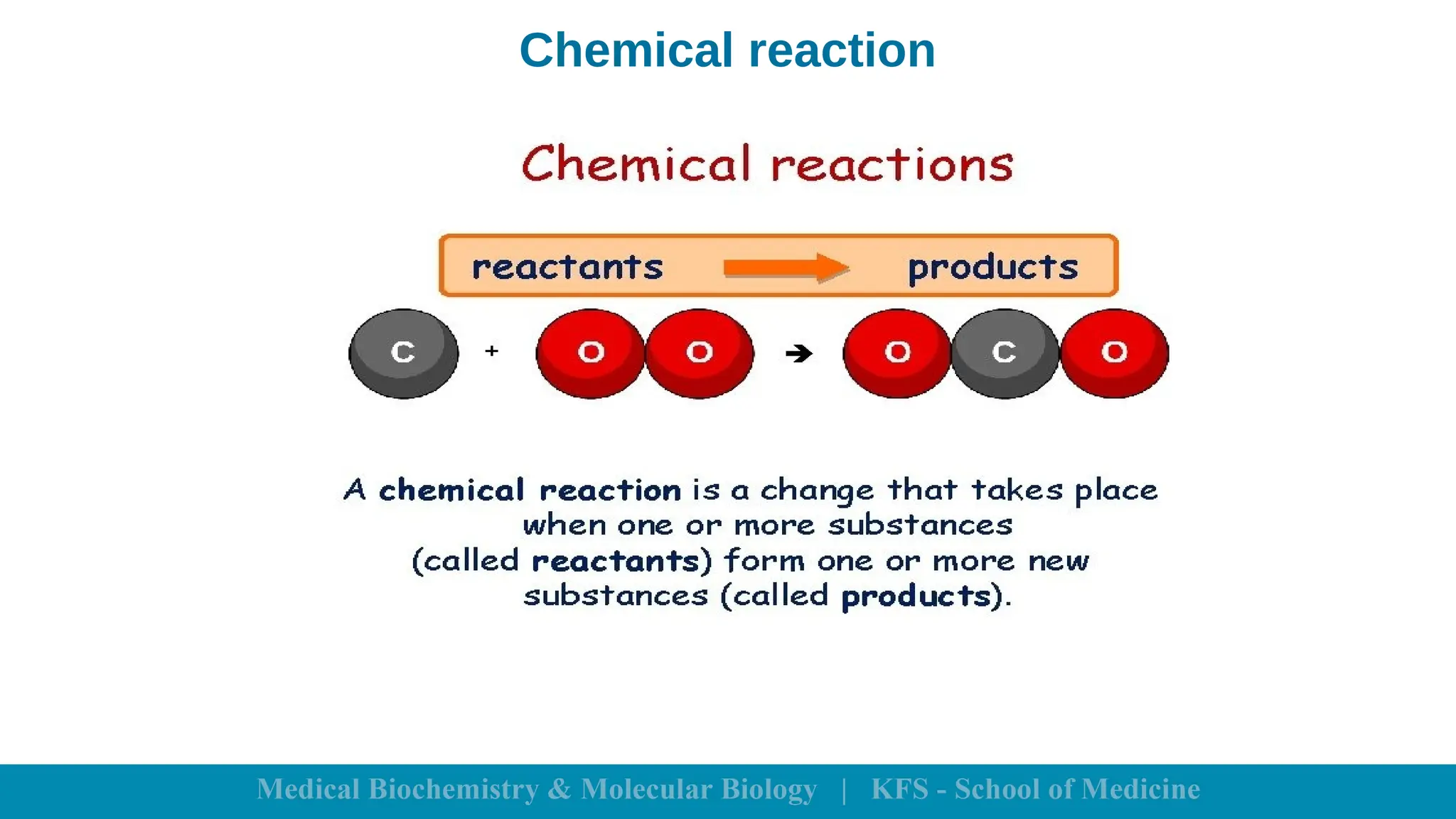
Chemical reaction
GENERAL PROPERTIES OF ENZYMES
 They are mostly prote
 in in nature except for ribozymes which are RNA in nature.
 Enzyme-catalyzed reactions are highly efficient, proceeding from
103
–108
times faster than uncatalyzed reactions.
 They act within a moderate pH and temperature range.
 Enzymes can be produced and located inside the cell
(intracellular) e.g. metabolic enzymes. Also, they can be produced
inside the cell to be excreted later outside the cell(Extracellular)
e.g. digestive enzymes
Enzyme specificity
They are highly specific that catalyze only one type of chemical
reaction.
Types of specificity
Optical specificity (stereospecificity): Enzymes act only one of 2
isomers e.g. maltase acts on α-glycosides but not β-glycosides
Group specificity: Enzymes act on a specific group or linkage e.g.
pepsin acts on peptide bonds.
Absolute specificity: Enzyme acts only one substrate e.g. urease
enzyme acts on urea.
STRUCTURE OF ENZYMES
Enzymes are proteins in nature except for catalytic RNAs called
ribozymes.
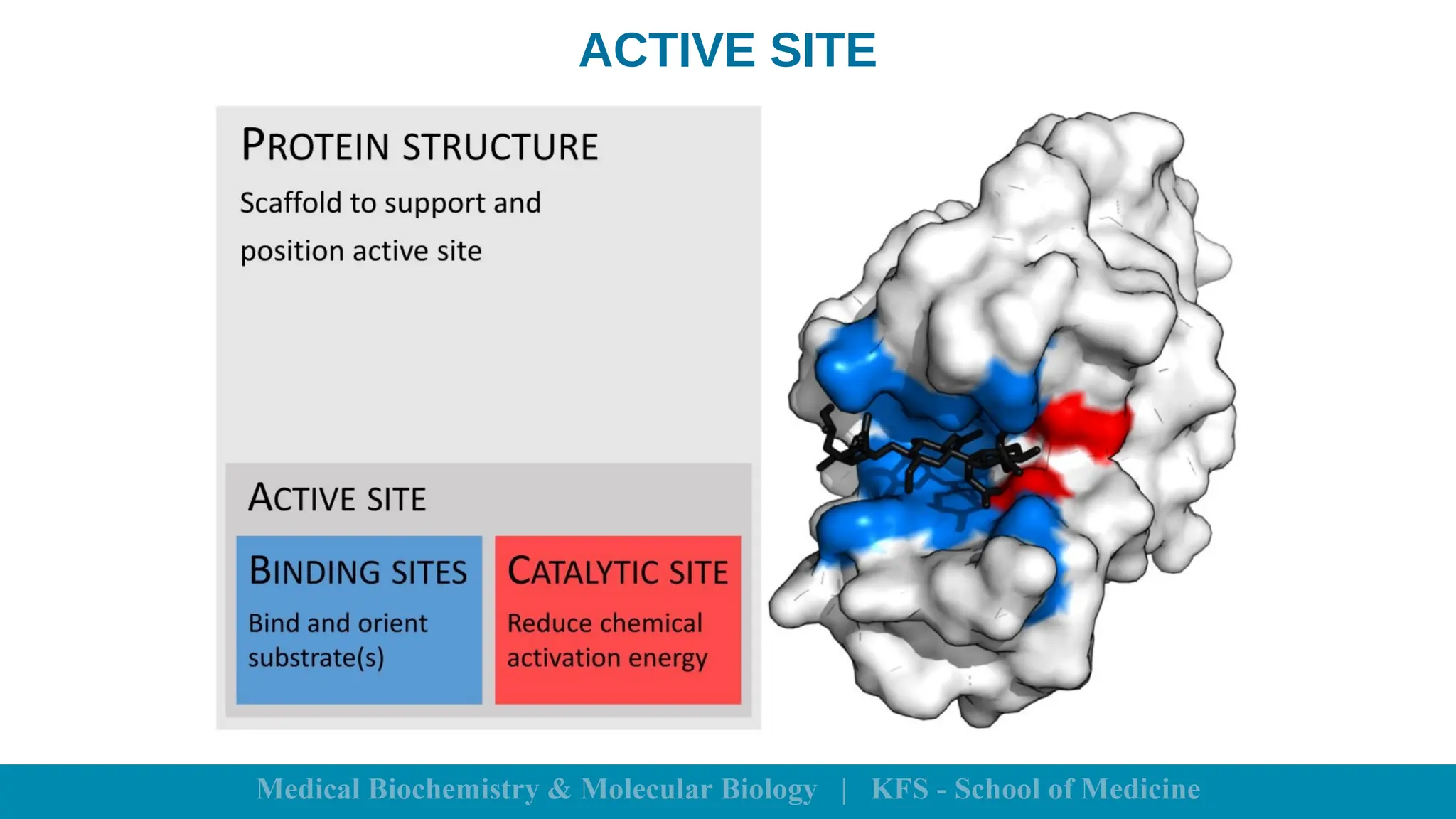
• The reaction takes place in a small part of the enzyme called the
active site, while the rest of the protein acts as "scaffolding.
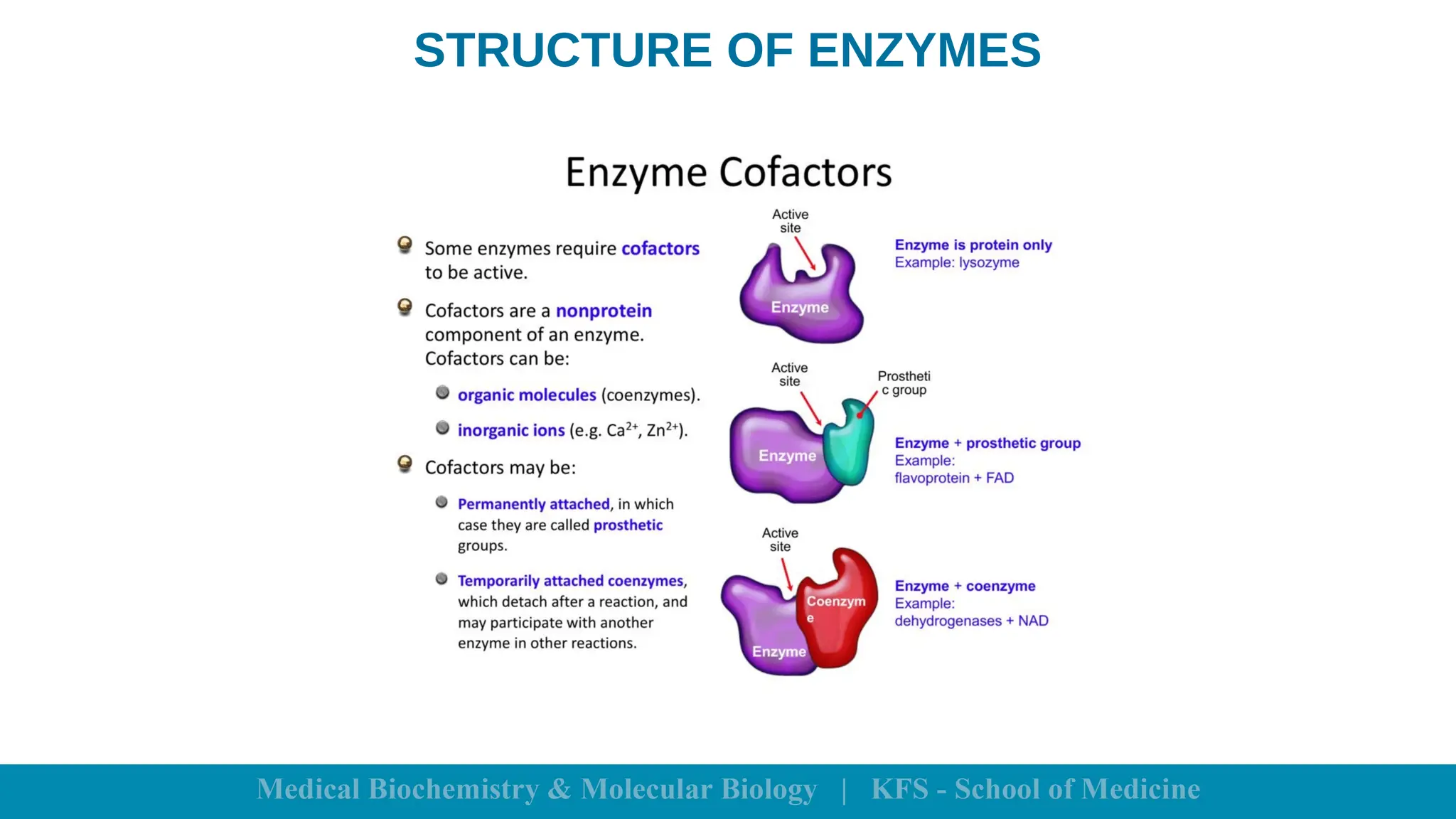
STRUCTURE OF ENZYMES
CLASSIFICATION OF ENZYMES
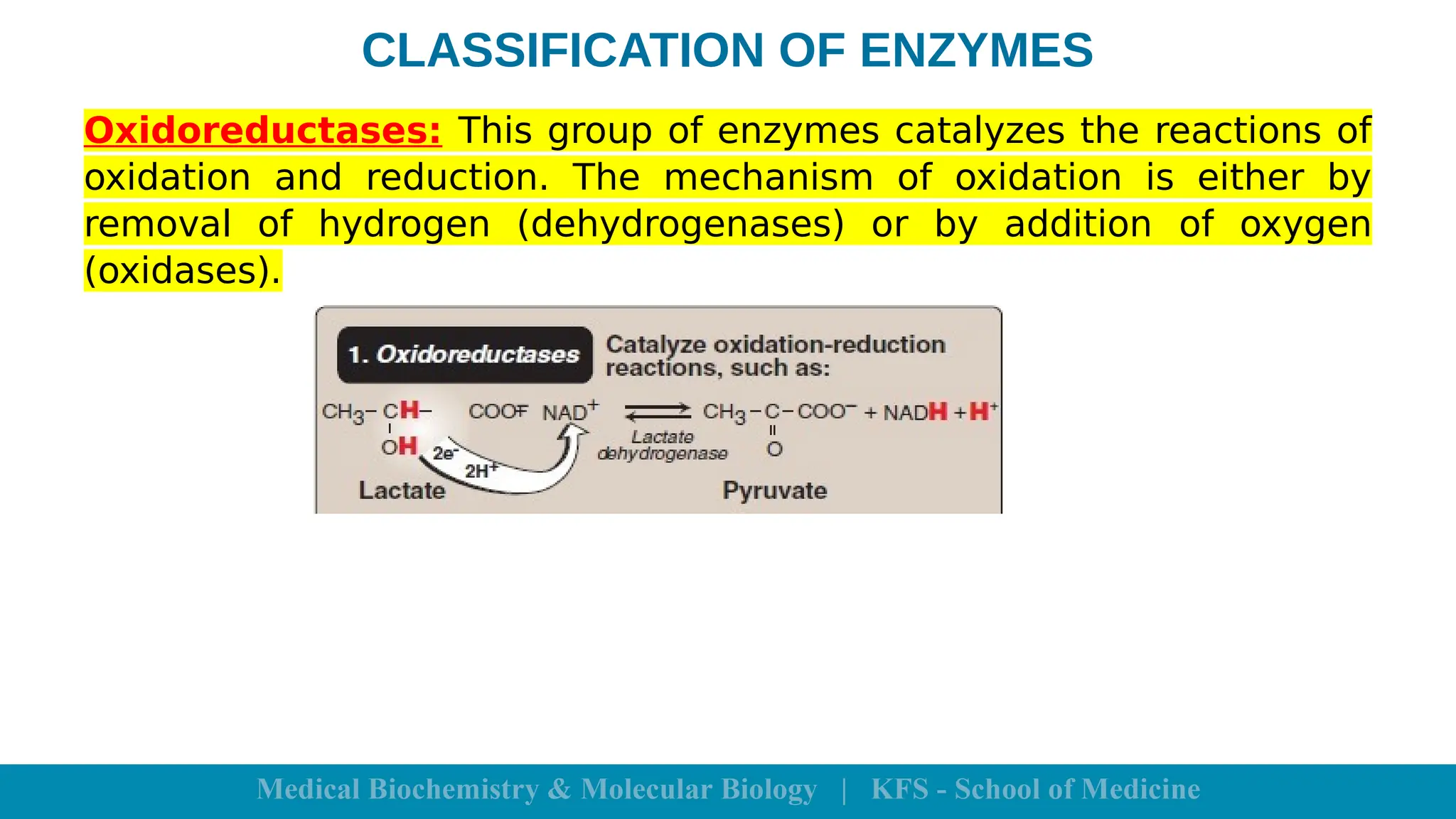
Oxidoreductases: This group of enzymes catalyzes the reactions of
oxidation and reduction. The mechanism of oxidation is either by
removal of hydrogen (dehydrogenases) or by addition of oxygen
(oxidases).
Transferases
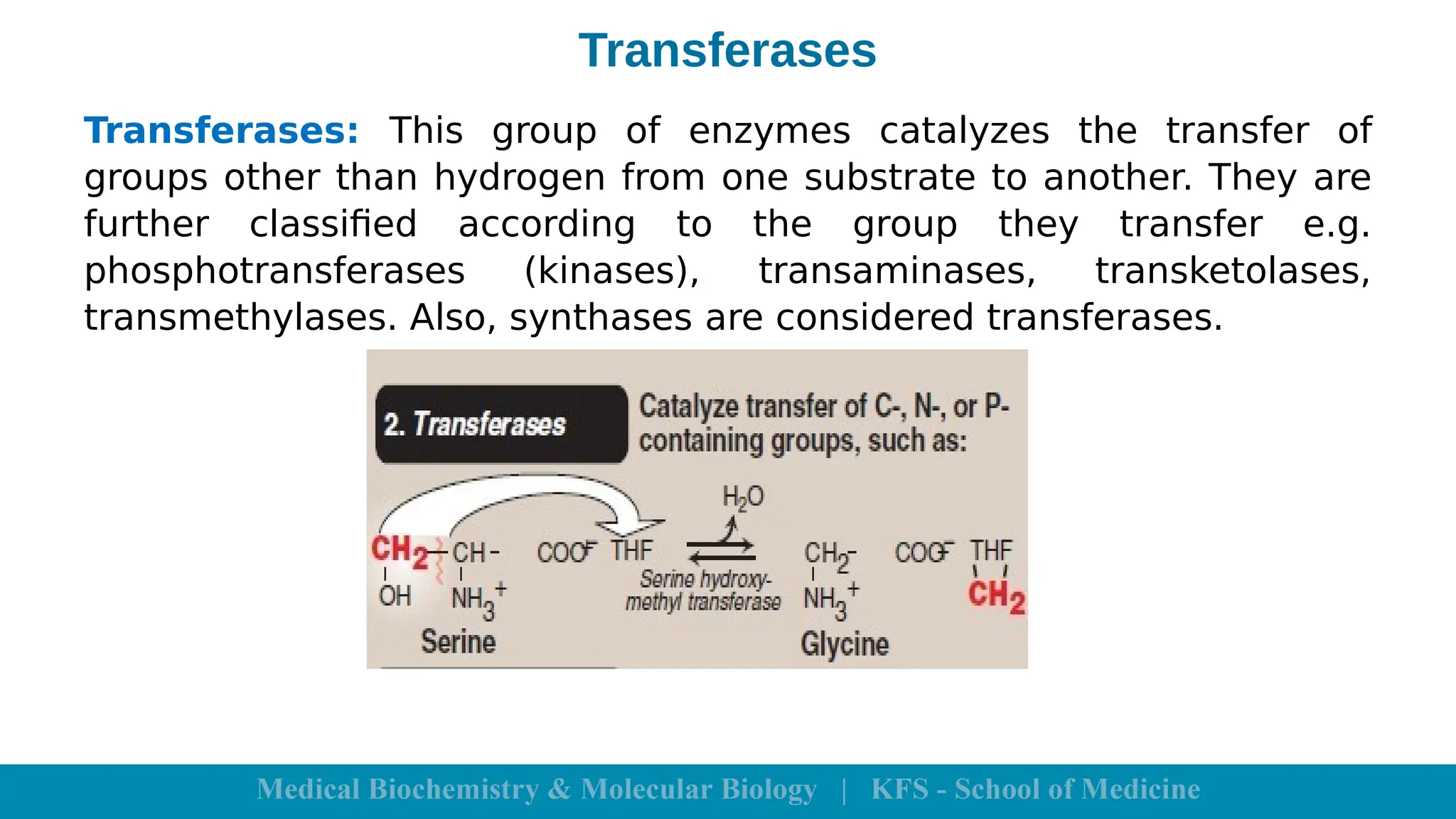
Transferases: This group of enzymes catalyzes the transfer of
groups other than hydrogen from one substrate to another. They are
further classified according to the group they transfer e.g.
phosphotransferases (kinases), transaminases, transketolases,
transmethylases. Also, synthases are considered transferases.
Hydrolases
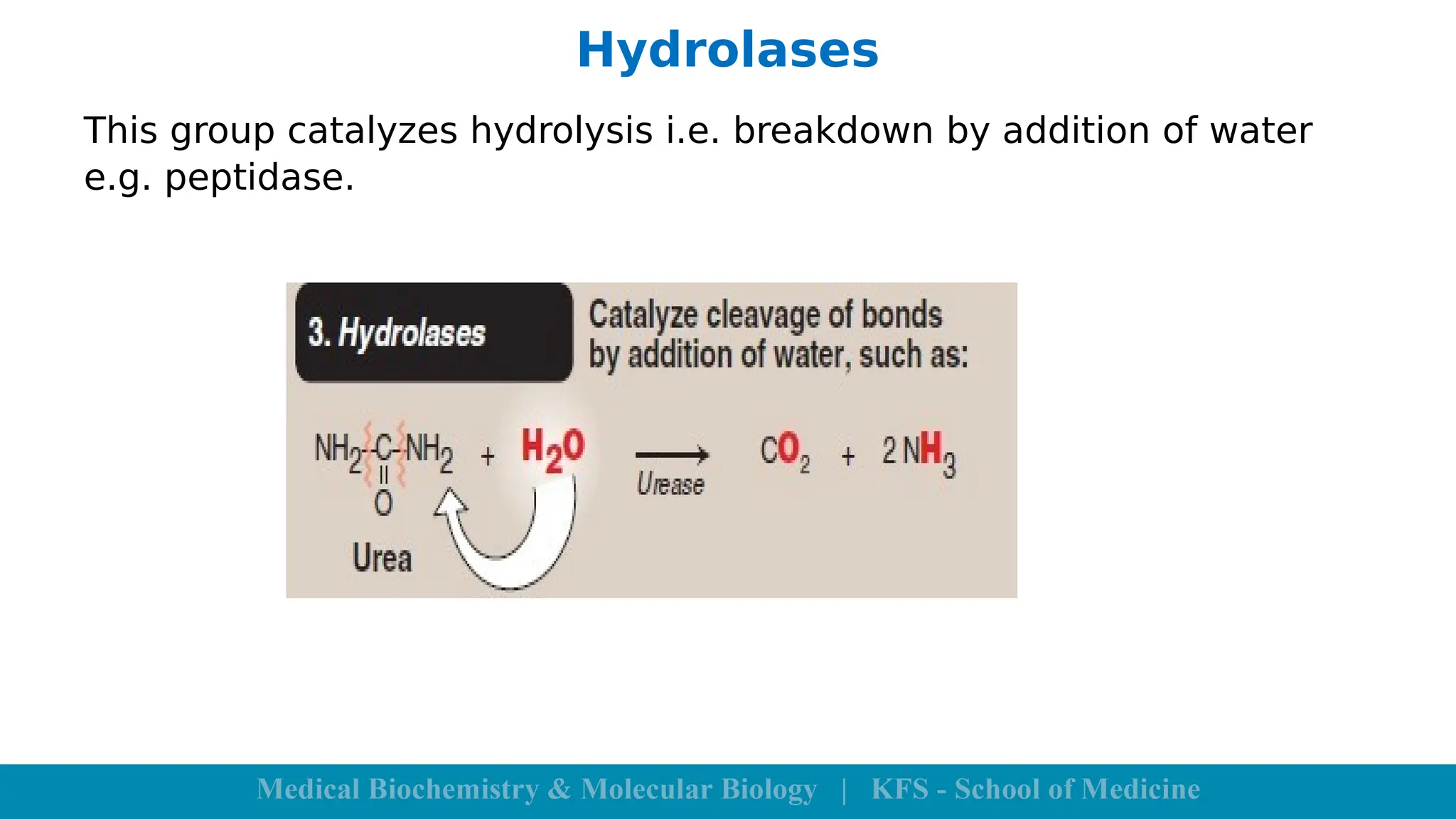
This group catalyzes hydrolysis i.e. breakdown by addition of water
e.g. peptidase.
Lyases
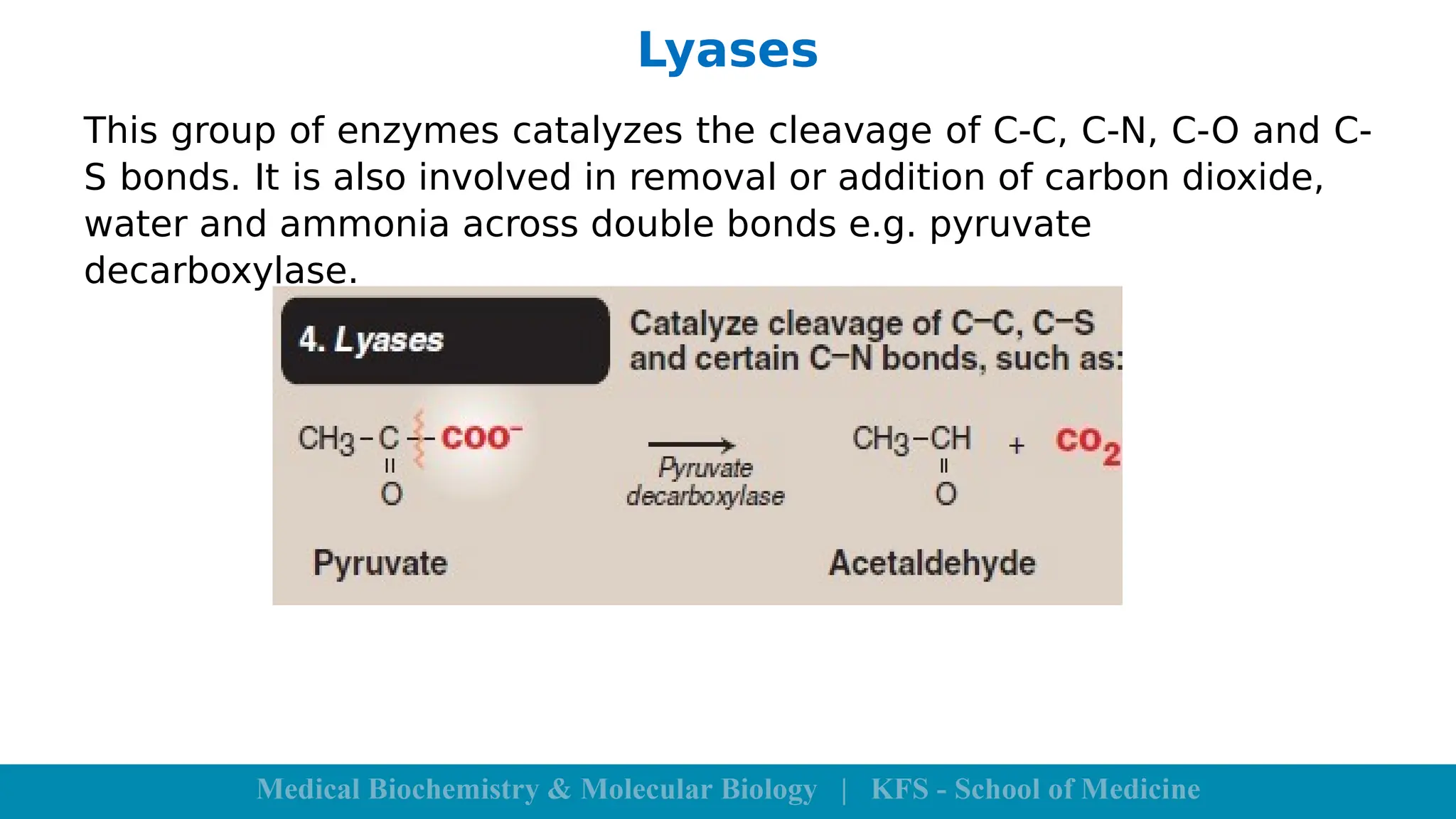
This group of enzymes catalyzes the cleavage of C-C, C-N, C-O and C-
S bonds. It is also involved in removal or addition of carbon dioxide,
water and ammonia across double bonds e.g. pyruvate
decarboxylase.
Isomerases
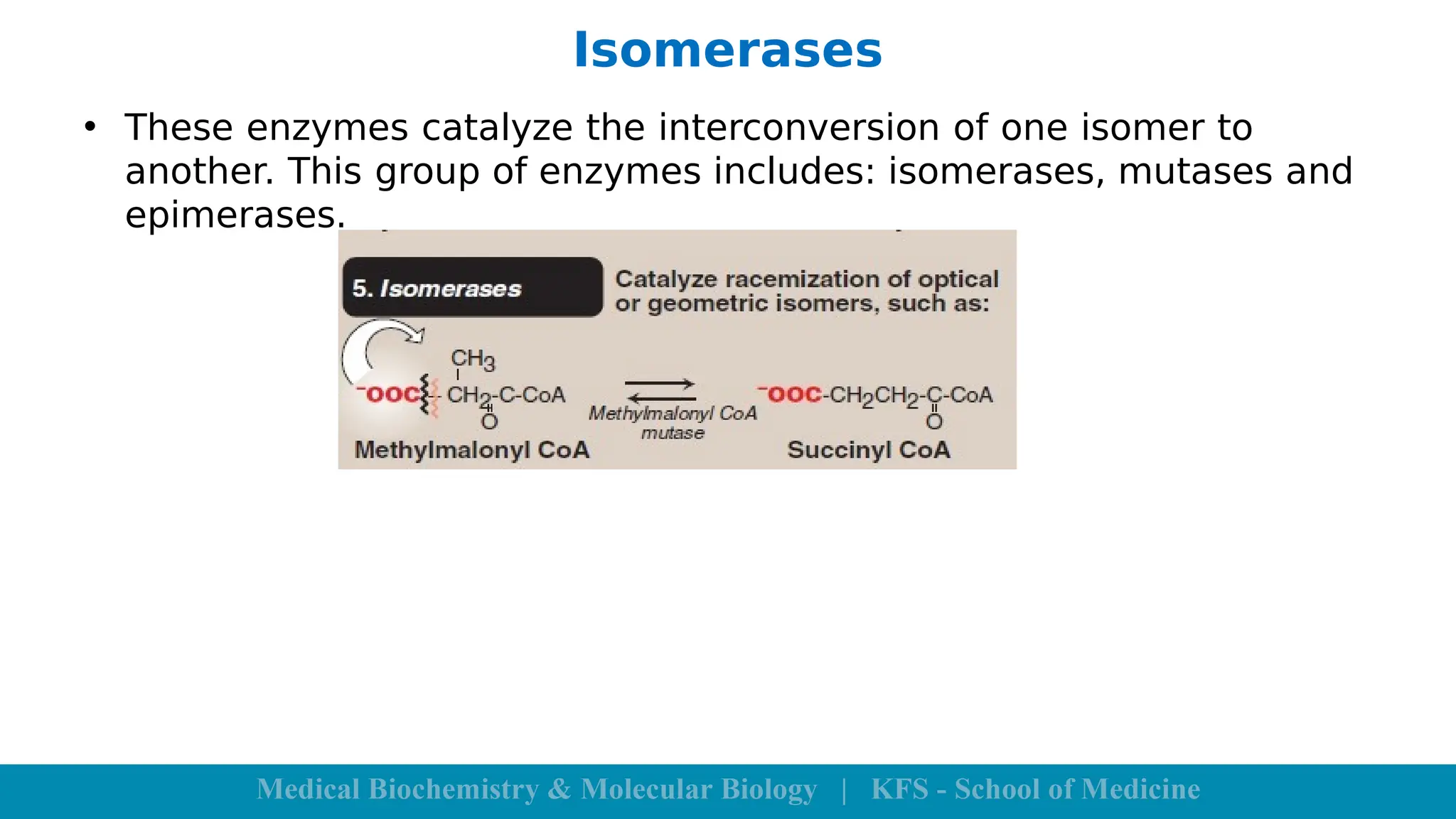
• These enzymes catalyze the interconversion of one isomer to
another. This group of enzymes includes: isomerases, mutases and
epimerases.
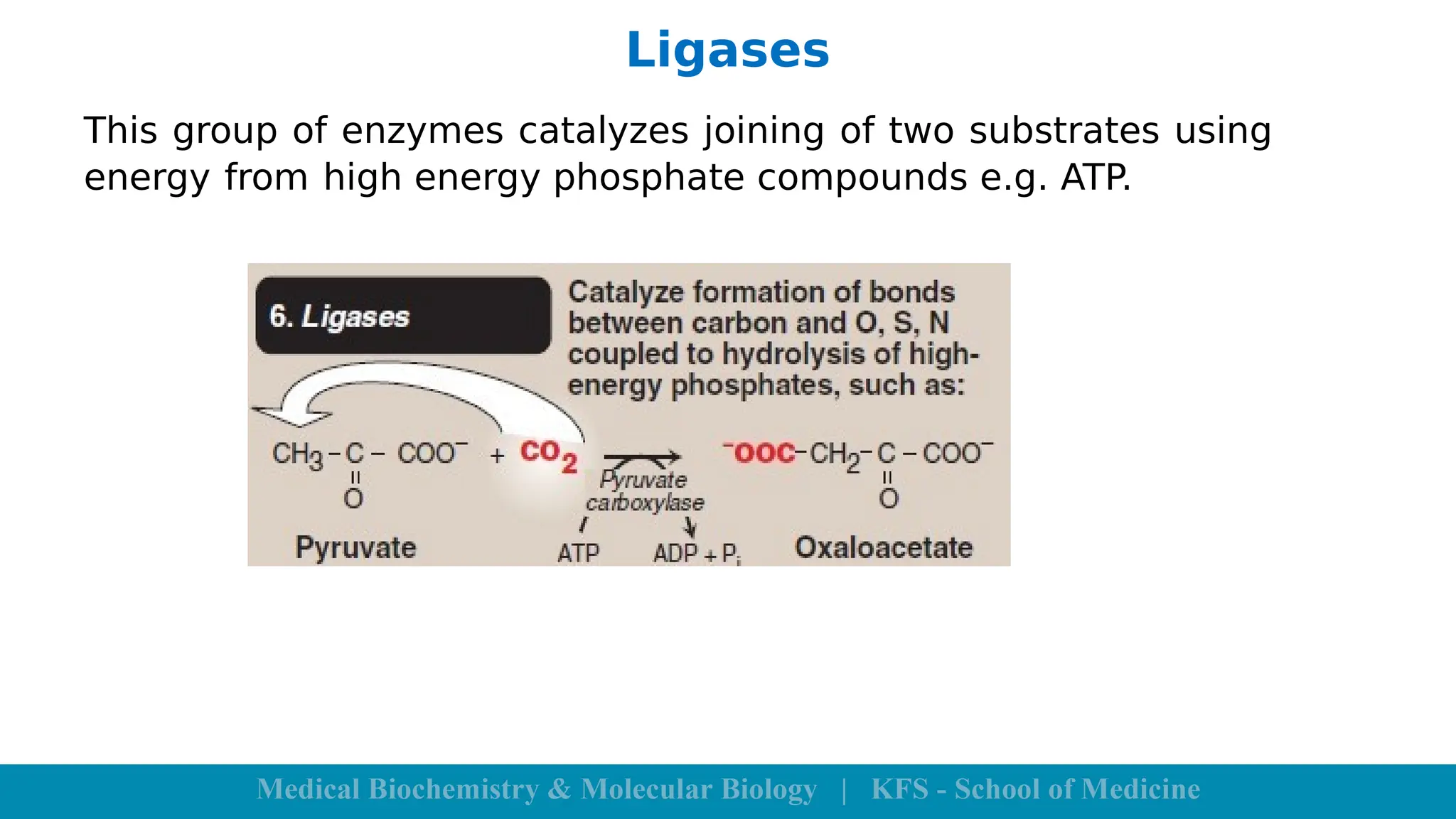
Ligases
This group of enzymes catalyzes joining of two substrates using
energy from high energy phosphate compounds e.g. ATP.
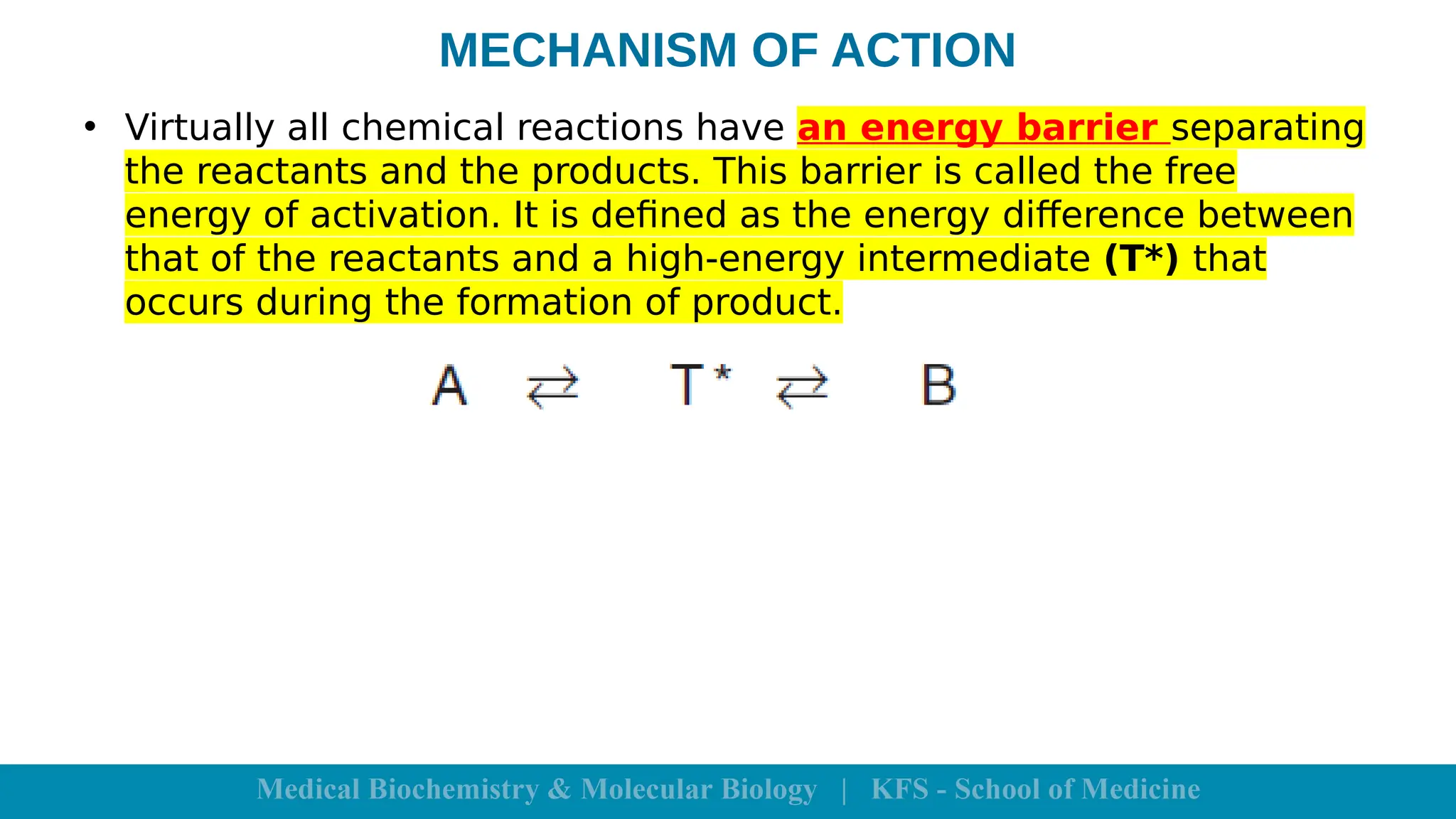
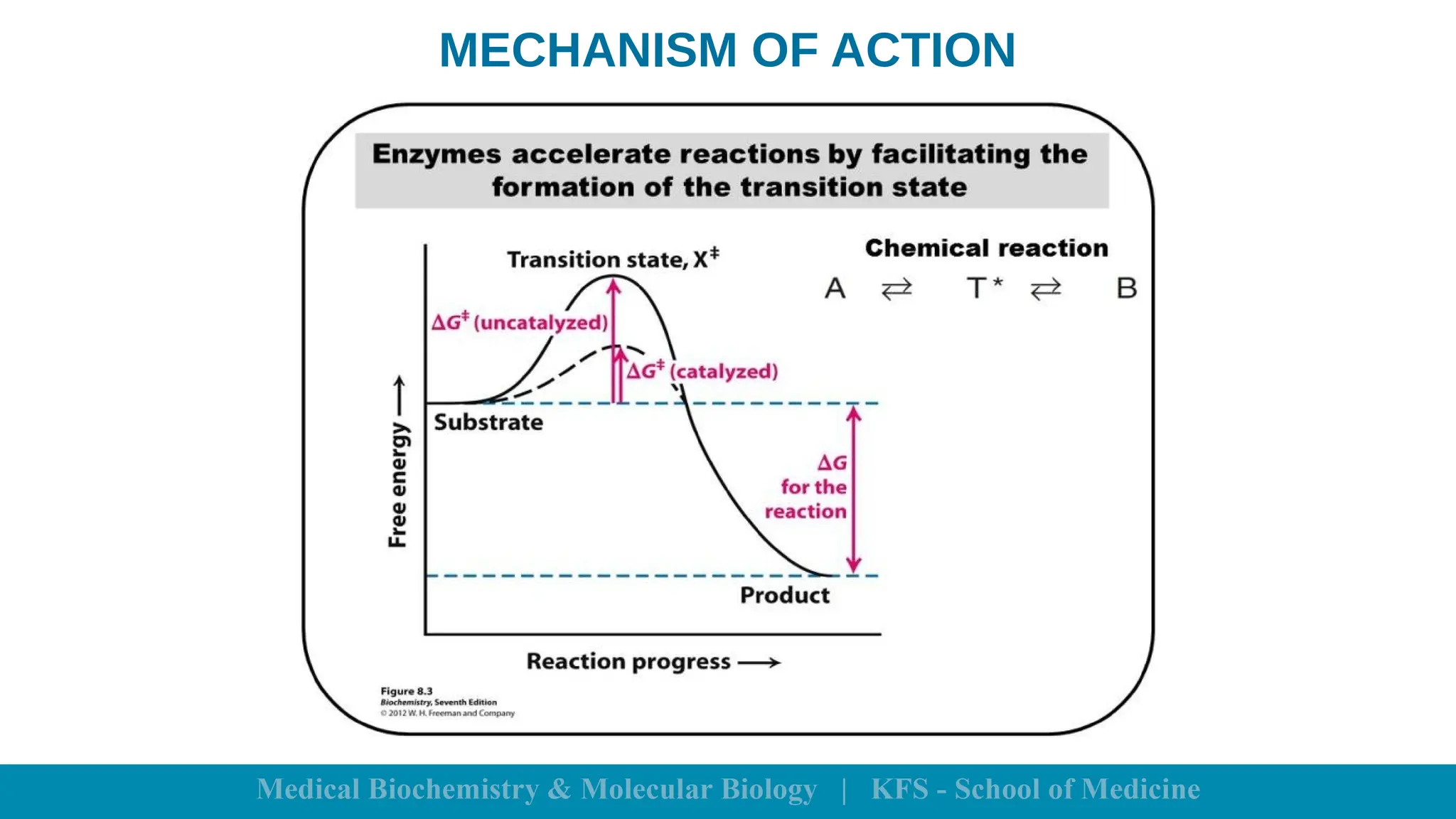
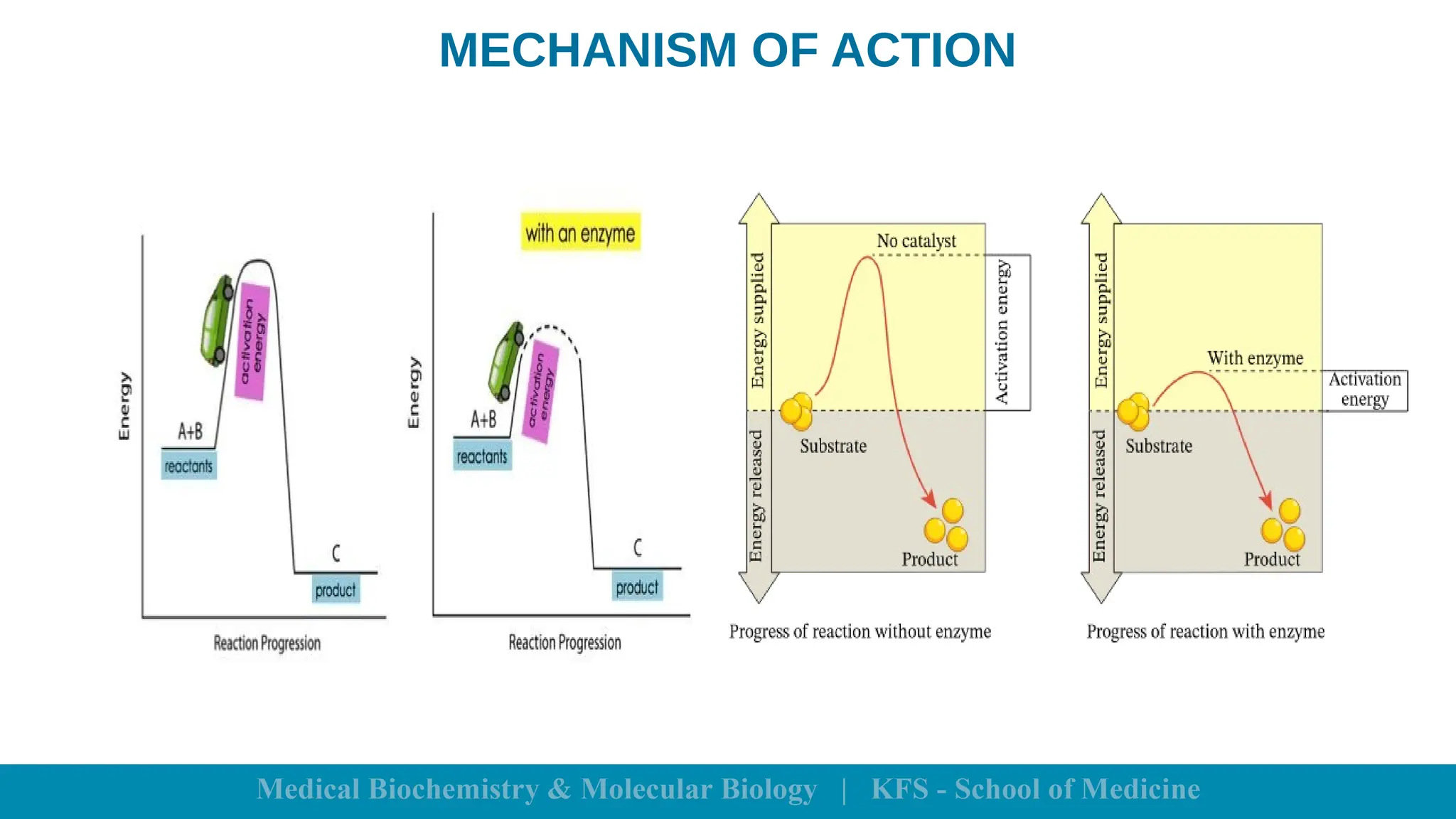
MECHANISM OF ACTION
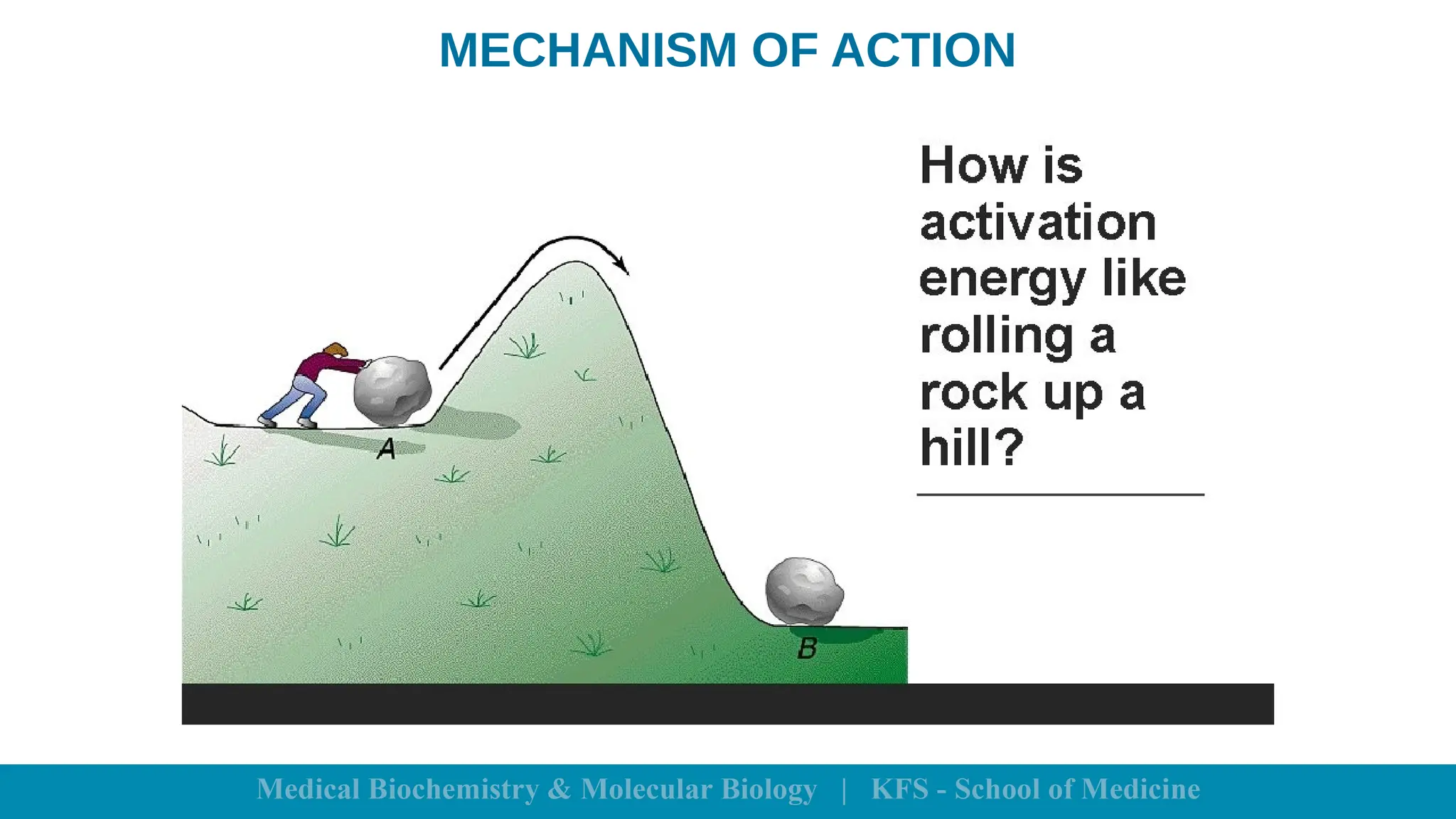
• Virtually all chemical reactions have an energy barrier separating
the reactants and the products. This barrier is called the free
energy of activation. It is defined as the energy difference between
that of the reactants and a high-energy intermediate (T*) that
occurs during the formation of product.
MECHANISM OF ACTION
MECHANISM OF ACTION
MECHANISM OF ACTION
ACTIVE SITE
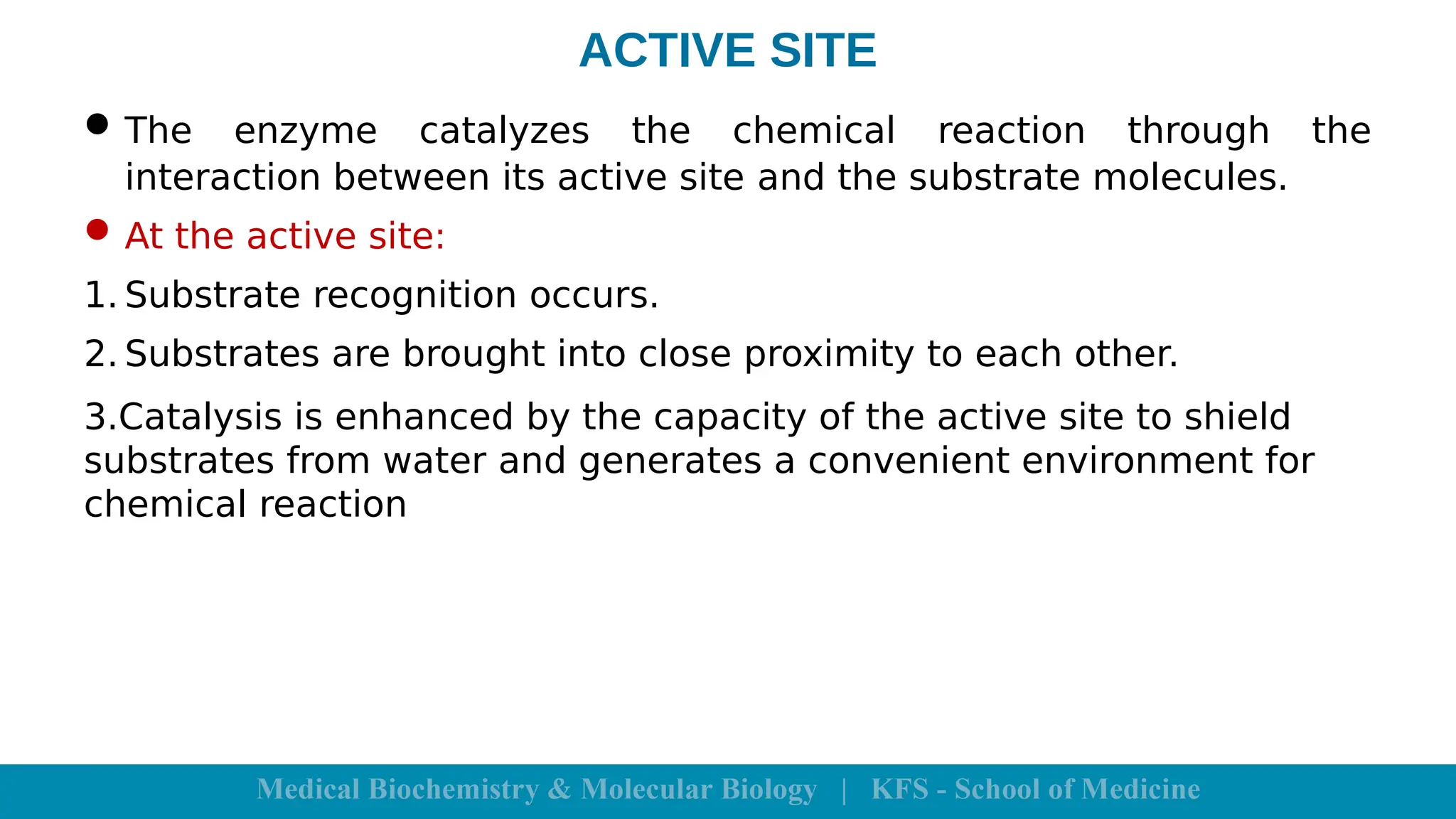
The enzyme catalyzes the chemical reaction through the
interaction between its active site and the substrate molecules.
At the active site:
1. Substrate recognition occurs.
2. Substrates are brought into close proximity to each other.
3.Catalysis is enhanced by the capacity of the active site to shield
substrates from water and generates a convenient environment for
chemical reaction
ACTIVE SITE
enzyme substrate complex
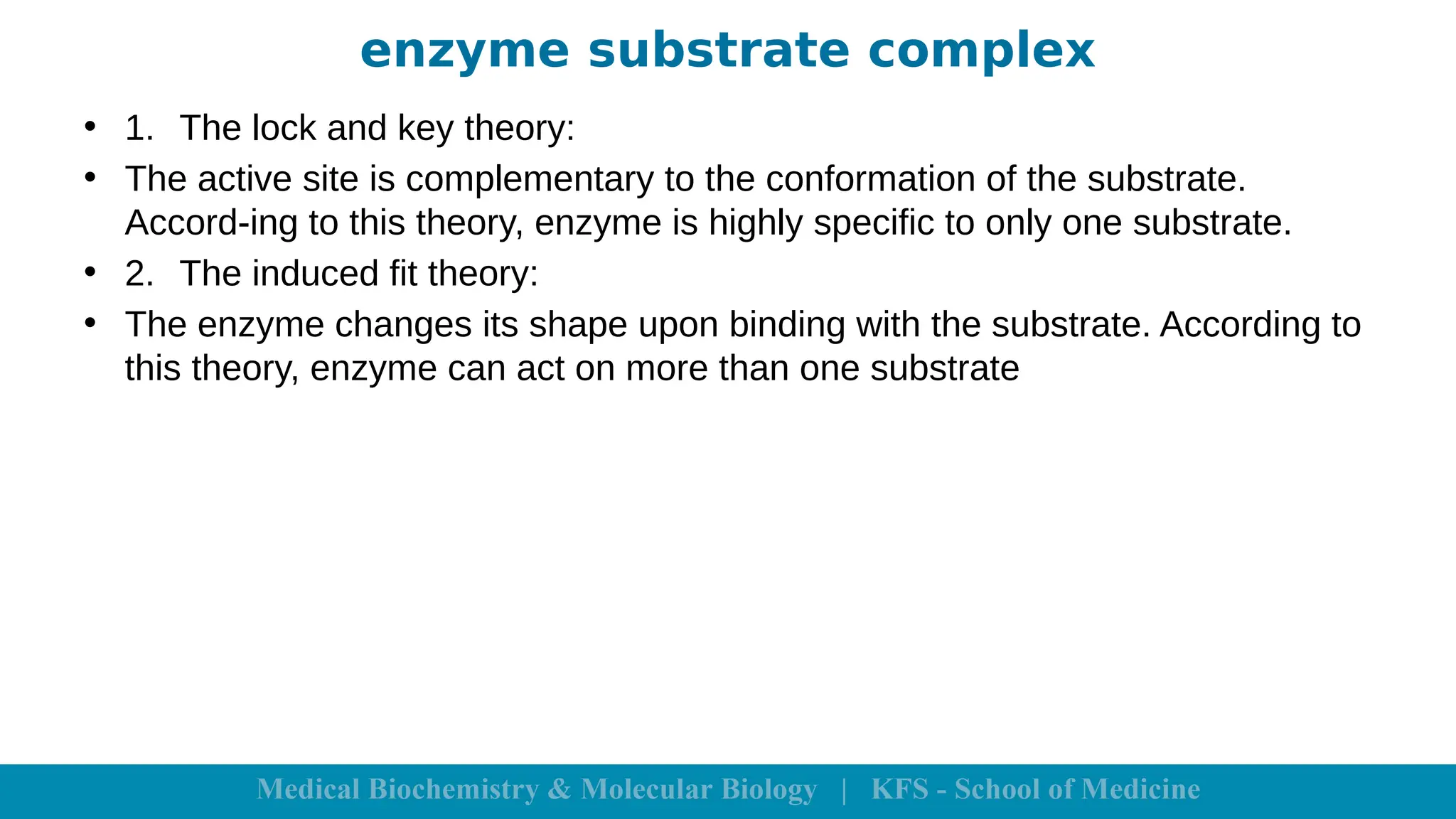
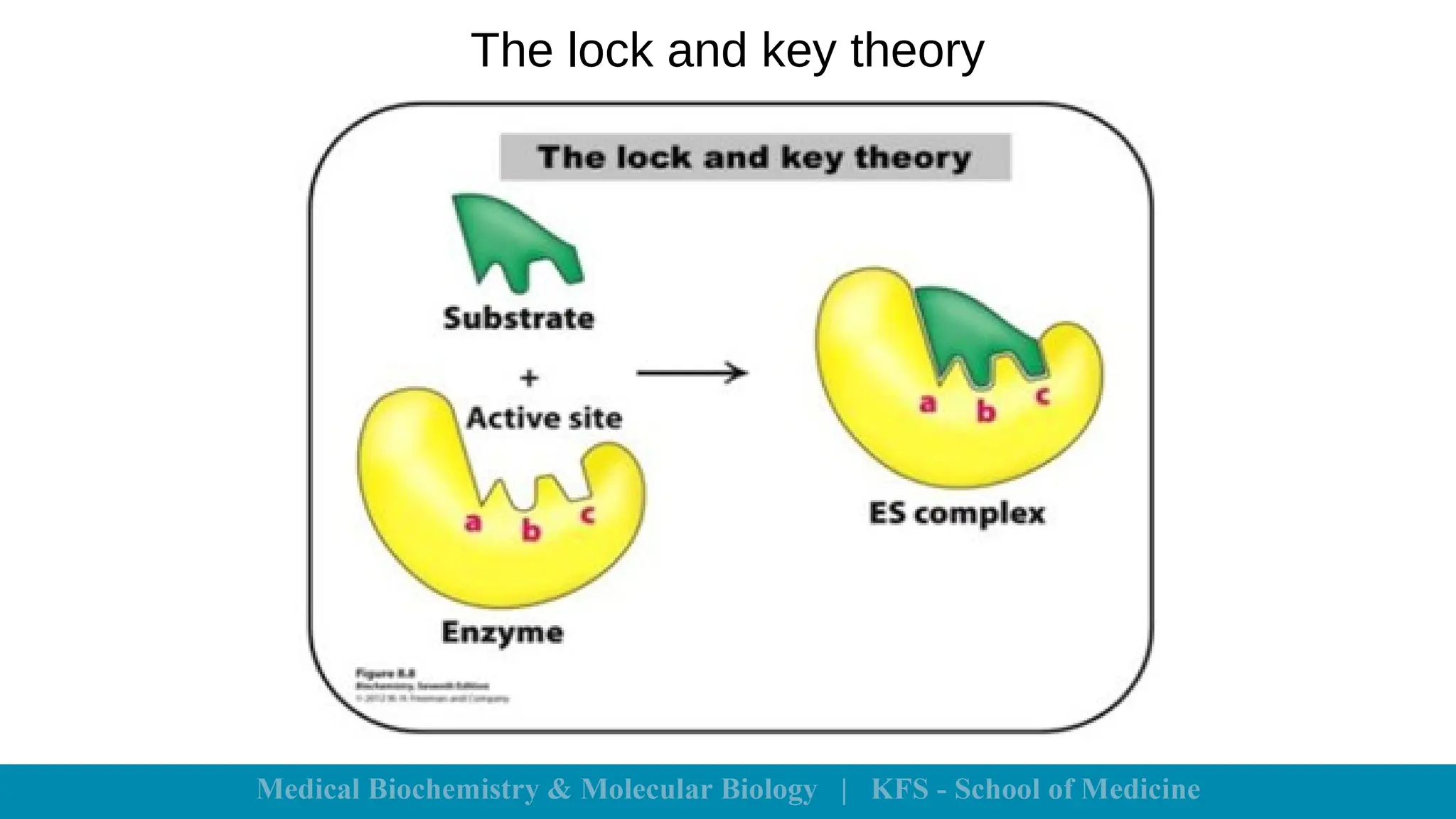
• 1. The lock and key theory:
• The active site is complementary to the conformation of the substrate.
Accord-ing to this theory, enzyme is highly specific to only one substrate.
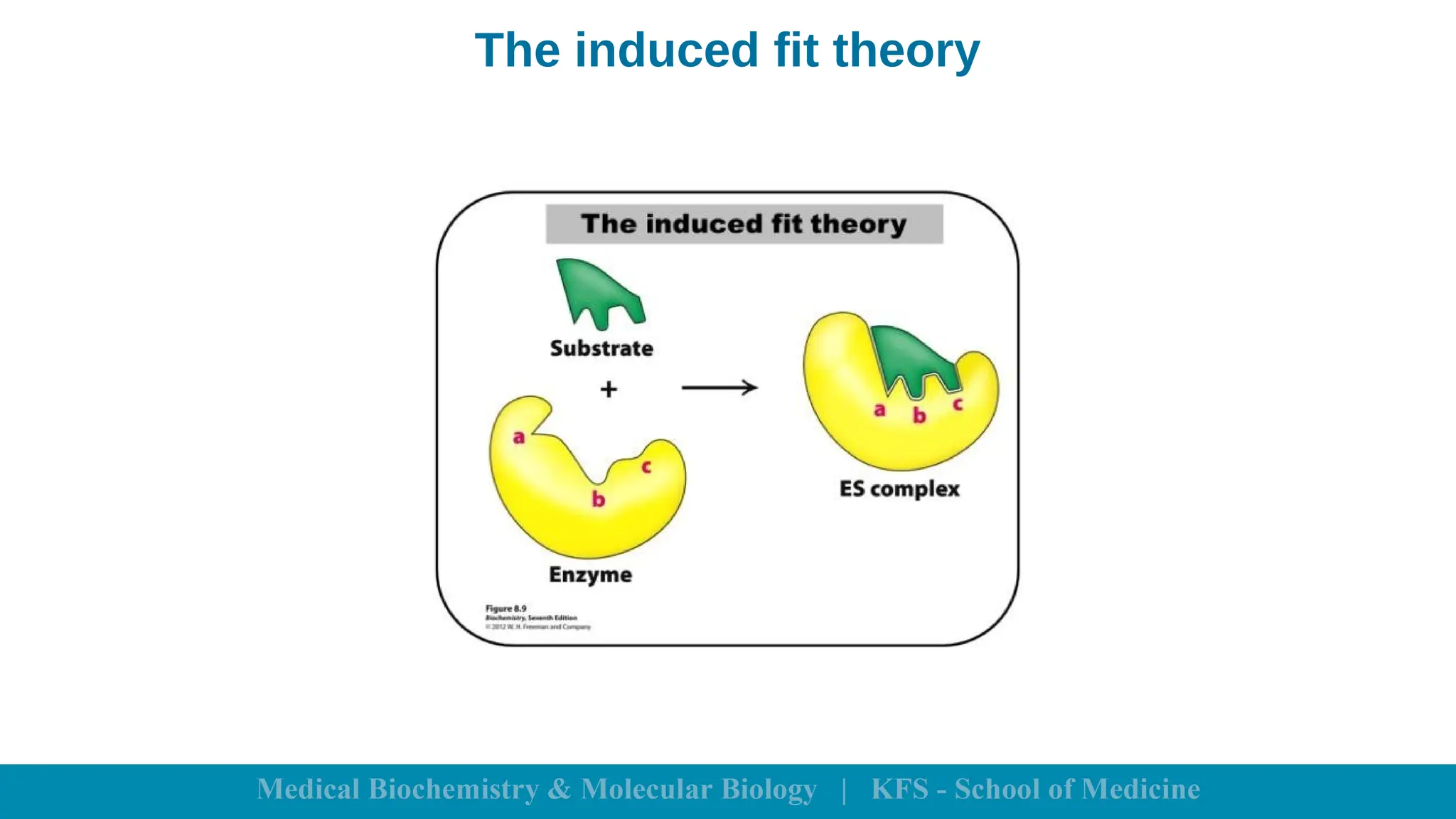
• 2. The induced fit theory:
• The enzyme changes its shape upon binding with the substrate. According to
this theory, enzyme can act on more than one substrate
The lock and key theory
The induced fit theory
Mechanisms of catalysis
Catalysis by proximity: When an enzyme binds substrate
molecules in its active site, it creates a region of high local substrate
concentration. This environment also orients the substrate molecules
spatially in a position ideal for them to interact, resulting in rate
enhancements of at least a thousand fold.
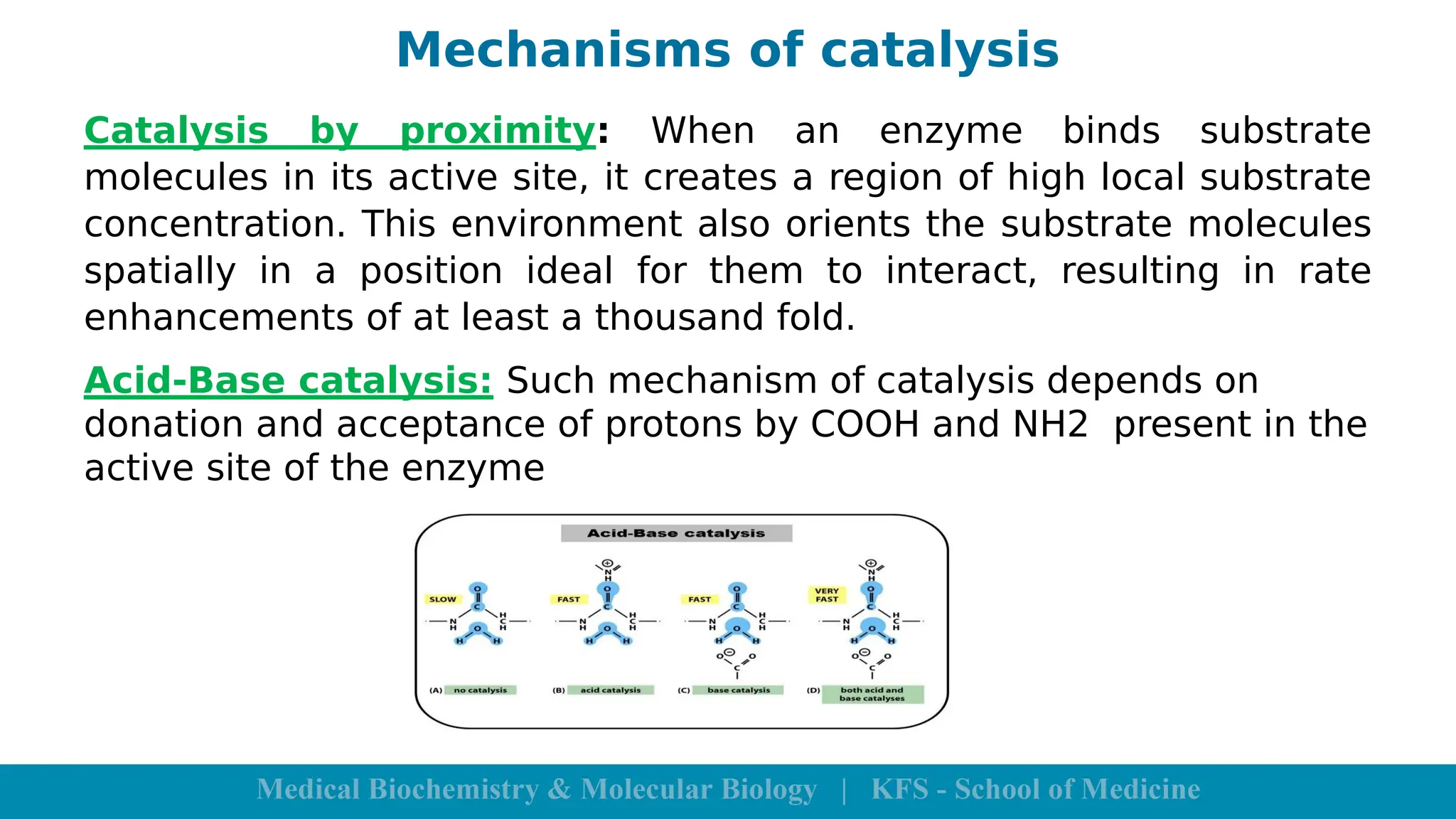
Acid-Base catalysis: Such mechanism of catalysis depends on
donation and acceptance of protons by COOH and NH2 present in the
active site of the enzyme
Mechanisms of catalysis
Covalent catalysis: The process of covalent catalysis involves the
formation of a covalent bond between the enzyme and one or more
substrates. Covalent catalysis introduces a new reaction pathway.
Then, enzyme is returned back to its original form at the end of the
chemical reaction.
Strain catalysis: Such mechanism is common with hydrolases and
lysozymes. Lytic enzyme induces strain that stretches or distorts the
targeted bond, weakening it and making it more vulnerable to
cleavage
FACTORS AFFECTING THE ENZYME ACTIVITY
1.ENZYME CONCENTRATION
•The rate of the reaction is directly proportional to the enzyme
concentration when substrate concentrations are stable. For example,
if the enzyme concentration is halved, the initial rate of the reaction
(Vo), as well as that of Vmax, are reduced to half that of the original.
2. SUBSTRATE CONCENTRATION
The rate or velocity of a reaction (v) is the number of
substrate molecules converted to product per unit time.
The rate of an enzyme-catalyzed reaction increases with
substrate concentration until a maximal velocity (Vmax) is
reached
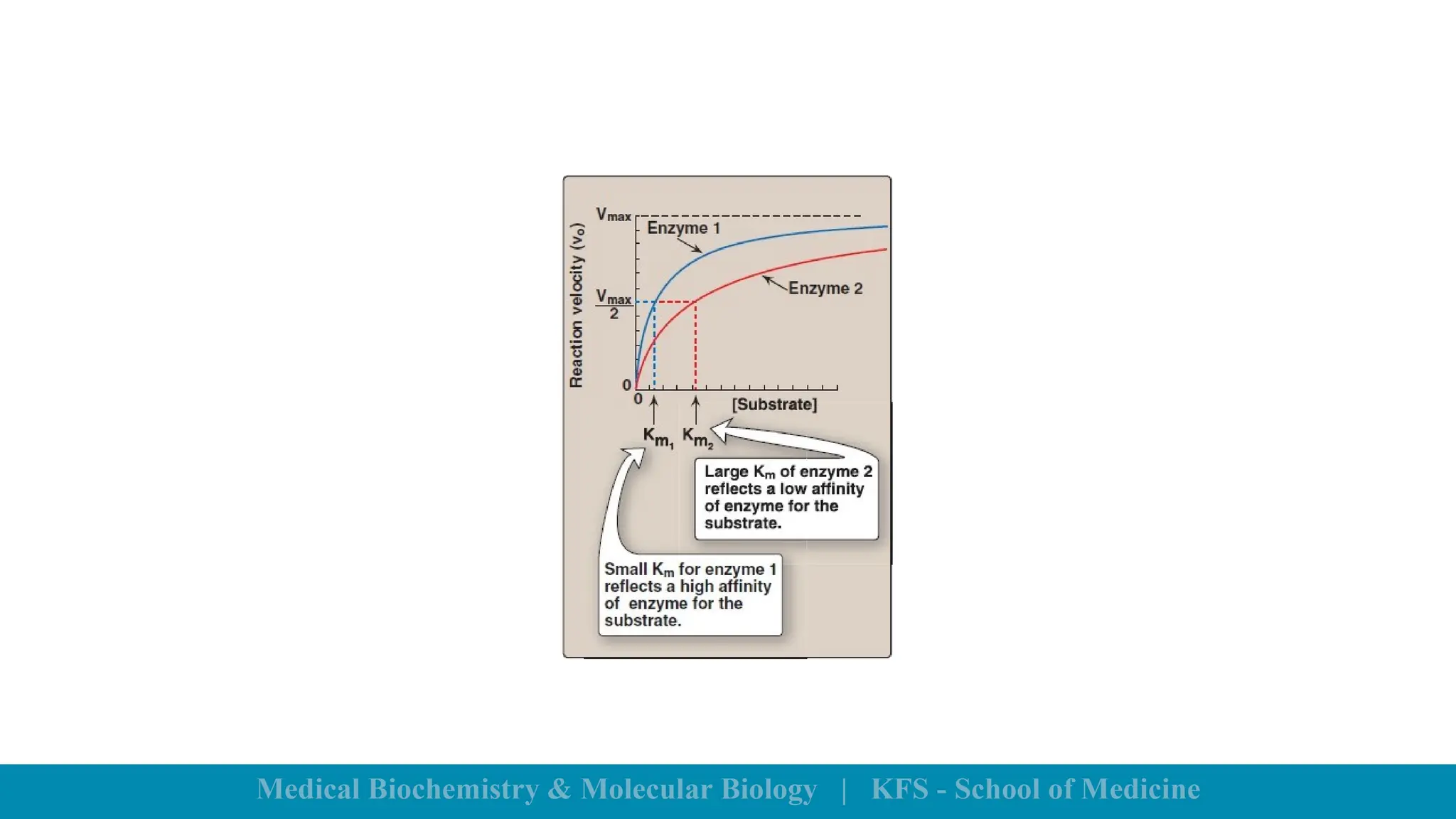
• Km is the amount of the substrate is needed to reach half of the Vmax.
The Km value reflects the affinity of the enzyme for that substrate.
• Small Km reflects the high affinity of the enzyme for substrate, because a low
concentration of substrate is needed to half-saturate the enzyme and to
reach 1⁄2 Vmax.
• Large Km reflects a low affinity of enzyme for substrate because a high
concentration of substrate is needed to half- saturate the enzyme
Km of Glucokinase and Hexokinase
TEMPERATURE
TEMPERATURE
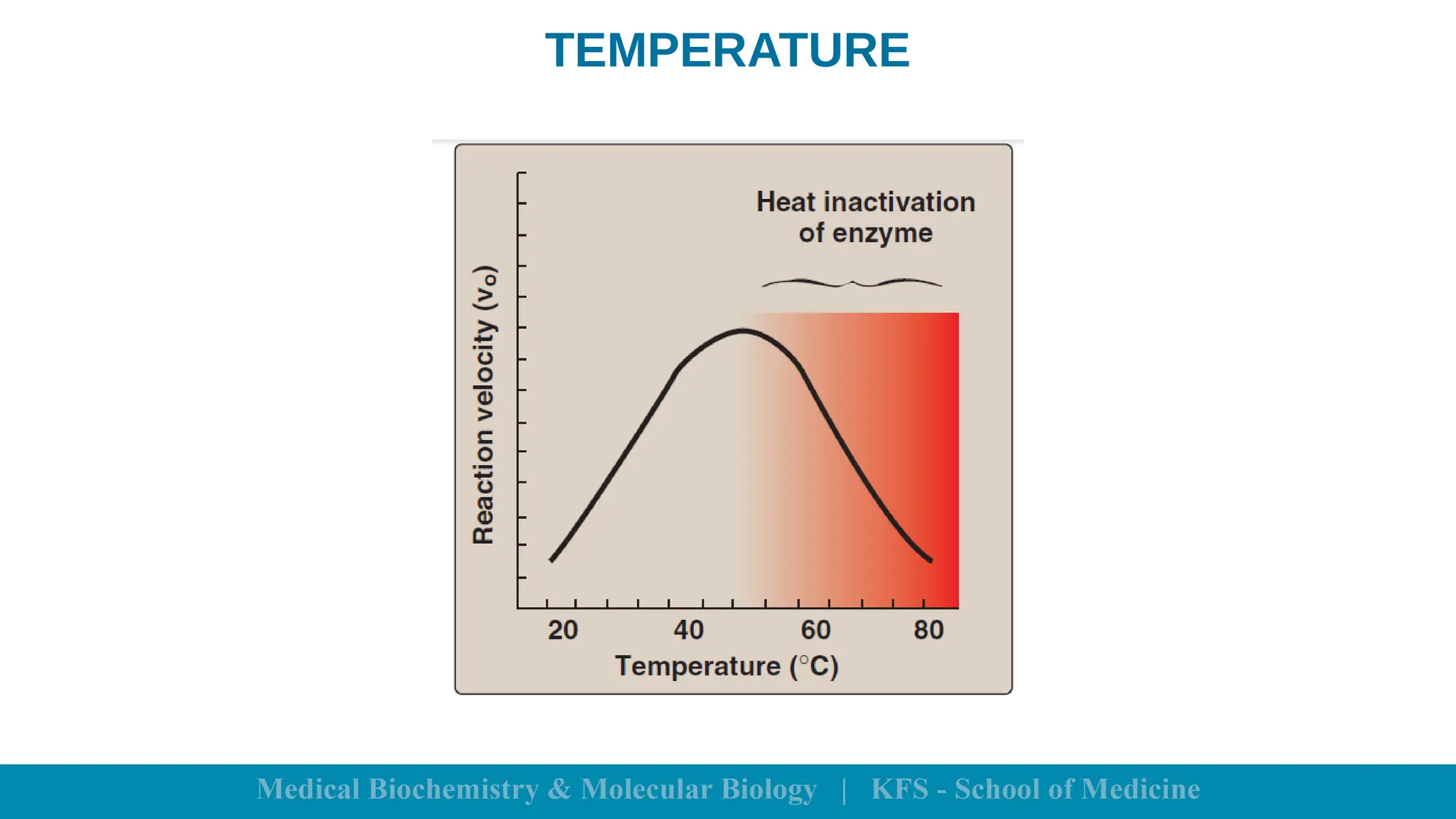
•The reaction velocity increases with temperature until a peak
velocity is reached. The optimum temperature for most human
enzymes is between 35 and 40°C. Human enzymes start to denature
at temperatures above 40°C.
PH
The pH at which maximal enzyme activity is achieved is different
for different enzymes e.g. pepsin works at pH 2 and alkaline
phosphatase works at alkaline pH.
The extremes of pH lead to denaturation of enzyme structure
Presence of activators
• Some enzymes called zymogens are produced in inactive form.
Zymogens are activated later by part removal of its polypeptide
chain in the presence of activators e.g. pepsinogen is converted
into pepsin by the action of HCL
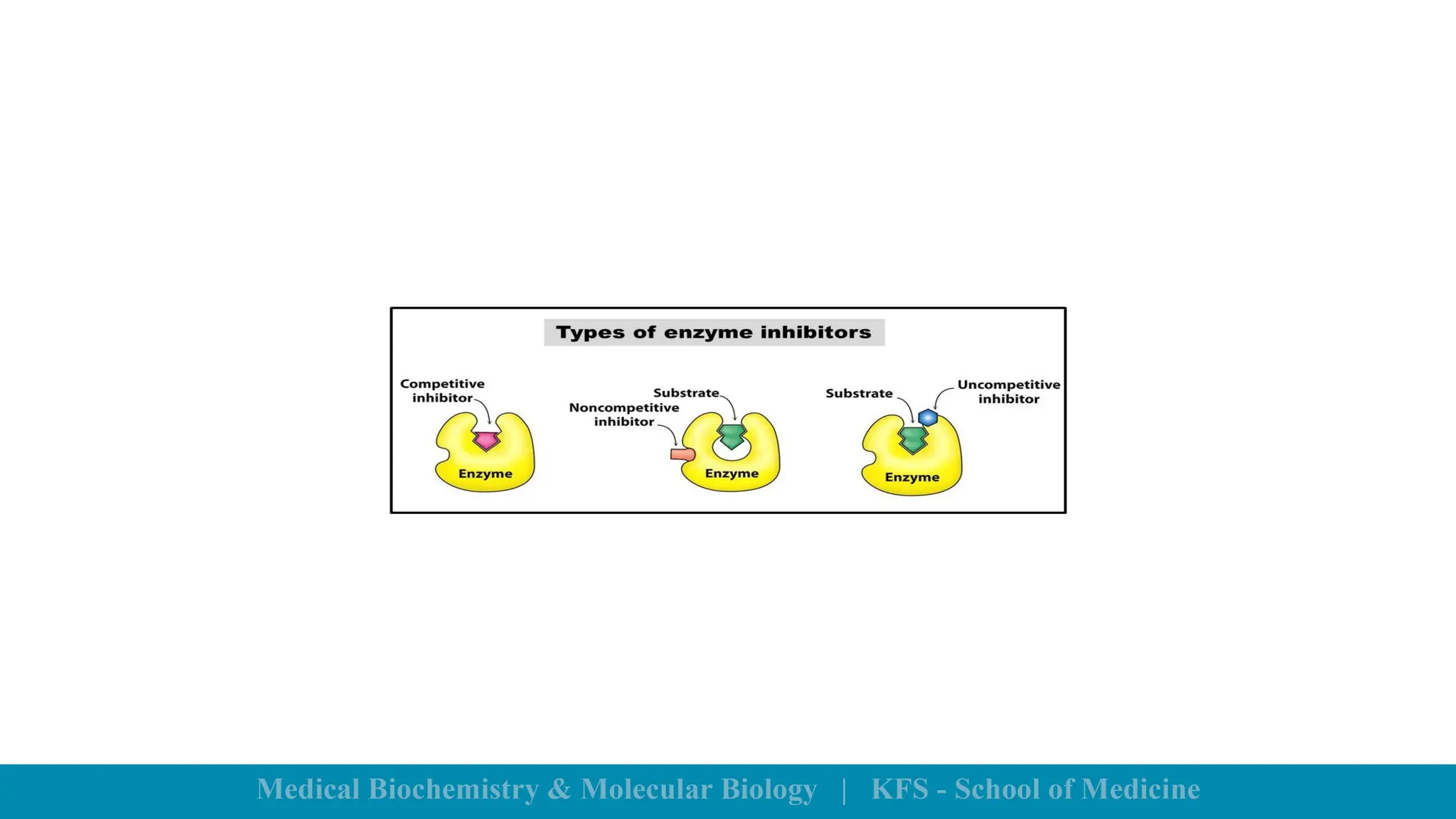
A.COMPETITIVE INHIBITORS
• There is a structural similarity between the substrate and inhibitor.
• The inhibitor competes with the substrate for binding with ACTIVE site.
• Inhibition is reversible and can be alleviated by increasing the substrate con-
centration.
• Kinetics: Km increases however the Vmax does not change i.e. competitive
inhibi-tor decreases the enzyme sensitivity or affinity towards the substrate
and a higher substrate concentration is needed to overcome this
suppression.
•  Examples:
• 1. Malonate with succinate dehydrogenase
COMPETITIVE INHIBITORS

Enzymes (1).please be aware of this fact

  • 1.
  • 2.
    Definitions Enzymes are specificbiological catalysts that accelerate the rate of chemical reaction meanwhile the enzyme itself does not change in structure or consumed during the reaction. Also, enzymes do not affect the equilibrium of the reaction they catalyze. The rate of chemical reaction is defined as the change in the amount of substrates or products per a unit of time. Substrate is defined as the reactants that enter the chemical reaction on which the enzyme works.
  • 3.
  • 4.
    GENERAL PROPERTIES OFENZYMES  They are mostly prote  in in nature except for ribozymes which are RNA in nature.  Enzyme-catalyzed reactions are highly efficient, proceeding from 103 –108 times faster than uncatalyzed reactions.  They act within a moderate pH and temperature range.  Enzymes can be produced and located inside the cell (intracellular) e.g. metabolic enzymes. Also, they can be produced inside the cell to be excreted later outside the cell(Extracellular) e.g. digestive enzymes
  • 5.
    Enzyme specificity They arehighly specific that catalyze only one type of chemical reaction. Types of specificity Optical specificity (stereospecificity): Enzymes act only one of 2 isomers e.g. maltase acts on α-glycosides but not β-glycosides Group specificity: Enzymes act on a specific group or linkage e.g. pepsin acts on peptide bonds. Absolute specificity: Enzyme acts only one substrate e.g. urease enzyme acts on urea.
  • 6.
    STRUCTURE OF ENZYMES Enzymesare proteins in nature except for catalytic RNAs called ribozymes. • The reaction takes place in a small part of the enzyme called the active site, while the rest of the protein acts as "scaffolding.
  • 7.
  • 8.
    CLASSIFICATION OF ENZYMES Oxidoreductases:This group of enzymes catalyzes the reactions of oxidation and reduction. The mechanism of oxidation is either by removal of hydrogen (dehydrogenases) or by addition of oxygen (oxidases).
  • 9.
    Transferases Transferases: This groupof enzymes catalyzes the transfer of groups other than hydrogen from one substrate to another. They are further classified according to the group they transfer e.g. phosphotransferases (kinases), transaminases, transketolases, transmethylases. Also, synthases are considered transferases.
  • 10.
    Hydrolases This group catalyzeshydrolysis i.e. breakdown by addition of water e.g. peptidase.
  • 11.
    Lyases This group ofenzymes catalyzes the cleavage of C-C, C-N, C-O and C- S bonds. It is also involved in removal or addition of carbon dioxide, water and ammonia across double bonds e.g. pyruvate decarboxylase.
  • 12.
    Isomerases • These enzymescatalyze the interconversion of one isomer to another. This group of enzymes includes: isomerases, mutases and epimerases.
  • 13.
    Ligases This group ofenzymes catalyzes joining of two substrates using energy from high energy phosphate compounds e.g. ATP.
  • 14.
    MECHANISM OF ACTION •Virtually all chemical reactions have an energy barrier separating the reactants and the products. This barrier is called the free energy of activation. It is defined as the energy difference between that of the reactants and a high-energy intermediate (T*) that occurs during the formation of product.
  • 15.
  • 16.
  • 17.
  • 18.
    ACTIVE SITE The enzymecatalyzes the chemical reaction through the interaction between its active site and the substrate molecules. At the active site: 1. Substrate recognition occurs. 2. Substrates are brought into close proximity to each other. 3.Catalysis is enhanced by the capacity of the active site to shield substrates from water and generates a convenient environment for chemical reaction
  • 19.
  • 20.
    enzyme substrate complex •1. The lock and key theory: • The active site is complementary to the conformation of the substrate. Accord-ing to this theory, enzyme is highly specific to only one substrate. • 2. The induced fit theory: • The enzyme changes its shape upon binding with the substrate. According to this theory, enzyme can act on more than one substrate
  • 21.
    The lock andkey theory
  • 22.
  • 23.
    Mechanisms of catalysis Catalysisby proximity: When an enzyme binds substrate molecules in its active site, it creates a region of high local substrate concentration. This environment also orients the substrate molecules spatially in a position ideal for them to interact, resulting in rate enhancements of at least a thousand fold. Acid-Base catalysis: Such mechanism of catalysis depends on donation and acceptance of protons by COOH and NH2 present in the active site of the enzyme
  • 24.
    Mechanisms of catalysis Covalentcatalysis: The process of covalent catalysis involves the formation of a covalent bond between the enzyme and one or more substrates. Covalent catalysis introduces a new reaction pathway. Then, enzyme is returned back to its original form at the end of the chemical reaction. Strain catalysis: Such mechanism is common with hydrolases and lysozymes. Lytic enzyme induces strain that stretches or distorts the targeted bond, weakening it and making it more vulnerable to cleavage
  • 25.
    FACTORS AFFECTING THEENZYME ACTIVITY 1.ENZYME CONCENTRATION •The rate of the reaction is directly proportional to the enzyme concentration when substrate concentrations are stable. For example, if the enzyme concentration is halved, the initial rate of the reaction (Vo), as well as that of Vmax, are reduced to half that of the original.
  • 26.
    2. SUBSTRATE CONCENTRATION Therate or velocity of a reaction (v) is the number of substrate molecules converted to product per unit time. The rate of an enzyme-catalyzed reaction increases with substrate concentration until a maximal velocity (Vmax) is reached
  • 28.
    • Km isthe amount of the substrate is needed to reach half of the Vmax. The Km value reflects the affinity of the enzyme for that substrate. • Small Km reflects the high affinity of the enzyme for substrate, because a low concentration of substrate is needed to half-saturate the enzyme and to reach 1⁄2 Vmax. • Large Km reflects a low affinity of enzyme for substrate because a high concentration of substrate is needed to half- saturate the enzyme
  • 29.
    Km of Glucokinaseand Hexokinase
  • 30.
  • 31.
    TEMPERATURE •The reaction velocityincreases with temperature until a peak velocity is reached. The optimum temperature for most human enzymes is between 35 and 40°C. Human enzymes start to denature at temperatures above 40°C.
  • 32.
    PH The pH atwhich maximal enzyme activity is achieved is different for different enzymes e.g. pepsin works at pH 2 and alkaline phosphatase works at alkaline pH. The extremes of pH lead to denaturation of enzyme structure
  • 34.
    Presence of activators •Some enzymes called zymogens are produced in inactive form. Zymogens are activated later by part removal of its polypeptide chain in the presence of activators e.g. pepsinogen is converted into pepsin by the action of HCL
  • 36.
    A.COMPETITIVE INHIBITORS • Thereis a structural similarity between the substrate and inhibitor. • The inhibitor competes with the substrate for binding with ACTIVE site. • Inhibition is reversible and can be alleviated by increasing the substrate con- centration. • Kinetics: Km increases however the Vmax does not change i.e. competitive inhibi-tor decreases the enzyme sensitivity or affinity towards the substrate and a higher substrate concentration is needed to overcome this suppression. •  Examples: • 1. Malonate with succinate dehydrogenase
  • 37.