1
ENVIRONMENTAL LAWS
Air Act, Water Act & Hazardous Waste Rules
Implemented by the Maharashtra Pollution Control
Board.
Website: mpcb.gov.in
by
Dr.Y.B.Sontakke
Regional Officer(HQ)
I/c Hazardous Substances Management
Div.
2
CHAPTER-I
Preamble, Application & scope of the Water
(Prevention & Control of Pollution) Act, 1974 and
the Air (Prevention & Control of Pollution) Act,
1981.
Part-1
 Water (P&CP) Act,1974:
(i) It provides for the prevention & control of water
pollution ;
(ii) Maintaining or restoring wholesomeness of the
water;
(iii) Establishment of Boards with powers & functions
relating thereto.
3
Contd..
Maharashtra Pollution Control Board has been
established under the Water (P&CP) Act,1974 vide
Act No. XXXI of 1981 by repealing the Maharashtra
Prevention of Water Pollution Act, 1969 w. e. f.
01/06/1981 and by declaring the whole State of
Maharashtra as Water Pollution, Prevention &
Control Area, by making applicable provisions of
the Act to whole State of Maharashtra. MPCB
comprises of the Chairman, Members and a full time
Member Secretary, who functions as a Chief
Executive Officer in accordance with the Maharashtra
Water / Air (P&CP) Rules,1983.
4
Contd..
 MPCB primarily performs functions to enforce
provisions of the Water (P&CP) Act, 1974 and
Air (P&CP) Act, 1981 as enumerated in
Section 17of both the Acts and exercise such
powers, which are given under both the Acts. It
is bound by such directions issued to it by the
Central Pollution Control Board or the State
Govt. in writing in performance of its
functions.
5
Contd..
 It takes policy & important decisions in regard
to the transactions of business at Board’s
Meetings.
 It may constitute various committees
consisting wholly of its members or of other
persons or of both for various purposes.
 It may also take assistance or advise of any
persons for various purposes in performing its
functions.
6
Contd..
 Chairman, Member Secretary can perform such powers
and perform such duties as may be prescribed from
time to time or delegated to them from time to time.
They are assisted by the officers & employees
appointed by it with the sanction of State Govt. for
efficient performance or its functions. The powers &
duties of the Member Secretary & Chairman are given
in the Annexure-1 & 2 of the Maharashtra Water / Air
(P&CP) Rules, 1983.
 MPCB or its officers empowered to make surveys of
any area & gauge and keep records of the flow or
volume and other characteristics of a stream or well or
such area and other steps including obtaining such
7
Contd..
 Hence, its officers empowered for entry &
inspection for the purposes of performing any
of the functions of the Board entrusted to
them.
 MPCB empowered to impose prohibition on
use of stream or well or land for disposal of
polluting matters or allowing emission of air
pollutants in excess of the standards laid down
by it.
8
Contd.
 MPCB regulates existing discharge of sewage / trade
effluent, new or altered outlets of effluents /operation
of industrial plants at source by grant of Consent to
Establish and operate under both the Acts.
 It may refuse/revoke/grant consent/s for
establishment of any industry, operation or process or
treatment & disposal system or extension or addition
thereto etc.
 It may carry out certain works under the Water
(P&CP) Act,1974.
9
Contd..
 MPCB has been empowered to make applications to
Courts for restraining apprehended pollution or
launch prosecutions against defaulters. It is also
empowered to issue directions including closure,
prohibition or regulation of industry, operation or
process or stoppage or regulation of supply of
electricity, water or any other service.
 MPCB has its own fund from receipts of various fees,
(Consent/Authorization, analysis charges, Water Cess
etc.), further having borrowing powers also subject to
general or special authority given by the State Govt.
10
Contd.
 Its’ officers empowered to collect samples as
per provisions of the Water/Air Acts and get
analysed through its Laboratories or Govt.
Laboratories and based on results, to initiate
further legal actions.
 State of Maharashtra empowered to make
various Rules as per provisions of the Water /
Air Acts.
11
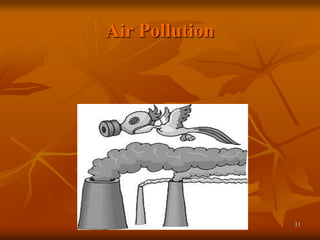
Air Pollution
12
Air (Prevention & Control of Pollution) Act,
1981 preamble
Part-2 : Air (P&CP) Act,1981 :
(i) It provides for the prevention, control or
abatement of air pollution;
(ii) Establishment of Boards with the powers &
functions relating thereto.
13
Contd.
 Initially, State of Maharashtra declared BMRDA as ‘Air
Pollution Control Area’ for making applicable
provisions of the Air (P&CP) Act,1981 from the year
1983 vide Notification No.POA-1082/119/CR.32/UD-
18, dtd.2/5/1983
 Thereafter, Maharashtra Industrial Development Corpn.
at Tarapur & Roha have been declared as ‘Air Pollution
Control Area’ from the year 1985 vide
G.R.No.POA.1185/518/CR-53, dtd.14/8/1985.
 Then, it was extended to Patalganga area from 1986
vide No.POA 1086/750/CR-169/Desk-I, dtd.11/11/1986.
 It has been further extended to the rest of Maharashtra
i.e. total Maharashtra from 1995 vide Notification
No.ENV 1093/237/CR-43/D.I., dtd. 6/11/1995 by
declaring it ‘Air Pollution Control Area’.
14
Contd.
 The provisions under Atomic Energy Act, 1962 in
relation to radioactive air pollution provisions will
have overriding effect in respect of provisions of the
Air (P&CP) Act, 1981.
 The standards for emission of air pollutants from
automobiles will be ensured by the Authority
Incharge of registration of motor vehicles under the
Motor Vehicles Act, 1939. MPCB can give
recommendations to the State Govt. and State Govt.
shall in consultation with the Board give such
instructions as are necessary to the RTO.
15
CHAPTER-II
Important powers & functions of the MPC
Board under both the Water & Air Acts.
 Section 17 of the Water (P&CP) Act, 1974 and the
Air (P&CP) Act, 1981
To plan a comprehensive programme for the
prevention, control & abatement of water & air
pollution and execution thereof – Board may prepare
such a programme in respect of implementation of
various environmental laws, rules & notifications,
which can be put up before the Board for necessary
approval & execution.
16
Contd.
 To advise State Govt. on matters related to
prevention, control or abatement of pollution–
Board may prepare draft policy decisions in
respect of prohibition & restriction on the
location of industries, processes & operations
in different areas, such as River Policy
Notification, Stone Crusher locations, Cattle
stables, brick kilns, exemption of certain
person from use of stream or well for disposal
of polluting matters subject to certain
conditions [Section 24 (3) of Water Act,1974].
17
Contd..
 To advise State Govt. on any matter concerning the
prevention, control or abatement of water/air
pollution including suitability of any premises or
location for carrying on any industry likely to cause
water/air pollution.
 To suggest alteration of water/air pollution,
prevention & control area/s or declaration of new
water / air pollution prevention area/s to the State
Govt.
 To collect & disseminate information relating to
water / air pollution & prevention, control or
abatement thereof.
18
Contd..
 To collaborate with the Central Pollution Control
Board in organising training of persons engaged in
programme about pollution prevention or abatement of
water / air pollution etc.
 To lay down, modify or annul effluent standards for
sewage & trade effluents and quality of receiving
water (excluding inter-state stream) and to classify it /
to lay down standards for emission of air pollutants
into the atmosphere from industrial plants &
automobiles or for discharge of air pollutants into
atmosphere from any source in consultation with
CPCB and taking into consideration standards laid
down by it– since, Central Govt. laid down uniform
standards under Environment (Protection) Rules, 1986,
State Board can not relax it, but may specify more
stringent standards for relevant parameters after
recording reasons.
19
Contd.
 To evolve economical & reliable methods of
treatment of sewage & trade effluent having regard to
the peculiar local conditions including methods of
utilization of sewage & trade effluent in agriculture /
land.
 To inspect sewage or trade effluents, works & plants /
any control equipments, industrial plant or
manufacturing process.
 To determine regulations in respect of method of
recruitment and the terms & conditions of service of
officers & employees other than Member Secretary .
20
Contd.
To delegate to any officer of the Board such of
Board’s powers & functions by general or
special order and subject to such conditions &
limitations as may be decided.
 To give consultation to the State Govt. in
respect of making of rules to carry out the
purposes of Water & Air Acts.
 To establish or recognize a Laboratory /
Laboratories for the performance of the
functions by the Board including analysis of
samples.
21
Contd..
To authorise officers to take samples of
effluents, visit & inspection.
 To carry out certain works in respect of any
conditions imposed by the Board under
Section 25/26 of the Water (P&CP) Act, 1974.
 To take emergency measures in case of
pollution of stream or well including removing
polluting matter from stream or well or land
and properly disposal thereof, taking remedial
measures for mitigating pollution or issuing
orders for restraining polluted discharge.
22
Contd..
Making application to the court for restraining
apprehended pollution of water / air.
 Giving Directions in exercise of powers u/s 33A /31A
of the Water/Air Acts in performance of functions
including directions of closure, prohibition or
regulation of industry, operation or process, stoppage
of or regulation of supply of electricity/water or any
other service.
To spend Board’s fund for performing its functions
under the Acts.
23
Contd..
 To borrow money from any source by way of loan/s
or issue of bonds / debentures / any other instruments
for performance of all or any of its functions under
the Act/s with the consent of State Govt.
 To prepare a budget in respect of next financial year
in the prescribed form and to prepare annual report
giving full account of activities under the Acts during
previous financial year and to forward to the State
Govt. for laying before State Legislation and to keep
proper account and audit.
 To initiate legal actions as per provisions of the Act/s.
24
(I) Delegation of powers by the MPC
Board to its officers & employees
 MPCB has delegated powers under the provisions of
the Water /Air (P&CP) Acts by general resolutions to
exercise its powers & functions under the Act,
including visit & inspection, collection of samples,
filing of prosecution, grant of consent & issuance of
directions etc. as under
(a) Concerned Regional Officer/ Sub-Regional Officer
authorized to file complaints/applications under the
provisions of the Water / Air Acts before appropriate
court of law having jurisdiction, as decided in the
122nd Meeting of the Board held on 19/12/1998 and
as per office order No.E-36 of 2000, dtd.29/3/2000.
25
Contd.
(b) Regional Officers/Sub-Regional Officers are authorized to
affirm affidavits in their respective jurisdiction and in
important matters of policy decision, senior officers in the
Head Quarter are authorized to file Affidavits before High
Court and Supreme Court matters and other Forums.
(c) Member Secretary and / or Chairman of the Board are
authorized by the Board to issue any directions under Section
33A / 31A of the Water / Air Acts respectively. Besides that
Regional Officers of the Board are authorized to issue
directions under Section 33A / 31A of the Water / Air Acts
respectively in their respective jurisdiction by following due
procedure and principles of natural justice, but conditional
directions to restart after ensuring concrete steps /
compliance can be issued by the Member Secretary /
Chairman only or with their approval
26
Contd.
(d) Central Govt. has authorized the Chairman or
Member Secretary or Regional Officers of the State
Pollution Control Board to file prosecution u/s 19
r.w. section 15 of the (Environment ) Act, 1986.
(e) MPCB has authorized Member Secretary, Water
Pollution Abatement Engineer, Air Pollution
Abatement Engineer, Principal Scientific Officer,
Regional Officers, Sub-Regional Officers, Sr.
Scientific Officers, Scientific Officers, Jr.Scientific
Officers and Field Officers to visit & inspect the
industry, operation or process, to collect samples of
air, water and environment.
27
(II) Delegation of Powers in respect
of Consent Management
28
(III) Delegation of powers in respect of
issuance of directions under Water / Air Acts.
 Member Secretary and Chairman of the Board
authorised to issue directions u/s 33A of the Water
(P&CP) Act, 1974 and u/s 31A of the Air (P&CP)
Act,1981 for whole State of Maharashtra, which
includes directions of closure, prohibition or
regulation of industry, operation or process as well as
disconnection of electricity/water supply of any
industry or regulation of any other service to the
industry.
 Regional Officers are empowered to issue directions
under the above provisions within their jurisdiction.
29
CHAPTER-III
Important Provisions frequently
enforced by the MPCB
Water (Prevention & Control of Pollution) Act,
1974
&
Air (Prevention & Control of Pollution) Act,
1981.
30
(A) Visit, Inspection & obtaining
information
The Officers of the Board are empowered to
visit the industries and processes for
implementing the laws. In practice, Field
Officers, Sub-Regional Officers and Regional
Officers carry out inspections and visits at
regular intervals. All officers of the
Maharashtra Pollution Control Board are
authorised by the Board for the purposes of
visit & inspection of industries, operations or
processes.
31
(B) Collection of samples u/s 21 of the Water
(P&CP) Act, 1974 and/or u/s 26 of the Air
(P&CP) Act, 1981
For initiating legal actions including filing of
prosecution in respect of non-compliance of
consent conditions and causing pollution, the
samples u/s 21 and/or u/s 26 of the said Acts
collected to show that various standards prescribed
by the Board are meeting or not?
Powers are given to Field Officer, Sub-Regional
Officers and Regional Officers of the Board.
However, these powers can further be delegated to
the Member Secretary, Water Pollution Abatement
Engineer, Air Pollution Abatement Engineer, PSO,
SSOs & JSOs in order to do extensive sampling.
32
Three situations arise for collection of samples after serving the notice
on the person in charge of and having control over the plant, vessel or
occupation of the place.
I)) In case, the occupier or his agent request division of sample in to two
parts, then to divide sample in to two parts in his presence, send one
container to the Laboratory established or recognized by the Board and
send second set of sample at his request to the Laboratory established
or recognized by the State Government
II) Where occupier or his agent will fully absents, then only one set of
sample will be sent for analysis to the laboratory established or
recognized by the Board. by communicating his will full absence, and
III) Where occupier or his agent doesn't make a request for dividing
sample in to two parts, then sample taken will be placed in one
container and shall be sent to be Laboratory established or recognized
by the State Board
The Laboratories will send the report on analysis in triplicate to the
Board, Out of that, one report will be sent to the occupier or his agent
by obtaining his acknowledgement, second report will be preserved for
production before court and third will be kept in Boards records.
33
(C) Refusal/withdrawal of consent u/s 27 of
the Water (P&CP) Act, 1974
The Board may refuse consent in case of non-compliance of
conditions prescribed in the consent to establish / consent to
operate or in case, the project proponent is not complying with
other statutory provisions such as EIA Notification, River Policy
Notification and other notifications issued by the Govt. from time to
time.
Consent can also be revoked in case of non-compliance of
consent conditions and other statutory provision.
While issuance of refusal / revocation order, reasonable
opportunities of hearing either by way of show cause notice or
personal hearing has to be extended. Powers of revocation/review
are given to the higher officer/authority in the rank above the
officer, who has been empowered to grant consent e.g. in case,
SRO has to revoke consent for ‘Green’ Category industry, the
same will have to be referred to the Regional Officer for
revocation. Likewise, if Regional Officer has to revoke consent to
‘Orange’ Category industry, for which, he is empowered to grant
consent, it will have to be submitted to the HQ for
revocation/review.
34
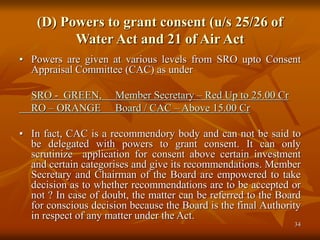
(D) Powers to grant consent (u/s 25/26 of
Water Act and 21 of Air Act
▪ Powers are given at various levels from SRO upto Consent
Appraisal Committee (CAC) as under
SRO - GREEN, Member Secretary – Red Up to 25.00 Cr
RO – ORANGE Board / CAC – Above 15.00 Cr
▪ In fact, CAC is a recommendory body and can not be said to
be delegated with powers to grant consent. It can only
scrutinize application for consent above certain investment
and certain categorises and give its recommendations. Member
Secretary and Chairman of the Board are empowered to take
decision as to whether recommendations are to be accepted or
not ? In case of doubt, the matter can be referred to the Board
for conscious decision because the Board is the final Authority
in respect of any matter under the Act.
35
(E) Review of refusal / revocation of
Consent Order.
 Water Act, 1974 in Section 27 provides for review of
conditions imposed u/s 25/26 of the said Act or
refusal order or consent order. No such review
provision is separately made under Air Act, 1981,
 However, Section 21(6) of Air Act, 1981 provides
that if due to technological improvement or
otherwise, the State Board opines that all or any
condition requires variation, it may do so after giving
reasonable opportunity to concern person.
36
(F) Appeals u/s 28 of Water Act /
u/s 31 of Air Act
 Any aggrieved person against the order passed in
respect of grant / refusal of consent may prefer an
appeal to the Appellate Authority constituted by the
State Govt. [consisting of Principal Secretary
(Environment), Hydraulic Engineer, MCGM and
Suptd. Engineer, MJP].
 Appeal is to be preferred with necessary fees, within
30 days from the date on which, the order is
communicated. However, if Appellate Authority is
satisfied that the Appellant was prevented by
sufficient cause from filing the Appeal in time, the
appeal can be entertained within 45 days of time.
 Appellate Authority determines unreasonableness of
any condition or any variation of a condition.
37
(G) Revision
 State Govt. either of its own motion or on an
application made to it, may call the records of any
case, where an order has been made by the State
Board u/s 25/26/27 of the Water Act, 1974 to satisfy
itself as to the legality or propriety of such a order,
after giving State Board and the person who may be
affected by such order, a reasonable opportunity of
hearing, but, during pendency of appeal or where
appeal remedy is available but not exhausted, the
revision can be not entertained.
 No separate provision for Revision available under
Air Act, 1981.
38
CHAPTER-IV
(A) Power of State Board to carry out
certain works under Water Act, 1974
 Section 30 of Water Act,1974 empowers State
Board to execute itself or cause to be executed
any work in connection with conditions
imposed on any person u/s 25/26 of the Water
Act,1974, by giving 30 days notice first and in
case of failure by executing the work.
Expenses incurred by the Board for such
execution together with interest may be
recovered by the Board as an arrears of land
revenue or of public demand.
39
Contd..
 Central Govt. identified a list of works that can be
undertaken by the State Board out of Cess proceeds
and therefore, in case of emergent situation of
pollution / sensitive issues, the Board can execute
works in respect of conditions imposed under
Consent for water pollution prevention.
 No provision for executing such work available under
Air Act, 1981.
40
(B) Power to obtain information under
Water & Air Acts.
 Section 20 of Water Act, 1974 empowers State
Board or its officer to make surveys of any
area, gauge, record or flow of volume and
other characteristics of stream or well in such
area including recording of rainfall as well as
information regarding construction or
operation of any industry, process or disposal
system and to obtain any such information by
giving appropriate directions to persons in
possession thereof.
41
Contd…
 Water & Air Acts provide for furnishing of
information by a person incharge of industry,
operation or process in respect of any accident or
other unforeseen act or event, thereby discharge of
poisonous, noxious or polluting matters or
apprehended discharge into stream or well or sewer
or on land or where emission occurs or is
apprehended in excess of standards laid down by the
Board, for taking remedial measures. Expenses
incurred by the State Board, Authority or Agency in
respect of remedial measures can be recovered
together with interest from the concerned persons.
42
(c) Powers to give instructions for ensuring
standards for emission from automobiles by
giving necessary consultation to the State Govt.
 State Govt. empowered to give such
instructions to the RTO in consultation with the
MPC Board under the provisions of the Air
(P&CP) Act, 1981 for ensuring standards for
emission of air pollutants from the
automobiles, which shall be bound to comply
with such instructions.
43
CHAPTER- V
(I) Emergency Measures under
Water / Air Acts.
 Section 33 of Water Act,1974 and Section 22A of the
Air Act,1981 provide for making an application to the
court for restraining persons from causing water
pollution/ apprehended pollution/air pollution, where,
after receipt of application, JMFC/ Metropolitan
Magistrate may make such orders as may necessary
in the circumstances including directions to the
concerned person to desist from taking action likely
to cause pollution or to remove such polluting matter
or causing such emission etc.
44
Contd..
 Earlier, MPCB had filed a number of such
applications in respect of severe pollution or
apprehended pollution and used such a tool
very effectively, however, nowadays, because
of frequent recourse to issuance of directions
u/s 33A / 31A of the Water / Air Acts, this is
not being effectively used, as it is time
consuming.
45
Contd.
Powers under Section 32 of the Water (P&CP) Act, 1974 in respect of issuance
of orders for removing polluting matters, remedying or mitigating any
pollution of water or prohibiting from discharging any poisonous, noxious or
polluting matter.
 Frequent accident or other unforeseen act occurred /
apprehended, but MPCB has not so far utilised this particular
power effectively because there is no provision to execute these
orders.
 Water Act provides for taking emergency measures in case of
pollution of stream or well, by way of removing that matter
from the stream or well or land and disposing it in an
appropriate manner, taking remedial measures and issuing
appropriate orders restraining/prohibiting the concerned
persons from discharging such polluted matters. Earlier a
number of such emergency measures taken by the Board, when
the provision for issuance of directions u/s 33A of the Water
Act, 1974 was not available. But now MPCB is not so far using
this provision. It becomes necessary to use this remedy prior to
issuance of directions or in emergent cases.
46
CHAPTER-VI
Command and Control through filing of
prosecutions / applications before Court of Law
under Water / Air Acts.
 MPCB is empowered to file applications u/s 33 / 22A
of the Water / Air Acts respectively in respect of
apprehended or severe pollution as stated above. In
case of violation of the orders issued by the courts u/s
33 / 22A of the above Acts, the remedy available is
prosecution under sub-Section 2 of Section 41 of the
Water Act, 1974 and corresponding section 39 of the
Air Act, 1981. This remedy had been used in
continuous offenses, by the MPCB.
47
Contd..
 Prosecutions u/s 43 &/or 44 read with Section 24,
25/26 and 27 of the Water Act, 1974 and u/s 37 & 39
r.w.Section 21 or 22 or Section 31A of the Air Act,
1981 – After 1984, MPCB used, command &
control approach by filing prosecutions under above
sections till 1995. However, prosecutions remain
pending years together and in between period
pollution contine, therefore, the Board in 1995
decided to take recourse to powers to issue
directions. Powers are delegated to Member
Secretary, Chairman & Regional Officers to issue
directions, but not given to senior officers of the
Board like WPAE, APAE, PSO & Sr.Law Officers.
In CPCB, powers are given to all the senior officers
so as to use consciously, reasonably and effectively.
48
Contd..
 These are the frequently used provisions for initiating
actions. However, the provisions are not used as per
requirements taking into consideration the degree of
non-compliances, e..g. where an action can be
initiated by way of prohibitory order restraining
apprehended pollution either by officers of the Board
or through court, and it can be effective in a given
situation, it should be used instead of direct recourse
to issuance of directions u/s 33A/31A of Water / Air
Acts. Similarly, in case of non-compliance of
directions, remedy available is prosecution only.
49
Contd.
Before launching prosecution against the defaulters, the
concerned Officers (Sub-Regional Officers & Regional Officers)
investigate complaints, obtain information about pollution
prevention of particular activities, visit & inspect any place to
verify the compliance of environmental laws, collect joint
vigilance samples and law evidence samples under the
provisions of the Environmental Laws (Water, Air &
Environment Acts). Accordingly, build-up case in respect of
non-compliances and submit prosecution proposal for necessary
approval of the higher authorities. The prosecution proposals
are scrutinized by the Technical and Legal Deptts. at Head
Quarter and being sent for necessary approval of the Member
Secretary / Chairman. After approval of prosecution proposal,
the complaints are being filed before appropriate court of law,
having local jurisdiction with the help of panel Advocates of the
Board by the respective Regional Officer / Sub-Regional Officer.
50
(II) Powers to give directions under Section
33A / 31A of the Water / Air Acts.
 After passing of Environment (Protection) Act,1986,
the Parliament has amended Air & Water Acts,
incorporating the powers to give directions in the
amendment in the year 1987 & 1988 respectively.
Section 33A / 31A of Water / Air Acts provide for
issuance of any directions in writing to any person,
officer or authority subject to the provisions of
Water/Air Acts and directions given by the Central
Govt., if any, which includes directions of closure,
prohibition or regulation of any industry, operation or
process or stoppage or regulation of supply of
electricity, water or any other service.
51
Contd..
 MPCB has taken review of all its legal actions in the
year, 1995. It was observed that at that particular
time, command & control by way of filing of
prosecutions, applications before the various courts of
law was being exercised. In spite of amendments
incorporating powers to give directions under Air /
Water Acts, the same were being exercised sparingly.
 The cases filed before the Court of Law remained
pending years together. The penal provisions
remained as threats for a while and fade away after
some years. The pollution in the intervening period
till disposal of cases continue.
52
Contd..
 After due deliberations, MPCB has taken a conscious
decision to take resort/recourse to initiate actions u/s
33A /31A of the Water / Air Acts in 1995 An
extensive surveys undertaken to identify initially
most polluting industries and then to identify medium
and small scale industries, which had not complied
with the MPCB norms. Thereafter, proposed
directions issued, pointing out non-compliances and
after receipt of objections to the proposed directions /
replies, opportunities extended to present their case/s.
53
Contd..
 During personal hearings, legal and technical
officers and the representatives of defaulting
industries appeared before the Member
Secretary/ Chairman and based on decisions
taken in the personal hearing, interim
directions finalized and issued. Some time was
given to comply with the directions and in
appropriate cases, a system of bank guarantee
or / and Affidavit-Undertaking introduced to
ensure compliance of directions in a time
bound manner.
54
Contd.
 A review was taken in respect of compliance of
directions and based on non-compliance reports from
the Board officials, the directions of closure issued
after giving reasonable opportunities. Directions were
also issued for upgradation of existing pollution
control devices, adopting cleaner technologies and
prescribing more stringent standards / conditions to
decrease pollution load by restraining discharges into
the stream or river and encouraging disposal on land
for irrigation / gardening purposes including
recirculation of waste water in the process itself. The
result was that during 1995 to 2000, almost all large
& medium scale industries provided necessary
primary & secondary treatment facilities and more
than Rs.150 crores investment was made on pollution
control measures in the State of Maharashtra.
55
Contd…
 After 2000, MPCB concentrated on the non-
compliances of small scale industries and
accordingly encouraged the installation and
commissioning of CETPs. The SSI units not
becoming members of CETPs were either
directed to provide full-fledge primary &
secondary treatment facilities or to close down
manufacturing activities till membership of
CETPs obtained.
56
Contd.
 After 2003, MPCB had taken review of all
CETPs and issued directions to not only CETP
authorities, but also to individual members to
upgrade it and operate it efficiently, so as to
contain the pollution.
 Thus issuance of directions played a very
important role in securing compliance.
57
CHAPTER-VII
Water (P&CP) Cess Act,1977
 MPCB is collecting Cess from every person carrying
on any industry and every local authority on the basis
of water consumed by such person or local authority
for the purposes specified in Schedule-II and rates
specified by the Central Govt., industries (does not
include any Hydel Power Unit) consuming water
more than 10 kilo liters per day, provided in case of
industries generating hazardous waste, all industries
are covered for the levy of cess. In case of
compliance of Section 25 of Water Act, Environment
Standards and consumption quantity, 25% rebate
granted. Two types of rates specified by the Central
Govt. as under :
58
Sr.
No.
Purpose for which Water
consumed
Normal Rate in case of
Compliance of provisions of
Water Act,1974,
Environmental Standards
and consumption of water in
excess of maximum quantity
prescribed
Penal Rate for not
complying with
provisions of Section
25 of the Water
Act,1974,
environmental
standards under
E(P) Act,1986 or
consumption of
water in excess of
prescribed quantity
1,. Industrial Cooling, spraying in
mine pits or boiler feeds
5 Paise per kilo liter 10 paise per kilo liter
2. Domestic purpose 2 Paise per kilo liter . 3 Paise per kilo ltr.
3. Processing whereby water gets
polluted and pollutants easily
biodegradable or non-toxic or
both
10 paise per kilo liter. 20 paise per kilo ltr.
4. Processing whereby water gets
polluted and not easily
biodegradable or toxic or both
15 paise per kilo liter 30 paise per kilo liter.
59
Contd.
 Affixing of meters for measuring & recording
quantity of water consumed prescribed in the
rules. However, in case of huge quantity of
consumption of water, the water quantity
measured by v-notch.
 Power of entry given to the Officer or Authority
of State Govt. for carrying out the purposes of
the Act including testing of correctness of the
meters
60
(i) Assessing Authority & Cess Proceeds
 Member Secretary, MPCB is notified as the Assessing
Authority. State Govt. may specify more officers &
authorities for the purposes of collection of cess.
Member Secretary issues the assessment orders on the
basis of returns furnished by the industries or local
bodies after making necessary inquiries.
 The proceeds of the cess credited to the Consolidated
Funds of India. Central Govt. may pay to the Central
Board or State Board from time to time as per
appropriation made by law in this behalf by Parliament.
State Board to utilise it under the Water (P&CP)
Act,1974.CPCB laid down guidelines for utilisation of
cess funds.
61
(ii) Recovery of Cess
 Failure to pay cess within specified date in the order of
assessment, makes liable to pay interest for the period
from which the payment is due till such amount is
actually paid.
 If cess is not paid within specified date in the order, it
will be deemed to be an arrears and the authority
prescribed may impose a penalty not exceeding the
amount of cess in arrears on defaulter, however, the
recovery of amount due under the Act is entrusted with
the Central Govt. and not MPCB. Before imposing
penalty for non-payment of cess not exceeding the
amount of cess in arrears, a reasonable opportunity is to
be given to the assesee.
 Cess including any interest or penalty can be recovered
by the Central Govt. in the same manner as an arrears of
land revenue.
62
(iii) Provisions regarding Appeals
 Any aggrieved person or local Authority aggrieved by
the order of assessment or imposition of penalty may
prefer an appeal with such fees as may be prescribed
before the Appellate Authority constituted by the
Chairman of the Board within a period of 30 days
from the date of communication of order, provided
appeal can be allowed after 30 days, but before 45
days, if Chairman of Appellate Authority satisfied
that there was good & sufficient reason for delay in
making appeal. The Appellate Authority will give the
appellant an opportunity of being heard in the matter
and will dispose off appeal expeditiously. Provision
of appeal is exercised frequently by the industries /
local bodies.
 Chairman of the Maharashtra Pollution Control Board
is authorised to constitute the Appellate Authority.
63
PRESENTATION ON
THE HAZARDOUS WASTES
(MANAGEMENT, HANDLING &TRANSBOUNDRY
MOVEMENT) RULES, 2008
By
Dr. Y. B. Sontakke.
Regional Officer (HQ), I/c HSMD
Maharashtra Pollution Control Board
June 19,2009
64
INTRODUCTION
Bhopal Incident in 1984
Environment Protection Act, 1986
Hazardous Wastes ( Management & Handling )
Rules-1989
Effective From Date of Publication - 28.07.1989
Applicable: Whole India & Up to 5 Km Sea Ward
side
Hazardous Wastes not covered
 Radio-active Wastes, Bio-medical Wastes,
Municipal Solid Wastes, and Lead Acid Batteries
Amendment - 05.02.1990, 31.03.1992, 03.06.1996,
06.01.2000 and 21.05.2003
65
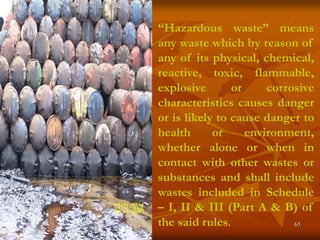
“Hazardous waste” means
any waste which by reason of
any of its physical, chemical,
reactive, toxic, flammable,
explosive or corrosive
characteristics causes danger
or is likely to cause danger to
health or environment,
whether alone or when in
contact with other wastes or
substances and shall include
wastes included in Schedule
– I, II & III (Part A & B) of
the said rules.
66
•The Central Govt. has issued notification in
exercise of the powers conferred by Sections 6, 8,
& 25 of the Environment (Protection) Act, 1986,
namely the Hazardous Wastes (Management &
Handling) Rules, 1989 on 28.7.1989 which is
subsequently amended five times on 5.2.1990,
31.3.1992, 3.9.1996, 6.1.2000 & 21.5.2003.
Supersession of the Hazardous Wastes
(Management and Handling) Rules, 1989 dated
28.09.2008
NOTIFICATION
67
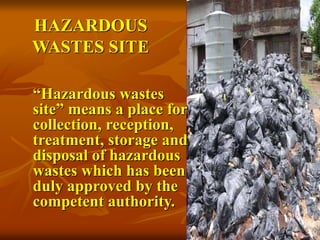
HAZARDOUS
WASTES SITE
“Hazardous wastes
site” means a place for
collection, reception,
treatment, storage and
disposal of hazardous
wastes which has been
duly approved by the
competent authority.
68
High Powered Committee
Writ Petition No.657 of 1995
Research foundation for Science, Technology &
Natural Resources Policy, Delhi
V/s
Union of India & Others
 Hon’ble Supreme Courts Order: 13th Oct. 97
 GoI Constituted HPC on 17th Oct. 97
 Under the Chairmanship of: Prof. M.G.K. Menon
and 10 other members.
69
Supreme Court Directives
 Court order, dated 14.10.2003: compliance of direction in a time
bound manner.
 Supreme Court Monitoring Committee for compliance of the
directives.
 issued. SCMC chaired by Dr. G. Thyagarajan. Consists of 8
Members.
 The SCMC to submit quarterly report to the Court on
compliance.
 SPCBs/ PCCs to comply with directions 0f MoEF
 Produce comprehensive report on illegal HWs dump sites
 Draw up a plan with financial estimates to take measures
required to stop environmental damage
70
Applicability of the rules
These rules shall apply to the handling of hazardous
wastes as specified in the Schedules and shall not
apply to the wastes covered under the provisions of :
 Water (P & CP) Act, 1974
 Air (P & CP) Act, 1981
 Merchant Shipping Act, 1958
 Atomic Energy Act, 1962
 Biomedical Wastes (M&H) Rules, 1998
 Municipal Solid Wastes (M&H) Rules, 2000
 Batteries (M&H) rules, 2001
71
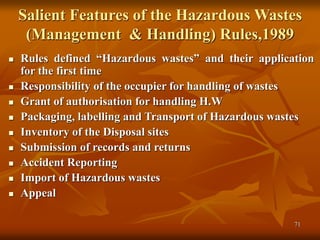
Salient Features of the Hazardous Wastes
(Management & Handling) Rules,1989
 Rules defined “Hazardous wastes” and their application
for the first time
 Responsibility of the occupier for handling of wastes
 Grant of authorisation for handling H.W
 Packaging, labelling and Transport of Hazardous wastes
 Inventory of the Disposal sites
 Submission of records and returns
 Accident Reporting
 Import of Hazardous wastes
 Appeal
72
Contd…
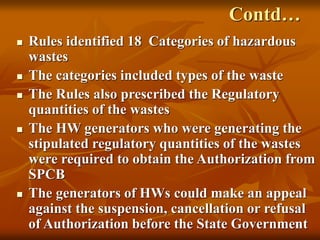
 Rules identified 18 Categories of hazardous
wastes
 The categories included types of the waste
 The Rules also prescribed the Regulatory
quantities of the wastes
 The HW generators who were generating the
stipulated regulatory quantities of the wastes
were required to obtain the Authorization from
SPCB
 The generators of HWs could make an appeal
against the suspension, cancellation or refusal
of Authorization before the State Government
73
Contd…
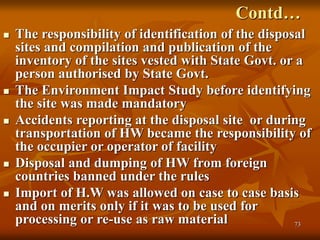
 The responsibility of identification of the disposal
sites and compilation and publication of the
inventory of the sites vested with State Govt. or a
person authorised by State Govt.
 The Environment Impact Study before identifying
the site was made mandatory
 Accidents reporting at the disposal site or during
transportation of HW became the responsibility of
the occupier or operator of facility
 Disposal and dumping of HW from foreign
countries banned under the rules
 Import of H.W was allowed on case to case basis
and on merits only if it was to be used for
processing or re-use as raw material
74
Contd…
 Format prescribed for maintaining the
records of HWs at the facility
 Formats for filing the Returns ,
Transportation, Accident Reporting and
Import of HWs laid down in the Rules.
75
Salient Features of the Hazardous Wastes
(Management & Handling) Rules,1989
As amended, 2000
 Definition of HWS further modified
 HWs included
(a) Waste Substances which are generated in the
process indicated in column-2 of Schedule-1 and
consists of wholly or partly of the waste streams
referred to in column - 3 of the same schedule;
(b) Waste substances which consists wholly or partly
of substances indicated in Schedule-2, unless the
concentration of the substances is less than the limit
indicated in the same schedule: and
76
Contd…
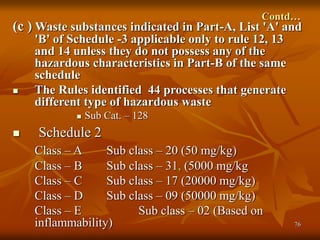
(c ) Waste substances indicated in Part-A, List 'A' and
'B' of Schedule -3 applicable only to rule 12, 13
and 14 unless they do not possess any of the
hazardous characteristics in Part-B of the same
schedule
 The Rules identified 44 processes that generate
different type of hazardous waste
 Sub Cat. – 128
 Schedule 2
Class – A Sub class – 20 (50 mg/kg)
Class – B Sub class – 31, (5000 mg/kg
Class – C Sub class – 17 (20000 mg/kg)
Class – D Sub class – 09 (50000 mg/kg)
Class – E Sub class – 02 (Based on
inflammability)
77
Contd…
 The occupier and the operator of a facility both are
required to take all steps to ensure that the wastes listed
in schedules -1, 2 and 3 are properly handled, and
disposed of without any adverse effects to the
environment.
 Besides occupier, the operator of a facility is also now
responsible for proper collection, reception, treatment
and disposal of H.W listed in Schedule 1, 2 & 3.
78
Contd…
 Treatment of HWs prescribed for the first time in the
Rules and it included
technique or process, designed to change the physical,
chemical or biological characteristics or composition of
any hazardous waste so as to render such wastes
harmless
 All hazardous waste containers to be provided with a
general label as specified in Form 8.
 Concept of Manifests for transportation of HWs
introduced for the first time to keep a thorough check
on the transportation, storage treatment and final
disposal of the HWs
79
Contd…
 No transporter to accept hazardous wastes from
an occupier for disposal unless it is accompanied
by five copies of the manifest (Form 9) as per the
colour codes.
 The transporter shall give a copy of the manifest
signed and dated to the occupier and retain the
remaining four copies to be used as prescribed in
sub- rule (5).
80
Contd…
 Disposal Sites
 The site identification and establishment responsibility
fixed on the occupier or any operator of a facility
 The concept of establishing common hazardous wastes
disposal facility in the state is recognized
 Preliminary impact assessment studies to identify
possible sites for disposal facility made necessary
 Import of hazardous wastes from any country to India
was already banned. The export of hazardous wastes
from India to any country for dumping or disposal
also banned under revised Rules
81
Contd…
 The Export of Hazardous Wastes for recycling and reuse
permitted only if it was used as a raw material
 The Ministry of Environment and Forests appointed as
Nodal Agency to deal with transboundary movement
issues of hazardous wastes
 The export or import of hazardous waste from or to
India to be in accordance with the articles of the Basel
Convention to which the Central Government is a
signatory."
82
Contd…
 Illegal Traffic
 The permission of Central Govt. essential for the
movement of hazardous wastes from or to the country
 The HW traffic considered illegal if it is without the
conformity in the rules.
 Transitional provisions
 Compliance of the revised Rules necessary by the occupier
and authorities
 State Pollution Control Boards and Pollution Control
Committees empowered to oversee the compliance.“
 Appeal
 Detailed procedure notified on the submission and dealing
of the appeals.
83
Salient Features of the Hazardous Wastes
(Management & Handling) Rules, 1989
As amended, 2003
 The Rules further defined the hazardous wastes in 2003
which included
physical, chemical, reactive, toxic, flammable, explosive
or corrosive characteristics of the materials that is
dangerous to health or environment,
 The Rules are now applicable to the wastes included in:
 Column (3) of Schedule-1( irrespective of Conc. Limits Sch-2
except as mention)
 Schedule-2 if their concentration is equal to or more than the limit
indicated
84
Contd…
 Lists ‘A’ and ‘B’ of Schedule-3 (Part-A) applicable only in
case (s) of import or export of hazardous wastes in
accordance with the rules and if they possess any of the
hazardous characteristics listed in Part-B of Schedule 3
 Bio-medical wastes covered under the Bio-Medical
Wastes (Management and Handling) Rules, 1998
 Wastes covered under the Municipal Solid Wastes
(Management and Handling) Rules, 2000
 The lead acid batteries covered under the Batteries
(Management and Handling) Rules, 2001
85
Contd…
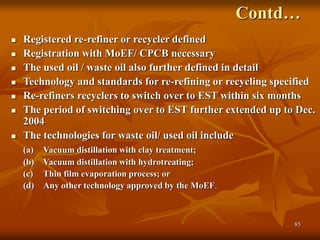
 Registered re-refiner or recycler defined
 Registration with MoEF/ CPCB necessary
 The used oil / waste oil also further defined in detail
 Technology and standards for re-refining or recycling specified
 Re-refiners recyclers to switch over to EST within six months
 The period of switching over to EST further extended up to Dec.
2004
 The technologies for waste oil/ used oil include
(a) Vacuum distillation with clay treatment;
(b) Vacuum distillation with hydrotreating;
(c) Thin film evaporation process; or
(d) Any other technology approved by the MoEF.
86
Contd…
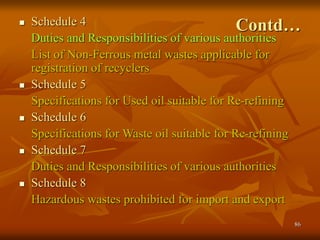
 Schedule 4
Duties and Responsibilities of various authorities
List of Non-Ferrous metal wastes applicable for
registration of recyclers
 Schedule 5
Specifications for Used oil suitable for Re-refining
 Schedule 6
Specifications for Waste oil suitable for Re-refining
 Schedule 7
Duties and Responsibilities of various authorities
 Schedule 8
Hazardous wastes prohibited for import and export
87
HW (M&H) Rules, 1989 (2000)
(2003)
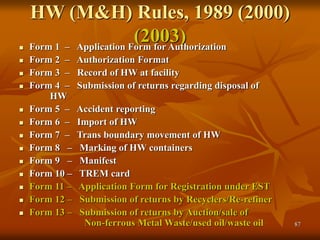
 Form 1 – Application Form for Authorization
 Form 2 – Authorization Format
 Form 3 – Record of HW at facility
 Form 4 – Submission of returns regarding disposal of
HW
 Form 5 – Accident reporting
 Form 6 – Import of HW
 Form 7 – Trans boundary movement of HW
 Form 8 – Marking of HW containers
 Form 9 – Manifest
 Form 10 – TREM card
 Form 11 – Application Form for Registration under EST
 Form 12 – Submission of returns by Recyclers/Re-refiner
 Form 13 – Submission of returns by Auction/sale of
Non-ferrous Metal Waste/used oil/waste oil
88
Contd…
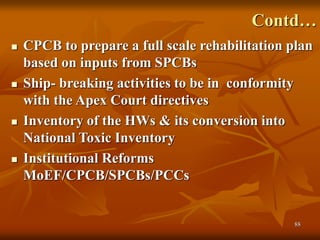
 CPCB to prepare a full scale rehabilitation plan
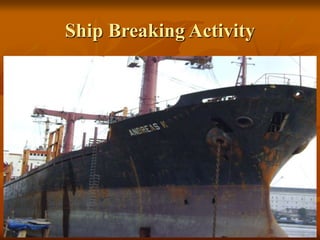
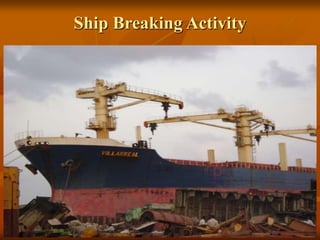
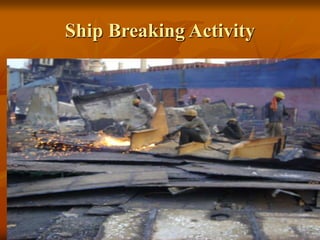
based on inputs from SPCBs
 Ship- breaking activities to be in conformity
with the Apex Court directives
 Inventory of the HWs & its conversion into
National Toxic Inventory
 Institutional Reforms
MoEF/CPCB/SPCBs/PCCs
89
Issues of Serious Concerns
 Used oil / Waste oil
 CETP Sludge
 Illegal dumps of HWs
 Backyard smelting of Lead Acid Batteries
 Landing of Explosive Cargo
 Import of Waste paper- Garbage
 E-Waste Management
90
Hazardous waste reduction
 Source reduction:
 Eliminate hazardous waste within process.
 Cleaner production technologies
 Recycling:
 Reducing volume/toxicity by reuse of recovered material from waste.
 Waste minimization methods
 Treatment:
 To modify physical and/or chemical properties of waste.
 Choice depends on:
 Availability & suitability of treatment & disposal facility.
 Discharge standards.
 Cost consideration.
91
Waste TSD Options
 Direct disposal into landfill
 Treatment/stabilization of wastes and then disposal
into landfill
 Direct incineration
 Pre-treatment and incineration
 Pre-treatment, incineration and disposal of
incineration ash in landfill
 Waste processed for fuel/industrial bye products for
recycle
 Others
 Hazardous Waste could be handled in different ways as
follows:
92
 Closure directions to un-authorized & non-
complying units
 Preparation of HW Inventory & submit to
SCMC
 Inventory of waste dump sites and
rehabilitation plan
 Time frame implementation of rehabilitation
plan
 Directions to ship breaking
SUPREME COURT ORDER DATED
14.10.2003
93
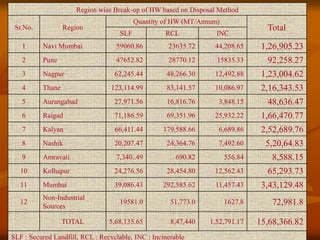
Region wise Break-up of HW based on Disposal Method
Sr.No. Region
Quantity of HW (MT/Annum)
Total
SLF RCL INC
1 Navi Mumbai 59060.86 23635.72 44,208.65 1,26,905.23
2 Pune 47652.82 28770.12 15835.33 92,258.27
3 Nagpur 62,245.44 48,266.30 12,492.88 1,23,004.62
4 Thane 123,114.99 83,141.57 10,086.97 2,16,343.53
5 Aurangabad 27,971.56 16,816.76 3,848.15 48,636.47
6 Raigad 71,186.59 69,351.96 25,932.22 1,66,470.77
7 Kalyan 66,411.44 179,588.66 6,689.86 2,52,689.76
8 Nashik 20,207.47 24,364.76 7,492.60 5,20,64.83
9 Amravati 7,340..49 690.82 556.84 8,588.15
10 Kolhapur 24,276.56 28,454.80 12,562.43 65,293.73
11 Mumbai 39,086.43 292,585.62 11,457.43 3,43,129.48
12
Non-Industrial
Sources
19581.0 51,773.0 1627.8 72,981.8
TOTAL 5,68,135.65 8,47,440 1,52,791.17 15,68,366.82
SLF : Secured Landfill, RCL : Recyclable, INC : Incinerable
94
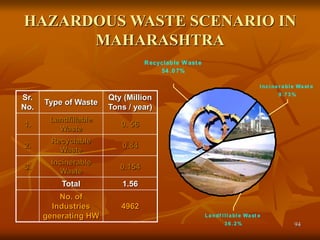
HAZARDOUS WASTE SCENARIO IN
MAHARASHTRA
Inc ine r a ble Wa st e
9 .7 3 %
La ndf illa ble Wa st e
3 6 .2 %
Recyclable W ast e
54 .0 7%
Sr.
No.
Type of Waste
Qty (Million
Tons / year)
1.
Landfillable
Waste
0. 56
2.
Recyclable
Waste
0.84
3.
Incinerable
Waste
0.154
Total 1.56
No. of
Industries
generating HW
4962
95
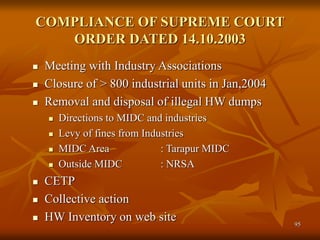
COMPLIANCE OF SUPREME COURT
ORDER DATED 14.10.2003
 Meeting with Industry Associations
 Closure of > 800 industrial units in Jan,2004
 Removal and disposal of illegal HW dumps
 Directions to MIDC and industries
 Levy of fines from Industries
 MIDC Area : Tarapur MIDC
 Outside MIDC : NRSA
 CETP
 Collective action
 HW Inventory on web site
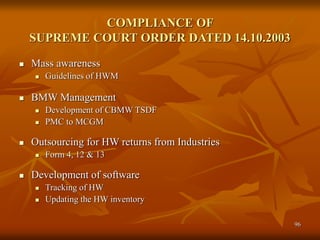
96
 Mass awareness
 Guidelines of HWM
 BMW Management
 Development of CBMW TSDF
 PMC to MCGM
 Outsourcing for HW returns from Industries
 Form 4, 12 & 13
 Development of software
 Tracking of HW
 Updating the HW inventory
COMPLIANCE OF
SUPREME COURT ORDER DATED 14.10.2003
97
Major Achievements
 Appreciation from SCMC
 Inventorisation of hazardous waste work has been
completed by MPCB and report submitted to MoEF,
SCMC, CPCB
 Identification of illegal hazardous waste dump site through
satellite imaginary in Thane District has been completed by
NRSA
 Disposal of 133 Waste containers has been lifted to MWML
from JNPT
 Hazardous waste lying at Mumbai Port Trust has been lifted
to MWML
 Hazardous waste lying at Air cargo has been shifted to
MWML
98
Contd…
 HW Transporter in Maharashtra : 60
 Waste oil/ used oil recycling units: 27
 Non ferrous HW Recycler: 36
 Notices issued for levy of fine: 23.
 Remediation cost recovered : Rs.3.75 Crore
 Levy of fine received by MPCB: Rs.36, 00,000
 Formation of HWM Cell by out sourcing for
 inventory preparation and up gradation
 Tracking of hazardous wastes
99
Objectives:
 To allow regular updating of the Inventory.
 To provide on-line access to the Inventory through various search options.
 To manage the process of Authorisation Amendments more efficiently.
Features:
 A streamlined interface supported by an efficient database
 Advanced Criteria-based (Region-wise, etc.) and Individual Industry Search
 A facility to view and issue Authorisation Amendments
 A quick-view of Hazardous Waste Quantity Totals across different criteria
 A Data-Entry Section for updating the inventory through add/edit/delete
operations.
100
Module II: Online Annual Returns System
Features:
 For Users [Industries generating HW, Recyclers, Reprocessors,
Auctioneers]:
A Data-Entry facility for filing Form 4/12/13 Annual Returns.
 For Administrator [MPCB]:
 Quick-view Summary of returns filed on-line.
 A variety of Reports, such as Log Reports, Summary Reports, Viewing
Filed Returns, etc.
 Data-Entry Facility
 Provision for changing Login Details of Industries
101
Hazardous Waste Notification
24th September, 2008
 Salient features of the Hazardous Wastes (Management,
Handling & Transboundary Movement ) Rules, 2008.
 Application – Apply to the handling of hazardous wastes
specified in Schedules but not apply to –
i) Waste water and exhaust gases covered under the Water
and the Air Acts.
ii) Waste arising out of the operations from ships beyond 5
km of relevant base line as covered under the Merchant
Shipping Act, 1958.
iii) Radio-active wastes as covered under the provisions of
Atomic Energy Act, 1962.
102
 Contd.
iv) Bio-medical Wastes covered under BMW Rules, 1998.
v) Wastes covered under MSW Rules, 2000.
 Important definitions :
a) Authorisation : Means permission for generation,
handling, collection, reception, treatment, transport,
storage, recycling, reprocessing, recovery, reuse and
disposal of hazardous wastes granted under sub-rule (4) of
Rule 5.
b) Basal Convention : The United Nations Environment
Programme Convention on the Control of Transboundary
Movement of Hazardous Wastes and their Disposal.
103
Contd.
c) Disposal : Means any operation which does not
lead to recycling, recovery or reuse and includes
physico-chemcial, Bio-logical treatment,
incineration and disposal in secured landfill.
d) Environmentally sound management of
hazardous wastes - Means taking all steps
required to ensure that, the hazardous wastes are
managed in a manner to protect health and the
environment against adverse effects which result
from such wastes.
104
Contd.
 e) Environmentally Sound Technologies : Means any
technology approved by the Central Pollution Control
Board from time to time.
f) Facility : Means any establishment wherein the processes
incidental to the handling, collection, reception, treatment,
storage, recycling, recovery, reuse, and disposal of
hazardous wastes carried out.
g) Hazardous Wastes : Means any wastes by reason of any of
its physical, chemical, reactive, toxic, flammable, explosive
or corrosive characteristics causes danger or is likely to
danger to the health or environment whether alone or in
contact with other wastes or substances and shall include
105
Contd.
i) Waste specified under Schedule-I (Column-3)
ii) Wastes having constituents specified in schedule-
II, provided their concentration is equal to or
more than the limits indicated in the Schedule.
iii) Wastes specified in Part-A or Part-B or
Schedule-III in respect of Import or Export of
such wastes in accordance with rules 12, 13 and 14
and other than the wastes specified in Part-A or
Part-B which possess any of the hazardous
characteristics specified in Part-III.
106
Contd.,
iv) Recycler or Reprocessor or Actual User : Means
an occupier who procures and possesses
hazardous wastes for recycling or recovery or
reuse.
v) Recycling : Means reclamation and reprocessing
of hazardous wastes in an environmentally sound
manner for the original purpose or other purposes
vi) Reuse : Means use of hazardous wastes for the
original purpose or other purposes
vii) Recovery : Means any operation in the recycling
activity wherein specific materials are recovered.
107
Contd.,
viii) Transboundary Movement : Means any
movement of hazardous wastes from an area
under the jurisdiction of one country to or
through an area under the jurisdiction of another
country or through an area not under the
jurisdiction of any country, provided atleast 2
countries are involved in the movement.
ix) Treatment : Means a method, technic or process,
designed to modify the physical, chemical or
biological characteristics or composition of any
hazardous wastes, so as to reduced its potential to
cause harm.
108
Contd.
x) Besides that, used oil and waste oil also defined.
 The Rules further imposes responsibilities on the
occupier for safe and environmentally sound
handling of hazardous wastes generated in his
establishment with further responsibility to send
or sold to a recycler or re-processor or re-user
registered or authorised under these rules or
dispose of in an authorised disposal facility, with
proper transportation in accordance with the
Rules by giving to the Operator a facility,
information as may be determined by the State
Pollution Control Board.
109
Contd.
it also makes it obligatory on the occupier to take all steps
at the time of handling of hazardous wastes to contained
contaminants, prevent accidents and limit their
consequences on human beings and environment and to
provide working persons on the site, training and
information necessary to ensure safety.
 Regarding storage of hazardous wastes, the period of 90
days prescribed for the first time to the occupiers,
recyclers, re-processors, re-users and operators of facility
with further provision that, SPCB may extent period in
case of small generators upto 10 tones, 6 months for
recyclers, re-processors and facility operators of their
annual capacity as well as to generators not having
assessed to any TSDF in the concern State as well as wastes
needing special provision for storage for the development
of a process for recycling, re-use.
110
Contd.
 Recycler, Re-processor or reuse of hazardous wastes to
make an application for the grant of renewal of
registration with Consent to Establishment from the
SPCB, certificate of registration by the Dist. Industry
Centre and proof of installed capacity of plant and
machinery as well as compliance of effluent, emissions
standards and treatment and disposal of hazardous wastes.
CPCB is authorized to grant registration.
 Sale or Transfer of Hazardous Wastes for Recycling : The
generator of HW specified in Schedule-IV may sale it only
to the Recycler having a valid registration from the CPCB
for recycling of recovery.
111
 Standards for Recycling : Central Government or CPCB
may issue guidelines for the same from time to time.
 Utilisation of Hazardous Wastes : Utilisation of hazardous
wastes as a supplementary resource or for energy recovery
or after processing shall be carried out only after approval
from the CPCB.
 Import and Export of Hazardous Wastes :
a) MoEF is nodal agency to deal with transboundary
movement of hazardous wastes.
b) No hazardous wastes shall be imported from any country
to India for disposal except for recycling, recovery or
reuse.
112
Contd.
c) Export may be allowed to an actual user of the wastes or
operator of a disposal facility with the prior informed
consent of the importing country to ensure
environmentally sound management.
d) No import or export of hazardous wastes specified in
Schedule-VI permitted.
e) Procedure for import and expert of hazardous wastes given
in the rules.
 Schedule-I maintains 36 categories of processes generating
hazardous wastes giving it the category number. Schedule-
II gives list of waste constituents with concentration limits
for Class-A to Class-E on the basis of concentration limit
such as 50 mg/kg, 5,000 mg/kg, 20,000 mg/kg, 50,000
mg/kg and regardless of concentration limits, if the waste
113
Contd.
exhibits the characteristics like flammable ( with
flash point 65.6 centigrade or below, explosives –
waste which may explode under effect of frame,
heat or photochemical conditions as well as wastes
material under Indian Explosives Act, corrosive
which will cause severe damage in contact with
leaving tissue, toxic with established toxic and
eco-toxic constituents and carcinogencity,
mutagencity and Endocrine disruptivity.
 Schedule-III gives description of hazardous wastes
such as metal and metal bearing wastes, waste
containing principally inorganic /constituents,
which may contain metals and organic materials
114
Contd.
waste which may contain either inorganic or
organic constituents which has been identified by
the Basal Convention in Annexure-VIII. In part-A
 Part-B contains hazardous wastes which can be
imported or exported without requiring prior
informed consent as per Annexure-IX of the Basal
Convention.
 Part-C gives the list of hazardous characteristics
 Schedule-IV gives list of hazardous wastes
requiring registration for recycling/re-processing.
115
Contd.
 Schedule-V: gives specifications of used oil
suitable for reprocessing/recycling in Part-A
and in Part-B it gives specifications of fuel
derived from waste oil.
 Schedule-VI – gives list of hazardous wastes
prohibited for import and export.
 Schedule-VII – gives list of authorities and
corresponding duties.
116
ROLE OF GOVT. OF MAHARASHTRA FOR
DEVELOPING CHWTSDF SITES
The Government of Maharashtra (GoM) declared MIDC as
a nodal agency for selection of potential sites, carrying out
EIA, developing sites etc under the Rule 8(i),(ii)&(iii) of the
Hazardous Waste (M&H) Rules, 1989 & entrusted the
power to MIDC vide their GR ENV 1096/CR-19/TC-2 dated
12th March 1997.
MIDC invited the global tenders under the guidance of an
Expert committee comprising of M.S. CPCB, Advisor MoEF,
M.S.MPCB, Prof. S.K. Gupta & Prof. Shyam Asolekar from
IIT, Mumbai and CEO MIDC as conveyor for the
development of the TSDF facility on BOOT basis.
Developer is Responsible to Design, Construct, Operate &
maintain the facility over a period of 50 years (20 years
operation + 30 years post closure period).
117
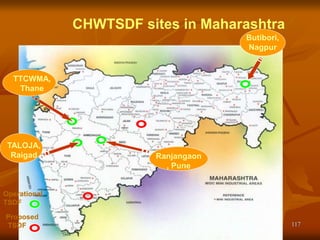
CHWTSDF sites in Maharashtra
Proposed
TSDF
Operational
TSDF
Butibori,
Nagpur
Ranjangaon
, Pune
TTCWMA,
Thane
TALOJA,
Raigad
118
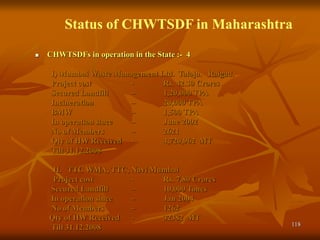
Status of CHWTSDF in Maharashtra
 CHWTSDFs in operation in the State :- 4
I) Mumbai Waste Management Ltd. Taloja. Raigad.
Project cost - Rs. 42.30 Crores
Secured Landfill – 1,20,000 TPA
Incineration – 20,000 TPA
BMW – 1,500 TPA
In operation since – June 2002
No of Members – 2621
Qty of HW Received - 4,720,962 MT
Till 31.12.2008
II. TTC WMA, TTC, Navi Mumbai
Project cost - Rs. 7.80 Crores
Secured Landfill – 10,000 Tones
In operation since – Jan 2004
No of Members – 1262
Qty of HW Received - 32382 MT
Till 31.12.2008
119
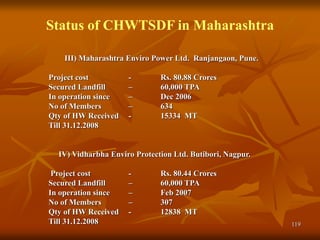
Status of CHWTSDF in Maharashtra
III) Maharashtra Enviro Power Ltd. Ranjangaon, Pune.
Project cost - Rs. 80.88 Crores
Secured Landfill – 60,000 TPA
In operation since – Dec 2006
No of Members – 634
Qty of HW Received - 15334 MT
Till 31.12.2008
IV) Vidharbha Enviro Protection Ltd. Butibori, Nagpur.
Project cost - Rs. 80.44 Crores
Secured Landfill – 60,000 TPA
In operation since – Feb 2007
No of Members – 307
Qty of HW Received - 12838 MT
Till 31.12.2008
120
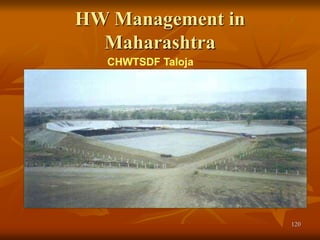
HW Management in
Maharashtra
CHWTSDF Taloja
121
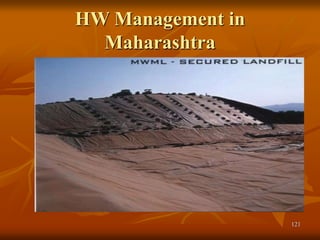
HW Management in
Maharashtra
122
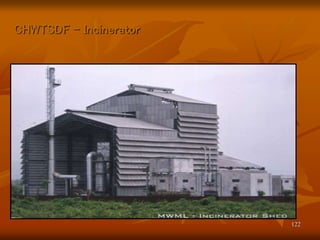
CHWTSDF - Incinerator
123
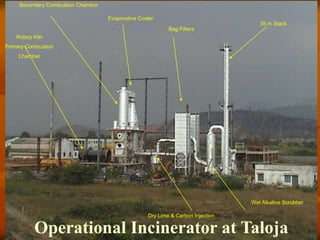
Dry Lime & Carbon Injection
Wet Alkaline Scrubber
Bag Filters
Evaporative Cooler
Secondary Combustion Chamber
Rotary Kiln
Primary Combustion
Chamber
35 m Stack
Operational Incinerator at Taloja
124
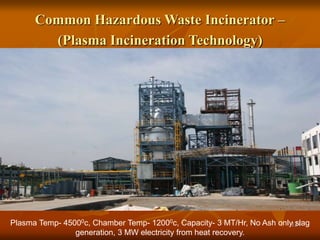
Common Hazardous Waste Incinerator –
(Plasma Incineration Technology)
Plasma Temp- 45000c, Chamber Temp- 12000c, Capacity- 3 MT/Hr, No Ash only slag
generation, 3 MW electricity from heat recovery.
125
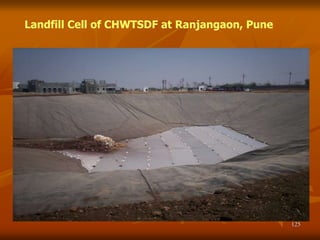
Landfill Cell of CHWTSDF at Ranjangaon, Pune
126
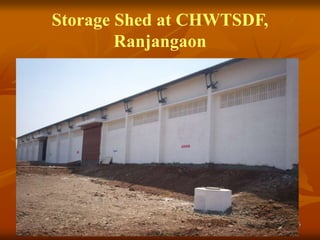
Storage Shed at CHWTSDF,
Ranjangaon
127
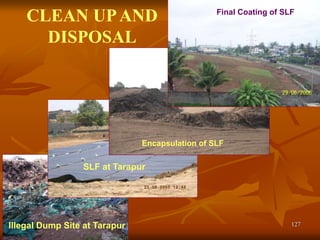
CLEAN UPAND
DISPOSAL
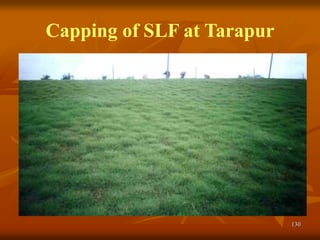
Illegal Dump Site at Tarapur
SLF at Tarapur
Encapsulation of SLF
Final Coating of SLF
128
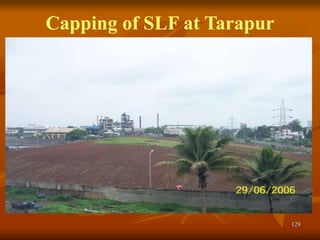
Capping of SLF at Tarapur
129
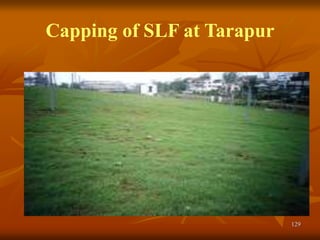
Capping of SLF at Tarapur
130
Capping of SLF at Tarapur
131
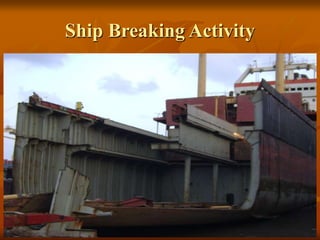
Ship Breaking Activity
132
Ship Breaking Activity
133
Ship Breaking Activity
134
Ship Breaking Activity
135
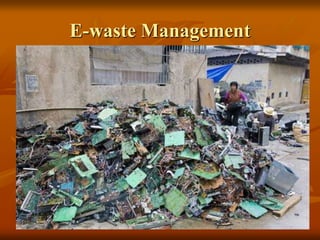
E-waste Management
136
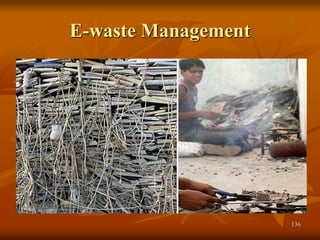
E-waste Management
137
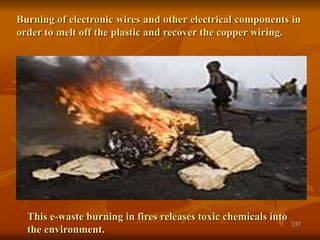
Burning of electronic wires and other electrical components in
order to melt off the plastic and recover the copper wiring.
This e-waste burning in fires releases toxic chemicals into
the environment.
138
E-waste Generation in Maharashtra.
 The e-waste includes electronics, electrical and
equipments (EEE).
 The e-wastes covered in hazardous waste.
 Total generation in India – 3,34,000 MT/Y.
 Authorised facility for re-processing – 7200
MT/Y.
 Recycling - 13000 T/Y.
 Rest through unknown sources.
139
MAHARASHTRA POLLUTION CONTROL BOARD
MUMBAI – 22.
140
Thanks !
Avoid Pollution. Protect Environment !

Environmental_Laws for knowledge Education.ppt

  • 1.
    1 ENVIRONMENTAL LAWS Air Act,Water Act & Hazardous Waste Rules Implemented by the Maharashtra Pollution Control Board. Website: mpcb.gov.in by Dr.Y.B.Sontakke Regional Officer(HQ) I/c Hazardous Substances Management Div.
  • 2.
    2 CHAPTER-I Preamble, Application &scope of the Water (Prevention & Control of Pollution) Act, 1974 and the Air (Prevention & Control of Pollution) Act, 1981. Part-1  Water (P&CP) Act,1974: (i) It provides for the prevention & control of water pollution ; (ii) Maintaining or restoring wholesomeness of the water; (iii) Establishment of Boards with powers & functions relating thereto.
  • 3.
    3 Contd.. Maharashtra Pollution ControlBoard has been established under the Water (P&CP) Act,1974 vide Act No. XXXI of 1981 by repealing the Maharashtra Prevention of Water Pollution Act, 1969 w. e. f. 01/06/1981 and by declaring the whole State of Maharashtra as Water Pollution, Prevention & Control Area, by making applicable provisions of the Act to whole State of Maharashtra. MPCB comprises of the Chairman, Members and a full time Member Secretary, who functions as a Chief Executive Officer in accordance with the Maharashtra Water / Air (P&CP) Rules,1983.
  • 4.
    4 Contd..  MPCB primarilyperforms functions to enforce provisions of the Water (P&CP) Act, 1974 and Air (P&CP) Act, 1981 as enumerated in Section 17of both the Acts and exercise such powers, which are given under both the Acts. It is bound by such directions issued to it by the Central Pollution Control Board or the State Govt. in writing in performance of its functions.
  • 5.
    5 Contd..  It takespolicy & important decisions in regard to the transactions of business at Board’s Meetings.  It may constitute various committees consisting wholly of its members or of other persons or of both for various purposes.  It may also take assistance or advise of any persons for various purposes in performing its functions.
  • 6.
    6 Contd..  Chairman, MemberSecretary can perform such powers and perform such duties as may be prescribed from time to time or delegated to them from time to time. They are assisted by the officers & employees appointed by it with the sanction of State Govt. for efficient performance or its functions. The powers & duties of the Member Secretary & Chairman are given in the Annexure-1 & 2 of the Maharashtra Water / Air (P&CP) Rules, 1983.  MPCB or its officers empowered to make surveys of any area & gauge and keep records of the flow or volume and other characteristics of a stream or well or such area and other steps including obtaining such
  • 7.
    7 Contd..  Hence, itsofficers empowered for entry & inspection for the purposes of performing any of the functions of the Board entrusted to them.  MPCB empowered to impose prohibition on use of stream or well or land for disposal of polluting matters or allowing emission of air pollutants in excess of the standards laid down by it.
  • 8.
    8 Contd.  MPCB regulatesexisting discharge of sewage / trade effluent, new or altered outlets of effluents /operation of industrial plants at source by grant of Consent to Establish and operate under both the Acts.  It may refuse/revoke/grant consent/s for establishment of any industry, operation or process or treatment & disposal system or extension or addition thereto etc.  It may carry out certain works under the Water (P&CP) Act,1974.
  • 9.
    9 Contd..  MPCB hasbeen empowered to make applications to Courts for restraining apprehended pollution or launch prosecutions against defaulters. It is also empowered to issue directions including closure, prohibition or regulation of industry, operation or process or stoppage or regulation of supply of electricity, water or any other service.  MPCB has its own fund from receipts of various fees, (Consent/Authorization, analysis charges, Water Cess etc.), further having borrowing powers also subject to general or special authority given by the State Govt.
  • 10.
    10 Contd.  Its’ officersempowered to collect samples as per provisions of the Water/Air Acts and get analysed through its Laboratories or Govt. Laboratories and based on results, to initiate further legal actions.  State of Maharashtra empowered to make various Rules as per provisions of the Water / Air Acts.
  • 11.
  • 12.
    12 Air (Prevention &Control of Pollution) Act, 1981 preamble Part-2 : Air (P&CP) Act,1981 : (i) It provides for the prevention, control or abatement of air pollution; (ii) Establishment of Boards with the powers & functions relating thereto.
  • 13.
    13 Contd.  Initially, Stateof Maharashtra declared BMRDA as ‘Air Pollution Control Area’ for making applicable provisions of the Air (P&CP) Act,1981 from the year 1983 vide Notification No.POA-1082/119/CR.32/UD- 18, dtd.2/5/1983  Thereafter, Maharashtra Industrial Development Corpn. at Tarapur & Roha have been declared as ‘Air Pollution Control Area’ from the year 1985 vide G.R.No.POA.1185/518/CR-53, dtd.14/8/1985.  Then, it was extended to Patalganga area from 1986 vide No.POA 1086/750/CR-169/Desk-I, dtd.11/11/1986.  It has been further extended to the rest of Maharashtra i.e. total Maharashtra from 1995 vide Notification No.ENV 1093/237/CR-43/D.I., dtd. 6/11/1995 by declaring it ‘Air Pollution Control Area’.
  • 14.
    14 Contd.  The provisionsunder Atomic Energy Act, 1962 in relation to radioactive air pollution provisions will have overriding effect in respect of provisions of the Air (P&CP) Act, 1981.  The standards for emission of air pollutants from automobiles will be ensured by the Authority Incharge of registration of motor vehicles under the Motor Vehicles Act, 1939. MPCB can give recommendations to the State Govt. and State Govt. shall in consultation with the Board give such instructions as are necessary to the RTO.
  • 15.
    15 CHAPTER-II Important powers &functions of the MPC Board under both the Water & Air Acts.  Section 17 of the Water (P&CP) Act, 1974 and the Air (P&CP) Act, 1981 To plan a comprehensive programme for the prevention, control & abatement of water & air pollution and execution thereof – Board may prepare such a programme in respect of implementation of various environmental laws, rules & notifications, which can be put up before the Board for necessary approval & execution.
  • 16.
    16 Contd.  To adviseState Govt. on matters related to prevention, control or abatement of pollution– Board may prepare draft policy decisions in respect of prohibition & restriction on the location of industries, processes & operations in different areas, such as River Policy Notification, Stone Crusher locations, Cattle stables, brick kilns, exemption of certain person from use of stream or well for disposal of polluting matters subject to certain conditions [Section 24 (3) of Water Act,1974].
  • 17.
    17 Contd..  To adviseState Govt. on any matter concerning the prevention, control or abatement of water/air pollution including suitability of any premises or location for carrying on any industry likely to cause water/air pollution.  To suggest alteration of water/air pollution, prevention & control area/s or declaration of new water / air pollution prevention area/s to the State Govt.  To collect & disseminate information relating to water / air pollution & prevention, control or abatement thereof.
  • 18.
    18 Contd..  To collaboratewith the Central Pollution Control Board in organising training of persons engaged in programme about pollution prevention or abatement of water / air pollution etc.  To lay down, modify or annul effluent standards for sewage & trade effluents and quality of receiving water (excluding inter-state stream) and to classify it / to lay down standards for emission of air pollutants into the atmosphere from industrial plants & automobiles or for discharge of air pollutants into atmosphere from any source in consultation with CPCB and taking into consideration standards laid down by it– since, Central Govt. laid down uniform standards under Environment (Protection) Rules, 1986, State Board can not relax it, but may specify more stringent standards for relevant parameters after recording reasons.
  • 19.
    19 Contd.  To evolveeconomical & reliable methods of treatment of sewage & trade effluent having regard to the peculiar local conditions including methods of utilization of sewage & trade effluent in agriculture / land.  To inspect sewage or trade effluents, works & plants / any control equipments, industrial plant or manufacturing process.  To determine regulations in respect of method of recruitment and the terms & conditions of service of officers & employees other than Member Secretary .
  • 20.
    20 Contd. To delegate toany officer of the Board such of Board’s powers & functions by general or special order and subject to such conditions & limitations as may be decided.  To give consultation to the State Govt. in respect of making of rules to carry out the purposes of Water & Air Acts.  To establish or recognize a Laboratory / Laboratories for the performance of the functions by the Board including analysis of samples.
  • 21.
    21 Contd.. To authorise officersto take samples of effluents, visit & inspection.  To carry out certain works in respect of any conditions imposed by the Board under Section 25/26 of the Water (P&CP) Act, 1974.  To take emergency measures in case of pollution of stream or well including removing polluting matter from stream or well or land and properly disposal thereof, taking remedial measures for mitigating pollution or issuing orders for restraining polluted discharge.
  • 22.
    22 Contd.. Making application tothe court for restraining apprehended pollution of water / air.  Giving Directions in exercise of powers u/s 33A /31A of the Water/Air Acts in performance of functions including directions of closure, prohibition or regulation of industry, operation or process, stoppage of or regulation of supply of electricity/water or any other service. To spend Board’s fund for performing its functions under the Acts.
  • 23.
    23 Contd..  To borrowmoney from any source by way of loan/s or issue of bonds / debentures / any other instruments for performance of all or any of its functions under the Act/s with the consent of State Govt.  To prepare a budget in respect of next financial year in the prescribed form and to prepare annual report giving full account of activities under the Acts during previous financial year and to forward to the State Govt. for laying before State Legislation and to keep proper account and audit.  To initiate legal actions as per provisions of the Act/s.
  • 24.
    24 (I) Delegation ofpowers by the MPC Board to its officers & employees  MPCB has delegated powers under the provisions of the Water /Air (P&CP) Acts by general resolutions to exercise its powers & functions under the Act, including visit & inspection, collection of samples, filing of prosecution, grant of consent & issuance of directions etc. as under (a) Concerned Regional Officer/ Sub-Regional Officer authorized to file complaints/applications under the provisions of the Water / Air Acts before appropriate court of law having jurisdiction, as decided in the 122nd Meeting of the Board held on 19/12/1998 and as per office order No.E-36 of 2000, dtd.29/3/2000.
  • 25.
    25 Contd. (b) Regional Officers/Sub-RegionalOfficers are authorized to affirm affidavits in their respective jurisdiction and in important matters of policy decision, senior officers in the Head Quarter are authorized to file Affidavits before High Court and Supreme Court matters and other Forums. (c) Member Secretary and / or Chairman of the Board are authorized by the Board to issue any directions under Section 33A / 31A of the Water / Air Acts respectively. Besides that Regional Officers of the Board are authorized to issue directions under Section 33A / 31A of the Water / Air Acts respectively in their respective jurisdiction by following due procedure and principles of natural justice, but conditional directions to restart after ensuring concrete steps / compliance can be issued by the Member Secretary / Chairman only or with their approval
  • 26.
    26 Contd. (d) Central Govt.has authorized the Chairman or Member Secretary or Regional Officers of the State Pollution Control Board to file prosecution u/s 19 r.w. section 15 of the (Environment ) Act, 1986. (e) MPCB has authorized Member Secretary, Water Pollution Abatement Engineer, Air Pollution Abatement Engineer, Principal Scientific Officer, Regional Officers, Sub-Regional Officers, Sr. Scientific Officers, Scientific Officers, Jr.Scientific Officers and Field Officers to visit & inspect the industry, operation or process, to collect samples of air, water and environment.
  • 27.
    27 (II) Delegation ofPowers in respect of Consent Management
  • 28.
    28 (III) Delegation ofpowers in respect of issuance of directions under Water / Air Acts.  Member Secretary and Chairman of the Board authorised to issue directions u/s 33A of the Water (P&CP) Act, 1974 and u/s 31A of the Air (P&CP) Act,1981 for whole State of Maharashtra, which includes directions of closure, prohibition or regulation of industry, operation or process as well as disconnection of electricity/water supply of any industry or regulation of any other service to the industry.  Regional Officers are empowered to issue directions under the above provisions within their jurisdiction.
  • 29.
    29 CHAPTER-III Important Provisions frequently enforcedby the MPCB Water (Prevention & Control of Pollution) Act, 1974 & Air (Prevention & Control of Pollution) Act, 1981.
  • 30.
    30 (A) Visit, Inspection& obtaining information The Officers of the Board are empowered to visit the industries and processes for implementing the laws. In practice, Field Officers, Sub-Regional Officers and Regional Officers carry out inspections and visits at regular intervals. All officers of the Maharashtra Pollution Control Board are authorised by the Board for the purposes of visit & inspection of industries, operations or processes.
  • 31.
    31 (B) Collection ofsamples u/s 21 of the Water (P&CP) Act, 1974 and/or u/s 26 of the Air (P&CP) Act, 1981 For initiating legal actions including filing of prosecution in respect of non-compliance of consent conditions and causing pollution, the samples u/s 21 and/or u/s 26 of the said Acts collected to show that various standards prescribed by the Board are meeting or not? Powers are given to Field Officer, Sub-Regional Officers and Regional Officers of the Board. However, these powers can further be delegated to the Member Secretary, Water Pollution Abatement Engineer, Air Pollution Abatement Engineer, PSO, SSOs & JSOs in order to do extensive sampling.
  • 32.
    32 Three situations arisefor collection of samples after serving the notice on the person in charge of and having control over the plant, vessel or occupation of the place. I)) In case, the occupier or his agent request division of sample in to two parts, then to divide sample in to two parts in his presence, send one container to the Laboratory established or recognized by the Board and send second set of sample at his request to the Laboratory established or recognized by the State Government II) Where occupier or his agent will fully absents, then only one set of sample will be sent for analysis to the laboratory established or recognized by the Board. by communicating his will full absence, and III) Where occupier or his agent doesn't make a request for dividing sample in to two parts, then sample taken will be placed in one container and shall be sent to be Laboratory established or recognized by the State Board The Laboratories will send the report on analysis in triplicate to the Board, Out of that, one report will be sent to the occupier or his agent by obtaining his acknowledgement, second report will be preserved for production before court and third will be kept in Boards records.
  • 33.
    33 (C) Refusal/withdrawal ofconsent u/s 27 of the Water (P&CP) Act, 1974 The Board may refuse consent in case of non-compliance of conditions prescribed in the consent to establish / consent to operate or in case, the project proponent is not complying with other statutory provisions such as EIA Notification, River Policy Notification and other notifications issued by the Govt. from time to time. Consent can also be revoked in case of non-compliance of consent conditions and other statutory provision. While issuance of refusal / revocation order, reasonable opportunities of hearing either by way of show cause notice or personal hearing has to be extended. Powers of revocation/review are given to the higher officer/authority in the rank above the officer, who has been empowered to grant consent e.g. in case, SRO has to revoke consent for ‘Green’ Category industry, the same will have to be referred to the Regional Officer for revocation. Likewise, if Regional Officer has to revoke consent to ‘Orange’ Category industry, for which, he is empowered to grant consent, it will have to be submitted to the HQ for revocation/review.
  • 34.
    34 (D) Powers togrant consent (u/s 25/26 of Water Act and 21 of Air Act ▪ Powers are given at various levels from SRO upto Consent Appraisal Committee (CAC) as under SRO - GREEN, Member Secretary – Red Up to 25.00 Cr RO – ORANGE Board / CAC – Above 15.00 Cr ▪ In fact, CAC is a recommendory body and can not be said to be delegated with powers to grant consent. It can only scrutinize application for consent above certain investment and certain categorises and give its recommendations. Member Secretary and Chairman of the Board are empowered to take decision as to whether recommendations are to be accepted or not ? In case of doubt, the matter can be referred to the Board for conscious decision because the Board is the final Authority in respect of any matter under the Act.
  • 35.
    35 (E) Review ofrefusal / revocation of Consent Order.  Water Act, 1974 in Section 27 provides for review of conditions imposed u/s 25/26 of the said Act or refusal order or consent order. No such review provision is separately made under Air Act, 1981,  However, Section 21(6) of Air Act, 1981 provides that if due to technological improvement or otherwise, the State Board opines that all or any condition requires variation, it may do so after giving reasonable opportunity to concern person.
  • 36.
    36 (F) Appeals u/s28 of Water Act / u/s 31 of Air Act  Any aggrieved person against the order passed in respect of grant / refusal of consent may prefer an appeal to the Appellate Authority constituted by the State Govt. [consisting of Principal Secretary (Environment), Hydraulic Engineer, MCGM and Suptd. Engineer, MJP].  Appeal is to be preferred with necessary fees, within 30 days from the date on which, the order is communicated. However, if Appellate Authority is satisfied that the Appellant was prevented by sufficient cause from filing the Appeal in time, the appeal can be entertained within 45 days of time.  Appellate Authority determines unreasonableness of any condition or any variation of a condition.
  • 37.
    37 (G) Revision  StateGovt. either of its own motion or on an application made to it, may call the records of any case, where an order has been made by the State Board u/s 25/26/27 of the Water Act, 1974 to satisfy itself as to the legality or propriety of such a order, after giving State Board and the person who may be affected by such order, a reasonable opportunity of hearing, but, during pendency of appeal or where appeal remedy is available but not exhausted, the revision can be not entertained.  No separate provision for Revision available under Air Act, 1981.
  • 38.
    38 CHAPTER-IV (A) Power ofState Board to carry out certain works under Water Act, 1974  Section 30 of Water Act,1974 empowers State Board to execute itself or cause to be executed any work in connection with conditions imposed on any person u/s 25/26 of the Water Act,1974, by giving 30 days notice first and in case of failure by executing the work. Expenses incurred by the Board for such execution together with interest may be recovered by the Board as an arrears of land revenue or of public demand.
  • 39.
    39 Contd..  Central Govt.identified a list of works that can be undertaken by the State Board out of Cess proceeds and therefore, in case of emergent situation of pollution / sensitive issues, the Board can execute works in respect of conditions imposed under Consent for water pollution prevention.  No provision for executing such work available under Air Act, 1981.
  • 40.
    40 (B) Power toobtain information under Water & Air Acts.  Section 20 of Water Act, 1974 empowers State Board or its officer to make surveys of any area, gauge, record or flow of volume and other characteristics of stream or well in such area including recording of rainfall as well as information regarding construction or operation of any industry, process or disposal system and to obtain any such information by giving appropriate directions to persons in possession thereof.
  • 41.
    41 Contd…  Water &Air Acts provide for furnishing of information by a person incharge of industry, operation or process in respect of any accident or other unforeseen act or event, thereby discharge of poisonous, noxious or polluting matters or apprehended discharge into stream or well or sewer or on land or where emission occurs or is apprehended in excess of standards laid down by the Board, for taking remedial measures. Expenses incurred by the State Board, Authority or Agency in respect of remedial measures can be recovered together with interest from the concerned persons.
  • 42.
    42 (c) Powers togive instructions for ensuring standards for emission from automobiles by giving necessary consultation to the State Govt.  State Govt. empowered to give such instructions to the RTO in consultation with the MPC Board under the provisions of the Air (P&CP) Act, 1981 for ensuring standards for emission of air pollutants from the automobiles, which shall be bound to comply with such instructions.
  • 43.
    43 CHAPTER- V (I) EmergencyMeasures under Water / Air Acts.  Section 33 of Water Act,1974 and Section 22A of the Air Act,1981 provide for making an application to the court for restraining persons from causing water pollution/ apprehended pollution/air pollution, where, after receipt of application, JMFC/ Metropolitan Magistrate may make such orders as may necessary in the circumstances including directions to the concerned person to desist from taking action likely to cause pollution or to remove such polluting matter or causing such emission etc.
  • 44.
    44 Contd..  Earlier, MPCBhad filed a number of such applications in respect of severe pollution or apprehended pollution and used such a tool very effectively, however, nowadays, because of frequent recourse to issuance of directions u/s 33A / 31A of the Water / Air Acts, this is not being effectively used, as it is time consuming.
  • 45.
    45 Contd. Powers under Section32 of the Water (P&CP) Act, 1974 in respect of issuance of orders for removing polluting matters, remedying or mitigating any pollution of water or prohibiting from discharging any poisonous, noxious or polluting matter.  Frequent accident or other unforeseen act occurred / apprehended, but MPCB has not so far utilised this particular power effectively because there is no provision to execute these orders.  Water Act provides for taking emergency measures in case of pollution of stream or well, by way of removing that matter from the stream or well or land and disposing it in an appropriate manner, taking remedial measures and issuing appropriate orders restraining/prohibiting the concerned persons from discharging such polluted matters. Earlier a number of such emergency measures taken by the Board, when the provision for issuance of directions u/s 33A of the Water Act, 1974 was not available. But now MPCB is not so far using this provision. It becomes necessary to use this remedy prior to issuance of directions or in emergent cases.
  • 46.
    46 CHAPTER-VI Command and Controlthrough filing of prosecutions / applications before Court of Law under Water / Air Acts.  MPCB is empowered to file applications u/s 33 / 22A of the Water / Air Acts respectively in respect of apprehended or severe pollution as stated above. In case of violation of the orders issued by the courts u/s 33 / 22A of the above Acts, the remedy available is prosecution under sub-Section 2 of Section 41 of the Water Act, 1974 and corresponding section 39 of the Air Act, 1981. This remedy had been used in continuous offenses, by the MPCB.
  • 47.
    47 Contd..  Prosecutions u/s43 &/or 44 read with Section 24, 25/26 and 27 of the Water Act, 1974 and u/s 37 & 39 r.w.Section 21 or 22 or Section 31A of the Air Act, 1981 – After 1984, MPCB used, command & control approach by filing prosecutions under above sections till 1995. However, prosecutions remain pending years together and in between period pollution contine, therefore, the Board in 1995 decided to take recourse to powers to issue directions. Powers are delegated to Member Secretary, Chairman & Regional Officers to issue directions, but not given to senior officers of the Board like WPAE, APAE, PSO & Sr.Law Officers. In CPCB, powers are given to all the senior officers so as to use consciously, reasonably and effectively.
  • 48.
    48 Contd..  These arethe frequently used provisions for initiating actions. However, the provisions are not used as per requirements taking into consideration the degree of non-compliances, e..g. where an action can be initiated by way of prohibitory order restraining apprehended pollution either by officers of the Board or through court, and it can be effective in a given situation, it should be used instead of direct recourse to issuance of directions u/s 33A/31A of Water / Air Acts. Similarly, in case of non-compliance of directions, remedy available is prosecution only.
  • 49.
    49 Contd. Before launching prosecutionagainst the defaulters, the concerned Officers (Sub-Regional Officers & Regional Officers) investigate complaints, obtain information about pollution prevention of particular activities, visit & inspect any place to verify the compliance of environmental laws, collect joint vigilance samples and law evidence samples under the provisions of the Environmental Laws (Water, Air & Environment Acts). Accordingly, build-up case in respect of non-compliances and submit prosecution proposal for necessary approval of the higher authorities. The prosecution proposals are scrutinized by the Technical and Legal Deptts. at Head Quarter and being sent for necessary approval of the Member Secretary / Chairman. After approval of prosecution proposal, the complaints are being filed before appropriate court of law, having local jurisdiction with the help of panel Advocates of the Board by the respective Regional Officer / Sub-Regional Officer.
  • 50.
    50 (II) Powers togive directions under Section 33A / 31A of the Water / Air Acts.  After passing of Environment (Protection) Act,1986, the Parliament has amended Air & Water Acts, incorporating the powers to give directions in the amendment in the year 1987 & 1988 respectively. Section 33A / 31A of Water / Air Acts provide for issuance of any directions in writing to any person, officer or authority subject to the provisions of Water/Air Acts and directions given by the Central Govt., if any, which includes directions of closure, prohibition or regulation of any industry, operation or process or stoppage or regulation of supply of electricity, water or any other service.
  • 51.
    51 Contd..  MPCB hastaken review of all its legal actions in the year, 1995. It was observed that at that particular time, command & control by way of filing of prosecutions, applications before the various courts of law was being exercised. In spite of amendments incorporating powers to give directions under Air / Water Acts, the same were being exercised sparingly.  The cases filed before the Court of Law remained pending years together. The penal provisions remained as threats for a while and fade away after some years. The pollution in the intervening period till disposal of cases continue.
  • 52.
    52 Contd..  After duedeliberations, MPCB has taken a conscious decision to take resort/recourse to initiate actions u/s 33A /31A of the Water / Air Acts in 1995 An extensive surveys undertaken to identify initially most polluting industries and then to identify medium and small scale industries, which had not complied with the MPCB norms. Thereafter, proposed directions issued, pointing out non-compliances and after receipt of objections to the proposed directions / replies, opportunities extended to present their case/s.
  • 53.
    53 Contd..  During personalhearings, legal and technical officers and the representatives of defaulting industries appeared before the Member Secretary/ Chairman and based on decisions taken in the personal hearing, interim directions finalized and issued. Some time was given to comply with the directions and in appropriate cases, a system of bank guarantee or / and Affidavit-Undertaking introduced to ensure compliance of directions in a time bound manner.
  • 54.
    54 Contd.  A reviewwas taken in respect of compliance of directions and based on non-compliance reports from the Board officials, the directions of closure issued after giving reasonable opportunities. Directions were also issued for upgradation of existing pollution control devices, adopting cleaner technologies and prescribing more stringent standards / conditions to decrease pollution load by restraining discharges into the stream or river and encouraging disposal on land for irrigation / gardening purposes including recirculation of waste water in the process itself. The result was that during 1995 to 2000, almost all large & medium scale industries provided necessary primary & secondary treatment facilities and more than Rs.150 crores investment was made on pollution control measures in the State of Maharashtra.
  • 55.
    55 Contd…  After 2000,MPCB concentrated on the non- compliances of small scale industries and accordingly encouraged the installation and commissioning of CETPs. The SSI units not becoming members of CETPs were either directed to provide full-fledge primary & secondary treatment facilities or to close down manufacturing activities till membership of CETPs obtained.
  • 56.
    56 Contd.  After 2003,MPCB had taken review of all CETPs and issued directions to not only CETP authorities, but also to individual members to upgrade it and operate it efficiently, so as to contain the pollution.  Thus issuance of directions played a very important role in securing compliance.
  • 57.
    57 CHAPTER-VII Water (P&CP) CessAct,1977  MPCB is collecting Cess from every person carrying on any industry and every local authority on the basis of water consumed by such person or local authority for the purposes specified in Schedule-II and rates specified by the Central Govt., industries (does not include any Hydel Power Unit) consuming water more than 10 kilo liters per day, provided in case of industries generating hazardous waste, all industries are covered for the levy of cess. In case of compliance of Section 25 of Water Act, Environment Standards and consumption quantity, 25% rebate granted. Two types of rates specified by the Central Govt. as under :
  • 58.
    58 Sr. No. Purpose for whichWater consumed Normal Rate in case of Compliance of provisions of Water Act,1974, Environmental Standards and consumption of water in excess of maximum quantity prescribed Penal Rate for not complying with provisions of Section 25 of the Water Act,1974, environmental standards under E(P) Act,1986 or consumption of water in excess of prescribed quantity 1,. Industrial Cooling, spraying in mine pits or boiler feeds 5 Paise per kilo liter 10 paise per kilo liter 2. Domestic purpose 2 Paise per kilo liter . 3 Paise per kilo ltr. 3. Processing whereby water gets polluted and pollutants easily biodegradable or non-toxic or both 10 paise per kilo liter. 20 paise per kilo ltr. 4. Processing whereby water gets polluted and not easily biodegradable or toxic or both 15 paise per kilo liter 30 paise per kilo liter.
  • 59.
    59 Contd.  Affixing ofmeters for measuring & recording quantity of water consumed prescribed in the rules. However, in case of huge quantity of consumption of water, the water quantity measured by v-notch.  Power of entry given to the Officer or Authority of State Govt. for carrying out the purposes of the Act including testing of correctness of the meters
  • 60.
    60 (i) Assessing Authority& Cess Proceeds  Member Secretary, MPCB is notified as the Assessing Authority. State Govt. may specify more officers & authorities for the purposes of collection of cess. Member Secretary issues the assessment orders on the basis of returns furnished by the industries or local bodies after making necessary inquiries.  The proceeds of the cess credited to the Consolidated Funds of India. Central Govt. may pay to the Central Board or State Board from time to time as per appropriation made by law in this behalf by Parliament. State Board to utilise it under the Water (P&CP) Act,1974.CPCB laid down guidelines for utilisation of cess funds.
  • 61.
    61 (ii) Recovery ofCess  Failure to pay cess within specified date in the order of assessment, makes liable to pay interest for the period from which the payment is due till such amount is actually paid.  If cess is not paid within specified date in the order, it will be deemed to be an arrears and the authority prescribed may impose a penalty not exceeding the amount of cess in arrears on defaulter, however, the recovery of amount due under the Act is entrusted with the Central Govt. and not MPCB. Before imposing penalty for non-payment of cess not exceeding the amount of cess in arrears, a reasonable opportunity is to be given to the assesee.  Cess including any interest or penalty can be recovered by the Central Govt. in the same manner as an arrears of land revenue.
  • 62.
    62 (iii) Provisions regardingAppeals  Any aggrieved person or local Authority aggrieved by the order of assessment or imposition of penalty may prefer an appeal with such fees as may be prescribed before the Appellate Authority constituted by the Chairman of the Board within a period of 30 days from the date of communication of order, provided appeal can be allowed after 30 days, but before 45 days, if Chairman of Appellate Authority satisfied that there was good & sufficient reason for delay in making appeal. The Appellate Authority will give the appellant an opportunity of being heard in the matter and will dispose off appeal expeditiously. Provision of appeal is exercised frequently by the industries / local bodies.  Chairman of the Maharashtra Pollution Control Board is authorised to constitute the Appellate Authority.
  • 63.
    63 PRESENTATION ON THE HAZARDOUSWASTES (MANAGEMENT, HANDLING &TRANSBOUNDRY MOVEMENT) RULES, 2008 By Dr. Y. B. Sontakke. Regional Officer (HQ), I/c HSMD Maharashtra Pollution Control Board June 19,2009
  • 64.
    64 INTRODUCTION Bhopal Incident in1984 Environment Protection Act, 1986 Hazardous Wastes ( Management & Handling ) Rules-1989 Effective From Date of Publication - 28.07.1989 Applicable: Whole India & Up to 5 Km Sea Ward side Hazardous Wastes not covered  Radio-active Wastes, Bio-medical Wastes, Municipal Solid Wastes, and Lead Acid Batteries Amendment - 05.02.1990, 31.03.1992, 03.06.1996, 06.01.2000 and 21.05.2003
  • 65.
    65 “Hazardous waste” means anywaste which by reason of any of its physical, chemical, reactive, toxic, flammable, explosive or corrosive characteristics causes danger or is likely to cause danger to health or environment, whether alone or when in contact with other wastes or substances and shall include wastes included in Schedule – I, II & III (Part A & B) of the said rules.
  • 66.
    66 •The Central Govt.has issued notification in exercise of the powers conferred by Sections 6, 8, & 25 of the Environment (Protection) Act, 1986, namely the Hazardous Wastes (Management & Handling) Rules, 1989 on 28.7.1989 which is subsequently amended five times on 5.2.1990, 31.3.1992, 3.9.1996, 6.1.2000 & 21.5.2003. Supersession of the Hazardous Wastes (Management and Handling) Rules, 1989 dated 28.09.2008 NOTIFICATION
  • 67.
    67 HAZARDOUS WASTES SITE “Hazardous wastes site”means a place for collection, reception, treatment, storage and disposal of hazardous wastes which has been duly approved by the competent authority.
  • 68.
    68 High Powered Committee WritPetition No.657 of 1995 Research foundation for Science, Technology & Natural Resources Policy, Delhi V/s Union of India & Others  Hon’ble Supreme Courts Order: 13th Oct. 97  GoI Constituted HPC on 17th Oct. 97  Under the Chairmanship of: Prof. M.G.K. Menon and 10 other members.
  • 69.
    69 Supreme Court Directives Court order, dated 14.10.2003: compliance of direction in a time bound manner.  Supreme Court Monitoring Committee for compliance of the directives.  issued. SCMC chaired by Dr. G. Thyagarajan. Consists of 8 Members.  The SCMC to submit quarterly report to the Court on compliance.  SPCBs/ PCCs to comply with directions 0f MoEF  Produce comprehensive report on illegal HWs dump sites  Draw up a plan with financial estimates to take measures required to stop environmental damage
  • 70.
    70 Applicability of therules These rules shall apply to the handling of hazardous wastes as specified in the Schedules and shall not apply to the wastes covered under the provisions of :  Water (P & CP) Act, 1974  Air (P & CP) Act, 1981  Merchant Shipping Act, 1958  Atomic Energy Act, 1962  Biomedical Wastes (M&H) Rules, 1998  Municipal Solid Wastes (M&H) Rules, 2000  Batteries (M&H) rules, 2001
  • 71.
    71 Salient Features ofthe Hazardous Wastes (Management & Handling) Rules,1989  Rules defined “Hazardous wastes” and their application for the first time  Responsibility of the occupier for handling of wastes  Grant of authorisation for handling H.W  Packaging, labelling and Transport of Hazardous wastes  Inventory of the Disposal sites  Submission of records and returns  Accident Reporting  Import of Hazardous wastes  Appeal
  • 72.
    72 Contd…  Rules identified18 Categories of hazardous wastes  The categories included types of the waste  The Rules also prescribed the Regulatory quantities of the wastes  The HW generators who were generating the stipulated regulatory quantities of the wastes were required to obtain the Authorization from SPCB  The generators of HWs could make an appeal against the suspension, cancellation or refusal of Authorization before the State Government
  • 73.
    73 Contd…  The responsibilityof identification of the disposal sites and compilation and publication of the inventory of the sites vested with State Govt. or a person authorised by State Govt.  The Environment Impact Study before identifying the site was made mandatory  Accidents reporting at the disposal site or during transportation of HW became the responsibility of the occupier or operator of facility  Disposal and dumping of HW from foreign countries banned under the rules  Import of H.W was allowed on case to case basis and on merits only if it was to be used for processing or re-use as raw material
  • 74.
    74 Contd…  Format prescribedfor maintaining the records of HWs at the facility  Formats for filing the Returns , Transportation, Accident Reporting and Import of HWs laid down in the Rules.
  • 75.
    75 Salient Features ofthe Hazardous Wastes (Management & Handling) Rules,1989 As amended, 2000  Definition of HWS further modified  HWs included (a) Waste Substances which are generated in the process indicated in column-2 of Schedule-1 and consists of wholly or partly of the waste streams referred to in column - 3 of the same schedule; (b) Waste substances which consists wholly or partly of substances indicated in Schedule-2, unless the concentration of the substances is less than the limit indicated in the same schedule: and
  • 76.
    76 Contd… (c ) Wastesubstances indicated in Part-A, List 'A' and 'B' of Schedule -3 applicable only to rule 12, 13 and 14 unless they do not possess any of the hazardous characteristics in Part-B of the same schedule  The Rules identified 44 processes that generate different type of hazardous waste  Sub Cat. – 128  Schedule 2 Class – A Sub class – 20 (50 mg/kg) Class – B Sub class – 31, (5000 mg/kg Class – C Sub class – 17 (20000 mg/kg) Class – D Sub class – 09 (50000 mg/kg) Class – E Sub class – 02 (Based on inflammability)
  • 77.
    77 Contd…  The occupierand the operator of a facility both are required to take all steps to ensure that the wastes listed in schedules -1, 2 and 3 are properly handled, and disposed of without any adverse effects to the environment.  Besides occupier, the operator of a facility is also now responsible for proper collection, reception, treatment and disposal of H.W listed in Schedule 1, 2 & 3.
  • 78.
    78 Contd…  Treatment ofHWs prescribed for the first time in the Rules and it included technique or process, designed to change the physical, chemical or biological characteristics or composition of any hazardous waste so as to render such wastes harmless  All hazardous waste containers to be provided with a general label as specified in Form 8.  Concept of Manifests for transportation of HWs introduced for the first time to keep a thorough check on the transportation, storage treatment and final disposal of the HWs
  • 79.
    79 Contd…  No transporterto accept hazardous wastes from an occupier for disposal unless it is accompanied by five copies of the manifest (Form 9) as per the colour codes.  The transporter shall give a copy of the manifest signed and dated to the occupier and retain the remaining four copies to be used as prescribed in sub- rule (5).
  • 80.
    80 Contd…  Disposal Sites The site identification and establishment responsibility fixed on the occupier or any operator of a facility  The concept of establishing common hazardous wastes disposal facility in the state is recognized  Preliminary impact assessment studies to identify possible sites for disposal facility made necessary  Import of hazardous wastes from any country to India was already banned. The export of hazardous wastes from India to any country for dumping or disposal also banned under revised Rules
  • 81.
    81 Contd…  The Exportof Hazardous Wastes for recycling and reuse permitted only if it was used as a raw material  The Ministry of Environment and Forests appointed as Nodal Agency to deal with transboundary movement issues of hazardous wastes  The export or import of hazardous waste from or to India to be in accordance with the articles of the Basel Convention to which the Central Government is a signatory."
  • 82.
    82 Contd…  Illegal Traffic The permission of Central Govt. essential for the movement of hazardous wastes from or to the country  The HW traffic considered illegal if it is without the conformity in the rules.  Transitional provisions  Compliance of the revised Rules necessary by the occupier and authorities  State Pollution Control Boards and Pollution Control Committees empowered to oversee the compliance.“  Appeal  Detailed procedure notified on the submission and dealing of the appeals.
  • 83.
    83 Salient Features ofthe Hazardous Wastes (Management & Handling) Rules, 1989 As amended, 2003  The Rules further defined the hazardous wastes in 2003 which included physical, chemical, reactive, toxic, flammable, explosive or corrosive characteristics of the materials that is dangerous to health or environment,  The Rules are now applicable to the wastes included in:  Column (3) of Schedule-1( irrespective of Conc. Limits Sch-2 except as mention)  Schedule-2 if their concentration is equal to or more than the limit indicated
  • 84.
    84 Contd…  Lists ‘A’and ‘B’ of Schedule-3 (Part-A) applicable only in case (s) of import or export of hazardous wastes in accordance with the rules and if they possess any of the hazardous characteristics listed in Part-B of Schedule 3  Bio-medical wastes covered under the Bio-Medical Wastes (Management and Handling) Rules, 1998  Wastes covered under the Municipal Solid Wastes (Management and Handling) Rules, 2000  The lead acid batteries covered under the Batteries (Management and Handling) Rules, 2001
  • 85.
    85 Contd…  Registered re-refineror recycler defined  Registration with MoEF/ CPCB necessary  The used oil / waste oil also further defined in detail  Technology and standards for re-refining or recycling specified  Re-refiners recyclers to switch over to EST within six months  The period of switching over to EST further extended up to Dec. 2004  The technologies for waste oil/ used oil include (a) Vacuum distillation with clay treatment; (b) Vacuum distillation with hydrotreating; (c) Thin film evaporation process; or (d) Any other technology approved by the MoEF.
  • 86.
    86 Contd…  Schedule 4 Dutiesand Responsibilities of various authorities List of Non-Ferrous metal wastes applicable for registration of recyclers  Schedule 5 Specifications for Used oil suitable for Re-refining  Schedule 6 Specifications for Waste oil suitable for Re-refining  Schedule 7 Duties and Responsibilities of various authorities  Schedule 8 Hazardous wastes prohibited for import and export
  • 87.
    87 HW (M&H) Rules,1989 (2000) (2003)  Form 1 – Application Form for Authorization  Form 2 – Authorization Format  Form 3 – Record of HW at facility  Form 4 – Submission of returns regarding disposal of HW  Form 5 – Accident reporting  Form 6 – Import of HW  Form 7 – Trans boundary movement of HW  Form 8 – Marking of HW containers  Form 9 – Manifest  Form 10 – TREM card  Form 11 – Application Form for Registration under EST  Form 12 – Submission of returns by Recyclers/Re-refiner  Form 13 – Submission of returns by Auction/sale of Non-ferrous Metal Waste/used oil/waste oil
  • 88.
    88 Contd…  CPCB toprepare a full scale rehabilitation plan based on inputs from SPCBs  Ship- breaking activities to be in conformity with the Apex Court directives  Inventory of the HWs & its conversion into National Toxic Inventory  Institutional Reforms MoEF/CPCB/SPCBs/PCCs
  • 89.
    89 Issues of SeriousConcerns  Used oil / Waste oil  CETP Sludge  Illegal dumps of HWs  Backyard smelting of Lead Acid Batteries  Landing of Explosive Cargo  Import of Waste paper- Garbage  E-Waste Management
  • 90.
    90 Hazardous waste reduction Source reduction:  Eliminate hazardous waste within process.  Cleaner production technologies  Recycling:  Reducing volume/toxicity by reuse of recovered material from waste.  Waste minimization methods  Treatment:  To modify physical and/or chemical properties of waste.  Choice depends on:  Availability & suitability of treatment & disposal facility.  Discharge standards.  Cost consideration.
  • 91.
    91 Waste TSD Options Direct disposal into landfill  Treatment/stabilization of wastes and then disposal into landfill  Direct incineration  Pre-treatment and incineration  Pre-treatment, incineration and disposal of incineration ash in landfill  Waste processed for fuel/industrial bye products for recycle  Others  Hazardous Waste could be handled in different ways as follows:
  • 92.
    92  Closure directionsto un-authorized & non- complying units  Preparation of HW Inventory & submit to SCMC  Inventory of waste dump sites and rehabilitation plan  Time frame implementation of rehabilitation plan  Directions to ship breaking SUPREME COURT ORDER DATED 14.10.2003
  • 93.
    93 Region wise Break-upof HW based on Disposal Method Sr.No. Region Quantity of HW (MT/Annum) Total SLF RCL INC 1 Navi Mumbai 59060.86 23635.72 44,208.65 1,26,905.23 2 Pune 47652.82 28770.12 15835.33 92,258.27 3 Nagpur 62,245.44 48,266.30 12,492.88 1,23,004.62 4 Thane 123,114.99 83,141.57 10,086.97 2,16,343.53 5 Aurangabad 27,971.56 16,816.76 3,848.15 48,636.47 6 Raigad 71,186.59 69,351.96 25,932.22 1,66,470.77 7 Kalyan 66,411.44 179,588.66 6,689.86 2,52,689.76 8 Nashik 20,207.47 24,364.76 7,492.60 5,20,64.83 9 Amravati 7,340..49 690.82 556.84 8,588.15 10 Kolhapur 24,276.56 28,454.80 12,562.43 65,293.73 11 Mumbai 39,086.43 292,585.62 11,457.43 3,43,129.48 12 Non-Industrial Sources 19581.0 51,773.0 1627.8 72,981.8 TOTAL 5,68,135.65 8,47,440 1,52,791.17 15,68,366.82 SLF : Secured Landfill, RCL : Recyclable, INC : Incinerable
  • 94.
    94 HAZARDOUS WASTE SCENARIOIN MAHARASHTRA Inc ine r a ble Wa st e 9 .7 3 % La ndf illa ble Wa st e 3 6 .2 % Recyclable W ast e 54 .0 7% Sr. No. Type of Waste Qty (Million Tons / year) 1. Landfillable Waste 0. 56 2. Recyclable Waste 0.84 3. Incinerable Waste 0.154 Total 1.56 No. of Industries generating HW 4962
  • 95.
    95 COMPLIANCE OF SUPREMECOURT ORDER DATED 14.10.2003  Meeting with Industry Associations  Closure of > 800 industrial units in Jan,2004  Removal and disposal of illegal HW dumps  Directions to MIDC and industries  Levy of fines from Industries  MIDC Area : Tarapur MIDC  Outside MIDC : NRSA  CETP  Collective action  HW Inventory on web site
  • 96.
    96  Mass awareness Guidelines of HWM  BMW Management  Development of CBMW TSDF  PMC to MCGM  Outsourcing for HW returns from Industries  Form 4, 12 & 13  Development of software  Tracking of HW  Updating the HW inventory COMPLIANCE OF SUPREME COURT ORDER DATED 14.10.2003
  • 97.
    97 Major Achievements  Appreciationfrom SCMC  Inventorisation of hazardous waste work has been completed by MPCB and report submitted to MoEF, SCMC, CPCB  Identification of illegal hazardous waste dump site through satellite imaginary in Thane District has been completed by NRSA  Disposal of 133 Waste containers has been lifted to MWML from JNPT  Hazardous waste lying at Mumbai Port Trust has been lifted to MWML  Hazardous waste lying at Air cargo has been shifted to MWML
  • 98.
    98 Contd…  HW Transporterin Maharashtra : 60  Waste oil/ used oil recycling units: 27  Non ferrous HW Recycler: 36  Notices issued for levy of fine: 23.  Remediation cost recovered : Rs.3.75 Crore  Levy of fine received by MPCB: Rs.36, 00,000  Formation of HWM Cell by out sourcing for  inventory preparation and up gradation  Tracking of hazardous wastes
  • 99.
    99 Objectives:  To allowregular updating of the Inventory.  To provide on-line access to the Inventory through various search options.  To manage the process of Authorisation Amendments more efficiently. Features:  A streamlined interface supported by an efficient database  Advanced Criteria-based (Region-wise, etc.) and Individual Industry Search  A facility to view and issue Authorisation Amendments  A quick-view of Hazardous Waste Quantity Totals across different criteria  A Data-Entry Section for updating the inventory through add/edit/delete operations.
  • 100.
    100 Module II: OnlineAnnual Returns System Features:  For Users [Industries generating HW, Recyclers, Reprocessors, Auctioneers]: A Data-Entry facility for filing Form 4/12/13 Annual Returns.  For Administrator [MPCB]:  Quick-view Summary of returns filed on-line.  A variety of Reports, such as Log Reports, Summary Reports, Viewing Filed Returns, etc.  Data-Entry Facility  Provision for changing Login Details of Industries
  • 101.
    101 Hazardous Waste Notification 24thSeptember, 2008  Salient features of the Hazardous Wastes (Management, Handling & Transboundary Movement ) Rules, 2008.  Application – Apply to the handling of hazardous wastes specified in Schedules but not apply to – i) Waste water and exhaust gases covered under the Water and the Air Acts. ii) Waste arising out of the operations from ships beyond 5 km of relevant base line as covered under the Merchant Shipping Act, 1958. iii) Radio-active wastes as covered under the provisions of Atomic Energy Act, 1962.
  • 102.
    102  Contd. iv) Bio-medicalWastes covered under BMW Rules, 1998. v) Wastes covered under MSW Rules, 2000.  Important definitions : a) Authorisation : Means permission for generation, handling, collection, reception, treatment, transport, storage, recycling, reprocessing, recovery, reuse and disposal of hazardous wastes granted under sub-rule (4) of Rule 5. b) Basal Convention : The United Nations Environment Programme Convention on the Control of Transboundary Movement of Hazardous Wastes and their Disposal.
  • 103.
    103 Contd. c) Disposal :Means any operation which does not lead to recycling, recovery or reuse and includes physico-chemcial, Bio-logical treatment, incineration and disposal in secured landfill. d) Environmentally sound management of hazardous wastes - Means taking all steps required to ensure that, the hazardous wastes are managed in a manner to protect health and the environment against adverse effects which result from such wastes.
  • 104.
    104 Contd.  e) EnvironmentallySound Technologies : Means any technology approved by the Central Pollution Control Board from time to time. f) Facility : Means any establishment wherein the processes incidental to the handling, collection, reception, treatment, storage, recycling, recovery, reuse, and disposal of hazardous wastes carried out. g) Hazardous Wastes : Means any wastes by reason of any of its physical, chemical, reactive, toxic, flammable, explosive or corrosive characteristics causes danger or is likely to danger to the health or environment whether alone or in contact with other wastes or substances and shall include
  • 105.
    105 Contd. i) Waste specifiedunder Schedule-I (Column-3) ii) Wastes having constituents specified in schedule- II, provided their concentration is equal to or more than the limits indicated in the Schedule. iii) Wastes specified in Part-A or Part-B or Schedule-III in respect of Import or Export of such wastes in accordance with rules 12, 13 and 14 and other than the wastes specified in Part-A or Part-B which possess any of the hazardous characteristics specified in Part-III.
  • 106.
    106 Contd., iv) Recycler orReprocessor or Actual User : Means an occupier who procures and possesses hazardous wastes for recycling or recovery or reuse. v) Recycling : Means reclamation and reprocessing of hazardous wastes in an environmentally sound manner for the original purpose or other purposes vi) Reuse : Means use of hazardous wastes for the original purpose or other purposes vii) Recovery : Means any operation in the recycling activity wherein specific materials are recovered.
  • 107.
    107 Contd., viii) Transboundary Movement: Means any movement of hazardous wastes from an area under the jurisdiction of one country to or through an area under the jurisdiction of another country or through an area not under the jurisdiction of any country, provided atleast 2 countries are involved in the movement. ix) Treatment : Means a method, technic or process, designed to modify the physical, chemical or biological characteristics or composition of any hazardous wastes, so as to reduced its potential to cause harm.
  • 108.
    108 Contd. x) Besides that,used oil and waste oil also defined.  The Rules further imposes responsibilities on the occupier for safe and environmentally sound handling of hazardous wastes generated in his establishment with further responsibility to send or sold to a recycler or re-processor or re-user registered or authorised under these rules or dispose of in an authorised disposal facility, with proper transportation in accordance with the Rules by giving to the Operator a facility, information as may be determined by the State Pollution Control Board.
  • 109.
    109 Contd. it also makesit obligatory on the occupier to take all steps at the time of handling of hazardous wastes to contained contaminants, prevent accidents and limit their consequences on human beings and environment and to provide working persons on the site, training and information necessary to ensure safety.  Regarding storage of hazardous wastes, the period of 90 days prescribed for the first time to the occupiers, recyclers, re-processors, re-users and operators of facility with further provision that, SPCB may extent period in case of small generators upto 10 tones, 6 months for recyclers, re-processors and facility operators of their annual capacity as well as to generators not having assessed to any TSDF in the concern State as well as wastes needing special provision for storage for the development of a process for recycling, re-use.
  • 110.
    110 Contd.  Recycler, Re-processoror reuse of hazardous wastes to make an application for the grant of renewal of registration with Consent to Establishment from the SPCB, certificate of registration by the Dist. Industry Centre and proof of installed capacity of plant and machinery as well as compliance of effluent, emissions standards and treatment and disposal of hazardous wastes. CPCB is authorized to grant registration.  Sale or Transfer of Hazardous Wastes for Recycling : The generator of HW specified in Schedule-IV may sale it only to the Recycler having a valid registration from the CPCB for recycling of recovery.
  • 111.
    111  Standards forRecycling : Central Government or CPCB may issue guidelines for the same from time to time.  Utilisation of Hazardous Wastes : Utilisation of hazardous wastes as a supplementary resource or for energy recovery or after processing shall be carried out only after approval from the CPCB.  Import and Export of Hazardous Wastes : a) MoEF is nodal agency to deal with transboundary movement of hazardous wastes. b) No hazardous wastes shall be imported from any country to India for disposal except for recycling, recovery or reuse.
  • 112.
    112 Contd. c) Export maybe allowed to an actual user of the wastes or operator of a disposal facility with the prior informed consent of the importing country to ensure environmentally sound management. d) No import or export of hazardous wastes specified in Schedule-VI permitted. e) Procedure for import and expert of hazardous wastes given in the rules.  Schedule-I maintains 36 categories of processes generating hazardous wastes giving it the category number. Schedule- II gives list of waste constituents with concentration limits for Class-A to Class-E on the basis of concentration limit such as 50 mg/kg, 5,000 mg/kg, 20,000 mg/kg, 50,000 mg/kg and regardless of concentration limits, if the waste
  • 113.
    113 Contd. exhibits the characteristicslike flammable ( with flash point 65.6 centigrade or below, explosives – waste which may explode under effect of frame, heat or photochemical conditions as well as wastes material under Indian Explosives Act, corrosive which will cause severe damage in contact with leaving tissue, toxic with established toxic and eco-toxic constituents and carcinogencity, mutagencity and Endocrine disruptivity.  Schedule-III gives description of hazardous wastes such as metal and metal bearing wastes, waste containing principally inorganic /constituents, which may contain metals and organic materials
  • 114.
    114 Contd. waste which maycontain either inorganic or organic constituents which has been identified by the Basal Convention in Annexure-VIII. In part-A  Part-B contains hazardous wastes which can be imported or exported without requiring prior informed consent as per Annexure-IX of the Basal Convention.  Part-C gives the list of hazardous characteristics  Schedule-IV gives list of hazardous wastes requiring registration for recycling/re-processing.
  • 115.
    115 Contd.  Schedule-V: givesspecifications of used oil suitable for reprocessing/recycling in Part-A and in Part-B it gives specifications of fuel derived from waste oil.  Schedule-VI – gives list of hazardous wastes prohibited for import and export.  Schedule-VII – gives list of authorities and corresponding duties.
  • 116.
    116 ROLE OF GOVT.OF MAHARASHTRA FOR DEVELOPING CHWTSDF SITES The Government of Maharashtra (GoM) declared MIDC as a nodal agency for selection of potential sites, carrying out EIA, developing sites etc under the Rule 8(i),(ii)&(iii) of the Hazardous Waste (M&H) Rules, 1989 & entrusted the power to MIDC vide their GR ENV 1096/CR-19/TC-2 dated 12th March 1997. MIDC invited the global tenders under the guidance of an Expert committee comprising of M.S. CPCB, Advisor MoEF, M.S.MPCB, Prof. S.K. Gupta & Prof. Shyam Asolekar from IIT, Mumbai and CEO MIDC as conveyor for the development of the TSDF facility on BOOT basis. Developer is Responsible to Design, Construct, Operate & maintain the facility over a period of 50 years (20 years operation + 30 years post closure period).
  • 117.
    117 CHWTSDF sites inMaharashtra Proposed TSDF Operational TSDF Butibori, Nagpur Ranjangaon , Pune TTCWMA, Thane TALOJA, Raigad
  • 118.
    118 Status of CHWTSDFin Maharashtra  CHWTSDFs in operation in the State :- 4 I) Mumbai Waste Management Ltd. Taloja. Raigad. Project cost - Rs. 42.30 Crores Secured Landfill – 1,20,000 TPA Incineration – 20,000 TPA BMW – 1,500 TPA In operation since – June 2002 No of Members – 2621 Qty of HW Received - 4,720,962 MT Till 31.12.2008 II. TTC WMA, TTC, Navi Mumbai Project cost - Rs. 7.80 Crores Secured Landfill – 10,000 Tones In operation since – Jan 2004 No of Members – 1262 Qty of HW Received - 32382 MT Till 31.12.2008
  • 119.
    119 Status of CHWTSDFin Maharashtra III) Maharashtra Enviro Power Ltd. Ranjangaon, Pune. Project cost - Rs. 80.88 Crores Secured Landfill – 60,000 TPA In operation since – Dec 2006 No of Members – 634 Qty of HW Received - 15334 MT Till 31.12.2008 IV) Vidharbha Enviro Protection Ltd. Butibori, Nagpur. Project cost - Rs. 80.44 Crores Secured Landfill – 60,000 TPA In operation since – Feb 2007 No of Members – 307 Qty of HW Received - 12838 MT Till 31.12.2008
  • 120.
  • 121.
  • 122.
  • 123.
    123 Dry Lime &Carbon Injection Wet Alkaline Scrubber Bag Filters Evaporative Cooler Secondary Combustion Chamber Rotary Kiln Primary Combustion Chamber 35 m Stack Operational Incinerator at Taloja
  • 124.
    124 Common Hazardous WasteIncinerator – (Plasma Incineration Technology) Plasma Temp- 45000c, Chamber Temp- 12000c, Capacity- 3 MT/Hr, No Ash only slag generation, 3 MW electricity from heat recovery.
  • 125.
    125 Landfill Cell ofCHWTSDF at Ranjangaon, Pune
  • 126.
    126 Storage Shed atCHWTSDF, Ranjangaon
  • 127.
    127 CLEAN UPAND DISPOSAL Illegal DumpSite at Tarapur SLF at Tarapur Encapsulation of SLF Final Coating of SLF
  • 128.
  • 129.
  • 130.
  • 131.
  • 132.
  • 133.
  • 134.
  • 135.
  • 136.
  • 137.
    137 Burning of electronicwires and other electrical components in order to melt off the plastic and recover the copper wiring. This e-waste burning in fires releases toxic chemicals into the environment.
  • 138.
    138 E-waste Generation inMaharashtra.  The e-waste includes electronics, electrical and equipments (EEE).  The e-wastes covered in hazardous waste.  Total generation in India – 3,34,000 MT/Y.  Authorised facility for re-processing – 7200 MT/Y.  Recycling - 13000 T/Y.  Rest through unknown sources.
  • 139.
  • 140.
    140 Thanks ! Avoid Pollution.Protect Environment !