18cv753
Environmental management standards
Definition:
The International Organization for Standardization (ISO)
defines an environmental management system as “part of the
management system used to manage environmental aspects,
fulfill compliance obligations, and address risks and
opportunities.”
 Genetic Modification Of Crops
 Waste Production
 Population Growth
 Water Pollution
 Overfishing
 Deforestation
 Urban Sprawl
 Acid Rain
 Ozone Layer Depletion
 Ocean Acidification
 Air Pollution
 Lowered Biodiversity
 The Nitrogen Cycle
 Natural Resource Use
 Climate Change
Unique characteristics of Environmental Problems
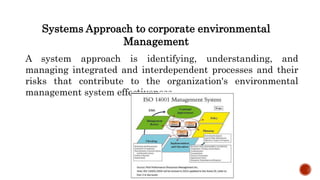
Systems Approach to corporate environmental
Management
A system approach is identifying, understanding, and
managing integrated and interdependent processes and their
risks that contribute to the organization's environmental
management system effectiveness.
Environmental impact reduction
efforts
Use energy more efficiently.
Install renewables.
Conserve water.
Reduce, reuse, recycle.
Travel less.
Consider near sourcing.
Ship goods more efficiently.
Business charter for sustainable production and
consumption
 Sustainable economic growth provides the foundation and resources for societies to develop and
prosper, and for people to meet their needs and pursue their aspirations.
 It helps enable economic empowerment and poverty eradication, advance environmental
stewardship;
 It contribute to dealing with the trans-boundary global challenges highlighted by the UN
Sustainable Development Goals.
Sustainable development as a business
priority
 To recognize the business contribution to sustainable development as a key priority and
an enabler for long-term business success.
 To build the necessary awareness and understanding amongst its employees,
shareholders, customers, and other stakeholders.
 To clarify and integrate sustainability into its strategies, leadership principles,
operations, activities and investments according to each business’ individually relevant
context.
 To govern its business with integrity, develop best practices in any relevant area of
work, and promote ethical conduct, including fighting corruption.
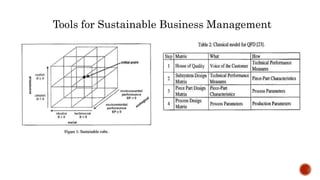
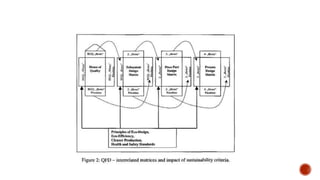
Tools for Sustainable Business Management
What is Environmental Stewardship
 Human responsible consumption, protection of the natural environment or corrective activities
that could be achieved through conservation efforts and sustainable practices.
 The responsible use and management of natural resources in a way that takes a full and
balanced account of the interests of society, future generations, and other species while
accepting significant answerability to society for these actions.
 Reduce the number of bags you use for shopping. Use reusable bags.
 Reduce water usage and waste by closing taps and lower the flow to the smallest needed to do
the job in reasonable time.
 Reduce the amount of fuel you use by choosing smaller, lighter vehicles. Carpool. Live close to
where you work. Use public transit if you can.
Environmental stewardship ties in with land stewardship and good
agricultural practices which farmers would not truly practice if they
care about obtaining optimal yields for an infinite period of time.
It includes things like:
 Planting trees around fields to act as wind break barriers which reduce soil erosion due to winds
blowing across cultivated ground.
 Reduced tillage or no tillage methods of growing crops. This also helps reduce soil erosion by wind
because less or nose bare soil is left open to the elements.
 Incorporation of plant waste, such as stems, back into the soil to add organic matter. This means
healthier soil and corresponding increased yields. It also can mean soil which is more open allowing
for better drainage.
 Not using equipment on soil when it is too wet resulting in compaction. This can mean reduced yields
and reduced drainage. Also using suitable equipment to match the soil such as tracked equipment
versus just plain wheels on muck type soil.
 Applying the correct amount of fertilizer or manure at the correct time to achieve optimal growing
results without having run off issues. Allowing fertilizer or manure to leach into waterways is harmful
to the environment as well as a waste of the resource. As part of this, incorporating the fertilizer or
manure into the soil
Drivers of sustainability
The business case for sustainability has been at the
forefront of much of the literature. Some of the most
commonly mentioned drivers/benefits of sustainability
include: competitive advantage, reduced costs, increased
sales, improved image and reputation, and increased
employee motivation
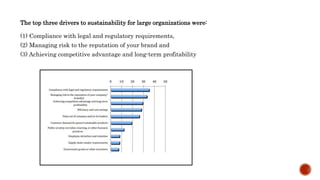
The top three drivers to sustainability for large organizations were:
(1) Compliance with legal and regulatory requirements,
(2) Managing risk to the reputation of your brand and
(3) Achieving competitive advantage and long-term profitability
BARRIERS
Sustainable development has been widely promoted as a holistic concept
which aims or targets to integrate social, economic and cultural policies
to ensure high-quality growth.
 Economic and financial barriers
 Innovational Barriers
 Social barriers
 Political barriers
 Poor monitoring and evaluation systems
 Institutional barriers
 Trade barriers
Environmental Management Principles
 Principles of environmental management are a set of rules and guidelines that
help attain desirable environmental outcome.
 Principles of environmental management, refers to procedure, government,
industries and people should follow.
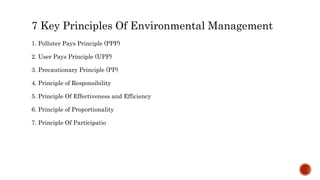
7 Key Principles Of Environmental Management
1. Polluter Pays Principle (PPP)
2. User Pays Principle (UPP)
3. Precautionary Principle (PP)
4. Principle of Responsibility
5. Principle Of Effectiveness and Efficiency
6. Principle of Proportionality
7. Principle Of Participatio
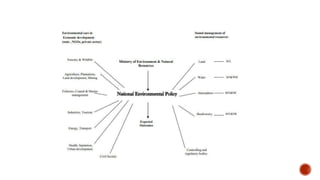
National Environment Policy (NEP)
 The National Environment Policy (NEP) by the Ministry of Environment and Forests (MoEF)
aims at mainstreaming environmental concerns into all developmental activities.
 It emphasizes conservation of resources, and points that the best way to aid conservation is to
ensure that people dependent on resources obtain better livelihoods from conservation, than
from degradation of the resources.
➢ Important role of human beings in the sustainable development processes
➢ The non negotiability and incomparable value of environmental resources
➢ Right to development for all
➢ Equity in the use of environmental resources
The document goes on to highlight the principles underlying
the policy that emphasise the following
 Conservation of critical environmental resources
 Intra-generational equity
 Livelihood security for the poor
 Inter-generational equity
 Integration of environmental concerns in economic and social development
 Efficiency in environmental resource use
 Environmental governance
 Enhancement of resources for environmental conservation
The objectives of the policy include:
Abatement of pollution and conservation of
resources
 Pollution abatement refers to any measure taken to reduce, control or
eliminate pollution from a given environment.
 Abatement measures can be technological, like catalytic converters on vehicles
to reduce air pollution, or they may be regulatory, like laws limiting the
amount of solid waste a sewage management facility can release into a
waterway
 Air , Soil , Water , Energy Conservation
Action Points under CREP for Tannery Sector
 All the chrome-tanning units in the country will have the Chrome Recovery Plant either on
individual basis or on collective basis in the form of Common Chrome Recovery Plant and use
the recovered chrome in the tanning process. By December 2004
 Common Chrome Recovery Plant is to be installed and commissioned at Kanpur, for which the
Feasibility Report has already been prepared. All the chrome tanning units will make their
financial contribution to the extent of 10% By June 2003
 Recovered Chromium is to be utilized in tanning process By December 2005
• Chrome Recovery
 Waste minimization circles will be formed in all the clusters of tanneries in the country
to implement waste minimization measures and for adoption of clean technologies
March 2004
 Waste minimization measures as identified by the Task Force to be implemented in all
the tanneries By December 2005
• Waste Minimization Measures
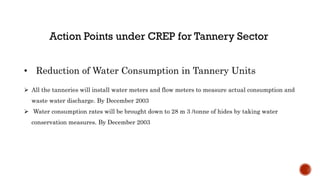
• Reduction of Water Consumption in Tannery Units
 All the tanneries will install water meters and flow meters to measure actual consumption and
waste water discharge. By December 2003
 Water consumption rates will be brought down to 28 m 3 /tonne of hides by taking water
conservation measures. By December 2003
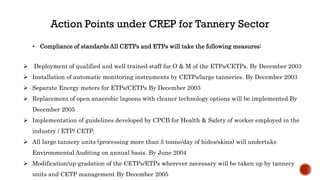
 Deployment of qualified and well trained staff for O & M of the ETPs/CETPs. By December 2003
 Installation of automatic monitoring instruments by CETPs/large tanneries. By December 2003
 Separate Energy meters for ETPs/CETPs By December 2003
 Replacement of open anaerobic lagoons with cleaner technology options will be implemented By
December 2005
 Implementation of guidelines developed by CPCB for Health & Safety of worker employed in the
industry / ETP/ CETP.
 All large tannery units (processing more than 5 tonne/day of hides/skins) will undertake
Environmental Auditing on annual basis. By June 2004
 Modification/up-gradation of the CETPs/ETPs wherever necessary will be taken up by tannery
units and CETP management By December 2005
• Compliance of standards All CETPs and ETPs will take the following measures:
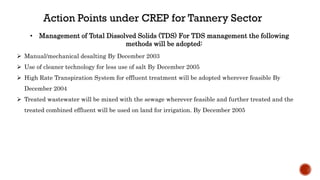
 Manual/mechanical desalting By December 2003
 Use of cleaner technology for less use of salt By December 2005
 High Rate Transpiration System for effluent treatment will be adopted wherever feasible By
December 2004
 Treated wastewater will be mixed with the sewage wherever feasible and further treated and the
treated combined effluent will be used on land for irrigation. By December 2005
• Management of Total Dissolved Solids (TDS) For TDS management the following
methods will be adopted:
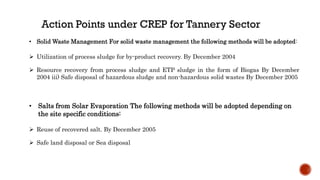
• Solid Waste Management For solid waste management the following methods will be adopted:
 Utilization of process sludge for by-product recovery. By December 2004
 Resource recovery from process sludge and ETP sludge in the form of Biogas By December
2004 iii) Safe disposal of hazardous sludge and non-hazardous solid wastes By December 2005
• Salts from Solar Evaporation The following methods will be adopted depending on
the site specific conditions:
 Reuse of recovered salt. By December 2005
 Safe land disposal or Sea disposal
• Use of Boron bearing compounds will be dispensed with. By
December 2003
• Ground water quality monitoring to be strengthened wherever the
treated effluents are applied on land for irrigation. By December
2004
• Implementation of recommendations of the Task Force constituted
by the MOEF, Govt.of India will be commenced by June 2003. By
June 2003

Environmental protection and management Module_1.pptx

  • 1.
  • 2.
    Environmental management standards Definition: TheInternational Organization for Standardization (ISO) defines an environmental management system as “part of the management system used to manage environmental aspects, fulfill compliance obligations, and address risks and opportunities.”
  • 3.
     Genetic ModificationOf Crops  Waste Production  Population Growth  Water Pollution  Overfishing  Deforestation  Urban Sprawl  Acid Rain  Ozone Layer Depletion  Ocean Acidification  Air Pollution  Lowered Biodiversity  The Nitrogen Cycle  Natural Resource Use  Climate Change Unique characteristics of Environmental Problems
  • 4.
    Systems Approach tocorporate environmental Management A system approach is identifying, understanding, and managing integrated and interdependent processes and their risks that contribute to the organization's environmental management system effectiveness.
  • 5.
    Environmental impact reduction efforts Useenergy more efficiently. Install renewables. Conserve water. Reduce, reuse, recycle. Travel less. Consider near sourcing. Ship goods more efficiently.
  • 6.
    Business charter forsustainable production and consumption  Sustainable economic growth provides the foundation and resources for societies to develop and prosper, and for people to meet their needs and pursue their aspirations.  It helps enable economic empowerment and poverty eradication, advance environmental stewardship;  It contribute to dealing with the trans-boundary global challenges highlighted by the UN Sustainable Development Goals.
  • 7.
    Sustainable development asa business priority  To recognize the business contribution to sustainable development as a key priority and an enabler for long-term business success.  To build the necessary awareness and understanding amongst its employees, shareholders, customers, and other stakeholders.  To clarify and integrate sustainability into its strategies, leadership principles, operations, activities and investments according to each business’ individually relevant context.  To govern its business with integrity, develop best practices in any relevant area of work, and promote ethical conduct, including fighting corruption.
  • 8.
    Tools for SustainableBusiness Management
  • 10.
    What is EnvironmentalStewardship  Human responsible consumption, protection of the natural environment or corrective activities that could be achieved through conservation efforts and sustainable practices.  The responsible use and management of natural resources in a way that takes a full and balanced account of the interests of society, future generations, and other species while accepting significant answerability to society for these actions.  Reduce the number of bags you use for shopping. Use reusable bags.  Reduce water usage and waste by closing taps and lower the flow to the smallest needed to do the job in reasonable time.  Reduce the amount of fuel you use by choosing smaller, lighter vehicles. Carpool. Live close to where you work. Use public transit if you can.
  • 11.
    Environmental stewardship tiesin with land stewardship and good agricultural practices which farmers would not truly practice if they care about obtaining optimal yields for an infinite period of time. It includes things like:  Planting trees around fields to act as wind break barriers which reduce soil erosion due to winds blowing across cultivated ground.  Reduced tillage or no tillage methods of growing crops. This also helps reduce soil erosion by wind because less or nose bare soil is left open to the elements.  Incorporation of plant waste, such as stems, back into the soil to add organic matter. This means healthier soil and corresponding increased yields. It also can mean soil which is more open allowing for better drainage.  Not using equipment on soil when it is too wet resulting in compaction. This can mean reduced yields and reduced drainage. Also using suitable equipment to match the soil such as tracked equipment versus just plain wheels on muck type soil.  Applying the correct amount of fertilizer or manure at the correct time to achieve optimal growing results without having run off issues. Allowing fertilizer or manure to leach into waterways is harmful to the environment as well as a waste of the resource. As part of this, incorporating the fertilizer or manure into the soil
  • 12.
    Drivers of sustainability Thebusiness case for sustainability has been at the forefront of much of the literature. Some of the most commonly mentioned drivers/benefits of sustainability include: competitive advantage, reduced costs, increased sales, improved image and reputation, and increased employee motivation
  • 13.
    The top threedrivers to sustainability for large organizations were: (1) Compliance with legal and regulatory requirements, (2) Managing risk to the reputation of your brand and (3) Achieving competitive advantage and long-term profitability
  • 14.
    BARRIERS Sustainable development hasbeen widely promoted as a holistic concept which aims or targets to integrate social, economic and cultural policies to ensure high-quality growth.  Economic and financial barriers  Innovational Barriers  Social barriers  Political barriers  Poor monitoring and evaluation systems  Institutional barriers  Trade barriers
  • 15.
    Environmental Management Principles Principles of environmental management are a set of rules and guidelines that help attain desirable environmental outcome.  Principles of environmental management, refers to procedure, government, industries and people should follow.
  • 16.
    7 Key PrinciplesOf Environmental Management 1. Polluter Pays Principle (PPP) 2. User Pays Principle (UPP) 3. Precautionary Principle (PP) 4. Principle of Responsibility 5. Principle Of Effectiveness and Efficiency 6. Principle of Proportionality 7. Principle Of Participatio
  • 17.
    National Environment Policy(NEP)  The National Environment Policy (NEP) by the Ministry of Environment and Forests (MoEF) aims at mainstreaming environmental concerns into all developmental activities.  It emphasizes conservation of resources, and points that the best way to aid conservation is to ensure that people dependent on resources obtain better livelihoods from conservation, than from degradation of the resources.
  • 19.
    ➢ Important roleof human beings in the sustainable development processes ➢ The non negotiability and incomparable value of environmental resources ➢ Right to development for all ➢ Equity in the use of environmental resources The document goes on to highlight the principles underlying the policy that emphasise the following
  • 20.
     Conservation ofcritical environmental resources  Intra-generational equity  Livelihood security for the poor  Inter-generational equity  Integration of environmental concerns in economic and social development  Efficiency in environmental resource use  Environmental governance  Enhancement of resources for environmental conservation The objectives of the policy include:
  • 21.
    Abatement of pollutionand conservation of resources  Pollution abatement refers to any measure taken to reduce, control or eliminate pollution from a given environment.  Abatement measures can be technological, like catalytic converters on vehicles to reduce air pollution, or they may be regulatory, like laws limiting the amount of solid waste a sewage management facility can release into a waterway  Air , Soil , Water , Energy Conservation
  • 22.
    Action Points underCREP for Tannery Sector  All the chrome-tanning units in the country will have the Chrome Recovery Plant either on individual basis or on collective basis in the form of Common Chrome Recovery Plant and use the recovered chrome in the tanning process. By December 2004  Common Chrome Recovery Plant is to be installed and commissioned at Kanpur, for which the Feasibility Report has already been prepared. All the chrome tanning units will make their financial contribution to the extent of 10% By June 2003  Recovered Chromium is to be utilized in tanning process By December 2005 • Chrome Recovery
  • 23.
     Waste minimizationcircles will be formed in all the clusters of tanneries in the country to implement waste minimization measures and for adoption of clean technologies March 2004  Waste minimization measures as identified by the Task Force to be implemented in all the tanneries By December 2005 • Waste Minimization Measures
  • 24.
    • Reduction ofWater Consumption in Tannery Units  All the tanneries will install water meters and flow meters to measure actual consumption and waste water discharge. By December 2003  Water consumption rates will be brought down to 28 m 3 /tonne of hides by taking water conservation measures. By December 2003
  • 25.
     Deployment ofqualified and well trained staff for O & M of the ETPs/CETPs. By December 2003  Installation of automatic monitoring instruments by CETPs/large tanneries. By December 2003  Separate Energy meters for ETPs/CETPs By December 2003  Replacement of open anaerobic lagoons with cleaner technology options will be implemented By December 2005  Implementation of guidelines developed by CPCB for Health & Safety of worker employed in the industry / ETP/ CETP.  All large tannery units (processing more than 5 tonne/day of hides/skins) will undertake Environmental Auditing on annual basis. By June 2004  Modification/up-gradation of the CETPs/ETPs wherever necessary will be taken up by tannery units and CETP management By December 2005 • Compliance of standards All CETPs and ETPs will take the following measures:
  • 26.
     Manual/mechanical desaltingBy December 2003  Use of cleaner technology for less use of salt By December 2005  High Rate Transpiration System for effluent treatment will be adopted wherever feasible By December 2004  Treated wastewater will be mixed with the sewage wherever feasible and further treated and the treated combined effluent will be used on land for irrigation. By December 2005 • Management of Total Dissolved Solids (TDS) For TDS management the following methods will be adopted:
  • 27.
    • Solid WasteManagement For solid waste management the following methods will be adopted:  Utilization of process sludge for by-product recovery. By December 2004  Resource recovery from process sludge and ETP sludge in the form of Biogas By December 2004 iii) Safe disposal of hazardous sludge and non-hazardous solid wastes By December 2005 • Salts from Solar Evaporation The following methods will be adopted depending on the site specific conditions:  Reuse of recovered salt. By December 2005  Safe land disposal or Sea disposal
  • 28.
    • Use ofBoron bearing compounds will be dispensed with. By December 2003 • Ground water quality monitoring to be strengthened wherever the treated effluents are applied on land for irrigation. By December 2004 • Implementation of recommendations of the Task Force constituted by the MOEF, Govt.of India will be commenced by June 2003. By June 2003