Understanding Our Environment
The environment encompasses everything that surrounds us, functioning as a vital life-support system. It consists of both living (biotic) and non-living (abiotic) components that collectively influence the survival, growth, and development of every organism on Earth.
The Three Pillars of Environment
The environment is categorized into three distinct components:
Natural Environment: This includes all nature-created elements. It is divided into the Lithosphere (land), Hydrosphere (water), Atmosphere (air), and Biosphere (all living organisms).
Human-made Environment: To fulfill specific needs, humans create infrastructure such as buildings, roads, bridges, factories, and various technologies.
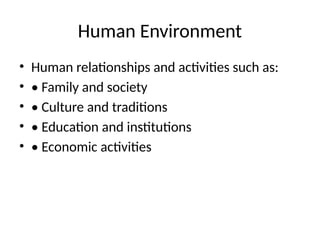
Human Environment: This refers to the social fabric of our lives, including family, culture, education, economic activities, and societal institutions.
Importance and Challenges
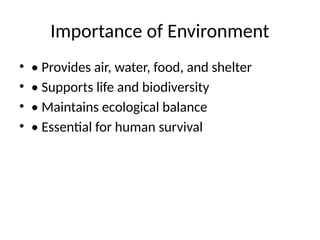
The environment is essential for human survival because it provides fundamental necessities: air, water, food, and shelter. Beyond human needs, it supports global biodiversity and maintains the delicate ecological balance required for a healthy planet.
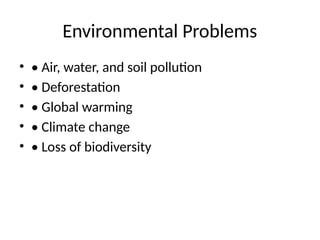
However, the environment currently faces significant threats, primarily driven by human activity. These problems include:
Pollution: Contamination of air, water, and soil.
Ecological Loss: Deforestation and the resulting loss of biodiversity.
Climate Issues: Global warming and rapid climate change.
Conservation and Responsibility
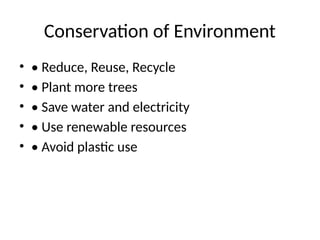
Protecting the environment is not optional; it is the responsibility of every citizen. Conservation can be achieved through sustainable practices such as the "Reduce, Reuse, Recycle" mantra, planting trees, and transitioning to renewable resources. By avoiding plastic and saving water and electricity, we can ensure a cleaner, healthier environment and a better future for all.