GEOG 102 – Population, Resources, and the Environment
Professor: Dr. Jean-Paul Rodrigue
Topic 9 – Environmental Sustainability
A – The Concept of Sustainability
B – Towards a Sustainable World?
The Concept of Sustainability
■ 1. Sustainable Development
■ 2. Sustainable Society
■ 3. General Indicators
A
Sustainable Development
■ The issue
• Brought forward in view of challenges at a scale never seen
before.
• Demographic challenge:
• Strong population growth, notably in the developing world.
• Resource challenge:
• An increasing usage of resources, renewable and non renewable alike.
– Raw materials.
– Energy.
– Food.
• Environmental challenge:
• Higher levels of environmental impacts of human activities.
• The capacity of this world to sustain its population is
compromised.
1
Sustainable Development
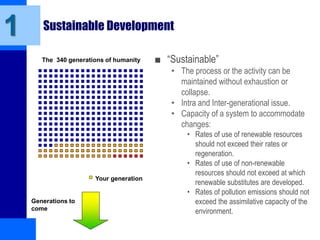
■ “Sustainable”
• The process or the activity can be
maintained without exhaustion or
collapse.
• Intra and Inter-generational issue.
• Capacity of a system to accommodate
changes:
• Rates of use of renewable resources
should not exceed their rates or
regeneration.
• Rates of use of non-renewable
resources should not exceed at which
renewable substitutes are developed.
• Rates of pollution emissions should not
exceed the assimilative capacity of the
environment.
1
Your generation
The 340 generations of humanity
Generations to
come
Sustainable Development
■ “Development”
• Development is about people, not necessarily the economy.
• Development is a process.
• Improvement of the welfare of the population:
• Create an enabling environment for people.
• Often forgotten in the immediate concern with the accumulation of
commodities and wealth.
• Finding ways to satisfy and improve human needs.
1
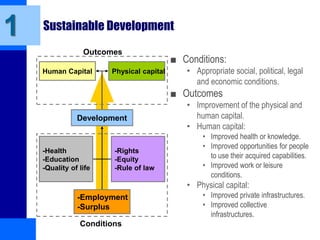
Sustainable Development
■ Conditions:
• Appropriate social, political, legal
and economic conditions.
■ Outcomes
• Improvement of the physical and
human capital.
• Human capital:
• Improved health or knowledge.
• Improved opportunities for people
to use their acquired capabilities.
• Improved work or leisure
conditions.
• Physical capital:
• Improved private infrastructures.
• Improved collective
infrastructures.
Development
-Health
-Education
-Quality of life
-Rights
-Equity
-Rule of law
Conditions
-Employment
-Surplus
Human Capital Physical capital
Outcomes
1
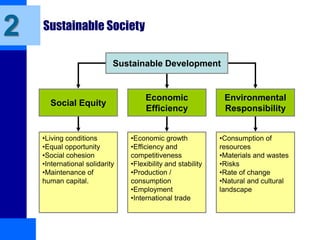
Sustainable Society
Sustainable Development
Social Equity
Economic
Efficiency
Environmental
Responsibility
•Living conditions
•Equal opportunity
•Social cohesion
•International solidarity
•Maintenance of
human capital.
•Economic growth
•Efficiency and
competitiveness
•Flexibility and stability
•Production /
consumption
•Employment
•International trade
•Consumption of
resources
•Materials and wastes
•Risks
•Rate of change
•Natural and cultural
landscape
2
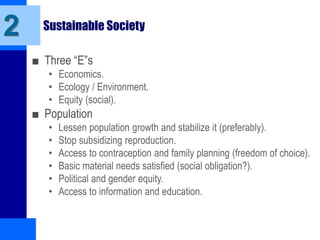
Sustainable Society
■ Three “E”s
• Economics.
• Ecology / Environment.
• Equity (social).
■ Population
• Lessen population growth and stabilize it (preferably).
• Stop subsidizing reproduction.
• Access to contraception and family planning (freedom of choice).
• Basic material needs satisfied (social obligation?).
• Political and gender equity.
• Access to information and education.
2
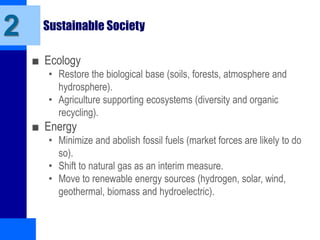
Sustainable Society
■ Ecology
• Restore the biological base (soils, forests, atmosphere and
hydrosphere).
• Agriculture supporting ecosystems (diversity and organic
recycling).
■ Energy
• Minimize and abolish fossil fuels (market forces are likely to do
so).
• Shift to natural gas as an interim measure.
• Move to renewable energy sources (hydrogen, solar, wind,
geothermal, biomass and hydroelectric).
2
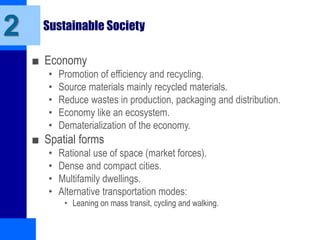
Sustainable Society
■ Economy
• Promotion of efficiency and recycling.
• Source materials mainly recycled materials.
• Reduce wastes in production, packaging and distribution.
• Economy like an ecosystem.
• Dematerialization of the economy.
■ Spatial forms
• Rational use of space (market forces).
• Dense and compact cities.
• Multifamily dwellings.
• Alternative transportation modes:
• Leaning on mass transit, cycling and walking.
2
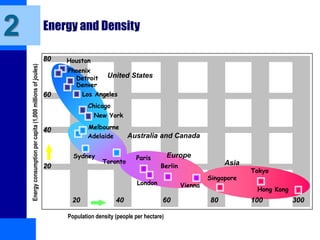
Energy and Density
2
80
40
20
60
20 60 300
40 80 100
Los Angeles
Sydney
London
Singapore
United States
Australia and Canada
Europe
Asia
Hong Kong
Chicago
Houston
Phoenix
Detroit
Denver
Adelaide
Melbourne
Toronto
New York
Vienna
Paris
Berlin
Tokyo
Energy
consumption
per
capita
(1,000
millions
of
joules)
Population density (people per hectare)
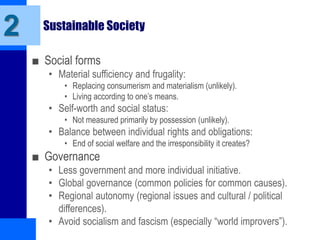
Sustainable Society
■ Social forms
• Material sufficiency and frugality:
• Replacing consumerism and materialism (unlikely).
• Living according to one’s means.
• Self-worth and social status:
• Not measured primarily by possession (unlikely).
• Balance between individual rights and obligations:
• End of social welfare and the irresponsibility it creates?
■ Governance
• Less government and more individual initiative.
• Global governance (common policies for common causes).
• Regional autonomy (regional issues and cultural / political
differences).
• Avoid socialism and fascism (especially “world improvers”).
2
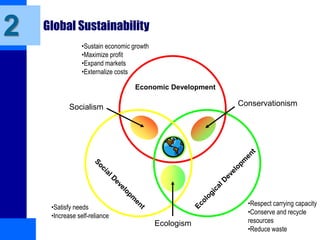
Global Sustainability
Economic Development
•Sustain economic growth
•Maximize profit
•Expand markets
•Externalize costs
•Respect carrying capacity
•Conserve and recycle
resources
•Reduce waste
•Satisfy needs
•Increase self-reliance
Socialism Conservationism
Ecologism
2
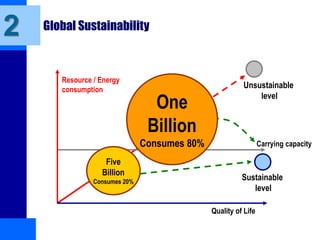
Global Sustainability
Quality of Life
Sustainable
level
Five
Billion
Consumes 20%
Resource / Energy
consumption
Carrying capacity
2
One
Billion
Consumes 80%
Unsustainable
level
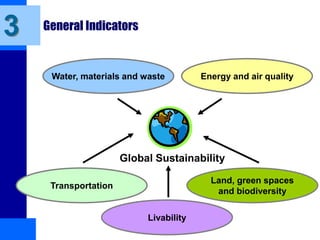
General Indicators
Global Sustainability
3
Water, materials and waste Energy and air quality
Livability
Transportation
Land, green spaces
and biodiversity
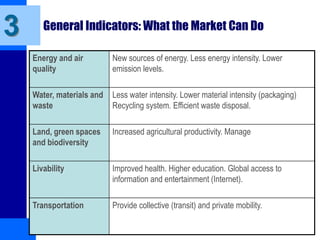
General Indicators: What the Market Can Do
Energy and air
quality
New sources of energy. Less energy intensity. Lower
emission levels.
Water, materials and
waste
Less water intensity. Lower material intensity (packaging)
Recycling system. Efficient waste disposal.
Land, green spaces
and biodiversity
Increased agricultural productivity. Manage
Livability Improved health. Higher education. Global access to
information and entertainment (Internet).
Transportation Provide collective (transit) and private mobility.
3
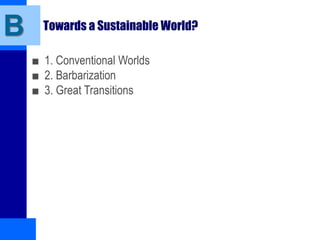
Towards a Sustainable World?
■ 1. Conventional Worlds
■ 2. Barbarization
■ 3. Great Transitions
B
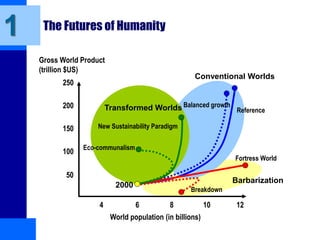
The Futures of Humanity
1
Reference
Balanced growth
Fortress World
New Sustainability Paradigm
Eco-communalism
2000
4 6 8 10 12
50
100
150
200
250
Gross World Product
(trillion $US)
Breakdown
World population (in billions)
Transformed Worlds
Conventional Worlds
Barbarization
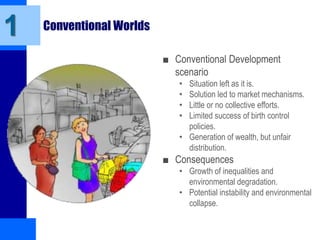
Conventional Worlds
■ Conventional Development
scenario
• Situation left as it is.
• Solution led to market mechanisms.
• Little or no collective efforts.
• Limited success of birth control
policies.
• Generation of wealth, but unfair
distribution.
■ Consequences
• Growth of inequalities and
environmental degradation.
• Potential instability and environmental
collapse.
1
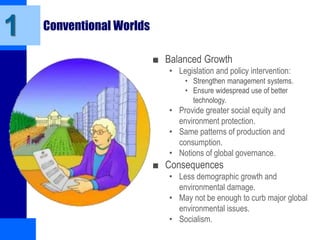
Conventional Worlds
■ Balanced Growth
• Legislation and policy intervention:
• Strengthen management systems.
• Ensure widespread use of better
technology.
• Provide greater social equity and
environment protection.
• Same patterns of production and
consumption.
• Notions of global governance.
■ Consequences
• Less demographic growth and
environmental damage.
• May not be enough to curb major global
environmental issues.
• Socialism.
1
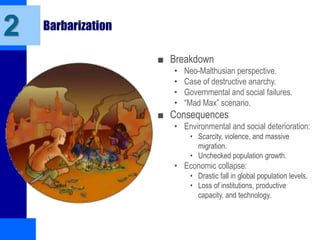
Barbarization
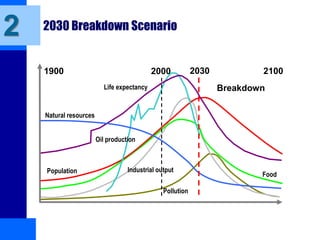
■ Breakdown
• Neo-Malthusian perspective.
• Case of destructive anarchy.
• Governmental and social failures.
• “Mad Max” scenario.
■ Consequences
• Environmental and social deterioration:
• Scarcity, violence, and massive
migration.
• Unchecked population growth.
• Economic collapse:
• Drastic fall in global population levels.
• Loss of institutions, productive
capacity, and technology.
2
2030 Breakdown Scenario
1900 2000 2100
Pollution
Industrial output
Population
Life expectancy
Natural resources
Oil production
2030
Food
2
Breakdown
Barbarization
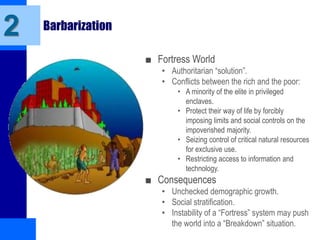
■ Fortress World
• Authoritarian “solution”.
• Conflicts between the rich and the poor:
• A minority of the elite in privileged
enclaves.
• Protect their way of life by forcibly
imposing limits and social controls on the
impoverished majority.
• Seizing control of critical natural resources
for exclusive use.
• Restricting access to information and
technology.
■ Consequences
• Unchecked demographic growth.
• Social stratification.
• Instability of a “Fortress” system may push
the world into a “Breakdown” situation.
2
3 Great Transitions
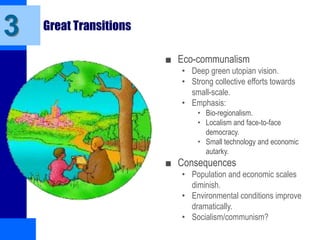
■ Eco-communalism
• Deep green utopian vision.
• Strong collective efforts towards
small-scale.
• Emphasis:
• Bio-regionalism.
• Localism and face-to-face
democracy.
• Small technology and economic
autarky.
■ Consequences
• Population and economic scales
diminish.
• Environmental conditions improve
dramatically.
• Socialism/communism?
Great Transitions
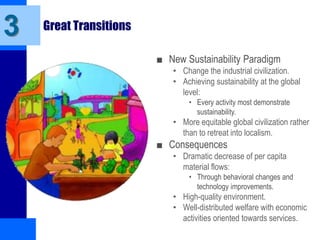
■ New Sustainability Paradigm
• Change the industrial civilization.
• Achieving sustainability at the global
level:
• Every activity most demonstrate
sustainability.
• More equitable global civilization rather
than to retreat into localism.
■ Consequences
• Dramatic decrease of per capita
material flows:
• Through behavioral changes and
technology improvements.
• High-quality environment.
• Well-distributed welfare with economic
activities oriented towards services.
3
Conclusion
■ Which Future?
• In light of the current situation around the world, which scenario
is the most likely?
• What are the alternatives?
■ Population, resources and the environment
• The absolute bottom line.
• Will shape the fate of humanity in the 21st century.
• Period of strong demographic growth (demographic transition).
• Population policy and family planning.
• Migration and urbanization.
• Consumption of resources (commodities and energy).
• The environmental challenge.

Environment Sustainability and Renewable Resources

  • 1.
    GEOG 102 –Population, Resources, and the Environment Professor: Dr. Jean-Paul Rodrigue Topic 9 – Environmental Sustainability A – The Concept of Sustainability B – Towards a Sustainable World?
  • 2.
    The Concept ofSustainability ■ 1. Sustainable Development ■ 2. Sustainable Society ■ 3. General Indicators A
  • 3.
    Sustainable Development ■ Theissue • Brought forward in view of challenges at a scale never seen before. • Demographic challenge: • Strong population growth, notably in the developing world. • Resource challenge: • An increasing usage of resources, renewable and non renewable alike. – Raw materials. – Energy. – Food. • Environmental challenge: • Higher levels of environmental impacts of human activities. • The capacity of this world to sustain its population is compromised. 1
  • 4.
    Sustainable Development ■ “Sustainable” •The process or the activity can be maintained without exhaustion or collapse. • Intra and Inter-generational issue. • Capacity of a system to accommodate changes: • Rates of use of renewable resources should not exceed their rates or regeneration. • Rates of use of non-renewable resources should not exceed at which renewable substitutes are developed. • Rates of pollution emissions should not exceed the assimilative capacity of the environment. 1 Your generation The 340 generations of humanity Generations to come
  • 5.
    Sustainable Development ■ “Development” •Development is about people, not necessarily the economy. • Development is a process. • Improvement of the welfare of the population: • Create an enabling environment for people. • Often forgotten in the immediate concern with the accumulation of commodities and wealth. • Finding ways to satisfy and improve human needs. 1
  • 6.
    Sustainable Development ■ Conditions: •Appropriate social, political, legal and economic conditions. ■ Outcomes • Improvement of the physical and human capital. • Human capital: • Improved health or knowledge. • Improved opportunities for people to use their acquired capabilities. • Improved work or leisure conditions. • Physical capital: • Improved private infrastructures. • Improved collective infrastructures. Development -Health -Education -Quality of life -Rights -Equity -Rule of law Conditions -Employment -Surplus Human Capital Physical capital Outcomes 1
  • 7.
    Sustainable Society Sustainable Development SocialEquity Economic Efficiency Environmental Responsibility •Living conditions •Equal opportunity •Social cohesion •International solidarity •Maintenance of human capital. •Economic growth •Efficiency and competitiveness •Flexibility and stability •Production / consumption •Employment •International trade •Consumption of resources •Materials and wastes •Risks •Rate of change •Natural and cultural landscape 2
  • 8.
    Sustainable Society ■ Three“E”s • Economics. • Ecology / Environment. • Equity (social). ■ Population • Lessen population growth and stabilize it (preferably). • Stop subsidizing reproduction. • Access to contraception and family planning (freedom of choice). • Basic material needs satisfied (social obligation?). • Political and gender equity. • Access to information and education. 2
  • 9.
    Sustainable Society ■ Ecology •Restore the biological base (soils, forests, atmosphere and hydrosphere). • Agriculture supporting ecosystems (diversity and organic recycling). ■ Energy • Minimize and abolish fossil fuels (market forces are likely to do so). • Shift to natural gas as an interim measure. • Move to renewable energy sources (hydrogen, solar, wind, geothermal, biomass and hydroelectric). 2
  • 10.
    Sustainable Society ■ Economy •Promotion of efficiency and recycling. • Source materials mainly recycled materials. • Reduce wastes in production, packaging and distribution. • Economy like an ecosystem. • Dematerialization of the economy. ■ Spatial forms • Rational use of space (market forces). • Dense and compact cities. • Multifamily dwellings. • Alternative transportation modes: • Leaning on mass transit, cycling and walking. 2
  • 11.
    Energy and Density 2 80 40 20 60 2060 300 40 80 100 Los Angeles Sydney London Singapore United States Australia and Canada Europe Asia Hong Kong Chicago Houston Phoenix Detroit Denver Adelaide Melbourne Toronto New York Vienna Paris Berlin Tokyo Energy consumption per capita (1,000 millions of joules) Population density (people per hectare)
  • 12.
    Sustainable Society ■ Socialforms • Material sufficiency and frugality: • Replacing consumerism and materialism (unlikely). • Living according to one’s means. • Self-worth and social status: • Not measured primarily by possession (unlikely). • Balance between individual rights and obligations: • End of social welfare and the irresponsibility it creates? ■ Governance • Less government and more individual initiative. • Global governance (common policies for common causes). • Regional autonomy (regional issues and cultural / political differences). • Avoid socialism and fascism (especially “world improvers”). 2
  • 13.
    Global Sustainability Economic Development •Sustaineconomic growth •Maximize profit •Expand markets •Externalize costs •Respect carrying capacity •Conserve and recycle resources •Reduce waste •Satisfy needs •Increase self-reliance Socialism Conservationism Ecologism 2
  • 14.
    Global Sustainability Quality ofLife Sustainable level Five Billion Consumes 20% Resource / Energy consumption Carrying capacity 2 One Billion Consumes 80% Unsustainable level
  • 15.
    General Indicators Global Sustainability 3 Water,materials and waste Energy and air quality Livability Transportation Land, green spaces and biodiversity
  • 16.
    General Indicators: Whatthe Market Can Do Energy and air quality New sources of energy. Less energy intensity. Lower emission levels. Water, materials and waste Less water intensity. Lower material intensity (packaging) Recycling system. Efficient waste disposal. Land, green spaces and biodiversity Increased agricultural productivity. Manage Livability Improved health. Higher education. Global access to information and entertainment (Internet). Transportation Provide collective (transit) and private mobility. 3
  • 17.
    Towards a SustainableWorld? ■ 1. Conventional Worlds ■ 2. Barbarization ■ 3. Great Transitions B
  • 18.
    The Futures ofHumanity 1 Reference Balanced growth Fortress World New Sustainability Paradigm Eco-communalism 2000 4 6 8 10 12 50 100 150 200 250 Gross World Product (trillion $US) Breakdown World population (in billions) Transformed Worlds Conventional Worlds Barbarization
  • 19.
    Conventional Worlds ■ ConventionalDevelopment scenario • Situation left as it is. • Solution led to market mechanisms. • Little or no collective efforts. • Limited success of birth control policies. • Generation of wealth, but unfair distribution. ■ Consequences • Growth of inequalities and environmental degradation. • Potential instability and environmental collapse. 1
  • 20.
    Conventional Worlds ■ BalancedGrowth • Legislation and policy intervention: • Strengthen management systems. • Ensure widespread use of better technology. • Provide greater social equity and environment protection. • Same patterns of production and consumption. • Notions of global governance. ■ Consequences • Less demographic growth and environmental damage. • May not be enough to curb major global environmental issues. • Socialism. 1
  • 21.
    Barbarization ■ Breakdown • Neo-Malthusianperspective. • Case of destructive anarchy. • Governmental and social failures. • “Mad Max” scenario. ■ Consequences • Environmental and social deterioration: • Scarcity, violence, and massive migration. • Unchecked population growth. • Economic collapse: • Drastic fall in global population levels. • Loss of institutions, productive capacity, and technology. 2
  • 22.
    2030 Breakdown Scenario 19002000 2100 Pollution Industrial output Population Life expectancy Natural resources Oil production 2030 Food 2 Breakdown
  • 23.
    Barbarization ■ Fortress World •Authoritarian “solution”. • Conflicts between the rich and the poor: • A minority of the elite in privileged enclaves. • Protect their way of life by forcibly imposing limits and social controls on the impoverished majority. • Seizing control of critical natural resources for exclusive use. • Restricting access to information and technology. ■ Consequences • Unchecked demographic growth. • Social stratification. • Instability of a “Fortress” system may push the world into a “Breakdown” situation. 2
  • 24.
    3 Great Transitions ■Eco-communalism • Deep green utopian vision. • Strong collective efforts towards small-scale. • Emphasis: • Bio-regionalism. • Localism and face-to-face democracy. • Small technology and economic autarky. ■ Consequences • Population and economic scales diminish. • Environmental conditions improve dramatically. • Socialism/communism?
  • 25.
    Great Transitions ■ NewSustainability Paradigm • Change the industrial civilization. • Achieving sustainability at the global level: • Every activity most demonstrate sustainability. • More equitable global civilization rather than to retreat into localism. ■ Consequences • Dramatic decrease of per capita material flows: • Through behavioral changes and technology improvements. • High-quality environment. • Well-distributed welfare with economic activities oriented towards services. 3
  • 26.
    Conclusion ■ Which Future? •In light of the current situation around the world, which scenario is the most likely? • What are the alternatives? ■ Population, resources and the environment • The absolute bottom line. • Will shape the fate of humanity in the 21st century. • Period of strong demographic growth (demographic transition). • Population policy and family planning. • Migration and urbanization. • Consumption of resources (commodities and energy). • The environmental challenge.