UPSC CSE
भूगोल (वैकल्पिक) ववषय
पाठ्यक्रम
(सविन अरोड़ा)
Environmental Geography / पर्यावरणीर् भूगोल
Ecological Principles & Adaptation
पयररस्थितिक तिद्यांि एवां अनुक
ू लन
Stockholm Declaration Principles
Conservation and Protection centric:
• Principle 4: Wildlife Conservation
• Principle 6: Management of pollution
• Principle 7: Management of sea pollution
• Principle 22: Compensation to Victims
Human Capacity Building centric:
• Principle 1: Rights and Responsibilities for protecting the environment.
• Principle 15: Human settlement and Urbanization.
• Principle 18: Application of science
• Principle 19: Education in environmental matters
• Principle 20: Expanding scientific research
Stockholm Declaration Principles
िांरक्षण और िांरक्षण क
े स्िि:
• तिद्यांि 4: वन्यजीव िांरक्षण
• तिद्यांि 6: प्रदू षण कय प्रबांधन
• तिद्यांि 7: िमुद्री प्रदू षण कय प्रबांधन
• तिद्यांि 22: पीत़ििोां को मुआवजय
मयनव क्षमिय तनमयाण क
े स्िि:
• तिद्यांि 1: पर्यावरण की रक्षय क
े तलए अतधकयर और तजम्मेदयररर्य।
• तिद्यांि 15: मयनव बस्ती और शहरीकरण।
• तिद्यांि 18: तवज्ञयन कय अनुप्रर्ोग
• तिद्यांि 19: पर्यावरणीर् मयमलोां में तशक्षय
• तिद्यांि 20: वैज्ञयतनक अनुिांधयन कय तवस्तयर
Stockholm Declaration Principles
Sustainable development centric:
• Principle 2: Duty to protect natural resources
• Principle 3: Duty to preserve renewable resources
• Principle 5: Duty to preserve non-renewable resources
• Principle 8: Social and Economic development
• Principle 13: Rational Management of Resources
• Principle 14: Rational Planning
• Principle 16: Population Control
• Principle 21: Respect of customary international law
• Principle 24: Cooperation with nations
• Principle 25: Coordination with nations
Stockholm Declaration Principles
Other principles
• Principle 9: Aid and Technology Transfer to remedy Environmental Deficiencies
• Principle 10: Stability of prices and incomes
• Principle 11: Environmental Policy
• Principle 12: Resources allocation to preserve and improve environment
• Principle 17: Setting up of national institutions
• Principle 23: Implementing a national agenda
• Principle 26: Ban on nuclear weapons
1972 : Maurice Strong is elected as first
head of UNEP.
• After successfully leading the United
Nations Conference on the Human
Environment, the UN General
Assembly elects Strong, a Canadian, as
UNEP’s first Executive Director. He led
UNEP until 1975
• The first meeting of the Governing
Council of UNEP takes place in the
Palais des Nations, Geneva, in June
1973.
• In 1975, UNEP moves to a new
location on the site of an old coffee
farm on the outskirts of Nairobi,
where it remains to this day.
About IMO
• IMO's work to protect our oceans goes beyond the ships,by regulating the
prevention of pollution from dumping at wastes at sea, including climate change
mitigation options such as carbon capture and storage. This is done through two
treaties known as the London Convention and Protocol.
• IMO understands the need for special protection in some areas because of
ecological, socio-economic or scientific significance. Special areas and particularly
sensitive sea areas (PSSA) are designated to ensure higher levels of protection
from shipping activities
• IMO is also working to reduce marine plastic litter and to mitigate against
invasive aquatic species. IMO also works to protect marine mammals from ship
strikes and reduce underwater noise from ships.
• IMO is also playing an active role in other environmental cooperation
mechanisms in the UN, such as UN-Oceans and the UN Environment
Management Group (UN EMG).
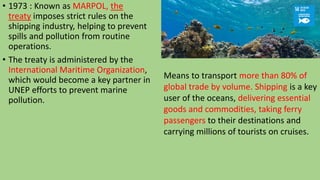
• 1973 : Known as MARPOL, the
treaty imposes strict rules on the
shipping industry, helping to prevent
spills and pollution from routine
operations.
• The treaty is administered by the
International Maritime Organization,
which would become a key partner in
UNEP efforts to prevent marine
pollution.
Means to transport more than 80% of
global trade by volume. Shipping is a key
user of the oceans, delivering essential
goods and commodities, taking ferry
passengers to their destinations and
carrying millions of tourists on cruises.
Q. Consider the following MARPOL related statements :
1. MARPOL was first adopted in 1973 with annexes covering the prevention of all
types of pollution from ships.
2. The convention was expanded in 1997 to regulate air pollution and emissions
from ships.
Codes:
a) 1 only
b) only
c) Both 1 and 2
d) Neither 1 nor 2
Q. Which of the following is correct about a PSSA
1. UNEP designates special marine areas as Particularly Sensitive Sea Areas
(PSSAs).
2. There are currently 15 areas (plus two extensions) protected areas in this way.
Codes:
a) 1 only
b) only
c) Both 1 and 2
d) Neither 1 nor 2
• IMO has a process to designate Particularly Sensitive Sea Areas (PSSAs), which are
subject to associated protective measures such as mandatory ship-routeing
systems.
• There are currently 15 areas (plus two extensions) protected in this way, including
those covering UNESCO World Heritage Marine Sites, such as the Great Barrier
Reef (Australia), the Galápagos Archipelago (Ecuador), the Papahānaumokuākea
Marine National Monument (United States), and the Wadden Sea (Denmark,
Germany, Netherlands).
• This long-established practice of designating Special Areas and PSSAs fully
supports the SDG 14 target to increase coverage of marine protected areas.
Q. Which of the following is correct about the GloLitter Project?
1. IMO and the UNEP have launched the GloLitter project, to help shipping and
fisheries move to a low-plastics future.
2. GloLitter will assist developing countries to identify opportunities to prevent
and reduce marine plastic litter.
Codes:
a) 1 only
b) only
c) Both 1 and 2
d) Neither 1 nor 2
IMO and the Food and Agriculture Organization of the United Nations (FAO) have
launched the GloLitter project, with initial funding for the project from the
Government of Norway, to help shipping and fisheries move to a low-plastics
future.
GloLitter will assist developing countries to identify opportunities to prevent and
reduce marine plastic litter, including plastic litter, from within the maritime
transport and fisheries sectors, and to decrease the use of plastics in these
industries, including identifying opportunities to re-use and recycle plastics.
GloFouling partnerships project : IMO is executing the GEF-UNDP-IMO GloFouling
Partner project to address the transfer of harmful aquatic species through
biofouling in some of the developing regions of the world
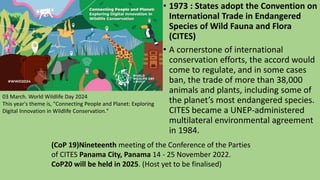
• 1973 : States adopt the Convention on
International Trade in Endangered
Species of Wild Fauna and Flora
(CITES)
• A cornerstone of international
conservation efforts, the accord would
come to regulate, and in some cases
ban, the trade of more than 38,000
animals and plants, including some of
the planet’s most endangered species.
CITES became a UNEP-administered
multilateral environmental agreement
in 1984.
(CoP 19)Nineteenth meeting of the Conference of the Parties
of CITES Panama City, Panama 14 - 25 November 2022.
CoP20 will be held in 2025. (Host yet to be finalised)
03 March. World Wildlife Day 2024
This year's theme is, "Connecting People and Planet: Exploring
Digital Innovation in Wildlife Conservation."
Which of the following is correct about CITES ?
1. CITES is an international, legally binding instrument for its members.
2. It is a powerful tools for wildlife conservation through the regulation of trade.
3. CITES has a permit system that allows international trade in listed species.
Codes:
a) 1 and 2
b) 1 and 3
c) 2 and 3
d) All the above
CITES was signed in Washington D.C. on 3 March 1973 and entered into force on 1 July 1975.
CITES is an international, legally binding instrument that must be implemented and enforced by
the 184 Parties (183 countries and the European Union) that have agreed to be bound by it.
CITES regulates international trade in over 38,000 species of plants and animals, including their
products and derivatives, to ensure their survival in the wild with benefits for the livelihoods of
local people and the global environment.
More than 30 percent of the world’s tree species are at risk of extinction and international trade
in more than 500 tree species is regulated under CITES.
With 184 Parties, the Convention on International Trade in Endangered Species of Wild Fauna
and Flora (CITES) remains one of the world's most powerful tools for wildlife conservation
through the regulation of trade. Thousands of species are internationally traded and used by
people in their daily lives for food, health care, housing, tourist souvenirs, cosmetics or fashion.
The CITES permit system seeks to ensure that international trade in listed species is sustainable,
legal and traceable and contributes to both the livelihoods of the communities that live closest to
them and to national economies for a healthy planet and the prosperity of the people in support
of UN Sustainable Development Goals.
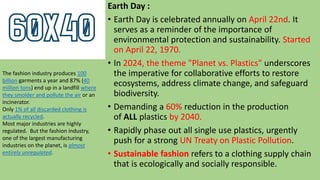
Earth Day :
• Earth Day is celebrated annually on April 22nd. It
serves as a reminder of the importance of
environmental protection and sustainability. Started
on April 22, 1970.
• In 2024, the theme "Planet vs. Plastics" underscores
the imperative for collaborative efforts to restore
ecosystems, address climate change, and safeguard
biodiversity.
• Demanding a 60% reduction in the production
of ALL plastics by 2040.
• Rapidly phase out all single use plastics, urgently
push for a strong UN Treaty on Plastic Pollution.
• Sustainable fashion refers to a clothing supply chain
that is ecologically and socially responsible.
The fashion industry produces 100
billion garments a year and 87% (40
million tons) end up in a landfill where
they smolder and pollute the air or an
incinerator.
Only 1% of all discarded clothing is
actually recycled.
Most major industries are highly
regulated. But the fashion industry,
one of the largest manufacturing
industries on the planet, is almost
entirely unregulated.
• 1974 World Environment Day makes its
debut
• The world celebrates the first World
Environment Day organized by UNEP on 5
June (the first day of the Stockholm
Conference on the human environment.)
under the theme “Only One Earth.”
• World Environment Day was first observed in
1974 in the USA.
• Since then, the day has been commemorated
annually, raising awareness about critical
environmental issues, and galvanizing action
and commitment from member states.
• The theme for World Environment Day 2021
was ‘Ecosystem Restoration’ and Pakistan
will be the global host for the big day.
• This day will also see the launch of the UN
Decade on Ecosystem Restoration.
WED 2024 :
• In 2024, WED focuses on land
restoration, desertification and
drought resilience (भूतम
पुनथियापन, मरुथिलीकरण
और िूखय लचीलयपन)under
the slogan
• “Our land. Our future. We are
GenerationRestoration.”
• The Kingdom of Saudi Arabia will
host the 2024 World Environment
Day global celebrations.
Q. Which of the following is true about
World Environment Day (WED) 2024?
1. It marks the 50th anniversary of the
establishment of UNEP as an outcome
of the Stockholm Conference.
2. The host country for 2024 is Saudi
Arabia.
3. “Only One Earth” is the motto for
2024.
Codes:
a) 1 and 2
b) Only 2
c) 1 and 3
d) All the above
ववश्व पयाावरण विवस (WED)
2024 क
े बारे में वनम्नवलल्पित में
से कौन सा सत्य है?
1. यह स्टॉकहोम सम्मेलन क
े
पररणामस्वरूप यूएनईपी की
स्थापना की 50वीीं वषागाींठ
है।
2. 2024 का मेजबान िेश
सऊिी अरब है।
3. "क
े वल एक पृथ्वी" 2024
का आिशा वाक्य है।

Environment Ecological Principles Geography

  • 1.
    UPSC CSE भूगोल (वैकल्पिक)ववषय पाठ्यक्रम (सविन अरोड़ा) Environmental Geography / पर्यावरणीर् भूगोल Ecological Principles & Adaptation पयररस्थितिक तिद्यांि एवां अनुक ू लन
  • 2.
    Stockholm Declaration Principles Conservationand Protection centric: • Principle 4: Wildlife Conservation • Principle 6: Management of pollution • Principle 7: Management of sea pollution • Principle 22: Compensation to Victims Human Capacity Building centric: • Principle 1: Rights and Responsibilities for protecting the environment. • Principle 15: Human settlement and Urbanization. • Principle 18: Application of science • Principle 19: Education in environmental matters • Principle 20: Expanding scientific research
  • 3.
    Stockholm Declaration Principles िांरक्षणऔर िांरक्षण क े स्िि: • तिद्यांि 4: वन्यजीव िांरक्षण • तिद्यांि 6: प्रदू षण कय प्रबांधन • तिद्यांि 7: िमुद्री प्रदू षण कय प्रबांधन • तिद्यांि 22: पीत़ििोां को मुआवजय मयनव क्षमिय तनमयाण क े स्िि: • तिद्यांि 1: पर्यावरण की रक्षय क े तलए अतधकयर और तजम्मेदयररर्य। • तिद्यांि 15: मयनव बस्ती और शहरीकरण। • तिद्यांि 18: तवज्ञयन कय अनुप्रर्ोग • तिद्यांि 19: पर्यावरणीर् मयमलोां में तशक्षय • तिद्यांि 20: वैज्ञयतनक अनुिांधयन कय तवस्तयर
  • 4.
    Stockholm Declaration Principles Sustainabledevelopment centric: • Principle 2: Duty to protect natural resources • Principle 3: Duty to preserve renewable resources • Principle 5: Duty to preserve non-renewable resources • Principle 8: Social and Economic development • Principle 13: Rational Management of Resources • Principle 14: Rational Planning • Principle 16: Population Control • Principle 21: Respect of customary international law • Principle 24: Cooperation with nations • Principle 25: Coordination with nations
  • 5.
    Stockholm Declaration Principles Otherprinciples • Principle 9: Aid and Technology Transfer to remedy Environmental Deficiencies • Principle 10: Stability of prices and incomes • Principle 11: Environmental Policy • Principle 12: Resources allocation to preserve and improve environment • Principle 17: Setting up of national institutions • Principle 23: Implementing a national agenda • Principle 26: Ban on nuclear weapons
  • 6.
    1972 : MauriceStrong is elected as first head of UNEP. • After successfully leading the United Nations Conference on the Human Environment, the UN General Assembly elects Strong, a Canadian, as UNEP’s first Executive Director. He led UNEP until 1975 • The first meeting of the Governing Council of UNEP takes place in the Palais des Nations, Geneva, in June 1973. • In 1975, UNEP moves to a new location on the site of an old coffee farm on the outskirts of Nairobi, where it remains to this day.
  • 7.
    About IMO • IMO'swork to protect our oceans goes beyond the ships,by regulating the prevention of pollution from dumping at wastes at sea, including climate change mitigation options such as carbon capture and storage. This is done through two treaties known as the London Convention and Protocol. • IMO understands the need for special protection in some areas because of ecological, socio-economic or scientific significance. Special areas and particularly sensitive sea areas (PSSA) are designated to ensure higher levels of protection from shipping activities • IMO is also working to reduce marine plastic litter and to mitigate against invasive aquatic species. IMO also works to protect marine mammals from ship strikes and reduce underwater noise from ships. • IMO is also playing an active role in other environmental cooperation mechanisms in the UN, such as UN-Oceans and the UN Environment Management Group (UN EMG).
  • 8.
    • 1973 :Known as MARPOL, the treaty imposes strict rules on the shipping industry, helping to prevent spills and pollution from routine operations. • The treaty is administered by the International Maritime Organization, which would become a key partner in UNEP efforts to prevent marine pollution. Means to transport more than 80% of global trade by volume. Shipping is a key user of the oceans, delivering essential goods and commodities, taking ferry passengers to their destinations and carrying millions of tourists on cruises.
  • 9.
    Q. Consider thefollowing MARPOL related statements : 1. MARPOL was first adopted in 1973 with annexes covering the prevention of all types of pollution from ships. 2. The convention was expanded in 1997 to regulate air pollution and emissions from ships. Codes: a) 1 only b) only c) Both 1 and 2 d) Neither 1 nor 2
  • 10.
    Q. Which ofthe following is correct about a PSSA 1. UNEP designates special marine areas as Particularly Sensitive Sea Areas (PSSAs). 2. There are currently 15 areas (plus two extensions) protected areas in this way. Codes: a) 1 only b) only c) Both 1 and 2 d) Neither 1 nor 2
  • 11.
    • IMO hasa process to designate Particularly Sensitive Sea Areas (PSSAs), which are subject to associated protective measures such as mandatory ship-routeing systems. • There are currently 15 areas (plus two extensions) protected in this way, including those covering UNESCO World Heritage Marine Sites, such as the Great Barrier Reef (Australia), the Galápagos Archipelago (Ecuador), the Papahānaumokuākea Marine National Monument (United States), and the Wadden Sea (Denmark, Germany, Netherlands). • This long-established practice of designating Special Areas and PSSAs fully supports the SDG 14 target to increase coverage of marine protected areas.
  • 12.
    Q. Which ofthe following is correct about the GloLitter Project? 1. IMO and the UNEP have launched the GloLitter project, to help shipping and fisheries move to a low-plastics future. 2. GloLitter will assist developing countries to identify opportunities to prevent and reduce marine plastic litter. Codes: a) 1 only b) only c) Both 1 and 2 d) Neither 1 nor 2
  • 13.
    IMO and theFood and Agriculture Organization of the United Nations (FAO) have launched the GloLitter project, with initial funding for the project from the Government of Norway, to help shipping and fisheries move to a low-plastics future. GloLitter will assist developing countries to identify opportunities to prevent and reduce marine plastic litter, including plastic litter, from within the maritime transport and fisheries sectors, and to decrease the use of plastics in these industries, including identifying opportunities to re-use and recycle plastics. GloFouling partnerships project : IMO is executing the GEF-UNDP-IMO GloFouling Partner project to address the transfer of harmful aquatic species through biofouling in some of the developing regions of the world
  • 14.
    • 1973 :States adopt the Convention on International Trade in Endangered Species of Wild Fauna and Flora (CITES) • A cornerstone of international conservation efforts, the accord would come to regulate, and in some cases ban, the trade of more than 38,000 animals and plants, including some of the planet’s most endangered species. CITES became a UNEP-administered multilateral environmental agreement in 1984. (CoP 19)Nineteenth meeting of the Conference of the Parties of CITES Panama City, Panama 14 - 25 November 2022. CoP20 will be held in 2025. (Host yet to be finalised) 03 March. World Wildlife Day 2024 This year's theme is, "Connecting People and Planet: Exploring Digital Innovation in Wildlife Conservation."
  • 15.
    Which of thefollowing is correct about CITES ? 1. CITES is an international, legally binding instrument for its members. 2. It is a powerful tools for wildlife conservation through the regulation of trade. 3. CITES has a permit system that allows international trade in listed species. Codes: a) 1 and 2 b) 1 and 3 c) 2 and 3 d) All the above
  • 16.
    CITES was signedin Washington D.C. on 3 March 1973 and entered into force on 1 July 1975. CITES is an international, legally binding instrument that must be implemented and enforced by the 184 Parties (183 countries and the European Union) that have agreed to be bound by it. CITES regulates international trade in over 38,000 species of plants and animals, including their products and derivatives, to ensure their survival in the wild with benefits for the livelihoods of local people and the global environment. More than 30 percent of the world’s tree species are at risk of extinction and international trade in more than 500 tree species is regulated under CITES. With 184 Parties, the Convention on International Trade in Endangered Species of Wild Fauna and Flora (CITES) remains one of the world's most powerful tools for wildlife conservation through the regulation of trade. Thousands of species are internationally traded and used by people in their daily lives for food, health care, housing, tourist souvenirs, cosmetics or fashion. The CITES permit system seeks to ensure that international trade in listed species is sustainable, legal and traceable and contributes to both the livelihoods of the communities that live closest to them and to national economies for a healthy planet and the prosperity of the people in support of UN Sustainable Development Goals.
  • 17.
    Earth Day : •Earth Day is celebrated annually on April 22nd. It serves as a reminder of the importance of environmental protection and sustainability. Started on April 22, 1970. • In 2024, the theme "Planet vs. Plastics" underscores the imperative for collaborative efforts to restore ecosystems, address climate change, and safeguard biodiversity. • Demanding a 60% reduction in the production of ALL plastics by 2040. • Rapidly phase out all single use plastics, urgently push for a strong UN Treaty on Plastic Pollution. • Sustainable fashion refers to a clothing supply chain that is ecologically and socially responsible. The fashion industry produces 100 billion garments a year and 87% (40 million tons) end up in a landfill where they smolder and pollute the air or an incinerator. Only 1% of all discarded clothing is actually recycled. Most major industries are highly regulated. But the fashion industry, one of the largest manufacturing industries on the planet, is almost entirely unregulated.
  • 18.
    • 1974 WorldEnvironment Day makes its debut • The world celebrates the first World Environment Day organized by UNEP on 5 June (the first day of the Stockholm Conference on the human environment.) under the theme “Only One Earth.” • World Environment Day was first observed in 1974 in the USA. • Since then, the day has been commemorated annually, raising awareness about critical environmental issues, and galvanizing action and commitment from member states. • The theme for World Environment Day 2021 was ‘Ecosystem Restoration’ and Pakistan will be the global host for the big day. • This day will also see the launch of the UN Decade on Ecosystem Restoration. WED 2024 : • In 2024, WED focuses on land restoration, desertification and drought resilience (भूतम पुनथियापन, मरुथिलीकरण और िूखय लचीलयपन)under the slogan • “Our land. Our future. We are GenerationRestoration.” • The Kingdom of Saudi Arabia will host the 2024 World Environment Day global celebrations.
  • 19.
    Q. Which ofthe following is true about World Environment Day (WED) 2024? 1. It marks the 50th anniversary of the establishment of UNEP as an outcome of the Stockholm Conference. 2. The host country for 2024 is Saudi Arabia. 3. “Only One Earth” is the motto for 2024. Codes: a) 1 and 2 b) Only 2 c) 1 and 3 d) All the above ववश्व पयाावरण विवस (WED) 2024 क े बारे में वनम्नवलल्पित में से कौन सा सत्य है? 1. यह स्टॉकहोम सम्मेलन क े पररणामस्वरूप यूएनईपी की स्थापना की 50वीीं वषागाींठ है। 2. 2024 का मेजबान िेश सऊिी अरब है। 3. "क े वल एक पृथ्वी" 2024 का आिशा वाक्य है।