ENTREPRENEURSHIP DEVELOPMENT
UNIT – I
ENTREPRENEURIAL COMPETENCE
MBA – I Year | VCEW
SYLLABUS
UNIT – I – ENTREPRENEURIAL COMPETENCE
Entrepreneurship concept – Entrepreneurship as a Career –
Entrepreneurial Personality - Characteristics of Successful,
Entrepreneur – Knowledge and Skills of Entrepreneur.
ENTREPRENEURSHIP CONCEPT
What is meant by Entrepreneurship?
Entrepreneurship can be defined by describing what entrepreneurs
do. For example: "Entrepreneurs use personal initiative, and engage
in calculated risk-taking, to create new business ventures by raising
resources to apply innovative new ideas that solve problems, meet
challenges, or satisfy the needs of a clearly defined market.
 Entrepreneurship involves bringing about change to achieve some
benefit. This benefit may be financial but it also involves the
satisfaction of knowing you have changed something for the better.
 Entrepreneurship is essentially the act of creation requiring the
ability to recognize an opportunity, shape a goal, and take
advantage of a situation. Entrepreneurs plan, persuade, raise
resources, and give birth to new ventures."
WHO IS AN ENTREPRENEUR?
 Entrepreneur is another name of Risk Taker.
 An entrepreneur is an individual who takes moderate risks and
brings innovation.
 Entrepreneur is a person who organises/ manages the risks in
his/her enterprise.
 “Entrepreneur is a individual who takes risks and starts
something new”
DEFINITION OF ENTREPRENEUR
According to J. B. say, “Entrepreneur is an Economic agent to unites
all the means of production” An entrepreneur is an individual who
takes moderate risks and brings innovation. An entrepreneur is a
person who has possession of a new enterprise, venture or idea
and assumes significant accountability for the inherent risks and
the outcome. An entrepreneur is "one who undertakes an
enterprise, especially a contractor, acting as intermediately
between capital and labour."
ENTREPRENEURSHIP AS A CAREER
Entrepreneurship involves designing of business idea followed by
launching and running a new business. Typically, it begins as a
small business, such as a start-up company. The business can
involve offering a product, process or service for sale. The owners
of such a venture are referred as 'entrepreneurs'.
POSITIVE ASPECTS OF ENTREPRENEURSHIP.
 Working on one's own and thus getting rewards yields immense
satisfaction and pleasure for more than what he can get in a job.
 Monetary rewards can be more than commensurate with his
capacity and capabilities
 He can command deference and respect of his immediate family
and friends. It is a kind of intangible reward
 Instead of depending on others, he generates employment for
others
 He can make significant contribution to the development of the
country and be proud of taking part in nation building activities.
 He can be a great achiever realising his goals and proving his
achievements to the world. He can be recognised for his
outstanding efforts.
NEGATIVE ASPECTS ENTREPRENEURSHIP
 Though an entrepreneur is his own boss, in some respects he is
not. It is so because he is constrained by various people like his
financiers, labourers, suppliers, customers and so on.
 He may have to face frustration since the scope of his operations
is limited by his limited resources.
 He has to work long and hard hours from morning to dusk and his
venture tends to absorb all his energy and time. This may affect
his social and family life.
 At times he may have to face disappointments and frustrations
since everything in his venture may not always work the way he
would like it to.
 He has to always work with tension since there is always the risk
of failure.
ENTREPRENEURIAL PERSONALITY
There are 9 types of personality in entrepreneurship
 The Improver
 The Advisor
 The Superstar
 The Artist
 The Visionary
 The Analyst
 The Fireball
 The Hero
 The Healer
CHARACTERISTICS OF SUCCESSFUL
ENTREPRENEUR
CHARACTERISTICS OF SUCCESSFUL
ENTREPRENEUR
 Capacity to take risk
 Capacity to work hand
 Above average intelligence and wide knowledge
 Self Motivation
 Vision and foresight
 Willingness to defer consumption
 Imagination initiative and emulation
 Incentive ability and sound judgment
 Flexibility and sociability
 Desire to take personal responsibility.
 Desire to seek and use feedback
 Persistence in the face of adversity
 Innovativeness and future orientation
 Mobility and drive
 Creative Thinking.
 Strong need for achievement
 Ability to Marshall resources
 High degree of ambition
 Will to conquer and impulse to fight.
 Will to prove superior to others.
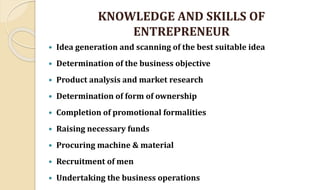
KNOWLEDGE AND SKILLS OF
ENTREPRENEUR
KNOWLEDGE AND SKILLS OF
ENTREPRENEUR
 Idea generation and scanning of the best suitable idea
 Determination of the business objective
 Product analysis and market research
 Determination of form of ownership
 Completion of promotional formalities
 Raising necessary funds
 Procuring machine & material
 Recruitment of men
 Undertaking the business operations
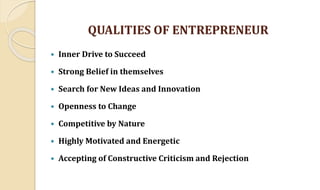
QUALITIES OF ENTREPRENEUR
 Inner Drive to Succeed
 Strong Belief in themselves
 Search for New Ideas and Innovation
 Openness to Change
 Competitive by Nature
 Highly Motivated and Energetic
 Accepting of Constructive Criticism and Rejection
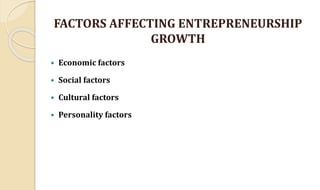
FACTORS AFFECTING ENTREPRENEURSHIP
GROWTH
 Economic factors
 Social factors
 Cultural factors
 Personality factors
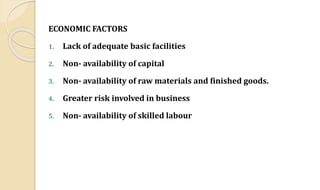
ECONOMIC FACTORS
1. Lack of adequate basic facilities
2. Non- availability of capital
3. Non- availability of raw materials and finished goods.
4. Greater risk involved in business
5. Non- availability of skilled labour
SOCIAL FACTORS
 Customs and traditions
 Rationality of the society
 Social system
 Social set-up
PERSONALITY FACTORS
 Suspect personality
 Emergence of planning
THANK YOU

Entrepreneurship Development

  • 1.
    ENTREPRENEURSHIP DEVELOPMENT UNIT –I ENTREPRENEURIAL COMPETENCE MBA – I Year | VCEW
  • 2.
    SYLLABUS UNIT – I– ENTREPRENEURIAL COMPETENCE Entrepreneurship concept – Entrepreneurship as a Career – Entrepreneurial Personality - Characteristics of Successful, Entrepreneur – Knowledge and Skills of Entrepreneur.
  • 3.
  • 4.
    ENTREPRENEURSHIP CONCEPT What ismeant by Entrepreneurship? Entrepreneurship can be defined by describing what entrepreneurs do. For example: "Entrepreneurs use personal initiative, and engage in calculated risk-taking, to create new business ventures by raising resources to apply innovative new ideas that solve problems, meet challenges, or satisfy the needs of a clearly defined market.
  • 5.
     Entrepreneurship involvesbringing about change to achieve some benefit. This benefit may be financial but it also involves the satisfaction of knowing you have changed something for the better.  Entrepreneurship is essentially the act of creation requiring the ability to recognize an opportunity, shape a goal, and take advantage of a situation. Entrepreneurs plan, persuade, raise resources, and give birth to new ventures."
  • 6.
    WHO IS ANENTREPRENEUR?  Entrepreneur is another name of Risk Taker.  An entrepreneur is an individual who takes moderate risks and brings innovation.  Entrepreneur is a person who organises/ manages the risks in his/her enterprise.  “Entrepreneur is a individual who takes risks and starts something new”
  • 7.
    DEFINITION OF ENTREPRENEUR Accordingto J. B. say, “Entrepreneur is an Economic agent to unites all the means of production” An entrepreneur is an individual who takes moderate risks and brings innovation. An entrepreneur is a person who has possession of a new enterprise, venture or idea and assumes significant accountability for the inherent risks and the outcome. An entrepreneur is "one who undertakes an enterprise, especially a contractor, acting as intermediately between capital and labour."
  • 8.
  • 9.
    ENTREPRENEURSHIP AS ACAREER Entrepreneurship involves designing of business idea followed by launching and running a new business. Typically, it begins as a small business, such as a start-up company. The business can involve offering a product, process or service for sale. The owners of such a venture are referred as 'entrepreneurs'.
  • 10.
    POSITIVE ASPECTS OFENTREPRENEURSHIP.  Working on one's own and thus getting rewards yields immense satisfaction and pleasure for more than what he can get in a job.  Monetary rewards can be more than commensurate with his capacity and capabilities  He can command deference and respect of his immediate family and friends. It is a kind of intangible reward  Instead of depending on others, he generates employment for others
  • 11.
     He canmake significant contribution to the development of the country and be proud of taking part in nation building activities.  He can be a great achiever realising his goals and proving his achievements to the world. He can be recognised for his outstanding efforts.
  • 12.
    NEGATIVE ASPECTS ENTREPRENEURSHIP Though an entrepreneur is his own boss, in some respects he is not. It is so because he is constrained by various people like his financiers, labourers, suppliers, customers and so on.  He may have to face frustration since the scope of his operations is limited by his limited resources.  He has to work long and hard hours from morning to dusk and his venture tends to absorb all his energy and time. This may affect his social and family life.
  • 13.
     At timeshe may have to face disappointments and frustrations since everything in his venture may not always work the way he would like it to.  He has to always work with tension since there is always the risk of failure.
  • 14.
  • 15.
    ENTREPRENEURIAL PERSONALITY There are9 types of personality in entrepreneurship  The Improver  The Advisor  The Superstar  The Artist  The Visionary  The Analyst
  • 16.
     The Fireball The Hero  The Healer
  • 17.
  • 18.
    CHARACTERISTICS OF SUCCESSFUL ENTREPRENEUR Capacity to take risk  Capacity to work hand  Above average intelligence and wide knowledge  Self Motivation  Vision and foresight  Willingness to defer consumption  Imagination initiative and emulation  Incentive ability and sound judgment
  • 19.
     Flexibility andsociability  Desire to take personal responsibility.  Desire to seek and use feedback  Persistence in the face of adversity  Innovativeness and future orientation  Mobility and drive  Creative Thinking.  Strong need for achievement
  • 20.
     Ability toMarshall resources  High degree of ambition  Will to conquer and impulse to fight.  Will to prove superior to others.
  • 21.
    KNOWLEDGE AND SKILLSOF ENTREPRENEUR
  • 22.
    KNOWLEDGE AND SKILLSOF ENTREPRENEUR  Idea generation and scanning of the best suitable idea  Determination of the business objective  Product analysis and market research  Determination of form of ownership  Completion of promotional formalities  Raising necessary funds  Procuring machine & material  Recruitment of men  Undertaking the business operations
  • 23.
    QUALITIES OF ENTREPRENEUR Inner Drive to Succeed  Strong Belief in themselves  Search for New Ideas and Innovation  Openness to Change  Competitive by Nature  Highly Motivated and Energetic  Accepting of Constructive Criticism and Rejection
  • 24.
    FACTORS AFFECTING ENTREPRENEURSHIP GROWTH Economic factors  Social factors  Cultural factors  Personality factors
  • 25.
    ECONOMIC FACTORS 1. Lackof adequate basic facilities 2. Non- availability of capital 3. Non- availability of raw materials and finished goods. 4. Greater risk involved in business 5. Non- availability of skilled labour
  • 26.
    SOCIAL FACTORS  Customsand traditions  Rationality of the society  Social system  Social set-up PERSONALITY FACTORS  Suspect personality  Emergence of planning
  • 27.