4
WHY DO YOUTHINK COMPANIES
CREATE PROTOTYPES BEFORE
LAUNCHING A PRODUCT?
5.
5
Prototype is createdbefore the massive production of
such product; an entrepreneur must consider
prototyping. One of the important early steps in the
inventing process is making a prototype. Most
importantly, it is better to test your product prototype to
meet customers’ needs and expectations; and for your
product to be known and saleable. Pretesting of the
product or service is similar to a sample of the product
or service given to the consumer free of cost in order
that he/she may try the product before committing to a
purchase.
6.
6
Most importantly, itis better to test your product
prototype to meet customers’ needs and expectations;
and for your product to be known and saleable.
Pretesting of the product or service is similar to a
sample of the product or service given to the consumer
free of cost in order that he/she may try the product
before committing to a purchase. The entrepreneur’s
main concern is the satisfaction of a customer, for they
are the life blood of the business. Without them, all the
efforts, will be wasted as well as the chance to venture
into a new business.
7.
7
PRODUCT PROTOTYPE
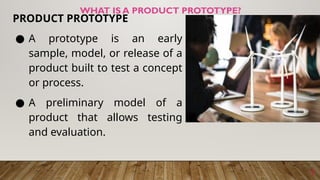
● Aprototype is an early
sample, model, or release of a
product built to test a concept
or process.
● A preliminary model of a
product that allows testing
and evaluation.
WHAT IS A PRODUCT PROTOTYPE?
8.
8
Designing means thatthe entrepreneur must render the
concept and translate it into its very physical and very
real dimension. This entails building a prototype of the
product that will be ready for actual testing by the
entrepreneur. Once your testing has finished, it is
important to document your findings for future use and
share them with the rest of the team. A unified
understanding of the insights will help to generate
empathy for the customer and create a team focus.
9.
9
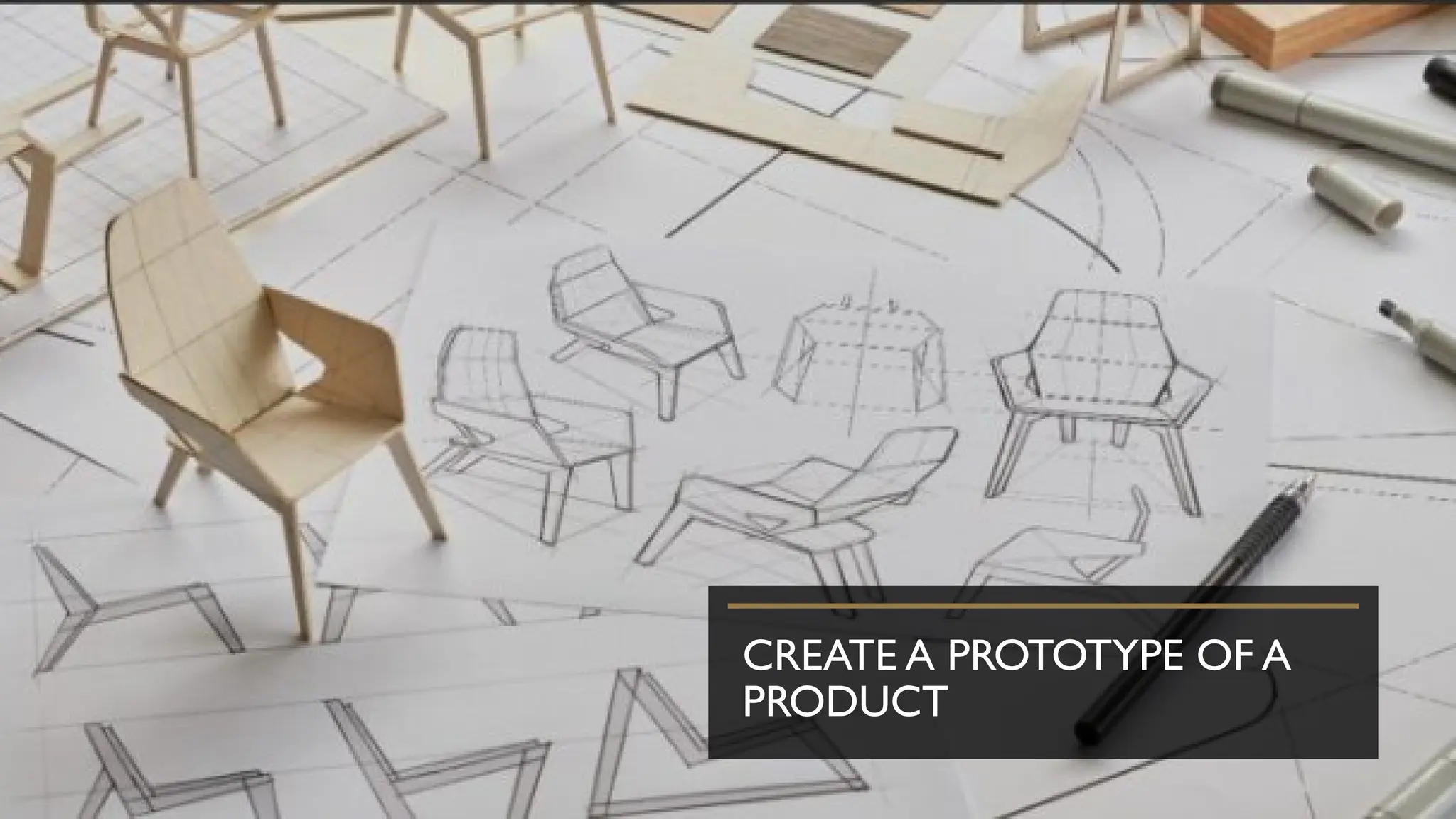
1. CREATE ACONCEPT SKETCH
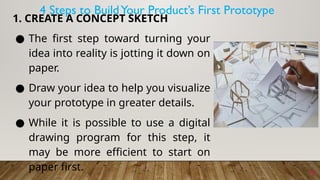
● The first step toward turning your
idea into reality is jotting it down on
paper.
● Draw your idea to help you visualize
your prototype in greater details.
● While it is possible to use a digital
drawing program for this step, it
may be more efficient to start on
paper first.
4 Steps to BuildYour Product’s First Prototype
10.
10
2. DEVELOP AVIRTUAL PROTOTYPE
● A standard digital design tool used by engineers
and other professionals is AutoCAD, which enables
them to make both 2-D and 3-D renderings.
● A 3-D rendering let you rotate and animate your
virtual sketch, so you can visualize it from all angles.
If you’re not skilled with computer drawing and
rendering tools, professional graphic designers or
prototype designers can assist you with this step.
4 Steps to BuildYour Product’s First Prototype
11.
11
3. BUILD APHYSICAL PROTOTYPE
● Once you have a virtual prototype, you’re ready to
build a physical prototype. If you have the skill, you
can build one for yourself. If you need help, there
are several types of resources you can tap to get this
step done. One way is going to a professional
prototype designer. An alternative is getting a
designer or engineer to build your prototype. If
you’re cash strapped, you might seek out a
handyman or advertise at an industrial design
college.
4 Steps to BuildYour Product’s First Prototype
12.
12
4. LOCATE AMANUFACTURER
● Once you have a working prototype, you’re
technically ready to apply for a patent; however, you
might want to take the additional step of locating a
manufacturer that can make your product at a
profitable price. If your idea is going to be
profitable, you need to build it at a cost that is low
enough that you can cover expenses without cutting
too far into your revenue.
4 Steps to BuildYour Product’s First Prototype
14
GROUP ACTIVITY: PRODUCTPROTOTYPING
1. In a group of 4 students, each group will create a new
product prototype which can be a variation of an existing
product with a point of difference.
2. Try to come up with your own version of product
prototype.
3. Share your output with your classmates and teacher
thru a video presentation and will be evaluated using a
rubric.
Editor's Notes
#2 For the answer key, please refer to the Answer Key of the study guide provided in the Teacher's Content.
#4 For the answer key, please refer to the Answer Key of the study guide provided in the Teacher's Content.