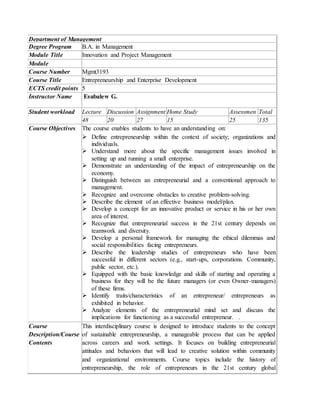
Department of Management
Degree Program B.A. in Management
Module Title Innovation and Project Management
Module
CoordinatorCourse Number Mgmt3193
Course Title Entrepreneurship and Enterprise Development
ECTS credit points 5
Instructor Name Esubalew G.
Student workload Lecture Discussion Assignment Home Study Assessmen
t
Total
48 20 27 15 25 135
Course Objectives The course enables students to have an understanding on:
 Define entrepreneurship within the context of society; organizations and
individuals.
 Understand more about the specific management issues involved in
setting up and running a small enterprise.
 Demonstrate an understanding of the impact of entrepreneurship on the
economy.
 Distinguish between an entrepreneurial and a conventional approach to
management.
 Recognize and overcome obstacles to creative problem-solving.
 Describe the element of an effective business model/plan.
 Develop a concept for an innovative product or service in his or her own
area of interest.
 Recognize that entrepreneurial success in the 21st century depends on
teamwork and diversity.
 Develop a personal framework for managing the ethical dilemmas and
social responsibilities facing entrepreneurs.
 Describe the leadership studies of entrepreneurs who have been
successful in different sectors (e.g., start-ups, corporations. Community,
public sector, etc.).
 Equipped with the basic knowledge and skills of starting and operating a
business for they will be the future managers (or even Owner-managers)
of these firms.
 Identify traits/characteristics of an entrepreneur/ entrepreneurs as
exhibited in behavior.
 Analyze elements of the entrepreneurial mind set and discuss the
implications for functioning as a successful entrepreneur. .
Course
Description/Course
Contents
This interdisciplinary course is designed to introduce students to the concept
of sustainable entrepreneurship, a manageable process that can be applied
across careers and work settings. It focuses on building entrepreneurial
attitudes and behaviors that will lead to creative solution within community
and organizational environments. Course topics include the history of
entrepreneurship, the role of entrepreneurs in the 21st century global
economy, and the identification of entrepreneurial opportunities. The
elements of creative problem solving, the development of a business
concept/model, the examination of feasibility studies and the social
/moral/ethical implication of entrepreneurship will be incorporated. Issues
related to starting and financing a new venture are included.
Pre-requisites No pre-requisite
Status of the
Course
Core
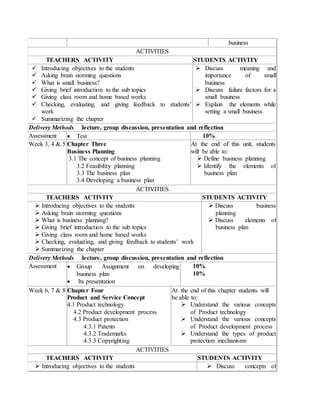
Week Topics and Sub Topics Course Objectives and Competences to
be Acquired
Week 1 Chapter One
Entrepreneurship and Free Enterprise
1.1. Definition and philosophy
1.2. History
1.3. Role within the economy
1.4. Entrepreneurship, creativity and
Innovation
After completing this unit, students will
be able to:
 Define entrepreneur and
entrepreneurship
 Identify the importance of
entrepreneurship
 Relate among Entrepreneurship,
creativity and Innovation
ACTIVITIES
TEACHERS ACTIVITY STUDENTS ACTIVITY
 Introducing objectives to the students
 Asking brain storming questions
 What is entrepreneurship?
 What is an entrepreneur?
 Giving brief introduction to the sub topics
 Giving class room and home based works
 Checking, evaluating, and giving feedback to students’
work
 Summarizing the chapter
 Define entrepreneur and
entrepreneurship
 Discuss importance of
entrepreneurship
Delivery Methods lecture, group discussion and reflection
Assessment QUIZ: 5%
Chapter Two
Small Business
2.1 Definition and importance
2.2 Economic social & political aspects of small
business enterprise
2.3 Small Business Failure factors.
2.4 Problems in Ethiopia small business
2.5 Setting Small Business
2.5.1 What is Basic Business Idea?
2.5.2 What project an Entrepreneur should have?
2.5.3 Definition of industry and small scale industry
2.5.4 Steps in setting a small scale unit
After completing this unit,
students will be able to:
 Explain the
meaning and
importance of
small business
 List the failure
factors for a small
business
 Understand the
elements while
setting a small
business
ACTIVITIES
TEACHERS ACTIVITY STUDENTS ACTIVITY
 Introducing objectives to the students
 Asking brain storming questions
 What is small business?
 Giving brief introduction to the sub topics
 Giving class room and home based works
 Checking, evaluating, and giving feedback to students’
work
 Summarizing the chapter
 Discuss meaning and
importance of small
business
 Discuss failure factors for a
small business
 Explain the elements while
setting a small business
Delivery Methods lecture, group discussion, presentation and reflection
Assessment  Test 10%
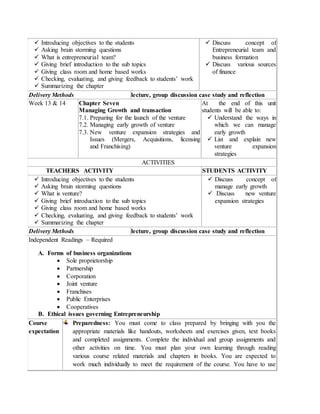
Week 3, 4 & 5 Chapter Three
Business Planning
3.1 The concept of business planning
3.2 Feasibility planning
3.3 The business plan
3.4 Developing a business plan
At the end of this unit, students
will be able to:
 Define business planning
 Identify the elements of
business plan
ACTIVITIES
TEACHERS ACTIVITY STUDENTS ACTIVITY
 Introducing objectives to the students
 Asking brain storming questions
 What is business planning?
 Giving brief introduction to the sub topics
 Giving class room and home based works
 Checking, evaluating, and giving feedback to students’ work
 Summarizing the chapter
 Discuss business
planning
 Discuss elements of
business plan
Delivery Methods lecture, group discussion, presentation and reflection
Assessment  Group Assignment on developing
business plan
 Its presentation
10%
10%
Week 6, 7 & 8 Chapter Four
Product and Service Concept
4.1 Product technology
4.2 Product development process
4.3 Product protection
4.3.1 Patents
4.3.2 Trademarks
4.3.3 Copyrighting
At the end of this chapter students will
be able to:
 Understand the various concepts
of Product technology
 Understand the various concepts
of Product development process
 Understand the types of product
protection mechanisms
ACTIVITIES
TEACHERS ACTIVITY STUDENTS ACTIVITY
 Introducing objectives to the students  Discuss concepts of
 Asking brain storming questions
 What is product?
 What are the means to protect a product?
 Giving brief introduction to the sub topics
 Giving class room and home based works
 Checking, evaluating, and giving feedback to students’ work
 Summarizing the chapter
Product technology
 Discuss Product
development process
and product protection
mechanisms
Delivery Methods lecture, group discussion and reflection
Assessment  Quiz 5%
Week 9& 10 Chapter Five
Marketing and new venture development
5.1 Marketing research
5.2 Marketing intelligence
5.3 Competitive analysis
5.4 Marketing strategies
5.5 International markets
At the end of this unit students will
be able to:
 Explain the concept of
Marketing research
 Explain the term Marketing
intelligence
 Understand the concept of
Marketing strategies and
International markets
ACTIVITIES
TEACHERS ACTIVITY STUDENTS ACTIVITY
 Introducing objectives to the students
 Asking brain storming questions
 What is the difference between marketing research and
marketing intelligence?
 Giving brief introduction to the sub topics
 Giving class room and home based works
 Checking, evaluating, and giving feedback to students’ work
 Summarizing the chapter
 Discuss concept of
Marketing research
 Discuss of Marketing
strategies and
International markets
Delivery Methods lecture, group discussion case study and reflection
Assessment  Individual assignment 10%
Week 11 & 12 Chapter Six
Organizing and financing the new venture
6.1 Entrepreneurial team and business formation
6.2. Sources of financing
6.2.1 Asset management
6.2.2 Equity Financing
6.2.3 Venture Capital
6.2.4 Debt financing
6.2.5 Government Programs
At the end of this unit students
will be able to:
 Understand the concept of
Entrepreneurial team and
business formation
 List out the various
sources of finance
ACTIVITIES
TEACHERS ACTIVITY STUDENTS ACTIVITY
 Introducing objectives to the students
 Asking brain storming questions
 What is entrepreneurial team?
 Giving brief introduction to the sub topics
 Giving class room and home based works
 Checking, evaluating, and giving feedback to students’ work
 Summarizing the chapter
 Discuss concept of
Entrepreneurial team and
business formation
 Discuss various sources
of finance
Delivery Methods lecture, group discussion case study and reflection
Week 13 & 14 Chapter Seven
Managing Growth and transaction
7.1. Preparing for the launch of the venture
7.2. Managing early growth of venture
7.3. New venture expansion strategies and
Issues (Mergers, Acquisitions, licensing
and Franchising)
At the end of this unit
students will be able to:
 Understand the ways in
which we can manage
early growth
 List and explain new
venture expansion
strategies
ACTIVITIES
TEACHERS ACTIVITY STUDENTS ACTIVITY
 Introducing objectives to the students
 Asking brain storming questions
 What is venture?
 Giving brief introduction to the sub topics
 Giving class room and home based works
 Checking, evaluating, and giving feedback to students’ work
 Summarizing the chapter
 Discuss concept of
manage early growth
 Discuss new venture
expansion strategies
Delivery Methods lecture, group discussion case study and reflection
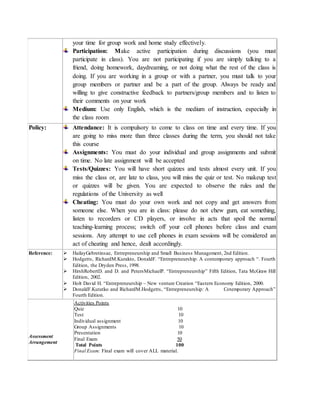
Independent Readings – Required
A. Forms of business organizations
 Sole proprietorship
 Partnership
 Corporation
 Joint venture
 Franchises
 Public Enterprises
 Cooperatives
B. Ethical issues governing Entrepreneurship
Course
expectation
Preparedness: You must come to class prepared by bringing with you the
appropriate materials like handouts, worksheets and exercises given, text books
and completed assignments. Complete the individual and group assignments and
other activities on time. You must plan your own learning through reading
various course related materials and chapters in books. You are expected to
work much individually to meet the requirement of the course. You have to use
your time for group work and home study effectively.
Participation: Make active participation during discussions (you must
participate in class). You are not participating if you are simply talking to a
friend, doing homework, daydreaming, or not doing what the rest of the class is
doing. If you are working in a group or with a partner, you must talk to your
group members or partner and be a part of the group. Always be ready and
willing to give constructive feedback to partners/group members and to listen to
their comments on your work
Medium: Use only English, which is the medium of instruction, especially in
the class room
Policy: Attendance: It is compulsory to come to class on time and every time. If you
are going to miss more than three classes during the term, you should not take
this course
Assignments: You must do your individual and group assignments and submit
on time. No late assignment will be accepted
Tests/Quizzes: You will have short quizzes and tests almost every unit. If you
miss the class or, are late to class, you will miss the quiz or test. No makeup test
or quizzes will be given. You are expected to observe the rules and the
regulations of the University as well
Cheating: You must do your own work and not copy and get answers from
someone else. When you are in class: please do not chew gum, eat something,
listen to recorders or CD players, or involve in acts that spoil the normal
teaching-learning process; switch off your cell phones before class and exam
sessions. Any attempt to use cell phones in exam sessions will be considered an
act of cheating and hence, dealt accordingly.
Reference:  HailayGebretinsae, Entrepreneurship and Small Business Management, 2nd Edition.
 Hodgetts, RichardM.Kurakto, DonaldF. “Entrepreneurship: A contemporary approach “. Fourth
Edition, the Dryden Press, 1998.
 HirshRobertD. and D. and PetersMichaelP. “Entrepreneurship” Fifth Edition, Tata McGraw Hill
Edition, 2002.
 Holt David H. “Entrepreneurship – New venture Creation “Eastern Economy Edition, 2000.
 DonaldF.Kutatko and RichardM.Hodgetts, “Entrepreneurship: A Cotemporary Approach”
Fourth Edition.
Assessment
Arrangement
Activities Points
Quiz 10
Test 10
Individual assignment 10
Group Assignments 10
Presentation 10
Final Exam 50
Total Points 100
Final Exam: Final exam will cover ALL material.

Entrepreneurship course outline

  • 1.
    Department of Management DegreeProgram B.A. in Management Module Title Innovation and Project Management Module CoordinatorCourse Number Mgmt3193 Course Title Entrepreneurship and Enterprise Development ECTS credit points 5 Instructor Name Esubalew G. Student workload Lecture Discussion Assignment Home Study Assessmen t Total 48 20 27 15 25 135 Course Objectives The course enables students to have an understanding on:  Define entrepreneurship within the context of society; organizations and individuals.  Understand more about the specific management issues involved in setting up and running a small enterprise.  Demonstrate an understanding of the impact of entrepreneurship on the economy.  Distinguish between an entrepreneurial and a conventional approach to management.  Recognize and overcome obstacles to creative problem-solving.  Describe the element of an effective business model/plan.  Develop a concept for an innovative product or service in his or her own area of interest.  Recognize that entrepreneurial success in the 21st century depends on teamwork and diversity.  Develop a personal framework for managing the ethical dilemmas and social responsibilities facing entrepreneurs.  Describe the leadership studies of entrepreneurs who have been successful in different sectors (e.g., start-ups, corporations. Community, public sector, etc.).  Equipped with the basic knowledge and skills of starting and operating a business for they will be the future managers (or even Owner-managers) of these firms.  Identify traits/characteristics of an entrepreneur/ entrepreneurs as exhibited in behavior.  Analyze elements of the entrepreneurial mind set and discuss the implications for functioning as a successful entrepreneur. . Course Description/Course Contents This interdisciplinary course is designed to introduce students to the concept of sustainable entrepreneurship, a manageable process that can be applied across careers and work settings. It focuses on building entrepreneurial attitudes and behaviors that will lead to creative solution within community and organizational environments. Course topics include the history of entrepreneurship, the role of entrepreneurs in the 21st century global
  • 2.
    economy, and theidentification of entrepreneurial opportunities. The elements of creative problem solving, the development of a business concept/model, the examination of feasibility studies and the social /moral/ethical implication of entrepreneurship will be incorporated. Issues related to starting and financing a new venture are included. Pre-requisites No pre-requisite Status of the Course Core Week Topics and Sub Topics Course Objectives and Competences to be Acquired Week 1 Chapter One Entrepreneurship and Free Enterprise 1.1. Definition and philosophy 1.2. History 1.3. Role within the economy 1.4. Entrepreneurship, creativity and Innovation After completing this unit, students will be able to:  Define entrepreneur and entrepreneurship  Identify the importance of entrepreneurship  Relate among Entrepreneurship, creativity and Innovation ACTIVITIES TEACHERS ACTIVITY STUDENTS ACTIVITY  Introducing objectives to the students  Asking brain storming questions  What is entrepreneurship?  What is an entrepreneur?  Giving brief introduction to the sub topics  Giving class room and home based works  Checking, evaluating, and giving feedback to students’ work  Summarizing the chapter  Define entrepreneur and entrepreneurship  Discuss importance of entrepreneurship Delivery Methods lecture, group discussion and reflection Assessment QUIZ: 5% Chapter Two Small Business 2.1 Definition and importance 2.2 Economic social & political aspects of small business enterprise 2.3 Small Business Failure factors. 2.4 Problems in Ethiopia small business 2.5 Setting Small Business 2.5.1 What is Basic Business Idea? 2.5.2 What project an Entrepreneur should have? 2.5.3 Definition of industry and small scale industry 2.5.4 Steps in setting a small scale unit After completing this unit, students will be able to:  Explain the meaning and importance of small business  List the failure factors for a small business  Understand the elements while setting a small
  • 3.
    business ACTIVITIES TEACHERS ACTIVITY STUDENTSACTIVITY  Introducing objectives to the students  Asking brain storming questions  What is small business?  Giving brief introduction to the sub topics  Giving class room and home based works  Checking, evaluating, and giving feedback to students’ work  Summarizing the chapter  Discuss meaning and importance of small business  Discuss failure factors for a small business  Explain the elements while setting a small business Delivery Methods lecture, group discussion, presentation and reflection Assessment  Test 10% Week 3, 4 & 5 Chapter Three Business Planning 3.1 The concept of business planning 3.2 Feasibility planning 3.3 The business plan 3.4 Developing a business plan At the end of this unit, students will be able to:  Define business planning  Identify the elements of business plan ACTIVITIES TEACHERS ACTIVITY STUDENTS ACTIVITY  Introducing objectives to the students  Asking brain storming questions  What is business planning?  Giving brief introduction to the sub topics  Giving class room and home based works  Checking, evaluating, and giving feedback to students’ work  Summarizing the chapter  Discuss business planning  Discuss elements of business plan Delivery Methods lecture, group discussion, presentation and reflection Assessment  Group Assignment on developing business plan  Its presentation 10% 10% Week 6, 7 & 8 Chapter Four Product and Service Concept 4.1 Product technology 4.2 Product development process 4.3 Product protection 4.3.1 Patents 4.3.2 Trademarks 4.3.3 Copyrighting At the end of this chapter students will be able to:  Understand the various concepts of Product technology  Understand the various concepts of Product development process  Understand the types of product protection mechanisms ACTIVITIES TEACHERS ACTIVITY STUDENTS ACTIVITY  Introducing objectives to the students  Discuss concepts of
  • 4.
     Asking brainstorming questions  What is product?  What are the means to protect a product?  Giving brief introduction to the sub topics  Giving class room and home based works  Checking, evaluating, and giving feedback to students’ work  Summarizing the chapter Product technology  Discuss Product development process and product protection mechanisms Delivery Methods lecture, group discussion and reflection Assessment  Quiz 5% Week 9& 10 Chapter Five Marketing and new venture development 5.1 Marketing research 5.2 Marketing intelligence 5.3 Competitive analysis 5.4 Marketing strategies 5.5 International markets At the end of this unit students will be able to:  Explain the concept of Marketing research  Explain the term Marketing intelligence  Understand the concept of Marketing strategies and International markets ACTIVITIES TEACHERS ACTIVITY STUDENTS ACTIVITY  Introducing objectives to the students  Asking brain storming questions  What is the difference between marketing research and marketing intelligence?  Giving brief introduction to the sub topics  Giving class room and home based works  Checking, evaluating, and giving feedback to students’ work  Summarizing the chapter  Discuss concept of Marketing research  Discuss of Marketing strategies and International markets Delivery Methods lecture, group discussion case study and reflection Assessment  Individual assignment 10% Week 11 & 12 Chapter Six Organizing and financing the new venture 6.1 Entrepreneurial team and business formation 6.2. Sources of financing 6.2.1 Asset management 6.2.2 Equity Financing 6.2.3 Venture Capital 6.2.4 Debt financing 6.2.5 Government Programs At the end of this unit students will be able to:  Understand the concept of Entrepreneurial team and business formation  List out the various sources of finance ACTIVITIES TEACHERS ACTIVITY STUDENTS ACTIVITY
  • 5.
     Introducing objectivesto the students  Asking brain storming questions  What is entrepreneurial team?  Giving brief introduction to the sub topics  Giving class room and home based works  Checking, evaluating, and giving feedback to students’ work  Summarizing the chapter  Discuss concept of Entrepreneurial team and business formation  Discuss various sources of finance Delivery Methods lecture, group discussion case study and reflection Week 13 & 14 Chapter Seven Managing Growth and transaction 7.1. Preparing for the launch of the venture 7.2. Managing early growth of venture 7.3. New venture expansion strategies and Issues (Mergers, Acquisitions, licensing and Franchising) At the end of this unit students will be able to:  Understand the ways in which we can manage early growth  List and explain new venture expansion strategies ACTIVITIES TEACHERS ACTIVITY STUDENTS ACTIVITY  Introducing objectives to the students  Asking brain storming questions  What is venture?  Giving brief introduction to the sub topics  Giving class room and home based works  Checking, evaluating, and giving feedback to students’ work  Summarizing the chapter  Discuss concept of manage early growth  Discuss new venture expansion strategies Delivery Methods lecture, group discussion case study and reflection Independent Readings – Required A. Forms of business organizations  Sole proprietorship  Partnership  Corporation  Joint venture  Franchises  Public Enterprises  Cooperatives B. Ethical issues governing Entrepreneurship Course expectation Preparedness: You must come to class prepared by bringing with you the appropriate materials like handouts, worksheets and exercises given, text books and completed assignments. Complete the individual and group assignments and other activities on time. You must plan your own learning through reading various course related materials and chapters in books. You are expected to work much individually to meet the requirement of the course. You have to use
  • 6.
    your time forgroup work and home study effectively. Participation: Make active participation during discussions (you must participate in class). You are not participating if you are simply talking to a friend, doing homework, daydreaming, or not doing what the rest of the class is doing. If you are working in a group or with a partner, you must talk to your group members or partner and be a part of the group. Always be ready and willing to give constructive feedback to partners/group members and to listen to their comments on your work Medium: Use only English, which is the medium of instruction, especially in the class room Policy: Attendance: It is compulsory to come to class on time and every time. If you are going to miss more than three classes during the term, you should not take this course Assignments: You must do your individual and group assignments and submit on time. No late assignment will be accepted Tests/Quizzes: You will have short quizzes and tests almost every unit. If you miss the class or, are late to class, you will miss the quiz or test. No makeup test or quizzes will be given. You are expected to observe the rules and the regulations of the University as well Cheating: You must do your own work and not copy and get answers from someone else. When you are in class: please do not chew gum, eat something, listen to recorders or CD players, or involve in acts that spoil the normal teaching-learning process; switch off your cell phones before class and exam sessions. Any attempt to use cell phones in exam sessions will be considered an act of cheating and hence, dealt accordingly. Reference:  HailayGebretinsae, Entrepreneurship and Small Business Management, 2nd Edition.  Hodgetts, RichardM.Kurakto, DonaldF. “Entrepreneurship: A contemporary approach “. Fourth Edition, the Dryden Press, 1998.  HirshRobertD. and D. and PetersMichaelP. “Entrepreneurship” Fifth Edition, Tata McGraw Hill Edition, 2002.  Holt David H. “Entrepreneurship – New venture Creation “Eastern Economy Edition, 2000.  DonaldF.Kutatko and RichardM.Hodgetts, “Entrepreneurship: A Cotemporary Approach” Fourth Edition. Assessment Arrangement Activities Points Quiz 10 Test 10 Individual assignment 10 Group Assignments 10 Presentation 10 Final Exam 50 Total Points 100 Final Exam: Final exam will cover ALL material.