MAHARASHTRA INSTITUTE OF
   TECHNOLOGY
   AURANGABAD
   (PLASTICS & POLYMER ENGINEERING
   DEPT.)

   PRESENTATION ON: -

   ENTREPRENEURSHIP

NAME- Anshul Gautampurkar
CLASS- T.Y. (P.P.E.)
ROLL NO.- T3715
OVERVIEW: -

 What is an entrepreneur?
 Characteristics of an entrepreneur

 Planning to be an entrepreneur

 Growth pressures, managing a family
  business, and corporate intrapreneurship
ENTREPRENEURS: -

 Do things that are not generally done in the
  ordinary course of business
 Some entrepreneurs become
  celebrities...others become ridiculed for their
  failed dreams
 All contribute to the spirit of free enterprise
ENTREPRENEURS V/S INTRAPRENEURS: -
 Entrepreneurs are people that notice
  opportunities and take the initiative to
  mobilize resources to make new goods and
  services.
 Intrapreneurs also notice opportunities and
  take initiative to mobilize resources, however
  they work in large companies and contribute
  to the innovation of the firm.

   Intrapreneurs often become entrepreneurs.
ENTREPRENEURSHIP:-
 Entreprendre...17th century French...the
  individual who undertook the risk of a new
  enterprise... “undertakers”.
 They were “contractors” who bore the risks of
  profit or loss.
 Entrepreneurs are not equal to
  inventors...inventor might only create anew
  product, whereas an entrepreneur will gather
  resources, organize talent, and provide
  leadership to make it a commercial success.
ENTREPRENEURS:                                                  -
MANY DEFINITIONS, ONE MEANING

   Adam Smith...The Wealth of Nations: spoke of the
    “enterpriser” as an individual who undertook the formation of
    an organization for commercial purposes
   A. Smith...mentioned “role of industrialist...,person with
    unusual foresight who could recognize potential demand for
    goods and services”
   John Stuart Mill...describes an entrepreneur as a business
    founder
   Carl Menger...Principles of Economics: “Economic change
    does not arise from circumstances but from an individual’s
    awareness and understanding of those circumstances
WHO ARE ENTREPRENEURS ?
   Common traits
     Original thinkers
     Risk takers
     Take responsibility for own actions
     Feel competent and capable
     Set high goals and enjoy working toward them
     Self employed parents
     Firstborns
     Between 30-50 years old
     Well educated – 80% have college degree and 1/3
      have a graduate level degree
ENTREPRENEURS...TRAITS II

 Energetic and diligent
 Creative, need to achieve

 Dynamic Leader

 Responsive to suggestions

 Take initiatives

 Resourceful and persevering

 Perceptive with foresight
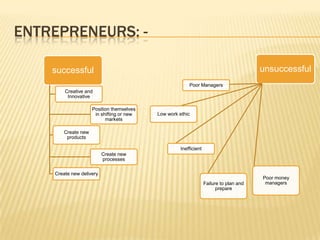
ENTREPRENEURS: -

    successful                                                                          unsuccessful
                                                        Poor Managers
        Creative and
         Innovative

                    Position themselves
                     in shifting or new   Low work ethic
                          markets

       Create new
        products

                                                    Inefficient
                          Create new
                          processes

    Create new delivery
                                                                                        Poor money
                                                                  Failure to plan and    managers
                                                                        prepare
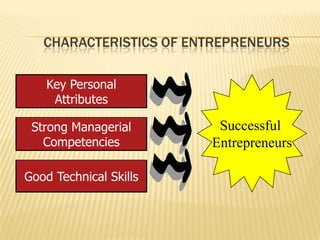
CHARACTERISTICS OF ENTREPRENEURS

    Key Personal
     Attributes

 Strong Managerial       Successful
   Competencies         Entrepreneurs

Good Technical Skills
ENTREPRENEURSHIP

 Is a dynamic process of creating incremental
  wealth. This wealth is created by individuals
  who assume the major risks in terms of
  equity, time and career commitment of
  providing value for some product or service
 The entrepreneur must somehow infuse
  value to the product or service...
THE DIFFERENCE BETWEEN INVENTION AND
INNOVATION IS:
 Invention - is the creation of new products,
  processes, and technologies not previously
  known to exist.
 Innovation - is the transformation of creative
  ideas into useful applications by combining
  resources in new or unusual ways to provide
  value to society for or improved products,
  technology, or services.
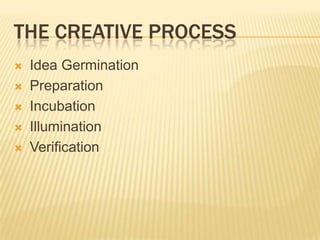
THE CREATIVE PROCESS
   Idea Germination
   Preparation
   Incubation
   Illumination
   Verification
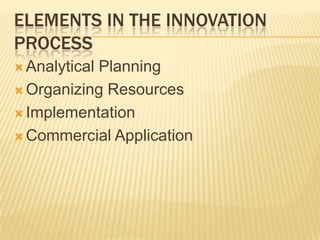
ELEMENTS IN THE INNOVATION
PROCESS
 Analytical
           Planning
 Organizing Resources

 Implementation

 Commercial Application
KEY PERSONAL ATTRIBUTES
   Entrepreneurs are Made, Not Born!
       Many of these key attributes are developed early in life,
        with the family environment playing an important role
       Entrepreneurs tend to have had self employed parents
        who tend to support and encourage independence,
        achievement, and responsibility
       Firstborns tend to have more entrepreneurial attributes
        because they receive more attention, have to forge their
        own way, thus creating higher self-confidence
KEY PERSONAL ATTRIBUTES (CONT.)

   Need for Achievement
       A person’s desire either for excellence or to succeed in
        competitive situations
       High achievers take responsibility for attaining their
        goals, set moderately difficult goals, and want immediate
        feedback on their performance
       Success is measured in terms of what those efforts have
        accomplished
       McClelland’s research
KEY PERSONAL ATTRIBUTES (CONT.)

   Desire for Independence
       Entrepreneurs often seek independence from others
       As a result, they generally aren’t motivated to perform
        well in large, bureaucratic organizations
       Entrepreneurs have internal drive, are confident in their
        own abilities, and possess a great deal of self-respect
KEY PERSONAL ATTRIBUTES (CONT.)

   Self-Confidence
       Because of the high risks involved in running an
        entrepreneurial organization, having an “upbeat” and
        self-confident attitude is essential
       A successful track record leads to improved self-
        confidence and self-esteem
       Self-confidence enables that person to be optimistic in
        representing the firm to employees and customers alike
QUESTIONS TO KEEP IN MIND
   What are my motivations for owning a business?

   Should I start or buy a business?

   What and where is the market for what I want to sell?

   How much will all this cost me?

   Should my company be domestic or global?
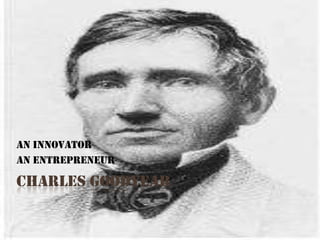
An innovator
An entrepreneur

CHARLES GOODYEAR
CHARLES GOODYEAR-
    AN INNOVATOR, AN ENTREPRENEUR.
   Charles Goodyear was born in New Haven Connecticut, on 29th December, 1800.
   In 1814, learnt the hardware business and worked industriously until he was twenty-
    one years old, and then, returning to Connecticut, entered into partnership in his
    father's business in Naugatuck, where they manufactured ivory and metal buttons,
    and a variety of agricultural implements.
   In 1826, opened a hardware store, where he did most of his work. His specialties
    were the valuable agricultural implements that his firm had been manufacturing, he
    found himself heading a successful business.
     This continued to increase until between 1829 and 1830 he broke down in health,
    being troubled with dyspepsia. At the same time came the failure of a number of
    business houses that seriously embarrassed his firm. They struggled and finally
    failed.
   Between the years 1831 and 1832, the condition of his products was such that they
    had to be tested for a year before it could be determined if they were perfect or not.
    To their surprise, thousands of dollars worth of goods that they had determined to be
    of good quality were being returned, the gum having rotted, making them useless.
    Goodyear at once made up his mind to experiment on this gum and see if he could
    overcome the problems with these rubber products.
   By then a creditor had him arrested and imprisoned. While there, he tried his first experiments
    with India rubber and he managed to incorporate in it a certain amount of magnesia which
    produced a beautiful white compound and appeared to take away the stickiness.
   He thought he had discovered the secret, and improved his invention in New Haven. The first
    thing that he made was shoes, and he used his own house for grinding, calendering and
    vulcanizing. His compound at this time consisted of India rubber, lampblack, and magnesia, the
    whole dissolved in turpentine and spread upon the flannel cloth which served as the lining for
    the shoes. It was not long, however, before he discovered that the gum, even treated this way,
    became sticky. His creditors, completely discouraged, decided that he would not be allowed to
    go further in his research.
   Goodyear, however, had no mind to stop here in his experiments. Selling his furniture and
    placing his family in a quiet boarding place, continued his experiments. His next step was to
    compound the rubber with magnesia and then boil it in quicklime and water. This appeared to
    solve the problem. At once it was noticed abroad that he had treated India rubber to lose its
    stickiness, and he received international acclamation. He seemed on the high road to success,
    but still his products were vulnerable even to weak acids.
   In the line of these, he discovered that rubber dipped in nitric acid formed a surface cure, and
    he made many products with this acid cure which were held in high regard.
   Exposure to such harsh chemicals, adversely affected his health, and once nearly suffocated by
    gas generated in his laboratory. Goodyear some how survived.
   Together with an old business partner, he built up a factory and began to make clothing, life
    preservers, rubber shoes, and a great variety of rubber goods. But due to the panic of 1837 he
    again went bankrupted.
   His next move was to go to Boston, where he became acquainted with J. Haskins, of the
    Roxbury Rubber Company. Goodyear found him to be a good friend, who lent him money and
    stood by him when no one would have anything to do with the visionary inventor. He therefore
    invented a huge machine for doing the mixing by mechanical means. The goods that were
    made in this way were beautiful to look at, and it appeared, as it had before, that all difficulties
    were overcome.
   Goodyear discovered a new method for making rubber shoes and received a patent which he
    sold to the Providence Company in Rhode Island. However, a method had not yet been found
    to process rubber so that it would withstand hot and cold temperatures and acids, and so the
    rubber goods were constantly growing sticky, decomposing and being returned to the
THE LAST ONE


   In 1838, Goodyear met Nathaniel Hayward in Woburn, Massachusetts, where
    Hayward was running a factory. Some time after this Goodyear himself moved to
    Woburn, all the time continuing his experiments. He was very much interested in
    Hayward's sulfur experiments for drying rubber. Hayward told Goodyear that he had
    used sulfur in rubber manufacturing.
   Some say (Damian Francis Mullin, circa Feb 1865) that Goodyear tried the
    experiment with a similar material over an open flame, and saw that the gum elastic
    was charred, but on the edge of the charred areas were portions that were not
    charred, but were instead perfectly cured. Other sources claim that Goodyear
    accidentally spilled the rubber mixture on a hot stove. The key discovery was that
    heating natural rubber and sulfur created vulcanized rubber. This process was
    eventually refined to become the vulcanizing process.
   The inventor himself admitted that the discovery of the vulcanizing process was not
    the direct result of the scientific method, but claims that it was not accidental. Rather
    it was the result of application and observation.
THANK YOU


  HAVE
   A
  NICE
  DAY

Entrepreneurship

  • 1.
    MAHARASHTRA INSTITUTE OF TECHNOLOGY AURANGABAD (PLASTICS & POLYMER ENGINEERING DEPT.) PRESENTATION ON: - ENTREPRENEURSHIP NAME- Anshul Gautampurkar CLASS- T.Y. (P.P.E.) ROLL NO.- T3715
  • 2.
    OVERVIEW: -  Whatis an entrepreneur?  Characteristics of an entrepreneur  Planning to be an entrepreneur  Growth pressures, managing a family business, and corporate intrapreneurship
  • 3.
    ENTREPRENEURS: -  Dothings that are not generally done in the ordinary course of business  Some entrepreneurs become celebrities...others become ridiculed for their failed dreams  All contribute to the spirit of free enterprise
  • 4.
    ENTREPRENEURS V/S INTRAPRENEURS:-  Entrepreneurs are people that notice opportunities and take the initiative to mobilize resources to make new goods and services.  Intrapreneurs also notice opportunities and take initiative to mobilize resources, however they work in large companies and contribute to the innovation of the firm.  Intrapreneurs often become entrepreneurs.
  • 5.
    ENTREPRENEURSHIP:-  Entreprendre...17th centuryFrench...the individual who undertook the risk of a new enterprise... “undertakers”.  They were “contractors” who bore the risks of profit or loss.  Entrepreneurs are not equal to inventors...inventor might only create anew product, whereas an entrepreneur will gather resources, organize talent, and provide leadership to make it a commercial success.
  • 6.
    ENTREPRENEURS: - MANY DEFINITIONS, ONE MEANING  Adam Smith...The Wealth of Nations: spoke of the “enterpriser” as an individual who undertook the formation of an organization for commercial purposes  A. Smith...mentioned “role of industrialist...,person with unusual foresight who could recognize potential demand for goods and services”  John Stuart Mill...describes an entrepreneur as a business founder  Carl Menger...Principles of Economics: “Economic change does not arise from circumstances but from an individual’s awareness and understanding of those circumstances
  • 7.
    WHO ARE ENTREPRENEURS?  Common traits  Original thinkers  Risk takers  Take responsibility for own actions  Feel competent and capable  Set high goals and enjoy working toward them  Self employed parents  Firstborns  Between 30-50 years old  Well educated – 80% have college degree and 1/3 have a graduate level degree
  • 8.
    ENTREPRENEURS...TRAITS II  Energeticand diligent  Creative, need to achieve  Dynamic Leader  Responsive to suggestions  Take initiatives  Resourceful and persevering  Perceptive with foresight
  • 9.
    ENTREPRENEURS: - successful unsuccessful Poor Managers Creative and Innovative Position themselves in shifting or new Low work ethic markets Create new products Inefficient Create new processes Create new delivery Poor money Failure to plan and managers prepare
  • 10.
    CHARACTERISTICS OF ENTREPRENEURS Key Personal Attributes Strong Managerial Successful Competencies Entrepreneurs Good Technical Skills
  • 11.
    ENTREPRENEURSHIP  Is adynamic process of creating incremental wealth. This wealth is created by individuals who assume the major risks in terms of equity, time and career commitment of providing value for some product or service  The entrepreneur must somehow infuse value to the product or service...
  • 12.
    THE DIFFERENCE BETWEENINVENTION AND INNOVATION IS:  Invention - is the creation of new products, processes, and technologies not previously known to exist.  Innovation - is the transformation of creative ideas into useful applications by combining resources in new or unusual ways to provide value to society for or improved products, technology, or services.
  • 13.
    THE CREATIVE PROCESS  Idea Germination  Preparation  Incubation  Illumination  Verification
  • 14.
    ELEMENTS IN THEINNOVATION PROCESS  Analytical Planning  Organizing Resources  Implementation  Commercial Application
  • 15.
    KEY PERSONAL ATTRIBUTES  Entrepreneurs are Made, Not Born!  Many of these key attributes are developed early in life, with the family environment playing an important role  Entrepreneurs tend to have had self employed parents who tend to support and encourage independence, achievement, and responsibility  Firstborns tend to have more entrepreneurial attributes because they receive more attention, have to forge their own way, thus creating higher self-confidence
  • 16.
    KEY PERSONAL ATTRIBUTES(CONT.)  Need for Achievement  A person’s desire either for excellence or to succeed in competitive situations  High achievers take responsibility for attaining their goals, set moderately difficult goals, and want immediate feedback on their performance  Success is measured in terms of what those efforts have accomplished  McClelland’s research
  • 17.
    KEY PERSONAL ATTRIBUTES(CONT.)  Desire for Independence  Entrepreneurs often seek independence from others  As a result, they generally aren’t motivated to perform well in large, bureaucratic organizations  Entrepreneurs have internal drive, are confident in their own abilities, and possess a great deal of self-respect
  • 18.
    KEY PERSONAL ATTRIBUTES(CONT.)  Self-Confidence  Because of the high risks involved in running an entrepreneurial organization, having an “upbeat” and self-confident attitude is essential  A successful track record leads to improved self- confidence and self-esteem  Self-confidence enables that person to be optimistic in representing the firm to employees and customers alike
  • 19.
    QUESTIONS TO KEEPIN MIND  What are my motivations for owning a business?  Should I start or buy a business?  What and where is the market for what I want to sell?  How much will all this cost me?  Should my company be domestic or global?
  • 20.
  • 21.
    CHARLES GOODYEAR- AN INNOVATOR, AN ENTREPRENEUR.  Charles Goodyear was born in New Haven Connecticut, on 29th December, 1800.  In 1814, learnt the hardware business and worked industriously until he was twenty- one years old, and then, returning to Connecticut, entered into partnership in his father's business in Naugatuck, where they manufactured ivory and metal buttons, and a variety of agricultural implements.  In 1826, opened a hardware store, where he did most of his work. His specialties were the valuable agricultural implements that his firm had been manufacturing, he found himself heading a successful business. This continued to increase until between 1829 and 1830 he broke down in health, being troubled with dyspepsia. At the same time came the failure of a number of business houses that seriously embarrassed his firm. They struggled and finally failed.  Between the years 1831 and 1832, the condition of his products was such that they had to be tested for a year before it could be determined if they were perfect or not. To their surprise, thousands of dollars worth of goods that they had determined to be of good quality were being returned, the gum having rotted, making them useless. Goodyear at once made up his mind to experiment on this gum and see if he could overcome the problems with these rubber products.
  • 22.
    By then a creditor had him arrested and imprisoned. While there, he tried his first experiments with India rubber and he managed to incorporate in it a certain amount of magnesia which produced a beautiful white compound and appeared to take away the stickiness.  He thought he had discovered the secret, and improved his invention in New Haven. The first thing that he made was shoes, and he used his own house for grinding, calendering and vulcanizing. His compound at this time consisted of India rubber, lampblack, and magnesia, the whole dissolved in turpentine and spread upon the flannel cloth which served as the lining for the shoes. It was not long, however, before he discovered that the gum, even treated this way, became sticky. His creditors, completely discouraged, decided that he would not be allowed to go further in his research.  Goodyear, however, had no mind to stop here in his experiments. Selling his furniture and placing his family in a quiet boarding place, continued his experiments. His next step was to compound the rubber with magnesia and then boil it in quicklime and water. This appeared to solve the problem. At once it was noticed abroad that he had treated India rubber to lose its stickiness, and he received international acclamation. He seemed on the high road to success, but still his products were vulnerable even to weak acids.  In the line of these, he discovered that rubber dipped in nitric acid formed a surface cure, and he made many products with this acid cure which were held in high regard.  Exposure to such harsh chemicals, adversely affected his health, and once nearly suffocated by gas generated in his laboratory. Goodyear some how survived.  Together with an old business partner, he built up a factory and began to make clothing, life preservers, rubber shoes, and a great variety of rubber goods. But due to the panic of 1837 he again went bankrupted.  His next move was to go to Boston, where he became acquainted with J. Haskins, of the Roxbury Rubber Company. Goodyear found him to be a good friend, who lent him money and stood by him when no one would have anything to do with the visionary inventor. He therefore invented a huge machine for doing the mixing by mechanical means. The goods that were made in this way were beautiful to look at, and it appeared, as it had before, that all difficulties were overcome.  Goodyear discovered a new method for making rubber shoes and received a patent which he sold to the Providence Company in Rhode Island. However, a method had not yet been found to process rubber so that it would withstand hot and cold temperatures and acids, and so the rubber goods were constantly growing sticky, decomposing and being returned to the
  • 23.
    THE LAST ONE  In 1838, Goodyear met Nathaniel Hayward in Woburn, Massachusetts, where Hayward was running a factory. Some time after this Goodyear himself moved to Woburn, all the time continuing his experiments. He was very much interested in Hayward's sulfur experiments for drying rubber. Hayward told Goodyear that he had used sulfur in rubber manufacturing.  Some say (Damian Francis Mullin, circa Feb 1865) that Goodyear tried the experiment with a similar material over an open flame, and saw that the gum elastic was charred, but on the edge of the charred areas were portions that were not charred, but were instead perfectly cured. Other sources claim that Goodyear accidentally spilled the rubber mixture on a hot stove. The key discovery was that heating natural rubber and sulfur created vulcanized rubber. This process was eventually refined to become the vulcanizing process.  The inventor himself admitted that the discovery of the vulcanizing process was not the direct result of the scientific method, but claims that it was not accidental. Rather it was the result of application and observation.
  • 24.
    THANK YOU HAVE A NICE DAY