ENTREPRENEURSHIP I
Babs Bailey Carryer
Fall 2002
8/28/02 2
Goals of course
• To distinguish between an idea and a
business opportunity
– Inventor vs. entrepreneur
• To understand the value of and know
how to conduct market research to help
identify a market opportunity
– Marketplace advantage(s)
8/28/02 3
Entrepreneurship
• Why do we care?
– Creation of jobs
» 5% of young and fast growing companies
create 77% of new jobs
» 15% of them account for 94% of all these new
jobs
» Fortune 500 employed 1 in 5 in 1980; now 1 in
14
8/28/02 4
Entrepreneurship continued
• 70% of companies that are hiring ≤ 4
years old
• 70-80% of jobs are with companies ≤ 20
people
• > 95% of the wealth in America has been
created by entrepreneurs since 1980
• Millionaires are self-made : > 80%
accumulated their wealth in 1 generation
8/28/02 5
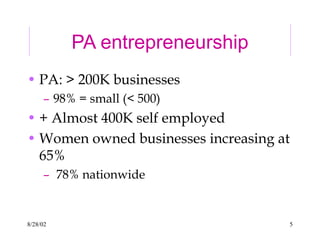
PA entrepreneurship
• PA: > 200K businesses
– 98% = small (< 500)
• + Almost 400K self employed
• Women owned businesses increasing at
65%
– 78% nationwide
8/28/02 6
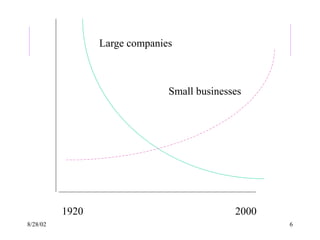
Large companies
Small businesses
1920 2000
8/28/02 7
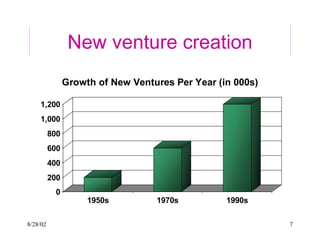
New venture creation
0
200
400
600
800
1,000
1,200
1950s 1970s 1990s
Growth of New Ventures Per Year (in 000s)
8/28/02 8
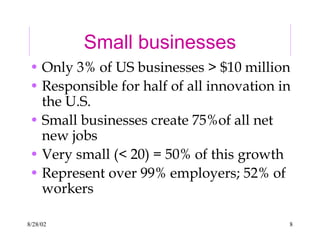
Small businesses
• Only 3% of US businesses > $10 million
• Responsible for half of all innovation in
the U.S.
• Small businesses create 75%of all net
new jobs
• Very small (< 20) = 50% of this growth
• Represent over 99% employers; 52% of
workers
8/28/02 9
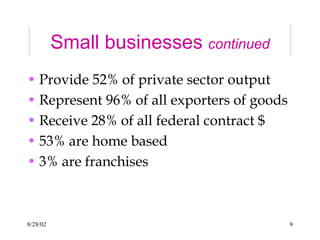
Small businesses continued
• Provide 52% of private sector output
• Represent 96% of all exporters of goods
• Receive 28% of all federal contract $
• 53% are home based
• 3% are franchises
8/28/02 10
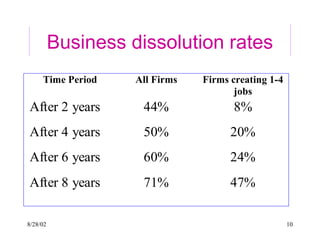
Business dissolution rates
Time Period All Firms Firms creating 1-4
jobs
After 2 years 44% 8%
After 4 years 50% 20%
After 6 years 60% 24%
After 8 years 71% 47%
8/28/02 11
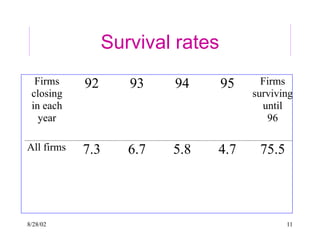
Survival rates
Firms
closing
in each
year
92 93 94 95 Firms
surviving
until
96
All firms 7.3 6.7 5.8 4.7 75.5
8/28/02 12
Entrepreneurship
• What is it?
8/28/02 13
Entrepreneurship =
• Way of thinking
• Spotting opportunity
• Taking initiative
• Implementation driven
• Resource utilization
• Acceptance of risk/failure
8/28/02 14
Entrepreneur
One who brings resources, labor, material and
other assets into combinations that make
their value greater than before.
An entrepreneur is also one who introduces
changes, innovations and a new order.
Thinkers who do.
8/28/02 15
Entrepreneurship is the dynamic process of
creating incremental wealth. The wealth is
created by individuals who assume the
major risks in terms of equity, time and /or
career commitment providing value for a
product or service. The product or service
may or may not be new or unique but value
must somehow be infused by the
entrepreneur.
8/28/02 16
Examples
• Nolan Bushnell - in 1972 founded Atari
(electronic games) on $500. In 1976 he
sold it to Warner Communications for
$28 m
• Ross Perot started EDS with $1K
• Michael Dell started selling computer
parts by mail order while a Freshman at
the University of Texas
8/28/02 17
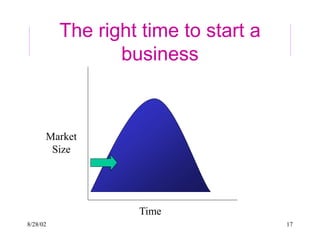
The right time to start a
business
Time
Market
Size
8/28/02 18
Characteristics
• Focus
• Drive
• Energy
• Self confidence
• Don’t start by wanting to get rich but to
do something extremely well
• Not seeking the trappings of success,
but success itself
8/28/02 19
Characteristics continued
• Most have history of entrepreneurship
• Sports
• Expulsion or fired
• 2/3 are 1st children
• 40% were raised by self-employed
parents (vs. 18% of general population)
• Entrepreneurial test
8/28/02 20
Entrepreneurs do
• Seldom invent and market unique
products but build ventures around
incremental innovations and
modifications
• Enter industries in their growth phase,
not infancy
• Find fulfillment in their work
• Start more than one company
8/28/02 21
Entrepreneurial know-how
• Resource utilization - entrepreneurs
know how to do more with less
• Selling ability
• Recognize business opportunities:
– Markets in flux
– Industries with low capital requirements
– Customers will pay for customization
– Unit sale can support direct sales effort
8/28/02 22
Risk tolerance
• Entrepreneurs pick a relatively low
level of risk and then come up with
suggestions as to how to increase
returns at the given level of risk
• Bankers pick a return that they aspire to
and then come up with ideas to reduce
the risk involved at that level
8/28/02 23
Innovation
• Entrepreneurs don’t have common
personalities but a commitment to
innovation
• Entrepreneurship refers not to an
enterprise’s size or age, but to a certain
kind of activity
• Innovation is the effort to create
purposeful, focused change in an
enterprise’s economic or social potential
8/28/02 24
How innovation occurs
• 1. Unexpected occurrences
– IBM
– Ford and Edsel
• 2. Incongruities
– Alcon
– Steel
– Shipping
8/28/02 25
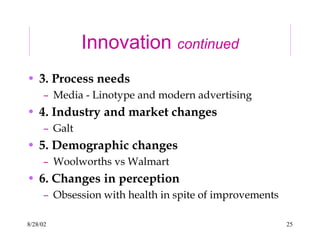
Innovation continued
• 3. Process needs
– Media - Linotype and modern advertising
• 4. Industry and market changes
– Galt
• 5. Demographic changes
– Woolworths vs Walmart
• 6. Changes in perception
– Obsession with health in spite of improvements
8/28/02 26
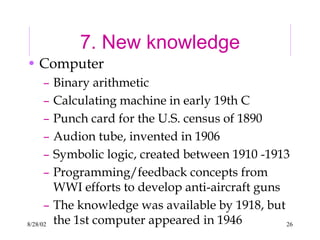
7. New knowledge
• Computer
– Binary arithmetic
– Calculating machine in early 19th C
– Punch card for the U.S. census of 1890
– Audion tube, invented in 1906
– Symbolic logic, created between 1910 -1913
– Programming/feedback concepts from
WWI efforts to develop anti-aircraft guns
– The knowledge was available by 1918, but
the 1st computer appeared in 1946
8/28/02 27
Effective innovations start small. They are
not grandiose. They try to do one specific
thing. It may be the elementary idea of
putting the same number of matches in a
matchbox. This simple notion gave the
Swedes a world monopoly on matches for
half a century.
Peter Drucker
8/28/02 28
We succeeded (in the Normandy
Invasion) because we didn’t know it
was impossible.
Winston Churchill

01 entrepreneurship intro.ppt

  • 1.
  • 2.
    8/28/02 2 Goals ofcourse • To distinguish between an idea and a business opportunity – Inventor vs. entrepreneur • To understand the value of and know how to conduct market research to help identify a market opportunity – Marketplace advantage(s)
  • 3.
    8/28/02 3 Entrepreneurship • Whydo we care? – Creation of jobs » 5% of young and fast growing companies create 77% of new jobs » 15% of them account for 94% of all these new jobs » Fortune 500 employed 1 in 5 in 1980; now 1 in 14
  • 4.
    8/28/02 4 Entrepreneurship continued •70% of companies that are hiring ≤ 4 years old • 70-80% of jobs are with companies ≤ 20 people • > 95% of the wealth in America has been created by entrepreneurs since 1980 • Millionaires are self-made : > 80% accumulated their wealth in 1 generation
  • 5.
    8/28/02 5 PA entrepreneurship •PA: > 200K businesses – 98% = small (< 500) • + Almost 400K self employed • Women owned businesses increasing at 65% – 78% nationwide
  • 6.
    8/28/02 6 Large companies Smallbusinesses 1920 2000
  • 7.
    8/28/02 7 New venturecreation 0 200 400 600 800 1,000 1,200 1950s 1970s 1990s Growth of New Ventures Per Year (in 000s)
  • 8.
    8/28/02 8 Small businesses •Only 3% of US businesses > $10 million • Responsible for half of all innovation in the U.S. • Small businesses create 75%of all net new jobs • Very small (< 20) = 50% of this growth • Represent over 99% employers; 52% of workers
  • 9.
    8/28/02 9 Small businessescontinued • Provide 52% of private sector output • Represent 96% of all exporters of goods • Receive 28% of all federal contract $ • 53% are home based • 3% are franchises
  • 10.
    8/28/02 10 Business dissolutionrates Time Period All Firms Firms creating 1-4 jobs After 2 years 44% 8% After 4 years 50% 20% After 6 years 60% 24% After 8 years 71% 47%
  • 11.
    8/28/02 11 Survival rates Firms closing ineach year 92 93 94 95 Firms surviving until 96 All firms 7.3 6.7 5.8 4.7 75.5
  • 12.
  • 13.
    8/28/02 13 Entrepreneurship = •Way of thinking • Spotting opportunity • Taking initiative • Implementation driven • Resource utilization • Acceptance of risk/failure
  • 14.
    8/28/02 14 Entrepreneur One whobrings resources, labor, material and other assets into combinations that make their value greater than before. An entrepreneur is also one who introduces changes, innovations and a new order. Thinkers who do.
  • 15.
    8/28/02 15 Entrepreneurship isthe dynamic process of creating incremental wealth. The wealth is created by individuals who assume the major risks in terms of equity, time and /or career commitment providing value for a product or service. The product or service may or may not be new or unique but value must somehow be infused by the entrepreneur.
  • 16.
    8/28/02 16 Examples • NolanBushnell - in 1972 founded Atari (electronic games) on $500. In 1976 he sold it to Warner Communications for $28 m • Ross Perot started EDS with $1K • Michael Dell started selling computer parts by mail order while a Freshman at the University of Texas
  • 17.
    8/28/02 17 The righttime to start a business Time Market Size
  • 18.
    8/28/02 18 Characteristics • Focus •Drive • Energy • Self confidence • Don’t start by wanting to get rich but to do something extremely well • Not seeking the trappings of success, but success itself
  • 19.
    8/28/02 19 Characteristics continued •Most have history of entrepreneurship • Sports • Expulsion or fired • 2/3 are 1st children • 40% were raised by self-employed parents (vs. 18% of general population) • Entrepreneurial test
  • 20.
    8/28/02 20 Entrepreneurs do •Seldom invent and market unique products but build ventures around incremental innovations and modifications • Enter industries in their growth phase, not infancy • Find fulfillment in their work • Start more than one company
  • 21.
    8/28/02 21 Entrepreneurial know-how •Resource utilization - entrepreneurs know how to do more with less • Selling ability • Recognize business opportunities: – Markets in flux – Industries with low capital requirements – Customers will pay for customization – Unit sale can support direct sales effort
  • 22.
    8/28/02 22 Risk tolerance •Entrepreneurs pick a relatively low level of risk and then come up with suggestions as to how to increase returns at the given level of risk • Bankers pick a return that they aspire to and then come up with ideas to reduce the risk involved at that level
  • 23.
    8/28/02 23 Innovation • Entrepreneursdon’t have common personalities but a commitment to innovation • Entrepreneurship refers not to an enterprise’s size or age, but to a certain kind of activity • Innovation is the effort to create purposeful, focused change in an enterprise’s economic or social potential
  • 24.
    8/28/02 24 How innovationoccurs • 1. Unexpected occurrences – IBM – Ford and Edsel • 2. Incongruities – Alcon – Steel – Shipping
  • 25.
    8/28/02 25 Innovation continued •3. Process needs – Media - Linotype and modern advertising • 4. Industry and market changes – Galt • 5. Demographic changes – Woolworths vs Walmart • 6. Changes in perception – Obsession with health in spite of improvements
  • 26.
    8/28/02 26 7. Newknowledge • Computer – Binary arithmetic – Calculating machine in early 19th C – Punch card for the U.S. census of 1890 – Audion tube, invented in 1906 – Symbolic logic, created between 1910 -1913 – Programming/feedback concepts from WWI efforts to develop anti-aircraft guns – The knowledge was available by 1918, but the 1st computer appeared in 1946
  • 27.
    8/28/02 27 Effective innovationsstart small. They are not grandiose. They try to do one specific thing. It may be the elementary idea of putting the same number of matches in a matchbox. This simple notion gave the Swedes a world monopoly on matches for half a century. Peter Drucker
  • 28.
    8/28/02 28 We succeeded(in the Normandy Invasion) because we didn’t know it was impossible. Winston Churchill